Individual Differences in Navigating and Experiencing
Presence in Virtual Environments
Corina Sas
Department of Computer Science National University of Ireland, Dublin
Belfield, Dublin 4, Ireland
A thesis submitted to the National University of Ireland, Dublin for the degree of Doctor of Philosophy in the Faculty of Science
January, 2004
Contents
List of Figures 8
List of Tables 11
List of Abbreviations 13
Abstract 14
Acknowledgements 15
Declaration 16
Associated Publications 17
1 Introduction 20
1.1 Individual Differences . . . 21
1.2 Motivation . . . 21
1.3 Study Objectives . . . 23
1.4 Contributions . . . 24
1.5 Thesis Overview. . . 25
2 Usability of Virtual Reality Systems 28 2.1 Introduction . . . 29
2.2 Usability . . . 29
2.2.1 Usability Construct . . . 29
2.2.2 Measuring Usability . . . 30
2.3 Virtual Environments . . . 31
2.3.1 Types of Virtual Environments . . . 31
2.3.2 User’s Actions w ithin Virtual Environments . . . 33
2.4 Usability of Virtual Environments . . . 38
2.5 Individual Differences Related to Usability . . . 39
2.5.1 User-Centred Design . . . 41
2.6 Adaptive Virtual Environments . . . 42
2.6.1 User Adaptive Systems . . . 42
2.6.3 Accommodating Individual Differences . . . 46
2.7 Summary . . . 47
3 Navigation in Virtual Environments 48 3.1 Introduction . . . 49
3.2 Spatial Mental Models . . . 50
3.2.1 Mental Models . . . 50
3.2.2 Spatial Mental Models . . . 57
3.2.3 Acquiring Spatial Know ledge . . . 60
3.2.4 Eliciting Spatial Know ledge . . . 63
3.3 Navigation in Virtual Environments . . . 65
3.3.1 Navigational Behaviours . . . 66
3.3.2 Individual Differences in Navigating in VEs . . . 67
3.3.3 Navigable Virtual Environments . . . 70
3.3.4 Designing Guidelines for Supporting Navigation in VEs . . . 72
3.4 Discussion . . . 75
3.5 Summary . . . 77
4 Sense of Presence 78 4.1 Introduction . . . 79
4.1.1 Construction of the w orld . . . 79
4.1.2 Mediation . . . 80
4.2 Sense of Presence . . . 81
4.2.1 Defining Presence . . . 81
4.3 Determinants of Presence . . . 82
4.3.1 Technological Factors . . . 82
4.3.2 Human Factors . . . 83
4.3.3 Presence Theories . . . 89
4.4 Measuring Presence . . . 96
4.5 Presence and Task Performance . . . 97
4.6 Summary . . . 99
5 Methodology 100 5.1 Introduction . . . 101
5.2 Apparatus . . . 102
5.3 Participants . . . 107
5.4 Procedure . . . 107
5.5 Methods . . . 108
5.5.1 Triangulation . . . 108
5.6 Measurement Instruments . . . 109
5.6.1 Measuring User Satisfaction . . . 110
5.6.3 Measuring Cognitive Factors Impacting on Presence . . . 116
5.7 Measuring User Performance . . . 118
5.8 Recording Spatial Behaviour Data . . . 118
5.9 Analysing Spatial Behaviour . . . 119
5.10 Summary . . . 120
6 Artificial Intelligence for Advanced Data Interpretation and Exploita-tion 121 6.1 Introduction . . . 122
6.2 Machine Learning Techniques for User Adaptive Systems . . . 123
6.2.1 Machine Learning for Studying Cognitive Models . . . 124
6.2.2 Machine Learning Algorithms . . . 124
6.3 Unsupervised Learning . . . 124
6.3.1 Self-Organising Maps . . . 125
6.4 Supervised Learning . . . 126
6.4.1 Artificial Neural Netw ork . . . 127
6.4.2 Decision Trees . . . 131
6.4.3 ID3 . . . 131
6.4.4 Learning Vector Quantisation . . . 133
6.5 Intelligent Agents . . . 134
6.5.1 Agent-Based Systems . . . 135
6.6 Summary . . . 137
7Individual Differences Related to Usability 138 7.1 Introduction . . . 139
7.2 Individual Differences Related to Task Performance . . . 140
7.2.1 Gender and Task Performance . . . 140
7.2.2 Computer Games Experience and Task Performance . . . 141
7.2.3 Presence and Task Performance . . . 142
7.2.4 Cognitive Style and Task Performance . . . 144
7.3 Individual Differences Related to User Satisfaction . . . 145
7.3.1 Gender and Satisfaction . . . 145
7.3.2 Computer Games Experience and Satisfaction . . . 146
7.3.3 Presence and Satisfaction . . . 146
7.4 Discussion . . . 146
7.5 Summary . . . 148
8 Individual Differences in Navigational Patterns — A Machine Learn-ing Approach 150 8.1 Introduction . . . 151
8.2 Clustering Trajectories . . . 152
8.2.2 Collecting Data . . . 154
8.2.3 Pre-Processing Data . . . 154
8.2.4 Training SOM . . . 155
8.2.5 Map Visualisation . . . 155
8.2.6 Cluster Identification . . . 155
8.2.7 Training LVQ . . . 159
8.2.8 Conclusions . . . 159
8.3 Trajectory Prediction . . . 160
8.3.1 Collecting Data . . . 161
8.3.2 Pre-Processing Data . . . 162
8.3.3 Training RNN . . . 166
8.3.4 Netw ork Performances . . . 168
8.3.5 Analysis of Hidden Layer . . . 170
8.3.6 Hidden Nodes Specialisation . . . 171
8.3.7 Spatial Representation . . . 171
8.3.8 Conclusions . . . 173
8.4 Rule Extraction . . . 174
8.4.1 Pattern Error Analysis . . . 175
8.4.2 Clustering Neural Netw ork Predictions . . . 175
8.4.3 Pre-Processing Data . . . 176
8.4.4 Training SOM . . . 176
8.4.5 Map Visualisation . . . 177
8.4.6 Cluster Identification . . . 177
8.4.7 Training LVQ . . . 177
8.5 Symbolic Rule Induction . . . 178
8.5.1 Pre-Processing Data . . . 182
8.5.2 C5.0 Algorithm . . . 183
8.5.3 Classification Accuracy . . . 183
8.5.4 Decision Tree . . . 183
8.5.5 Confusion Matrix . . . 183
8.5.6 Rule Production . . . 185
8.5.7 Rule Interpretation . . . 185
8.5.8 Rule Generalisation . . . 191
8.5.9 Conclusions . . . 193
8.6 Summary . . . 193
9 Individual Differences in Navigational Patterns — A Curve Geometry Approach 196 9.1 Introduction . . . 197
9.2 Motion Analysis . . . 197
9.2.1 Conceptual Delimitations . . . 198
9.4 B´ezier Curves . . . 200
9.4.1 Properties of B´ezier Curves . . . 201
9.4.2 Numerical Instability . . . 201
9.4.3 Curvature . . . 202
9.5 Results . . . 203
9.5.1 Goodness of Fit . . . 203
9.5.2 Curvature . . . 205
9.5.3 Inflexion Points . . . 206
9.5.4 Rotational Behaviour . . . 207
9.5.5 Translational Behaviour . . . 209
9.5.6 Behaviour Around Landmarks . . . 209
9.5.7 Area Enclosed . . . 209
9.6 Discussion . . . 210
9.6.1 Minimum Energy Principle . . . 211
9.6.2 Spatial Orientation . . . 212
9.7 Summary . . . 213
10 Individual Differences in Experiencing Presence 214 10.1 Introduction . . . 215
10.2 Presence and Personality Factors — A Correlational Approach . . . 217
10.3 Multiple Regression Analysis . . . 218
10.4 Presence and Personality Cognitive Style . . . 219
10.5 Discussion . . . 219
10.6 Summary . . . 222
11 Towards Accommodating Individual Differences: Design Guidelines 225 11.1 Introduction . . . 226
11.2 Design Guidelines for Enhancing Usability of VEs . . . 227
11.3 Design Guidelines for Enhancing Presence in VEs . . . 229
11.4 Design Guidelines for Navigation Support within VEs . . . 231
11.4.1 High-Level Navigational Rules . . . 231
11.4.2 Low -Level Navigational Rules . . . 232
11.4.3 User Model of Navigation . . . 233
11.4.4 Design Guidelines . . . 235
11.4.5 Adaptive ECHOES . . . 240
11.4.6 Agent-based Adaptive ECHOES Architecture . . . 243
11.5 Summary . . . 247
12 Conclusions 248 12.1 Contributions . . . 250
12.2 Future Work . . . 251
A Instructions 286
B User Satisfaction Questionnaire 288
List of Figures
1.1 Major Research Areas Addressed in this Thesis . . . 23
1.2 Study Objectives . . . 24
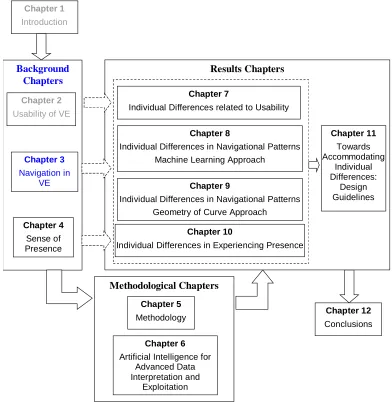
1.3 Road Map of the Thesis . . . 27
2.1 Road Map . . . 28
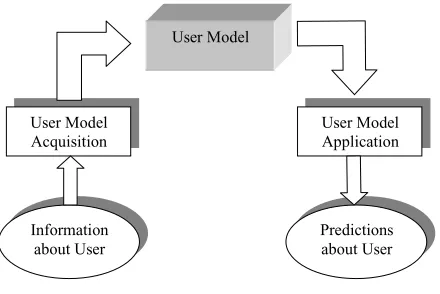
2.2 General Schema for User Adaptive Systems . . . 43
3.1 Road Map . . . 48
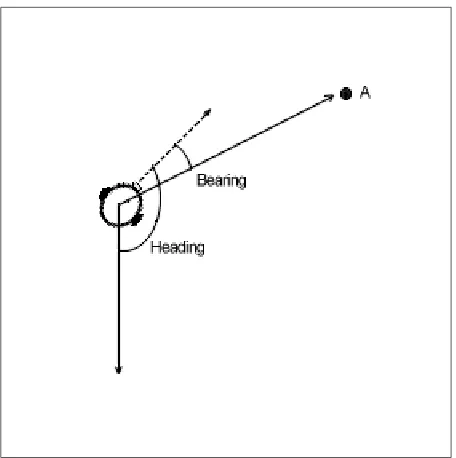
3.2 Basic Terms Used for Describing Spatial Behaviour . . . 58
4.1 Road Map . . . 78
4.2 Sheridan’s Determinants of Presence . . . 91
4.3 Zeltzer’s AIP Cube . . . 93
5.1 Road Map . . . 100
5.2 Virtual Building . . . 102
5.3 Bird’s Eye View of Ground Floor . . . 102
5.4 Bird’s Eye View of First Floor . . . 103
5.5 Virtual Lobby . . . 103
5.6 Virtual Library . . . 104
5.7 Virtual Conference Room . . . 104
5.8 Virtual Training Room . . . 104
5.9 Virtual Office Room . . . 105
5.10 The Viewing Angle Through Which the User Perceives the Virtual World Provided by ECHOES . . . 105
5.11 Virtual Lift Closed . . . 106
5.12 Virtual Lift Open . . . 106
5.13 Starting Point Where User is Initially Positioned . . . 106
6.1 Road Map . . . 121
6.2 Architectural Graph of a Multilayer Perceptron with One Hidden Layer 127 6.3 Simple Recurrent Neural Network Architecture . . . 130
7.1 Road Map . . . 138
7.2 Task Performance as a Function of Level of Presence and Subjects’ Gender143 7.3 The Four Dimensions of Cognitive Style Averaged for Groups of Users Identified on the Basis of Their Collision Rate . . . 144
7.4 The Four Dimensions of Cognitive Style Averaged for Groups of Users Identified on the Basis of Their Collision Rate . . . 145
8.1 Road Map . . . 150
8.2 Modular System for On-line Trajectory Classification . . . 154
8.3 The resulting organisation of the SOM map obtained through clustering trajectories from the training set. Each winner neuron on the map was replaced by a plot of the corresponding trajectory, while the numbers from 1 to 5 represent trajectory clusters. . . 156
8.4 The result SOM map obtained through testing its initial organisation with trajectories from the testing set. The white boxes represent indi-vidual trajectories from the testing set. . . 157
8.5 Poor Trajectory 1 . . . 160
8.6 Poor Trajectory 2 . . . 160
8.7 Good Trajectory 1 . . . 160
8.8 Good Trajectory 2 . . . 160
8.9 Modular System for Trajectory Prediction . . . 162
8.10 Shortest Distance to the Landmark in the Shape of Rectangle . . . 164
8.11 Shortest Distance to the Landmark in the Shape of Segment . . . 165
8.12 Shortest Distance to the Landmark in the Shape of Ellipse . . . 166
8.13 The Architecture of the Elman RNN Used for Trajectory Prediction . . 168
8.14 Centres of the Landmarks Predicted by the RNN . . . 172
8.15 Original Landmarks Centres and the Centroids of their RNN Prediction 173 8.16 Modular System for Clustering the RNN Prediction Error . . . 176
8.17 SOM of the Best Predictions of RNN Used for Trajectory Prediction . . 178
8.18 SOM – Cluster 1 . . . 179
8.19 SOM – Cluster 2 . . . 179
8.20 SOM – Cluster 3 . . . 180
8.21 SOM – Cluster 4 . . . 180
8.22 SOM – Cluster 5 . . . 181
8.23 SOM – Cluster 6 . . . 181
8.24 SOM – Cluster 7 . . . 182
8.25 Modular System for Symbolic Rule Induction . . . 182
8.26 Cluster 1, Level 0 . . . 187
8.27 Cluster 1, Level 1 . . . 187
8.28 Cluster 2, Level 0 . . . 187
8.29 Cluster 2, Level 2 . . . 187
8.31 Cluster 3, Level 2 . . . 188
8.32 Cluster 3, Level 3 . . . 189
8.33 Cluster 4, Level 0 . . . 190
8.34 Cluster 4, Level 1 . . . 190
8.35 Cluster 4, Level 3 . . . 190
8.36 Cluster 6, Level 0 . . . 192
8.37 Cluster 6, Level 1 . . . 192
8.38 Cluster 6, Level 2 . . . 192
9.1 Road Map . . . 196
9.2 Cubic B´ezier Curve . . . 200
9.3 Distances to B´ezier Curve . . . 203
9.4 Original Trajectory and B´ezier Curve of a Poor User (Female) . . . 204
9.5 Original Trajectory and B´ezier Curve of a Poor User (Male) . . . 204
9.6 Original Trajectory and B´ezier Curve of a Good User (Female) . . . 205
9.7 Original Trajectory and B´ezier Curve of a Good User (Male) . . . 205
9.8 Curvature Histogram of B´ezier Curves Approximating Users’ Trajectories 206 9.9 Observation Angle . . . 207
9.10 Moving Angle . . . 208
9.11 The Area Enclosed by a Poor Trajectory . . . 211
10.1 Road Map . . . 214
11.1 Road Map . . . 225
11.2 User Model of Navigation . . . 234
11.3 Schema of the Adaptive ECHOES . . . 240
11.4 Phase 1. Building an Adaptive VE Architecture: Identifying User Class and Rule Capturing . . . 241
11.5 Phase 2. Building an Adaptive VE Architecture: Applying the Efficient Navigational Rules for Supporting LowSpatial Users . . . 242
11.6 ECHOES: Architecture Overview . . . 244
11.7 Adaptive ECHOES: Architecture Overview. . . 245
11.8 Mental State of Low Level Adaptivity Agent . . . 247
List of Tables
2.1 Milgram’s Reality–Virtuality Continuum . . . 32
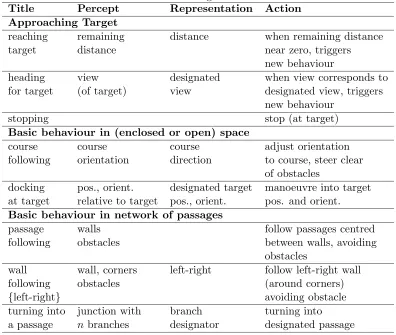
3.1 Basic Navigation Behaviours . . . 66
5.1 User Satisfaction Operationalisation . . . 111
5.2 Mean, Median and Std. Dev. for Each User Satisfaction Variable . . . . 112
5.3 Presence Operationalisation . . . 113 5.4 Mean, Median and Std. Dev. for Each Presence Variable . . . 114
5.4 Mean, Median and Std. Dev. for Each Presence Variable . . . 115
7.1 T-Test Comparing Task Performance in Terms of Search Time Required
by Female and Male Users . . . 140
7.2 T-Test Comparing Performance in Terms of Collisions Encountered by Female and Male Users . . . 141
7.3 T-Test Comparing Performance in Terms of Search Time Experienced by
Users Grouped on the Basis of their Computer Games Experience . . . 141 7.4 T-Test Comparing Performance in Terms of Collisions Encountered by
Users Grouped on the Basis of their Computer Games Experience . . . 142
7.5 T-Test Comparing Presence Experienced by Users Grouped on the Basis of the Amount of Time Required for Search Task . . . 142
7.6 T-Test Comparing Presence Experienced by Users Grouped on the Basis
of their Collision Rate . . . 143 7.7 T-Test Comparing Satisfaction Experienced by Female and Male Users . 146
7.8 T-Test Comparing Performance (search time) Experienced by User
Grouped on the Basis of their Computer Games Experience . . . 146 7.9 T-Test Comparing Satisfaction Experienced by User Grouped on the
Ba-sis of their Level of Presence . . . 146
7.10 Summary of Study Participants Along Two Dimensions: Gender and Length of Playing Computer Games . . . 147
8.1 Input/Output Vectors Used for Training RNN for Trajectory Prediction — Excerpt . . . 169
8.2 Summary of Performance Obtained by the RNN Used for Trajectory
8.3 Summary of the Prediction Accuracy of Each Input Element Used for Training the RNN . . . 169
8.4 Specialisation of Hidden Nodes of RNN According to their Firing
Pat-terns for the Input Elements . . . 171 8.5 Decision Tree Generated by the C5.0 Rule Induction Algorithm . . . 184
8.6 Confusion Matrix Generated by the C5.0 Rule Induction Algorithm . . 185 8.7 Rules Generated by the C5.0 Rule Induction Algorithm — Excerpt . . . 186
10.1 Correlations Between Presence and Empathy, Absorption, Creative
Imag-ination and Willingness to experience presence . . . 217 10.2 Correlations Between Presence and Empathy Subscales . . . 217
10.3 Summary of Regression Analysis for Variables Predicting Presence . . . 218
10.4 Percentage of Participants Belonging to Each Bi-polar Dimension of Cog-nitive Style, w ithin Sample and Population . . . 219
10.5 Correlations Between Presence and Personality Cognitive Style Dimensions219
List of Abbreviations
3D 3 Dimensional
2D 2 Dimensional
AI Artificial Intelligence
ANN Artificial Neural Network
AR Augmented Reality
BDI Belief Desire Intention
CAVE Cave Automatic Virtual Environment CIS Creative Imagination Scale
CSA Cognitive Styles Analysis
DV Dependent Variables
E Extroversion Type
ECHOES EduCational Hypermedia OnlinE Systems
F Feeling Type
FIPA Foundation for Intelligent Physical Agents
HCI Human–Computer Interaction
HMD Head Mounted Display
I Introversion Type
IV Independent Variables
J Judging Type
LRS Landmark Route Survey
LVQ Learning Vector Quantisation
MBTI Myers-Briggs Type Indicator
MR Mixed Reality
N Intuition Type
P Perceving Type
PDP Parallel Distributed Processing
RNN Recurrent Neural Network
S Sensing Type
SOM Self-Organising Map
SSH Spatial Semantic Hierarchy
SUS Slater, Usoh and Steed Questionnaire
T Thinking Type
TAS Tellegen Absorption Scale
UCD User-Centred Design
VE Virtual Environment
VR Virtual Reality
Abstract
The effort of making Virtual Environments (VEs) more useful and satisfactory to use
lie at the core of usability research. Because of their development and widespread ac-cessibility, VEs are being used by an ever-increasing diversity of users, whose individual
differences impact on both task performance and level of satisfaction. This aspect raises
a major challenge in terms of designingadaptive VEs, suitable not for theaverage user
but for each individual user. One way to address this challenge is through the study of
individual differences and their implications, which should lead to new effective ways to
accommodate them.
Adaptivity reflects the system’s capability to automatically tailor itself to
dynami-cally changing user behaviour. This capability is enabled by a user model, acquired on
the basis of identifying the user’s patterns of behaviour.
This thesis addresses the issue of studying and accommodating individual differences
with the purpose of designing adaptive VEs. The individual differences chosen to be
investigated are those that impact particularly on two fundamental aspects underlying each interaction with a VE, namely navigation and sense of presence. Both these aspects
are related to the perceived usability of VEs.
The impact that a set of factors like empathy, absorption, creative imagination and willingness to be transported within the virtual world has on presence has been
investigated and described through a prediction equation. Based on these findings,
a set of guidelines has been developed for designing VEs able to accommodate these individual differences in order to support users to experience a higher level of presence.
The individual differences related to navigation within VE have been investigated in the light of discriminating between efficient versus inefficient search strategies.
Build-ing a user model of navigation affords not only a better understandBuild-ing of user spatial
behaviour, but also supports the development of an adaptive VE which could help low spatial users to improve their navigational skills by teaching them the efficient
Acknowledgements
I wish to thank my supervisor Ronan Reilly for believing in me more then others and
for enabling the opportunity of pursuing this degree. I am grateful for the unconditional trust he puts in me, for his wisdom and friendship. I also wish to thank my supervisor
Gregory O’Hare for all his guidance and support.
I am indebted to Dr. Fred Cummins for fruitful discussions. I am grateful to my colleagues who showed me that besides reaching the goal, the journey itself could be a
fulfilling experience. Special thanks to Ioana Marian, Mary O’Donoghue, Claire Cullen,
Nikolinka Collier, Georgios Tagalakis and Michael O’Grady. Their support and kind feelings I greatly value. I also wish to thank all those who agreed to be subjects in my
experiment.
I am indebted to all those involved in creating ECHOES, from Alenia-Marconi Sys-tems, Sogitec, University of Sienna and University College Dublin. In particular, I wish
to thank Thomas Delahunty and Katherine Sewell for providing assistance in preparing
ECHOES for my experimental study.
I am grateful to all those anonymous reviewers who took the trouble to read my
pa-pers and to send me their feedback. It was essential in improving quality and soundness
of this work.
I would like to express my special gratitude to Nikita Schmidt for helping me more
than he can imagine. Having him besides me all these years has been a gift.
I thank my parents who never stopped believing in me. They have loved me enough to encourage me pursue this opportunity, when they needed me most.
Declaration
I declare that this thesis is my own work and has not been submitted in any form
for another degree or diploma at this, or any other, University or institute of tertiary education.
Associated Publications
The following publications have arisen directly as a result of the research described in
this thesis.
• Sas, C., O’Hare, G. and Reilly, R. (2004). Virtual environment trajectory analy-sis: A basis for navigational assistance and scene adaptivity. Future Generation Computer Systems, Special Issue on “Interaction and Visualisation Techniques for Problem Solving Environments”, Elsevier Press (in press).
• Sas, C. and O’Hare, G. (2003). Presence equation: An investigation into cognitive factors underlying presence. Presence: Teleoperators and Virtual Environments
12(5), MIT Press, p. 523–537.
• Sas, C., O’Hare, G. and Reilly, R. (2003). Presence and task performance: An approach in the light of personality cognitive style. International Journal of Cog-nition Technology and Work. Special Issue on “Presence: design and technology challenges for cooperative activities in virtual or remote environments”, Elsevier Press (in press).
• Sas, C., Reilly, R., O’Hare, G., Marian, I. and Mangina, E. (2003). Modelling user navigation. Special Issue of the World Scientific and Engineering Academy and Society (WSEAS)Transactions on Systems, 3(2), p. 582–588.
• Sas, C. (2001). Acquiring spatial knowledge: An experiment in virtual envi-ronment. International Association for People–Environment Studies, Bulletin of People–Environment Studies, 20, p. 10.
• O’Hare, G., Sas, C. and Byrne, C.A. (2001). Agent mediation and management of virtual communities: A redefinition of the traditional community concept. In
Proceedings of IEEE International Conference on Systems, Man and Cybernetics (SMC’01), IEEE Computer Society Press.
• Sas, C., O’Hare, G.M.P. and Reilly, R. (2004). A Performance Analysis of Move-ment Patterns. International Conference on Computational Science, Workshop
on Scientific Visualisation and Human-Machine Interaction in a Problem-Solving
Environment. InLecture Notes in Computer Science. Springer-Verlag (in press).
Visu-alisation and Human-Machine Interaction in a Problem-Solving Environment. In
Lecture Notes in Computer Science 2659 (p. 1035–1044). Springer-Verlag.
• Sas, C., O’Grady, M. and O’Hare, G.M.P. (2003). Electronic navigation—Some design issues. Fifth International Symposium on Human Computer Interaction
with Mobile Devices and Services. In Lecture Notes in Computer Science 2795 (p. 471–475). Springer-Verlag.
• Sas, C. and O’Hare, G. (2003). Impact of cognitive style upon sense of pres-ence. In J. Jacko and C. Stephanidis (eds.), Proceedings of the 10th International Conference on Human–Computer Interaction (p. 696–700). Mahwah: Lawrence Erlbaum Associates.
• Sas, C., O’Hare, G. and Reilly, R. (2003). A connectionist model of human naviga-tion. InProceedings of the 7th International Conference on Cognitive and Neural Systems (p. 89). Boston: Boston University Press.
• Sas, C., O’Hare, G. and Reilly, R. (2003). A connectionist model of spatial knowl-edge acquisition in a virtual environment. In S.A. Macskassy, R. Wilkinson, A.
Goker and M. Bauer (eds.), The 9th International Conference on User Modeling,
Proceedings of Workshop on User Modeling, Information Retrieval and Machine Learning (p. 40–47).
• Sas, C. and Reilly, R. (2003). Extracting a spatial grammar from recurrent neural network. The 7th Neural Computation and Psychology Workshop.
• Sas, C. and O’Hare, G. (2002). Presence and individual differences in virtual environment: Usability study. In H. Sharp, P. Chalk, J. LePeuple, J. Rosbottom (eds.), Proceedings of 16th British HCI Conference Vol. 2 (p. 50–53). London: British Computer Society.
• Sas, C., O’Hare, G. and Byrne, C. (2002). Navigation in 3D non-immersive virtual reality: A usability study. In N. Callaos, M. Bica, M. Sanchez (eds.),Proceedings of the 6th World Conference on Systemics, Cybernetics and Informatics(p. 30–34) Orlando, FL: International Institute of Informatics and Systemics.
• Sas, C., O’Hare, G. and Reilly, R. (2002). A connectionist approach to modelling navigation: Trajectory self organization and prediction. In N. Carbonell and C.
Stephanidis (eds.),Proceedings of 7th ERCIM Workshop: User Interfaces for All
Vol. XII (p. 111–116). Chantilly: ERCIM.
• Sas, C. and O’Hare, G. (2001). The presence equation: An investigation into cognitive factors underlying presence within non-immersive virtual environments.
The 4th Annual International Workshop on Presence.
Chapter 1
Introduction
The explosive growth of Information Technology has enabled an ever-increasing number
of users to perform a large variety of computer-mediated activities, serving the goals
of working, learning or playing. The wide diversity characterising these users in terms of backgrounds, skills, interests, motivations, expertise and learning style has started
to challenge the traditional way of delivering computer technology. Universal
Usabil-ity requires that software systems accommodate a diverse set of users (Shneiderman, 2000), since no single interface is capable of satisfying every user (Kules, 2000).
Adap-tive systems, able to monitor user’s activity and automatically adjust themselves to
accommodate such user individual differences, seem to provide a promising solution to this problem (Savidis et al., 1997; Jameson, 2003).
Given its infancy and inherent complexity, the advent of Virtual Reality (VR) tech-nology puts additional strains on adaptivity. The major goal of this thesis is to improve
the understanding of howadaptive Virtual Environments (VEs) should be designed in
order to accommodate the individual differences of their users.
The work carried out in this thesis targets two fundamental aspects underlying
al-most every interaction with a VE, namely the sense of presence experienced by users and
their spatial behaviour. The sense of presence, or so-calledsense of being there (inside the virtual world), is a psychological side effect of any mediated experience. Probably
the most common form of spatial behaviour defined as a “behaviour that occurs in
response to the spatially distributed nature of the environment” (Ungar, 2003), is nav-igation. Navigation is a complex and challenging activity, even when it is performed in the physical world. In addition, studies have shown that navigational tasks performed
within VEs put unusual demands on their users (Waller, 2000).
Both these aspects are relevant, because of their prevalence and of their impact on
user’s interaction with VEs. Central to the latter is the concept ofusability, which lies at the core of the design of any artefact. A well designed VE is intuitive, easy to use, enables a smooth learning curve and therefore allows users to successfully accomplish
the required tasks. In addition, it is expected to provide a good degree of satisfaction,
which characterises any enjoyable experience.
influence the usability of VEs. In contrast, the impact of human factors on the perceived usability of a system has been less well addressed. The lack of such studies is even
more significant when it comes to VEs (Waller, 2000). This thesis aims to address this
shortcoming. It focuses onindividual differences related to performance on navigational tasks and to the degree of sense of presence experienced by the users. The study findings
indicate that the conceptone size fits all is obsolete when it comes to the design of VEs.
1.1
Individual Differences
Individual differences is an umbrella term used to describe an entire field of research,
primarily involving psychology, that focuses on aspects of behaviour that differentiate individuals from one another. Clinical studies involve an in depth investigation of one or
a limited number of subjects in order to highlight their individual unique profile. There
is, however, a more general approach to studying individual differences. This approach, and the one taken by this thesis, strives to capturedimensions of individual differences rather than individual patterns. Accordingly, one can group subjects together, based on
the commonly shared variance with respect to a particular aspect of their individuality. Such an approach leads to the identification of differences among groups of subjects
(inter-group differences) as opposed to the differences among individuals within the same
group (intra-group differences). Grouping subjects in clusters according to some criteria offers a better understanding of the relevant aspects of the phenomenon by reducing the
amount of data, while at the same time preserving the amount of information (Lorr,
1983).
The study of individual differences can be pursued in three areas (Revelle, 2000)
which have been addressed in this thesis:
• Identifying, and consequently describing groups of individuals sharing common features, is only a preliminary stage in this kind of research. It leads to a
descrip-tive taxonomy of those factors which underlie the individual differences.
• Attempts to highlight a causal relationship between these factors which underlie the individual differences and other relevant aspects on which they impact
consti-tute another area of research in this field. A significant outcome of such studies consists in the predictive validity of their findings.
• The third area of research in this field is a theoretical one, aiming to explain the structure and dynamics of individual differences.
1.2
Motivation
The ultimate goal when studying individual differences is to enhance system usability. Once they have been identified, and if their impact is found to be significant, efforts
should be made to accommodate them. Properly accommodated, these individual
from their practical interest, an additional benefit of studying individual differences resides in providing a framework for understanding them.
This work focuses on two major aspects which usually describe any interaction with
a VE:
• navigation, and
• sense of presence.
Because of its prevalence, there is a tendency to take the navigational process for
granted. However, navigation is a complex activity which requires seamless integra-tion of several cognitive processes. The difficulties associated with navigaintegra-tion become
especially obvious when it is performed in unfamiliar environments (i.e. one becomes
lost). Due to their specific characteristics, VEs put additional demands on untrained users (see Chapter 2). Fortunately, the adaptive versions of such VE systems have the
potential of adapting themselves in order to accommodate individual differences which
impact on users’ performance on spatial tasks.
Most studies focusing on navigation have addressed the issue of individual differences
with respect to navigation in abstract information space, such as hypermedia space or
semantic space (Chen and Ford, 1997; Chen, 2000; Brusilovsky and Maybury, 2002). In contrast, less research has been carried out in the area of human spatial navigation
within VEs. The potential of VEs for training spatial skills has been extensively
ac-knowledged, but little work has been carried out on the potential use of VEs for training basic spatial abilities (Durlach et al., 2000).
The work presented in this thesis focuses on accommodating the individual
differ-ences reflected in navigational patterns. The ability to succeed in navigational tasks, of any kind, depends on howhumans understand space. This involves an implicitly
devel-oped representation of the spatial layout, usually in the form of so-calledcognitive maps. Despite its significance, the process of accessing such representations raises difficulties. In an attempt to overcome these limitations, this thesis proposes original alternative
methods, inspired by the tools and techniques developed in the area of machine learning. The individual differences in experiencing presence, a psychologically related
phe-nomenon experienced by users while they interact with virtual reality systems, have
been hypothesised by the presence literature, but no experimental study has been un-dertaken. In this thesis, some individual differences in experiencing presence are
iden-tified and their value for understanding and predicting presence is discussed. Based
on such individual differences, this work seeks to examine how these may be used for improving the design of VEs in order to increase presence or performance on spatial
tasks.
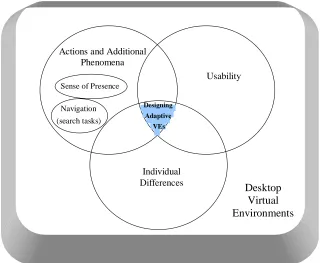
Figure 1.1 presents the interrelationships between these major areas: navigation and sense of presence approached through the study of individual differences, for increasing
the usability of desktop VEs. Providing guidelines for designing adaptive VEs in order
this thesis. Figure 1.1 also suggests the niche occupied by the thesis in the context of the previously mentioned research fields.
Individual Differences
Usability
Sense of Presence
Navigation (search tasks)
Designing Adaptive VEs
Actions and Additional Phenomena
[image:23.595.177.498.117.380.2]Desktop Virtual Environments
Figure 1.1: Major Research Areas Addressed in this Thesis
1.3
Study Objectives
This thesis focuses on the following aspects which primarily define users’ experience within VEs:
• perceived usability of the system;
• user model of acquiring spatial knowledge;
• sense of presence.
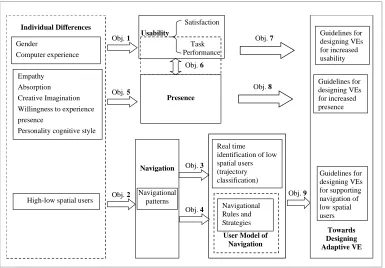
These three themes have been addressed through eight study objectives whose
in-terrelationships are represented in Figure 1.2, where Obj stands for objective. These objectives are summarised as follows:
1. The investigation of the individual differences related to system usability
(Chap-ter 7).
2. The investigation of the individual differences in navigational patterns followed
Guidelines for designing VEs for increased usability Satisfaction Usability Task Performance Obj. 8 Obj. 1 Obj. 5 Obj. 7 Obj. 2 Navigation Navigational Rules and Strategies
User Model of Navigation
Real time identification of low spatial users (trajectory classification) Obj. 3 Guidelines for designing VEs for increased presence Guidelines for designing VEs for supporting navigation of low spatial users Towards Designing Adaptive VE Empathy Absorption Creative Imagination Willingness to experience presence
Personality cognitive style Gender
Computer experience
High-low spatial users
[image:24.595.135.520.61.329.2]Individual Differences Presence Obj. 6 Navigational patterns Obj. 4 Obj. 9
Figure 1.2: Study Objectives
3. The implicit and real-time discrimination of lowand high spatial users through
on-line trajectory classification (Chapter 8).
4. The investigation of the rules and strategies underlying user spatial behaviour and
the development of a user model based on them (Chapters 8, 9 and 11).
5. The investigation of the individual differences which impact on the level of sense
of presence (Chapter 10).
6. The investigation of the relationship between presence and task performance
(Chapters 7 and 10).
7. The development of a set of guidelines for the design of more usable VEs
(Chap-ter 11).
8. The development of a set of guidelines for the design of VEs able to ensure
in-creased presence (Chapter 11).
9. The development of a set of guidelines for the design of VEs able to provide
navigation support to lowspatial users (Chapter 11).
1.4
Contributions
The most important contributions of this thesis are:
1. The proposal of a hybrid connectionist-symbolic system for modelling users’ search
knowledge related to searching strategies was investigated by analysing the tra-jectory paths using methods and techniques developed in the area of machine
learning.
2. The proposal of a novel methodology which consists of applying B´ezier curves
for modelling trajectories. This methodology allows the capturing of navigational
rules and can be also employed as a diagnosis tool for discriminating high versus lowspatial users.
3. The development of a model of navigation, tailored to naive search tasks.
4. The development of a trajectory classification methodology that allows the online
identification of groups of users. It links users’ patterns of spatial behaviour and their spatial performance.
5. The empirical investigation of some individual differences impacting on experienc-ing presence. The impact that a set of factors like empathy, absorption, creative
imagination and willingness to be transported within the virtual world, carries
on presence has been shown as significant and described through a prediction equation. Fewempirical studies have been conducted in the area of users’
char-acteristics impacting on presence, despite the fact that presence literature largely
acknowledged their significance.
6. The empirical investigation of the debated relationship between presence and task
performance. The implications of these findings are harnessed through suggestions for designing VEs, in order to enable users to experience a higher level of sense of
presence.
1.5
Thesis Overview
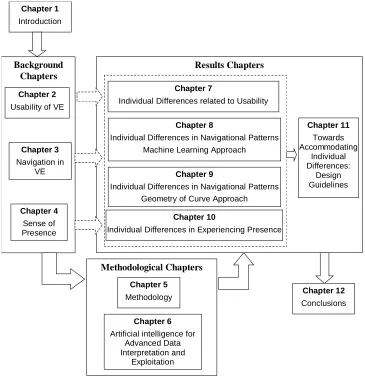
This thesis is structured along three fundamental aspects related to users’ interaction
with VEs: usability, navigation and sense of presence. The core idea consists of studying users’ individual differences and their impact on each of these aspects.
Chapter two provides an introduction of the concept of usability related to Virtual
Reality technologies, highlighting both user characteristics and a taxonomy of tasks that can be performed within VEs. The individual differences impacting on usability of VEs
can benefit from the findings of individual difference studies, carried out in the field of
Human–Computer Interaction (HCI). The adaptive system are also described together with a brief introduction of user modelling.
Chapter three focuses on those aspects related to navigation within VEs. The
con-cept of spatial models that individuals build while they navigate, and an overview of several navigational models are presented. The individual differences in navigation and
possible ways to accommodate them are also described.
and a summary of instruments and techniques employed for measuring it are presented. Presence determinants are highlighted and the relationship between presence and task
performance is discussed.
Chapter five presents the study methodology in terms of sample, apparatus, pro-cedure and measuring instruments. The latter aspect refers to a set of questionnaires,
partly designed by the author of this thesis, for measuring user satisfaction and user sense of presence. Other questionnaires have been developed in the area of hypnosis and
previous studies indicate their validity and reliability. Another questionnaire measures
personality cognitive style.
Chapter six details various machine learning techniques utilised throughout the
the-sis. These include Self-Organising Maps, Learning Vector Quantisation, Decision Tree,
Rule Induction and Recurrent Neural Networks (RNNs). In particular, issues arising from the use of previously mentioned techniques to implicitly capture the knowledge of
navigational strategies embedded in user mental model of navigation are described. This
chapter also introduces the concept of Intelligent Agents which describes an important application area for designing adaptive systems.
The following five chapters are concerned with the presentation of study results and
design guidelines for developing adaptive VEs.
Chapter seven refers to the individual differences related to usability. Two aspects
are relevant in this context, namely task performance and user satisfaction. The
indi-vidual differences impacting on these two aspects have been identified as:
• demographic factors: gender and prior computer experience;
• personality and cognitive factors.
Chapter eight describes individual differences related to navigational patterns
anal-ysed from a machine learning perspective. This chapter focuses on two relevant aspects:
trajectory classification which offers a basis for discriminating on-line low skilled spa-tial users from high skilled spaspa-tial users, and trajectory prediction. The latter aspect
offers a twofold benefit. It enables the exploration of regularities implicitly embedded in the trajectory paths and, their extraction in the shape of symbolic rules governing
the spatial behaviour.
Chapter nine presents another method of analysing and discriminating trajectory paths followed by high versus low spatial users, through an attempt to approximate
these trajectories with high order B´ezier curves. The findings and benefits of this
approach as a diagnostic tool for capturing navigational rules of both inefficient and efficient navigators are discussed.
Chapter ten presents the findings related to individual differences in experiencing
presence. Each of the following factors: empathy, absorption, creative imagination and willingness to be transported in the VE, and their impact on presence is discussed. Their
overall impact is described through a regression equation. The relationship between
Chapter eleven offers a discussion of study results and proposes a series of guide-lines for designing VEs able to accommodate the identified individual differences. This
chapter offers also a summary of the navigational rules, based on which a user model of
navigation has been elaborated. Finally, it describes the architecture of an agent-based VE — an adaptive version of the ECHOES system.
Chapter twelve provides a review of the main outcomes of this thesis. Future work which might be relevant in this context is also discussed.
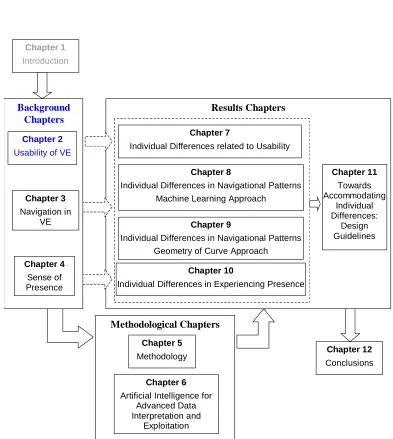
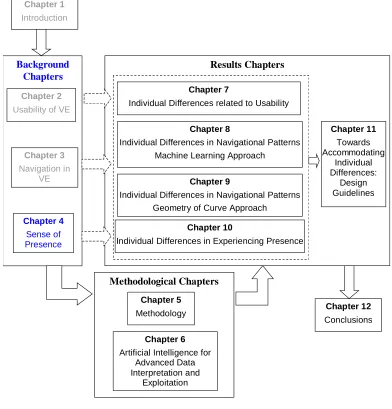
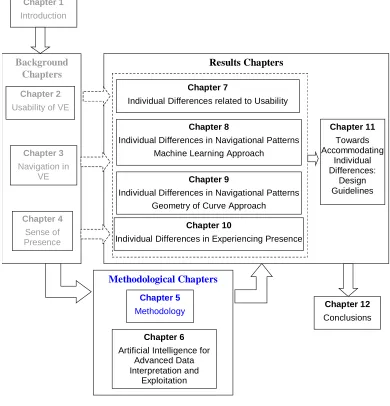
The road map (Figure 1.3) is intended to assist the reader by providing
naviga-tional clues for better wayfinding in the abstract space of this thesis. It is presented at the beginning of each of the following chapters offering additional orientation support,
through indicating the reader’s location in the thesis content.
Chapter 1
Introduction
Background Chapters
Chapter 2
Usability of VE
Chapter 3
Navigation in VE
Chapter 4
Sense of Presence
Methodological Chapters
Chapter 6 Artificial intelligence for
Advanced Data Interpretation and
Exploitation Chapter 5
Methodology Chapter 12
Conclusions
Results Chapters
Chapter 8
Individual Differences in Navigational Patterns
Machine Learning Approach
Chapter 9
Individual Differences in Navigational Patterns Geometry of Curve Approach
Chapter 10
Individual Differences in Experiencing Presence Chapter 7
Individual Differences related to Usability
Chapter 11
Towards Accommodating
Individual Differences:
[image:27.595.152.517.257.640.2]Design Guidelines
Chapter 2
Usability of Virtual Reality
Systems
Chapter 1
Introduction
Background Chapters
Chapter 2 Usability of VE
Chapter 3 Navigation in
VE
Chapter 4 Sense of Presence
Methodological Chapters
Chapter 6 Artificial Intelligence for
Advanced Data Interpretation and
Exploitation Chapter 5
Methodology Chapter 12
Conclusions
Results Chapters
Chapter 8
Individual Differences in Navigational Patterns Machine Learning Approach
Chapter 9
Individual Differences in Navigational Patterns Geometry of Curve Approach
Chapter 10
Individual Differences in Experiencing Presence Chapter 7
Individual Differences related to Usability
Chapter 11 Towards Accommodating
Individual Differences:
[image:28.595.137.530.270.709.2]Design Guidelines
2.1
Introduction
It has been observed that today, the simple delivery of any kind of artefacts for end
user’s consumption is not enough to ensure satisfaction and successful exploitation of
all the designed features that these products hold. Above all, usability is a business phenomenon and this gives some urgency to all usability related issues (Rubin, 1994).
Economic reasons justify the efforts put in both academic and industrial research
fo-cusing on system usability. The outcomes of this line of study are expected to lead to higher task performance and increased user satisfaction. Usability is therefore a product
quality factor that has grown in importance during the last years.
This chapter introduces two constructs underpinning the present thesis and tries to highlight their interrelationship. It starts by depicting the conceptual delimitations of
usability, its goals and its measurements. VEs are then introduced as one of the
appli-cation areas in Computer Science, which seems to receive relatively little consideration when it comes to usability issues. VEs offer considerable potential limited only by the
infancy of the concepts and the technology underlying them. This makes VEs more
difficult to design, implement and use than any other conventional interfaces. The next section describes VEs and their features, with an emphasis on task characteristics and
user characteristics as major aspects impacting on system usability. Particular
atten-tion has been given to navigaatten-tional tasks in VEs and the difficulty associated with their completion. To meet the need for providing navigational support and accordingly to
increase the usability of VEs, adaptive VEs are proposed and discussed.
2.2
Usability
Usability is an umbrella term and the research literature acknowledges both the multi-dimensionality and the multifaceted nature of this construct. Usability has been
con-sidered a research and design discipline, a set of product qualities, an objective and
subjective criterion of interaction. Keinonen (1998) defines usability as “relationship between an artefact and a human being who is engaged in interaction with the artefact
to achieve some practical goals”.
2.2.1 Usability Construct
Originally, usability was related to making systems easy to use and easy to learn, as well
as supporting users during their interaction with the equipment. A more operational definition is provided by the international standards related to usability (ISO, 1997),
which described usability along the following conceptual dimensions:
• Effectiveness: “the accuracy and completeness with which specified users can achieve specified goals in particular environments”;
• Satisfaction: “the comfort and acceptability of the work system to its users and other people affected by its use”.
Following the line of operational definitions, Booth (1989) considered the next four
factors as capturing the essence of usability: usefulness, effectiveness, learnability (ease
of learning) and attitude (likability). Nielsen (1993) considered the following five aspects as relevant usability attributes: learnability, efficiency (high productivity), memorability
(ease of remembering howto use), errors (reduced error rate and easy recovery from
them) and satisfaction. In a similar vein, Preece et al. (2002) suggested that usability can be broken down into the following goals: effectiveness, efficiency, safety, utility,
learnability and memorability.
An analysis of these sets of factors defining usability led to two dimensions of this construct. One refers to the performance in accomplishing the tasks, while the other
one taps a more subjective perception of the interaction with the system. In direct
relation to these aspects, two methods of measuring usability have been developed.
2.2.2 Measuring Usability
The modalities of measuring usability can be broadly grouped into two classes:
objec-tive and subjecobjec-tive methods (Nielsen, 2000). Objecobjec-tive methods focus on performance measurement expressed in terms of users’ behaviour in accomplishing tasks. Subjective
methods consist of users’ attitude measurement regarding their interaction with the
system.
Task Performance
In a broad sense, task performance is a construct related to the notion of ability. In
an operational definition, task performance refers to howwell the users perform and
complete a specific task. This involves a set of criteria for assessing the task completion. Some of the most frequently cited objective measures of task performance (Hix and
Hartson, 1993) are:
• task completion time,
• task error rate, and
• task learning time.
User Satisfaction
Typically, user satisfaction or subjective measurement of system usability consists of users’ attitude measurement regarding their interaction with the system. User
satisfac-tion is usually measured through self-rating quessatisfac-tionnaires administered after the task
An entire field of research has emerged in order to provide both theoretical back-ground and techniques for producing usable products and systems. Human–Computer
Interaction (HCI) focuses primarily on software and hardware usability (Avouris, 2001;
Hix and Hartson, 1993; Isensee and Vredenburg, 2000), web usability (Fleming, 1998; Nielsen, 1993), and on specific domains such as hypermedia (Brusilovsky and Maybury,
2002) and virtual reality applications (Gabbard and Hix, 1997). While a great deal of usability research has focused on improving web design and the assessment of different
software products, usability studies in the arena of non-immersive VEs have been rather
limited (Gabbard and Hix, 1997; Marsh and Wright, 1999; Munro et al., 1999b; Neale and Caroll, 1999).
Before presenting the usability aspects relating to VEs, a basic introduction to the
most relevant concepts is depicted. The following section introduces VEs and the most important aspects relating to them.
2.3
Virtual Environments
Virtual Reality (VR), also called Artificial Reality, Cyberspace or Synthetic Environ-ment is an umbrella term, whose meaning has been enriched from computer-mediated
systems to technologies, or even to imaginary spaces generated by human fantasy.
Emphasising its main functionality, Aukstakalnis and Blatner (1992) defined VR as “a way for humans to visualize, manipulate and interact with computers and extremely
complex data”. VR technology offers the basis for the designing and developing Virtual Environments (VEs). VEs are three-dimensional (3D), computer-generated, simulated
environments that are rendered in real time according to the behaviour of the user
(Loeffler and Anderson, 1994).
The potential of VR can be envisaged, judging by the variety of VEs which have
been already developed. A brief description of the most important and commonly used
types of VEs is outlined below.
2.3.1 Types of Virtual Environments
A major distinction among different types of VEs refers toimmersiveandnon-immersive
VEs. While immersive VEs involve the restriction of users’ senses in terms of their
reference to the real world, non-immersive VEs, or desktop VEs, do not restrict users’ senses in any way (Fernie and Richards, 2002). Desktop VEs allow the user to maintain
awareness of the physical reality (Kaur, 1998). While desktop VEs are probably the most common type of VR systems, due primarily to their lowcost, immersive VEs
seem more appealing because they enable users to completely immerse their personal
viewpoint inside the virtual world (Slater and Usoh, 1995). This is usually achieved through the use of Head Mounted Display (HMD) technology (Isdale, 2002).
enabling individuals to act in real but remote world, through the use of robotic arms. It is used particularly in dangerous or difficult to reach conditions, a specific case being
in the human body (Sas et al., 2001).
Projected environments involve a physical space onto which the virtual environment is projected, such as a room as in Cave projects (Wloka, 1996) and the Virtual Dome
(Hirose, 1996). TheCave Automatic Virtual Environment (CAVE) is a surround-screen and projection-based VR system. This type of VE enables multiple users’ participation
in a space of the size of a room. Projectors are used to throwfull-colour,
computer-generated images onto three walls and the floor, images that are viewed with stereo glasses. The high-resolution 3D video and audio inputs facilitate the illusion of
immer-sion.
Mixed Reality (MR), term coined by Milgram et al. (1994), represents a spectrum that extends from real to virtual experiences, withAugmented Reality (AR) and Aug-mented Virtuality (AV) bridging the two. MR consists of a combination of telepresence with VR systems, where the computer generated world is merged with the input pro-vided by telepresence, thus enriching the user’s perception and experience of the real
world (Isdale, 2002; Duffy et al., 2003). This technology allows the digital world to be
extended into the user’s physical world.
When a user’s viewof the world is supplemented with computer-generated
informa-tion which can potentially enrich the meaning of the real world, an AR emerges (Adam,
1993; Balcisoy et al., 2000). The augmentation or enhancement may consist of virtual artefacts placed into the physical world or a display of information about real objects.
Enabling users to perform tasks which involve real objects, while receiving additional
information about those objects represents a major benefit of AR. The goal of AR is to improve the understanding of the real world by the user.
AV systems are mostly synthetic with some real world imagery added such as texture
mapping video onto virtual objects (Milgram et al., 1994). The user is immersed in a virtual world based on real data that is updated in real time. The goal of AV is to present
a part of the real world in a simplified environment. The relationships between these
types of VEs are better understood when placed on the reality-virtuality continuum (Milgram et al., 1994) (Table 2.1).
Mixed Reality (MR)
——————————————————–
↓ ↓
Real → Augmented Augmented ← Virtual
Environment Reality (AR) Virtuality (AV) Environment
Table 2.1: Milgram’s Reality–Virtuality Continuum
The main aspect which differentiates MR from immersive VR resides in user’s
from interacting with real objects. In contrast, MR allows its users to stay in touch and act naturally in the real environment, while their view is overlaid with
computer-generated information. There is a different paradigm of user interaction and information
visualisation which differentiates immersive VR and MR: while immersive VR systems strive to bring the world into user’s computer, the MR systems bring the computer to
the user’s real work environment (Tryan, 2001).
Collaborative Virtual Environments (CVEs) are multi-user virtual environments,
designed to support collaborative activities (Tromp, 1997; Benford et al., 1996; Benford
and Fahl´en, 1993; Benford et al., 1994). Either immersive or nonimmersive, CVEs pro-vide a potentially infinite, graphically realised digital landscape which offers a framework
for users to interact not only with each other but also with different data representations
(Churchill and Snowdon, 1998). Several such CVEs have been developed, for example the DIVE system (Benford and Fahl´en, 1993) or the MASSIVE system (Greenhalgh
and Benford, 1995).
Central to these types of VEs is the idea of multiple users sharing the virtual world. This provides an increased social significance for virtual space as a practical resource,
with the purpose of supporting different types of social activities and abilities (Benford
et al., 1994).
Benford and Fahln’s (1993) spatial model aims to harness the properties of virtual
space for mediating social interaction. It proposes five concepts such as medium, aura,
awareness, focus, nimbus and adapters. Interactions between people occur through some medium, where some adapters can be used to alter different subspaces such as
individuals’ aura, focus or nimbus which impact on people’s level of awareness of the
space, of themselves or of others.
A type of navigation particularly supported within CVEs issocial navigation, w hich involves relying on information from other inhabitants of the collaborative world, to
help make decisions (Munro et al., 1999a; Dieberger et al., 2000). Apart from the similarities shared with solitary navigation performed in non-collaborative VEs, social
navigation is characterised by a series of features which pinpoint its distinctiveness.
It requires awareness of the others, communication between participants, negotiating goals, synchronising actions etc. Given these dissimilarities in relation to non-social
navigation, investigating social navigation is beyond the purpose of this thesis.
Without being exhaustive, the above description summarises briefly the most
im-portant types of VEs and their distinctive features. In order to refer to usability of VEs,
the functionality they address and the set of tasks they enable have to be understood.
2.3.2 User’s Actions within Virtual Environments
The VR paradigm allows the observer to act in computer generated worlds and the
basic goal of VEs is to create a place for people to act (Tromp, 1997). However, due to
the one developed by Esposito (1996):
• navigation and locomotion;
• object selection;
• manipulation, modification and query.
This thesis focuses particularly on navigation and associated spatial tasks in a desk-top VE. Therefore, this class of user’s actions will be briefly introduced in the following
subsection. However, given the relevance of navigation topic to this thesis, an entire subsequent Chapter 3 will provide a more thorough description of it.
Navigation and locomotion
Despite the extensive literature about spatial behaviour and its determinants in animals,
the experimental work in humans is only fragmentary (Nadel et al., 1998). Some of the
reasons for this lack of research and the potential of VEs for covering the existing gap in investigating human navigation are outlined below. VEs are able to provide new
methodological possibilities to investigate spatial cognition (Wartenberg et al., 1998;
Waller, 2000; Darken and Sibert, 1996a,b; Satalich, 1995). The distinctive features of VEs which transform them in excellent test beds for such studies are outlined below.
One of the main difficulties of investigating human spatial behaviour has been re-lated to its cost along two fundamental dimensions: time and space. Natural
experi-ments identified problems related to recording user’s behaviour, while a more controlled
environment presents difficulties related to the organisation of the spatial layout and landmark configuration. In addition, each experiment involving locomotion always
re-quires user’s investment in terms of physical resources.
VEs are able to partly overcome these limitations of classical studies on spatial cog-nition because of their characteristic of high controllability of computer graphics stimuli
(Mallot et al., 1998). Each natural behaviour, and in particular spatial navigation, is
embedded in the perception–action cycle, which justifies the use of VR as a technique for carrying out complex behavioural experiments in well controlled conditions (Mallot
et al., 2002). VEs can be built to represent any kind of physical space, from indoor
cluttered spaces to large spaces, from urban environments to natural settings, for ex-ample those representing terrain, forest, desert, sea or others types of landscapes. VEs
can also provide a mere replication of a physical space or a completely new, imagined
space. The former provides a perfect setting for testing the transfer of knowledge and skills from VEs to their physical counterparts. In other words, VEs offer the context for
training and exploration, enabling the replacement of training and exploration within
the physical world. Such a potential is particularly appealing when experiencing the real world is expensive or dangerous, or the environment is difficult to reach or must be
known before the interaction (Darken, 1995). VEs present the additional advantage of
This thesis focuses primarily on investigating spatial cognition in VEs. Only in rare situations could the experience mediated by VR technology become a goal in itself (i.e.
in game industry or arts), whereas usually its ultimate purpose is to serve a better
adaptation to the real world. In this case, the possible transfer of knowledge form virtual to real world is of particular interest. Several studies carried out at the U.S.
Army Research Institute for Behavioral and Social Sciences led to findings indicating that significant spatial learning occurred as a result of training in a VE (Boswell, 2001).
Witmer, Bailey and Knerr’s (1995) study suggested that the likelihood of transferring
the spatial skills acquired in VE to physical world increases when the VE is designed so as to represent adequately the significant landmarks. Other studies indicate that VEs
better support users in acquiring landmark and route knowledge than studying map
alone does (Bliss et al., 1997; Goerger et al., 1998). Evidences of significant similarities in the acquisition of spatial knowledge from real and VEs have been identified (Jacobs
et al., 1998). For a more detailed reviewsee Chapter 3.
In addition, once a VE has been created, it can always be transformed, at low cost, in order to test additional hypotheses. This suggests another strength of VEs,
related to their potential to help experimenters to manipulate particular variables (e.g.,
field of view, combining different navigation modes etc.), that are difficult or almost impossible to manipulate in physical world. A good control of extraneous variables is
also more easily achieved than in the real world. Furthermore, VEs can be designed
either to realistically simulate or alternatively defy the laws of physics (Slater and Usoh, 1993a). Along the realism continuum, the potential of VEs for hypothesis testing
varies accordingly. An additional purpose, related primarily to the VEs developed for
training spatial skills, addresses the users’ ability to both learn and represent the spatial characteristics of such virtual spaces (Waller, 2000).
One of the main advantages of VEs consists of their powerful tractable
character-istic (Amant and Riedl, 2001), which enables accurate spatio-temporal recording of users’ trajectory within the virtual space. Such recording is carried out in real time,
automatically and unobtrusively (Mallot et al., 1998).
To conclude, VEs are suitable technologies to be harnessed for studying and training spatial behaviour, given their characteristics, summarised by Durlach (2000) as follows:
• scaling space and time;
• emphasising components of interest;
• tracing user behaviour;
• real time adaptation;
• realistic or unrealistic features for the purpose of training.
All these strengths of VEs, however, come at a price. As Sayers (2000) observed,
during navigation in VEs are related to a general lack of familiarity with using VEs, and in particular to people’s lack of knowledge of their position, their orientation and the
structure of a VE (Ruddle et al., 1998). Other difficulties arise because of the sensory
deprivation: among the five senses, VEs in general, and desktop VEs in particular privilege vision. There may be limitations in interactions, such as the absence of tactile
feedback, substitutions, such as the use of gestures for navigation instead of whole body movement, or empowerments, such as the ability to walk through walls (Kaur,
1998). Desktop VEs, even in 3D versions, present limitations with respect to depth
perception. Another serious threat to the usability of VEs is related to motion sickness or cybersickness (Stanney et al., 1998a).
The potential of VEs for studying navigation and the limitations of VEs particularly
associated with navigation are two intertwined aspects which require the need of study-ing the usability of VEs for supportstudy-ing navigation. A promisstudy-ing direction of research in
this sense, which is also followed within this thesis, consists of exploring the possibilities
of designing adaptive VEs able to support navigation (see Chapter 11).
Conceptual delimitations The etymology of navigation refers to “driving a ship”
agere — to drive andnavis — ship. This understanding reveals that navigation is more than travel and it requires technical skills, knowledge and a plan.
Montello (2003) defined navigation as “coordinated and goal-directed body
move-ment through the environmove-ment”, and identified two components of this construct:
• locomotion, which is the body movement through the environment, coordinated to local surrounds; and
• wayfinding, which is efficient goal-directed planning and decision-making plan of navigation, coordinated to distal environment.
Darken and Sibert (1996b) present a classification for wayfinding tasks:
• Naive search, searching tasks where users have no prior knowledge of target loca-tion;
• Primed search, searching tasks where users know location of target a priori;
• Exploration, wayfinding tasks where there are no targets.
Given the complexity and goal-dependent characteristic of human wayfinding be-haviour it is difficult to identify a particular cognitive process underlying wayfinding in
general, apart from specific processes such as path integration, route retrace or landmark
recognition (Golledge, 1999). This difficulty is even more increased when the individu-als exhibiting navigational strategies are completely unaware of using them (Golledge,
1996).
Search Strategies Because of the relevance of search behaviour in the context of this