Munich Personal RePEc Archive
The Effect of Pseudo-exogenous
Instrumental Variables on Hausman Test
Jeong, Jinook and Yoon, Byung
Yonsei University
April 2007
Online at
https://mpra.ub.uni-muenchen.de/9792/
The Effect of Pseudo-exogenous Instrumental Variables on
Hausman Test
by
Jinook Jeong1 School of Economics
Yonsei University
and
Byung Ho Yoon School of Economics
Yonsei University
April 2007
Abstract
This paper investigates the potential problem of ‘pseudo-exogenous’ instruments in regression models. We show that the performance of Hausman test is deteriorated when the instruments are asymptotically exogenous but endogenous in finite samples, through Monte Carlo simulations.
Keywords: Hausman test, endogeneity, instrumental variable
JEL classifications: C12, C15
Acknowledgement: We are grateful for the helpful comments from Professor Dong H. Kim and the participants of NAIS conference at Yonsei University. This research has been financially supported by Suam Foundation. The authors are members of ‘Brain Korea 21’ Research Group of Yonsei University.
1 Corresponding Author, 1) address: School of Economics, Yonsei University, Seoul,
I. Introduction
When there exist endogenous explanatory variables in a regression model, the least
squares estimator fails to achieve consistency. To identify the endogeneity of the
explanatory variables, Hausman test is widely employed. Hausman test works pretty
well, but it is not free of problems. Meepagala (1992) shows that the power of Hausman
test decreases as the sample size becomes smaller. Staiger and Stock (1994) show that
‘weak’ instruments weaken the power of Hausman test. Wong (1996) proposes a
bootstrap procedure to improve the finite sample properties of Hausman test when the
instruments are weak.
This paper identifies another potential problem of Hausman test. When the
instruments of IV estimation are correlated with the error term of the regression, although
the correlation converges to zero eventually, the finite sample performance of Hausman
test becomes seriously deteriorated. Let us call such instruments, which are
asymptotically exogenous but endogenous in the finite sample, ‘pseudo-exogenous’
instruments. Pseudo-exogenous instruments, of course, do not affect the asymptotic
distribution of Hausman test. However, as we will show through a series of Monte Carlo
experiments, the empirical sizes and powers of Hausman test could be considerably
inaccurate in finite samples. Especially, we will show the empirical power function of
Hausman test actually ‘collapses’ in some cases.
One of the most popularly used instruments is the fitted value of the endogenous
variable from the reduced form regression. This so-called 2SLS (two-stage least
squares) is widely used as it gives a proper instrument. Such a fitted value is by
construction a pseudo-exogenous instrument. The correlation between the fitted value
II. Hausman Test with the Pseudo-exogenous Instrument
Let us consider the following model.
u x y= β+
where is an ( ×1) vector of explanatory variable, is an ( ×1) vector of error
terms, and is an ( ×1) vector of dependent variable. Suppose there exists an ( ×1)
vector of the instrumental variable, z . We are interested in testing : “x is
exogenous” against : “x is endogenous.” By a similar derivation as in Bound et al.
(1995), it is straightforward that
x N u N
y N 1 H N 0 H 2 x xu 1
ols plim(x'x) x'y
ˆ im pl σ σ + β = = β − xz zu 1
iv plim(z'x) z'y ˆ im pl σ σ + β = = β −
where )
N u ' x ( m pli xu ≡
σ , )
N u ' z ( m pli zu ≡
σ , )
N z ' x ( m pli xz ≡
σ and )
N x ' x ( m pli 2 x ≡ σ .
First, suppose that z is exogenous so that 0 xz zu = σ σ
. Let us define
. If is exogenous (i.e. is true) as well as , then
) ˆ ˆ ( m pli
q≡ βiv −βols x H0 z
0 xz zu 2 x xu = σ σ = σ σ
and q=0. If is still exogenous but is endogenous (i.e. is
true), then
z x H1
0 xz zu = σ σ
and 2
x xu
σ σ
q= − . Now Hausman statistic H is
[
Var(ˆ ) Var(ˆ )]
(ˆ ˆ )) ˆ ˆ (
H≡ βiv−βols ′ βiv − βols −1 βiv−βols
which converges to zero under and diverges from zero under . It has been
shown by Hausman (1978) that Hausman statistic has an asymptotic distribution
is not exogenous at all. In this case, Hausman test is not
define
0
H , H1
χ2
under H . 0
Second, suppose z
d well. If z is not exogenous, then 0 xz zu ≠ σ σ
. Thus, even when x is
exogenous (i.e. H0 is true), q is not zero any longer but xz zu σ σ
endogenous (i.e. H1 is true), q is now zu xu2 σx xz σ − σ σ
. Thus, Haus statistic H no
longer converges t zero under H , and is no longer guaranteed to diverge from ero 0
1
are as totically exogenous but endogenous the finite sample. In th c man
under . , the null distribution of is no longer an asymptotic
Third, let us consider the case of ‘pse instrumental variables, which
se,
Hausm
is e the
z
2 .
s a o
Accordingly
III. Monte Carlo Simulation
d. Consider
H ymp utio perform H udo-exogenous’ in er
ng data generating process (DGP):
χ
i
an test is well-defined in large samples, but could be problematic in small samples.
Although q≡plim(βˆiv −βˆols)=0under H and 0 q≡plim(βˆiv −βˆols)≠0 under H1, as
0 ) u ' z (
E ≠ in finite samples, the Hausman statistic, H , may not be close enough to zero
under H0 enoug rom z finite sample
of Hausman statistic may not be χ2 eith The following section examines
the effect of the pseudo-exogenous instrument on Hausman test through simulations.
To substantiate the effect of the pseudo-exogenous instrument, a Monte Carlo study and/or distinguishe
n
d
followi
h f o under H1 . The
er. distrib
u x
y= β+
where ⎟ ⎟ ⎟ ⎠ ⎞ ⎜ ⎜ ⎜ ⎝ ⎛ ⎥ ⎥ ⎥ ⎦ ⎤ ⎢ ⎢ ⎣ ⎡ ⎥ ⎥ ⎥ ⎦ ⎤ 2 u s a
⎢ , ρ ρ ρ ρ ρ ρ ⎢ ⎢ ⎢ ⎣ ⎡ = ⎟⎟ ⎟ ⎟ ⎠ ⎥ ⎥ ⎥ ⎦ ⎤ ⎢ ⎢ ⎢ ⎣ ⎡ ⎟ ⎟ ⎟ ⎠ ⎞ 1 N 20 N 20 1 1 0 0 0 N s s s s s , N ~ zu xu zu xz xu xz 2 u xu zu xz xu x i i i
where i = 1, 2, …, N For sim , nd ⎞ 2 ⎜⎜ ⎜ ⎜ ⎝ ⎛ ⎥ ⎥ ⎥ ⎦ ⎤ ⎢ ⎢ ⎢ ⎣ ⎡ 0 0 0 . ⎜ ⎜ ⎜ ⎝ ⎛ u z x s s s licity s zu 2 z xz
p s , 2x s , 2z β are all set to one. ake
the instrument ‘pseudo-exogenous,’ is defined as
To m zu s N 20 s zu zu ρ
≡ . Note that the
l 2
in finite samples. As the sam le size zu, ρ
p
correlation coefficient between z and u in a sampe size of 0 (N=20), is not set to always
increases, however, s converses to zero (i.e. the instrument becomes exogenous). zu
Thus, z is a ‘pseudo-exogenous’ instrument. The correlation coefficient between x and z,
xz
ρ is set to 0.7 so that we can avoid the so-called ‘weak instrument’ problems. Four
alternative sample sizes are considered: 20, 50, 100, and 500 for comparisons. The
ulation has been performed 1,000 times.
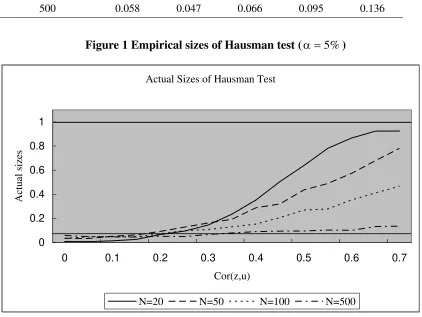
Table 1 and Figure 1 present the empirical sizes of Hausman test. First, we notice
that the empirical size of Hausman test is not accurate in small samples even when the
u sim
instr ment is perfectly exogenous (ρzu=0). For instance, when N=20 and ρzu=0, the
rejection rate is only 0.008 while the nominal size is 0.05. Second, when the instrument
is pseudo-exogenous (i.e. ρzu≠0), mpirical sizes of Hausman test are seriously
distorted. For example, when N=20 and zu 0.7 the e
=
ρ , Hausman test rejects the true null
empirical size is far from accurate even whe : the empirical size is 13.6% while
the nominal size is 5%.
hypothesis 925 times out of 1,000 simulations: the empirical size is 92.5% while the
inal size is 5%. ch size distortion fades away as the sample size grows, but the
n N=500
ble 1 Empirical sizes of Hausman test (
nom Su
Ta 2
% 5
=
α )
N ρzu
0 0.1 0.3 0.5 0.7
20 0.008 0.014 0.145 0.638 0.925
50 0.035 0.052 0.162 0.436 0.781
2 We experimented how big the sample size (N) should be to achieve an accurate
[image:6.595.79.486.628.704.2]100 0.035 0.047 0.108 0.269 0.467
500 0.058 0.047 0.066 0.095 0.136
Figure 1 Empirical sizes of Hausman test (α =5%)
Actual Sizes of Haus st
0 0.2 0.4 0.6 0.8 1
0 0.1 0.2 0.3 0.4 0.5 0.6 0.7
Cor(z,u)
Actu
al sizes
man Te
N=20 N=50 N=100 N=500
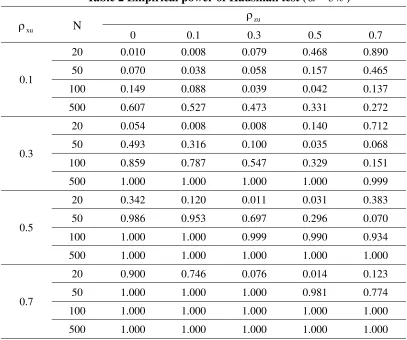
Table 2 shows the empirical powers of Hausman test. First of all, it is obvious
that Hausman test does not work well in small samples when the instrument is
pseudo-exogenous. For example, even when ρxu=0.7, Hausman test does not easily reject the
false null hypothesis H0: 0ρxu = in N = 20 cases, if ρzu ≠0: the empirical powers are
7.6% (for ρzu =0.3), 1.4% (for ρzu =0.5), and 12.3% (for ρzu =0.7). Generally, the
empirical po 0 s showing higher
a p owers become a
case (
wers are ex
powers than 10% in T
1 . 0
= and
exogeneity of the instrum trem
ble 2. Wh
7 . 0 =
ent
ely low when N = 2 , only a few exception
le size is 50, the em
ite a fe
). It should be noted that even when the
pseudo-1 . 0 en the sam
is quite weak (such as
pirical p
bit higher, but still show powers lower than 10% in qu w cases. Even when the
sample size is 100, Hausman test rejects only 13.7% of the false null hypothesis in some
xu zu
zu
ρ ρ
=
ρ ), the empirical power of
Hausman test could be pretty low in small samples. For example, in the case of ρxu=
ma
[image:7.595.82.504.100.417.2]decreases to 0.120 for ρzu=0.1. It implies that, in small samples, Hausman test could be
[image:8.595.79.486.200.540.2]distorte eak co between the instrument and the error term even though
Table 2 Empirical power of Hausman test ( 5%
d by a w ation
they are asymptotically independent. rrel
=
α )
xu
ρ N ρzu
0 0.1 0.3 0.5 0.7
0.1
20 0.010 0.008 0.079 0.468 0.890
50 0.070 0.038 0.058 0.157 0.465
100 0.149 0.088 0.039 0.042 0.137
500 0.607 0.527 0.473 0.331 0.272
0.3
008 0.008 0.140 0.712 20 0.054 0.
50 0.493 0.316 0.100 0.035 0.068
100 0.859 0.787 0.547 0.329 0.151
500 1.000 1.000 1.000 1.000 0.999
0.5
20 0.342 0.120 0.011 0.031 0.383
50 0.986 0.953 0.697 0.296 0.070
100 1.000 1.000 0.999 0.990 0.934
500 1.000 1.000 1.000 1.000 1.000
0.7
20 0.900 0.746 0.076 0.014 0.123 50 1.000 1.000 1.000 0.981 0.774 100 1.000 1.000 1.000 1.000 1.000 500 1.000 1.000 1.000 1.000 1.000
Second, the empirical powers of Hausman te
increases ntuit pow xpected to become as th nitude of
the instrument ndog =
st show quite irregular variations as
zu
ρ . I iv
en
ely, the er is e lower e mag
’s e eity ( ρzu) becomes As shown in Ta ,
intuition. Som the power becomes
as com (f le, see se of
higher. ble 2, however
the em
higher
pirical powers do not support such
es
etimes
be higher or examp the ca ρxu=0 zu
ρ .3 and , among
oth while etimes the power becomes lo s expected. It is apparent from
Ta co cy at The reason why the
N=20
ers), som wer a
empir
con
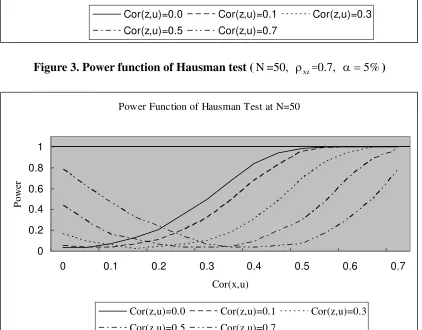
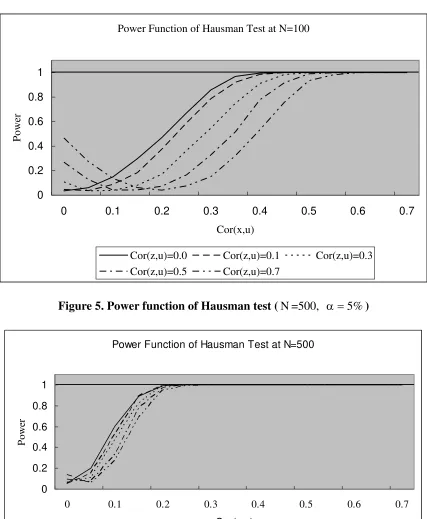
The empirical power functions depicted in Figures 2-5 confirm
Figure 2 presents the empirical power function of Hausman test when N = 20 for various
0 1
ical powers are inconsistent is explained in section II. Although (βˆiv−βˆols)
verges to zero under H0 and to a positive number under H1 in large samples, it could
well be non-zero under H0 and zero under H1 in small samples. As a result, Hausman
statistic is not defined well.
values of ρ . Unlike a typical power function, they do not either approach to the
nominal size under H , nor approach to 1 under extreme H . When the magnitude of
pseudo-exogeneity is high (for example, zu 0.7
such irregularities.
zu
=
ρ ), the power function goes even the
opposite way. As sample size grows, such an odd behavior weakens a little. However,
even when N = 50 and N = 100, the power function ‘collapses’ at around ρzu =0.35 and
15 . 0 zu =
Figure 2. Power function of Hausman test (N=20, α=5%)
Power Function of Hausman Test at N=20
0 0.2 0.4 0.6 0.8 1
0 0.1 0.2 0.3 0.4 0.5 0.6 0.7
Cor(x,u)
Po
w
er
Cor(z,u)=0.0 Cor(z,u)=0.1 Cor(z,u)=0.3
Cor(z,u)=0.5 Cor(z,u)=0.7
Figure 3. Power function of Hausman test (N=50, ρxz=0.7, α=5%)
Power Function of Hausman Test at N=50
0 0.2 0.4 0.6 0.8 1
0 0.1 0.2 0.3 0.4 0.5 0.6 0.7
Cor(x,u)
Po
w
er
Cor(z,u)=0.0 Cor(z,u)=0.1 Cor(z,u)=0.3
[image:10.595.88.510.323.653.2]Figure 4. Power function of Hausman test (N=100, α=5%)
Power Function of Hausman Test at N=100
0 0.2 0.4 0.6 0.8 1
0 0.1 0.2 0.3 0.4 0.5 0.6 0.7
Cor(x,u)
Power
[image:11.595.87.510.351.677.2]Cor(z,u)=0.0 Cor(z,u)=0.1 Cor(z,u)=0.3 Cor(z,u)=0.5 Cor(z,u)=0.7
Figure 5. Power function of Hausman test (N=500, α=5%)
Power Function of Hausman Test at N=500
0 0.2 0.4 0.6 0.8 1
0 0.1 0.2 0.3 0.4 0.5 0.6 0.7
Cor(x,u)
Po
w
er
Cor(z,u)=0.0 Cor(z,u)=0.1 Cor(z,u)=0.3
IV. Conclusion
While the problems of ‘weak’ instruments in IV estimation have been thoroughly
studied 3, the problems that ‘endogenous’ instruments may create have not been studied to
a great extent. This paper examines the effects of ‘pseudo-exogenous’ instruments on
Hausman test in finite samples. We show that the size and power of Hausman test could
be very inaccurate in finite samples when the instruments are pseudo-exogenous.
Researchers need to be cautious about the exogeneity of the instruments when they use IV
estimation in practice.
References
Bound, J., D. A. Jaeger and R. M. Baker (1995) “Problems with Instrumental Variables Estimation When the Correlation Between the Instruments and the Endogenous Explanatory Variable is Weak,” Journal of the American Statistical Association 90 (430), 443-450.
Hausman, J. A. (1978) “Specification Tests in Econometrics,” Econometrica 46(6), 1251-1270.
Maddala, G.S. and J. Jeong (1992), “On the Exact Small Sample Distribution of the Instrumental Variable Estimator,” Econometrica 60, pp.181-183.
Meepagala, G.. (1992) “On the Finite Sample Performance of Exogeneity Tests of Revankar, Revankar and Hartley and Wu-Hausman,” Econometric Review 11, 337-353.
Wong, K. (1996) “Bootstrapping Hausman’s exogeneity test,” Economics Letters 53(2), 139-143.