Copyright © 2004, American Society for Microbiology. All Rights Reserved.
Use of 16S rRNA, 23S rRNA, and
gyrB
Gene Sequence Analysis
To Determine Phylogenetic Relationships of
Bacillus cereus
Group Microorganisms
Sergei G. Bavykin,
1* Yuri P. Lysov,
1,2Vladimir Zakhariev,
1,2John J. Kelly,
1,3Joany Jackman,
4David A. Stahl,
5and Alexey Cherni
1,2BioChip Technology Center, Argonne National Laboratory, Argonne, Illinois, 604391; Engelhardt Institute of Molecular
Biology, Moscow 117984, Russia2; Department of Biology, Loyola University Chicago, Chicago, Illinois 606263;
Applied Physics Laboratory, Johns Hopkins University, Laurel, Maryland 207234; and Department of
Civil and Environmental Engineering, University of Washington, Seattle, Washington 981955
Received 1 December 2003/Returned for modification 23 February 2004/Accepted 22 April 2004
In order to determine if variations in rRNA sequence could be used for discrimination of the members of the
Bacillus cereusgroup, we analyzed 183 16S rRNA and 74 23S rRNA sequences for all species in theB. cereus
group. We also analyzed 30gyrBsequences forB. cereusgroup strains with published 16S rRNA sequences. Our
findings indicated that the three most common species of theB. cereusgroup,B. cereus, Bacillus thuringiensis,
andBacillus mycoides, were each heterogeneous in all three gene sequences, while all analyzed strains ofBacillus anthracis were found to be homogeneous. Based on analysis of 16S and 23S rRNA sequence variations, the
microorganisms within the B. cereusgroup were divided into seven subgroups, Anthracis, Cereus A and B,
Thuringiensis A and B, and Mycoides A and B, and these seven subgroups were further organized into two
distinct clusters. This classification of theB. cereusgroup conflicts with current taxonomic groupings, which
are based on phenotypic traits. The presence ofB. cereusstrains in six of the seven subgroups and the presence
ofB. thuringiensisstrains in three of the subgroups do not support the proposed unification ofB. cereusand
B. thuringiensisinto one species. Analysis of the available phenotypic data for the strains included in this study revealed phenotypic traits that may be characteristic of several of the subgroups. Finally, our results
demon-strated that rRNA andgyrBsequences may be used for discriminatingB. anthracisfrom other microorganisms
in theB. cereusgroup.
Analysis of 16S rRNA sequences is a simple, commonly used method for the identification of microorganisms (1, 47, 53). However, early studies performed with a limited number of isolates from theBacillus cereusgroup revealed that the 16S rRNA sequences of species in this group had as high as a 99 to 100% similarity and, thus, suggested that rRNA sequences might not be useful for discrimination of members of that group (6). However, that study examined only five isolates from theB. cereusgroup. TheB. cereusgroup contains seven closely related species: Bacillus anthracis, B. cereus, Bacillus thuringiensis, Bacillus mycoides(16, 45, 51),Bacillus pseudomy-coides(38),Bacillus weihenstephanensis(33), andBacillus me-dusa(15). To date, identification and discrimination of these species has been based on analysis of morphological, biochem-ical, and immunological characteristics.
Although conserved in sequence overall, the 16S rRNAs actually exhibit great variation in some regions. These differ-ences in 16S rRNA sequence provide the basis for the design of nucleic acid probes of various specificities, ranging from probes targeting all living organisms to group-specific and spe-cies-specific probes. Another advantage of using the rRNAs as a target is the fact that these molecules are naturally amplified within the cell. In general, rRNA represents about 80% of total nucleic acids in microbial cells and, thus, is present in many
hundreds of thousands of copies per cell. This natural ampli-fication allows for direct detection of rRNA sequences without the need for intermediate amplification via PCR (1).
16S and 23S rRNA are currently considered the most useful molecules for the determination of prokaryotic phylogeny. Analysis of these rRNA sequences has resulted in a tremen-dous expansion in our knowledge of prokaryotic diversity and has demonstrated the limitations of the existing prokaryotic taxonomy, which is based primarily on the analysis of pheno-typic traits (35). Attempts have been made recently to address conflicts between molecular and phenotypic data, such as the work on the phylogenetically heterogeneous genus Pseudomo-nas(29). Here we have conducted a similar analysis for theB. cereusgroup. We have investigated the molecular phylogeny of theB. cereusgroup by extensively analyzing a set ofB. cereus group sequences in order to determine if the rRNA sequences contained enough variation to discriminateB. anthracisfrom other members of theB. cereusgroup.
Previous work has demonstrated thatgyrBgene sequences may also be useful for discrimination ofB. cereusgroup organ-isms (57). Therefore, in addition to the rRNA analyses, we have also analyzedgyrBsequences for members of theB. cereus group and compared rRNA-based andgyrB-based phylogenies.
MATERIALS AND METHODS
Bacterial strains.Twelve strains belonging to theB. cereusgroup were used for sequencing:B. anthracisstrain Ames ANR,B. anthracisstrain Delta Ames-1, B. anthracisstrain Sterne, B. anthracisstrain 1, B. anthracisstrain 2, B. thurin-* Corresponding author. Mailing address: BioChip Technology
Cen-ter, Argonne National Laboratory, Argonne, IL 60439. Phone: (630) 252-3980. Fax: (630) 252-9155. E-mail: [email protected].
3711
on May 15, 2020 by guest
http://jcm.asm.org/
Downloaded from
on May 15, 2020 by guest
http://jcm.asm.org/
Downloaded from
on May 15, 2020 by guest
http://jcm.asm.org/
giensisstrain B8, B. cereusstrain NCTC 9620, B. cereusstrain T, B. thuringiensis strain 4Q281,B. medusastrain ATCC 25621,B. mycoidesstrain ATCC 6462m, andB. mycoidesstrain ATCC 10206 (obtained as a generous gift from John Ezzell, U.S. Army Medical Research Institute of Infectious Diseases, Fort De-trick, Frederick, Md.) (see Table 2). Two of theB. mycoidesstrains were isolated as an occasional admixture from a culture previously identified asB. mycoides strain ATCC 6462. These strains revealed different colony morphologies and were assigned different strain numbers:B. mycoidesATCC 6462m andB. my-coidesATCC 10206. B. thuringiensisstrains 4R1, 4D1, 4F1, 4T1, 4W1, 4J4, 4A1, 4A7, 4Q1, 4Q2, and 4M1 were received as a generous gift from Dan Zeigler of the Bacillus Genetic Stock Center.B. cereusHER 1414 was acquired from the National Collection of Type Cultures (NCTC).
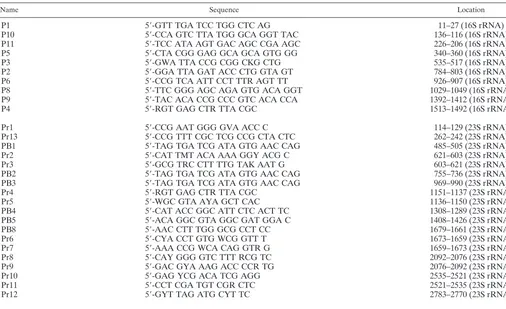
Sequencing of 16S and 23S rRNA genes.Total DNA was isolated from frozen cell pellets using the guanidine extraction method as described previously (11). 16S rDNA was amplified from total genomic DNA for 12 strains. The 23S rDNA was amplified for 10 of the 12 strains (B. anthracisstrains 1 and 2 were excluded). For each amplification reaction mixture, 0.1g of bacterial DNA was subjected to PCR in a total volume of 100l, with 2.5 U ofTaqpolymerase (Perkin-Elmer, Boston, Mass.), 50 mM KCl, 10 mM Tris-HCl (pH 8.3), 1.5 mM MgCl2, 0.01%
(wt/vol) gelatin, a 200M concentration of each deoxynucleoside triphosphate (dATP, dCTP, dGTP, and dTTP), and a 6M concentration of each of two primers. The primers used for 16S rDNA and 23S rDNA amplification are listed in Table 1. The thermal profile included denaturation at 94°C for 2 min, primer annealing at 45°C for 2 min, extension at 72°C for 2 min, and then 35 cycles of denaturation at 94°C for 15 s, primer annealing at 45°C for 15 s, and extension at 72°C for 4 min. DNA was purified using a QIAquick PCR purification kit (QIAGEN Inc., Valencia, Calif.), and purified PCR products were directly se-quenced by the cycle sequencing method using AmpliTaqDNA polymerase FS (Perkin-Elmer), fluorescently labeled dye terminators, and 373A fluorescent sequencer (ABI, Perkin-Elmer). Sequencing primers are shown in Table 1. Both strands of studied DNA fragments were sequenced twice for each strand.
Development of expanded sequence databases.We retrieved 16S rRNA, 23S rRNA, andgyrBsequences for members of theB. cereusgroup from GenBank (www.ncbi.nlm.nih.gov). Twelve 16S rRNA and 10 23SrRNA sequences were determined in this study, including oneB. anthracisstrain (Sterne) resequenced by our laboratory (Table 1). In this article, numbers are shown in all sequences in accordance with numbering in theB. anthracisAmes genome.
[image:2.603.45.551.81.390.2]Creation of phylogenetic tree.The 16S, 23S rRNA, andgyrBsequence data-bases were used to create phylogenetic trees. Sequences of isolates with different names but representing the same strain, incomplete sequences, sequences con-taining a large number of mistakes, strain-specific variations, or undetermined nucleotides (particularly at the sites of subgroup-specific signatures) were ex-cluded from consideration. For an accurate determination of species similarities, all 5⬘and 3⬘ends were cut to identical positions along the 16S rRNA, 23S rRNA, andgyrBgenes atB. anthracisAmes bp 49 to 1462, 24 to 2779, and 381 to 1499, respectively. The sequences were aligned using the multiprocessor (version 1.81) of CLUSTAL W (http:www.cmbi.kun.nl/bioinf/tools/clustalw.shtml). Aligned se-quences were analyzed using the Molecular Evolutionary Genetics Analysis package version 2.1 (31; http://www.megasoftware.net). Rooted and unrooted phylogenetic trees were built with minimum evolution, neighbor-joining, un-weighted pair group method with averages (UPGMA), and maximum parsimony methods. During analysis of alignments with the minimum evolution method, gaps were considered missing data points, genetic distances were estimated using nucleotide/Jukes-Cantor (for rRNA) or nucleotide/p-distance (forgyrB) models, where all substitutions were included in pairwise distance calculations. A close-neighbor-interchange search was performed to examine the neighborhood of the neighbor-joining tree to find a potential minimum evolution tree. Bootstrap confidence values were generated using 1,000 permutations of the data set for 16S rRNA andgyrBand 100 permutations for 23S rRNA to derive the nucleotide sequence similarities. In the maximum parsimony method for 16S rRNA and gyrB, gaps in the analysis were treated as missing data points; for 23S rRNA, where insertion G(1218-1219) was considered as a subgroup-specific signature, TABLE 1. Primers used for PCR and for sequencing of 16S and 23S rRNA genes ofB. cereusgroup bacteriaa
Name Sequence Location
P1 5⬘-GTT TGA TCC TGG CTC AG 11–27 (16S rRNA)
P10 5⬘-CCA GTC TTA TGG GCA GGT TAC 136–116 (16S rRNA)
P11 5⬘-TCC ATA AGT GAC AGC CGA AGC 226–206 (16S rRNA)
P5 5⬘-CTA CGG GAG GCA GCA GTG GG 340–360 (16S rRNA)
P3 5⬘-GWA TTA CCG CGG CKG CTG 535–517 (16S rRNA)
P2 5⬘-GGA TTA GAT ACC CTG GTA GT 784–803 (16S rRNA)
P6 5⬘-CCG TCA ATT CCT TTR AGT TT 926–907 (16S rRNA)
P8 5⬘-TTC GGG AGC AGA GTG ACA GGT 1029–1049 (16S rRNA)
P9 5⬘-TAC ACA CCG CCC GTC ACA CCA 1392–1412 (16S rRNA)
P4 5⬘-RGT GAG CTR TTA CGC 1513–1492 (16S rRNA)
Pr1 5⬘-CCG AAT GGG GVA ACC C 114–129 (23S rRNA)
Pr13 5⬘-CCG TTT CGC TCG CCG CTA CTC 262–242 (23S rRNA)
PB1 5⬘-TAG TGA TCG ATA GTG AAC CAG 485–505 (23S rRNA)
Pr2 5⬘-CAT TMT ACA AAA GGY ACG C 621–603 (23S rRNA)
Pr3 5⬘-GCG TRC CTT TTG TAK AAT G 603–621 (23S rRNA)
PB2 5⬘-TAG TGA TCG ATA GTG AAC CAG 755–736 (23S rRNA)
PB3 5⬘-TAG TGA TCG ATA GTG AAC CAG 969–990 (23S rRNA)
Pr4 5⬘-RGT GAG CTR TTA CGC 1151–1137 (23S rRNA)
Pr5 5⬘-WGC GTA AYA GCT CAC 1136–1150 (23S rRNA)
PB4 5⬘-CAT ACC GGC ATT CTC ACT TC 1308–1289 (23S rRNA)
PB5 5⬘-ACA GGC GTA GGC GAT GGA C 1408–1426 (23S rRNA)
PB8 5⬘-AAC CTT TGG GCG CCT CC 1679–1661 (23S rRNA)
Pr6 5⬘-CYA CCT GTG WCG GTT T 1673–1659 (23S rRNA)
Pr7 5⬘-AAA CCG WCA CAG GTR G 1659–1673 (23S rRNA)
Pr8 5⬘-CAY GGG GTC TTT RCG TC 2092–2076 (23S rRNA)
Pr9 5⬘-GAC GYA AAG ACC CCR TG 2076–2092 (23S rRNA)
Pr10 5⬘-GAG YCG ACA TCG AGG 2535–2521 (23S rRNA)
Pr11 5⬘-CCT CGA TGT CGR CTC 2521–2535 (23S rRNA)
Pr12 5⬘-GYT TAG ATG CYT TC 2783–2770 (23S rRNA)
R1 5⬘-GGC GGC GTC CTA CTC TCA C 112–95 (5S rRNA)
aPrimers P1 to P4, Pr1 to Pr7, and R1 were used for DNA amplification. All other primers were utilized for sequencing. Primers P8, P9, P10, and P11 were selected
de novo; other primers were described earlier (for details, see reference 32).
on May 15, 2020 by guest
http://jcm.asm.org/
all sites were included for consideration. We utilized the close-neighbor-inter-change algorithm to find the maximum parsimony tree. The random addition option with 10 replicates was used to produce the initial trees. In calculations of tree length, relative weights for different types of changes were specified uni-formly using the standard parsimony method. In the both the neighbor-joining and UPGMA methods forgyrB, gaps were treated with the “complete deletion” option, genetic distances were estimated using the nucleotide/p-distance method in neighbor-joining analysis and nucleotide/Jukes-Cantor method for UPGMA, and bootstrap confidence values were generated using 1,000 permutations for both the neighbor-joining and UPGMA methods.
RESULTS
Sequencing of 16S and 23S rRNA genes ofB. cereusgroup
microorganisms.In this study we sequenced 12 16S rRNA and
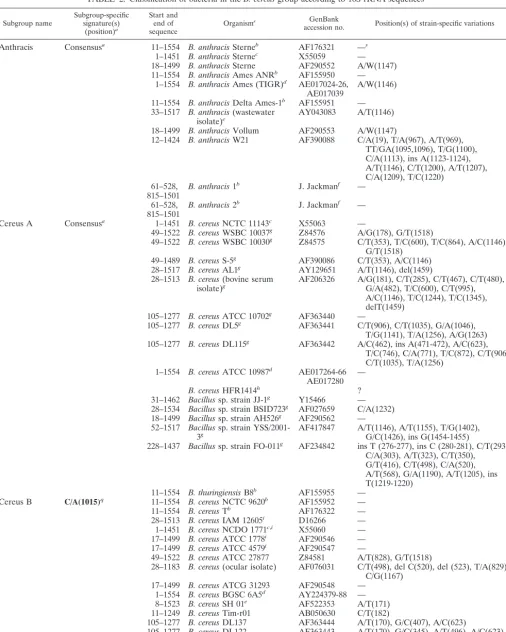
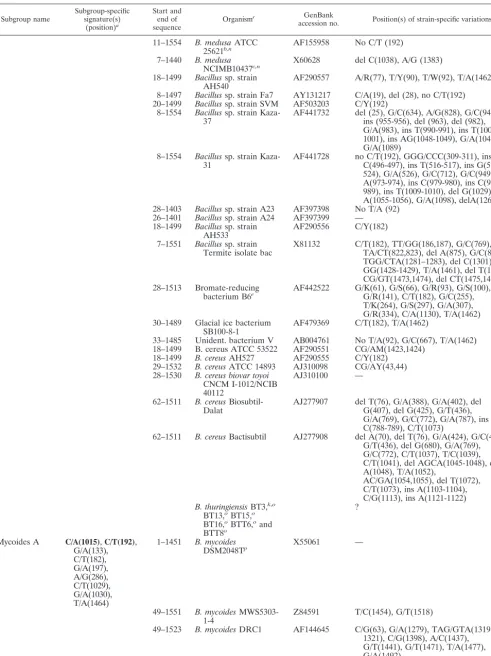
10 23S rRNA genes (Tables 2 and 3). There are published sequences available (6, 7) for two of the microorganisms that we sequenced,B. medusaNCIMB10437 (ATCC 25621) andB. anthracisSterne. We found a number of discrepancies between our sequences and these previously published sequences. The published 16S rRNA sequences ofB. anthracisSterne (6; Gen-Bank accession no. X55059) andB. medusaNCIMB10437(7; GenBank accession no. X60628) have a deletion of a C (posi-tion 942) in comparison with other strains ofB. anthracisand B. medusathat were later sequenced (Table 2). We did not find this deletion in our resequencing of the 16S rRNA genes ofB. anthracis Sterne (GenBank accession no. AF176321) and B. medusaATCC 25621 (GenBank accession no. AF155958), or in the recent resequencing of this gene inB. anthracisSterne by Ticknor et al. (50; GenBank accession no. AF290552). We also did not find this deletion in ours or The Institute for Genomic Research’s sequencing ofB. anthracisAmes (GenBank acces-sion numbers AF267734, AE017024 to AE017026, and AE017039). We believe that the reported deletion was a com-pression artifact of sequencing this GC-rich region (56), i.e., GGGGCCG instead of GGGGCCCG. We suggest that the same compression artifact at the same site may also have compromised the 16S rRNA sequences of B. cereus NCDO1771, B. cereusNCTC 11143, B. mycoidesDSM2048T, and B. thuringiensis NCIMB9134 (6, 7; GenBank accession numbers X55060 to X55063). For this reason, these deletions were not included in Table 2.
In addition, our resequencing of the 16S rRNA gene forB. medusa ATCC 25621 did not reveal the C-to-T transition at position 192 (presence of T instead of C found inB. anthracis) or the A-to-G transversion at position 1383 previously re-ported forB. medusaNCIMB10437 16S rRNA (Table 2).
We did not include in Table 2 the 108 inconsistencies found in the six 16S rRNA sequences mentioned above, which had been deposited in GenBank by Ash et al. (6, 7). These were not supported by the resequencing of B. anthracisSterne and B. medusa or in any other 16S rRNA sequences (Table 2) and probably represented systematic errors in sequencing which occurred when the base following T was incorrectly read as A, generally, instead of T or G.
We also found differences between the previously published 23S rRNA sequence ofB. anthracisSterne (5; GenBank ac-cession no. S43426) and our resequencing of this isolate (Gen-Bank accession no. AT267877). The differences that we found were the following: T instead of C at position 491, deletion of CG (1413, 1414), and T instead of C at position 2651. We also did not find these changes in any other 23S rRNA sequence in
the B. cereus group, including B. anthracisAmes and B. an-thracisDelta Ames (Table 3). Therefore, we suggest that these differences inB. anthracisSterne and also the same differences inB. cereusNCTC 11143 (GenBank accession no. X64646) are due to errors in the previously reported sequences (5).
We did not include in Table 3 the substitutions of A for G, T, and C reported earlier for the 23S rRNA sequences ofB. anthracisSterne andB. cereusNCTC 11143 (5) that were not confirmed by our resequencing of the same gene inB. anthracis Sterne. These inconsistencies with our results, C/A(1037), T/A(1127), G/A(1411), G/A(1827), G/A(1834), C/A(2079), G/A(2182), G/A(2278), and C/A(2391), previously reported in combination with several Ns were not observed in any other isolates (Table 3).
Comparison of 16S and 23S rRNA sequences in theB. cereus
group.Our analyses indicated that in terms of known 16S and
23S rRNA sequences,B. anthraciswas the most homogeneous species within theB. cereusgroup (Tables 2 and 3). This finding confirms PCR fingerprinting studies that demonstrated almost complete homogeneity of bulk DNA recovered from different strains ofB. anthracis(2, 9, 14, 20, 21, 24–27, 30, 34, 39, 40, 43, 44, 48, 54). Because of this homogeneity, we have used theB. anthracis 16S and 23S rRNA sequences as a reference for reporting differences among closely related bacteria within the B. cereusgroup (Fig. 1 and 2; Tables 2 and 3).
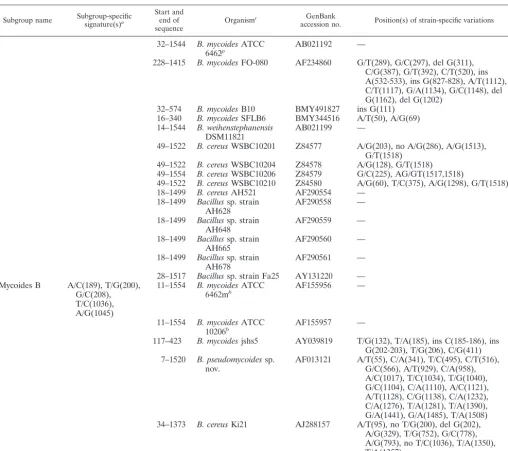
Analysis of our 16S rRNA sequences and sequences found in GenBank for the otherB. cereusgroup organisms identified six characteristic regions which contained the majority of the positional sequence differences: position(s) 77 to 92, 133, 182 to 208, 286, 1015 to 1045, and 1462 (Fig. 1 and Table 2). Because sequence variation in these regions can be used to divide the B. cereus group organisms into several large sub-groups, we have termed the differences located within these regions subgroup-specific differences. The most common were C/A (1015) and C/T (192). A set of subgroup-specific differ-ences that characterized a subgroup were called subgroup-specific signatures (Table 2). In addition, a number of other differences were observed, which we have termed strain-spe-cific differences (Tables 2 and 3). Most of the strain-spestrain-spe-cific differences were unique to each strain and were located ran-domly along the 16S rRNA molecule, i.e., they did not occur within the same sites as the subgroup-specific differences. Based on our resequencing experience, it is possible that some of the strain-specific variants represented mistakes in sequenc-ing.
It is necessary to stress that all of the different subgroup-specific differences were not equally important for subgroup identification. For example, 16S rRNA subgroup-specific dif-ferences C/T (182) and T/A (1462) were found in all microor-ganisms from the Cereus A subgroup. However, both of these alterations, as well as C/Y (192), sometimes appeared in Thu-ringiensis B isolates (B. thuThu-ringiensis82347,Bacillussp. strain AH540,Bacillussp. strain AH533, Bacillussp. strain Termite isolate bac, bromate-reducing bacterium B6, glacial ice bacte-rium SB100-8-1, unidentified bactebacte-rium V, and B. cereus AH527) (Table 2). Alterations C/T (182) and C/Y (182) also were found in some Thuringiensis A microorganisms (Bacillus sp. strain KPU-0013,B. cereusATCC 43881) (Table 2). These findings suggested close relationships for the subgroups Thu-ringiensis A, ThuThu-ringiensis B, and Mycoides A.
on May 15, 2020 by guest
http://jcm.asm.org/
TABLE 2. Classification of bacteria in theB. cereusgroup according to 16S rRNA sequences
Subgroup name Subgroup-specificsignature(s) (position)a
Start and end of
sequence Organism
r GenBank
accession no. Position(s) of strain-specific variations
Anthracis Consensusa 11–1554 B. anthracisSterneb AF176321 —s 1–1451 B. anthracisSternec X55059 — 18–1499 B. anthracisSterne AF290552 A/W(1147) 11–1554 B. anthracisAmes ANRb AF155950 —
1–1554 B. anthracisAmes (TIGR)d AE017024-26,
AE017039 A/W(1146) 11–1554 B. anthracisDelta Ames-1b AF155951 — 33–1517 B. anthracis(wastewater
isolate)e AY043083 A/T(1146)
18–1499 B. anthracisVollum AF290553 A/W(1147)
12–1424 B. anthracisW21 AF390088 C/A(19), T/A(967), A/T(969), TT/GA(1095,1096), T/G(1100), C/A(1113), ins A(1123-1124), A/T(1146), C/T(1200), A/T(1207), C/A(1209), T/C(1220)
61–528,
815–1501 B. anthracis1
b J. Jackmanf —
61–528,
815–1501 B. anthracis2
b J. Jackmanf —
Cereus A Consensusa 1–1451 B. cereusNCTC 11143c X55063 —
49–1522 B. cereusWSBC 10037g Z84576 A/G(178), G/T(1518)
49–1522 B. cereusWSBC 10030g Z84575 C/T(353), T/C(600), T/C(864), A/C(1146), G/T(1518)
49–1489 B. cereusS-5g AF390086 C/T(353), A/C(1146) 28–1517 B. cereusAL1g AY129651 A/T(1146), del(1459) 28–1513 B. cereus(bovine serum
isolate)g AF206326 A/G(181), C/T(285), C/T(467), C/T(480),G/A(482), T/C(600), C/T(995), A/C(1146), T/C(1244), T/C(1345), delT(1459)
105–1277 B. cereusATCC 10702g AF363440 —
105–1277 B. cereusDL5g AF363441 C/T(906), C/T(1035), G/A(1046), T/G(1141), T/A(1256), A/G(1263) 105–1277 B. cereusDL115g AF363442 A/C(462), ins A(471-472), A/C(623),
T/C(746), C/A(771), T/C(872), C/T(906), C/T(1035), T/A(1256)
1–1554 B. cereusATCC 10987d AE017264-66 AE017280 —
B. cereusHFR1414h ?
31–1462 Bacillussp. strain JJ-1g Y15466 — 28–1534 Bacillussp. strain BSID723g AF027659 C/A(1232) 18–1499 Bacillussp. strain AH526g AF290562 — 52–1517 Bacillussp. strain
YSS/2001-3g AF417847 A/T(1146), A/T(1155), T/G(1402),G/C(1426), ins G(1454-1455) 228–1437 Bacillussp. strain FO-011g AF234842 ins T (276-277), ins C (280-281), C/T(293),
C/A(303), A/T(323), C/T(350), G/T(416), C/T(498), C/A(520), A/T(568), G/A(1190), A/T(1205), ins T(1219-1220)
11–1554 B. thuringiensisB8b AF155955 — Cereus B C/A(1015)q 11–1554 B. cereusNCTC 9620b AF155952 —
11–1554 B. cereusTb AF176322 —
28–1513 B. cereusIAM 12605i D16266 — 1–1451 B. cereusNCDO 1771c,i X55060 — 17–1499 B. cereusATCC 1778i AF290546 — 17–1499 B. cereusATCC 4579i AF290547 —
49–1522 B. cereusATCC 27877 Z84581 A/T(828), G/T(1518)
28–1183 B. cereus(ocular isolate) AF076031 C/T(498), del C(520), del (523), T/A(829), C/G(1167)
17–1499 B. cereusATCG 31293 AF290548 — 1–1554 B. cereusBGSC 6A5d AY224379-88 — 8–1523 B. cereusSH 01e AF522353 A/T(171) 11–1249 B. cereusTim-r01 AB050630 C/T(182)
105–1277 B. cereusDL137 AF363444 A/T(170), G/C(407), A/C(623)
105–1277 B. cereusDL122 AF363443 A/T(170), G/C(345), A/T(496), A/C(623) 20–1534 Bacillussp. strain P16 AY048782 G/A(28), T/C(30)
Continued on following page
on May 15, 2020 by guest
http://jcm.asm.org/
TABLE 2—Continued
Subgroup name Subgroup-specificsignature(s) (position)a
Start and end of
sequence Organism
r GenBank
accession no. Position(s) of strain-specific variations
11–1515 Bacillussp. strain 82344 AF227848 —
45–1513 Bacillussp. strain F26 AF385082 T/C(49), G/C(530) 30–1484 Glacial ice bacterium
SB-12K-9-4 AF479367 —
30–1481 Glacial ice bacterium
G500K-2 AF479333 —
30–1475 Glacial ice bacterium
G50-TS3 AF479356 —
47–1470 Bacillaceaebacterium
PH27B AF513473 ins GT(1379-1380)
49–1517 Unident. HTA484
(Mariana Trench isol.) AB002640 G/C(72), GC/CG(297,298), del (946), insC(1111-1112), del (1279) 49–1522 B. thuringiensisWS2614 Z84584 A/C(128), G/T(1518)
49–1522 B. thuringiensisWS2617 Z84585 G/A(1153), G/T(1518) 49–1522 B. thuringiensisWS2618 Z84586 A/G(725), G/T(1518) 49–1522 B. thuringiensisWS2626 Z84588 G/T(1518)
Thuringiensis A C/A(1015),C/T(192) 49–1522 B. thuringiensisWS2623 Y18473 G/T(109), A/G(679), T/C(1228), A/G(1503)
49–1522 B. thuringiensisWS2625 Z84587 C/T(565), G/T(1183), G/T(1518) 18–1479 B. thuringiensisATCC
33679 AF290549 C/Y(192)
B. thuringiensis4R1,j4D1,j 4F1,j4S2,j4T1, 4W1,j and 4J4j
?
22–1502 Bacillussp. strain FPI/
2002 AY124766 —
8–1514 Bacillussp. strain
KPU-0013 AB067810 C/G(131), C/T(182), G/A(202), del (298),C/T(444), T/G(781), A/C(796), G/A(952), TC/CT(1036,1037), G/T(1313)
55–1510 Unident. sp6 (bovine
rumen isolate) AB003391 C/T(63), del(108), C/T(182), C/G(227),GC/CG(297,298), del(565), del(1038) 20–1530 Bacillussp. strain CMB03 AF406633 G/A(28), T/C(30), ins C(730-731),
A/T(1146), G/A(1254), T/A(1256), A/G(1263), G/A(1266), A/G(1269), G/A(1271), GG/TA(1282,1283), T/C(1287), T/C(1292), A/T(1299), C/T(1301), T/C(1317), T/C(1319), G/T(1322), C/A(1333), A/G(1336), A/G(1338), G/A(1451), T/A(1463), T/G(1477)
18–1499 B. cereusATCC 43881 AF290550 C/Y (182) Thuringiensis B C/A(1015),C/T(192),
A/G(77), T/C(90), T/A(92)
11–1554 B. thuringiensis4Q281b AF155954 — 28–1513 B. thuringiensisIAM
12077k D16281 —
1–1451 B. thuringiensisNCIMB
9134c,k X55062 —
18–1499 B. thuringiensisATCC
10792k AF290545 —
37–1491 B. thuringiensis82347 AF157112 C/Y(182), del C(303), del C(347), ins T(395-396), G/A(1029), C/T(1111), del G(1148), del G(1240), del C(1246), del G(1262), GG/AS(1321,1322), del G(1492)
49–1522 B. thuringiensis(Pieris
brassicae isolate) AF160221 A/C(161), A/T(183), no C/T(192),G/T(1518) 50–1513 B. thuringiensisBactisubtil AF172711 G/A(733), G/A(778), C/A(857) 11–1052 B. thuringiensis
HMB12389 AF501348 G/C(39)
B. thuringiensis9308,l20,l
Lb5,l1230,land L3l ? B. thuringiensis4A1,j4A7,j
4Q1,j4Q2,jand 4M1j ? B. cereusNagoya 126m
and 127m ?
Continued on following page
on May 15, 2020 by guest
http://jcm.asm.org/
TABLE 2—Continued
Subgroup name Subgroup-specificsignature(s) (position)a
Start and end of
sequence Organism
r GenBank
accession no. Position(s) of strain-specific variations
11–1554 B. medusaATCC
25621b,n AF155958 No C/T (192) 7–1440 B. medusa
NCIMB10437c,n X60628 del C(1038), A/G (1383) 18–1499 Bacillussp. strain
AH540 AF290557 A/R(77), T/Y(90), T/W(92), T/A(1462) 8–1497 Bacillussp. strain Fa7 AY131217 C/A(19), del (28), no C/T(192) 20–1499 Bacillussp. strain SVM AF503203 C/Y(192)
8–1554 Bacillussp. strain
Kaza-37 AF441732 del (25), G/C(634), A/G(828), G/C(949),ins (955-956), del (963), del (982), G/A(983), ins T(990-991), ins T(1000-1001), ins AG(1048-1049), G/A(1049), G/A(1089)
8–1554 Bacillussp. strain
Kaza-31 AF441728 no C/T(192), GGG/CCC(309-311), insC(496-497), ins T(516-517), ins G(523-524), G/A(526), G/C(712), G/C(949), ins A(973-974), ins C(979-980), ins C(988-989), ins T(1009-1010), del G(1029), ins A(1055-1056), G/A(1098), delA(1269) 28–1403 Bacillussp. strain A23 AF397398 No T/A (92)
26–1401 Bacillussp. strain A24 AF397399 — 18–1499 Bacillussp. strain
AH533 AF290556 C/Y(182)
7–1551 Bacillussp. strain
Termite isolate bac X81132 C/T(182), TT/GG(186,187), G/C(769),TA/CT(822,823), del A(875), G/C(897), TGG/CTA(1281–1283), del C(1301), ins GG(1428-1429), T/A(1461), del T(1463), CG/GT(1473,1474), del CT(1475,1476) 28–1513 Bromate-reducing
bacterium B6e AF442522 G/K(61), G/S(66), G/R(93), G/S(100),G/R(141), C/T(182), G/C(255), T/K(264), G/S(297), G/A(307), G/R(334), C/A(1130), T/A(1462) 30–1489 Glacial ice bacterium
SB100-8-1 AF479369 C/T(182), T/A(1462)
33–1485 Unident. bacterium V AB004761 No T/A(92), G/C(667), T/A(1462) 18–1499 B. cereus ATCC 53522 AF290551 CG/AM(1423,1424)
18–1499 B. cereusAH527 AF290555 C/Y(182) 29–1532 B. cereusATCC 14893 AJ310098 CG/AY(43,44) 28–1530 B. cereus biovar toyoi
CNCM I-1012/NCIB 40112
AJ310100 —
62–1511 B. cereus
Biosubtil-Dalat AJ277907 del T(76), G/A(388), G/A(402), delG(407), del G(425), G/T(436), G/A(769), G/C(772), G/A(787), ins C(788-789), C/T(1073)
62–1511 B. cereusBactisubtil AJ277908 del A(70), del T(76), G/A(424), G/C(431), G/T(436), del G(680), G/A(769), G/C(772), C/T(1037), T/C(1039), C/T(1041), del AGCA(1045-1048), del A(1048), T/A(1052),
AC/GA(1054,1055), del T(1072), C/T(1073), ins A(1103-1104), C/G(1113), ins A(1121-1122) B. thuringiensisBT3,k,o
BT13,oBT15,o BT16,oBTT6,oand BTT8o
?
Mycoides A C/A(1015),C/T(192), G/A(133), C/T(182), G/A(197), A/G(286), C/T(1029), G/A(1030), T/A(1464)
1–1451 B. mycoides
DSM2048Tp X55061 —
49–1551 B. mycoides
MWS5303-1-4 Z84591 T/C(1454), G/T(1518)
49–1523 B. mycoidesDRC1 AF144645 C/G(63), G/A(1279), TAG/GTA(1319-1321), C/G(1398), A/C(1437), G/T(1441), G/T(1471), T/A(1477), G/A(1492)
49–1522 B. mycoides
MWS5303-2-51 Z84583 A/G(180), G/T(1518)
Continued on following page
on May 15, 2020 by guest
http://jcm.asm.org/
TABLE 2—Continued
Subgroup name Subgroup-specificsignature(s)a
Start and end of
sequence Organism
r GenBank
accession no. Position(s) of strain-specific variations
32–1544 B. mycoidesATCC
6462p AB021192 —
228–1415 B. mycoidesFO-080 AF234860 G/T(289), G/C(297), del G(311), C/G(387), G/T(392), C/T(520), ins A(532-533), ins G(827-828), A/T(1112), C/T(1117), G/A(1134), G/C(1148), del G(1162), del G(1202)
32–574 B. mycoidesB10 BMY491827 ins G(111) 16–340 B. mycoidesSFLB6 BMY344516 A/T(50), A/G(69) 14–1544 B. weihenstephanensis
DSM11821 AB021199 —
49–1522 B. cereusWSBC10201 Z84577 A/G(203), no A/G(286), A/G(1513), G/T(1518)
49–1522 B. cereusWSBC10204 Z84578 A/G(128), G/T(1518) 49–1554 B. cereusWSBC10206 Z84579 G/C(225), AG/GT(1517,1518)
49–1522 B. cereusWSBC10210 Z84580 A/G(60), T/C(375), A/G(1298), G/T(1518) 18–1499 B. cereusAH521 AF290554 —
18–1499 Bacillussp. strain
AH628 AF290558 —
18–1499 Bacillussp. strain
AH648 AF290559 —
18–1499 Bacillussp. strain
AH665 AF290560 —
18–1499 Bacillussp. strain
AH678 AF290561 —
28–1517 Bacillussp. strain Fa25 AY131220 — Mycoides B A/C(189), T/G(200),
G/C(208), T/C(1036), A/G(1045)
11–1554 B. mycoidesATCC
6462mb AF155956 —
11–1554 B. mycoidesATCC
10206b AF155957 —
117–423 B. mycoidesjshs5 AY039819 T/G(132), T/A(185), ins C(185-186), ins G(202-203), T/G(206), C/G(411) 7–1520 B. pseudomycoidessp.
nov. AF013121 A/T(55), C/A(341), T/C(495), C/T(516),G/C(566), A/T(929), C/A(958), A/C(1017), T/C(1034), T/G(1040), G/C(1104), C/A(1110), A/C(1121), A/T(1128), C/G(1138), C/A(1232), C/A(1276), T/A(1281), T/A(1390), G/A(1441), G/A(1485), T/A(1508) 34–1373 B. cereusKi21 AJ288157 A/T(95), no T/G(200), del G(202),
A/G(329), T/G(752), G/C(778), A/G(793), no T/C(1036), T/A(1350), T/A(1357)
aFor more details, see Fig. 1. bSequenced in this work.
cSequences need to be reexamined; see also Results.
dFrom sequences of whole genome; data represent average sequence of all available 16S rRNA genes. eSequence submitted in 3⬘to 5⬘form.
fJ. Jackman, unpublished.
gFinal discrimination from Anthracis subgroup will be done after sequencing of 23S rRNA gene (see Results). hNot sequenced; identified through hybridization analysis (see Results).
iThese four strains are identical and correspond toB. cereusDSM 31; see 23S rRNA sequence of this strain in Table 3.
jNot sequenced; assignment to subgroups Thuringiensis A or B was based on hybridization with subgroup-specific probes (S. Bavykin and J. Jackman, unpublished). kThese four strains are identical and correspond toB. thuringiensisDSM2046; see the 23S rRNA sequence of this strain in Table 3.
lNot sequenced; subgroup-specific signatures A/G(77), T/C(90), and T/A(92) were identified by hybridization with subgroup-specific probes (18). mNot sequenced; subgroup-specific signatures A/G(77), T/C(90), and T/A(92) were identified by hybridization with subgroup-specific probes (55). nAccording toBergey’s Manual(45), these two strains ofB. medusashould be identical.
oNot sequenced; subgroup-specific signatures A/G(77), T/C(90), and T/A(92) were identified by hybridization with subgroup-specific probes (13). pAccording toBergey’s Manual(45), these two strains ofB. mycoidesshould be identical.
qSubgroup-specific mutations, which are highlighted in bold, were identical for two or more subgroups and are shown on separate lines to demonstrate connections
between different subgroups.
rSelected abbreviations of collections and institutions appearing in titles of listed strains: ATCC, American Type Culture Collection, Rockville, Md; NCTC, National
Collection of Type Cultures and Pathogenic Fungi, London, United Kingdom; DSM or DSMZ, German Collection of Microorganisms and Cell Cultures, Braunschweig, Germany; HER, Center of Reference bacteria and viruses, Laval University, Department of Microbiology, Quebec, Canada; IAM, Institute of Applied Microbiology, University of Tokyo, Tokyo, Japan; NSDO or NSFB, National Collection of Food Bacteria, c/o NCIMB Ltd., Aberdeen, Scotland, United Kingdom; NCIMB or NCIB, National Collections of Industrial and Marine Bacteria Ltd., Aberdeen, Scotland, United Kingdom; CNCM, National Collection of Microorganisms and Cell Cultures, Pasteur Institute, Paris, France; TIGR, The Institute for Genomic Research, Rockville, Md. W⫽A or T; Y⫽C or T; S⫽C or G; M⫽A or C. Del, deletion; ins, insertion.
s—, no strain-specific variations in this strain.
on May 15, 2020 by guest
http://jcm.asm.org/
TABLE 3. Classification of bacteria in theB. cereusgroup according to 23S rRNA sequences
Subgroup name Subgroup-specific signature(s) (position)a Start and end
of sequence Organism accession no.GenBank Position(s) of strain-specificvariation(s)
Anthracis Consensusa 1–2922 B. anthracisSterneb AF267877 —k
1–2922 B. anthracisDelta Ames-1b AF267876 —
1–2922 B. anthracisAmes ANRb AF267734 —
1–2922 B. anthracisAmes (TIGR)c AE017024 to -26,
AE017039 —
15–2943 B. anthracisSterned S43426 T/C(491), del CG(1413, 1414),
T/C(2651)
Cereus A Y/C(594)j 1–2923 B. cereusNCTC11143d S43429 T/C(2651)
G/A(1559) 1–2923 B. cereusATCC 10987c AE017264 to -66 —
Insertion G(1218-1219) AE017280
1–527 B. cereusWSBC10030e Z84589 —
B. cereusHER1414f ?
1–2923 B. thuringiensisB8b AF267880 —
Cereus B Y/C(594) 1–2922 B. cereusNCTC9620b AF267878 —
G/A(1559) 1–2922 B. cereusTb AF267879 G/R(1559)
T/A(2153) 1–2787 B. cereusDSM31g X94448 T/C(1275)
24–2789 B. cereusLMG6923g AJ310096 —
1–2922 B. cereusATCC 14579c,g AF016998 to
AF017000, AF017013
—
1–2922 B. cereusBGSC 6A5c AY224379 to
AY224388 —
18–2897 B. cereusTim-r01 AB050631 ins G(1218–1219), G/T(1268), G/A(1557), ins
T(1781–1782), T/A(1938) 1–527 B. thuringiensisWS2617e Z84594 —
1–527 B. thuringiensisWS2614e Z84593 —
Thuringiensis A T/A(2153)
Insertion G(1218–1219) B. thuringiensisstrs. 4R1,
h
4D1,h4F1,h4T1,h4W1,h
4S2,hand 4J4h
?
Thuringiensis B Y/T(594) 1–2922 B. thuringiensis4Q281b AF267881 G/R(1559)
T/C(157) 24–2789 B. thuringiensisLMG7138i AJ310738 G/R(546)
G/A(921), A/G(1020), C/T(1037), G/A(1209), A/G(1251), T/C(1283) C/T(132), A/T(174), G/T(1250) T/A(2153)
1–2784 B. thuringiensisDSM2046i X89895 C/T(57), T/G(413), ins
AATA(479–480), del GG(541–542), G/A(646), C/G(670), G/A(1953), G/A(2055), ins AGT(2556– 2557), del G(2573) B. thuringiensis4A1,h4A7,h
4Q1,h4Q2,hand 4M1h ?
1–2922 B. medusaATCC 25621b AF267885 —
20–2790 B. cereusATCC 14893 AJ310099 CA/TC(265,266), T/C(358), G/A(646), C/T(655), G/A(663), C/G(1816), G/C(1849)
24–2799 B. cereusbiovar toyoi CNCM 1-1012/NCIB 40112
AJ310101 CA/TC(265,266), G/A(646), C/T(655), G/A(663), C/G(1816), G/C(1849)
Mycoides A Y/T(594) 1–527 B. mycoidesDSM2048T Z84592 —
T/C(157) 1–527 B. mycoidesMWS5303-1-4 Z84591 —
G/A(921), A/G(1020), C/T(1037),
G/A(1209), A/G(1251), T/C(1283) 23–2789 B. mycoidesDSM2048 AJ310097 CA/AY(375, 376), T/C(1112),T/C(2651)
CA/TC(265,266), GT/AC(364,365),
C/G(1816), G/C(1849) 1–527 B. cereusWSBC10206 Z84590 — C/T(132),A/T(174), G/T(1250)
T/A(2153)
C/T(375)
Mycoides B Y/T(594) 1–2922 B. mycoidesATCC 6462mb AF267884 —
T/C(157) 1–2922 B. mycoidesATCC 10206b AF267883 —
G/A(921), A/G(1020), C/T(1037), G/A(1209), A/G(1251), T/C(1283) CA/TC(265,266), GT/AC(364,365),
C/G(1816), G/C(1849)
GA/AG(346,347), TC/CT(358,359), C/A(482), C/T(672), A/T(1219), G/T(1268), A/G(2159)
aFor more details, see Fig. 2. b23S rDNA sequenced in this work.
cFrom sequences of whole genome; data represent average sequence of all available 23S rRNA genes. dNeed to be reexamined (see Results).
eAssigned to this subgroup in accordance with the 16S rRNA sequence (see Table 2). fNot sequenced; identified through hybridization analysis (see Results).
gThese three strains are identical and correspond toB. cereusIAM12605,B. cereusNCDO1771,B. cereusATCC 11778, andB. cereusATCC 14579; see 16S rRNA
sequences of these strains in Table 2.
hNot sequenced; subgroup-specific signatures A/G(77), T/C(90), and T/A(92) were identified by hybridization with subgroup-specific probes (S. Bavykin and J.
Jackman, unpublished).
iThese two strains are identical and correspond toB. thuringiensisIAM12077,B. thuringiensisNCIMB9134,B. thuringiensisATCC 10792, andB. thuringiensisBT3;
see 16S rRNA sequences of these strains in Table 2. Y⫽C or T; R⫽G or A.
jSee footnoteqof Table 2. kSee footnotesof Table 2.
on May 15, 2020 by guest
http://jcm.asm.org/
Analysis of the 23S rRNA sequences for theB. cereusgroup organisms revealed 12 regions within which the majority of the sequence variation occurred (Fig. 2 and Table 3). The differ-ences within these regions were analogous to the subgroup-specific variants found in the 16S rRNA.
However, due to the limited number of 23S rRNA se-quences in the database, it may be that not all of these differ-ences are subgroup specific. Some of the regions which appear to contain subgroup-specific differences may actually contain strain-specific variations. For example, the Mycoides B sub-group signature contained five subsub-group-specific differences in the 16S rRNA and nine subgroup-specific differences in 23S rRNA sequences that were not found in other subgroups (Fig. 2). However, available rRNA sequences for the Mycoides B subgroup currently include only five strains for which 16S rRNA sequences have been determined and two strains for 23S rRNA sequences (Tables 2 and 3). Among them,B. my-coidesATCC 6462m andB. mycoidesATCC 10206 had iden-tical 16S and 23S rRNA sequences (Fig. 2; Tables 2 and 3) as well as 16S-23S rRNA spacers (GenBank accession numbers AF267905 and AF267906). However, they differed in colony morphology (see Materials and Methods). If additional mem-bers of the Mycoides B subgroup will be sequenced, we may find that some of the subgroup-specific differences are actually strain specific. Further work is needed to address this issue.
The most common subgroup-specific differences in 23S rRNA sequence occurred at positions 157 and 594 (Table 3; Fig. 2). The presence of these common variants among the subgroups supports a phylogenetic relationship among them.
Grouping of microorganisms in theB. cereusgroup
accord-ing to 16S rRNA sequences.TheB. cereusgroup can be divided
into seven subgroups based on 16S rRNA sequence differences (Table 2). We have labeled each of these subgroups according to the name of the most common member of the subgroup: Anthracis, Cereus A and B, Thuringiensis A and B, and My-coides A and B.
The following subgroups reflect the 16S rRNA sequence relationships (Table 2). Subgroup Anthracis includes eight strains of B. anthracis. Most of the published 16S rRNA se-quences in this subgroup contain a polymorphic site at position 1146 or 1147.
Subgroup Cereus A includes 17 members which do not con-tain any subgroup-specific sequence differences from the B. anthracisconsensus but which were not identified asB. anthra-cisby conventional taxonomic methods. Ten of these 17 iso-lates do contain strain-specific sequence differences. However, at least six of the other seven members,B. cereusNCTC 11143, B. cereus ATCC 10702,B. thuringiensisB8, Bacillussp. strain
JJ-1, andBacillussp. strain AH526, have sequences identical to subgroup Anthracis in the region of the 16S rRNA compared. Two isolates of the subgroup Cereus A,B. cereusWSBC10037 andB. cereusWSBC10030, have been previously characterized as mesophilic (33).B. thuringiensisB8 apparently represents a misclassification, because it does not contain anycrygenes (J. Jackman, personal communication).
Subgroup Cereus B includes 23 strains ofB. cereusandB. thuringiensisthat differ fromB. anthracisby a C-to-A change at position 1015. B. cereus NCTC 9620, B. cereus T, B. cereus IAM12605, B. cereusNCDO1771, B. cereusATCC 11778,B. cereus ATCC 14579,B. cereusATCC 31293, B. cereusBGSC 6A5,Bacillussp. strain 82344, and glacial ice bacterium strains SB-12K-9-4, G500K-2, and G50-TS3 do not differ from one another in 16S rRNA sequence and, thus, they would be in-distinguishable based on 16S rRNA hybridization. StrainsB. cereus IAM12605, B. cereus NSDO1771, B. cereus ATCC 11778, andB. cereus ATCC 14579 represent the same strain and correspond toB. cereusDSM31 andB. cereusLMG6923, whose 23S rRNA sequences are considered below (Tables 2 and 3).
Subgroups Thuringiensis A and Thuringiensis B include, respectively, 15 and 42 strains of microorganisms which con-tain two and five subgroup-specific sequence differences, re-spectively, C/A (1015) and C/T (192) being shared among the two subgroups. These two subgroups include mainlyB. thurin-giensisstrains. Six strains in the subgroup Thuringiensis B (B. thuringiensis4Q281,B. thuringiensisIAM12077,B. thuringiensis NCIM9134, B. thuringiensis ATCC 10792, Bacillus sp. strain A24, andB. cereusbiovartoyoiCNSMI-1012/NCIB40112) have identical 16S rRNA sequences. Strains B. thuringiensis IAM12077, B. thuringiensis NCIMB9134, B. thuringiensis ATCC 10792, and B. thuringiensis BT3 comprise the same strain and correspond to B. thuringiensis DSM2046, the 23S rRNA sequence of which is considered below (Tables 2 and 3). Two other members of this subgroup,B. medusaATCC 25621 andB. medusaNCIMB10437, should be identical according to those inBergey’s Manual(45). However, according to our se-quencing and hybridization studies (data not shown), strainB. medusa ATCC 25621 does not contain the subgroup-specific alteration C/T (192), whereas according to published se-quences (7), B. medusa NCIMB10437 does contain this se-quence variant.
[image:9.603.56.530.68.147.2]In the last two subgroups, Mycoides A and Mycoides B, 18 B. mycoidesstrains group in subgroup Mycoides A and 5 fall under subgroup Mycoides B. Subgroups contain, respectively, nine and five subgroup-specific differences in their signatures. Strains B. mycoides DSM2048 andB. mycoides ATCC 6462 FIG. 1. Positions of subgroup-specific sequence differences in the 16S rRNA of B. cereussubgroups. The sequence ofB. anthracisSterne (GenBank accession no. AF 176321) has been used as the consensus sequence. Vertical lines indicate nucleotides identical to the consensus sequence. Arrows indicate regions containing subgroup-specific differences. For more details, see Table 2.
on May 15, 2020 by guest
http://jcm.asm.org/
on May 15, 2020 by guest
http://jcm.asm.org/
according to Bergey’s Manual(45) represent the same strain. Psychrotolerant isolatesB. weihenstephanensisDSM11821 and B. cereusstrains WSBC 10201, 10204, 10206, and 10210 were also included in subgroup Mycoides A. Nine isolates,B. my-coidesstrain DSM2048T,B. mycoidesATCC 6462,B. weihen-stephanensis DSM11821, B. cereus AH521, and Bacillus sp. strains AH628, AH648, AH665, AH678, and Fa25 have iden-tical 16S rRNA sequences. Subgroup Mycoides B containsB. cereus Ki21 andB. pseudomycoidessp. nov., which may have split off from the other three isolates in this subgroup rather early in their evolution, as they have a large number of strain-specific sequence differences (Table 2).
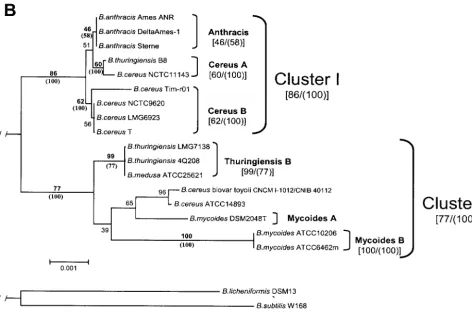
The same groups containing the same microorganisms were identified in a rooted phylogenetic tree that was generated with the minimum evolution method using 16S rRNA sequences of the B. cereus group with Bacillus licheniformis strain GA8 (GenBank accession no. AY162136), Bacillus megaterium strain C1 (GenBank accession no. AJ491841), andB. megate-rium strain KL-181 (GenBank accession no. AY030336) 16S rRNA sequences as an outgroup. This grouping was also com-pletely and independently confirmed by reconstructing an un-rooted 16S rRNA tree with the maximum parsimony method (Fig. 3A).
Although the affiliations in the tree are consistent with those we defined earlier by signature analysis (Table 2 and Fig. 1), these groupings do not correspond exactly to the current tax-onomy, which divides theB. cereusgroup into seven species:B. anthracis, B. cereus, B. thuringiensis, B. medusa, B. mycoides, B. pseudomycoidessp. nov., andB. weihenstephanensis(15, 16, 33, 38, 45, 51).
Grouping of microorganisms in theB. cereusgroup
accord-ing to 23S rRNA sequences.For all microorganisms whose 23S
rRNA genes were sequenced (Table 3), 16S rRNA sequences were also available. This finding gave us a unique opportunity to confirm the division of theB. cereusgroup into seven sub-groups that was done according to 16S rRNA sequences (Fig. 1 and 3A; Table 2). Unfortunately, there were no 23S rRNA sequences available for any of the organisms from subgroup Thuringiensis A. Analyzing 23S rRNA signatures obtained for six subgroups did not reveal any serious contradictions with the groupings based on 16S rRNA sequence analysis (compare data in Table 2 and Fig. 3A with Fig. 2 and Table 3 data). However, in contrast to 16S rRNA sequences, 23S rRNA se-quences of isolates in the Anthracis subgroup revealed a set of variations that provided the possibility for differentiation of the Anthracis subgroup from all the other six subgroups (Table 3; Fig. 2).
Subgroup Cereus A contains B. cereus ATCC 10987, B. thuringiensisB8, andB. cereusNCTC 11143 (Table 2). The 23S rRNA sequences of these two organisms include subgroup-specific alterations at positions 594 and 1559 and an insertion
G(1218-1219) (Fig. 2; Table 3). The 23S rRNA sequence ofB. cereusWSBC10030 was sequenced only partially (Fig. 2; Table 3). It does not contain any differences that are specific for any other subgroups, but also it does not cover subgroup-specific sites for the Cereus A subgroup.
Subgroup Cereus B contains seven strains. We observed that 23S rRNA sequences of this subgroup contain three subgroup-specific differences at positions 594, 1559, and 2153 (Fig. 2). Unfortunately, the 23S rRNA sequences available forB. thu-ringiensisWS2614 andB. thuringiensisWS2617 do not extend beyond position 527 from the 5⬘ end of the gene. StrainsB. cereusDSM31,B. cereusATCC 14579, andB. cereusLMG6923 represent the same strain that corresponds to B. cereus IAM12605,B. cereusNCDO1771, andB. cereusATCC 11778 (Table 3), whose 16S rRNA sequences are also available (Ta-ble 2).
Subgroup Thuringiensis B consists of 10 microorganisms containing 12 subgroup-specific alterations. B. thuringiensis LMG7138 andB. thuringiensisDSM2046 (Table 3) represent one strain, whose synonyms areB. thuringiensisIAM 12077,B. thuringiensisNCIMB9134,B. thuringiensisATCC 10792, andB. thuringiensis BT3, whose 16S rRNA sequences were consid-ered above (Table 2).
B. mycoidesDSM2048,B. mycoidesDSM2048T,B. mycoides MWS5303-1-4, andB. cereusWSBC10206 form subgroup My-coides A. Although only 527 nucleotides of sequence from the 5⬘end of 23S rRNAs are available for the last three organisms, they revealed enough (8) variations to be discriminated from members of all other subgroups (Table 3; Fig. 2).
Subgroup Mycoides B includes only two microorganisms,B. mycoides ATCC 6462m and B. mycoides ATCC 10206. We found 23 specific differences in their 23S rRNA sequences (Table 3; Fig. 2).
The subgroups described above were consistent with the 23S rRNA phylogenetic trees obtained by two independent meth-ods where the minimum evolution tree was rooted using B. licheniformisstrain DSM 13 (GenBank accession no. X68433) and Bacillus subtilis strain W168 (GenBank accession no. K00637) as an outgroup (Fig. 3B). Phylogenetic analysis also revealed a division ofB. cereusgroup bacteria into two clades which we called cluster I, which includes subgroups Anthracis, Cereus A, and Cereus B, and cluster II, which consists of subgroups Thuringiensis B, Mycoides A, and Mycoides B (Fig. 3B). Thuringiensis A could not be placed in a cluster due to the lack of 23S rRNA sequences for any microorganisms which were members of this subgroup (based on their 16S rRNA sequences). We also found that microorganismsB. cereus bio-vartoyoiandB. cereus14893, which according to their 16S and 23S rRNA sequences unambiguously belonged to subgroup Thuringiensis B, also contained four alterations in their 23S rRNA (CA/TC [265, 266], C/G [1816], and G/C[1849]) that are
FIG. 2. Positions of subgroup-specific differences in the 23S rRNA sequences ofB. cereussubgroups. The sequence ofB. anthracisSterne (GenBank accession no. AF176321) has been used as the consensus sequence. Arrows indicate regions containing subgroup-specific differences. Vertical lines indicate nucleotides identical to consensus sequences. Dots note nonsequenced regions. Superscript letters: a, 16S rRNA sequences are available (Table 2); b, whole-genome sequences are available (Table 3); c, 5 of 11 23S rRNA genes contain T(594); d, 4 of 12 23S RNA genes contain the insertion G(1218-129); e, 6 of 12 23S rRNA genes have A(1559); f, 7 of 11 23S rRNA genes inB. cereusATCC 14579 reveal A(1559); g, 8 of 11 23S rRNA genes contain A(1559).
on May 15, 2020 by guest
http://jcm.asm.org/
on May 15, 2020 by guest
http://jcm.asm.org/
typical for the Mycoides A and Mycoides B subgroups. The same connection between different subgroups was found forB. cereusTim-r01 (subgroup Cereus B), which shares its G(1218-1219) insertion with subgroup Cereus A and variation G/T(1268) with subgroup Mycoides B (Fig. 2; Table 3).
Therefore, the division of theB. cereusgroup members into the specified subgroups was supported by both the 16S and 23S rRNA sequence analyses.
Subgroup identification through hybridization. Recently,
two 16S rRNA probes containing A/G (77), T/C (90), and T/A (92) differences were described as a tool for discrimination of B. thuringiensisfromB. cereus(18). In this study, we demon-strated that this signature is sufficient only for identification of bacteria included in the Thuringiensis B group (Fig. 1; Table 2). Using these probes, this signature was found inB. thurin-giensisstrains 9308, 20, Lb5, 1230, and L3 (18), in B. thurin-giensisserotypes Galleriae and Israelensis (55) (Table 4), inB. cereusstrains Nagoya 126 and 127 (55), and inB. thuringiensis strains BT3, BT13, BT15, BT16, BTT6, and BTT8 (13). We included all these microorganisms in the Thuringiensis B sub-group (Table 2).
We also included for consideration (Fig. 2; Tables 2 and 3) isolates B. cereus HER1414 and two sets of B. thuringiensis
strains,B. thuringiensisstrains 4R1, 4D1, 4F1, 4S2, 4T1, 4W1, and 4J4 andB. thuringiensisstrains 4A1, 4A7, 4Q1, 4Q2, and 4M1, whose 16S and 23S rRNA sequences have not yet been sequenced. According to hybridization experiments of rRNA isolated from these bacteria with oligonucleotide probes spe-cific to all described 16S rRNA subgroup-spespe-cific signatures (Fig. 1; Table 2), these strains were identified as belonging to subgroups Cereus A, Thuringiensis A, and Thuringiensis B, respectively. 23S rRNA signatures identified in these microor-ganisms after hybridization with probes specific to regions 3, 9, 10, and 12 are shown on Fig. 2 (S. Bavykin and J. Jackman, unpublished data).
Grouping of microorganisms in theB. cereusgroup
accord-ing to gyrBgene sequences. Recently, a set of parallel 16S
[image:13.603.60.532.76.388.2]rRNA and partial (more then 60% of the whole gene length) gyrBsequences forB. cereusgroup isolates was placed in Gen-Bank. We classified these microorganisms (Table 4) according to subgroup-specific signatures found for 16S rRNA sequences (Fig. 1 and Table 2). Additional information about the 23S rRNA obtained from whole-genome sequences of B. cereus ATCC 10987 made it possible to identify this organism as belonging to the Cereus A subgroup (Fig. 2; Table 3) and, therefore, to differentiate it from bacteria of the Anthracis FIG. 3. Genetic relationship among B. cereusgroup strains. 16S rRNA (A) and 23S rRNA (B) phylogenetic trees obtained by minimum evolution method demonstrate the division of theB. cereusgroup into subgroups. Subgroup names are marked with bold on the right side of the brackets. Bootstrap volumes are reported on the branches. Numerals indicated in the quadrant parentheses denote the bootstrap volumes for each subgroup. During calculation of consensus parsimonious trees 7615 and 219 most-parsimonious trees were obtained for 16S rRNA and 23S rRNA, respectively. The percentages of most-parsimonious trees that support each subgroup in consensus parsimonious trees are presented in round parentheses. Bars indicate the scales of genetic distances.
on May 15, 2020 by guest
http://jcm.asm.org/
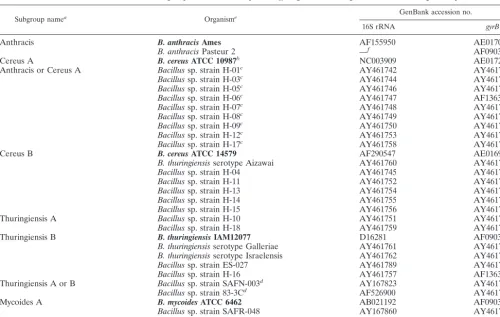
subgroup. Because 23S rRNA genes for isolates Bacillus sp. strains H-01, H-03, H-05, H-06, H-07, H-08, H-09, H-12, and H-17 are not yet published, we identified these microorganisms as belonging to the Anthracis or Cereus A subgroups. The absence of 98 and 139 nucleotides in the beginning of the 16S rRNA sequences for isolatesBacillussp. strain SAFN-003 and Bacillussp. strain 83-3C, respectively, led us to identify these organisms as belonging to the Thuringiensis A or Thuringiensis B subgroups. Finally, among 30 microorganisms for which both 16S RNA andgyrB gene sequences were published, we iden-tified members of six of the seven subgroups, ideniden-tified using rRNA sequences (Tables 2 and 3 and Fig. 1 to 3). Unfortu-nately, there were nogyrBsequences available in GenBank for any members of the Mycoides B subgroup.
The same groups containing the same microorganisms were identified in rooted and unrooted phylogenetic trees that were generated with minimum evolution (compare Table 4 and Fig. 4), neighbor-joining, UPGMA, and maximum parsimony methods with thegyrBsequences ofB. cereusgroup organisms and the Bacillus pumilis strain KL-052gyrB sequence (Gen-Bank accession no. AY167878) as an outgroup. All four trees revealed completely identical branching patterns (data not
shown) with high bootstrapping values from all four methods for five of six subgroups (Fig. 4). The subgroups in all four trees were organized into two clusters, as was observed for the 23S rRNA tree (Fig. 3B). Cluster I contained subgroups Anthrax, Cereus A, and Cereus B, and Cluster II included subgroups Thuringiensis B and Mycoides A. Additionally, the Thurin-giensis A subgroup was located in cluster I of thegyrBtree, but it was not completely separated from subgroup Cereus B. Un-fortunately, as was mentioned above, there are no 23S rRNA sequences for Thuringiensis A subgroup organisms available.
[image:14.603.45.546.79.396.2]Subgroups Anthracis and Cereus A were identified in the gyrB phylogenetic trees (Fig. 4) in accordance with the pres-ence in these subgroups ofB. anthracisAMES and B. cereus ATCC 10987, whose correspondence to subgroups Anthracis and Cereus A, respectively, were confirmed through indepen-dent grouping of 16S rRNA and 23S rRNA sequences (Tables 2 to 4). The presence ofB. anthracisPasteur 2 andB. anthracis Ames at the same subgroup (Fig. 4) also confirms this identi-fication. IsolatesBacillussp. strain SAFN-003 andBacillussp. strain 83-3C were found in thegyrBphylogenetic tree in sub-group Thuringiensis B (Fig. 4).
TABLE 4. Classification ofB. cereusgroup bacteria with sequencedgyrBgenes according to their 16S rRNA gene sequences
Subgroup namea Organisme GenBank accession no.
16S rRNA gyrB
Anthracis B. anthracisAmes AF155950 AE017024
B. anthracisPasteur 2 —f AF090333
Cereus A B. cereusATCC 10987b NC003909 AE017264
Anthracis or Cereus A Bacillussp. strain H-01c AY461742 AY461763
Bacillussp. strain H-03c AY461744 AY461764
Bacillussp. strain H-05c AY461746 AY461766
Bacillussp. strain H-06c AY461747 AF136389
Bacillussp. strain H-07c AY461748 AY461767
Bacillussp. strain H-08c AY461749 AY461768
Bacillussp. strain H-09c AY461750 AY461769
Bacillussp. strain H-12c AY461753 AY461772
Bacillussp. strain H-17c AY461758 AY461776
Cereus B B. cereusATCC 14579 AF290547 AE016998
B. thuringiensisserotype Aizawai AY461760 AY461778
Bacillussp. strain H-04 AY461745 AY461765
Bacillussp. strain H-11 AY461752 AY461771
Bacillussp. strain H-13 AY461754 AY461773
Bacillussp. strain H-14 AY461755 AY461774
Bacillussp. strain H-15 AY461756 AY461775
Thuringiensis A Bacillussp. strain H-10 AY461751 AY461770
Bacillussp. strain H-18 AY461759 AY461777
Thuringiensis B B. thuringiensisIAM12077 D16281 AF090331
B. thuringiensisserotype Galleriae AY461761 AY461779
B. thuringiensisserotype Israelensis AY461762 AY461780
Bacillussp. strain ES-027 AY461789 AY461783
Bacillussp. strain H-16 AY461757 AF136387
Thuringiensis A or B Bacillussp. strain SAFN-003d AY167823 AY461786
Bacillussp. strain 83-3Cd AF526900 AY461781
Mycoides A B. mycoidesATCC 6462 AB021192 AF090332
Bacillussp. strain SAFR-048 AY167860 AY461787
Bacillussp. strain FO-080 AY461791 AY461785
aSubgroups were identified in accordance with 16S rRNA sequences of the organisms.
bBelongs to subgroup Cereus A according to 16S rRNA and 23S rRNA sequences, which were extracted from whole-genome sequences of this organism (GenBank
accession nos. AE017264, AE017265, AE01266, and AE017280).
cBecause 23S rRNA genes of the organisms are not sequenced yet, the isolates were assigned to Anthracis or Cereus A subgroups.
dBecause of incomplete 16S rRNA sequences, these two isolates were identified as belonging to Thuringiensis A or Thuringiensis B subgroup. eMicroorganisms whose names are marked in bold were also subgroup identified based on their 23S rRNA sequences.
f—, not sequenced.
on May 15, 2020 by guest
http://jcm.asm.org/
gyrBas a phylogenetic marker for subgroup identification in theB. cereusgroup.In accordance with our 16S rRNA analysis, we aligned gyrB sequences for 31 B. cereus group isolates. Analysis of thegyrBalignment resulted in identification of 93 unique subgroup-specific differences (Fig. 5). As shown in Ta-ble 5, we defined these differences for each subgroup as sub-group-specific signatures. Because the number of members of each subgroup was not statistically large enough, we defined subgroup-specific signatures according to the rule that all members of the subgroup should contain all of the selected subgroup-specific differences. In total, we identified 15 unique subgroup-specificgyrBdifferences for the Anthracis subgroup (Table 5) which were absent from the other five subgroups (Fig. 5). For subgroups Cereus A, Thuringiensis B, and My-coides A, we identified 12, 13, and 32 unique subgroup-specific differences, respectively (Table 5). For subgroups Cereus B and Thuringiensis A, we did not find significant differences in the gyrB sequences. For this reason, we defined one set of signatures for these two subgroups (Table 5).
We also found that isolates B. sp. SAFN-003 and B. sp.
83-3C, which were found in the Thuringiensis B subgroup in the gyrB phylogenetic tree, included all 13 subgroup-specific differences (Fig. 5) that were present in subgroup Thuringien-sis B (Table 5). This confirmed that these two isolates belonged in the Thuringiensis B subgroup.
DISCUSSION
Identification of subgroups in theB. cereusgroup.Based on
analysis of the 16S rRNA sequence alignments, we divided the B. cereus group into the seven above-mentioned subgroups, each containing microorganisms with similar 16S rRNA gene sequences. The strains within each subgroup include all or most of the alterations specific for that subgroup (Fig. 1 and Table 2).
[image:15.603.58.529.71.417.2]Some of the 16S rRNA subgroup-specific differences, indi-cated in Table 2, have already been used by other researchers for identification of certain Bacillus sp. (18, 33, 41), but a systematic analysis of all B. cereus group microorganisms in accordance with their 16S and 23S rRNA sequences had not been done before.
FIG. 4. Grouping of theB. cereusgroup strains based ongyrBgene sequences. Names of the subgroups were identified through 16S rRNA sequences of their members (Table 4) and are displayed with bold on the right sides of the brackets. Subgroup identities of the microorganisms, whose names appear in bold, were confirmed by their 23S rRNA sequences. The phylogenetic tree was constructed by the minimum evolution method. Bootstrap volumes are reported on the branches. Numerals indicated in the quadrant parentheses designate the bootstrap volumes for each subgroup. Phylogenetic trees obtained by neighbor-joining, UPGMA, and maximum parsimony methods gave identical branching patterns. Bootstrap numbers for these three methods are presented in round parentheses. Bar indicates scale of genetic distances.
on May 15, 2020 by guest
http://jcm.asm.org/
We have also sequenced the 23S rRNA gene for a selected set of members of the B. cereus group. During 23S rRNA sequence alignment analysis of these and GenBank sequences, we did not find any conflicts between subgroupings based on
[image:16.603.49.534.74.426.2]16S rRNA and subgroupings based on 23S rRNA (Tables 2 and 3 and Fig. 1 and 2). We also found that isolates from subgroup Cereus A, which have the same 16S rRNA sequence as B. anthracisSterne (Fig. 1 and Table 2), have three sub-FIG. 5. Positions of subgroup-specific differences in thegyrBgene in theB. cereusgroup. Only differences that are unique for one of the subgroups are shown. (Members of each subgroup are displayed in Fig. 4.) Differences indicated for each subgroup were present ingyrBsequences of all members of that subgroup. The sequence complementary to theB. anthracisAmesgyrBgene (GenBank accession no. AE017024) has been used as the consensus sequence. Vertical lines indicate nucleotides identical to the consensus sequence. Multiple nucleotide substitutions (w, y, m, and r) indicate that more than one subgroup member revealed alternative differences. w, a or t; y, c or t; m, a or c; r, a or g.
TABLE 5. Subgroup-specific signatures ingyrBinB. cereusgroup microorganisms
Subgroup name Subgroup-specific signatures
Anthracis...Consensusa: G(195), C(313), G(315), G(318), A(348), C(399), C(531), G(600), C(616), C(651), C(808), T(891), A(945), G(1008), C(1092)
Cereus A...A/C(267), T/C(387), G/A(600), T/C(636), T/G(642), T/C(696), T/C(891), G/A(900), G/A(1047), G/A(1074), A/G(1083), A/C(1149)
Cereus B and Thuringiensis A...G/A(51), T/G(69), A/G(225), T/C(234), A/T(255), T/C(363), A/G(432), T/C(435), T/C(495), T/C(528), T/C(594), T/C(684), G/A(723), T/A(810), A/G(813), A/T(843), A/T(861), T/G(1068)
Cereus B ...A/M(186), A/R(489), A/R(777), A/R(1077), A/R(1028) Thuringiensis A...A/G(489), A/G(777), A/G(1128)
Thuringiensis B ...C/A(190), G/T(195), C/T(252), A/G(354), T/C(360), C/G(474), G/A(561), T/C(573), T/A(762), A/G(795), A/G(879), A/T(885), A/G(930)
Mycoides A...T/A(60), T/A(114), T/C(129), A/C(145), T/G(150), T/C(158), C/A(174), T/A(177), T/A(183), A/T(186), A/G(191), A/T(192), A/C(204), T/A(207), C/T(223), A/C(236), A/T(438), A/C(441), T/G(456), A/C(492), C/T(510), T/C(543), A/G(567), T/C(663), G/A(717), A/G(861), A/G(885), T/C(928), T/C(963), A/G(978), T/C(996), A/C(1157)
aFor more details, see Fig. 5.