A Study on Interactive Marketing Communication Tools and Brand
knowledge with Special reference to Royal Enfield bike owners.
Praveen Kumar
Ph.D. Scholar in Business Administration School of Management
AnnamalaiUniversity Annamalainagar,Tamilnadu, India
Dr. J. Tamil Selvi Associate Professor School of Management
AnnamalaiUniversity Annamalainagar,Tamilnadu, India
Abstract:
Brand knowledge isthe consumer’s awareness about their brand, which relates to consumers’ strength to recognize or recall the brand and image under different conditions which consists of consumers’ perceptions and of associations for the brand.”(Kevin Lane Keller 1993).The main objective of this study is to examine the impact of interactive marketing communication tools on Brand knowledge and to elucidatedemographic influence ofbrand knowledge in Royal Enfield motorcycle owners in north Chennai city, India. A survey was conducted among Royal Enfield bike owners in north Chennai city. The primary data was collected from 150 Royal Enfieldbike owners through an interview schedule. The study concludes that there is a strong positive influence ofinteractive marketing communication tools on brand knowledge.This study will help marketers for the effective use of Interactive marketing communication tools to achieve brand awareness amongtheir consumers. Introduction:
In the competing market the consumer will choose their favourite product or service by the awareness and consciousness about the product.So in order to survive in the market the company should create love for their brands in the minds of the customers.In order to make familiar with the brand the company should concentrate on brand knowledge of the consumers.
International Research Journal of Management and Commerce
ISSN: (2348-9766)
Impact Factor 5.564 Volume 5, Issue 1, January 2018
Brand Knowledge:
Brand Knowledge consists of two dimensions.They are brand awareness and brand image.Brand awareness can be defined as how the consumers are able to identify thebrand under different situation.Brand image is how the consumers perceive their brand as reflected by brand association.The different dimension of brand knowledge has been described in Kevin Lane Keller pyramid (2003) which consists of lower pyramid elements that provide foundation for the higher element in the top most pyramid.The pyramid consist of five elements starting from lower brand awareness, performance, imagery, judgement, feeling and resonance.In order to achieve the Brand resonance brand awareness ismost important and it is the base for the resonance.Brand knowledge measures are often called as consumer’s mind set measures because it describes the perception of the consumer about the brand.
Brand Awareness:
Brand awarenessis defined as the accessibility of the brand in the consumer’s memory.Brand awareness can be achieved by means of Brand recall and brand recognition.Brand recognition means consumer’s ability to identify the brand when given the brand as cue.Brand recall is the consumer’s ability to retrieve the brand from the memory that fulfils the consumer’s needs or purchase or usage situation as a cue. Many researchers suggest that consumers will make a purchase decision when there is a brand name,logo, packaging that are physically present and visible.On the other hand if the consumer’s buying decision is away from the point of purchase decision then the brand recall is important.
The brand awareness plays a crucial role in purchasing a product or service and brand awareness has control on perceived risk evaluation of customers and the level of assurance for buying the product and the decision completely depends on brand awareness and its uniqueness.
Brand Image:
Brand image can be denoted as the perception of customer about their brand and it is measured by the brand association in the customer’s mind. The marketers can create a positive brand image through marketing programs that link strong, favourable and unique association in the consumer’s mind.The customer can make brand association in many ways other than marketing .These include the consumer’s experience with the brand, through information with others and by word of mouth. Hence the marketers should consider these possible methods to create brand image in their consumers. Brand image consists of three dimensions according to Kevin Lane Keller (2003).They are strength of brand association, favourability of brand association and uniqueness of brand association.
Strength of Brand association:
brand association.Two major factors that play important role in increasing the strength of brand association are the personal relevance and the consistency presented over time.
Favourability of Brand association:
In order to identify the favourable and unique association to the brand, the marketer should carefully analyse the consumer’s mind and the various methods to position the brand in the market. The marketers should create a favourable brand association in the minds of customers by convincing them with relevant attributes and benefits that satisfy the consumer needs with favourable judgement.The favourable association for a brand are the strong desire created among the customers by convenient, effective, efficient and successfully delivered various marketing activities.
Uniqueness of Brand Association:
Marketers should create a unique selling proposition in order to differentiate from the other competitors so that the consumers have a reason to buy the product or service. Marketers can make a unique strong difference by directly comparing their product with their competitors or they can highlight the salient features.Strong and unique association of the product is very important for brand success.
Interactive Marketing Communication:
Interactive marketing communication concept includes all forms of marketing strategies to work in a unified way rather than in an isolated way.It makes use of entire marketing efforts in the form of different dimensions like advertising,personal selling,internet marketing,direct marketing in order to get maximum effort to reach the consumers at minimum cost.
According to Willian Stanton, interactive marketing communication consists of marketing mix used by the firm to inform, persuade and remind the consumers regarding the firm’s products or services. Interactive marketing communication can be achieved through continuous personal touch with consumers .Effective interactive marketing communication can be provided by meaningful messages and images to consumers with consistency.
Review of Literature:
Brand Awareness:
Aaker (2000) stated that brand awareness is a truly tangible and sustainable asset. According to him other than mass media communication there are also other effective ways to create brand awareness like publicity, promoting events, sampling and other attracting approaches.
Beverland (2001) revealed that brand awareness can be increased subsequently through a relationship making events involving positioning and targeting the desired market and supply chain management of the product.
Chen (2001) analysedthat brand awareness is an important and necessary asset but for brand building, customer based pyramid is not sufficient. According to him brand can be well known to the consumers by maintaining the quality of the product.
Florian et al (2012) concluded that brand equity plays a major role in customer acquisition, retention and high turnover of the company. The relationship with the customer stands till broad array that affect customer life time value both directly and indirectly through brand equity.
Brand image:
Yi Zhang (2015)stated in his research paper titled “The impact of Brand Image on Consumer Behaviour” therelationship between brand image and brand equity.The author concluded that there is high impact on brand image of consumer from perspective of customer based brand equity.
Ayesha Anwar and Amir Gulzar(2011) conducted a research study titled “Impact of brand image, Trust and Affect on Consumer Brand Extension Attitude”.The authors analysed the impact of brand image, brandtrust and brand affect on brand extension attitude. The authors further add that brand loyalty has a mediating relationship between brand image and brand affect. The authors concluded that brand loyalty mediates the relationship between brand image, brand trust and brand extension attitude.
Bina Nazir and Muhammad Ali(2016) published a research paper titled “The Impact of Brand Image on the Customer Retention”.The main objective of this paper is to analyse the influence of brand image on customer retention under the construct effect of customer satisfaction.The authors concluded that there is a significant influence of customer retention on brand awareness,brand experience and brand loyalty.
Interactive marketing communication:
Schultz (1993) revealed that interactive marketing communication is a new concept of marketing strategy that combine and evaluate the different forms of online communication to get greater clarity, consistency and greater impact.
Percy et al (2001) stated that planning and execution of all marketing online communication strategy are required to meet the company objectives. They revealed that IMC process starts with customers and tend to define the influential online communication programs.
Morozan and Ciacu(2012) stated that the interactive marketing communication is globalizing the market on internet.They revealed that advanced technologies enhance the production and distribution process.The advancement in online channel is the key performance for success of companies.
Rakie (2014) documented that interactive marketing communications are divided into five segments.They are media,online communication channels, interaction and content creation.The digitization of marketing is necessary for survival of companies in the competitive environment. According to Mohammed and Alkubise (2014) the online advertising is an effective form of interactive marketing communication .They have stated in their research work that online advertising is very effective to create trust in the minds of consumers and to increase repurchase intention among the consumers.
Brand Knowledge:
According to M J Eppler and Muwill (2001) as published in their research paper titled “Brand Knowledge: Brand building beyond product and service brands” the product and corporate brands are to be extended by another type of brand through brand knowledge.The authors concluded that brand knowledge is clearly a differentiated visuals of product and identity that bundles and communicate set of skills, competencies and various methodologies in a unique coherent manner.
Ian Richards and David Fosters (2013) documented in a research paper titled” Brand knowledge management: Growing brand equity”, the concept of brand knowledge management that moves the brand to organisations from content to process and tactic management to consumers. The authors conclude that brand marketing should focus its various activities and behaviour of consumers and its management.
OBJECTIVES
The objective of the study is to analyse the impact of interactive marketing communication tools on Brand knowledge towards the Royal Enfield bike owners in north Chennai city.
1.To find out demographic influence on Brand knowledge. 2. To study the influence of IMC tools on brand knowledge. LIMITATIONS OF THE STUDY
Following are the limitations of this study:
1. The research work covers only north Chennai city.
2. The respondents are not willing to share their personal information completely.
3.The sample size of this study does not ensure representative and conclusive finding and hence a more detailed study is needed to reach a strong conclusion.
Theoretical Frame work:
The schematic diagram shows that there are two independent variables for the study i.e IMC tools and Brand knowledge .The dependent variable is brand awareness and brand image.
Research Methodology:
The study is based on the primary data only.The entire study depends on primary data collected through well framed and structured questionnaire to ensure good considered opinion of the respondents.The study analysed the Royal Enfield bike owners ofnorth Chennai city.Due to financial constraints the study covers only north Chennai city for survey by adopting convenient sampling technique.A total 150 respondents were chosen from different age groups and with help of structured interview the information is gathered.The survey was conducted during three months period from July 2017 to October 2017.The interview schedule had 30 questions divided into three sections namely IMC tools, brand knowledge factors and personal information of the respondents.Based on review of literature, the researcher proposed two dimensions for Brand knowledge viz Brand awareness and Brand image.
Research Design:
Sample Plan:
Sampling design:Convenient sampling Sample size:150
Sample location:North Chennai city. Product Selection:
As a product category, Royal Enfield bike has been used in the current research work.The researcher considered several factors for selecting the Royal Enfield bike.Royal Enfield Bullet series is one of the most popular range of bikes in north Chennai city and sales is still going strong in Chennai cityas source collected from various Royal Enfield dealers in north Chennai city. Most of the youth in north Chennai city prefer Royal Enfield bullet series of bike because of ample power, impressive fuel efficiency and lucrative pricing.
Brand loyalty is also high for Enfield Bullet owners becauseof attractivestyling, premium features with impressive engine performance as compared to other competitors.Many youngsters are attracted to Royal Enfieldbullet bike every year and brand community also have high influence among the users.
Data Analysis and Interpretation:
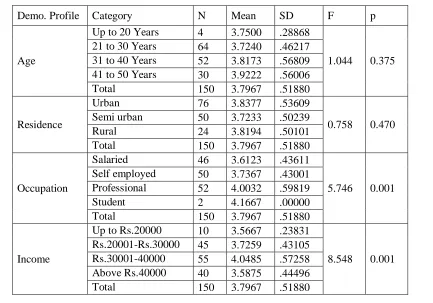
Table 1: One way analysis for mean difference towards brand knowledge based on
demographic profile
Demo. Profile Category N Mean SD F p
Age
Up to 20 Years 4 3.7500 .28868
1.044 0.375 21 to 30 Years 64 3.7240 .46217
31 to 40 Years 52 3.8173 .56809 41 to 50 Years 30 3.9222 .56006
Total 150 3.7967 .51880
Residence
Urban 76 3.8377 .53609
0.758 0.470
Semi urban 50 3.7233 .50239
Rural 24 3.8194 .50101
Total 150 3.7967 .51880
Occupation
Salaried 46 3.6123 .43611
5.746 0.001 Self employed 50 3.7367 .43001
Professional 52 4.0032 .59819
Student 2 4.1667 .00000
Total 150 3.7967 .51880
Income
Up to Rs.20000 10 3.5667 .23831
8.548 0.001 Rs.20001-Rs.30000 45 3.7259 .43105
Rs.30001-40000 55 4.0485 .57258 Above Rs.40000 40 3.5875 .44496
[image:7.612.105.538.401.704.2]The analysis found that there is significant difference towards brand knowledge based on occupation and income of the Royal Enfield bike owners. The analysis also found that there is no significant difference towards brand knowledge based on age and residence of the Royal Enfield bike owners. The analysis highlighted that education of professional, student Royal Enfield bike owners and income Rs.30001-40000 Royal Enfield bike owners are highly rated towards brand knowledge when compared receptive categories.
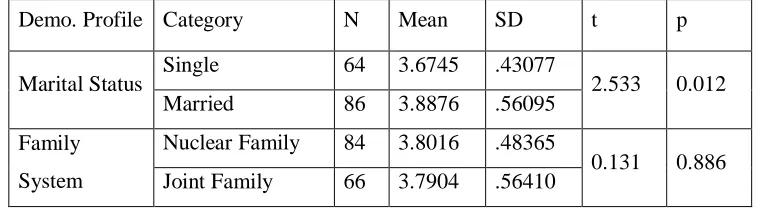
Table 2: Independent sample t test for mean difference towards brand knowledge based on
demographic profile
Demo. Profile Category N Mean SD t p
Marital Status Single 64 3.6745 .43077 2.533 0.012
Married 86 3.8876 .56095
Family System
Nuclear Family 84 3.8016 .48365
0.131 0.886 Joint Family 66 3.7904 .56410
.
[image:8.612.125.504.198.305.2]The analysis found that there is significant difference towards brand knowledge based on marital status of the Royal Enfield owners. The analysis also found that there is no significant difference towards brand knowledge based on family system of the Royal Enfield bike owners. The analysis highlighted that unmarried Royal Enfield bike owners are highly rated towards brand knowledge when compared to married Royal Enfield bike owners.
Table 3: Multiple Regression analysis for Influence of IMC tools on Brand Knowledge
Model Summary
R R Square
Adjusted R Square
Std. Error of
the Estimate F Sig.
Coefficients
S.No.
IMC tools
Un standardized Coefficients
Standardized
Coefficients t p
B Std. Error Beta
Constant 10.070 .934 10.778 0.000
1 Mobile app pop-ups 1.199 .539 0.246 2.226 0.028
2 Social networking -1.418 .588 0.302 2.411 0.017
3 Email Marketing 4.587 .356 0.931 12.889 0.000
4 Blogs .388 .834 0.074 0.465 0.642
5 Widgets -1.143 .850 -0.223 -1.344 0.181
6 Tele marketing .400 .397 0.077 1.008 0.315
Dependent Variable: brand knowledge
The computed F value is 77.135, which is significant at one percent level. Hence, the multiple regression model may be measured as a good fit. The R2 value is 0.764 and confirms that 76.4% of IMC tools are influenced by brand knowledge.
From this multiple regression analysis result, it is concluded that there is significant influence of Mobile app pop-ups, Social networking and Email marketing on brand knowledge. The analysis also found that there is no influence of Blogs, Widgets and Tele marketing on brand knowledge.
Findings ofthe Study:
1.It is found that education of professional, student Royal Enfield bike owners and income Rs.30001-40000 Royal Enfield bike owners are highly rated towards brand knowledge when compared receptive categories.
2.The analysis also found that there is no significant difference towards brand knowledge based on family system of the Royal Enfield bike owners. The analysis highlighted that unmarried Royal Enfield bike owners are highly rated towards brand knowledge when compared to married Royal Enfield bike owners.
3.It is found that there is significant influence of Mobile app pop-ups, Social networking and Email marketing on brand knowledge. The analysis also found that there is no influence of Blogs, Widgets and Tele marketing on brand knowledge.
Conclusion and Discussion:
Royal Enfield company should try to give more appealing advertisement in an authorised way to create the strongbr and knowledge about their product to the consumers.
References:
Ayesha Anwar , Amir Gulzar(2011)” Impact of Brand Image ,Trust and Affection on Consumer Brand Extension Attitude” International Journal of Economics and Management Sciences Vol. 1, No. 5, 2011, pp. 73-79
Bina Nazir, Muhammad Ali(2016)” The Impact of Brand Image on the Customer Retention: A Mediating Role of Customer Satisfaction in Pakistan”. International Journal of Business and Management Invention ISSN (Online): 2319 – 8028, ISSN (Print): 2319 – 801X
Ian RichardsDavid Foster(2013)”Brand Knowledge Management: Growing Brand Equity” Journal of Knowledge Management, Vol. 2 Issue: 1, pp.47-54
Keller, K. L., Heckler, S. E. Heckler & Houston, M.J. (1998)
Keller, Kevin Lane, Conceptualizing, Measuring & Managing Customer-Based Brand Equity, Journal of Marketing. Volume: 57, Issue: 1, 1993.
Kotler,P. (2003), “Marketing Management”, 11th ed., Prentice Hall/Pearson, Englewood cliffs,NJ.
kotler,P., Keller,K.L.,et.al. (2009), “Marketing Management: A South Asian
Perspective”,13th,Prentice Hall/Pearson,New Delhi, India.
Kothari, C. R.; (1973). Research Methodology methods and Techniques. 2nd edition. Wiley Eastern Ltd. New Delhi.
Laurent, G., Kapferer, J. N. & Roussel, F. (1987) Philip kotler , Koshy , Jha Marketing management. Lia Zarantonello and Bernd H Schmitt (2014)” How to Advertise and Build Brand Knowledge Globally”. Journal of Advertising Research Issue: Vol. 54, No. 4, 2014
Morozan, C. and Ciacu, N. (2012) Aspects of Online and Mobile Marketing. Economy Transdisciplinarity Cognition, 15, 191-199.
Mohammed, A.B. and AlKubise, M. (2012) How Do Online Advertisements Affect Consumer Purchasing Intention: Empirical Evidence from a Developing Country. European Journal of Business and Management, 4, 208-218.
M J Eppler and M will (2001)” Branding knowledge: Brand building beyond product and service brands.”Journal of Brand ManagementJuly 2001, Volume 8, Issue 6, pp 445–456
Percy, L. (1997) Strategies for Implementing Integrated Marketing Communication. NTC Business Books, Chicago
Philip Kotler & Kevin Lane Keller, Marketing Management, New Delhi, Pearson Education, 2006,. Rakic, B. and Rakic, M. (2014) Integrated Marketing Communications Paradigm in Digital Environment: The Five Pillars of Integration. Megatrend Review, 11, 187-204.
Sweety Gupta,Manpreet Kaur(2013)” Brand Awareness Among Consumers on
Daily Consuming Goods”. International Journal of Management. Opinion Vol. 3, No. 1, June 2013 Shabir Majeed(2014)” Brand Awareness in Rural Area: A Case Study of Fast Moving Consumer Goods in Pulwama District of J&KState.” International Journal of Business and Management Invention Volume 3 Issue 5ǁ May. 2014 ǁ PP.50-53
Schultz,D.E. (2003), “The Next Generation of Integrated Marketing Communication”, Interactive Maketing, Vol. 4, No. 4, pp. 318-319.
Statistics For Business And EconomicsBy Anderson, Sweeney, Williams.
Yi Zhang(2015)” The Impact of Brand Image on Consumer Behavior: A Literature Review”.Journal of Business and Management, 2015, 3, 58-62
Published Online January 2015. Philip kotler, Koshy ,
Jha Marketing management.
The journal of consumer research 17(2), 141-148.
International Journal of management( ISSN: 2231-5470), Vol. 3, No. 1, June 2013 William G .Zikmund: Business Research Methods