HRD MODEL FOR ORGANIZATIONAL EFFECTIVENESS
Dr Sandeep Bansal,
Associate Professor
Indira Gandhi National College, Ladwa
ABSTRACT
A survey by Industrial Team Service in 1969 indicated that the personnel function is no
longer viable if it doesn't include or allow scope for employment, training, welfare measures,
employee education, employee benefits, industrial relations and industrial insurance. Thus,
the concept was subjected to serious criticism and this has ultimately paved the way for the
emergence of Human Resources Development. Training plays a crucial role in HRD.
Training is the most important activity that plays an important role in the development of
human resources. In today’s globalize world, putting right man at the right place has become
essential. No organization has a choice on whether or not to develop employees. Training,
therefore, has nowadays become an important and required factor for maintaining and
improving interpersonal and intergroup skills. Before examining this role, it is essential to
Introduction
A HRD mechanism is the most important element in organizational effectiveness. Other
resources like capital assets, technology can not ensure long-term survival and growth of the
organization. It is possible only through the HRD mechanism. HRD in this context can
contribute for organizational effectiveness. . Training plays a crucial role in HRD. Training
is the most important activity that plays an important role in the development of human
resources. In today’s globalize world, putting right man at the right place has become
essential. No organization has a choice on whether or not to develop employees. Training,
therefore, has nowadays become an important and required factor for maintaining and
improving interpersonal and intergroup skills. Before examining this role, it is essential to
clarify HRD at both Micro and Macro Levels.
1. Optimizing the use of employees for the long-run growth of the organization.
2. Enabling employees to grow with the organization.
3. Helping in matching individual aspirations and organizational expectations.
4. Promoting collaboration and team spirit by establishing a climate of trust, openness and
interdependence.
5. Maximizing managerial effectiveness by having an involved, committed and highly
motivated team of managers.
6. Building the skills necessary to meet existing and long-term organizational needs.
7. Providing a favourable work environment and consciously fostering an open, largely
participative management style based on trust and cooperation.
8. Achieving good employer-employee relations through regards for basic human values.
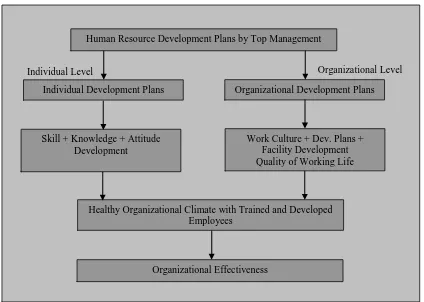
Organizational effectiveness results from trained and developed employees working in a
healthy organization climate which results from both individual development interventions
Figure 1 shows the HRD model of organizational effectiveness.
Figure 1 Organizational Effectiveness
The role of top management is very important in implementation of HRD plans for
developing committed human resources and the work-environment committed to human
resources.
Essentials of Effective Human Resource Development
HRD is an effort to develop capabilities and competencies among employees as well
as create organizational environment conducive to the employees' development. While
introducing HRD in an organization, the following essentials have to be kept in view:
1. Will to Improve: An urge and desire on the part of the human resources to find better
methods to improve quality and productivity.
2. Removing Hurdles: Removal of hurdles and irritants from the organization affecting
productivity of the employees.
Individual Level Organizational Level Human Resource Development Plans by Top Management
Individual Development Plans Organizational Development Plans
Skill + Knowledge + Attitude Development
Work Culture + Dev. Plans + Facility Development Quality of Working Life
Healthy Organizational Climate with Trained and Developed Employees
3. Competent Members of HRD Team: Requisite skills, attitudes and ability in the
persons engaged in HRD.
4. Proper Coordination: Proper rapport between the HRD members and the key personnel
in the organization. Involvement of the personnel of the organization to get a lot of
unwritten information for understanding the dynamics of the organization for developing
an HRD programme.
5. Appropriate Methods: The need for suggesting the introduction of only such indigenous
methods which can be implemented by the HRD division without much cost and
resistance.
6. Effective HR Information System: Strengthening of human resource information
system to keep continuous track of every employee and use performance appraisal,
training etc. to change in desired direction.
7. Solution for Resistance: The HRD department must be ready to face resistance to their
ideas and dispel these with facts, patience and consideration. The aim should be to
develop acceptance through co-operation.
8. Emphasis on New Methods: The HRD department must make all the employees in the
organization understand the implications of new methods through seminars, lectures, role
plays or any other method to thwart the potential fears amongst the employees of the
proposed changes.
Role of Training in HRD
A survey by Industrial Team Service in 1969 indicated that the personnel function is no
longer viable if it doesn't include or allow scope for employment, training, welfare measures,
employee education, employee benefits, industrial relations and industrial insurance. Thus,
the concept was subjected to serious criticism and this has ultimately paved the way for the
emergence of Human Resources Development.
Training plays a crucial role in HRD. Training is the most important activity that plays an
important role in the development of human resources. In today’s globalize world, putting
right man at the right place has become essential. No organization has a choice on whether or
required factor for maintaining and improving interpersonal and intergroup skills. Before
examining this role, it is essential to clarify HRD at both Micro and Macro Levels.
HRD as stated earlier is mainly concerned with developing the competencies of people.
When we call it as a people-oriented concept then several questions come to mind like should
the people be developed in the larger and national context or in the smaller institutional
context? Is it different at the macro level and micro level? As things stand now, HRD applies
to both institutional (micro) as well as national (macro) issues. The main objective, however,
is to develop the newer capabilities in people so as to enable them to tackle both present and
future challenges while realizing organisational goals. However, it is useful both at macro
and micro levels.
Macro Level: At the macro level HRD is concerned with the development of people for the
nation's well being. It takes health, capabilities, skills, attitudes of people which are more
useful to the development of the nation as a whole. While calculating the national income and
economic growth, the prospective HRD concept examines the individuals' potentialities, their
attitudes, aspirations, skills, knowledge, etc. and establishes a concrete base for economic
planning. However, HRD's contribution at macro level has not gained popularity as yet.
Micro Level: HRD has concern for grass root development in the organizations. Small
wonder, then, that HRD was well received by companies' managements as they realized its
importance and foresaw its future contribution for the individual and organizational
development. Generally, HRD at micro level talks of the organizations' manpower planning,
selection, training, performance appraisal, development, potential appraisal, compensation,
organizational development, etc. HRD's involvement in all these areas is mainly with an
objective to develop certain new capabilities in people concerned to equip them to meet the
present job challenges and to accept future job requirements.
Top management for HRD, both at micro and macro levels requires training for its employees
Methods of Training
The training of employee can be (i) on the job training and (ii) off the job training. In the first
case, worker is trained under the guidance of a superior whereas off the job training is usually
through lectures, conferences, case studies, audio visual etc.
The role of training in HRD is explained below in terms of need for manpower training:
1. Updating Knowledge: Technological advancement, business environmental
changes and new management philosophies have now made it imperative for
the organization to renew and update the knowledge and skills of the
employees so that they do not become redundant for obvious functional
incompetence. The first and foremost need for manpower human resource
training therefore, is to renew and update knowledge and skills of employees to
sustain their effective performance and so also to develop them for future
managerial positions.
2. Avoiding Obsolescence: Recent economic liberalization programmes of
Government of India are necessitating organizational restructuring, which inter
alia, calls for training the employees, irrespective of their functional level, for
their redeployment in restructured jobs. Therefore, the second important need
for training in HRD is to avert functional obsolescence.
3. Improving Performance: Continuous training being required to renew and
update knowledge and skills of employees, it makes them functionally
effective. The third need is therefore, to make employees effective in their
performance through continuous training.
4. Developing Human Skills:Apart from emphasizing on technical and conceptual
skills, new training programmes also emphasize on developing human skills of
employees. Such human skill is necessary for effective interpersonal relations
and sustaining healtl1y work environment. This need for training therefore also
cannot be altogether ignored.
5. Imparting Trade-specific Skills: In industrial employment, the convention is to
Such apprenticeship training enables an organization to impart industry and
trade specific skills to workers. This also, therefore, is an important need for
manpower training in HRD.
6. Stabilizing the Workforce: Throughout the world the importance of training is
now increasingly felt for stabilizing the workforce to withstand the
technological change and for making the organization dynamic in this changed
process. Management theorists now unanimously agree that it is the
responsibility of the organization to train and develop their manpower as a
continuous process.
Classification of Training Programmes Required for HRD
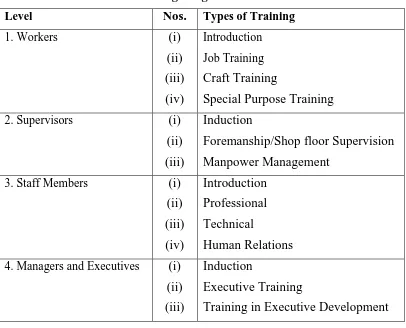
Depending on the functional level and occupational categories of employees, an organization
[image:7.595.84.490.388.716.2]can classify training programmes as shown in Table 1.
Table 1: Classification of Training Programmes
Level Nos. Types of Training
1. Workers (i)
(ii)
(iii)
(iv)
Introduction
Job Training
Craft Training
Special Purpose Training
2. Supervisors (i)
(ii)
(iii)
Induction
Foremanship/Shop floor Supervision
Manpower Management
3. Staff Members (i)
(ii)
(iii)
(iv)
Introduction
Professional
Technical
Human Relations
4. Managers and Executives (i)
(ii)
(iii)
Induction
Executive Training
Apart from the above routine training programmes for different levels, training on total
quality awareness and training encompassing all aspects of total quality management have
now become almost compulsory for all functional levels.
Role of Training Needs in Different Strategies for HRD
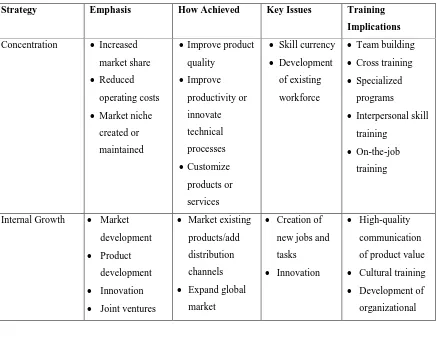
Table 2 shows four business strategies and highlights the implication of each for training
practices:
Concentration
Internal growth
External growth
Disinvestment
Focus of each strategy differs. Amount and type of training also differs. Key issues in each
strategy also differ. The end result of training for HRD is always positive and inspiring.
1. A concentration strategy focuses on increasing market share, reducing costs, or
creating and maintaining a market niche for products and services. Southwest Airlines
has a concentration strategy. It focuses on providing short-haul, low-fare, and
high-frequency air transportation. It utilizes one type of aircraft (the Boeing 737), has no
reserved seating, and serves no meals. This concentration strategy has enabled
southwest to keep costs low and revenues high.
2. An internal growth strategy focuses on new market and product development,
innovation, and joint ventures. For example, the merger between two publishing
companies, McGraw-Hill and Richard D. Irwin, created one company with strengths
in the U.S. and the international college textbook markets.
3. An external growth strategy emphasizes acquiring vendors and suppliers or buying
businesses that allow the company to expand into new markets. For example, General
Electric, a manufacturer of lighting products and jet engines, acquired the National
Broadcast Corporation (NBC), a television and communications company.
4. A disinvestment strategy emphasizes liquidation and divestiture of businesses. For
Preliminary research suggests a link between business strategy and amount and type of
training. Table shows that training issues vary greatly from one strategy to another. Divesting
companies need to train employees in job-search skills and to focus on cross-training
remaining employees who may find themselves in jobs with expanding responsibilities.
Companies focusing on a market niche (a concentration strategy need to emphasize skill
currency and development of their existing work force. New companies formed from a
merger or acquisition need to ensure that employees have the skills needed to help the
company reach its new strategic goals. Also, for mergers and acquisitions to be successful,
employees need to learn about the new, merged organization and its culture. The organization
must provide training on systems such as how the phone, e-mail, and company intranet work.
Managers need to be educated on how to make the new merger successful (e.g., dealing with
[image:9.595.71.509.425.763.2]resistance to change).
Table 2: Implications of Business strategy for Training
Strategy Emphasis How Achieved Key Issues Training
Implications
Concentration Increased market share
Reduced operating costs
Market niche created or maintained
Improve product quality
Improve productivity or innovate technical processes
Customize products or services
Skill currency
Development of existing workforce
Team building
Cross training
Specialized programs
Interpersonal skill training
On-the-job training
Internal Growth
Market development
Product development
Innovation
Joint ventures
Market existing products/add distribution channels
Expand global market
Creation of new jobs and tasks
Innovation
High-quality communication of product value
Cultural training
Modify existing products
Create new or different products
Expand through joint ownership
culture that values creative thinking and analysis
Technical competence in jobs
Manager training in feedback and communication
Conflict
negotiation skills External Growth
(Acquisition)
Horizontal integration
Vertical integration
Concentric diversification
Acquire firms operating at same stage in product market chain (new market access)
Acquire business that can supply or buy products
Acquire firms that have nothing in common with acquiring firm
Integration
Redundancy
Restructuring
Determination of capabilities of employees in acquired firms
Integration of training systems
Methods and procedures of combined firms
Team building
Development of shared culture
Disinvestment Retrenchment
Turnaround
Divestiture
Liquidation
Reduce costs
Reduce assets
Generate revenue
Redefine goals
Sell off all assets
Efficiency Motivation, goal setting, time management, stress management, cross training
Leadership training
Outplacement assistance
Job-search skills training
Source: Raymend A. Noe and Amitabh Deo Kodwani, Employee Training and Development,
Fourth Edition, Tata McGraw Hill Education Pvt. Ltd., New Delhi, 2008, PP. 60-62
Conclusion
The discussion of the training need in HRD as given above boils down to the conclusion that
the training gives the following inspiring and productive results:
1. Growth, expansion and modernization can not take place without trained manpower
2. It increases productivity and profitability, reduces cost and finally enhances skill and
knowledge of the employee
3. Prevents obsolescence
4. Helps in developing a problem solving attitude
5. gives people awareness of rules and procedures
6. Training thus makes people more competent
7. Personnel become committed to their job resulting in pro activeness
8. People trust each other more
References
1. Peter J. Dowling, Denice E. Welch, Randall S. Schuler, “International Human
Resource Management”, 3rd
ed., Thomson South Western Publications.
2. Polanyi, M. (1967). The tacit dimension. Leonard, D. & Sensiper, S. (1998). The Role
of Tacit Knowledge in Group Innovation. California Management Review.
3. Radjamanogary Resource, HRM Review, ICFAI University Press, Hyderabad, 2006.
4. Rao T V et al. (1988), “Alternative Approaches and Strategies of HRD” Jaipur; Rawat
Publications.
5. Rao, T V and D F Periera(1988), “Recent Experiences in HRD”, New Delhi Oxford
6. Rao, V S P, HRM, Excel Books, 2005, pp 270-275.
7. Sharma, Bharti(1998) “Perspective on HRD Measures for Effective Governance”.
IJPA, July-Sept.
8. Singh, B D (1997), “HRD Dimensions of Industrial Relations in Selected Readings in
HRD”, New Delhi, Tata McGraw Hill.
9. Sveiby, Karl-eric. What is knowledge management?