International Research Journal of Marketing and Economics
Vol. 3, Issue 4, April 2016 IF- 3.949 ISSN: (2349-0314)
© Associated Asia Research Foundation (AARF)
Website: www.aarf.asiaEmail : [email protected], [email protected]ECONOMIC DEVELOPMENT AND ENVIRONMENTAL CONCERNS
Manvi Aggarwal
ABSTRACT
Economic development is defined as the long term effort of an economy which provides
sustainable growth of economic, social, political and environmental factors. The world has seen
a lot of progress in the past years. Some economies are developed; some are developing, while
some are still under developing.
However, the concern arises with the fact that environment is being put on stake with the goals
of economic growth and development. Rising pollution levels and environmental degradation is
a world-wide concern in the present century. According to UN’s Intergovernmental Panel on
Climate Change, warnings have been issued for the increasing climatic changes dangers and
solutions need to be found out for the same.
The concern lies in the fact that when economies try to grow, and they must grow obviously,
what happens to the environment? Should the environment be put at stake in place of growth?
And if the answer is no, then what should be done to balance the two things, both of which are
very essential.
This paper addresses the above questions in a detailed manner with a focus on the National
Capital of India, New Delhi.
Keywords:
Scenario in Delhi:
First of all, the reasons need to be identified which hold responsible for the environmental
damage:
1. Population: Yes, the ever growing population is a major factor in the environment degradation. According to estimated figures of Census of India, the population of Delhi
alone is around 18.6 million. A lot of people migrate to Delhi in search of better job
opportunities and a good living standard, increasing the population and decreasing the per
capita density. This number has been growing ever since which is one of the main
reasons of environmental damage.
2. Vehicles: The rise in living standards of the people, which is a required sign of economic development of an economy, also raises environmental concerns. With greater per capita
income, people are now able to afford luxuries apart from the basic requirements. As per
the statistics of Delhi Police, around 4,30,603 new passenger vehicles were registered
alone in 2015. Delhi has the highest number of registered cars as compared to any other
metropolitan city in India. The harmful gas emissions from these vehicles contribute
majorly to pollution.
Other reasons include industrialization, chemical and gaseous emissions from various
industries and factories, inefficient allocation of resources, improper management of the
policies formulated, etc.
In India, there is Central Pollution Control Board (CPCB), which keeps a check on the
pollution levels of the country covering 240 cities. In Delhi, there are 6 such stations under
CPCB.
The board has identified 4 major pollutants, namely SO2, NO2, CO and PM10, which are
regularly monitored to identify pollution levels across various stations in the cities.
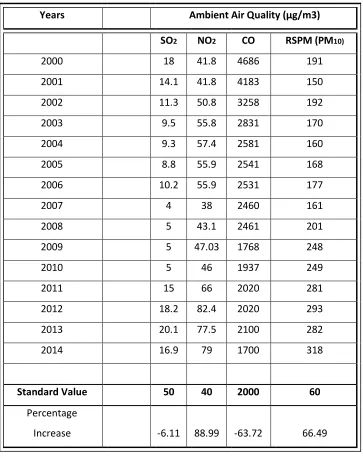
Below is a table comparing the actual values observed in years 2000-2014 with the standards
Table 1: Table showing Air Quality Standards from 2000-2014
Years Ambient Air Quality (μg/m3)
SO2 NO2 CO RSPM (PM10)
2000 18 41.8 4686 191
2001 14.1 41.8 4183 150
2002 11.3 50.8 3258 192
2003 9.5 55.8 2831 170
2004 9.3 57.4 2581 160
2005 8.8 55.9 2541 168
2006 10.2 55.9 2531 177
2007 4 38 2460 161
2008 5 43.1 2461 201
2009 5 47.03 1768 248
2010 5 46 1937 249
2011 15 66 2020 281
2012 18.2 82.4 2020 293
2013 20.1 77.5 2100 282
2014 16.9 79 1700 318
Standard Value 50 40 2000 60
Percentage
Increase -6.11 88.99 -63.72 66.49
As the table shows, the SO2 levels have been within the prescribed standards over the years, least
being in 2007 and highest in 2013. However, SO2 emissions have seen a decline of 6.11% from
2000 to 2014.
NO2 emissions are seen to be almost above the standards set with highest in the year 2012,
almost 2 times the standard value. The emissions have seen an increase of a major 88.99% from
CO emissions have however seen a downtrend of 63.72% from the year 2000 to 2014. It was
highest in 2000 and least in 2014.
The high levels of PM10 are of alarming concerns, have increased by 66.49% from 2000 to 2014.
The emissions are observed to be almost rising over the subsequent years and are almost 5 times
the prescribed standard in 2014. PM10 articles include very small particles which can deeply
enter the respiratory tract causing adverse health impacts.
According to a report of World Health Organisation (WHO), Delhi is amongst the cities with the
worst air quality.
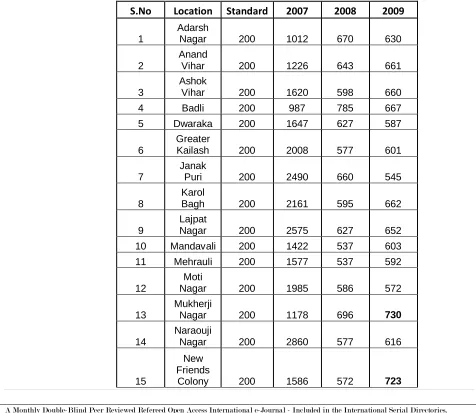
The following table shows the SPM levels in different locations of Delhi on Diwali nights, for
[image:4.612.67.543.313.726.2]the years 2007-2009:
Table 2: Table showing SPM levels on Diwali nights in different locations.
S.No Location Standard 2007 2008 2009
1
Adarsh
Nagar 200 1012 670 630
2
Anand
Vihar 200 1226 643 661
3
Ashok
Vihar 200 1620 598 660
4 Badli 200 987 785 667
5 Dwaraka 200 1647 627 587
6
Greater
Kailash 200 2008 577 601
7
Janak
Puri 200 2490 660 545
8
Karol
Bagh 200 2161 595 662
9
Lajpat
Nagar 200 2575 627 652
10 Mandavali 200 1422 537 603
11 Mehrauli 200 1577 537 592
12
Moti
Nagar 200 1985 586 572
13
Mukherji
Nagar 200 1178 696 730
14
Naraouji
Nagar 200 2860 577 616
15
New Friends
16
Paschim
Vihar 200 847 616 560
17
Patel
Nagar 200 1893 644 584
18
R.K.
Puram 200 2940 574 638
19
Rajpura
Road 200 873 581 508
20 Rohini 200 1096 652 718
21
Sarita
Vihar 200 843 792 710
22
Shalimar
Bagh 200 2793 597 637
23
Shanti
Vihar 200 1630 562 587
24
Vasant
Kunj 200 1720 659 572
25
Yamuna
Vihar 200 1002 624 568
The standard value set by CPCB is 200, which we can clearly see is exceeding multiple times on
diwali nights. Although there has been reduction in subsequent years but the problem still
pertains.
A report by System of Air Quality and Weather Forecasting and Research, pollution levels are
rising in Delhi and are reaching near Diwali levels.
The major contributor to air pollution is the increasing number of vehicles. With the rising
population and rising income levels, vehicle ownership has also increased which has shifted the
focus of government and environment ministry efforts in improving the air quality. Apart from
vehicular pollution, pollutants like nitrous oxide (NO2) and sulfur dioxide (SO2) affect health like
eye irritation, breathing issues, damage to respiratory tracts etc and the situation gets worse for
people already suffering from respiratory problems.
In Delhi, a recent step was taken to curb the rising pollution: Odd-Even Plan. According to this,
on even dates, only even numbered cars were allowed on road and on odd days, odd numbered
cars were allowed. This was effective from January 1, 2016 to January 15, 2016.
The reports were positive as they claimed that pollution levels reduced significantly. Not only
ridership, fuel consumption, emergency vehicles etc. Roads were found to be less congested even
on the busiest stretches like Akshardham flyover and others across the state, people used public
transport in rising numbers, petrol and diesel were consumed less, ambulances had an improved
response time and also, the driving time reduced significantly.
So what made this plan a successful one? The answer is- people’s cooperation. The general
public adhered to the rules as they are also familiar with the rising pollution problems. Persons
who violated this rule were fined a heavy amount of 2000 bucks. The government generated
good amount of revenue too, which it plans to use further promoting and forming strategies for
the same.
Steps undertaken:
What should be done then to curb pollution in developing countries like India so that the goals of
growth and development also get accomplished? First of all, there is a need to impart education
and awareness amongst people that they have a collective responsibility to save the earth. Even if
each person tries to maintain their immediate surroundings, imagine what a significant impact it
will have! People keep their houses clean, so should they do for the environment. There is a need
to inculcate responsibility and care in people for their environment. According to a report by
Hindustan Times, 14 metro construction sites were fined Rs. 50,000 environmental
compensation charge for flouting dust pollution norms. A recent study by IIT Kanpur on Delhi’s
air quality identified soil and road dust as the single biggest source [38%] of PM 2.5, fine
particles that severely harm the respiratory system. Supreme Court of India is soon planning to
make it mandatory for realty projects to initially fulfill the environmental clearance, which is
indeed a fantastic move. The government has also announced that startups in India will be asked
to self-certify compliance with environmental norms. Also, law judiciary is planning to set up
Green Courts, which will exclusively deal with the environment cases so that the issues can be
heard clearly and promptly.
Shri Prakash Javadekar, the Minister for Environment, Forests & Climate Change, launched The
National Air Quality Index (AQI) in New Delhi on 17 September 2014 under the Swachh Bharat
Abhiyan. It is outlined as ‘One Number- One Colour-One Description’ for the common man to
judge the air quality within his surroundings. Institutional and infrastructural measures are being
Also, apart from the above enforcements, financial and other support should also be given to
startups which help generate green energy or help in environmental improvement, boosting both
economy and environment.
Conclusion:
India stands among the worst countries for expat destinations across the globe, according to
Expat Insider 2015. As they say that a healthy person can work more efficiently and
productively, we first need to make our environment better so that it helps in increasing its
productivity and efficiency which will definitely help boost the economy. India still is facing
many challenges to match up the goals of development and environment and it has a long way to
go. However, India’s efforts for improving air quality and encouraging alternative energy fuels
like CNG, has definitely seen progress. But, it is not only the responsibility of government to
make and enforce stricter laws, the responsibility lies in the hands of people too. The
government’s ability to protect the environment depends upon the successful implementation of
various policies that will keep the economy growing and help in sustainable development too.
References:
1. Delhi Traffic Police, https://delhitrafficpolice.nic.in/about-us/statistics/
2. Economic Survey of Delhi, 2014-2015
3. India Today articles by Mandwi Singh