Citation:
Soobhany, AR and Sheikh Akbari, A and Schreuders, ZC (2017) Source Camera Identification using
Non-decimated Wavelet Transform. Communications in Computer and Information Science, 630. pp.
125-133. ISSN 1865-0929 DOI: https://doi.org/10.1007/978-3-319-51064-4_11
Link to Leeds Beckett Repository record:
http://eprints.leedsbeckett.ac.uk/3155/
Document Version:
Article
The aim of the Leeds Beckett Repository is to provide open access to our research, as required by
funder policies and permitted by publishers and copyright law.
The Leeds Beckett repository holds a wide range of publications, each of which has been
checked for copyright and the relevant embargo period has been applied by the Research Services
team.
We operate on a standard take-down policy.
If you are the author or publisher of an output
and you would like it removed from the repository, please
contact us
and we will investigate on a
case-by-case basis.
adfa, p. 1, 2011.
© Springer-Verlag Berlin Heidelberg 2011
Source Camera Identification using Non-decimated
Wavelet Transform
Ahmad Ryad Soobhany, Akbar Sheikh Akbari, Z. Cliffe Schreuders
Cybercrime & Security Innovation Centre, Leeds Beckett University, Leeds, UK {r.soobhany, csi}@leedsbeckett.ac.uk
Abstract. Source Camera identification of digital images can be performed by matching the sensor pattern noise (SPN) of the images with that of the camera reference signature. This paper presents a non-decimated wavelet based source camera identification method for digital images. The proposed algorithm ap-plies a non-decimated wavelet transform on the input image and split the image into its wavelet sub-bands. The coefficients within the resulting wavelet high frequency sub-bands are filtered to extract the SPN of the image. Cross correla-tion of the image SPN and the camera reference SPN signature is then used to identify the most likely source device of the image. Experimental results were generated using images of ten cameras to identify the source camera of the im-ages. Results show that the proposed technique generates superior results to that of the state of the art wavelet based source camera identification.
Keywords: Sensor Pattern Noise · Non-decimated Wavelet Transform · Source Identification · PRNU · Digital Forensics · SPN
1
Introduction
Within the scope of this paper, we will concentrate on sensor noise to identify the source device. The sensor noise, so-called sensor pattern noise (SPN), is a determinis-tic artifact left in any image created by an imaging sensor. The SPN consists mainly of the photo response non-uniformity (PRNU) and to a lesser extent the fixed pattern noise (FPN) [3]. The PRNU occurs due to manufacturing imperfections and inhomo-geneity in the silicon chips of the charge-coupled device (CCD) or complementary metal oxide semiconductor (CMOS) imaging sensors and the PRNU is unique to an individual sensor. The slight variation in conversion of light energy to electrical ener-gy by each sensor pixel also contributes to the PRNU [4]. The FPN occurs due to dark currents when the sensor is not exposed to light and is eliminated by some cameras. Lukas et al [3] proposed the extraction of SPN as a digital signature to identify the source imaging device and most subsequent extraction methods proposed by other researchers extract the SPN and use its main component PRNU as digital signature. The process for identification consists of creating a reference SPN signature for the camera sensor and matching the reference fingerprint against SPN signatures from suspect digital photographs.
The most common SPN extraction method is performed using wavelet transform in the frequency domain. The SPN, n, is a medium to high frequency signal, which can be separated from the image, I, using a high-pass filter [3]
n = I – f(I) (1)
where f is denoising function that performs as a low-pass filter to extract the required signal. To the knowledge of the authors, all the wavelet extraction method uses a Wiener filter as the low-pass filter. Some methods based on wavelet SPN extraction have been proposed to improve the underlying SPN signature. Chen et al introduced the maximum likelihood estimator (MLE) for the SPN combined from multiple imag-es [5]. They set the mean of the rows and columns of the SPN signature to zero in order to attenuate the linear pattern. They apply Wiener filtering after performing the Discrete Fourier Transform (DFT) of the SPN signature to remove blockness artifacts. Another method assumes that the strong components in the SPN signature are caused by image scene details and thus attenuates all strong components [6].
There have been other methods of extracting the SPN from photographs. A two dimensional Gaussian filter in the spatial domain can be used by altering the variance of the filter to find a trade-off between the level of scene details and SPN details [7]. A simplified version of the Total Variation based noise removal algorithm has been used to extract the PRNU [8]. Singular Value Decomposition (SVD) was used to extract the PRNU of images by first estimating the PRNU energy of each image and then converting the PRNU to an additive noise to facilitate extraction using the SVD method [9]. Kang et al, proposed an SPN predictor based on context-adaptive interpo-lation algorithm to suppress the effect of image scene [10].
during the wavelet decomposition in order to retain more information about the SPN, which is already a weak signal. Experimental results on a mixture of images from digital cameras and camera phones show promising results for identification of imag-ing source devices. The rest of the paper is organized as follows: in section 2, the proposed SPN extraction method is explained; in Section 3, a description of the ex-periments conducted together with the results obtained is detailed. Finally, Section 4 concludes the paper.
2
Proposed SPN Extraction Method
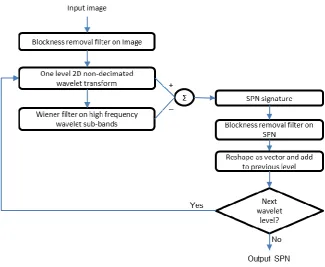
[image:4.595.135.461.361.628.2]Non-decimated wavelet transform keeps all the details of the wavelet sub-bands during the decomposition process, which allows more information to be retained. Whereas decimated wavelet transform performs down sampling of the sub-bands, most often halving the size of the decomposed signal. Figure 1 shows the block dia-gram of the proposed algorithm applying non-decimated wavelet transform to an in-put image in order to extract the SPN.
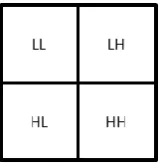
The algorithm takes an input color image and applies a 2D Wiener filter in the fre-quency domain by applying DFT (Discrete Fourier Transform). This step is per-formed to reduce periodical patterns and other artifacts that occur in JPEG images. These patterns are also called blockness artifacts and cause false positives between SPN signatures from different cameras of the same brand or model. A one level non-decimated wavelet transform is applied first on the rows then the columns of the im-age. The process produces two-dimensional wavelet decomposition where the sub-bands are as shown in Figure 2.
Fig. 2. Two dimensional wavelet sub-bands, where LL is LowLow, LH is LowHigh, HL is HighLow and HH is HighHigh coefficients frequency respectively.
The LL – LowLow, LH – LowHigh, HL – HighLow and HH – HighHigh wavelet sub-bands details represent the High and Low frequencies of the wavelet decomposi-tion of the image. The LL is the approximadecomposi-tion details that contain a low frequency representation of the image. The other three sub-bands contain the high frequency coefficients of the wavelet decomposition. The denoising of the three sub-bands of interest is done by applying a low pass filter, in the form of a 2D Wiener filter. The denoising process eliminates all medium to high frequency details from the bands. The SPN signature is obtained by subtracting the low-passed wavelet sub-bands from the original decomposed wavelet sub-sub-bands as shown in equation 1 in the first section of the paper. This process retains only the high frequency details from the non-decimated wavelet decomposition. The SPN extraction stage is performed on the three sub-bands of interest and does not include the approximation details (LL).
3
Experiments and Results
The performance of the proposed source device identification algorithm was as-sessed by running a set of experiments on an image dataset to test a predefined hy-pothesis. The results of the algorithm were compared against the state of the art wave-let extraction method.
3.1 Hypothesis and Performance Measure
The identification of a source device using SPN can be formulated as the following binary hypothesis testing:
H0 = Image was not created by camera
H1 = Image was created by camera (2)
where H0 is the null hypothesis and H1 is the alternative hypothesis. The
correla-tion match is performed between the camera reference SPN and each individual im-age SPN in the dataset. If the correlation coefficient is above a predetermined thresh-old, the null hypothesis can be rejected. The threshold is pre-set empirically to 0.01, and it has been shown in previous research in source device identification that a threshold of 0.01 for the cross correlation coefficient was reasonable [6]. If the null hypothesis is rejected, it can be inferred that the photo originates from the camera fingerprint being tested. If the null hypothesis is not rejected, it can be inferred that the photo does not originate from the camera fingerprint under test.
The results obtained from the proposed scheme were compared against the state of the art in wavelet SPN extraction method [13] and the source code was downloaded from [14]. The experiments were designed so that the SPN extraction methods will be able to identify the source device of an image and that the proposed method can dif-ferentiate between devices of the same make and model.
3.2 Experimental Setup
model (Canon Ixus70), it was decided to use one of the cameras (Canon_Ixus70_0) as the camera reference SPN signature.
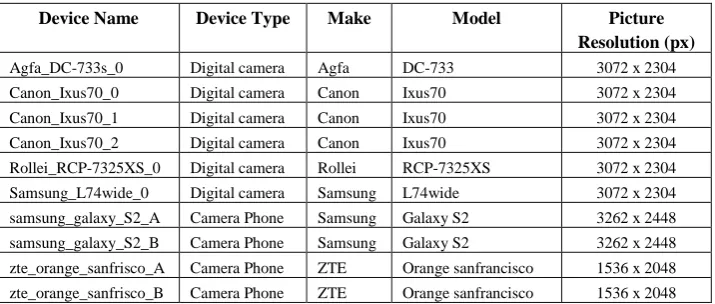
Table 1. Cameras used in experiment showing their makes, models and picture resolution
Device Name Device Type Make Model Picture Resolution (px) Agfa_DC-733s_0 Digital camera Agfa DC-733 3072 x 2304 Canon_Ixus70_0 Digital camera Canon Ixus70 3072 x 2304 Canon_Ixus70_1 Digital camera Canon Ixus70 3072 x 2304 Canon_Ixus70_2 Digital camera Canon Ixus70 3072 x 2304 Rollei_RCP-7325XS_0 Digital camera Rollei RCP-7325XS 3072 x 2304 Samsung_L74wide_0 Digital camera Samsung L74wide 3072 x 2304 samsung_galaxy_S2_A Camera Phone Samsung Galaxy S2 3262 x 2448 samsung_galaxy_S2_B Camera Phone Samsung Galaxy S2 3262 x 2448 zte_orange_sanfrisco_A Camera Phone ZTE Orange sanfrancisco 1536 x 2048 zte_orange_sanfrisco_B Camera Phone ZTE Orange sanfrancisco 1536 x 2048
To create the camera reference SPN signature, 50 flatfield pictures, pictures of white wall with no scene details, from the Canon_Ixus70_0 camera were downloaded separately from the natural scene images. The SPN of the 50 images were extracted and averaged into one camera reference SPN. All the 100 images, including the 10 images originating from the Canon_Ixus70_0 camera was matched against the camrea reference SPN. To ensure generality, the 100 pictures were natural images consisting of a mixture of outdoor and indoor scenes. The Dresden dataset contains natural pictures with similar scenes from different cameras, which ensures that the matching of the SPN is performed in more controlled conditions. To reduce computational complexity, all the images were cropped to a size of 512 x 512 pixels from the centre.
3.3 Results
Canon_Ixus70_0 camera. The mean correlation coefficient values for the non-decimated method was 0.0411 and for the non-decimated method was 0.0407 respectively. The variance in values for images 11 to 20 were 0.00024 and 0.00030 for the non-decimated and non-decimated methods respectively. The non-decimated method had more variation in results for positive matchings and the non-decimated method provided more consistent results.
Fig. 3.Canon_Ixus70_0 reference SPN signature and correlated with 100 images from 10 cam-eras. Images 11 to 20 come from this camera and rest of images from the other 9 camcam-eras. Both
non-decimated and decimated correlation coefficient results are displayed.
The correlation coefficient values for the other two Canon Ixus cameras (Canon_Ixus70_1, Canon_Ixus70_2), which were images 21 to 30 and 31 to 40 respectively, were close to zero for the non-decimated method similar to the decimated mehod. These results show that our proposed method was able to differentiate between cameras from the same make and model. The correlation coefficient values for the rest of the images from the other 7 cameras were all below the threshold, with no false positive and not rejecting the null hypothesis. The variance in correlation values was 0.00001 for both the non-decimated and decimated methods. Based on the variance of the correlation coefficients obtained it can be seen that the non-decimated method provided a more consistent identification result for the dataset used.
be due to the fact that the non-decimated wavelet transform retain more information about the SPN signal, so that it can be extracted after the first level of decomposition.
4
Conclusion
This paper presented a non-decimated wavelet based source camera identification method for digital images. The proposed algorithm applies a non-decimated wavelet transform on the input image and split the image into its wavelet sub-bands. The coef-ficients within the resulting wavelet high frequency sub-bands are denoised to extract the SPN from the picture. Cross correlation of the image SPN and the camera refer-ence SPN signature was then used to identify the source camera of the image. Exper-imental results were generated using images of ten cameras to identify the source device of the images. Results showed that the proposed technique generates superior results to that of the state of the art wavelet based source camera identification. A secondary benefit with non-decimated wavelet transform is that the SPN signature can be extracted after the first level of wavelet decomposition as opposed to decimated method where a reliable SPN can only be extracted after 4 levels of wavelet decom-position. Further works to improve the quality of the extracted SPN is underway as well as reduce the dimensionality of the SPN signature.
Acknowledgements. This work, as part of the CARI project, is supported by the Po-lice Knowledge Fund, which is administered by the College of Policing, the Home Office, and the Higher Education Funding Council for England (HEFCE). Special thanks to Sofia Soobhany for her insightful comments on the paper.
5
References
1. Soobhany, A.R., Leary, R., Lam K.P.: On the Performance of Li’s Unsupervised Image Classifier and the Optimal Cropping Position of Images for Forensic Investigations. In: In-ternational Journal of Digital Crime and Forensics (IJDCF), vol. 3, pp. 1-13 (2011) 2. Gloe, T., Kirchner, M., Winkler, A., Böhme, R.: Can We Trust Digital Image Forensics?
In: Proceedings of the 15th International Conference on Multimedia, Augsburg, Germany, pp. 78-86 (2007)
3. Lukas, J., Fridrich, J., Goljan, M.: Digital Camera Identification from Sensor Pattern Noise. In: IEEE Transactions on Information Forensics and Security, vol. 1, pp. 205-214 (2006)
4. Fridrich, J.: Digital Image Forensic Using Sensor Noise. In: IEEE Signal Processing Mag-azine, vol. 26, pp. 26–37 (2009)
5. Chen, M., Fridrich, J., Goljan, M., Lukas, J.: Determining Image Origin and Integrity Us-ing Sensor Noise. In: IEEE Transactions on Information Forensics and Security, vol. 3, no. 1, pp. 74–90 (2008)
7. Alles, E.J., Geradts, Z., Veenman, C.J.: Source Camera Identification for Low Resolution Heavily Compressed Images. In: International Conference on Computational Sciences and its Applications, (ICCSA), pp. 557-567 (2008)
8. Gisolf, F., Malgoezar, A., Baar, T., Geradts, Z.: Improving Source Camera Identification Using a Simplified Total Variation Based Noise Removal Algorithm. In: Digital Investiga-tion, vol. 10, no. 3,, pp. 207–214 (2013)
9. Soobhany, A.R., Lam, K.P., Fletcher P., Collins, D.: Source Identification of Camera Phones Using SVD. In: IEEE International Conference on Image Processing, Melbourne, VIC, pp. 4497-4501 (2013)
10. Kang, X., Chen, J., Lin, K., Anjie, P.: A Context-Adaptive SPN Predictor for Trustworthy Source Camera Identification. In: EURASIP Journal on Image and Video Processing, vol. 2014, no. 1, pp. 1–11 (2014)
11. Akbari, A.S., Zadeh, P.B., Behringer, R.: Iris Segmentation Using a Non-decimated Wave-let Transform. In: Proceedings of the 2nd IET International Conference on Intelligent Sig-nal Processing, London: Savoy Place, UK (2015)
12. Lin, X., Li, C.-T.: Enhancing Sensor Pattern Noise via Filtering Distortion Removal. In: IEEE Signal Processing Letters, vol. 23, no. 3, pp. 381-385 (2016)
13. Goljan, M., Fridrich, J., Filler, T.: Large Scale Test of Sensor Fingerprint Camera Identifi-cation. In: Proceedings of SPIE Electronic Imaging, Media Forensics and Security XI, vol-ume 7254, pp 0I-01–0I-12 (2009)
14. MATLAB implementation of digital camera fingerprint extraction. http://dde.binghamton.edu/download/camera fingerprint/