of context in recognition memory: a case report. Neurocase. pp. 1-10. ISSN 1465-3656 DOI: https://doi.org/10.1080/13554794.2017.1372482
Link to Leeds Beckett Repository record: http://eprints.leedsbeckett.ac.uk/4058/
Document Version: Article
The aim of the Leeds Beckett Repository is to provide open access to our research, as required by funder policies and permitted by publishers and copyright law.
The Leeds Beckett repository holds a wide range of publications, each of which has been checked for copyright and the relevant embargo period has been applied by the Research Services team.
We operate on a standard take-down policy. If you are the author or publisher of an output and you would like it removed from the repository, please contact us and we will investigate on a case-by-case basis.
1
Fractionating controlled memory processes and recall of context in recognition memory: A case report
Kata Pauly-Takacs* Leeds Beckett University School of Social Sciences Leeds LS1 3HE, United Kingdom
+44 (0)113 81 25357
Chris J.A. Moulin
LPNC CNRS 5105 Université Grenoble Alpes, Grenoble, France [email protected]
2
AcknowledgementsWe gratefully acknowledge the time given by CJ and his parents to take part in this research. We also thank Dr Eddy Estlin for his help with describing the medical aspects of CJ’s condition.
3
AbstractRecollection has been described both as a recognition memory judgement requiring cognitive control and the ability to retrieve contextual information about a prior occurrence. At the core of this article is the question whether or not these two subcomponents of recollection are dissociable in amnesia. In three experiments, we explored the influence of exclusion task instructions on performance in a single case (CJ), with the view to understand the relative contributions of control and source memory to recognition memory decisions. First, contrasting findings were obtained between tasks requiring strategic control or source reports. Second, even though CJ displayed some residual source memory relative to the ability to strategically control this information, his source memory capacity was time-limited. Our findings resonate with the novel proposal that recollection draws heavily upon working memory resources, and provide an example of how amnesic patients might utilise residual working memory capacity to solve episodic memory tasks.
4
IntroductionRecognition memory rests on a decision making process whereby an assessment of prior occurrence is made. A number of different theorists propose that this decision can be made either quickly and automatically, based on a process of familiarity; or with a top-down, deliberative process, often described as recollection (see Mandler, 2008 and Yonelinas, 2002 for reviews). Recollection has been defined in a number of different ways (for an overview see Moulin, Souchay, & Morris, 2013), with some authors describing it in terms of an automatic-strategic distinction, while others emphasising the content of information at retrieval. For instance, Jacoby, Toth and Yonelinas (1993) have stressed that recollection is a strategic process by which retrieval of specifics can bring to bear on the recognition decision. On the other hand, others, such as Mickes, Seale-Carlisle and Wixted (2013) stress that it is the production of material associated to a retrieval cue that characterises information as recollected. One such clear category of contextual information is source memory: the ability to retrieve features of memories that give rise to their episodic character (Mitchell & Johnson, 2009). According to several authors (e.g. DeMaster & Ghetti, 2013) the retrieval of the source of information, as opposed to the mere report of prior occurrence, can be used as an index of recollection.
5
Consistent with prevailing conceptions of recollection, neuropsychological studies report deficits both in source memory tasks and in paradigms emphasizing the strategic control requirement of recollection. For example, disproportionate source memory impairments were found relative to item memory in patients with amnesia in the context of fact learning tasks (Schacter et al., 1984; Shimamura & Squire, 1987; Thaiss & Petrides, 2003). Similarly, patients with medial-temporal lobe pathologies have been found to be impaired in making a frequency judgement on previously presented items (Huppert & Piercy, 1978; Meudell, Mayes, Ostergaard, & Pickering, 1985; Stanhope, Guinan, & Kopelman, 1998). They have also had impairments recollecting, when an item was presented (e.g. Hirst & Volpe, 1982; Kopelman, 1989), where an item was presented (e.g. Hirst & Volpe, 1984; Chalfonte et al.,1996), or which modality it was presented in (Pickering, Mayes & Fairbairn, 1989). From the perspective of the automatic vs. controlled distinction, several studies using the process dissociation procedure have documented that it is recollection that is impaired or more impaired relative to familiarity in amnesia (e.g. Bastin et al., 2004; Turriziani et al., 2008; Brandt, Gardiner, Vargha-Khadem, Baddeley, & Mishkin, 2009), although others report comparable deficits in the two types of processes (e.g. Cipolotti et al., 2006; Manns et al., 2003; Wais et al., 2006).Our view is that recollection itself is composed of two potentially dissociable components; a mnemonic component (i.e. source or other contextual detail) and a control or metacognitive component (i.e. the ability to respond according to the contextual detail, e.g. source, held in memory). When a participant finds a stimulus familiar, for instance, they must act metacognitively on that familiarity in order to make an additional judgement about its source. This decision to ‘recollect to reject’ a familiar repeating foil, for instance, is based on the
6
control component of recollection (i.e. as measured in exclusion tasks) draws heavily upon working memory resources (Elward & Wilding, 2010; Elward, Evans, & Wilding, 2013). Our view is that working memory resources would be necessary to hold in mind information at test and reflect metacognitively, or strategically upon it. In a task where distracters appear repeatedly for instance, this is particularly the case: it would be advantageous to keep a record in working memory of the distracter items and their source as they repeat.A further finding pertinent to our argument is that reports of source can be dissociated from the subjective experience of recollection in the Remember/Know paradigm such that recollection does not always depend on accurate and detailed source memory (Hicks, Marsh, & Ritschel, 2002). Similarly, in autism, Souchay, Wojcik, Williams, Crathern, & Clarke (2013) found that source monitoring was reliable, but that this did not lead to the expected phenomenology of ‘remembering’. Although the critical contextual information from the study
phase could be retrieved, it did not apparently lead to the subjective experience of recollection. There is converging evidence for this idea from ERP studies whereby participants can access source information in the absence of the ERP index of recollection (Addante, Ranganath, & Yonelinas, 2012). Event-related fMRI studies of episodic memory also suggest differential activation patterns associated with objective (i.e. source memory) and subjective measures of recollection (measured by the Remember/Know paradigm). Crucially, recollection is associated with preferential activation in the left hippocampus, while source memory is associated with increased activation in multiple areas of the prefrontal cortex (see Spaniol et al., 2009 for a quantitative meta-analysis).
7
from repeatedly presented foils. However, the extent to which this was due to a deficit in control or in the recuperation of information from study was assessed by probing his source memory at the point of making a decision about prior occurrence. To foreshadow our argument, we find that CJ has some residual source memory, but that this alone is insufficient to avoid making errors in an exclusion task with repeating distracters.Overview of Experiments
Three experiments were conducted. First, we presented a standard inclusion/exclusion memory task (Experiment 1) for CJ and controls. The task involves the presentation of repeated distracters at varying lag intervals. In the exclusion task participants were instructed to respond only to items that were presented at study. In the inclusion task, participants responded to all items that they had seen previously, whether at study or test. As such, the task measures the ability to discriminate items that are familiar from items from a particular context. This experiment was followed up with two further experiments, only administered to CJ (Experiments 2 and 3). In Experiments 2-3 we ran the inclusion task only with additional source probes to enable inferences about the ability to recollect information encoded at study. These experiments used an alternative means of reporting and scoring responses with the aim of exploring the different contributions of strategic control of memory and retrieval of contextual details. The slight differences in designs and rationale for each are presented below.
8
in the centre of blank cards. The reasoning here was twofold. First, in Experiment 1, we were able to use source (i.e. Bart Simpson) to refer to the targets when explaining the complex task instructions for the exclusion condition. That is, we emphasised that study words are ‘said by’ Bart Simpson, and only Bart Simpson’s words should be responded to with a “yes” answer attest. Second, we were able to test for source in the two follow-up experiments by explicitly asking whether or not the word was previously ‘said by’ Bart Simpson.
Case description
CJ was born as the third of four children, who completed all developmental milestones normally (see also Pauly-Takacs, Moulin, & Estlin, 2011; 2012). At 11 years of age he was diagnosed with a primary suprasellar germinoma with multiple periventricular and leptomeningeal metastases. The disease was successfully treated with chemotherapy (cisplatin, etoposide and ifosfamide) and radiotherapy (40 Gy) to the whole brain and spine. Figure 1 shows the resultant marked and generalised cerebral atrophy and associated white matter loss. Bilateral volume loss to the hippocampus was also noted in post-treatment clinical MRI scan reports. Additionally, due to deterioration of the optic nerve, CJ’s peripheral vision as well as sight in
his right eye were poor.
Insert Figure 1 about here
Parental descriptions of CJ’s behaviour following treatment were consistent with a profound
9
substantial cueing, and even so, he often commented that he just “worked it out” rather than remembered events. CJ’s navigation skills were severely compromised and he had difficultylearning routes in novel environments. For example, despite a number of visits to the university, he had never become confident about the route from reception to the office, and similarly, he needed help to find his way around at school at all times. In addition to evident memory difficulties in day-to-day life, CJ’s behaviour was somewhat disinhibited in social
situations, and he often made inappropriate comments.
After his treatment was completed, CJ returned to mainstream secondary education where he was able to achieve average to good marks in subjects that he had substantial prior knowledge of (e.g. science and history). Premorbid knowledge was well preserved; initially he outperformed his peers on a general knowledge test. CJ was also able to learn novel facts such as people’s names, with sufficient repetition. By contrast, the acquisition of novel
concepts and terminology especially in newly introduced subjects became a significant challenge for him ultimately leading to a decline in his school performance. Despite his extensive brain injury, there was no indication of significant language impairment; CJ’s
spontaneous speech was fluent, syntactically correct and he was able to communicate effectively. The overall impression that CJ left us with is that of a friendly and ingenious young man who had very little awareness of the profound nature and consequences of his memory deficit. CJ was 16 years old at the time of the experiments reported here.
Neuropsychological Profile
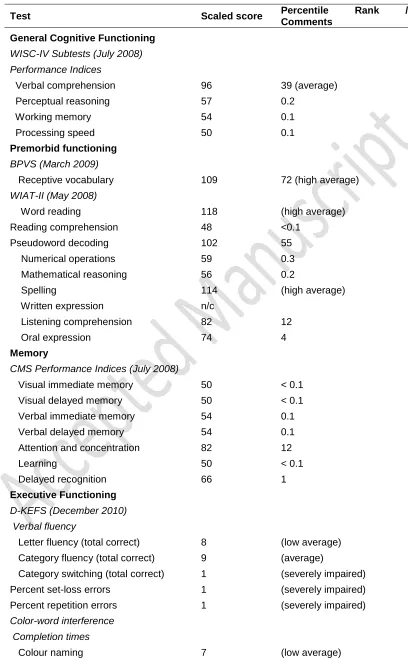
CJ’s overall neuropsychological profile reflects a profound anterograde amnesia with
additional working memory and executive function difficulties (Table 1).
10
Due to a large discrepancy between his Verbal Comprehension and Perceptual Reasoning scores on the Wechsler Intelligence Scale for Children (WISC-IV; Wechsler, 2003), CJ’s FullScale IQ score could not be computed meaningfully. Derivation of his Verbal IQ is similarly problematic due to a large discrepancy between his Verbal Comprehension and Working Memory indices. However, taking the Verbal Comprehension index as an overall measure of verbal intelligence (Wechsler, 2003) and contrasting this with the memory indices of the Children’s Memory Scale (CMS; Cohen, 1997), it is evident that CJ’s neuropsychological
profile is characterized by a discrepancy between IQ and memory, at least in the verbal domain. CJ’s retained intellectual abilities in the verbal domain are also apparent from the
scores obtained on the Wechsler Individual Achievement Test (WIAT-II; Wechsler, 2005), where some of the subtests pertaining to language function are in the above average range (e.g. word reading and spelling). Similarly, his scores are in the high average range on the British Picture Vocabulary test (BPVS-II; Dunn & Dunn, 1997). Apart from preservation of function, these scores are likely to reflect CJ’s relatively high premorbid intelligence.
In contrast with well-preserved verbal skills, CJ has shown virtually no ability to learn and retain information in standardised tests of memory, either visual or verbal. For example, in the ‘stories’ subtest of the CMS two stories were read to the patient which was followed by tests
of immediate and delayed recall and recognition of the units composing each story. CJ was unable to recall more than five story units for each story even immediately after presentation (note: there are 88 story units across the two stories). Other tests of episodic memory, such as word-pair learning, face recognition, and the ‘family pictures’ task (this requires integration
of character, location and action information of a scene) all yielded scores in the extremely low range.
11
simultaneously. Although his performance was inconsistent across tests, CJ was capable of achieving within normal limits performance on a ‘forward digit span’ task. CJ recalled 6 digitsin both trials of the CMS, which places him in the low average range, but he only reached a digit span of 4 when tested using the WISC-IV on a different day. By contrast, in tasks that required the ability to hold and manipulate information simultaneously, his performance was consistently poor. For example, in the ‘backward digit span’ task he recalled only 3 digits in
only one of the two trials (i.e. both in the CMS and the WISC-IV). Similarly, he was only able to correctly sequence 3 units of information in the ‘letter-number sequencing’ task of the WISC-IV. Although CJ’s overall Working Memory index is extremely low, his performance suggests
some residual normality in the short-term storage component of this memory system.
In addition to his profound memory impairment CJ shows signs of a significant executive function deficit which exacerbates his memory impairment. He experiences difficulties with task switching, inhibition, planning and organising behaviour as measured by the Delis-Kaplan Executive Function System test battery (D-KEFS; Delis, Kaplan & Kramer, 2001). While his ‘letter and category fluency’ performance is within normal limits (scaled scores 8 and 9 respectively), he shows a disproportionate impairment on the ‘category switching’ task. This
suggests that his main impairment is in cognitive flexibility and not in verbal fluency per se. He was able to search and retrieve words from his well-preserved vocabulary and he did not make any perseverative errors, but his memory deficit influenced his performance by producing distal repetition errors. Problems with inhibitory control were also evident from his frequent set-loss errors as well as his low scores on the ‘colour-word interference’ task. The ‘tower task’ was
extremely difficult for CJ; he was only able to solve the first two items of the test without breaking a rule. Of note, the first two items of this test do not require strategic planning to solve them, whereas further items do.
In sum, CJ’s neuropsychological profile indicate complex cognitive difficulties, but his verbal
12
such that CJ is able to use language effectively in everyday situations. On an anecdotal note, CJ enjoyed completing verbal tasks in the context of neuropsychological assessments and commented that he was “good with words”. In fact, it is CJ’s well-preserved verbal skills thatpermitted extensive experimental work into his residual memory abilities using verbal materials, as in the tasks reported here.
Experiment 1
Control participants
Ten control participants matched on years of education were drawn from CJ’s class in a
mainstream school. The mean age of controls was 14 years. All participants, including CJ, and their parents signed written consent to participate in the study, and in the case of controls, for the test session to take place at school. (CJ was tested at home). The study was approved by the Ethics Committee of the Institute of Psychological Sciences at the University of Leeds.
Materials and Procedure
As materials, we used common nouns with four to seven letters selected from the MRC Psycholinguistic Database (Coltheart, 1981). They were matched on concreteness (500-700) and familiarity (500-700). We ran the standard inclusion and exclusion tasks in study-test cycles. In the study phase, control participants were presented with 36 target words individually printed on cards for 3 seconds each, and were asked to memorise them for a later recognition test. In order to manage CJ’s very low level of memory function, he studied the 36 items as
13
A yes/no recognition test was administered immediately after study. There were 36 targets and 36 distracters presented individually on the centre of printed cards. In the test phase, the target items were intermixed with the distracters such that each distracter item occurred twice. A distracter item repeated either immediately after its first presentation (lag 0), after 3 intervening items (lag 3), or after 12 intervening items (lag 12). In the inclusion task, participants were instructed to answer ‘yes’ to any items that they had seen before (at study or at test), whereas ‘no’ answers were required for items they had not yet seen (i.e. the first occurrence of distracters). In the exclusion task, participants were instructed to answer with ‘yes’ only to the study items, and ‘no’ to both occurrences of the distracters. Participants were made aware ofthe fact that the distracters would be repeating at test. To ensure understanding, it was emphasised to participants that they were to respond with ‘yes’ only to those items that were ‘said by’ Bart Simpson.
Results1
The mean performance of controls and CJ is reported in Table 2. Our analysis strategy was to compare CJ’s performance to controls with a modified t-test (Crawford & Garthwaite, 2002). CJ’s performance was at a level comparable with that of controls with regard to adjusted hits
(i.e. hits – false positives); t(mod) (9)= 0.41, p > .6 (inclusion) and t(mod) (9)= 0.48, p > .6
(exclusion). CJ was generally proficient in the standard recognition component of the task showing no difficulty discriminating between old and new items; we adequately compensated for his poor episodic memory function in our design.
Insert Table 2 about here
Our critical measure is the proportion of ‘yes’ responses given to repeated distracters in inclusion (where ‘yes’ is correct) and exclusion (where ‘yes’ is incorrect) tasks. In the inclusion
14
for lag 3 and lag 12 items, t(mod) (9)=0.09 and t(mod) (9)=-0.11, p > .9, respectively (lag 0 wasperfect for both CJ and controls, and the t value is therefore incalculable). In contrast, the exclusion condition shows a striking impairment. CJ made far more repetition errors than controls; t(mod) (9)=13.83 and t(mod) (9)= 10.37, both p < .0001 for lag 3 and lag 12 items
respectively. The pattern is most obvious at a lag of 0: CJ made repetition errors for all immediately repeated items, whereas the controls made no errors at this level. To reiterate: we asked CJ explicitly only to endorse words as old that were ‘presented by’ Bart Simpson, but CJ’s response pattern in the exclusion condition was not different from that observed in
the inclusion condition.
Insert Table 3 about here
Interim discussion
Such a pattern of performance raises the concern that CJ may not have understood the task instruction for the exclusion condition. The memory demands at lag 0 are minimal and, the participant should be able to strategically report the immediately repeating foil as therefore encountered in test phase. It is exactly this kind of error that we were motivated to research. From such findings we would normally conclude that CJ has no recollection at all, or more probably, that the test was not fit for purpose.
An alternative possibility however is that CJ understood the task, but he had difficulty controlling his response. With this in mind, CJ’s false positives (FP) are of interest. CJ showed
15
than to successful recollection rejection. In sum, CJ is unable to make the correct response to repeating distracters in the exclusion condition, from which we might infer that he cannot correctly judge the source of that information. Thus, in the following two experiments, we wanted to explore the extent to which the information necessary to make such an exclusion decision was available.Experiment 2
On face value, CJ appears not to be able to use controlled memory in the exclusion task. In healthy participants we judge that when someone endorses a target as old, it is because they have retrieved the source as being the study list. Conversely, when they correctly reject a repeating distracter, it is because they are able to retrieve information about the source of that item. Thus, in this experiment, CJ was probed directly on the source of each recognised item in the repetition lag task. Between his performance in Experiments 1 and 2 we can ascertain whether he is able to access information relevant to solve the task, or whether he is simply unable to act upon it.
Materials and Procedure
A different 72 nouns were selected from the MRC Psycholinguistic Database matched on concreteness (500-700) and familiarity (500-700) (Coltheart, 1981). The design characteristics of the task were identical to Experiment 1: 36 words were presented at study, and the 36 distracters repeated at lag intervals 0, 3, and 12. CJ was asked to perform the yes/no recognition task indicating whether or not he had seen the word before (as in the inclusion condition), then immediately after a ‘yes’ answer he was asked to specify the source of the recognised word (whether the word was one of Bart Simpson’s words or in the test block): “Was this one of Bart’s words, or was it in the test block?” We used this source information as
16
with an asterix), whereby the correct report of source would be interpreted as an exclusion response (i.e. the correct rejection of a repeating distracter).Results
CJ’s hit rate (72%) was significantly above chance, p = .0113 (exact binomial probability). His
false positive rate was low and he performed at ceiling in recognising the repeated distracters (Table 2 and 3). He only missed one item that was presented at lag interval 12. As in Experiment 1, inclusion performance at lag 0 is perfect. In this task however, when he was asked about the source of the item (i.e. to report if it was one of Bart’s words), CJ was able to
report the source with 100% accuracy. In short, measuring his performance using an exclusion instruction (Experiment 1) and a report of source (Experiment 2) gives completely contrasting outcomes, at least at Lag 0. Across otherwise identical experiments, CJ is asked either to report the source, or to use the source of the item to control his response. In one case performance is at floor, in the other, it is at ceiling.
For longer lags, although the capacity to detect items from the study phase is better for the source than the classic exclusion task (Experiment 1) at lag 12 (see Table 3), performance is poor: CJ makes 92% and 75% FPs for lags of 3 and 12 respectively. At longer lags, CJ cannot differentiate between the source of an item being at study or during the test phase. This difference across lags may be attributable to CJ being able to detect immediate repetition and infer from that the source of the item. That is, if he sees a word repeat itself on the subsequent trial, he will know that it would not have been presented at study.
To see whether CJ has any residual source memory we can also consider his source performance on the target words. He correctly recognised 26 targets, of which he reported Bart Simpson as the source for 17 (65%) – the exact probability of him correctly reporting the
17
p = .05) in his source memory for hits. Note that he does not report Bart Simpson as the source of every yes response he makes – showing some awareness of the repeating foils. If we take CJ’s source report we can use it to calculate the probability that the word was presented atstudy: in essence asking how diagnostic the report of source is. On 41 trials, CJ reports that the source of the item is Bart Simpson, and is only correct 17 times. The probability of each item being from Bart is .33 (since there are two foils for every one target item) and the exact probability of having at least this level of performance is p=.162. This suggests that CJ’s source
reports are biased and not diagnostic in this task.
Experiment 3
Having observed perfect performance on the task at lag 0, when given the source instructions, it is clear that CJ could distinguish repeating foils from targets. The motivation of this third task was to use exactly the same instructions and design as Experiment 2, but with a lag of 1. Our reasoning was that performance was very poor at Lag 3, but the performance at lag 0 may be attributable merely to the immediate detection of repetition. Therefore, taking an incremented difficulty approach, we were motivated to test whether CJ was able to distinguish repeating foils from targets at the next level of difficulty, with one intervening item between repetitions. Should CJ’s residual source memory enable him to complete the task with our source
instructions, we expected to repeat the lag 0 findings from Experiment 2 at a lag of 1.
Materials and Procedure
18
he had seen the word before (as in the inclusion condition), then immediately after a ‘yes’ answer he was asked to specify the source of the recognised word (whether the word was one of Bart Simpson’s words or in the test block): “Was this one of Bart’s words, or was it in the test block?”Results
CJ’s detection of old and new items in this task was near ceiling. Not only did he achieve a
92% hit rate but he also did not produce any FPs. The critical measures in this task are again for the repeating foils – which are at 97% in the inclusion condition, as in previous experiments.
However, in this task, when CJ was asked to report the source he only made .33 FP errors for repeating foils (Table 3). That is, for only a third of items did CJ erroneously think that they derived from the study phase. This level of performance had an exact probability of p = .0652. In sum, CJ was able to reject the majority of repeating foils (in this case after a lag of 1) as having not derived from the study phase, and this was a non-random level of performance. Again, his source memory for hits was above chance, correctly reporting the source of 27 of his 33 hits (82%) – this has an exact probability of p = .0001. Again, if we look at the diagnosticity of reporting Bart Simpson as the source, we arrive at 69% correct. This level of performance has a very low exact probability of occurring by chance (p<.0001). At shorter lags (in Experiment 3), therefore, he is less likely to falsely attribute the source of an item to the study phase. In Experiment 2, CJ’s performance was biased and not diagnostic: this is
presumably because two thirds of the items were at lags of 3 and 12, and they were very easily confused with the study phase. At shorter lags, there is less confusion about source.
Discussion
19
yes/no item recognition and source memory tasks once the materials and questions are adapted in order to yield meaningful measures. That is, in contrast with CJ’s poor performanceon standardised tests of episodic memory which typically involve more trials in a single block and apply longer delays, our experimental adaptations permitted fine grained observations of his residual recognition memory. In Experiment 3, CJ is able to reliably judge prior occurrence, he is able to detect repetition, he is able to report the source of a target item, and his source information is diagnostic of repeating foils, all at a lag of 1. Note that with the standard exclusion conditions, even with a lag of 0, this was not the case. As such, we suggest he is unable to utilise source information in order to complete the exclusion task in Experiment 1: the source task suggests that the information on which to correctly reject repeating foils is available, even at lag 1, but is not acted on.
Our aim was to examine the strategic and informational contributions to recognition decision making. We suggested that a recollection type deficit could arise on the basis of a failure to retrieve source information, or to act strategically upon it (or both). In Experiment 1, CJ endorsed all items he had seen previously as from the study phase, regardless of their source suggesting that he is not able to strategically control memory even under conditions where memory load is not a concern (i.e. at lag 0). The principal finding is that when we changed the emphasis to a report of source rather than the strategic control of memory, performance was improved. In fact, when a report of source was required performance was perfect at lag 0 (Experiment 2) and reliably non-random at lag 1 (Experiment 3), showing that with exclusion task conditions the relevant information to make the correct decision was still available. It should be noted however, that source memory performance was still very poor at longer lags, suggesting that CJ’s source memory capacity is limited. Theoretical explanations of the observed pattern of performance across the three experiments will be considered below.
20
and where source memory was generally reliable. That is, his performance suggests a dissociation between the strategic and informational component of recollection, but only where working memory demands are low. We would like to draw out two main issues from these data. The critical point we make here is that given the task instructions – based on either control orinhibition of familiarity or the report of source we yield very different results, as we had predicted. While it is acknowledged that we cannot make definitive conclusions about healthy memory function based on a single case with profound and non-focal brain injury, the pattern of performance observed here is consistent with the idea that recollection might be fractionated into different subcomponents. A related theoretical concern is to consider the extent to which such dissociations may reflect an immature cognitive system given that both frontal and temporal areas of the brain have a protracted development continuing through adolescence (see Giedd and Rapaport, 2010 for a review). We leave these ideas here, but hope that future research will continue to consider and examine the differences between different types of recollection tasks in both healthy and clinical populations of adult and developmental age.
21
conceptualisation of the repetition lag task, participants have to mentally travel back to the study phase to resolve the familiarity between repeated foils and targets. With training, 3 of Jennings and Jacoby's (2003) 12 older adult participants could successfully complete the task with a lag of 48. Even with such a long lag, there is always the possibility that some form of rehearsal and maintenance of the distracters, rather than a recollection of the study phase was behind this performance. However, as lags get longer it is almost certainly the case that participants are drawing on long-term processes. By contrast, at shorter lags, it is possible to solve the task not by reinstating the context of encoding, but just by keeping track of repeating foils on-line in a temporary store (we would argue that this process is maintained in the sub-process Baddeley (2000) has termed the episodic buffer). By our account, items at test can be tagged as occurring at test and maintained by working memory processes. Then, when a test item is detected as familiar, this temporary buffer can be examined. If the word is stored in working memory, it can be rejected. If it is not in temporary storage, it is more likely that it came from the study list. Evans, Herron and Wilding (2012) have demonstrated exactly such effects in healthy groups, with a reduction in recollection occurring alongside a depletion of cognitive resources: recollection is a resource demanding process because it requires continuous updating of working memory in line with the task demands.22
compared to being able to manipulate this stored information (i.e. digit backward; letter-number sequencing).The recency strategy is likely to be relatively low on cognitive demands, especially at short lags, and it seems reasonable to us that this would be a preferential strategy at short lags in healthy participants too; relatively automatically, participants will be able to pinpoint that the familiarity that they feel for an item tallies with their very recent experiences. That is, they will reject repeating foils at short lags not because of a recollection strategy recalling the study phase, but an assessment of the episodic buffer. This hypothesis is testable by examining the effect of a dual task on longer and shorter lags in an exclusion task. We would expect more of a dual task decrement at shorter lags than at longer lags.In terms of memory impairment, and with cases such as CJ, we are presented with another example of how relatively intact memory systems may be used to support more gross impairments in episodic memory. Our initial aim was to use the sort of recollection training paradigm in CJ advocated by Jennings and Jacoby (2003) but our finding was that CJ struggles with any lags longer than 1. This in itself may reflect the inability to use residual long term memory strategically, and the reliance upon a recency-based strategy, although it does suggest that increasing working memory capacity may have knock-on benefits for long term memory tasks such as this one.
23
source makes CJ think about where the feeling of familiarity lies, meaning that he acts metacognitively in the recognition phase only when prompted. That is, in the exclusion task, although we offered repeated reminders before each study-test cycle, perhaps the confusion of the repeating foils was not overcome since CJ had not been encouraged to prompt his memory. In essence, the only difference between the tasks is the repeated reminding, and the fact that in the source condition CJ was encouraged to make a two-stage decision, free to report yes or no and then asked about source, whereas in the exclusion task, he was required to grapple both concepts at the same time. If nothing else, we recommend the use of this source instruction and scoring method as a novel approach in other groups where the complexity of the instructions of the exclusion task is in question, in order to make inferences about the extent to which recollection is impaired.24
scoring method introduced here will be of value for future research as a proxy measure to appreciate the extent to which recollection might be impaired in patients with complex cognitive difficulties.1 In Experiments 2 and 3 we calculate exact probabilities of the responses made by CJ. The
rationale for this analysis is that we calculate the probability that the pattern of responses could have occurred by chance. Like this, a value of .5 means that there is a high probability of receiving the same pattern by chance – i.e. we might imagine the pattern we have found arrived
25
ReferencesAddante, R. J., Ranganath, C., & Yonelinas, A. P. (2012). Examining ERP correlates of recognition memory: evidence of accurate source recognition without recollection. NeuroImage, 62(1), 439–50.doi:10.1016/j.neuroimage.2012.04.031
Baddeley, A. (2000). The episodic buffer: a new component of working memory? Trends in Cognitive Sciences, 4(11), 417-423.
Bastin, C., Linden, M., Charnallet, A., Denby, C., Montaldi, D., Roberts, N. et al. (2004). Dissociation between recall and recognition memory performance in an amnesic patient with hippocampal damage following carbon monoxide poisoning, Neurocase, 10, 330-344.
Brandt, K. R., Gardiner, J. M., Vargha-Khadem, F., Baddeley, A. D., & Mishkin, M. (2009). Impairment of recollection but not familiarity in a case of developmental amnesia. Neurocase, 15 (1), 60-65.
Cabeza, R., Dolcos, F., Graham, R., & Nyberg, L. (2002).Similarities and differences in the neural correlates of episodic memory retrieval and working memory. NeuroImage, 16(2), 317–30.doi:10.1006/nimg.2002.1063
Cipolotti, L., Bird, C., Good, T., Macmanus, D., Rudge, P, & Shallice, T. (2006). Recollection and familiarity in dense hippocampal amnesia: A case study. Neuropsychologia, 44, 489-506.
26
Cohen, M. (1997). Children’s Memory Scale. New York: The Psychological Corporation.Coltheart, M. (1981). The MRC Psycholinguistic Database. Quarterly Journal of Experimental Psychology, 33(4), 497-505.
Crawford, J. R. &Garthwaite P. H. (2002). Investigation of the single case in
neuropsychology: confidence limits on the abnormality of test scores and test score differences. Neuropsychologia, 40(8), 1196-1208.
Delis, D. C., Kaplan, E., & Kramer, J. H. (2001). Delis-Kaplan Executive Function System. NCS Pearson.
DeMaster, D. M. &Ghetti, S. (2013). Developmental differences in hippocampal and cortical contributions to episodic retrieval. Cortex, 49(6), 1482-1493.
Dunn. L. M., Dunn, L. M. (1997). The British Picture Vocabulary Scale, London: nferNelson Publishing Company Ltd.
Elward, R. L., Evans, L. H., & Wilding, E. L. (2013). The role of working memory capacity in the control of recollection. Cortex, 49(6), 1452–62. doi:10.1016/j.cortex.2012.07.003
Elward, R. L., & Wilding, E. L. (2010). Working memory capacity is related to variations in the magnitude of an electrophysiological marker of recollection. Brain research, 1342, 55– 62. doi:10.1016/j.brainres.2010.04.040
Evans, L. H., Herron, J. E., & Wilding, E. L. (2012). Electrophysiological insights into control over recollection. Cognitive neuroscience, 3(3-4), 168–73.
doi:10.1080/17588928.2012.662217
Giedd, J. N., & Rapoport, J. L. (2010). Structural MRI of pediatric brain development: What have we learned and where are we going? Neuron, 67 (5), 728-34.
27
Greene, J. D. W., Baddeley, A. D., & Hodges, J. R. (1995). Analysis of the episodic memorydeficit in early Alzheimer’s disease: Evidence from the doors and people test.
Neuropsychologia, 34(6), 537–551.
Hicks, J. L., Marsh, R. L., & Ritschel, L. (2002). The role of recollection and partial information in source monitoring. Journal of Experimental Psychology: Learning, Memory, and Cognition, 28(3), 503-508.
Hirst, W. & Volpe, B.T. (1982). Temporal order judgments with amnesia. Brain and Cognition, 1 (3), 294-306.
Hirst, W. & Volpe, B.T. (1984). Encoding of spatial relations with amnesia. Neuropsychologia, 22 (5), 631-634.
Huppert, F. A., & Piercy, M. (1978). Dissociation between learning and remembering in organic amnesia. Nature, 275, 317-318.
Jacoby, L. L., Toth, J. P., & Yonelinas, A. P. (1993). Separating conscious and unconscious influences of memory: Measuring recollection. Journal of experimental psychology. General, 122(2), 139–154.
Jennings, J. M., & Jacoby, L. L. (2003). Improving memory in older adults: Training recollection. Neuropsychological Rehabilitation, 13(4), 417–440.
doi:10.1080/09602010244000390
Klein, S. B. (2013). Making the case that episodic recollection is attributable to operations occurring at retrieval rather than to content stored in a dedicated subsystem of long-term memory. Frontiers in behavioral neuroscience, 7(3), 1-14.
28
Kopelman, M. D. (1989). Remote and autobiographical memory, temporal context memoryand frontal atrophy in Korsakoff and Alzheimer’s patients. Neuropsychologia, 27 (4),
437-460.
Mandler, G. (2008). Familiarity Breeds Attempts: A Critical Review of Dual-Process Theories of Recognition. Perspectives on Psychological Science, 3(5), 390–399.
doi:10.1111/j.1745-6924.2008.00087.
Manns, J. R., Hopkins, R. O., Reed, J. M., Kitchener, E. G., & Squire, L. R. (2003). Recognition memory and the human hippocampus. Neuron, 37, 171-180.
Meudell, P. R., Mayes, A. R., Ostergaard, A., & Pickering, A. (1985). Recency and frequency judgements in alcoholic amnesics and normal people with poor memory. Cortex, 21 (4), 487-511.
Mickes, L., Seale-Carlisle, T., & Wixted, J. (2013). Rethinking familiarity: Remember/Know judgments in free recall. Journal of Memory and Language, 68, 333–349.
Mitchell, K. J., Johnson, M. K. (2009). Source monitoring 15 years later: What have we learned from fMRI about the neural mechanisms of source memory? Psychological Bulletin, 135 (4), 638-677.
Moulin, C. J. A., Souchay, C., & Morris, R. G. (2013).The cognitive neuropsychology of recollection. Cortex, 49(6), 1445–1451.
Pauly-Takacs, K., Moulin, C. J., & Estlin, E. J. (2011). SenseCam as a rehabilitation tool in a child with anterograde amnesia. Memory, 19 (7), 705-712.
29
Pickering, A. D., Mayes, A. R., & Fairbairn, A. F. (1989). Amnesia and memory for modalityinformation. Neuropsychologia, 27 (10), 1249-1259.
Ranganath, C., Johnson, M. K., & D’Esposito, M. (2003). Prefrontal activity associated with
working memory and episodic long-term memory. Neuropsychologia, 41(3), 378–89.
Schacter, D. L., Harbluk, J. L., & McLachlan, D. R. (1984). Retrieval without recollection: An experimental analysis of source amnesia. Journal of Verbal Learning and Verbal Behavior, 23 (5), 593-611.
Shimamura, A. P., & Squire, L. R. (1987). A neuropsychological study of fact memory and source amnesia. Journal of Experimental Psychology: Learning, Memory and Cognition, 13 (3), 464-473.
Souchay, C., Wojcik, D. Z., Williams, H. L., Crathern, S., & Clarke, P. (2013). Recollection in adolescents with Autism Spectrum Disorder. Cortex, 49(6), 1598–1609.
doi:10.1016/j.cortex.2012.07.011
Spaniol, J., Davidson, P. S. R., Kim, A. S. N., Han, H., Moscovitch, M., & Grady, C.L. (2009). Event-related fMRI studies of episodic encoding and retrieval: Meta-analyses using activation likelihood estimation. Neuropsychologia, 47(8-9), 1765-1779.
Stanhope, N., Guinan, E., & Kopelman, M. D. (1998). Frequency judgements of abstract designs by patients with diencephalic, temporal lobe or frontal lobe lesions.
Neuropsychologia, 36 (12), 1387-1396.
Thaiss, L., & Petrides, M. (2003). Source versus content memory in patients with unilateral frontal cortex or a temporal lobe excision. Brain, 126 (5), 1112-1126.
30
Wais, P. E., Wixted, J. T., Hopkins, R. O., & Squire, L. R. (2006). The hippocampus supportsboth the recollection and the familiarity components of recognition memory. Neuron, 49, 459-466.
Wechsler, D. (2003). Wechsler Intelligence Scale for Children, Fourth Edition. San Antonio, TX: Harcourt Assessment, Inc.
Wechsler, D. (2005). Wechsler Individual Achievement Test, Second Edition. London: The Psychological Corp.
Yonelinas, A. P. (2002). The Nature of Recollection and Familiarity: A Review of 30 Years of Research. Journal of Memory and Language, 46(3), 441–517.
32
Table 1: Neuropsychological Assessment (May 2008-December 2010)Test Scaled score Percentile Rank /
Comments
General Cognitive Functioning WISC-IV Subtests (July 2008)
Performance Indices
Verbal comprehension 96 39 (average)
Perceptual reasoning 57 0.2
Working memory 54 0.1
Processing speed 50 0.1
Premorbid functioning
BPVS (March 2009)
Receptive vocabulary 109 72 (high average) WIAT-II (May 2008)
Word reading 118 (high average)
Reading comprehension 48 <0.1
Pseudoword decoding 102 55
Numerical operations 59 0.3
Mathematical reasoning 56 0.2
Spelling 114 (high average)
Written expression n/c
Listening comprehension 82 12
Oral expression 74 4
Memory
CMS Performance Indices (July 2008)
Visual immediate memory 50 < 0.1 Visual delayed memory 50 < 0.1 Verbal immediate memory 54 0.1
Verbal delayed memory 54 0.1
Attention and concentration 82 12
Learning 50 < 0.1
Delayed recognition 66 1
Executive Functioning D-KEFS (December 2010)
Verbal fluency
Letter fluency (total correct) 8 (low average) Category fluency (total correct) 9 (average)
Category switching (total correct) 1 (severely impaired) Percent set-loss errors 1 (severely impaired) Percent repetition errors 1 (severely impaired) Color-word interference
Completion times
33
Word-reading 7 (low average)
Inhibition 2 (severely impaired)
Inhibition / Switching 3 (impaired) Error analysis
Inhibition 3 (impaired)
Inhibition / Switching 1 (severely impaired) Tower Test
Total achievement score 1 (severely impaired)
34
Table 2: Observed probabilities of responding ‘yes’ to targets and the first occurrence of distracters (FP)P (yes)
Inclusion Exclusion Target FP Target FP Controls Exp. 1 Standard task .73 (.13) .04 (.05) .77 (.13) .04 (.04)
CJ Exp. 1 Standard task .78 .03 .92 .11
Inclusion Exclusion* Target FP Target FP CJ Exp. 2 Source task .72 .11 .47 .11
35
Table 3: Observed probabilities of responding ‘yes’ to repeating distractersP (yes)
Inclusion Exclusion
Controls Exp. 1 Standard task lag 0 1.00 (.00) .00 (.00)
lag 3 .91 (.11) .05 (.06) lag 12 .93 (.09) .05 (.08)
CJ Exp. 1 Standard task lag 0 1.00 1.00
lag 3 .92 .92
lag 12 .92 .92
Inclusion Exclusion*
CJ Exp. 2 Source task lag 0 1.00 .00
lag 3 1.00 .92
lag 12 .92 .75
CJ Exp. 3 Source task lag 1 .97 .33