Citation:
Dohme, L and Lara-Bercial (2016) Coaching Ireland Coaching Children Workshop Series: Develop-ing Physical Literacy Through Sport: CoachDevelop-ing Children to Think - Factsheet 4. Sport Ireland. Link to Leeds Beckett Repository record:
http://eprints.leedsbeckett.ac.uk/2715/
Document Version: Other
Editor Sheelagh Quinn. Printed by Sport Ireland.
The aim of the Leeds Beckett Repository is to provide open access to our research, as required by funder policies and permitted by publishers and copyright law.
The Leeds Beckett repository holds a wide range of publications, each of which has been checked for copyright and the relevant embargo period has been applied by the Research Services team.
We operate on a standard take-down policy. If you are the author or publisher of an output and you would like it removed from the repository, please contact us and we will investigate on a case-by-case basis.
Coaching Ireland
Coaching Children Workshop Series:
DEVELOPING PHYSICAL LITERACY
THROUGH SPORT:
COACHING CHILDREN TO THINK
CONTENTS
Introduction...Page 3
Principles of Learning ...Page 3
Types of Practice ...Page 4
Games Classification...Page 5
Fundamental Game Skills (FGS)...Page 7
Let’s get Real Task 1-4...Page 8
Inclusion and Differentiation ...Page 13
My Child-Proof Checklist...Page 15
References ...Page 16
Developed for Coaching Ireland by:
COACHING CHILDREN SERIES: WORKSHOP 2
INTRODUCTION
This factsheet aims to provide a supporting framework for the development of child appropriate sport and physical activity games. It aims to explain basic theories and methodologies of skill acquisition and gives examples of how to apply these into practice. Specifically, this factsheet gives insight into children’s FUNdamental Game Skills i.e. children’s ability to understand and manage the complexities of games and competitions. This will enable you to apply a game-bases approach to your coaching sessions. This factsheet aims to assist you to design games that support the development of FUNdamental Game Skills and deliver inclusive and differentiated sport and physical activity sessions that cater for a wide range of children’s abilities including children with disabilities.
“Play is often talked about as if it were a relief from serious learning. But for children play is serious learning. Play is really the work of childhood.”
Fred Rogers
PRINCIPLES OF LEARNING
The three golden rules:
1
. Make it relevant to the child.To make sport and physical activity sessions relevant to the child, coaches should explore children’s personal motives and facilitate basic goal setting.
2
. Promote understanding of why.To facilitate more effective learning it is important to explain to children the
following:
•
What does this activity achieve?•
Why is this needed?3. Combine short and long term learning methods
.To facilitate learning, coaches need to be aware of and implement a balance of different types of practice:
•
Blocked, Massed and StructuredVs
•
Random, Distributed and VariableTYPES OF PRACTICE
Short-Term Learning Practice
•
Blocked Practice: several skillspracticed in blocks
•
Massed: one skill practiced for a long time•
Structured: the skill is practiced in a very controlled wayBlocked, Massed and Structured practice produce rapid improvements but if practice stops, these improvements disappear rapidly too. Blocked, massed and structured practices are not too mentally demanding and thus ideal for beginners and young children to provide ‘quick wins’ for motivational purposes. However, these activities can become boring and mindless very quickly.
Long-Term Learning Practice
•
Random: several skills are practiced randomly in one drill•
Variable: one skill is practiced in a variety of ways•
Distributed: skill practiced in short burstsRandom, Variable and Distributed practice are good for long-term learning as they encourage children to think for themselves, retrieve previous learning in a dynamic environment and develop transferable and adaptable skills. These practices are suited for when a transfer to play or match situations is sought. This is mentally demanding. The coach needs to be aware of this in order to help the children manage these demands.
HOT QUESTION:
GAMES CLASSIFICATION
Sports and games can be classified according to a number of characteristics. In order to understand the fundamental tactical elements of a game, the key criteria to bear in mind are:
•
What is the purpose of the game? i.e., How do you win and how do you score points?•
What level of interaction is there between opponents?•
What level of interaction is there between teammates?•
How do the rules of the game prevent you from scoring or defending in the easiest way? ( e.g. football would be much easier if you could score with your hand).According to these criteria, sports can be classified into the following seven families:
•
Invasion•
Net/Wall•
Striking & Fielding•
Racing/Time•
Replication•
Combat•
TargetThe interesting thing about this is that sports belonging to the same category share a number of principles, certain elements that are similar in all the sports belonging to the family. The shared principles from all the families are what we call FUNdamental Game Skills (FGS).
A Games-Based Approach to Developing Skills
It is important that children learn a variety of FGS from an early age, as this will stand them in good stead when the time comes to specialise in a specific sport.
Some even propose that FGS should be targeted before any technical development. This philosophy, in its many guises (Teaching Games for Understanding; Game-Sense; etc), advocates that the understanding of the game should come first as this will allow the children (and the coach) to identify the skills needed to perform successfully in the context of the game and thus be more motivated to work on those skills. This approach is also very wary of the development of techniques in isolation and prefers to talk about skills (techniques applied to a specific context).
The idea is to develop skilful not technical children who are good decision-makers, both in terms of what needs to be done to resolve the challenge and the most appropriate technique to do it.
This games-based approach is very beneficial as it allows us to break types of games or specific sports into smaller and conditioned versions. This helps us as coaches to isolate a specific FGS that we want to work on (e.g.. spacing). In addition, it provides children with more opportunities to practice the FGS in an environment that fits them and gives them a stronger chance of learning and succeeding. This situational learning leads to learning that lasts longer and supports independent decision making.
And if that wasn’t enough, learning through games is much more fun, engaging and motivating than the traditional drill approach.
Warning: This doesn’t mean that technical drills are not used at all. What it means is that where possible children work on a skill without isolating it. If this cannot be done then the skill is introduced into more game-like scenarios and worked on under game conditions.
In summary, here are some reasons for a games-based approach to developing skills:
•
Games are FUN!•
Our aim is to develop children that KNOW and UNDERSTAND.•
Skills are Techniques in Context: Games develop skills and understanding, drills develop technical robots.•
Games allow us to break the game down into bit-sized chunks children can get their head around.FUNDAMENTAL GAME SKILLS & A GAMES-BASED
APPROACH TO DEVELOPING SKILLS
The final piece of the multi-skills jigsaw (Figure 1, please refer to factsheet 3 for details) relates to children’s ability to understand and manage the complexities of games and competitions. This challenges children to make the right decisions to give themselves a higher chance of success.
FUNdamental Game Skills (FGS) are the generic skills involved in solving the recurrent tactical challenges that are shared between most games (i.e. use of space, tracking players, keeping possession, etc.).
FGS are therefore as important as the FUNdamentals of Movement (FoM) and FUNdamental Movement Skills (FMS) in terms of developing children in an all-round manner and giving them a greater opportunity to be successful and to enjoy their participation in sport and physical activity.
Similarly to FoM and FMS, children with higher levels of FGS will be able to pick up sport specific tactics quicker and easier.
TIP: The following Let’s Get Real Tasks will challenge you to analyse games for FGS and FMS
Examples of FGS:
•
Keeping/Re-gaining possession•
Creating/Reducing space•
Timing•
Tracking•
Risk-assessment•
Patience•
Anticipation•
Creating & Using Advantages•
Pacing [image:8.595.84.510.536.734.2]•
Dictating playLET’S GET REAL TASK 1 – CAN YOU IDENTIFY WHICH FGS
ARE BEING WORKED ON?
Coaching Children to Think - Game Card 1
Game Name: Crazy Criket Target:
FMS/FGS Main Category: ? Intensity Level: ?
Description: Split children into 2 groups (or multiples of two if you have lots of them and you want to run more than one game simultaneously).
Set up two high cones 5 metres apart to act as the wicket.
One team is batting (kicking) and the other team is fielding. The ball is either bowled by the fielding team or is placed on top of a flat cone to make it easier. One child from the batting team steps up to the wicket and kicks the ball. The kicker starts running between the wickets to score runs. The other team has to pass the ball (no running with the ball) all the way back to the top wicket and knock the cone down. The kicker has to make sure he/she is home before the cone is knocked down or he/she will be out.
Kickers can be caught out.
Play until everyone in the kicking team has had a go or set a time.
Variations:
- Use different themes instead of cricket: score as many baskets as possible before they pass it back; score as many goals as possible; etc
- Have the non-kicking members of the batting team disrupt ball movement
- Condition the way the ball can be kicked/thrown (i.e. weak foot/hand), passed back (no dropping it, two steps allowed, rolling it…), condition the way children move (hopping, sideways, on all fours)
What FGS are we working on? What do you
Equipment: - High/Flat Cones
Coaching Children to Think - Game Card 2
Game Name: Crocs in the River (Cross the Border) Target: FMS/FGS Main Category: ? Intensity Level: ?
Description: Split children into groups of 6-8. In an area (marked with cones) similar in size to a badminton court (or bigger for older children) two lines are drawn (rivers) to split the area into three equal thirds. One child (croc) stands on each of the rivers and can only move along the river (cannot come off the line). In batches of 3, children have to pass the ball (no running with the ball) from one end of the area to the other without the crocs eating it.(intercepting or knocking the ball) Every time they achieve this they get a point. If the crocs get it, they get a point. Depending on the number of children, this game can be played as a competition between 2 teams or just by rotating the crocs.
Variations:
As children become more proficient add more crocs, add more rivers, condition the way they move/pass, make the rivers wider, allow one or more crocs to move off the river and roam free, change the ball type/size…
What FGS are we working on? What do you need to do to win?
What FMS?
Potential Hiccups?
Equipment: - Flat cones
- Balls (preferably soft, but footballs, volleyballs and basketballs can also be used)
LET’S GET REAL TASK 2 – GAMES DESIGN
This activity will help you understand existing games and develop new ones.
How to create games?
First thing I need to know what I want to achieve with the game:
•
What FGS do I want to work on?•
When does this happen in a game?•
What physical and technical skills are associated with it?•
What activities do I already know which work on similar principles?Then we can consider the following factors when designing a game and when making adaptations to it:
1. What SPACE are you going to use and why? What will the choice of space do to the activity?
a. Bigger space is easier (normally): more time, more options b. Smaller space is harder: less time, less options
2. What RULES are you going to put on the game?
a. No rules: easier, less cognitive load, less conducive to specific objectives b. Rules: harder, more thinking, more conducive to specific objectives…
tiring mentally
c. Modifying scoring system/way to foster certain behaviours
d. Force them to do certain things before scoring (number of passes; areas where the ball needs to go, etc.)
3. How will you distribute the NUMBERS?
a. Advantage/Disadvantage b. FREE players
c. Equal numbers
4. Creation of SPECIFIC SCENARIOS
a. Through the use of the above
b. Through the use of pre-engagement tasks
(i.e. delay defenders/attackers; send them to certain areas, etc.) Now use the table below to develop a new game:
Now use the questions below to develop a new game:
•
What FGS do I want to work on? What will be the goal of the game?•
When does this happen in a game?•
What movement/technical skills are needed?•
Any games/set-ups which work on this already?•
What works/doesn’t in those existing games?Game Name: Target: FMS/FGS Main Category: ? Intensity Level: ?
Description:
Variations:
What FGS are we working on? What do you need to do to win?
What FMS?
Potential Hiccups?
Equipment:
Coach’s Comments:
LET’S GET REAL TASK 3 – CHOOSE A FGS RELATED TO
YOUR SPORT AND DESIGN A NEW GAME USING THE
PRINCIPLES PROVIDED ABOVE.
LET’S GET REAL TASK 4 – GAME OBSERVATION &
EVALUATION
On this task, we will be using a simple protocol to observe and evaluate games. Use it to evaluate two or three games you play with your players until it this way of thinking becomes second nature.
1. What is the game supposed to be working on?
2. Is it? YES/NO
3. If NO
a. Is it because of the set-up?
i. Is it the space – what could you change? ii. Is it the rules – what could you change?
iii. Is it the players’ numbers, positions or roles – what could you change?
b. Is it because the players don’t understand it? i. Could you have explained it better? ii. Could you explain it again?
iii. Could you ask the players to explain it to you?
c. Is it because the players’ movement or technical skills are not up to it? i. Could you remove any technical/movement barriers?
ii. Could you find a way to make it easier by tweaking the space, the rules or the numbers?
4. If YES
a. Is the principle worked on happening often enough? If not, what change could you make to make it happen more often?
b. Does the principle worked on resemble the game situation? If not, what change could you make to make it more realistic?
c. Are all players involved learning the principle? If not, could you change anything? Could you rotate players into different positions?
INCLUSION AND DIFFERENTIATION
Delivering ‘Inclusive Sport’ means to cater for everyone’s needs
Inclusive Sport
Children arrive at our sessions at very different points in their developmental journey. This means that within one single group of children we will find large differences not only in their ability to perform physical tasks, but in all four beams of the SPEC model (please see factsheet 2). These differences may be due to maturational (children mature at different rates), developmental (some children will have accumulated more practice hours) factors or to the presence of learning and physical disabilities in some children.
As coaches, making sure that we cater for everyone (each individual) in our sessions is essential. We have to be able to deliver ‘Inclusive Sport’ for all regardless of their ability levels. There are a number of useful frameworks that allow coaches to be inclusive and to ensure that sessions and tasks are fit for purpose.
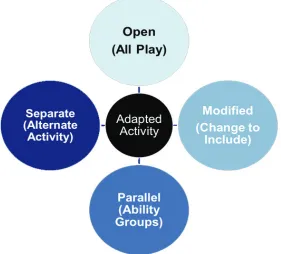
We will look at the Inclusion Spectrum Framework (ISF) developed by Ken Black and Pamela Stevenson (2011, Figure 2).
[image:14.595.63.344.429.683.2]The ISF shows various ways in which sport and physical activities can be presented and modified to ensure that every child is able to join in, learn and experience a certain level of achievement and success. It suggests four main ways of presenting sport and physical activity:
1. Open Activity:Everyone can play without the need to modify the activity.
2. Change to Include Activity:Everyone does the same activity but we incorporate a number of changes to support all children taking part. This method incorporates the widely known STEP and TREE models (please see factsheet 2).
3. Ability Groups Activity:Children are grouped according to ability and do the same activity or a modified version which meets their needs.
4. Separate Activity:Some participants work separately for a given time to develop a number of skills that will help them be more successful when they re-join the group.
5. Adapted Physical Activity/Disability Sport: We bring in activities, games or sports that are based on adapted physical activity or disability sport programmes.
It is important to note that, at times, to be able to set up these different environments, we may need more than one coach, but that on other occasions this can be achieved with one coach only. It will always take a bit of forward planning though… and even some quick thinking on your feet as we are faced with varying situations (i.e. weather, size of pitch, unusually high numbers, etc.), hence the value of trying to keep these models present in your mind at all times.
Recap of the TREE and STEP Models
The TREE and STEP models allow us to be more inclusive in our sessions by making activities easier or harder on demand. They also help us to modify and/or create new activities to work on something in a different way to avoid boredom, move children on, or when we need to work on something different but still want to use a relatively similar set up. It can also serve the purpose of creating completely new activities to enhance our coaching toolkit and activity bank.
The level of challenge can be raised or lowered in most activities and games. Although initially designed to enhance the inclusion of individuals with disabilities, the application of the TREE and STEP models which will help you to adapt your activities to suit the different levels of the abilities of the children you coach.
HOT QUESTIONS: THINK ABOUT THE FOLLOWING…
How inclusive are your sessions?
What key challenges do you face?
MY CHILD-PROOF COACHING CHECKLIST
Theme / Item I will start I will continue I will stop
make learning relevant to the children I coach
promote understanding of why
use a variety of practice methods
combine short and long term practice methods
have a clear idea of what games classification
my sport is in In my coaching I…
understand the main FGS of my sport and know how to work on them
provide opportunities for the children I coach to develop Gamecraft (FGS)
am inclusive and make sure all kids are engaged and get something from
COACHING IRELAND - A Unit of Sport Ireland
Tel: 061 202 895
www.irishsportscouncil.ie/Coaching-Ireland/
REFERENCES:
Abraham, A. and Collins, D. (2011).Effective skill development: how should athletes’ skills be developed? In Collins, D., Richards, H., & Abbott, A. (Eds), Performance Psychology: A Guide for the Practitioner, London: Churchill Livingstone. ( pp.207-230)
Lara-Bercial, S., Hetherington, N. and Hendrie, J. (2015). Developing Multi-skills in Sport Award. Glasgow: Sportscotland
Stevenson, P. and Black, Ken. The Inclusion Spectrum Framework (2011).