and bimanual rhythmic movement coordination: transfer is a function of the task dynamic. Experi-mental brain research, 233 (7). 2225 - 2238. ISSN 0014-4819 DOI: https://doi.org/10.1007/s00221-015-4292-y
Link to Leeds Beckett Repository record: http://eprints.leedsbeckett.ac.uk/1411/
Document Version: Article
The aim of the Leeds Beckett Repository is to provide open access to our research, as required by funder policies and permitted by publishers and copyright law.
The Leeds Beckett repository holds a wide range of publications, each of which has been checked for copyright and the relevant embargo period has been applied by the Research Services team.
We operate on a standard take-down policy. If you are the author or publisher of an output and you would like it removed from the repository, please contact us and we will investigate on a case-by-case basis.
Transfer of learning between unimanual and bimanual rhythmic movement coordination: Transfer is a function of the task dynamic
Winona Snapp-Childs1, Andrew D. Wilson2 and Geoffrey P. Bingham1
1
Department of Psychological & Brain Sciences, Indiana University 2
School of Social, Psychological and Communication Sciences, Leeds Beckett University
Send correspondence to (current address):
Winona Snapp-Childs
Department of Psychological and Brain Sciences Indiana University
1 Abstract
Under certain conditions, learning can transfer from a trained task to an untrained version of that same task. However, it is as yet unclear what those certain conditions are or why learning transfers when it does. Coordinated rhythmic movement is a valuable model system for
investigating transfer because we have a model of the underlying task dynamic that includes perceptual coupling between the limbs being coordinated. The model predicts that (1)
coordinated rhythmic movements, both bimanual and unimanual, are organized with respect to relative motion information for relative phase in the coupling function, (2) unimanual is less stable than bimanual coordination because the coupling is uni- rather than bi- directional, and (3)
learning a new coordination is primarily about learning to perceive and use the relevant
information which, with equal perceptual improvement due to training, yields equal transfer of
learning from bimanual to unimanual coordination and visa versa (but, given prediction (2), the resulting performance is also conditioned by the intrinsic stability of each task). In the present study, two groups were trained to produce 90° either unimanually or bimanually, respectively,
and tested in respect to learning (namely, improved performance in the trained 90° coordination task and improved visual discrimination of 90°) and transfer of learning (to the other, untrained
90° coordination task). Both groups improved in the task condition in which they were trained and in their ability to visually discriminate 90° and this learning transferred to the untrained condition. When scaled by the relative intrinsic stability of each task, transfer levels were found
to be equal. The results are discussed in the context of the perception-action approach to learning and performance.
2 1. Introduction
The acquisition of skilled performance generally depends on practice; more practice leads
to better performance. Also, there seems to be a high level of specificity in that performance is usually best when tested under the same conditions that were present during learning (e.g., Newell, Shapiro, and Carlton, 1979; Proteau, Marteniuk, and Le ́vesque, 1992). At the same
time, there is abundant evidence that the perception/action system is flexibly organized so that many actions can be skilfully executed despite changes in test conditions or modifications of the
task. A good example of this comes from handwriting. Merton (1972) showed that the shape and form of a person’s signature is largely preserved across changes in the effector system used to
produce the signature, an extension of the original use of handwriting by Bernstein (1967) to demonstrate ‘motor equivalence’. In line with this, one of the most prominent theories
concerning human motor control, Schema theory (Schmidt, 1975), used generality as its basis.
This apparent discrepancy between specificity and generality is vexing. How can learning be both specific and general? A number of solutions have been proposed (as seen in Keetch et al. 2005) dating back to Thorndike (1913) who theorized that it is the number of “identical
elements” between two tasks that dictates the degree of transfer. According to this, learning is
specific if the number of elements is low and, learning is general (i.e. learning transfers) if the
number is high. The difficulty lies in the ability to predict specificity or generality, i.e. how can one know (in advance) if learning will transfer to another task? Part of the problem comes from
finding a suitable definition of a task. In their review of the topic, Schmidt and Young (1987) noted the lack of a principled way to identify whether two movements are examples of different tasks or class of actions. The problem is generally solved post-hoc; when (positive) transfer of
3 transfer is interpreted to mean that they were different tasks. Solving this problem for prediction, rather than retro-diction, requires a way to formally define the structure of the perception-action
system assembled to perform a given action. Task-dynamics was formulated as a means for doing this (e.g. Beek and Bingham 1989; Bingham, 1988; 1995; Bingham, Schmidt, Turvey and
Rosenblum 1991; Kugler and Turvey 1987; Saltzman and Kelso 1987; Simko and Cummins 2010; Warren 2006). When the task-dynamic is well specified, then it is possible to make and
test predictions derived from the hypothesised mechanism about how learning should transfer.
Coordinated rhythmic movement is a standard model perception-action task for studying performance and learning, and the task dynamic has been modelled explicitly as a
perception-action system with terms in the equations representing the perceptual information and perception-action control variables involved (Bingham 2001, 2004a, b, Snapp-Childs et al. 2011). The model predicted results both from movement studies (e.g. Kay, Kelso, Saltzman and Schöner 1987;
Kay, Saltzman and Kelso 1991; Kelso 1984; Schmidt, Carello and Turvey 1990) and from perceptual judgment studies that had investigated both vision (Bingham, Schmidt and Zaal 1999;
Bingham, Schmidt, Shull and Collins 2001; Collins and Bingham 2001; Zaal, Bingham and Schmidt 2000) and proprioception (Wilson, Craig and Bingham 2003). It is this model that motivated the current study because it generates predictions about how learning one version of
this task should generalise to another version.
The basic phenomena of the rhythmic movement coordination task are well-known: people
can typically only produce two coordination patterns stably, 0° mean relative phase (in which the limbs oscillate so as to do the same thing at the same time) and 180° (in which the limbs
alternate). In addition, 180° is less stable than 0°; when the required movement frequency is
4 coordination) but not vice versa. Without training, other coordination patterns (such as the
intermediate 90° phase) are unstable with a reliable tendency to transition to 0° (Kelso 1984;
Kelso et al. 1986; Kelso et al. 1987). However, people can learn to produce initially unstable patterns either with feedback driven training (e.g. Wilson et al. 2010b) or with transformed
feedback displays which simplify the task (e.g. Kovacs et al. 2009a, b; Zanone and Kelso 1992a, 1992b, 1997). Studies on the learning of novel coordination patterns also found transfer.
Learning transfers to untrained and previously unstable coordination patterns (e.g. Kelso and
Zanone 2002), that are highly specific to the trained pattern. Improvement only transfers to the symmetry partners of the trained pattern. For example, improvement at 90° only transfers to 270°
and improvement at 135° only transfers to 225° (Zanone and Kelso 1997). Furthermore, the stability of the intrinsically stable coordination patterns (that is, 0° and 180°) or other novel
patterns is not affected.
The original Bingham model (2001, 2004a, b) was not explicitly set up to handle learning. However, the perception-action theory it instantiates can explain the pattern of transfer to
symmetry partners. The model is based on the premise that information guides the assembly of the movement patterns and the execution of actions. The model predicts that the system
producing coordinated rhythmic movements is organised with respect to the information for
relative phase, rather than relative phase per se. Learning a novel coordinated rhythmic movement is therefore primarily about learning to use appropriate perceptual information
(Wilson et al. 2010a) and the consequences of learning are constrained by the nature of this information. Wilson and Bingham (2008) demonstrated that learning to visually perceive 90° entails learning to use new information, either position or position plus velocity. That work also
5 not position (or position plus velocity). The information used to produce a learned 90°
coordination and (for example) a 180° coordination is different, and so learning fails to transfer
between these relative phases (Wilson, Snapp-Childs and Bingham 2010).
As far as relative direction is concerned, however, a coordinated rhythmic movement pattern and its symmetry partner are identical states with the only difference being which
oscillator is leading the other. The same is true for moving at 90° with one trained arm-leg combination versus another untrained combination. In each of these cases, the information is the
same and, thus to a large extent, learning one of these actions is learning the other. Training thus ‘transfers’. Information is thus the key factor that shapes learning and transfer of learning, and
transfer only occurs when the information that was learned is the same in both the trained and the transfer task. A similar idea was described by Langley and Zelaznik (1984) in terms of learning essential versus non-essential variables. However, they did not specify a way to identify which
were which ahead of time, and our analysis points specifically to information as the essential variable.
An intuition of how information might shape transfer comes from Wilson et al. (2010a)
who trained participants to become expert perceivers of 90° mean relative phase. This improved visual discrimination of 90° then allowed stable movement at 90°, without any training on the
movement task. We did not interpret these results as reflecting ‘transfer between a perceptual and a motor task’. Instead, we argued that both the perceptual judgment and movement tasks
required access to the same information and the training provided this common access. Nevertheless, the result following the perceptual learning reflected a type of transfer between tasks, from judgments to performance of actions. The latter entail additional dynamics that
6 unimanual versus bimanual rhythmic coordination tasks. The information is the same but the
action dynamics are different and thus, the stability.
In sum, learning to produce stable coordination patterns is largely about learning to detect the relevant information. There are multiple ways to facilitate the learning process. Wilson et al. (2010b) demonstrated that (augmented or extrinsic) feedback is required to learn 90°. The
feedback was a visual “hot/cold” signal which activated when the participant was producing 90° within a certain range of accuracy. There are, of course, other ways to provide feedback.
Auditory feedback about the relative positions of the hands or joints has been shown to be effective in enabling learning of 90° (de Boer et al. 2013). Another way to provide feedback is
by using Lissajous figures (for example, see Swinnen, De Pooter and Delrue 1991). Lissajous figures are a very powerful tool to enable performance of otherwise difficult tasks (for example, see Kovacs et al. 2009a). However, they do not actually enable learning of 90° (again, see
Kovacs et al. 2009a) unless the presence of the Lissajous figure is faded during the learning process (Kovacs and Shea, 2011). Without this fading, people become dependent on the
augmented feedback, failing to develop perceptual sensitivity to the naturally occurring information that can specify a 90° coordination, and thus, are unable to produce the trained movements without the Lissajous figure. Our previous work (Wilson et al. 2010a) showed that
people do not become dependent on the hot/cold feedback signal. Instead, the evidence shows that what the feedback does is signal when information specifying 90° coordination (in contrast
to 0° or 180°) is available and thus, it allows participants to learn to detect the new information.
Another variation in coordinated rhythmic movements is whether the required movement is unimanual or bimanual. Many studies have investigated bimanual coordinated rhythmic
7 pattern of key stability characteristics are preserved when the coordination is between two people (e.g. de Rugy et al. 2006; Schmidt et al. 1990; Temprado et al. 2003; Temprado and Laurent,
2004), or between a person and a computer display (e.g. Wimmers et al. 1992; Buekers et al. 2000; Wilson et al. 2005a, b, 2010a, b). These latter cases are called visual coordination. A
single actor is responsible for controlling only one of the oscillators and the two oscillators interact or are coupled visually. In the human-computer case, the coupling between the two oscillators is uni-directional because the computer does not perceive or react to the human.
However, the pattern of stabilities and instabilities (that is, the transition phenomena) of the bimanual task remain essentially the same. Accordingly, the visual (unimanual) and bimanual
versions are essentially the same task. However, unimanual coordination with uni-directional coupling exhibits weaker stability while preserving the overall patterns of stability.
Snapp-Childs et al. (2011) modified the Bingham model of bimanual coordination to
make the coupling unidirectional and then tested the effects of this change. The primary consequence was that coordination stability in the model was diminished. Simulations of the
bimanual model, for example, show that 180° movements remain stable with increases in frequency up to ≈3 Hz (matching empirical data, e.g. Kelso 1984; Kelso et al. 1986; Kelso et al.
1987). Simulations of the unimanual model showed that 180° movements only remained stable up to ≈1.5 Hz, again matching the empirical data (Snapp-Childs et al. 2011). Other than this, the
unimanual model produces all the same coordination phenomena as the bimanual model. The
coupling function is of the same form and entails the same information (the relative direction of motion).
As shown by Wilson and Bingham (2008) and Wilson et al (2010), learning to perform
8 information used to produce stable 90° movement. The original Bingham model, in both its bimanual and unimanual versions, successfully simulated coordinative movement at 0° and 180°
and transitions between them. However, the information represented in the coupling function of the model has to be changed to model 90° coordination. Bingham and Snapp-Childs (in
preparation) extended the original Bingham model to account for patterns of performance in the learning of 90° coordination. The driver in the original model was a normed velocity. The driver in the new model is a normed position.1 The models include hypotheses about perceptual
information variables and the hypothesis in the extended model is that participants learn to perform 90° coordination, in part, by learning to perceive the positions of the oscillators, whereas
the original model hypothesized that the velocities were perceived. Just as in the original model, bimanual and unimanual versions entail the same information variables and differ only in
whether the coupling is bi-directional or uni-directional.
The current experiment
Coordinated rhythmic movements exhibit a pattern of stability that emerges from a
perception-action task dynamic in which the information for relative phase provides much of the
structure. Learning a novel coordination pattern entails perceptual learning of new information that specifies the coordination and the learning only transfers to a symmetry partner or a novel
limb combination because the relevant information is the same. In the unimanual and bimanual versions of the tasks, the information remains the same (even though the coupling functions are
uni- and bi-directional, respectively) so these are, therefore, treated as examples of nearly (but obviously not entirely) the same task dynamic (Snapp-Childs et al. 2011). Our previous work
1 The normed forms of these state variables in the dynamics are those appropriate to model visual event perception
9 (Wilson et al. 2005a, b, 2010a, b) has assumed this to be this case, but we have never tested it empirically. Therefore, in the current study, we trained two groups of participants to move at 90°
either unimanually or bimanually, respectively. Participants used either one or two joysticks to control either one or two dots on a computer screen so as to move them at 90° to one another (in
the unimanual case one dot was controlled by the computer as a simple harmonic oscillator). We measured learning and also transfer of learning between unimanual and bimanual versions. We predicted that learning should indeed transfer between the two versions because the information
learned is the same. To confirm that it was the perceptual information that was learned and that this is what supports the predicted transfer, we also tested the visual perception of mean relative
phase at 90° (Wilson and Bingham 2008; Wilson et al. 2010a). Participants were asked to identify displays showing 90° in a 2 alternative forced choice paradigm (2AFC) and we measured thresholds for the required difference in displays. We predicted that practice of the
action tasks should be associated with lower perceptual thresholds for the trained relative phase.
Finally, Snapp-Childs et al. (2011) showed in model simulations and confirmed with data
that performance in the uni-manual tasks is inherently less stable than in the bi-manual tasks because the coupling is uni-directional instead of bi-directional. Thus, we must expect the level of improvement in performance, after equivalent amounts of training, to be less in the
uni-manual task than in the bi-uni-manual task. The same must be expected in tests of transfer. Thus, measured amounts of transfer from uni-manual to bimanual and visa versa must be adjusted by
the decrement in performance to be expected for the uni-manual as compared to the bi-manual task. We will measure the difference in performance (as expected due to the inherent difference in stability) as the proportion of the respective amounts of improvement in trained performance
10 adjust portions between transfer and trained performance. The prediction is that the adjusted
transfer levels should be equal.
2. Method
2.1 Participants
Fourteen adults (18-35 years old) participated in this study. All were right-handed, had normal or corrected-to-normal vision and were free from any known neurological defects or
motor disabilities. All participants were naïve to the experimental questions and their 90 relative
phase production was worse than their 0 and 180 relative phase production prior to training.
Ethical approval was granted by the Institutional Review Board at Indiana University, Bloomington.
2.2 Procedure
Participants performed seven separate sessions (see Table 1). Participants performed all sessions on a 20” iMac which was located 70 cm from the participants and was connected to one or two Logitech Force 3D Pro joysticks; the joysticks’ force feedback feature was disabled. The
computer presented a display2 of two white dots, one above the other, moving horizontally across a black background (screen refresh rate 60 Hz, resolution 1024x768). The vertical position of
both dots was fixed, but the horizontal position of either one or both dots, depending on condition, was controlled by the horizontal position of the joystick(s). The mapping of
2 All displays were presented and controlled by a custom Matlab toolbox written by ADW and incorporating the
11 joystick(s) to screen amplitude was set so that required amplitude on the screen did not entail
hitting limits of the joystick range of movement.
During the Baseline and Post-Training assessment sessions, participants performed three different tasks in the order described. In the Unimanual task, participants were shown an 8s
demonstration of 0 relative phase (two dots moving in the same direction at the same time).
Participants then performed one block of five 20s trials in which the computer controlled the motion of the top dot (0.75 Hz frequency, 300 pixels (~11.5 cm) amplitude) while they
controlled the motion of the bottom dot with their dominant hand. Participants were instructed to
move the joystick in a smooth, side-to-side, movement to produce 0. The first trial in the block
was practice and was not analyzed. This procedure was then repeated for 180 and 90 relative
phase. These data were used to be sure that none of the participants could already perform 90° at
a level equivalent to 0° or 180° and could take part in the learning study.
Next, in the Bimanual task, participants were shown another 8s demonstration of 90
relative phase and then performed one block of five, 20s duration, trials in which they controlled the horizontal motion of both dots (bottom dot controlled by the participant’s dominant hand).
Participants were instructed to move the joysticks in a smooth, side-to-side, movement to
produce 90 while an external metronome played at 45 beats-per-minute (0.75 Hz).
Bimanual movements introduce an additional aspect: muscle homology. Movements
which use homologous muscle groups at the same time (e.g. mirror symmetric movements in the fronto-parallel plane) are typically referred to as in-phase and are more stable than those which
12 interacts with the allocentric constraint of whether the motion is in the same direction or not to affect overall coordination stability (Swinnen et al. 1997; Swinnen et al. 1998). However, a 90°
coordination does not entail this interaction. Producing 90° bimanual movements produces 90° or 270° visually where 270° is the symmetry partner of 90° and, thus, these are identical states
with respect to the perceiver-actor. For the current study, we were only interested in learning and transfer of learning at 90°, where egocentric and allocentric constraints are not pitted against one another directly. We did, therefore, not assess changes in bimanual performance at 0°/anti-phase
or 180°/in-phase, and focused only on 90° where the interaction of these constraints does not affect the data. We did, nevertheless test 0° and 180° at baseline so we could use them to
establish the relative lack of ability to produce 90° coordination before training.
Finally, in the Judgment task, participants performed a series of two-alternative forced
choice (2AFC) judgments about 90. 2AFC is a standard psychophysical method for determining
perceptual thresholds that we have used with this task before (Wilson et al. 2010a; Wilson and
Bingham, 2008). Each trial consisted of a 4s demonstration trial of 90 and a pair of successively
presented stimuli (two dots moving harmonically on the screen at some mean relative phase, for 4s at 0.75Hz). The motion of both dots was centered at the screen center, with an amplitude of
300 pixels (~11.5 cm). One of each pair showed two dots moving at the target relative phase (90°) and the other was “different” from 90°; the participants’ goal was to choose which one of
the displays, first or second, was 90°. The magnitude of the “different” displays was determined using a transformed 1-up/2-down staircase procedure, using a step size ‘up’ of 10° and a stop rule of 8 reversals. Step size ‘down’ was fixed according to Table 5.1 of Kingdom and Prins
13 not the last choice was correct or incorrect; so, the number of trials that each participant
experiences varies as the pattern of responses varies. No feedback about performance was given.
After the Baseline session, participants were trained to produce 90° either unimanually or bimanually. The first group of seven participants was trained to produce 90° unimanually. In this case, the computer controlled the motion of the top dot while the participant controlled the
(horizontal) motion of the bottom dot. The second group of seven participants was trained to produce 90° bimanually. These participants controlled the (horizontal) motion of both the top
and bottom dots; unlike during the baseline and post-training sessions, there was no external metronome. During each of the five training sessions, participants performed twelve different
(20s duration) trials where their goal was to produce 90°. Participants received coordination feedback for all trials except for every fourth trial in each session; feedback was removed for every fourth trial to encourage participants not to become dependent on it (as it would not be
present during posttest) (see Kovacs et al. 2009b). The dot(s) which were under their control changed color from white to green when performance was within a given error bandwidth of the
target relative phase. This error bandwidth was reduced in each successive training session; the bandwidth during the first training session was 30° and decreased 5° (to 25°, 20°, 15° and 10°)
during each subsequent training session (as per Wilson et al. 2010).
2.2.1 A note on terminology
All of the action tasks included a display of two dots at all times. There was therefore
14 participants to maintain the coordination (Wilson et al. 2010a). During training only, we
provided visual feedback about the success of the coordination being performed. This feedback is
in the form of a color change that acts as a ‘hot/cold’ signal to the participant, and has been shown to drive learning successfully (Wilson et al. 2010b). We are therefore using feedback
(present only during training) to improve the detection of coordination information (present throughout but not reliably detected at the beginning) and it is this latter learning that we expect
to transfer between unimanual and bimanual movements.
2.3 Data Analysis
For the action tasks, a 60 Hz position time series for both the computer- and person-controlled dots was recorded. The time series data were filtered using a low-pass Butterworth
filter with a 10 Hz cut-off frequency and numerically differentiated using a central difference method to produce a velocity time series. For each trial, a continuous relative phase time series
was computed as the difference between the arctangent of each dot’s velocity divided by position with requisite corrections for the quadrants of the phase plane. From each relative phase time series (trial), we computed proportion of time-on-task. Proportion of time-on-task is the
proportion of each continuous relative phase time series (trial) that fell within the range of the target phase + a tolerance (set to 20° for all sessions, and, in addition, to the error bandwidth in
15 averaged proportion of time-on-task, for each participant, over the trials performed in a given
condition3.
For the judgment tasks, the computer recorded the responses (“correct” or “incorrect”) in relation to the relative phase of the “different” display that was shown. We separately averaged
the difference from 90° of relative phases at which reversals in the staircase procedure occurred for the “different” phases that were greater than 90° and those less than 90°, excluding the first
reversal, for each participant. We then averaged those thresholds for perceiving 90° for each
participant.
3. Results
INSERT FIGURE 1 ABOUT HERE
3.1 Baseline performance
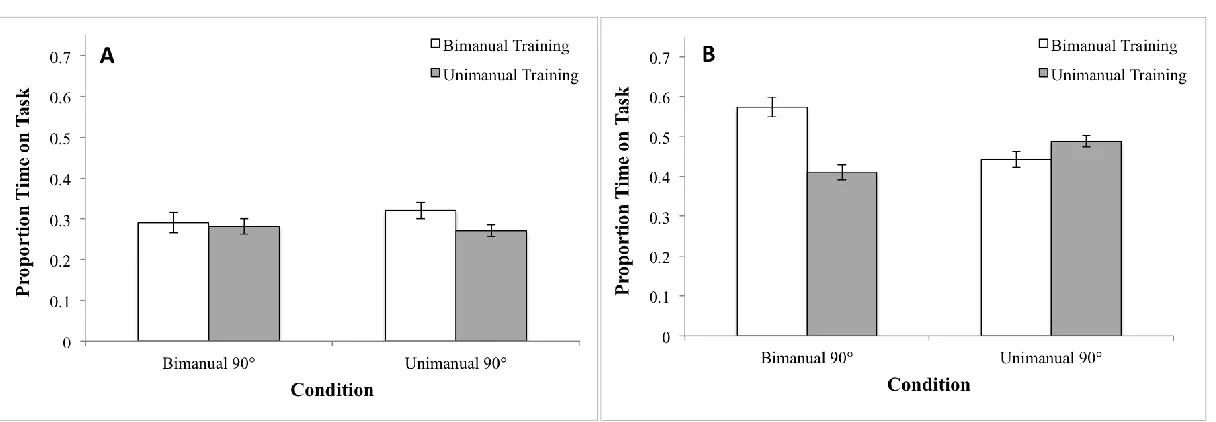
First, we verified that the groups were similar before training with respect to their 90°
performances (Figure 1A shows the group means at baseline for unimanual 90° and bimanual 90°). To do this, we first performed a repeated-measures ANOVA with the following factors and levels: Group (Unimanual Training, Bimanual Training) as a between subject factor and
Condition (Unimanual 90°, Bimanual 90°) as a within subject factor. The ANOVA yielded no significant factors (Group × Condition: F(1,12) = 0.40, p = 0.54, Group: F(1,12) = 0.19, p = 0.67,
Condition: F(1,12) = 0.09, p = 0.77).
3 Other coordination researchers rely on measures of mean error and variability. However, the hallmark of human
16 Next, we used the confidence interval approach to the two one-sided test procedure to infer equivalence. In this procedure, equivalence is established if the designated confidence
interval (for = 0.05, the CI = (1-2)×100 = 90%) for the mean difference between groups is
contained within the equivalence margin or (-, ) interval (Walker and Nowacki, 2011). For this
experiment, the mean difference between groups was obtained by subtracting the Unimanual training group’s performance from the Bimanual training group’s performance (so negative
numbers reflect the Unimanual group being superior to the Bimanual group). The (-, ) interval
was set at (-0.125, 0.125). We chose this (-, ) because this approximately reflects the
difference between 0° and 180°; again, 0° is well established to be more stable than 180° and, usually between 0.10 and 0.15, for the total proportion measure. For both the unimanual 90° and
bimanual 90° conditions, we report the mean difference between groups and the confidence intervals as follows: 0.049 ± 0.075 (-0.026, 0.124) and 0.009 ± 0.074 (-0.065, 0.083),
respectively. Therefore, performance levels were equivalent between the training groups at Baseline in both unimanual 90° and bimanual 90° conditions.
INSERT FIGURE 2 ABOUT HERE
3.2 Learning and transfer
Next, to examine how training mode influenced performance of 90° we analysed average
time-on-task using a three-way mixed design ANOVA with the following factors and levels: Group (Unimanual Training, Bimanual Training) as a between subject factor and Condition (Unimanual 90°, Bimanual 90°) and Session (Baseline, Post-Training) as within-subject factors.
17 significant three-way (Condition by Session by Group) interaction (F(1,12) = 7.03, p < 0.05) as well as a main effect of Session (F(1,12) = 77.3, p < 0.01). No other main effects or interactions were significant (all p’s >.05). The three-way interaction indicates that the groups changed
unequally, from before to after training, for the unimanual 90° and bimanual 90° conditions.
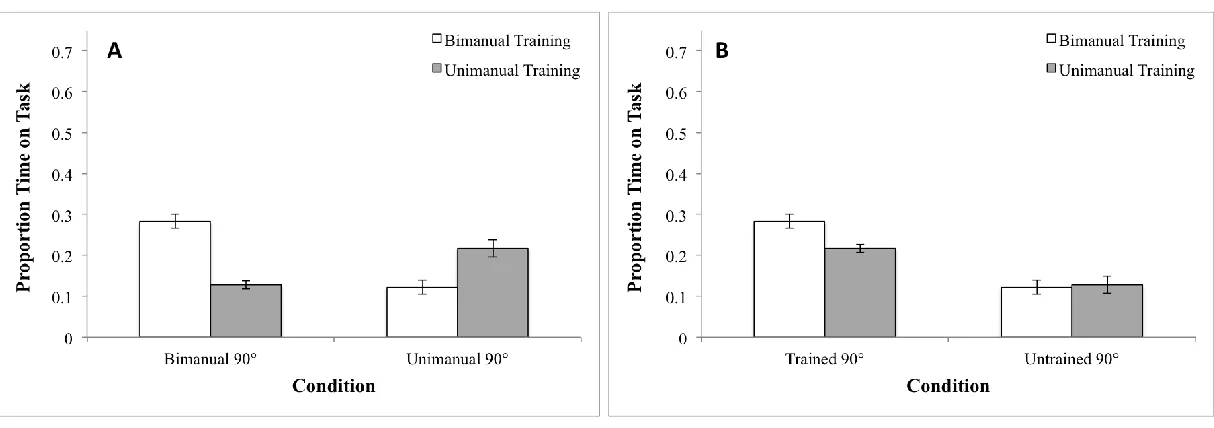
To illustrate the source of this interaction, we plotted improvement in performance by
performance condition (Figure 2a) and training condition (Figure 2b). The Trained data entail post testing using the task in which participants trained. So, Trained data are the difference
scores (post-test minus baseline) for Unimanual 90° performed by the Unimanual Training group and for Bimanual 90° performed by the Bimanual Training group. The Untrained data entail post
testing using the transfer task in each case. The Untrained data are the difference scores for Unimanual 90° performed by the Bimanual Training group and for Bimanual 90° performed by the Unimanual Training group. As expected given the difference in stability intrinsic to the
respective tasks, the Bimanual training group improved more at Bimanual 90° than the Unimanual group did at Unimanual 90° (the Trained conditions). On the other hand, the mean
difference scores were the same for the two groups in the Untrained 90° conditions. To confirm this, we tested for equivalence using the two one-sided test procedure. The mean difference between groups and 90% confidence intervals for the trained 90° and untrained 90° were: 0.066
± 0.078 (-0.012, 0.144) and -0.006 ± 0.077 (-0.083, 0.071), respectively. Thus, equivalence for the Trained 90° condition was not established but equivalence for the Untrained 90° was
established.
However, the latter scores (that is, the difference scores for Untrained) do not provide a measure of transfer. This requires the relevant proportions of untrained and trained difference
18 group) and untrained bimanual to trained unimanual (transfer for the unimanual training group). Respectively, these yielded 0.45 and 0.56. However, to control for the known difference in
inherent stability of unimanual and bimanual performance, these proportions must be adjusted by the proportion of unimanual trained to bimanual trained difference scores, which was 0.77. (That
is, unimanual only does 77% as well as bimanual.) So, 0.77 x 0.56 = 0.43. So, the two transfer amounts were 45% and 43%. Thus, as predicted, the measures of transfer, adjusted for the inherent difference in stability of the two tasks, reveal equal transfer in the two cases, that is,
from unimanual to bimanual and from bi-manual to unimanual. This is the main result of the study.
INSERT FIGURE 3 ABOUT HERE
3.3 Judgment thresholds
The perception-action approach to coordination predicts that learning primarily entails
learning to perceive the target novel relative phase, which then allows stable coordinated actions (Wilson et al. 2010a). We hypothesised that this perceptual learning underpins the observed
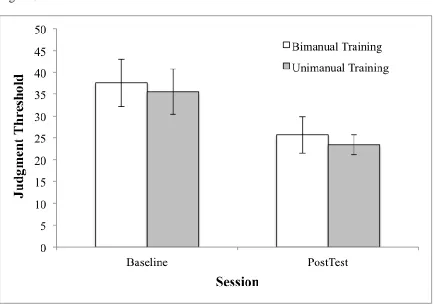
transfer of learning between the training conditions. To test this, we measured 90° visual judgment thresholds at Baseline and Post Training (note there was no training on the judgment task). These data are shown in Figure 3. We ran a two-way mixed design ANOVA with Group
(Unimanual Training, Bimanual Training) as a between subjects factor and Session (Baseline, Post-Training) as repeated measures. As shown in Figure 4, there were no group differences in
19 ability to visually perceive 90° after training, we tested for equivalence using the two one-sided
test procedure. The (-, ) interval was set at (-10°, 10°). The mean difference between groups
and 90% confidence intervals for the 90° judgment threshold at posttest was: -2.315° ± 5.663°
(-7.978°, 3.348°). Thus, equivalence was established for 90° judgment thresholds at post test.
3.4 Relating perceptual judgments and coordination performance
Initially, we hypothesised (1) that after equivalent amounts of training, the level of improvement in performance would be less in the unimanual task than in the bimanual task (due to differences
in intrinsic stability), and (2) that perceptual learning underpins the transfer of learning. We found equal perceptual improvement and unequal improvement in coordination performance as expected. Performance of the unimanual task is less stable not because of any difference in
information or perceptual ability, but because the coupling in the task dynamic is uni-directional rather than bi-directional as it is for the bimanual task. Accordingly, we also expected that there would be a stronger relationship between performance at 90° and judgment thresholds for the
bimanual task than for the unimanual task, although on average, there should be no difference between Trained and Untrained because the information and perceptual ability are the same. To
examine these possibilities, we performed Pearson correlations of performance at 90° and the 90° judgment thresholds separately for each training group and task. (The tasks in the context of training groups become Trained and Untrained.) Here we also expected all correlations to be
negative because the coordination performance measure goes up with training while the perceptual threshold measure goes down.
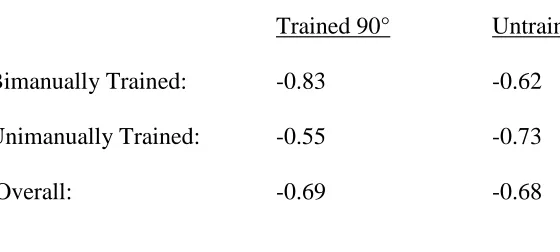
The resulting Pearson r’s are shown in Table 2. As expected, the r’s for the bimanual task
20 the different tasks were factored out by averaging over them) there was no difference in the overall r’s for Trained and Untrained, respectively. All tests revealed significant relations
between the judgments and the coordination performance levels accounting for about 40%-70% of the variance.
4. Discussion
We suggest that a task dynamic model can be used to predict the extent to which learning
will transfer among tasks with related task dynamics. (For task dynamics, see Beek & Bingham, 1991; Bingham, 1988; Feldman et al., 1990; Kugler & Turvey, 1987; Saltzman & Kelso, 1987). We tested this idea in the context of an extensively studied type of task, namely, rhythmic
movement coordination (e.g. Kelso, 1984). Both bimanual and unimanual versions of this general type of task have been modelled using a perception-action task dynamic in which the
movements are perceptually coupled (e.g. Snapp-Childs et al., 2011). In addition, previous studies have shown that novel patterns of coordination, i.e. 90° relative phase, must be learned (Wilson et al., 2010b; Zanone & Kelso, 1992). And, in this context, it has been shown that the
learning of a new coordination pattern is largely a matter of learning to perceive that
coordination (Wilson et al. 2010a). So, the task dynamic for a to-be-learned coordination pattern
is different in respect to perceptual information in the coupling function that specifies the relevant coordinative mode: for instance, 90° in contrast to 0° or 180° (Snapp-Childs & Bingham, in preparation; Wilson & Bingham, 2008). In other words, learning the new
21 accomplished, learning is predicted to transfer to other versions of the coordination task that include the same information variable in the respective task dynamics. Thus, the learning of a
90° bimanual coordination task is predicted to transfer to the performance of a 90° unimanual coordination task and visa versa.
Bimanual coordination and unimanual coordination are different tasks as shown by the fact
that they exhibit differences in their respective intrinsic stability (Snapp-Childs et al., 2011). The task dynamic for unimanual coordination entails a uni-directional coupling function whereas that
for bimanual coordination entails a bi-directional coupling. The former is weaker and thus the coordinative modes exhibited in a unimanual coordination task are less stable than those
exhibited in bimanual tasks. Of course, these differences must be taken into account when evaluating the amount of transfer between these tasks when a new coordinative mode has been learned. For a given amount of training, less improvement in performance can be expected for
the less stable task, namely, unimanual coordination as compared to bimanual coordination. Likewise, when learning transfers between these tasks, the respective level of performance
should be expected to be lower for unimanual coordination.
We set out in the current study to test these predictions. Over multiple sessions, we trained two groups of participants to produce 90° coordination, one group in a unimanual task
and the other in a bimanual task. Then, we measured both learning and transfer of learning. For learning, we measured performance in the trained task and judgment thresholds for the visual
discrimination of 90°. For transfer, we measured performance in the other, untrained task. Both groups improved in their ability to produce 90° in their trained task, although Bimanual more so than Unimanual as expected because of the difference in the intrinsic stability of the tasks. Both
22 derived measures of transfer of learning and found that the groups exhibited equal amounts of transfer. This derivation required that the differences in the intrinsic stability of the tasks be
taken into account.
When we evaluated the learning that had occurred as a result of the multi-session training, we found equal improvements in perceptual thresholds for both training groups, but
unequal improvements in coordination performance levels. The improvement was greater for the bimanual training group performing the bimanual coordination task than for the unimanual
training group performing the unimanual task. Direct comparison of improvements in perceptual judgments and in coordination performance yielded stronger correlations for the bimanual group
and task than for the unimanual group and task. This pattern of results had been expected. Equal improvements in ability to discriminate 90° perceptually were not expected to yield equal improvements in performance of 90° in the two tasks, unimanual and bimanual. The respective
task dynamics did entail the same information variable but different coupling functions that yield differences in performance level. The unidirectional coupling in unimanual coordination is
weaker and results in less stable and thus, poorer performance than that produced by the stronger bidirectional coupling in bimanual coordination.
Thus, the different correlational results were expected to reflect the tasks (and the
differences in coupling functions) and not the training groups as such, because the training groups entailed equivalent learning of the same information variable. To test this, we performed
the correlational analyses on the untrained data with the expectation that stronger correlations would be found for the bimanual as compared to the unimanual task. In the untrained data, the bimanual task was performed by the unimanual training group and the unimanual task was
23 confirm that the differences in these correlations between improvements in perceptual thresholds and improvements in coordination performance reflected differences in the stability of the tasks
(and thus, the nature of the coupling functions in the task dynamics), we performed the correlations on the combined data of the two training groups but separately in the case of the
trained data and the untrained data. This controlled for the difference in tasks but preserved the commonality of the information. The prediction was that the correlations would be of equal strength. This was indeed the result. In all cases, the correlations were significant and showed
that the perceptual learning underwrote the improvements in performance of the new coordination.
Thus, we were successful in predicting the relative levels of transfer of learning in the context of these two rhythmic coordination tasks using the task dynamics underlying the two tasks to make the predictions. The task dynamics conditioned the levels of transfer in two ways.
First, transfer was conditioned by the perceptual information variables incorporated into the coupling functions in the task dynamics for both tasks. Both the information used to perform
skilled coordination at 0° and 180° and new information used to perform learned coordination at 90° were common to both unimanual and bimanual tasks. Progressively learning to discriminate and perceive new information enabled participants to progressively improve in their performance
of 90° coordination in both unimanual and bimanual tasks. The performance of coordination tasks cannot, however, be reduced to the ability to perceive (contra Meschner et al., 2001)
because actions entail task dynamics that include, but are more complex than, mere perceptual information. So, second, transfer performance was conditioned by the intrinsic stability of each task and this is determined, in part, by the nature of the coupling. In these cases, the coupling in
24 the respective transfer performance was bound to be less good. This difference in stability must
be taken into account when evaluating the amount of transfer of learning.
So, transfer of learning occurs when the composition of the underlying task dynamic does not change, and in the case of coordinated rhythmic movement this dynamic critically involves perceptual information. When the information is different, the composition of the dynamic is
changed, and the two instances are then different tasks and learning does not transfer. When the information remains the same and there are not major alterations to the organization of the
dynamic, as in the current experiment, then the task remains the largely the same and transfer can occur (although as always the relative level of performance reflects the relative levels of stability
exhibited by the respective task dynamics). The details of learning itself depend on the alteration to the task dynamic; here, a change in the perceptual information. As shown in earlier studies, learning to perform 90° coordination entailed perceptual learning, learning to detect the
information required to perceive and control 90° coordination. The model shows that this
entailed a change from detecting velocity of movement to detecting the evolving position of each
oscillator as well as a change from detecting consistently same or opposite directions of movement to detecting a balance of both. The details of transfer depend on these changes to perception. Improved visual discrimination of 90° allowed transfer to occur but the magnitude of
transfer was incomplete, equal to about 40%-50%. This may have reflected the relatively modest magnitudes of improvement exhibited by the perceptual learning. Post-training visual perceptual
25 improvement may well contribute, when combined with the difference in stability of the
bimanual and unimanual tasks, to the magnitudes of transfer.
Finally, the understanding developed in the current study of what occurs during learning to promote transfer required theoretically motivated models of the task at hand such as the various versions of the Bingham model (bimanual 0°/180°: Bingham, 2001, 2004a, b; unimanual
0°/180°: Snapp-Childs et al. 2011; bimanual and unimanual 90°: Bingham and Snapp-Childs in preparation). These models contain specific hypotheses about mechanism that, in turn, enables us
to use them to make successful predictions about learning and transfer. The perception-action task dynamic models (and the theory driven research program that generated them) stand as
26 5. Appendix: Additional measures of coordination performance
Measures of mean error and variability have been used in some studies to evaluate
coordination performance and learning. We report these measures and show they are difficult to interpret in the current context in contrast to the proportion of time-on-task (PTT) measure that we have used. Similar to Maslovat and collaborators (Maslovat et al., 2010), we computed the
relative phase distributions windowed at intervals of 20° ranging from 0° to 180° and produced a histogram showing where participants were spending time when trying to move at 90° both
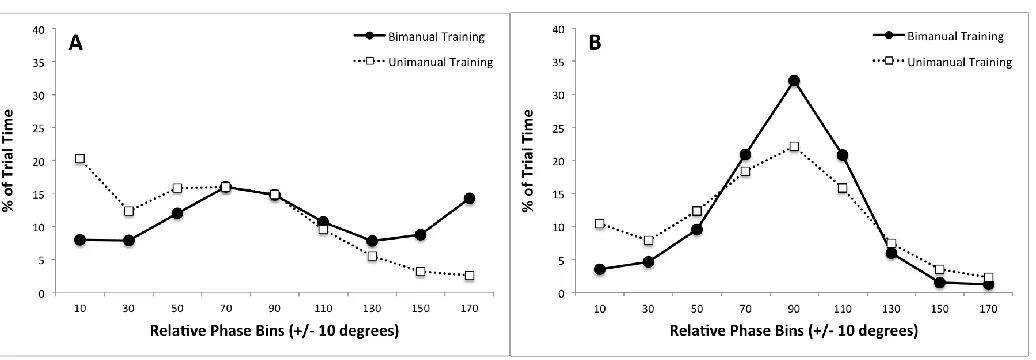
before and after training (see Figures 4A and 4B). We used this graph to interpret the mean error and variability.
The problem for the measures is as follows. As participants begin to try to perform 90°
coordination, they often fail to remain in the neighbourhood of 90° and transition to spend significant time at either 0° or 180°. As they learn and improve in performance, they succeed
better in staying near or at 90° (as shown directly by the PTT measure) although they may still occasionally transition to 0° or 180°. There are individual differences in whether a performer tends to transition either to 0° or to 180° or to both. If it is both rather than just 0° or 180°, for
instance, then the resultant overall variability can be increased. However, this is not relevant to the level of success in performing the task, which is to stay at or near 90°. It is all the same if the
movement is at 0° or 180° instead of 90°. Also, if the performer spends similar amounts of time at 0° and at 180°, then the mean can be 90°, whereas if the performer transitions more reliably to
0°, then the mean can biased towards 0°. Again, these differences are not of direct relevance to the success in performing the task. For these reasons, measures of mean error and variability are
27 First, we describe the relevant measures of mean error and variability.
5.1 Data analysis
Relative phase is a circular variable (the distribution of possible values lies on a circle) that creates a problem for computing standard means and standard deviations. Circular statistics
provide trigonometric solutions to these problems by treating each data point in a relative phase time series as a vector of unit length and an orientation that matches the relative phase at that time point. Mean direction is effectively the result of concatenating these vectors and computing
the orientation of the vector between the origin and the tip of the final data point vector. The mean vector length or uniformity (U) (Fisher, 1993) measures the variability as the length of the
resultant vector divided by the number of data points (and which therefore ranges from 0 to 1).
This latter was transformed into a linear variable (SD) that varies between 0 and infinity using
the following transformation:
SD
y
= -(
2logeU)
1 25.2 Results
First, to examine performance before and after training we computed relative phase distributions (that is, the proportion of time spent at relative phases between 0° and 180° using 20° bins) by condition (Unimanual 90°, Bimanual 90°) and separated by group. We illustrate the
resulting individual differences in Figure 4. When performing the Bimanual task at Baseline, as expected, neither training group consistently produced a relative phase at or near 90°. As shown
28 tended to transition to and spend time at 0°. This was merely an individual difference between the groups that was, however, reflected in the pattern of results for the mean direction at
Baseline. (Note that individual differences also appeared in results at Baseline for the
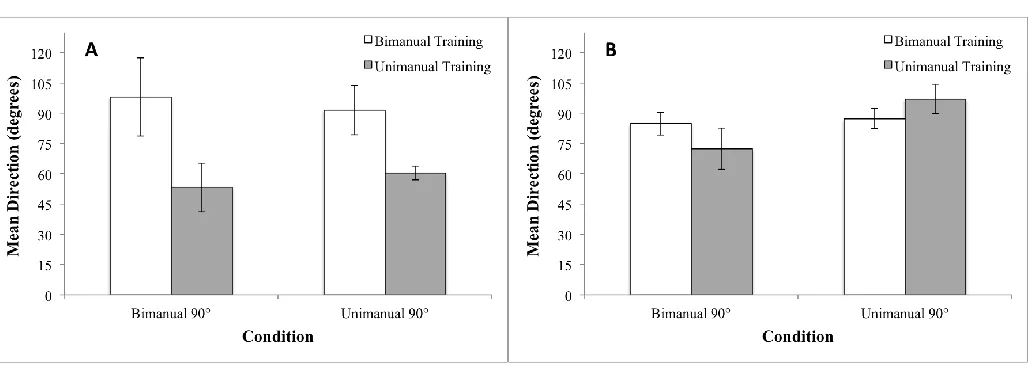
Unimanual task.) As shown in Figure 5A, the training groups exhibited significant differences in
mean direction that reflected the individual differences. To analyse the mean direction, we used a two-way mixed design analysis of variance (ANOVA) with Group (Unimanual Training,
Bimanual Training) as a between subjects factor and Condition (Unimanual 90°, Bimanual 90°)
as a within subjects factor. The result was a significant main effect of Group (F1, 12 = 4.98, p<.05). However, this difference was not relevant to the level of success in performing the task
to be learned. Accordingly, we had found no differences when performance was evaluated using the PTT measure of success in performing the 90° task.
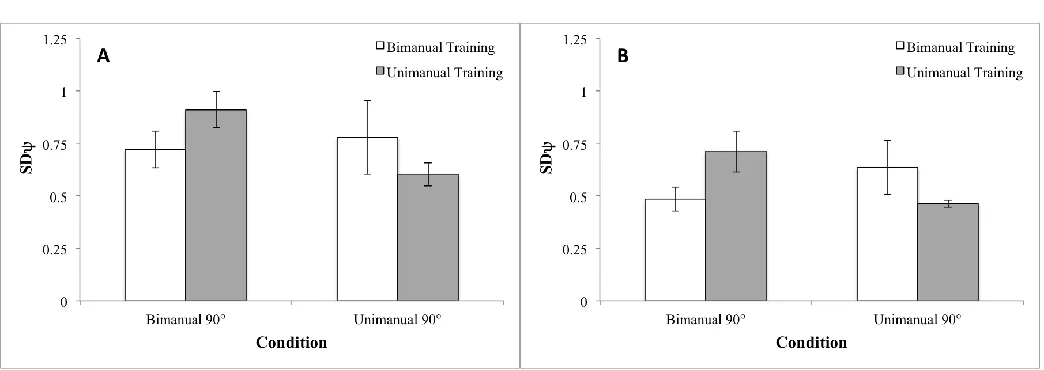
We used the same ANOVA design to analyse SD and found no significant main effects
or interactions. This indicated that there was no difference in consistency between the groups at
baseline as shown Figure 6A. (Note that there could have been a difference if participants in one of the groups had tended to transition equally often both to 0° and to 180°, but this difference, if
significant, also would not have been relevant to the evaluation of success in performing the task to be learned.)
Next, we analysed mean direction and SD at Post-test. For mean direction, as shown in
Figure 5B, there were no significant main effects or interactions. However, as shown in Figure 4B, the Unimanually trained group still spent more time at 0° (in the Bimanual task) while the
bimanually trained group spent more time at 90°. This yielded a result in the analysis of SD
where there was a significant group by condition interaction (F1, 12 = 7.82, p< 0.02) as shown in
29 12 = 13.50, p< 0.05), but not for mean direction. Nevertheless, both measures must be taken into account when evaluating success in learning this task. The reason is that stable but highly
inaccurate performance can result from spending time only at 0° or only at 180° and apparently accurate but highly unstable performance can result from spending equal time at 0° and at 180°.
So finally, using the two measures (mean direction and SD), it remained unclear how to
evaluate the relative transfer of training, appropriately scaled by intrinsic differences in stability between the tasks. PTT measures the goal of the learning task directly, providing a single measure of success in performing the 90° task. It also yielded good measures of transfer. Thus,
30 6. Acknowledgments
31 7. References
Beek PJ, Bingham GP (1991) Task-specific dynamics and the study of perception and action: A reaction to von Hofsten (1989). Ecol Psychol 3(1): 35-54
Beek PJ, Peper CE, Daffertshofer A (2002) Modeling rhythmic interlimb coordination: Beyond the Haken-Kelso-Bunz model. Brain Cognition 48:149-165
Bernstein NA (1967) The co-ordination and regulation of movements. Pergamon Press Oxford, England
Bingham GP (1988) Task-specific devices and the perceptual bottleneck. Hum Mov Sci 7(2): 225-264
Bingham GP (1995) The role of perception in timing: Feedback control in motor programming and task dynamics. In: Covey E, Hawkins H, Port R (Eds.) Neural representation of temporal patterns, Plenum Press, New York, pp 129-157
Bingham GP (2001) A perceptually driven dynamical model of rhythmic limb movement and bimanual coordination. In: Proceedings of the 23rd annual conference of the cognitive science society. Lawrence Erlbaum, Hillsdale, pp 75-79
Bingham GP (2004a) A perceptually driven dynamical model of bimanual rhythmic movement (and phase perception). Ecol Psychol 16:45-53
Bingham GP (2004b) Another timing variable composed of state variables: phase perception and phase driven oscillators. In: Hecht H, Savelsbergh GJP (Eds.) Advances in psychology 135: Time-to-contact. Elsevier, Amsterdam, pp 421 – 442
Bingham GP, Schmidt RC, Turvey MT, Rosenblum LD (1991) Task dynamics and resource dynamics in the assembly of a coordinated rhythmic activity. J Exp Psychol Human 17(2): 359-381
Bingham GP, Schmidt RC, Zaal FTJM (1999). Visual perception of relative phasing of human limb movements. Percept Psychophys 61:246-258
Bingham GP, Zaal FTJM, Shull JA, Collins D (2000). The effect of frequency on visual perception of relative phase and phase variability of two oscillating objects. Exp Brain Res 136:543–552
Brainard DH (1997) The Psychophysics Toolbox, Spat Vis 10:433-436
Bogaerts H, Buekers MJ, Zaal FT, Swinnen SP (2003) When visuo-motor incongruence aids motor performance: the effect of perceiving motion structures during transformed visual feedback on bimanual coordination. Behav Brain Res 138:45-57
32 Buekers MJ, Bogaerts HP, Swinnen SP, Helsen WF (2000) The synchronization of human arm
movements to external events. Neuro Lett 290:181-184
De Boer BJ, Peper CLE, Beek PJ (2013) Learning a new bimanual coordination pattern: Interlimb interactions, attentional focus, and transfer. J Motor Behav 45: 65-77
DeBruyn B, Orban G (1998). Human velocity and direction discrimination measured with random dot patterns. Vision Res 28:1323-1335
de Rugy A, Salesse R, Oullier O, Temprado JJ (2006) A neuro-mechanical model for interpersonal coordination. Biol Cybern 94:427-443
Feldman AG, Adamovich SV, Ostry DJ, Flanagan JR (1990) The origin of electromyograms: Explanation based on the equilibrium point hypothesis. In: Winters JM, Woo SLY (Eds.) Multiple muscle systems: Biomechanics and movement organization. Springer-Verlag, New York, pp 195-213
Fisher NI (1993) Statistical analysis of circular data. Cambridge University Press, Cambridge Fontaine R, Lee T, Swinnen S (1997) Learning a new bimanual coordination pattern: Reciprocal
influences of intrinsic and to-be-learned patterns. Can J Exp Psych 51 (1):1-9
Haken H, Kelso JAS, Bunz H (1985) A theoretical model of phase transitions in human hand movements. Biol Cybern 51:347-356
Kleiner, M., Brainard, D., & Pelli, D. (2007). What’s new in Psychtoolbox-3? Perception, 36, ECVP Abstract Supplement.
Kugler PN, Turvey MT (1987) Information, natural law, and the self-assembly of rhythmic movement. Hillsdale, Lawrence Erlbaum Associates
Langley DJ, Zelaznik HN (1984) The acquisition of time properties associated with a sequential motor skill. J Mot Behav 16(3):275-301
Golonka S, Wilson AD (2012) Gibson’s ecological approach–a model for the benefits of a theory driven psychology. Avant: Journal of Philosophical-Interdisciplinary Vanguard 3
Kay BA, Kelso JAS, Saltzman EI, Schöner G (1987) Space-time behavior of single and bimanual rhythmical movements: Data and limit cycle model. J Exp Psychol Human 13:178-192
Kay BA, Saltzman EL, Kelso JAS (1991). Steady-state and perturbed rhythmical movements: A dynamical analysis. J Exp Psychol Human 17(1):183 – 197
33 Kelso JS (1984) Phase transitions and critical behavior in human bimanual coordination. Am J
Physiol 246(6 Pt 2):R1000-R1004.
Kelso JAS, Zanone PG (2002) Coordination dynamics of learning and transfer across different effector systems. J Exp Psychol Human 28(4):776-797
Kelso JAS, Scholz JP, Schöner G (1986) Nonequilibrium phase transition in coordinated biological motion: critical fluctuations. Phys Lett A 118:279-284
Kelso JAS, Schöner G, Scholz JP, Haken H (1987) Phase-locked modes, phase transitions and component oscillators in biological motion. Phys Scripta 35:79-87
Kingdon FAA, Prins N (2009) Psychophysics: A practical introduction. Academic Press, Waltham
Kleiner M, Brainard D, Pelli D (2007). What's new in Psychtoolbox-3? Perception 36 ECVP Abstract Supplement
Kovacs AJ, Buchanan JJ, Shea CH (2009a) Bimanual 1:1 with 90 continuous relative phase:difficult or easy! Exp Brain Res 193:129 - 136
Kovacs AJ, Buchanan JJ, Shea CH (2009b) Using scanning trials to assess intrinsic coordination dynamics. Neuro Lett 455(3):162-167
Kovacs AJ, Buchanan JJ, Shea CH (2010) Impossible is nothing: 5:3 and 4:3 multi-frequency bimanual coordination. Exp Brain Res 201:249-259
Kovacs AJ, Shea CH (2011) The learning of 90° continuous relative phase with and without Lissajous feedback: External and internally generated bimanual coordination. Acta Psych 136(3):311-320.
Lee TD, Swinnen SP, Verschueren S (1995) Relative phase alterations during bimanual skill acquisition. J Motor Behav 27(3):263-274
Maslovat D, Hodges NJ, Krigolson OE, Handy TC (2010) Observational practice benefits are limited to perceptual improvements in the acquisition of a novel coordination skill. Exp Brain Res 204:119-130
Mechsner F, Kerzel D, Knoblich G, Prinz W (2001). Perceptual basis of bimanual coordination. Nature 414:69-73
Merton PA (1972). How we control the contraction of our muscles. Sci American 226:30–37
Newell KM, Shapiro DC, Carlton MJ (1979). Coordinating visual and kinaesthetic memory codes. Br J Psychol 70:87–96
34 Proteau L, Marteniuk RG, Le ́vesque L (1992). A sensorimotor basis for motor learning:
Evidence indicating specificity of practice. Q J Exp Psychol Human 44(A):557–575 Saltzman E, Kelso JAS (1987) Skilled actions: A task-dynamic approach. Psychological Review
94(1): 84-106
Schmidt RC, Carello C, Turvey MT (1990) Phase transitions and critical fluctuations in the visual coordination of rhythmic movements between people. J Exp Psychol Human 16:227-247
Schmidt RA, Young DE (1987) Transfer of movement control in motor skill learning. In Cormier SM, Hagman JD (Eds.) Transfer of Learning: Contemporary Research and Applications. Academic Press, Orlando pp 47–79
Schöner G, Kelso JAS (1988a) A synergetic theory of environmentally specified and learned patterns of movement coordination. I Relative phase dynamics Biol Cybern 58:71-80 Schöner G, Kelso JAS (1988b) A synergetic theory of environmentally specified and learned
patterns of movement coordination. II Components dynamics Biol Cybern 58:81-89 Simko J, Cummins F (2010) Embodied task dynamics. Psychological Review 117(4): 1229-1246
Snapp-Childs W, Wilson AD, Bingham GP (2011) The stability of rhythmic movement coordination depends on relative speed: the Bingham model supported. Exp Brain Res 215(2):89-100
Swinnen SP, De Pooter A, Delrue S (1991) Moving away from the in-phase attractor during bimanual oscillations. In Beek PJ, Bootsma RJ, van Wieringen PCW (Eds.) Studies in Perception and Action. Amsterdam: Rodopi, pp 315-319
Swinnen SP, Jardin K, Meulenbroek R, Dounskaia N, Den Brandt MHV (1997) Egocentric and allocentric constraints in the expression of patterns of interlimb coordination. J Cog Neuro 9(3):348-377
Swinnen SP, Jardin K, Verschueren S, Meulenbroek R, Franz L, Dounskaia N, Walter CB (1998) Exploring interlimb constraints during bimanual graphic performance: effects of muscle grouping and direction. Behav Brain Res 90(1):79-87
Temprado JJ, Laurent M (2004) Attentional load-associated with performing and stabilizing a between-persons coordination of rhythmic limb movements. Acta Psychol 115:1-16 Temprado JJ, Swinnen SP, Carson RG, Tourment A, Laurent M (2003) Interaction of directional,
neuromuscular and egocentric constraints on the stability of preferred bimanual coordination patterns. Hum Mov Sci 22:339-363
35 Warren WH (2006) The dynamics of perception and action. Psychological Review 113(2):
358-389
Wenderoth N, Bock O, Krohn R (2002) Learning a new bimanual coordination pattern is influenced by existing attractors. Motor Control 6(2):166-182
Wilson AD, Bingham GP (2008) Identifying the information for the visual perception of relative phase. Atten Percept Psycho 70(3):465-476
Wilson AD, Bingham GP, Craig JC (2003) Proprioceptive perception of phase variability. J Exp Psychol Human 29:1179-1190
Wilson AD, Collins DR, Bingham GP (2005a) Human movement coordination implicates relative direction as the information for relative phase. Exp Brain Res 165:351-361 Wilson AD, Collins DR, Bingham GP (2005b) Perceptual coupling in rhythmic movement coordination - stable perception leads to stable action. Exp Brain Res 164:517-528 Wilson AD, Snapp-Childs W, Bingham GP (2010) Perceptual learning immediately yields new
stable motor coordination. J Exp Psychol Human 36:1508-1514
Wilson AD, Snapp-Childs W, Coats R, Bingham GP (2010) Task appropriate augmented feedback for training novel coordinated rhythmic movements. Exp Brain Res 205: 513-520
Wimmers RH, Beek PJ, van Wieringen PCW (1992) Phase transitions in rhythmic tracking movements: A case of unilateral coupling. Hum Mov Sci 11:217-226
Zaal FTJM, Bingham GP, Schmidt RC (2000) Visual perception of mean relative phase and phase variability. J Exp Psychol Human 26:1209-1220
Zanone PG, Kelso JAS (1992a) Evolution of behavioral attractors with learning: Nonequilibrium phase transitions. J Exp Psychol Human 18:403-421
Zanone PG, Kelso JAS (1992b) Learning and transfer as dynamical paradigms for behavioral change. In: Stelmach G, Requin J (Eds.) Tutorials in Motor Behavior II, Advances in Psychology. North-Holland, Amsterdam, pp 563-581
Zanone PG, Kelso JAS (1994) The coordination dynamics of learning: Theoretical structure and experimental agenda In: Swinnen SP, Heuer H, Massion J, Casaer P (Eds.) Interlimb coordination: Neural, dynamical, and cognitive constraints. Academic Press, San Diego, pp 461-490
36
Session Unimanual Group Bimanual Group
Baseline 5 trials each of unimanual 0°, 180°, 90° 5 trials each of unimanual 0°, 180°, 90° 5 trials each of bimanual 90° 5 trials each of bimanual 90°
2AFC judgment task (90°) 2AFC judgment task (90°)
Training 1 12x trials unimanual 90° w/feedback (+/-30°) 12x trials bimanual 90° w/feedback (+/-30°) Training 2 12x trials unimanual 90° w/feedback (+/-25°) 12x trials bimanual 90° w/feedback (+/-25°) Training 3 12x trials unimanual 90° w/feedback (+/-20°) 12x trials bimanual 90° w/feedback (+/-20°) Training 4 12x trials unimanual 90° w/feedback (+/-15°) 12x trials bimanual 90° w/feedback (+/-15°) Training 5 12x trials unimanual 90° w/feedback (+/-10°) 12x trials bimanual 90° w/feedback (+/-10°) Post Training 5 trials each of unimanual 0°, 180°, 90° 5 trials each of unimanual 0°, 180°, 90°
5 trials each of bimanual 90° 5 trials each of bimanual 90°
2AFC judgment task (90°) 2AFC judgment task (90°)
37 Trained 90° Untrained 90°
Bimanually Trained: -0.83 -0.62 Unimanually Trained: -0.55 -0.73
[image:39.792.78.358.103.229.2]Overall: -0.69 -0.68
38 Figure Captions
Figure 1. Unimanual 90° and Bimanual 90° performance for both training groups A) Before training and B) After training. Error bars represent the standard error of the mean.
Figure 2. Difference scores (Post-Training – Baseline) for performance at 90° by A) Condition: Unimanual 90° versus Bimanual 90° and B) Training condition: Trained versus Untrained condition. Error bars represent the standard error of the mean.
Figure 3. Thresholds for judging 90° before and after training for the two training groups. Thresholds were high at Baseline but reduced equally with training. Error bars represent the standard error of the mean.
Figure 4. Relative phase distributions for Baseline and Post-Training for Bimanual 90° separated by group: A) Baseline; B) Post-Training.
Figure 5. Mean vector direction (in degrees) at Baseline and Post-Training separated by
condition and group: A) Baseline, Bimanual vs. Unimanual 90°; B) Post-Training, Bimanual vs. Unimanual 90°.