R. A. BORZOOEI, W. A. DUDEK, AND N. KOOHESTANI Received 24 June 2005; Revised 4 June 2006; Accepted 21 June 2006
We study hyper BCC-algebras which are a common generalization of BCC-algebras and hyper BCK-algebras. In particular, we investigate different types of hyper BCC-ideals and describe the relationship among them. Next, we calculate all nonisomorphic 22 hyper BCC-algebras of order 3 of which only three are not hyper BCK-algebras.
Copyright © 2006 Hindawi Publishing Corporation. All rights reserved. 1. Introduction
The study of BCK-algebras was initiated by Is´eki [7] as a generalization of the concept of set-theoretic difference and propositional calculus. Is´eki posed an interesting problem; whether the class of BCK-algebras is a variety. In connection with this problem Komori introduced in [9] a notion of BCC-algebra which is a generalization of a BCK-algebra and proved that the class of all BCC-algebras is not a variety. Dudek [3–5] followed this theory and has got a lot of related results. algebras are algebraic models of BCC-logic, implicational logic whose axiom schemes are the principal-type schemes of the combinatorsB,I, andK, and whose inference rules are modus ponens and modus ponens 2. So, in fact, such algebras ought to have been named BIK-algebras. In this convention, a BCK-algebra is a BCC-algebra satisfying the identityy→(x→z)=x→(y→z).
The hyperstructure theory (called also multialgebras) was introduced by Marty [10] at the eighth congress of Scandinavian mathematicians. Now hyperstructures of different types have many important applications (see, e.g., [1,2]).
In this paper, we study hyper BCC-algebras which are a common generalization of BCC-algebras and hyper BCK-algebras investigated by many authors. In particular, we investigate different types of hyper BCC-ideals and describe the relationship among them. Next, we calculate all nonisomorphic 22 hyper BCC-algebras of order 3 of which only three are not hyper BCK-algebras.
2. Preliminaries
Definition 2.1. An algebra (X,∗, 0) of type (2,0) is said to be a BCC-algebra if it satisfies the following: for allx,y,z∈X,
Hindawi Publishing Corporation
International Journal of Mathematics and Mathematical Sciences Volume 2006, Article ID 49703, Pages1–18
(I) ((x∗y)∗(z∗y))∗(x∗z)=0, (II)x∗0=x,
(III)x∗x=0, (IV) 0∗x=0,
(V)x∗y=0 andy∗x=0 implyx=y.
Definition 2.2. By a hyper BCK-algebra, it is meant a nonempty setH endowed with a hyperoperation “◦” and a constant “0” satisfying the following axioms:
(HK1) (x◦z)◦(y◦z)x◦y,
(HK2) (x◦y)◦z=(x◦z)◦y,
(HK3)x◦H {x},
(HK4)xyandyximplyx=y
for allx,y,z∈H, wherexyis defined by 0∈x◦yand for everyA,B⊆H,ABis defined by for alla∈A, there existsb∈Bsuch thatab. In such case, “” is called the hyperorder inH.
Proposition 2.3 (see [8]). In any hyper BCK-algebraH, for allx,y,z∈H, the following hold:
(i) 0◦0= {0}, (ii) 0◦x= {0}, (iii)x◦0= {x}.
Definition 2.4. LetIbe a nonempty subset of a hyper BCK-algebraHand 0∈I. ThenIis said to be a weak hyper BCK-ideal ofHifx◦y⊆Iandy∈Iimplyx∈Ifor allx,y∈H, hyper BCK-ideal ofH ifx◦yI and y∈I implyx∈I for allx,y∈H, strong hyper BCK-ideal ofHif (x◦y)∩I = ∅andy∈Iimplyx∈Ifor allx,y∈H, hyper subalgebra ofHifx◦y⊆Ifor allx,y∈I.
3. Hyper BCC-algebras
Definition 3.1. By a hyper BCC-algebra, it is meant a nonempty setH endowed with a hyperoperation “◦” and a constant 0 satisfying the following axioms:
(HC1) (x◦z)◦(y◦z)x◦y,
(HC2) 0◦x= {0},
(HC3)x◦0= {x},
(HC4)xyandyximplyx=y
for allx,y,z∈H, wherexyis defined by 0∈x◦yand for everyA,B⊆H,ABis defined by for alla∈A, there existsb∈Bsuch thatab. In such case, “” is called the hyperorder inH.
Example 3.2. (i) Let (H,∗, 0) be a BCC-algebra and define a hyper operation “◦” onH byx◦y= {x∗y}for allx,y∈H. Then (H,◦) is a hyper BCC-algebra.
(ii) LetH= {0, 1, 2, 3,...}and hyper operation “◦” onHis defined as follows:
x◦y= ⎧ ⎨ ⎩{0,x}
ifx≤y,
{x} ifx > y (3.1)
Table 3.1
◦1 0 1 2 3
0 {0} {0} {0} {0} 1 {1} {0} {0} {0} 2 {2} {2} {0,1} {2} 3 {3} {1,3} {0,1,3} {0,1,3}
Table 3.2
◦2 0 1 2
0 {0} {0} {0} 1 {1} {0} {0} 2 {2} {2} {0,1}
(iii) LetH1= {0, 1, 2, 3},H2= {0, 1, 2}, and hyper operations “◦1” and “◦2”,
respec-tively, onH1andH2be defined as in Tables3.1and3.2.
Then (H1,◦1) and (H2,◦2) are hyper BCC-algebras.
Theorem 3.3. Any hyper BCK-algebra is a hyper BCC-algebra.
Proof. The proof follows from (HK1), (HK4), andProposition 2.3(ii) and (iii).
The converse ofTheorem 3.3 is not true in general. As it is not difficult to see in
Example 3.2(iii) thatH1 andH2 are hyper BCC-algebras but they are not hyper
BCK-algebras because (2◦1)◦2 =(2◦2)◦1.
Definition 3.4. Hyper BCC-algebraH is called a proper hyper BCC-algebra ifH is not a hyper BCK-algebra.
Proposition 3.5. LetH be a hyper BCC-algebra. Then for allx,y,z∈H andA⊆H the following statements hold:
(i) 0◦0= {0}, (ii) 0x, (iii)xx, (iv)x◦y {x},
(v)A◦0=A, (vi) 0◦A= {0},
(vii)x◦y= {0}impliesx◦zy◦z. Proof. (i) In (HC2), letx=0. Then 0◦0= {0}.
(ii) By (HC2), 0∈0◦xand so 0x.
(iii) In (HC1), lety=z=0. Then by (i) and (HC3), we get thatxx.
(iv) By (HC1), we conclude that (x◦y)◦(z◦y)x◦z. Now, letz=0. Then by (HC2)
and (HC3), we get thatx◦y {x}.
(v) The proof follows by (HC3).
(vii) Letx◦y= {0}. Since by (HC1), (x◦z)◦(y◦z)x◦y= {0}, then for alla∈
(x◦z)◦(y◦z),a0 and so by (HC3) and (HC4),a=0. Hence (x◦z)◦(y◦z)= {0}.
Now, it is easy to show thatx◦zy◦z.
Theorem 3.6. LetHbe a hyper BCC-algebra. ThenH is a hyper BCK-algebra if and only if (x◦y)◦z=(x◦z)◦yholds for allx,y,z∈H.
Proof. Of course, every hyper BCK-algebra satisfies this identity. Conversely, in a hyper BCC-algebra satisfying this identity, for allx,y∈H, we have
x◦y {x} ⇐⇒x◦H {x}. (3.2)
Proposition 3.5(iv) completes the proof.
Theorem 3.7. LetHbe a hyper BCC-algebra. Then the set
S(H)=x∈H:x◦x= {0} (3.3)
is a BCC-algebra.
Proof. LetHbe a hyper BCC-algebra andS(H)= {x∈H:x◦x= {0}}. We claim that for all y,z∈S(H),|y◦z| =1. Let there existy,z∈S(H) such that|y◦z|>1. Hence there exista,b∈y◦zsuch thata =b. Since by (HC1) and hypothesis,
a◦b,b◦a⊆(y◦z)◦(y◦z)y◦y= {0}. (3.4)
Thena◦b {0}andb◦a {0}and soabandba. Hence by (HC4),a=bwhich
is a contradiction. Therefore, for all y,z∈S(H), y◦zis a singleton set and soS(H) is a
BCC-algebra.
Theorem 3.8. LetHbe a hyper BCC-algebra such that for allx,y∈H,
x◦(x◦y) {y}. (3.5)
Then,His a BCK-algebra.
Proof. By hypothesis and (HC3),x◦x=x◦(x◦0)0 for allx∈H and sox◦x= {0}
for all x∈H. Hence by Theorem 3.7, H is a BCC-algebra. Now, since by hypothesis, x◦(x◦y) {y}or equivalently, (x◦(x◦y))◦y=0 (sinceHis a BCC-algebra), then by
[4, Corollary 1],His a BCK-algebra.
Theorem 3.9. Let (H1,◦1) be a (proper) hyper BCC-algebra,a ∈H1, andH=H1∪ {a}.
Define the hyper operation “◦” onHas follows:
x◦y= ⎧ ⎪ ⎪ ⎪ ⎪ ⎪ ⎪ ⎪ ⎪ ⎪ ⎪ ⎪ ⎨ ⎪ ⎪ ⎪ ⎪ ⎪ ⎪ ⎪ ⎪ ⎪ ⎪ ⎪ ⎩
{a} ifx=a,y=0, {x} ifx∈H1, y=a,
{0,a} ifx=y=a,
{0} ifx=a,y∈H1− {0},
x◦1y ifx,y∈H1,
(3.6)
for allx,y∈H. Then (H,◦) is a (proper) hyper BCC-algebra.
Proof. The proof of (HC2), (HC3), and (HC4) is clear. So, we verify only the axiom (HC1).
Letx,y,z∈H. We consider two cases forx. Case 1 ((x∈H1)). Theny∈H1ory=a.
(1a) Lety∈H1. Ifz∈H1, then the proof is clear. Ifz=a, then
(x◦z)◦(y◦z)=(x◦a)◦(y◦a)=x◦y=x◦1yx◦1y=x◦y. (3.7)
(1b) Lety=a. Ifz=0, then
(x◦y)◦(y◦z)=(x◦0)◦(a◦0)=x◦10 ◦ {a} =x◦a= {x} {x} =x◦a=x◦y.
(3.8) Ifz∈H1− {0}, then
(x◦z)◦(y◦z)=(x◦z)◦(a◦z)=x◦1z ◦0=x◦1z {x} =x◦a=x◦y. (3.9)
Ifz=a, then
(x◦z)◦(y◦z)=(x◦a)◦(a◦a)=a◦ {0,a} = {0,a} {a} =x◦a=x◦y. (3.10) Case 2 ((x=a)). Then, as in the previous case,y∈H1ory=a.
(2a) Lety∈H1. Ifz=0, then
(x◦z)◦(y◦z)=(a◦0)◦(y◦0)=a◦ya◦y=x◦y. (3.11) Ifz∈H1− {0}, then
(x◦z)◦(y◦z)=(a◦z)◦(y◦z)=0◦(y◦z)= {0} a◦y=x◦y. (3.12) Ifz=a, then
(x◦z)◦(y◦z)=(a◦a)◦(y◦a)= {0,a} ◦y= {0} ∪a◦ya◦y=x◦y. (3.13) (2b) Lety=a. Ifz=0, then
Ifz∈H1− {0}, then
(x◦z)◦(y◦z)=(a◦z)◦(a◦z)=0◦0= {0} {0,a} =a◦a=x◦y. (3.15) Ifz=a, then
(x◦z)◦(y◦z)=(a◦a)◦(a◦a)= {0,a} {0,a} =a◦a=x◦z. (3.16) HenceHsatisfies the axiom of (HC1). Therefore, (H,◦) is a hyper BCC-algebra.
Corollary 3.10. For anyn≥3, there exists at least one proper hyper BCC-algebra of order n.
Proof. The proof follows fromTheorem 3.9andExample 3.2(iii). Theorem 3.11. Letα be a transfinite cardinal number. Then there exists a hyper BCC-algebraH such that Card(H)=α.
Proof. Sinceαis a transfinite cardinal number, then there exists an infinite setAsuch that Card(A)=α. Now, letC= {x0,x1,x2,x3,...}be an infinite countable subset ofA. Let
hyperoperation “” onCbe defined as follows:
xixj= ⎧ ⎨ ⎩
x0,xi
ifi≤j,
xi ifi > j (3.17)
for allxi,yj∈C. Similar toExample 3.2(ii), we can see that (C,,x0) is a hyper
BCC-algebra. If Card(A)=Card(C), the proof is complete. Now, let Card(C)<Card(A). Let Ω=Hi,◦i,x0 |
Hi,◦i,x0 is a hyper BCC-algebra,C⊆Hi⊆A,◦i|C= . (3.18) Since (C,,x0)∈Ω, thenΩ = ∅. Now, we define the relation “⊆” onΩas follows:
Hi,◦i,x0 ⊆
Hj,◦j,x0 ⇐⇒Hi⊆Hj, ◦j|Hi= ◦i. (3.19)
Then (Ω,⊆) is a partially ordered set. Now, let{(Hk,◦k,x0)}k∈I be a totally ordered set in ΩandH=k∈IHk. For allx,y∈H, there existsHtxy∈ {(Hk,◦k,x0)}k∈I such thatx,y∈Htxy and so we can define hyperoperation “◦” onH byx◦y=x◦txy y. It is easy to prove that (H,◦,x0) is a hyper BCC-algebra and soH∈Ω. Hence by Zoren’s
lemma,Ωhas a maximal element. Let (H,◦) be a maximal element ofΩ. IfH=A, the
proof is complete. LetH =A. Hence, there exists an elementa∈Asuch thata ∈H. Now, hyperoperation “◦” onH∪ {a}is defined as follows:
x◦y= ⎧ ⎪ ⎪ ⎪ ⎪ ⎪ ⎪ ⎪ ⎪ ⎪ ⎪ ⎪ ⎨ ⎪ ⎪ ⎪ ⎪ ⎪ ⎪ ⎪ ⎪ ⎪ ⎪ ⎪ ⎩
{a} ifx=a, y=x0,
{x} ifx∈H, y=a,
x0,a
ifx=y=a,
x0
ifx=a, y∈H−x0
, x◦y ifx,y∈H
for allx,y∈H. Then byTheorem 3.9, (H∪ {a},◦,x0) is a hyper BCC-algebra and so
belongs toΩ, which is a contradiction, becauseHis maximal inΩ. Hence,H=Aand so
Card(H)=α.
Corollary 3.12. For all transfinite cardinal numberα, there are infinite hyper BCC-alge-bras of orderα.
Proof. By Theorem 3.11, there exists a hyper BCC-algebraH such that Card(H)=α. Now, let A= {a1,a2,a3,...} be an infinite set such that H∩A= ∅. By Theorem 3.9,
H1=H∪ {a1} is a hyper BCC-algebra of orderα+ 1. Sinceα is a transfinite cardinal
number, thenα+ 1=α. Hence, Card(H1)=α. Similarly,H2=H1∪ {a2}is a hyper
BCC-algebra of orderα+ 1=α. By continuing this process, we get infinite hyper BCC-algebras
of orderα.
4. Hyper BCC-ideals
Definition 4.1. A subsetIof a hyper BCC-algebraHsuch that 0∈Iis called the follow-ing:
(i) a hyper BCC-ideal of type 1, if
(x◦y)◦zI, y∈I=⇒x◦z⊆I, (4.1)
(ii) a hyper BCC-ideal of type 2, if
(x◦y)◦z⊆I, y∈I=⇒x◦z⊆I, (4.2)
(iii) a hyper BCC-ideal of type 3, if
(x◦y)◦zI, y∈I=⇒x◦zI, (4.3)
(iv) a hyper BCC-ideal of type 4, if
(x◦y)◦z⊆I, y∈I=⇒x◦zI. (4.4)
Theorem 4.2. In any hyper BCC-algebra, the following statements are valid. (i) Any hyper BCC-ideal of type 1 is a hyper BCC-ideal of types 2 and 3. (ii) Any hyper BCC-ideal of type 2 is a hyper BCC-ideal of type 4. (iii) Any hyper BCC-ideal of type 3 is a hyper BCC-ideal of type 4. (iv) Any hyper BCC-ideal of type 1 is a hyper BCK-ideal.
(v) Any hyper BCC-ideal of type 2 is a weak hyper BCK-ideal.
Proof. The statements (i), (ii), and (iii) are clear. So, we prove only (iv) and (v).
(iv) LetIbe a hyper BCC-ideal of type 1,x◦yI, andy∈I. Hence, byProposition 3.5(v), we obtain (x◦y)◦0=x◦yI. But y∈I, so, applying the hypothesis and (HC3), we get{x} =x◦0⊆I. This shows thatIis a hyper BCK-ideal ofH.
Table 4.1
◦ 0 a b
0 {0} {0} {0}
a {a} {0} {0}
b {b} {b} {0,a,b}
Table 4.2
◦1 0 a b c
0 {0} {0} {0} {0}
a {a} {0} {0} {0}
b {b} {a} {0} {0}
c {c} {b} {a,b} {0,a}
Table 4.3
◦2 0 a b c
0 {0} {0} {0} {0}
a {a} {0,a} {0} {0}
b {b} {b} {0} {0}
c {c} {b} {b} {0,a}
Table 4.4
◦3 0 a b c
0 {0} {0} {0} {0}
a {a} {0,a} {0} {0}
b {b} {b} {0,b} {0,b}
c {c} {b} {a,b} {0,a,b}
Example 4.3. (i) In a hyper BCC-algebraHdefined inExample 3.2(i), every BCC-idealI of a BCC-algebra (H,∗, 0) is a hyper ideal of types 1, 2, 3, and 4 of a hyper BCC-algebra (H,◦, 0).
(ii) LetH= {0,a,b}. ConsiderTable 4.1.
ThenHis a proper hyper BCC-algebra (since (b◦a)◦b =(b◦b)◦a). Moreover,I1=
{0,a}is a hyper BCC-ideal of types 1, 2, 3 and 4 whileI2= {0,b}is a hyper BCC-ideal of
types 3 and 4 but it is not a hyper BCC-ideal of types 1 and 2 (since (a◦b)◦0⊆I2and
b∈I2buta◦0 ⊆I2, thenI2is not a hyper BCC-ideal of type 2 and so byTheorem 4.2(i)
it is not a hyper BCC-ideal of type 1).
(iii) Define onH= {0,a,b,c}the following three hyperoperations, Tables4.2,4.3, and
4.4.
Then, as it is not difficult to verify, (H,◦1), (H,◦2), and (H,◦3) are hyper BCC-algebras.
These algebras are proper BCC-algebras because (c◦a)◦b =(c◦b)◦a. In (H,◦1),I=
4
3 2 ∗ Weak hyper BCK-ideal
1
Hyper BCK-ideal
∗
∗: ifHis a hyper BCK-algebra.
Figure 4.1
(c◦b)◦0I andb∈Ibutc◦0 I). In (H,◦2),I= {0,a}is a hyper BCK-ideal ofH
but it is not a hyper BCC-ideal of type 1 (since (c◦a)◦bIanda∈Ibutc◦b ⊆I). In (H,◦3),I= {0,a,c}is a hyper BCC-ideal of type 2 but it is not a hyper BCC-ideal of type
1 (since (b◦a)◦aIanda∈Ibutb◦a ⊆I).
Open problem 4.4. Is there a proper hyper BCC-algebra in which the concepts of a hyper BCC-ideal of type 2 and a weak hyper BCK-ideal are different? We think that in hyper BCC-algebras of orders 3 and 4, these concepts are equivalent(?).
Theorem 4.5. LetHbe a hyper BCK-algebra and letIbe a nonempty subset ofH. Then, (i)Iis a hyper BCC-ideal of type 1 if and only ifIis a hyper BCK-ideal ofH, (ii)Iis a hyper BCC-ideal of type 2 if and only ifIis a weak hyper BCK-ideal ofH. Proof. (i) “If ” part. ByTheorem 4.2(iv).
“Only if ” part. LetIbe a hyper BCK-ideal ofH, (x◦y)◦zI andy∈I. By (HK2),
(x◦z)◦y=(x◦y)◦zIand so for eacha∈x◦z,a◦zI. Sincez∈IandIis a hyper BCK-ideal ofH, thena∈Iand sox◦y⊆I. HenceIis a hyper BCC-ideal of type 1.
(ii) The proof is similar to the proof of (i).
Now, we summarize Theorems4.2and4.5inFigure 4.1.
Definition 4.6. A nonempty subsetIof a hyper BCC-algebraHsatisfies the closed condi-tion ifxyandy∈Iimplyx∈I.
Theorem 4.7. A nonempty subsetIof a hyper BCC-algebraHsatisfying the closed condi-tion is a hyper BCC-ideal of typei, for 1≤i≤4 if and only ifIis a hyper BCC-ideal of type
j, for 1≤j≤4.
Proof. LetI satisfy the closed condition. It is easy to prove that for any subsetAofHif
Theorem 4.8. Any strong hyper BCK-ideal of a hyper BCC (BCK)-algebra is its hyper subalgebra.
Proof. LetI be a strong hyper BCK-ideal ofH andx,y∈I. ByProposition 3.5(iv),x◦ y {x}and so for eacha∈x◦y,axand so 0∈a◦x. Since 0∈I, thena◦x∩I = ∅. Now, sincex∈I andI is a strong hyper BCK-ideal ofH, thena∈I and so x◦y⊆I.
HenceIis a hyper subalgebra ofH.
5. Classification of hyper BCC-algebras of order 3
Based on the results of the previous section, we are to able to calculate of all noniso-morphic hyper BCC-algebras of order 3. For simplicity, let in this sectionH be a hyper BCC-algebra and letH= {0,a,b}.
We will say that this hyper BCC-algebra is linear if all its elements are comparable, that is, if 0abor 0ba. Any other hyper BCC-algebraH will be called nonlinear. Of course, in any case, we have 0aand 0b.
Theorem 5.1. There are only three nonisomorphic nonlinear hyper BCC-algebras of order 3, which are not proper hyper BCC-algebras.
Proof. In a nonlinear hyper BCC-algebraH, we have the following: (1)x ∈y◦xfor allx,y∈Hsuch thatx =y,
(2)a◦b= {a}andb◦a= {b},
(3)a◦a= {0}or{0,a}andb◦b= {0}or{0,b}.
Indeed, ifx =yandx∈y◦x, thenx =0, becausex=0 impliesy =0 and 0∈y◦0= {y}, whencey=0, which is impossible. ByProposition 3.5(iv),y◦x {y}. Therefore, xy. Butx =0, so,aborba, which is impossible by the assumption. This proves (1).
(2) Froma b, it follows that 0 ∈a◦b. So,a◦bcannot be equal to{0},{0,a},{0,b}, or{0,a,b}. Because by (1), we have alsob ∈a◦b, thena◦bcannot be equal to{b}or {a,b}. Thusa◦b= {a}. Similarly, we can prove thatb◦a= {b}.
(3) Fora◦a, the following cases are possible:{0},{0,a},{0,b}, or{0,a,b}. In the casea◦a= {0,b}ora◦a= {0,a,b}, byProposition 3.5(iv), we geta◦aa. But by the assumption,b∈a◦a, whenceba, which is impossible. So,a◦a = {0,a,b}and a◦a = {0,b}. This means thata◦b= {0}ora◦b= {0,a}. Similarly, we can show that b◦b= {0}orb◦b= {0},{0,b}.
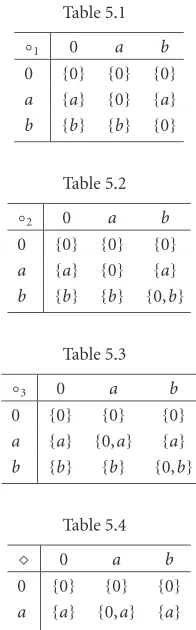
Therefore, by (1), (2), and (3), we conclude that there are four nonlinear hyper BCC-algebras containing three elements. Their hyperoperations are given by Tables5.1,5.2,
5.3, and5.4.
But (H,◦2) and (H,) are isomorphic. The isomorphism f : (H,◦)→(H,◦2) is
defined by f(0)=0, f(a)=b and f(b)=a. Other nonlinear hyper BCC-algebras are not isomorphic. It is clear that they are not proper hyper BCC-algebras.
Theorem 5.2. There are no linear hyper BCC-algebras of order 3 containing two proper hyper BCK-ideals.
Table 5.1
◦1 0 a b
0 {0} {0} {0}
a {a} {0} {a}
b {b} {b} {0}
Table 5.2
◦2 0 a b
0 {0} {0} {0}
a {a} {0} {a}
b {b} {b} {0,b}
Table 5.3
◦3 0 a b
0 {0} {0} {0}
a {a} {0,a} {a}
b {b} {b} {0,b}
Table 5.4
0 a b
0 {0} {0} {0}
a {a} {0,a} {a}
b {b} {b} {0}
ab. Thena◦bis equal to{0},{0,a},{0,b}, or{0,a,b}. In all these cases,a◦bI2.
SinceI2is a hyper BCK-ideal ofHandb∈I2, so,a∈I2, which is impossible. Forba,
we obtain a similar contradiction.
Theorem 5.3. There are 12 nonisomorphic linear hyper BCC-algebras of order 3 containing only one proper hyper BCK-ideal and this ideal is strong too. Only two such hyper BCC-algebras are proper.
Proof. Without loss of generality, letI1= {0,a}be the proper strong hyper BCK-ideal of
a linear hyper BCC-algebraH. Thenaborba. Forba, we have 0∈b◦a, which givesb◦a∩I1 = ∅. ButI1is a strong hyper BCK ideal, so,a∈I1 impliesb∈I1, which
is impossible. Hence,abandb a. Thusb◦ais equal to{a},{b}, or to{a,b}. If b◦a= {a}, thenb◦aI1, whenceb∈I1, which is not true. Therefore,b◦a = {a}. In
the caseb◦a= {a,b}, we haveb◦a∩I1 = ∅, consequently,b∈I1, becauseI1is strong.
Table 5.5
1 0 a b
0 {0} {0} {0}
a {a} {0} {0,a}
b {b} {b} {0}
Table 5.6
2 0 a b
0 {0} {0} {0}
a {a} {0} {0,a}
b {b} {b} {0,a}
Table 5.7
3 0 a b
0 {0} {0} {0}
a {a} {0} {0,a}
b {b} {b} {0,b}
Table 5.8
4 0 a b
0 {0} {0} {0}
a {a} {0} {0,a}
b {b} {b} {0,a,b}
{0,a,b}, we obtain the similar contradiction. Thusa◦b= {0}or{0,a}. To computea◦a, observe thata◦acan be equal to one of the sets{0},{0,a},{0,b}, or{0,a,b}. Ifa◦a= {0,b}or{0,a,b}, thena◦aaimpliesba, which is impossible. So,a◦a= {0}or {0,a}. Furthermore,b◦bis equal to{0},{0,a},{0,b}, or{0,a,b}. This means that totally we have 2×2×4=16 different cases forH.
Consider Tables5.5,5.6,5.7, and5.8.
In (H,i), 1≤i≤4, we have (a◦b)◦(a◦b) a◦a. Thus (H,i) are not hyper BCC-algebras.
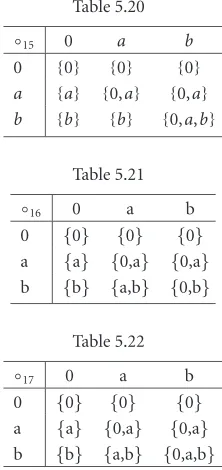
The other 12 cases are presented in Tables5.9,5.10,5.11,5.12,5.13,5.14,5.15,5.16,
5.17,5.18,5.19, and5.20.
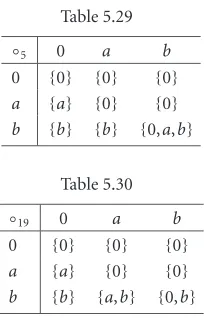
It is not difficult to verify that hyperstructures defined by these tables are hyper BCC-algebras. Because the nonidentity homomorphism f from (H,◦i) onto (H,◦j),i =j, and 4≤i,j≤15, is defined byf(0)=0,f(a)=b,f(b)=a, then these 12 hyper BCC-algebras are not isomorphic. Only hyper BCC-algebras (H,◦4) and (H,◦5) are proper. In these
Table 5.9
◦4 0 a b
0 {0} {0} {0}
a {a} {0} {0}
b {b} {b} {0,a}
Table 5.10
◦5 0 a b
0 {0} {0} {0}
a {a} {0} {0}
b {b} {b} {0,a,b}
Table 5.11
◦6 0 a b
0 {0} {0} {0}
a {a} {0} {0}
b {b} {b} {0}
Table 5.12
◦7 0 a b
0 {0} {0} {0}
a {a} {0} {0}
b {b} {b} {0,b}
Table 5.13
◦8 0 a b
0 {0} {0} {0}
a {a} {0,a} {0}
b {b} {b} {0}
Table 5.14
◦9 0 a b
0 {0} {0} {0}
a {a} {0,a} {0,a}
b {b} {b} {0}
Table 5.15
◦10 0 a b
0 {0} {0} {0}
a {a} {0,a} {a}
Table 5.16
◦11 0 a b
0 {0} {0} {0}
a {a} {0,a} {0}
b {b} {b} {0,b}
Table 5.17
◦12 0 a b
0 {0} {0} {0}
a {a} {0,a} {a}
b {b} {b} {0,a,b}
Table 5.18
◦13 0 a b
0 {0} {0} {0}
a {a} {0,a} {0,a}
b {b} {b} {0,b}
Table 5.19
◦14 0 a b
0 {0} {0} {0}
a {a} {0,a} {0,a}
b {b} {b} {0,a}
Theorem 5.4. There are four nonisomorphic linear hyper BCK-algebras of order 3 contain-ing only one proper hyper BCK-ideal and this ideal is not strong. One of them is a proper BCC-algebra.
Proof. Without loss of generality, letI1= {0,a} be the proper hyper BCK-ideal of H
which is not strong. SinceH is linear, then baorab. Ifba, then 0∈b◦a and sob◦a= {0}or{0,a}or{0,b}, or{0,a,b}. Sinceba, then in any of the above cases,b◦aI1. Now, sincea∈I1andI1is a hyper BCK-ideal ofH, thenb∈I1which is
impossible. Henceaband so 0 ∈b◦a. Therefore,b◦ais equal to{a}, {b}, or{a,b}. Ifb◦a={a}, thenb◦aI1= {0,a}. Sincea∈I1 andI1 is a hyper BCK-ideal, we get
b∈I1, which is not true. In the caseb◦a= {b},I1is a strong hyper BCK-ideal, because
Table 5.20
◦15 0 a b
0 {0} {0} {0}
a {a} {0,a} {0,a}
b {b} {b} {0,a,b}
Table 5.21
◦16 0 a b
0 {0} {0} {0} a {a} {0,a} {0,a} b {b} {a,b} {0,b}
Table 5.22
◦17 0 a b
0 {0} {0} {0} a {a} {0,a} {0,a} b {b} {a,b} {0,a,b}
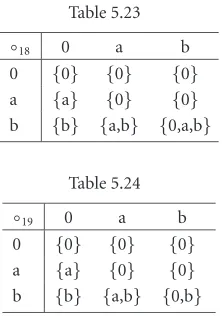
Next, similarly as in the proof ofTheorem 5.3, we can show thata◦ais equal to{0}or {0,a},a◦bis equal to{0}or {0,a}, andb◦bis equal to{0}, {0,a},{0,b}, or{0,a,b}. Thus there are 2×2×4=16 different cases forH.
(i) Leta◦a={0}. Ifa◦b={0},b◦b={0}, orb◦b= {0,a}, then
(b◦a)◦(b◦a) b◦b. (5.1)
Ifa◦b= {0,a}, then we have
(a◦b)◦(a◦b) a◦a. (5.2)
This means that in these six cases, obtained hyperstructures are not hyper BCC-algebras.
(ii) Leta◦a= {0,a}. Ifa◦b={0}, then
(a◦a)◦(b◦a) a◦b. (5.3)
Ifa◦b={a}andb◦b={0}, orb◦b= {0,a}, then
(b◦a)◦(b◦a) b◦b. (5.4)
So, in these cases, we do not obtain a hyper BCC-algebra too. In the remaining four cases, we obtain hyperstructures in Tables5.21,5.22,5.23, and5.24.
Table 5.23
◦18 0 a b
0 {0} {0} {0} a {a} {0} {0} b {b} {a,b} {0,a,b}
Table 5.24
◦19 0 a b
0 {0} {0} {0} a {a} {0} {0} b {b} {a,b} {0,b}
Theorem 5.5. There are three nonisomorphic and nonproper linear hyper BCC-algebras of order 3 without proper hyper BCK-ideals.
Proof. Without loss of generality, we letab. Then 0∈a◦b and soa◦bis equal to one of the sets{0},{0,a},{0,b}, or{0,a,b}. Ifa◦b= {0,b}, then byProposition 2.3, {0,b} =a◦b {a}, thusbawhich is not true. Ifa◦b= {0,a,b}, then similarly, we obtain a contradictionba. Thusa◦b= {0}or{0,a}. Clearly,a◦acan be equal to one of the sets{0},{0,a},{0,b}, or{0,a,b}. Ifa◦a= {0,b}or{0,a,b}, then sincea◦aa, we get thatbawhich is impossible. Thusa◦a= {0}or{0,a}. Alsob◦bis equal to one of the sets{0},{0,a},{0,b}, or{0,a,b}. Furthermore,b◦ais equal to one of the sets{a}, {b}, or{a,b}. Ifb◦a= {b}, then similar to the proof ofTheorem 5.4, we conclude thatI1
is strong, which is a contradiction. Ifb◦a={a,b}, then all of hyper BCK-algebras which are obtained are the same asTheorem 5.4. But each of these kinds of hyper BCK-algebras has a proper BCK-idealI1= {0,a}, while by hypothesis, the involved hyper BCK-algebras
have not a proper BCK-ideal. Sob◦a = {a,b}and we must haveb◦a= {a}. Thus we have 2×2×4=16 different possibilities.
(i) Leta◦a= {0}. Ifa◦b= {0}andb◦b={0,b}, orb◦b={0,a,b}, then
(b◦b)◦(a◦b) b◦a. (5.5)
Ifa◦b= {0,a}, then
(a◦b)◦(a◦b) a◦a. (5.6)
Therefore, in the above six cases, we do not obtain a hyper BCC-algebra. (ii) Leta◦a= {0,a}. Ifa◦b= {0}, then
(a◦a)◦(b◦a) a◦b. (5.7)
Ifa◦b= {0,a}andb◦bis one of the sets{0,b}or{0,a,b}, then
Table 5.25
◦20 0 a b
0 {0} {0} {0}
a {a} {0} {0}
b {b} {a} {0}
Table 5.26
◦21 0 a b
0 {0} {0} {0}
a {a} {0} {0}
b {b} {a} {0,a}
Table 5.27
◦22 0 a b
0 {0} {0} {0}
a {a} {0,a} {0,a}
b {b} {a} {0,a}
Table 5.28
◦4 0 a b
0 {0} {0} {0}
a {a} {0} {0}
b {b} {b} {0,a}
Ifa◦b= {0,a}andb◦b={0}, then
(b◦a)◦(b◦a) b◦b. (5.9)
Hence, in the above seven cases, we do not obtain a hyper BCC-algebra too. In the remaining three cases, we obtain the following hyperstructures in Tables5.25,5.26, and
5.27.
It is not difficult to check that these hyperstructures are hyper BCC-algebras which are not proper hyper BCC-algebras. Obviously, these hyper BCC-algebras are not
isomor-phic.
Summarizing our calculations, we obtain the following corollaries. Corollary 5.6. There are 22 nonisomorphic hyper BCC-algebras of order 3.
Table 5.29
◦5 0 a b
0 {0} {0} {0}
a {a} {0} {0}
b {b} {b} {0,a,b}
Table 5.30
◦19 0 a b
0 {0} {0} {0}
a {a} {0} {0}
b {b} {a,b} {0,b}
Acknowledgments
Authors would like to express their sincere thanks to the referees for their valuable sug-gestions and comments.
References
[1] P. Corsini, Prolegomena of Hypergroup Theory, 2nd ed., Aviani Editore, Tricesimo, 1993. [2] P. Corsini and V. Leoreanu, Applications of Hyperstructure Theory, Advances in Mathematics
(Dordrecht), vol. 5, Kluwer Academic, Dordrecht, 2003.
[3] W. A. Dudek, On BCC-algebras, Logique et Analyse. Nouvelle S´erie 33 (1990), no. 129-130, 103– 111.
[4] , On proper BCC-algebras, Bulletin of the Institute of Mathematics. Academia Sinica 20 (1992), no. 2, 137–150.
[5] , The number of subalgebras of finite BCC-algebras, Bulletin of the Institute of Mathemat-ics. Academia Sinica 20 (1992), no. 2, 129–135.
[6] , On constructions of BCC-algebras, selected papers on BCK- and BCI-algebras 1 (1992), 93–96.
[7] K. Is´eki, An algebra related with a propositional calculus, Proceedings of the Japan Academy 42 (1966), 26–29.
[8] Y. B. Jun, M. M. Zahedi, X. L. Xin, and R. A. Borzoei, On hyper BCK-algebras, Italian Journal of Pure and Applied Mathematics (2000), no. 8, 127–136.
[9] Y. Komori, The class of BCC-algebras is not a variety, Mathematica Japonica 29 (1984), no. 3, 391–394.
[10] F. Marty, Sur une generalization de la notion de groupe, 8th Congres Math. Scandinaves, Stock-holm, 1934, pp. 45–49.
R. A. Borzooei: Department of Mathematics, University of Sistan and Baluchestan, Zahedan, Iran
E-mail address:[email protected]
W. A. Dudek: Institute of Mathematics and Computer Science, Wroclaw University of Technology, 50-370 Wroclaw, Poland
E-mail address:[email protected]
N. Koohestani: Department of Mathematics, University of Sistan and Baluchestan, Zahedan, Iran