Virtual Reality
Kirti Sharma1, Himanshu Saini2, Girish Mehta3
1,2,3
Student (B.Tech Vth Sem) Department of Computer science
Dronacharya College Of Engineering,Gurgaon-123506
Abstract-This paper is based on Virtual Reality which is also known as immersive multimedia and is related to computer generated images, sounds, etc. that appear real to the senses. It is used to describe applications commonly related with immersive, highly visual, 3D environments. It is used for practical purposes. This technology is based on computer and allows the user to interact in such a way that it is possible to treat an artificial environment as if it is the real. The basic multimedia elements of animation, imagery and sound combined together are used in this technology. Virtual reality environments are primarily visual experiences which are displayed on a computer screen or through special stereoscopic displays. Some simulations include additional sensory information, such as sound through speakers or headphones. It can be said as a way of replicating an environment and the user experiences a sense of taking control by interacting personally as actually being there. Our paper also describes the applications of virtual reality in various fields like manufacturing, lifelong learning and education, telemedicine, entertainment, business and healthcare.
Keywords-Virtual, Multimedia, Animation, Stereoscopic, Tecnology
I. INTRODUCTION
A. Goals
Our main goal is to survey or present general view of absolutely up-to-date i.e., current stage of especially
technological development in “Virtual Reality” field with the
help of this paper. To keep track on the increasing needs of trendy market is major aspect that needs to be taken care of related to this field. The detailed comparison between the several ways taken till now in solving several issues while dealing with this technology has also been summarized.
B. Definition
Virtual Reality is defined as a man-made environment created by using hardware and software tools for the user in such a way so that he or she experiences it as reality, primarily through senses such as sound and sight as the most basic ones. It produces the illusion of real world by creating images and touching sensations with the use of computer. In other words, it refers to computer simulations with which user interacts using various devices and 3D graphics. Sensors are placed on the body of a user for sensing the movements in the more
highly developed and complex systems. After this, system interprets these movements just like in the simulated world.
For example, the projection of images and objects is usually done by the user using binocular goggles to increase the illusion and simulate the appearance in three dimensions. This term is used specifically for the representation of virtual world in a computer. This world may be represented either in the form of graphs or text.
C. Motivation
Virtual Reality is an interesting topic because it is not just limited to games but also includes text based chat rooms and computer conferencing. For representing facial expressions, it also provides emoticons. It is completely based on practical approach using computer, which allows the user to experience reality as actually being there. The optimum use of resources and highly productive output, thereby reducing the total expenditure are the other benefits that attract the user towards this technology.
II. APPLICATIONS OF VIRTUAL REALITY
reduce cost. The field of technology, medicine, engineering, entertainment, education has drastically changed with the increasing use of VR. Here are applications of VR in various fields:
A. Manufacturing
Manufacturing of objects has become cheaper with the use of VR. Use of VR to build prototypes has reduced the cost of finished products. Physical prototypes are much costlier to change, but virtual prototypes can be changed in no time and with less cost.
Here in these fig 1.1 Ford’s virtual tools even extends to the manufacturing arm of the company. Motion-capturing technology allows a team of developers to test-build vehicles early on. This allows the company to ensure that manufacturing line workers will not run into any issues.
Fig.1 Ford’s virtual tools extends to the manufacturing arm of the company.
1) Use in design: CAD/CAM has been mainstay in manufacturing industry but with the use of VR they can be extended through visualization technique.
2) Use for testing/prototyping: Virtual prototypes of a product can be created and tested in a virtual environment. It allows easy switching of dials and gauges in the design of aircraft and other experimenting with ergonomics. Simulated wind tunnel is another application of VR used by NASA. US government has given a statement that they have
been saving 1 billion dollar by using virtual design of one particular helicopter
3) Use for technicians/laborer: VR is also useful in the assembly, maintenance, and repair of complex machinery. Instructions are easier to understand if they are present in 3-D drawing instead of simple text and pictures. In a virtual environment step by step process can be shown and this helps in developing a nearly perfect product.
B. Medicine
Applications of virtual reality in medical are emerging. It is used as a visualization and training aid for surgery. This includes VR surgical simulations, complex database visualization, Tele presence surgery and rehabilitation. It may be possible to collect 3-D datasets of a patient in real time, without the use of Magnetic Resonance Imaging(MRI), Computed Tomography scans (CT), or ultrasound imaging. Instead of these datasets can be replaced by a real patient. This
simulation gives a doctor “X-ray vision” inside a patient. The
Green Tele presence Surgery System consists of two components, the surgical workstation and remote worksite. At the remote site there is a 3-D camera system and responsive manipulators with sensory input. At the workstation there is a 3-D monitor and dexterous handles with force feedback. The VR surgical simulator is a stylized recreation of the human abdomen with several essential organs.
Fig.2 A simulated human brain is shown. With the help of virtual reality, doctors can detect the affected part and can
VR is also helpful in surgical room for general medical visualization tasks. This helps surgeons in detecting some features with naked eyes those they cannot see in MRI or CT scans. VR might also guide surgeons to attain maximum possible precision in their work like in drilling a hole into the skull for brain surgery or where to perform a needle biopsy of a tiny tumor. VR can also guide the doctors in the major part operations, showing the target point directly.
VR is also useful in training of doctors. A surgeon can simulate the actions of a medicine on human body and also can see the re-actions of the same. So this saves the experimentation with real bodies.
C. Education and Training
The major advantage of a VR system is the way it can allow students to interact with educational orientated simulations. Students can understand complex techniques through the virtually created process so that they can grab it from deep inside.
D. Current situation
Use of computer is increasing all the time to support educational needs. Computer based training (CBT) systems have been in use for several years supporting routine training tasks and providing packages to allow the students to learn at their own place. CBT system presents pre-recorded videos at appropriate points in the program and makes this educational system very powerful. Early CBT systems have developed into multi-media systems which provide a richer environment by making use of text, graphics, video and audio to support the learning process. The advent of the CD-ROM has also made it possible to store considerable amounts of material onto a single disc. The CD-ROM of a multi-media system also contains software that is executed on the host computer and provides even higher levels of interaction than the early CBT systems.
E. VR in Today’s Education System
There are many examples of where VR has been used for educational purposes around the world. Each has shown a degree of success even though the technology was extremely
limited. It seems that the level of success was attributed to the flexibility offered by the virtual environment. By far the most prolific country to try VR in education is the USA where VR has been applied to secondary and higher education.
F. Soldier Training
Virtual Reality is a training method that puts the participant in 3-D environment. The three dimensional environment stimulates situations and events that are experienced in the job. The participant interacts with 3-D images to accomplish the training objectives.
Fig.3 Virtual Reality in Soldier Training
The U.S. armed forces spends about $4 billion a year to training equipments and programs involving simulations, and many of these features some degree of VR. Simulations help soldiers learn how to use complex equipment, work together,
and rehearse missions.
Like the military and the air industry, large businesses are starting to see VR as the best way to teach workers how to do jobs that are complex, dangerous, or both. VR training programs are not yet widespread because they are expensive to develop, but they can save companies money in the long run by cutting down on the amount of costly real equipment, such as heavy machinery, that must be used in training. Simulation programs also reduce risk to machines, the environment, and even human lives.
ambulances also use simulators to learn how to travel safely at high speeds.
G. Entertainment
For entertainment VR is mostly used in computer and video
games. One question may be asked “Why games”? Games
have had an important role in the development of human-machine interfaces and the introduction of I/O devices to the public. Games have made computer peripherals affordable to the general public. There is a huge demand for real 3-D games and this demand of human and competition between companies continuously pushing technology at higher level.
III. FUTURE SCOPE IN VIRTUAL REALITY
A. Current trends
Virtual Reality Cognitive Behavior Therapy is an effective technology and used in therapy for various psychological
disorders related to the study of human mind’s characteristics.
Psychotherapy and psychotherapy training are also being developed stage by stage with the several new advanced approaches in Virtual Reality. Cognitive behavior therapy is also found to be the best treatment regimen for the treatment of these mental disorders. But due to several difficulties encountered like loss of confidentiality in the exposure component and the lack of therapist control the current modern technology i.e., VRCBT is being chosen on large scale with first priority because of its promising results.
VRCBT is specially used for the treatment of special types of phobias. Several different types of phobias are:
B. Social Phobia
1) Generalized Social Phobia: In the study conducted for this type of Phobia mainly four situations were employed assertiveness, intimacy, scrutiny and performance. If we compare the VR treatment with cognitive behavior group therapy (CBGT) it has been found from the past results that for conducting 12 individual sessions, VR takes 45 minutes per session but CBGT completes 12 group sessions lasting two hours each. Fear reduction, assertiveness and global
functioning measures have been improved
significantly using both of these treatment groups.
2) Non Generalized Social Phobia: In the few studies where the therapy involves the problem related to public speaking anxiety, VRCBT is being generally used on large scale. In 1998, North, North and Coble compared VRCBT with a group having no treatment. And later in the final results, the significant reduction in fear is being measured in the treatment group as compared to the no-treatment group. In comparison with CBT, VRCBT is being found to be the most soothing technique conductive to the well being and for contributing to the cure of diseases.
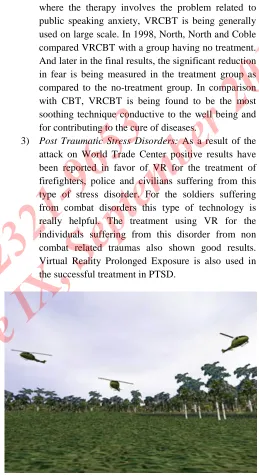
[image:5.612.292.551.122.597.2]3) Post Traumatic Stress Disorders: As a result of the attack on World Trade Center positive results have been reported in favor of VR for the treatment of firefighters, police and civilians suffering from this type of stress disorder. For the soldiers suffering from combat disorders this type of technology is really helpful. The treatment using VR for the individuals suffering from this disorder from non combat related traumas also shown good results. Virtual Reality Prolonged Exposure is also used in the successful treatment in PTSD.
Fig. 4 Virtual Reality in Social Phobia
previously disappeared on follow-up. In this study, at last many differences were reported on the number of patients flying post treatment with more VR patients flying than the control treatment patients. And these results were maintained till three-year follow-up. 5) Claustrophobia: In 2000, four patients were being
treated with eight sessions of VR therapy and significant improvement on the reduction of fear and depression ratings, questionnaires and on the behavioral test are being reported significantly.
6) Acrophobia: This phobia is used for the treatment of
people suffering from the fear of heights. Treatment gains were maintained at a six-month follow up using VR approach. There are three different types of virtual height situations in which there arises a great panic of heights which can be properly treated with virtual reality exposure therapy. This technology is shown to be very effective in reducing acrophobic subjects avoidance of heights and anxiety. It will also help in improving the attitudes toward heights in future also.
7) Panic disorder combined with Agoraphobia: In this study the first group received four sessions of VRCBT technology and the second group was being given 12-session panic control program. Both the groups improved in terms of reducing the ratings of anxiety and depression and in discontinuation of
medication. The efficacy of VR is being
demonstrated in the results afterwards, both post-treatment and follow-up.
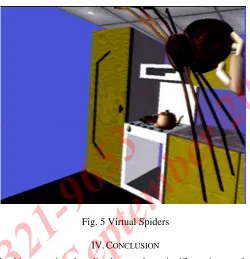
8) Arachnophobia: Virtual Reality also allows the experimenter to control how dreadful the spiders may appear. Virtual spiders obey computer commands, can be placed in various positions and orientations by patient or therapist, and can be touched without danger, unlike a real spider.
[image:6.612.296.546.104.363.2]In this study to treat spider phobia the utility of employing existing video games is being used. In a composed video game composed of five sessions lasting 90 minutes, 11 people suffering from this phobia were being treated with the help of VR technology. The significant reductions on behavioral task and self report measures were being found.
Fig. 5 Virtual Spiders
IV. CONCLUSION
In this way virtual reality has made a significant impact for the treatment of various types of psychological disorders and
anxiety levels. In today’s scenario the need for continuous
treatment of treatment availability is critical because almost one-fourth of the total world population is getting affected with these types of disorders. But still there is a hope with the improvement of these advanced technologies, that psychology has opportunity to rise to next higher level to offer more available healthcare at an affordable price.
V. PROBLEMS WITH VIRTUAL REALITY
instead, the illusion fails. The user requires some sense of tactile feedback while interacting with VR environment.
VR world are visually unconvincing because of its low resolution and limited field of view. They are like cartoons that lack realism. When a virtual creature moves it do not seems natural and lack in fine details. Also it lacks natural effects like gravity, momentum, friction. Because these effects cannot be seen in VR.VR is full of encumbrances by decking users in exotic H/W and cable tethers. It makes user sick because of latency in motion tracking and conflicts in visual displays. VR environment has enough potential as a tool in mental health research, but it is limited by the technical factors by mental health research factors. There are difficulties like cost and complexity of virtual environment creation. Also this technique takes more time, effort to implement. People may feel loss of reality and a feeling of isolation as they interact with an artificial world, instead of real world with real people. VR may lead to unemployment as less people are needed to design projects; products in their design state no longer need to be built, so it is less desired.
REFERENCES
[1] W. Shao and D. Terzopoulos,
BAutonomouspedestrians,[ Graph. Models, vol. 69, no. 5–
6,pp. 246–274, Sep./Nov. 2007.
[2] W. H. Widen, BSmart cameras and the rightto privacy,[ Proc. IEEE, vol. 96, no. 10,Oct. 2008.
[3] C. J. Costello, C. P. Diehl, A. Banerjee, andH. Fisher, BScheduling an active camera to observe people,[ in Proc. ACM Int. Workshopon Video Surveillance and Sensor
Networks,New York, 2004, pp. 39–45.
[4] F. Zhao, J. Liu, J. Liu, L. Guibas, and J.
Reich,BCollaborative signal and informationprocessing: An information directedapproach,[ Proc. IEEE, vol. 91, no. 8,pp.
1199–1209, Aug. 2003.
[5] C. Intanagonwiwat, R. Govindan, D. Estrin,J. Heidemann, and F. Silva, Bdirected diffusion for wireless sensor
networking,[IEEE/ACM Trans. Netw., vol. 11, no. 1,pp. 2–16,
Feb. 2003.
[6] F. Qureshi and D. Terzopoulos, BVirtualvision and smart
cameras,[ in Proc. 1stACM/IEEE Int. Conf. Distributed Smart
Cameras, Vienna, Austria, Sep. 2007,pp. 87–94.
[7] F. Qureshi and D. Terzopoulos,BSurveillance camera scheduling: A virtual vision approach,[ ACM Multimedia Syst.
J., vol. 12, pp. 269–283, Dec. 2006.
[8] D. Terzopoulos and T. Rabie, BAnimat vision: Active vision in artificial animals,[ Videre: J. Comp. Vision Res., vol.
1, no. 1, pp. 2–19, Sep. 1997.
[9] T. Rabie and D. Terzopoulos, Bactive perception in virtual humans,[ in Vision Interface, Montreal, QC, Canada, May
2000, pp. 16–22.
[10] T. Rabie, A. Shalaby, B. Abdulhai, and A. El-Rabbany, BMobile vision-based vehicle tracking and traffic control,[ in Proc. IEEE Int. Conf. Intelligent Transportation Systems,