5
IV
April 2017
Technology (IJRASET)
Implementation of Embedded System Based Face
Recognition System
Neel Ramakant Broker1, Sonia Kuwelkar2
1,2
Department of Electronics and Telecommunication, Goa College of Engineering, Goa, India.
Abstract: Face Recognition is the ability to detect and recognize a person by their facial characteristics. Face is a multidimensional and hence requires a lot of mathematical computations. Face recognition system is very essential and important for providing security, mug shot matching, law enforcement applications, user verification, user access control, etc and is mostly used for recognition for various applications. These all applications require an efficient Face recognition system. There are many methods that are already proposed and have low recognition capability, high false alarm rate. Hence the major task of the research is to develop face recognition system with improved accuracy and improved recognition time of an face recognition system. This paper proposes a hybrid face recognition algorithm by combining two face recognition techniques by integrating (PCA) principle Component Analysis, (LDA) Linear Descriminant Analysis and Jacobi method to compute Eigenvector to be implemented on Embedded system based Raspberry pi 3 board.
Keywords: Principle component analysis (PCA), Linear Descriminant Analysis (LDA), Jacobi Method, Eigenvalue, Eigenvector.
I. INTRODUCTION
The Face Recognition Systems has evolved greatly during the last few years. Because of this development there is increase in algorithmic complexity which takes long computation time and power. Face recognition have wide applications ranging from security to personal applications. An efficient face recognition can be of great help in identification of persons, forensics sciences, authentication systems, mug shot matching, security systems etc. Various Face recognition algorithms are used for face recognition system. PCA the principle component analysis, Linear Discriminant Analysis, Independent Component Analysis are mostly used Face Recognition Algorithms.
PCA is also called as Eigenface recognition algorithm was developed by Trunk and Pentland. The accuracy of this algorithm is dependent on the face that faces are centralized and are uniform and varies depending upon changes in illumination. The PCA algorithm was eventually used to reduce the dimensionality of a large dataset to reduce the mathematical complexity. The LDA algorithm eventually developed for data classification is now used for face recognition system. The LDA separate's the within class faces and those of individual faces thus increasing the recognition rate under varying conditions. LDA is less sensitive to lighting pose variations etc but is more mathematically more complicated than PCA.
The ICA algorithm uses the higher order relationship between the pixels whereas the PCA depends upon the pair wise relation between pixels. The neural Network based Face recognition systems are biologically inspired and behave like neurons of human beings. Just like neuron a perceptron calculates the weighted sum on numerical inputs and determines if person is recognized or not recognized. The neural networks requires a lot of mathematical computations.
This paper presents a combination of PCA and LDA algorithm for face recognition system and Jacobi method to calculate Eigenvalues and Eigenvectors which is most important part in PCA and LCA algorithms. The dataset of images are filtered using Gaussian filter using mask and RGB images are converted to grayscale. The principle component analysis is performed on the dataset to reduce the dimensionality to reduce mathematical complexity. After PCA, LDA algorithm is performed to calculate scatter matrix within class and between class. The Euclidian Distance is used to classify image as recognized or not recognized. This combination of algorithms in implemented on Embedded system based Raspberry Pi3 board for a real time application.
II. OVERVIEW OF PROPOSED ALGORITHM
Technology (IJRASET)
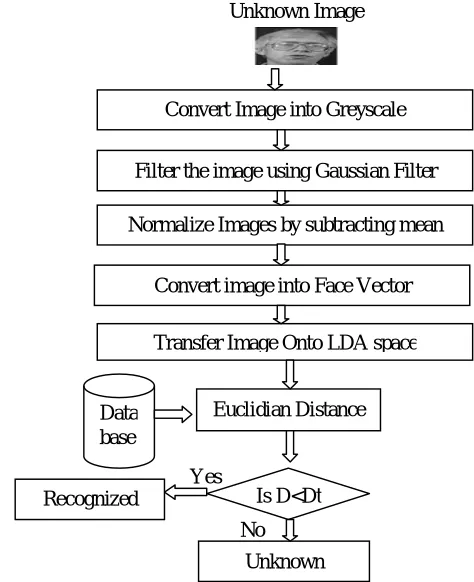
onto eigenspace. This creates database of images and completes recognition phases of Face Recognition System. During the recognition phase of Face Recognition system the unknown face is first converted into gray scale image. Next the test image is smoothened using Gaussian filter. Test image is then normalized by subtracting the mean of images from test image. Now the image is converted into 1-D row vector and then is projected onto eigenspace by multiplying weights that were generated by using PCA and LDA algorithm. Euclidean distance is calculated between the test image and train images that are also projected onto eigenspace. The minimum distance image is classified as recognized image. Fig 2 shows the recognition phase of Face recognition system.
[image:3.612.205.400.168.371.2]Set of database Images
Fig. 1. Block diagram showing Training phase of face recognition system
Unknown Image
Yes
No
Fig. 2.Block diagram showing Recognition phase of face recognition system Convert Image into Greyscale
Filter the image using Gaussian Filter
Normalize Images by subtracting mean
Convert image into Face Vector
PCA & LDA Data base
Convert Image into Greyscale
Filter the image using Gaussian Filter
Normalize Images by subtracting mean
Convert image into Face Vector
Transfer Image Onto LDA space
Data base
Euclidian Distance
Is D<Dt Recognized
[image:3.612.158.395.400.691.2]Technology (IJRASET)
III. ALGORITHM
In this section we discus all the mathematical steps that will be executed on the Raspberry Pi 3 embedded system board to implement face recognition system. This section is divided into two parts i.e. Training phase and Recognition phase.
A. Training Phase
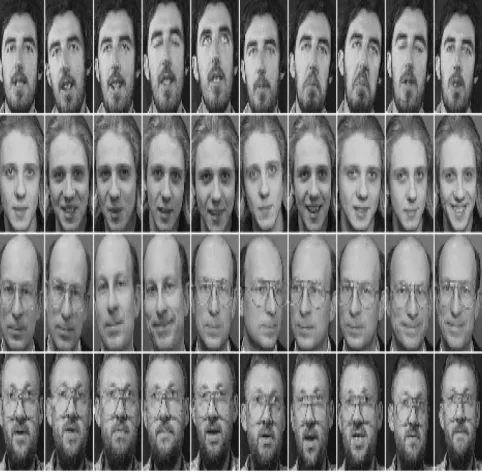
For any efficient Face Recognition system the main part is to have training images so that your algorithm can be implemented. Thanks to AT&T database that has 400 face images of 40 person each person having 10 images with various pose and illumination. AT&T dataset images will be used for training purpose.
1) Consider dataset of images each of n*m dimensions. The images in dataset are converted into grayscale as recognition rate of grayscale images is better than that of RGB images.
11 1 1
...
n m mna
a
Z
a
a
2) Gaussian filtering is done by using 3*3 Gaussian mask to reduce noise and smoothen the images to increases the recognition rate. 1/16 1/8 1/16
1/8 1/4 1/8
[image:4.612.199.431.288.513.2]1/16 1/8 1/16
Fig. 3.Figure showimg Gaussian mask
3) After Filtering all the images, all the images are converted from 2D image to 1D row vector with each row corresponds to person. 11 * 11 * 11 *
...
...
...
n m n m n ma
a
R
b
b
c
c
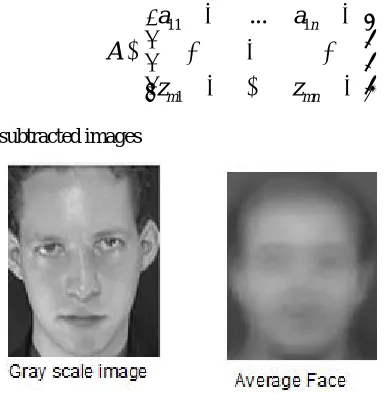
4) After converting all images to 1-D and appending them to one matrix we get a matrix of row size equal to total number of database images and the column size of number of pixels in each image. Next the mean of formed matrix R is calculated by adding all pixels row wise and dividing by total number of such faces and subtracted from each row matrix to normalize the dataset images. Thus we get Normalized images
Formula to Calculate Mean of images
1
M iM
Technology (IJRASET)
where M is the total number of images in training set11 1 1
...
n m mna
a
A
z
z
[image:5.612.201.395.97.294.2]where matrix A represents mean subtracted images
Fig. 4.Figure showimg Gray scale image and mean subtracted average face
5) Next the covariance matrix is calculated of Matrix A as the Eigenvalue calculation requires a symmetric matrix by using the formula
C=A*AT
But this results in lot of computation as there will be many images in training set. To reduce computation the dimensionality of matrix is reduced by using small variation in formula given by
L=AT*A
This results into a z*z matrix where z represents the number of images in training set. Next the eigenvalues and eigenvectors of symmetric matrix L is calculated using Jacobi Method.
6) Next each image is represented in eigenspace by multiplying the eigenvectors and normalized matrix A given by formula PCA=U*A
where U is the eigenvector of L matrix, A is normalized image. PCA represents all images in Eigenspace.
7) The next task is to calculate the weight matrix of PCA that will be input to LDA algorithm given by
_
weight
pca
=A.*PCATwhere A represents normalized images and PCA is eigenspace representation of database images.
This ends the PCA algorithm where in all images are projected onto PCA subspace. The output of PCA algorithm goes as an input to LDA algorithm.
8) Let P be number of image samples {x1,x2,x3,....xp} and let each image belong to one of the class c{c1,c2,c3,....cc}. Ni be number of samples in each class.
9) The mean of images in PCA subspace is calculated given by formula
1
1
_
M iweight
pca
M
where m is the total number of images in dataset
10) To calculate the Scatter matrix we also need the individual mean of images that belong to a particular class. This is calculated by using the formula
Technology (IJRASET)
where µi represents mean of all images in one class ci11) Next the Scatter matrix between class is calculated given by the formula
1
1
(
)(
)
c
T
b i i i
i
S
N
N
This scatter matrix Sb separtes the images of one class to that of others. 12) Next the within class scatter matrix is calculated using the formula
1
1
( _
)( _
)
k i c Tw i i i i i
i x c
S
N w
pca
w
pca
N
This matrix groups all the images belonging to one person together.
13) Next the eigenvalues and eigenvectors of scatter matrix within class and between class is calculated by using Jacobi method. 14) After computing the eigenvector of scatter matrix the eigenvector is multiplied to the weight matrix of PCA algorithm to
represent images onto LDA subspace given by the formula
Ω=eig_ldaT*weight_pca
where Ω is the calculated weight of LDA algorithm.
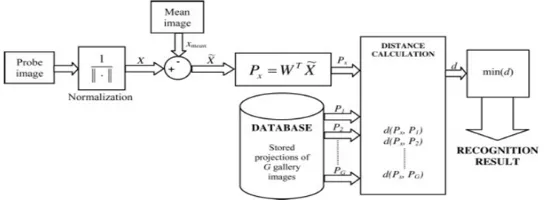
[image:6.612.187.459.333.433.2]15) This completes the training phase of Face recognition system
Fig. 5.Figure showing Pictorial representation of Face recognition Tranining phase
B. Recognition Phase
In recognition phase the Image to be tested goes through all the steps of pre-processing starting from colour to Gray conversion, Filtering, normalization and column vector conversion.
1) The gray scale filtered image is converted into a column matrix 11 mn
a
r
a
2) Average face calculated in PCA algorithm is subtracted from the column matrix to normalize unknown image. 11 nm
a
r
a
3) Next the unknown image is projected onto LDA subspace by multiplying weights of PCA and LDA given by the formula
Ω=eig_ldaT**eig_pcaT*r
4) In the final stage of recognition the Euclidian distance is calculated between LDA face projection of unknown image and that of dataset images given by formula
Technology (IJRASET)
5) The minimum Euclidian distance represents the authorized face from the dataset. IV. EXPERIMENTAL RESULTS
[image:7.612.186.427.180.417.2]The proposed Face recognition system using PCA and LDA algorithm was implemented in Raspberry pi 3 Embedded platform module and was also simulated in Matlab. The performance of proposed algorithm is evaluated on AT&T dataset of images. AT&T dataset of images consists of 400 face images of 40 individuals with 10 images per person each having dimensions of 112*92 pixels. Each pixel consists of an 8-bit gray scale value ranging from 0 to 255. The images are taken at various different times varying in light, facial expressions, pose, etc. The images are in PNG format
Fig. 6.Figure showing AT&T dataset images
A. Implementation Results
The combination of algorithms was implemented on raspberry pi 3 Embedded system board. When recognizing the Face that is already in the dataset the Euclidian distance calculated is negligible. When the image to be tested is in database but is not as exact as in dataset the Euclidian Distance will be some positive value but when the image is not in dataset the Euclidian distance calculated is very large.
Fig. 7.Figure showing the Euclidian distance Calculated for image that is in database
Technology (IJRASET)
Fig. 9.Figure showing the Euclidian distance Calculated for image that is not in database
In fig 7 the test image is taken to be image that is already in database and hence the image is matched and the computed Euclidian distance is 0. In fig 8 the Test image is taken to be the image that is not in database but its variant is in database. As the first 5 images are of person one in our database the recognized person is person 4 in our database In fig 9 the test image is taken to be that is not in database. Hence the result is shown as "not in database"
V. RESULTS AND CONCLUSION
Using AT&T dataset of images the accuracy of PCA and LDA algorithm is measured for our Face recognition system. The algorithm was applied to AT&T dataset of 100 training images of 20 persons taking 5 images of each person for training purpose. The accuracy of FACE RECOGNITION using PCA alone was found to be 91%, the accuracy of LDA alone was found to be 94% and that of proposed method was found to be 98% when implemented on raspberry pi 3 module.
Images Algorithm Recognition Rate (%)
100 PCA 91
100 LDA 94
100 PCA+LDA(Proposed) 98
Table.1. Table showing accuracy of PCA, LDA and that of PCA+LDA
In this paper, I have proposed an efficient Face recognition system based on PCA and LDA. Using these two combination of methods have given me accuracy of 98% by using raspberry pi 3 module. The Raspberry pi 3 module is a cost effective module and is a low weight compact module to be used for recognition system. This project on Face Recognition has given me an opportunity to study many face recognition algorithms that were used and being currently used. This project has also provided me with the knowledge that combining two or more methods increase the accuracy of Face recognition system.
In future this Face recognition system could be incorporated on a Robot to make it more Human like.
REFERENCES
[1] K. I. Kim, K. Jung, and H. J. Kim, “Face recogniiton using kernel principal component analysis,” IEEE Signal Processing Letters, vol. 9, no. 2, 2002.
[2] Vinay.A, Vinay.S.Shekhar, K.N.Balasubramanya Murthy, S.Natarajan Face Recognition using Gabor Wavelet Features with PCA and KPCA - A ELSEVIER: (ICRTC-2015)
[3] S.H yoo, S.K Ho, W.Pedrycz Design of face recognition algorithm realized with feature extraction from LDA IEEE: IFSA/NAFIPS 2013
[4] Sukaya Sagarika Meher & Pallavi Maben Face recognition and facial expression identification using PCA Advanced Computing Conference(IACC), 2014 IEEE International
[5] Firoz Mahmud, Mst. Taskia Khatun, Syed Tauhid Zuhori, Shyla Afroge, Mumu Aktar, Biprodip pal Face Recognition using Principle Component Analysis and Linear Discriminant Analysis IEEE:(ICEEICT) 2015
[6] Yangjie Zhang, Wei Cao*, Lingli Wang Face recognition algorithm based on local binary pattern on FPGA ASIC (ASICON), 2015 IEEE 11th
INTERNATIONAL CONFERENCE
[7] Ramu Endluri, Mohith Kathait, K.C.Ray, Face Recognition using PCA on FPGA based Embedded Platform 2013 International Conference on Controll , Automation, Robotics.
[8] Monkallas Praveena, Tallapelli Suresh, Face recognition system using raspberry pi and PCA International Journal of Scientific Engineering and Technology Reasearch.
[9] Suchitra, Suja P, Shikha Tripathi, Real Time Emotion Recognition from Facial Images using Raspberry Pi 2016 3rd International Conference of Signal Processing and Integrated Networks.
[10] M.a Turk and A.P Pentland " Face recognition using Eigenfaces" Computer Vision and pattern 1991 IEEE Computer Society Conference. [11] M.S Bartlett, J.R Movellan, T.J Sejnowski Face Recognitions uing Independent component analysis, IEEE Transactions on Neural Networks. [12] Juwei Lu, K.N Plataniotis, A.N Venetsanopoulos " Face Recognition using LDA- based algorithm" IEEE transactions on Neural Networks 2003.
[image:8.612.44.578.434.695.2]