5
IV
April 2017
Technology (IJRASET)
Video Processing Based Smart Helmet
Tadvidi Vinayak NaikElectronics and Telecommunications Department, Goa College of Engineering, Farmagudi, Ponda Goa, India- 403401
Abstract: As the statistics suggest the number of people using two wheeler as a mode of their transportation is increasing day by day. And in turn this increase in no. of two wheelers also has led to the increase in no. of accidents. This paper presents the computer vision approach to make a Smart helmet which will monitor the traffic behind the two wheeler rider in real time and will alert the driver of motorcycle in case of any safety issues. Thus giving the rider enough time to make necessary adjustment while changing lanes or turning left or right. The setup and the algorithm used for the same is being described below. MATLAB2016 is being used to design and develop the algorithm.
Keyword: Smart Helmet, Video Processing, MATLAB2016, Biker’s safety, Vehicle detection.
I. INTRODUCTION
India’s daily price as a result of road accidents is quite fourfold the annual price from act of terrorism. About one lakh plus individuals lose their lives on India’s roads throughout a year that’s almost 370 deaths daily. For example, the entire range of deaths as a result of terrorism-related incidents is approximately 80. According to the report of Ministry of Road Transport & Highways, the number of deaths in road accidents started rising after year 2014. The bulk of those deaths, around 75%, are because of the fault of the driver.
The share of two-wheeler is largest among other vehicles in India. So, it is obvious that the largest number of accidents in India are of two wheelers so as the number of fatalities caused due to two-wheelers. According to statistics in the year 2014, 1/4th of all road deaths were of the people commuting on two-wheelers, and the rate of cyclists was about 3% and pedestrians for 9%. The worst road safety record in the world is on the name of India. In the year 2015, almost 5, 00,000+ accident occurred on Indian roads which was with two-wheelers which led to approximately 1, 00,000+ people’s death. Nearly 12 lives are lost every hour.
The main reasons for the cause of accidents in two wheelers are as follows, Bad roads and Skidding.
Sloppy riding. (By other vehicles either in front or at the back of motorcycle.)
Inattentive riding by the rider itself. (Not having a look at the traffic behind while taking turns or changing the lane)
Wearing a helmet can reduce the risk of severe injury by 72% and the risk of death by 39%, according to the World Health
Organization. Using helmet also has some cons like the blind spots which are created by the sides of the helmet. Because of the blind spot a rider cannot completely view the traffic behind the bike with the help of mirrors. This paper discusses the computer vision approach to make a Smart helmet which will monitor the traffic behind the motorcycle using video processing. Hence giving a rider necessary and important information about rear traffic hence helping the rider to commutate safely.
II. EXISTING METHODOLOGIES
As in case of two wheelers, very less work has been done on detecting the rear end traffic scenario. Most of the research work is done on preventing rear end collision or front end collision for four wheeler vehicles and detecting lane in the autonomous vehicles. And most of the research work done for making a helmet smart is by detecting if the rider who is riding the two wheeler is wearing it or not, adding some sensors to helmet like Speed detection for informing rider about the speed of two-wheeler or including an alcohol sensor to check for alcohol level of the rider.
Technology (IJRASET)
III. DESIGNING
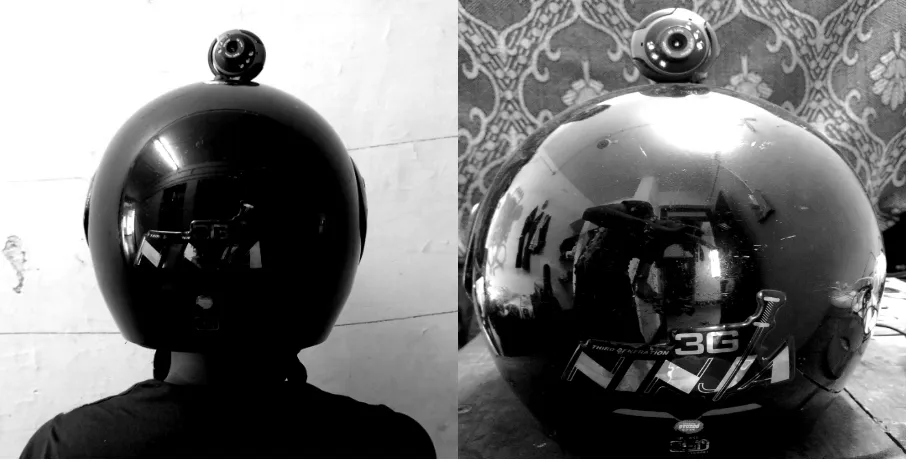
[image:3.612.85.539.145.376.2]The design of the system can be divided in two parts, hardware and software. In hardware, basic component Camera is included which is mounted on helmet at a perfect position facing backwards so that it can record the traffic scenario exactly at the back of the two wheeler. This recorded video can be processed for the detection of vehicles. Another hardware component that is important is the warning device which can be a simple speaker to convey the information to the two wheeler rider about the traffic behind.
Fig. 1 Camera mounted on helmet.
IV. ALGORITHM
This paper discusses the method for detecting the vehicle in the video frames which are recorded by the camera mounted on the helmet of the rider. The camera records the traffic scenario in real time and this video is utilized for processing. The following block diagram shows the actual flow of the algorithm.
A. Input to the Video Processor
Video from the camera mounted on helmet being fed to the video processing unit, in this case Matlab simulation software. In matlab the first step is to convert is video into frames which individually can be processed.
B. Color Conversion
The frames which are obtained from the video are color images, which is converted to grey scale input image is color image we have to convert it into grey scale image can also be called as black and white scale.
C. Pre-Processing of the Image
To reduce the noise present in the frames/image we use various pre-processing methods. It can be done using various filters, to name a few are median filter, mean filter, and convolution filter. For our system median filter is suitable for use. The mask of the median filter will be multiplied with image matrix and noise eradiated producing accurate or best possible result [1].
D. Background Subtraction and Frame Initialization
The essential part of the algorithm is this step, Background frame initialisation. Here first frame or the average of the brightness of the frames is taken as a background frame and foreground is taken from subsequent frames. Once we initialize the background frame we can perform background subtraction pixel by pixel.
Technology (IJRASET)
greater or smaller than threshold value, a frame or image is distinguished either as a background image or foreground image. After thresholding the image pixel value is either binary 1 for black color or binary 0 for white color. After segmentation and thresholding clear distinction between the moving vehicles in white and road black color can be observed. Thus helping in detecting the vehicle.
F. Morphological Operations for Noise Filtering
Morphological operations are used to reduce the noise in detected images. The pixel which have been wrongly identified as that belonging to vehicle though belonging to road can be removed using EROSION process. Disadvantage of erosion is, sometimes it wrongly considers a part of the vehicle itself as noise and diminishes the same. DIALATION is done to overcome this disadvantage of erosion process. i.e. to retrieve back the lost part of the vehicle.
G. Informing the Rider about Vehicle Detection
[image:4.612.193.430.254.483.2]After all the processing and vehicle detection, the message is communicated to the two wheeler rider in required form like voice message or some sort of signalling using LEDs blink etc.
Fig.2 Output showing vehicle being detected in a yellow rectangle.
[image:4.612.160.464.507.700.2]Technology (IJRASET)
V. CONCLUSIONS
In the approach described above we have presented a Smart helmet based on video processing, in order to improve the safety of riders riding motorbikes. It describes the algorithm to detect vehicular traffic of the rear end of the bike and also a system to alert the rider of their existence. This system is most useful to ensure safety especially while taking turns by the rider and also while changing the lanes at higher speeds. Through MATLAB simulation it was also found that the system takes a pretty less time to warn the rider about rear vehicle presence. In this way, by using a camera which worth a few rupees with a piece of safety equipment such as the helmet, and by using the video processing method specified in this paper, a huge number of fatalities due to rear end collisions could be avoided and a large number of lives can be saved every day.
VI. ACKNOWLEDGMENT
I am deeply indebted to my guide, Prof. Geeta Shet, Professor, Department of Electronics and Telecommunication Engineering, for allowing me to carry out this project under her supervision. She has given me a confidence to take up this project and guided me at the times of difficulty.
I thank my teachers, who have taught enthusiastically at the Goa College of Engineering. I also thank Dr. Hassanali Virani, (Head of the Department), Department of Electronics and Telecommunication Engineering, and Dr. Vinayak N. Shet (Principal), Goa College of Engineering.
REFERENCES
[1] Sudhir Rao Rupanagudi, Sumukha Bharadwaj, Varsha G. Bhat, S. Eshwari, S. Shreyas, B. S. Aparna, Anirudh Venkatesan, Amrit Shandilya “A Novel Video Processing Based Smart Helmet for Rear Vehicle Intimation & Collision Avoidance”, 2015 Intl. Conference on Computing and Network Communications (CoCoNet'15), Dec. 16-19, 2015, Trivandrum, India.
[2] Lee, D.; Yeo, H., "A study on the rear-end collision warning system by considering different perception-reaction time using multi-layer perceptron neural network," in Intelligent Vehicles Symposium (IV), 2015 IEEE , vol., no., pp.24-30, June 28 2015-July 1 2015
[3] Jhonghyun An; Baehoon Choi; Beomseong Kim; Euntai Kim; Jaeho Hwang, "Rear-end Collision warning system using linear discriminant analysis," in Soft Computing and Intelligent Systems (SCIS), 2014 Joint 7th International Conference on and Advanced Intelligent Systems (ISIS), 15th International Symposium on , vol., no., pp.218-221, 3-6 Dec. 2014 K. Erickson, Programmable Logic Controllers: An Emphasis on Design and Applications, Rolla: Dogwood Valley Press, 2005, pp. 1-20.
[4] Prem Kumar Bhaskar., “Image Processing Based Vehicle Detection and Tracking Method”, 2014 IEEE.