Technology (IJRASET)
Performance Of A Urea SCR System Combined
With Variable Injection Timings Of A Diesel
Engine To Reduce NO
x
Emissions
N.V. Tulasiram1, G.Logachander2
1
PG Student,2Assistance professor& Department of mechanical engineering& Sri Venkateswara college of engineering, Sriperumbudur – 602117, Tamil Nadu, India .
Abstract—The control of emissions in internal combustion engines can be achieved either by controlling combustion or by treating the exhaust gas. The latter was comparatively easy since there is less or no need to modify the engine itself. One such after treatment method is selective catalytic reduction(SCR). i.e., reduction of a particular emission based on the type of engine used. In diesel engine production of NOx is high comparatively HC and CO emissions, which needs development and up
gradation of the engine to reduce NOX emissions by using selective catalytic reduction technique. In this system cerium oxide
used as both pre –oxidation and SCR catalyst due to it is inexpensive and gives good results than Nobel metal catalyst. This analysis carried by varying the injection timings (210,230and250CAD)as retarding and advancing at 200 bar injection pressure at normal operating conditions and their effects on the performance and emission characteristics of engine are discussed.
Keywords ---Selective catalytic reduction, NOx emissions, retarding, advancing, CAD.
I. INTRODUCTION
The requirement for energy has grown exponentially over the past decades owing to industrialization and subsequent lifestyle changes. Much of this energy is generated by combusting fossil fuels such as coal, natural gas, gasoline and diesel. The combustion process releases the chemical energy contained in the fuels as thermal energy, which is used to run different power cycles depending upon the application. The combustion process involves complex chemical reactions; the reactants are fuel and air and the products include various species such as water, oxides of carbon, nitrogen and sulfur, unburned fuel, organic compounds and particulate matters. Some of these species have harmful effects on the living beings and the environment and hence are termed as pollutants. Global warming has resulted in serious climate changes and eco-system imbalances world-wide. Greenhouse gases (CO2, N2O) are
considered one of the major contributors of global warming. Hence Forthcoming European legislation pertaining to heavy duty diesel engines becomes more stringent. To feasible with those emission norms, requires the additional exhaust after treatment techniques.
Urea-SCR, the selective catalytic reduction(SCR) using urea as reducing agent, has been investigated in detail for about 10 years and today is a well established technique for DeNOx of stationary diesel engines. It is presently considered as the most promising way to diminish NOx emissions originating from heavy duty diesel engines. In the following we will discuss the SCR process and chemistry.
II. SELECTIVECATALYTICREDUCTION
A. SCR Process
The catalyst used are non-noble metal catalyst. SCR processes use ammonia as selective reducing agent, in that, main sub reactions are of nitrogen oxide reactions. In zeolite catalysts, the NOx conversion using the NH3 is independent of the oxygen concentration
over a wide range. The consequences in this reaction is a delayed reaction changes in NH3 input concentration with NH3 45%
to55% NOx conversion was attained using SCR. In contrast the presence of urea, nearly 98% NOX conversion was attained in the
range of 300°C through 350°C. In a catalytic reduction process involves several reaction steps that represent different physical and chemical processes. These processes can be independent, i.e. taking place in parallel, regardless of the other processes or dependent, i.e. taking place in series, one using up the product(s) of the process concluding before it. To model such a process requires a thorough understanding of the underlying chemistry and of the chemical and mechanical engineering principles.
B. SCR Chemistry
Technology (IJRASET)
©IJRASET: All Rights are Reserved
67
the exhaust gases of the engine.NOx in diesel exhaust is usually composed of >90% NO. Therefore, the main reaction of SCR with ammonia will be
4NH3+ 4NO + O2 4N2 + 6H2O (1)
This reaction implies a 1:1 stoichiometry for NH3 and NO and the consumption of some oxygen. The reaction consuming no oxygen is much slower and is therefore not relevant in lean combustion gases:
4NH3 + 6NO 5N2 +6H2O (2)
On the other hand, the reaction rate with equimolar amounts of NO and NO2 is much faster than that of the main reaction (1):
4NH3 + 2NO +2NO2 4N2 + 6H2O (3)
It should be mentioned that the reaction with pure NO2 is again slower than reactions (1) and (3): 4NH3 + 3NO2 3.5N2 + 6H2O (4)
At high temperatures (>400_C) the commonly used catalysts based on TiO2–WO3–V2O5 tend to form nitrous oxide. One of the possible reactions leading to nitrous oxide is
4NH3 + 4NO + 3O2 4N2O + 6H2O (5)
At still higher temperatures, ammonia may be oxidized to NO, thus limiting the maximum NOx conversion: 4NH3 + 5O2 4NO + 6H2O (6)
C. Design and Coating of Catalytic Converter
In this experiment we used two catalytic converters Pre-oxidation
SCR
NOx reduction done by the combined effect of the pre-oxidation and SCR catalyst.
Pre-Oxidation: The pre-oxidation catalyst is developed based on conventional diesel oxidation catalyst. The selectivity for high NO2 formation at lower temperature is the main target in this design; the high NO2 formation is a compromise between the higher point loading and catalyst volume
The primary effect of the pre-oxidation catalyst is to increase the NO2 fraction of the exhaust this permitting the fast SCR reaction.
The second effect is a considerable oxidation of hydrocarbon which inhibits the SCR reaction at low temperature; this will be also help increase the NOx conversion at low temperature.
For this we are using ceramic substrate coated with cerium oxide. spray coating is used for this type of catalyst. It is placed before the urea injection system and immediately after the exhaust pipe.
Technology (IJRASET)
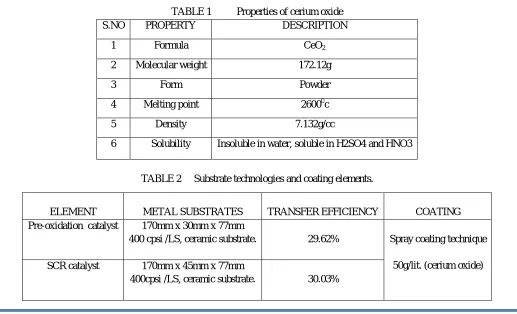
1) Cerium Oxide: Cerium Oxide has been used in catalytic converters in automotive applications. Since ceria can become non- stoichometric in oxygen content (i.e. it can Give up oxygen without decomposing) depending on its ambient partial pressure of oxygen, it can release or take in oxygen in the exhaust stream of an engine. In association with other catalysts, ceria can effectively reduce Nox emissions as well as convert harmful carbon monoxide to the less harmful carbon dioxide. Ceria is particularly interesting for catalytic conversion economically. Because, it has been shown that adding comparatively inexpensive ceria can allow for substantial reductions in the amount of platinum needed for complete oxidation of NOx and other harmful products of incomplete combustion. The properties of catalyst are listed in the table 1.
2) Coating Process: The catalyst was coated on substrate by spray coating process. cerium powder is mixed with distilled water and it was sprayed on the substrate. The efficiency of the catalyst coating on the substrate is measured by the transfer efficiency of the system to the substrate.
TRANSFER EFFICIENCY: It is defined as ratio of weight gained by the substrate after the coating to the weight of the spray equipment used to spay with the percentage of solid present in the spray content gives the transfer efficiency of the coating.
TE = (weight gain by substrate/(wt of spray material*percent of solid in the spray))*100. The dimensions and spray properties are listed on table 2.
[image:4.612.98.524.105.219.2]
TABLE 1 Properties of cerium oxide
S.NO PROPERTY DESCRIPTION
1 Formula CeO2
2 Molecular weight 172.12g
3 Form Powder
4 Melting point 26000c
5 Density 7.132g/cc
6 Solubility Insoluble in water, soluble in H2SO4 and HNO3
TABLE 2 Substrate technologies and coating elements.
ELEMENT METAL SUBSTRATES TRANSFER EFFICIENCY COATING
Pre-oxidation catalyst 170mm x 30mm x 77mm
400 cpsi /LS, ceramic substrate. 29.62% Spray coating technique
50g/lit. (cerium oxide) SCR catalyst 170mm x 45mm x 77mm
400cpsi /LS, ceramic substrate.
[image:4.612.49.566.429.743.2]Technology (IJRASET)
©IJRASET: All Rights are Reserved
69
3)Reducing Agent: Urea solution is used to produce reducing agent ammonia by hydrolysis process. Urea is produced in large scale worldwide product standard and distribution oriented to serve the major consumers such as food proceedings and fertilizer industries. Urea is preferred among the N-containing selective reductants for NOx because of safety and non-toxicity.it is easy to transport in the vehicle in an aqueous solution, which makes it also easy to dosage as required. Aqueous urea is stored in plastic or steel tank, not requiring any special safety equipment. All these advantages make urea solution the preferred reducing agent for the for nitrogen oxides. Urea is supplied in a 32.5 wt% aqueous solution (eutectic composition) that is to be injected in front of SCR. This solution is also called as Adblue solution.
Urea has high solubility in water .i.e.108g/100ml H2O at 20o c, enabling higher concentration to be transported in as storage tank. At
temperatures above 1600c urea starts to decompose and gives the ammonia according to the following reaction. H2 N-CO-NH2 2NH2 + CO (7)
H2 N-CO-NH2 + H2 O 2NH3 + CO2. (8)
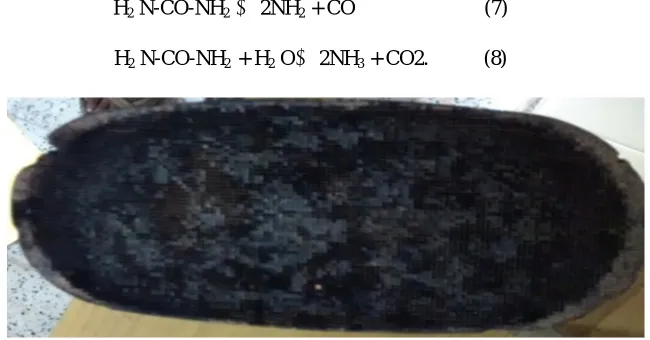
Figure2. Ceramic substrate coated with cerium oxide
[image:5.612.151.476.231.401.2]III. EXPERIMENTALSETUP
Technology (IJRASET)
TABLE 3 Engine specifications
Type Vertical, air cooled, four stroke single cylinder diesel engine
Make Kirloskar
Number of cylinders One
Bore 87.5 mm
Stroke 110 mm
Compression ratio 17.5:1
Maximum power 4.4 kW
Dynamometer Electrical
Speed 1500 rpm
Injection timing 23 deg CA(before TDC)
Injection pressure 200 bar
A. Test Procedure
The experiment was performed firstly with diesel and engine fitted with SCR set up. Diesel fuel was filled in burette. Then the diesel fuel is supplied to engine by accessing the valves provided on fuel supply line. Electrical power supply is provided to control panel, 5 gas analyzer and smoke meter. The engine is started under no load condition by hand cranking using decompression lever. Then engine is run under no load condition for a few minute so that the speed of engine, 5 gas analyzer and smoke meter is get warmed up and stabilized respectively. After that engine was made to run on desired load with the help of an electrical alternator. As the load on engine increased from no load to desired load, engine rpm decreases. The desired constant rpm is maintained using screw arrangement. After that run the engine for three minutes so that it can stabilize. Then supply valve of diesel was closed and the valve of burette was opened so that fuel filled up again. The time taken for 10cc of fuel consumption is noted. Temperature of exhaust gases from the engine is displayed on the digital control panel. Unburned hydrocarbon, carbon monoxide, nitrogen oxides and smoke opacity are noted down with the help of 5 gas analyzer and smoke meter respectively. These procedures are repeated for loads of 0%, 25%, 50%, 75%, 100% keeping the rpm constant [1500rpm].After the records of experiment is noted, engine was brought to no load condition and stopped. Before starting the next experiment engine is allowed to cool till exhaust gas temperature reaches the room temperature. The experiment is repeated like above by fitting SCR to the conventional exhaust manifold with newly designed manifold which holds urea injecting nozzle. Urea is injected by using the electrical vacuum pump through plastic hoses and the pump was operated with help of battery. The experiment was repeated for advance and retarded CAD angles i.e. 25 and 21 at 200bar injection pressures and readings to be noted.
IV. RESULTS AND DISCUSSION
A. Performance Characteristics
1) Brake thermal efficiency: The Brake thermal efficiency is defined as the ratio of work output at the engine shaft to the energy
Technology (IJRASET)
©IJRASET: All Rights are Reserved
71
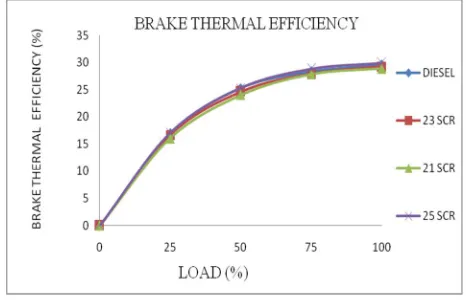
of different operating conditions of engine by varying the CAD angles (i.e.21, 23, 25) at 200 bar injection pressures. Advancing the CAD angle leads to increase in the brake thermal efficiency than the conventional engine. The SCR which causes for increase total fuel consumption and decrease the SFC. This is due to the ceramic filter placed in the path of exhaust gases gives the back pressure which in turn reduces the combustion efficiency of the engine. But difference in the BTE is negligible.
2) Specific fuel consumption: Brake Specific Fuel Consumption (or BSFC) is the ratio between the engine's fuel mass consumption and the crankshaft power it is producing. The fuel consumption of the engine at different operating conditions shown in fig 6. The retarding CAD angle injection consumes a little low from the base operating conditions and at advancing CAD angle fuel consumption increased. The engine operated with SCR will increase TFC that in turn decrease the BSFC of the engine.
B. Emission characteristics 2) Hydrocarbon Emissions (HC)
“
[image:7.612.179.412.168.321.2]
Figure 5 .effect of engine load on brake thermal efficiency
Figure 6. Effect of engine load on specific fuel consumption.
Technology (IJRASET)
Figure 7.effect of engine load on HC emissions
Since CI engine operates with an overall fuel-lean equivalence ratio, it has only 1/5th of HC emissions than SI engines. But fig 7. Shows that the load increase fuel required is increase but time required for the combustion of fuel decreases which increase the unburnt HC emissions. This is due to non-availability of oxygen to burn all the fuel. Some of the other reasons are wall deposition, oil film absorption, crevice volume etc. Advancing the injection keeps HC emission low at the zero loads. The pre oxidation catalyst used in SCR reduces HC at maximum load. But at the low loads are almost near to the base engine.
3) Carbon monoxide
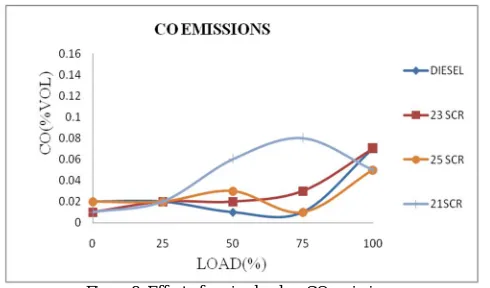
Fig 8. shows the variation of carbon monoxide emission among various injections. Poor mixing, local rich regions, insufficient oxygen may also be the source for CO emissions. At maximum loads CO emissions reduced because of decrease in the brake fuel consumption. Due retarded injection incomplete combustion will occur that leads to increase of CO emissions. SCR pre oxidation catalyst having cerium oxide as catalyst will convert harmful CO into less harmful.
4) Oxides of nitrogen (NOX).
Fig 9. shows the variation of NOx emission with respect to load .NOX emission. As the load increase, the peak temperatures inside
the cylinder increase as more fuel consumed and the oxides of the nitrogen in exhaust increases. By using SCR, at the retarding CAD angle injection at 200bar pressures, the cylinder temperatures are low gives low NOx, it was reduced up to 40% at maximum
[image:8.612.182.427.242.386.2]loads. At the normal CAD angle injections NOx reduced up to 15% at maximum loads. At advance CAD angle injections NOx
[image:8.612.182.439.480.629.2]Figure 8. Effect of engine load on CO emissions
Technology (IJRASET)
©IJRASET: All Rights are Reserved
73
V. CONCLUSION
The experimental study on performance and emission characteristics of diesel engine operated with SCR catalyst is concluded as this project the improved SCR technology ( pre-oxidation and Urea-SCR) is used. The conclusions are summarized as follows. It is conclude that the conversion efficiency of the SCR by using CeO2 as catalyst system is reduces the NOX emissions by 36% at
retarding, 8% at advanced and by 17% at normal injection timings.
The pre –oxidation catalyst reduces the HC and CO emissions up to some extent Due to pre-oxidation catalyst CO2 levels increase in exhaust gases.
NOMENCLATURE CV Calorific valave
BP Brake power
RPM Rotations per minute
CO Carbon monoxide
CO2 Carbon dioxide
HC Hydro carbans
NOX Oxides of nitrogen
CAD Crank angle degree
SCR Selective catalytic reduction PPM Parts per million
REFERENCES
[1] Ganesan, v. 0000 Internal Combustion Engines, Third Edition [2] B. Pundir, IC Engines Combustion and Emissions.
[3] D. Ravi, ‘selective catalytic reduction-an effective emission controller in Ci engines’. Middle East Journal of scientific research 20(11): 1379-1385, 2014..
[4] H.An, W.M. Yang, J.Li, D.Z. Zhou.’Modelling analysis of urea direct injection on the NOx emission reduction of biodiesel fueled diesel engines’. Energy
Conversion and Management 101(2015)442-449.
[5] Asad Naeem SHAH, Yun-Shan GE, Lei JIANG, Zhi-Hua LIU.’performance evaluation of a urea-water selective catalytic reduction(SCR) for controlling the exhaust emissions from a diesel engine’. Turkish J.Eng.Env.Sci.33 (2009), 259-271.
[6] C.Solaimuthu , V. Ganesan ,D. SenthilKumar , K.K. Ramaswamy.’Emission reductions studies of a biodiesel engine using EGR and SCR for agricultural operations in developing countries’. Applied Energy 138(2015) 91-98.
[7] Ioannis geakas, Par Gabrielsson and Keld Johansen, Ingvard Bjorn and Jens Husted Kjar, Walter Reczek, wolfgang Cartellieri. ‘Performance of a urea SCR system combined with a PM and fuel optimized heavy-duty diesel engine able to achieve the Euro V emission limits’. SAE technical paper 2002-01-2885.
[8] M. Koebel, M. Elsener, M. Kleemann. ‘Urea-SCR: A promising technique to reduce NOx emissions from automotive diesel engines’. Catalysis Today 59 (2000) 335–345.
[9] S.Sundarraj, P.M.Madhankumar, S.Natarajan. Experimental investigation of urea-scr in ci engine with Jatropha blends’. International Journal of International Innovative Research in Science and Engineering technology.
[10] Transfer efficiency theory and practical by GARCO publications USA.
[11] Jungmo Oh, Kihyung Lee . ‘Spray characteristics of aurea solution injector and optimal mixer location to improve droplet uniformity and NOx conversion
efficiency for selective catalytic reduction’. Fuel119(2014)90-97.
[12] Frencois jayat and alfred reck, kvr babu.’ SCR and SCRi as after treatment systems for low CO2 and low NOx vehicles’.symposium on internation automotive