Technology (IJRASET)
Performance testing of different blends of
Preheated Thumba Oil on a CI Engine
Shashi Kumar1, Apurv Yadav2
1
Mechanical Department, Ideal Institute of Technology, Ghaziabad, India
2
Amity Institute of Renewable and Alternate Energy, Amity University, Noida, India
Abstract— This Non renewable energy sources (fossil fuels such as natural gas, petroleum and coal) are getting depleted day by day as the energy demand keeps on increasing. This scarcity of fuel has increased the interest among researchers to find an alternative that can be used in place of conventional fuels. Biodiesels are considered most promising alternatives for internal combustion engines especially CI (compression engines) engines. Biodiesel are vegetable oil or animal fat-based diesel fuel consisting of long-chain alkyl esters. In Present work preheated Thumba oil is used for blending with diesel to run a single cylinder CI engine. Preheating of oil leads to decrease in viscosity which results in better atomization and combustion of fuel. It is found that the performance obtained by blending fuel is comparable to diesel and emissions are also less as compare to pure diesel.
Keywords— Biofuels; Thumba Oil; Engine Testing; Brake Power; Brake Specific Fuel Consumption
I. INTRODUCTION
Oil consumption in India has increased by 3% while the production has decreased by 1.3%. This has led to increasing interest among researchers for preparation of alternative fuels. Biodiesels are most promising solution that are comparable to conventional fuels. Mostly biodiesel is prepared from oils like soybean, sunflower, rapeseed etc. throughout the world. The extracted oil could not be used directly in diesel due of its high viscosity. Fuel atomization will increase due to high viscosity and also fuel spray penetration will increase, which will cause high engine deposits and thickening of lubricating oil. Whereas use of chemically treated vegetable oil called biodiesel does not require modification in injection system, engine or fuel lines and is possible in any diesel engine [1].A lot of research has been done on optimization of biodiesel performance parameters incorporating edible oils. Despite of that plenty of oilseeds remain un-utilized or underutilized for biodiesel production. One such vegetable oil is Thumba oil.
II. THUMBAOIL
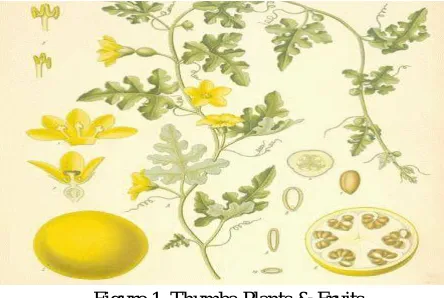
[image:2.612.201.423.511.660.2]Citrullus colocynthis Schrad, which is commonly known as Thumba, is a perennial vine which grows wildly in hot Indian arid zone. This unexploited creeper has a significant soil binding capacity and has a potential to yield approximately one million tonnes of the oil rich seeds from the arid regions of Rajasthan [2].
Figure 1. Thumba Plants & Fruits
III. PREPARATIONOFSAMPLE
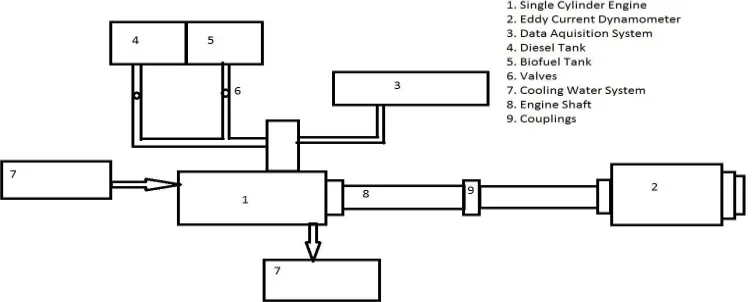
The setup is a four stroke, single cylinder, Kirloskar Diesel engine connected to eddy current type dynamometer. For loading
measurements it is used with necessary instruments for crank-angle (θ) and combustion pressure (P) measurements. These signals
are interpreted through a computer interface connected to engine indicator for P-θ & P-V diagrams. Sensors are used for the interfacing of flow of fuel, temperatures and flow of air. The setup comprises of a stand-alone panel box consisting of air box, two fuel tanks for dual fuel test, fuel measuring unit, transmitters for air and fuel flow measurements, process indicator, engine indicator and manometers. Rota-meters are provided for measurement of calorimeter water flow and cooling water. The setup enables varying the compression ratio for measurement of engine performance parameters like Brake Power (BP), Indicated Power (IP), Frictional Power (FP), Brake Mean Effective Pressure (BMEP), Indicated Mean Effective Pressure (IMEP), (Brake Thermal Efficiency (BTE), Indicated Thermal Efficiency (ITE), Mechanical Efficiency (ƞm), volumetric efficiency (ƞv), Specific Fuel Consumption (SFC), Air
[image:3.612.120.497.254.405.2]-Fuel ratio and heat balance. Engine soft LV (from LabView) is used for on line performance evaluation. A computerized diesel injection pressure sensor is used for the measurement of combustion chamber pressure. The experimental setup is shown in Fig. 2 and Fig 3.
[image:3.612.124.504.432.608.2]Figure 2. Schematic Layout of Single Cylinder Engine Setup
Figure 3. Actual Test Engine Setup
V. RESULTS&DISCUSSIONS
A. Variation of brake thermal efficiency w.r.t. brake power
Technology (IJRASET)
Figure 4. Variation of brake thermal efficiency w.r.t brake power
B. Variation of brake specific fuel consumption w.r.t. brake power
[image:4.612.145.471.282.414.2]In the graph of BSFC v/s BP power shown in Fig. 5, the specific fuel consumption of various blends have the similar trends except at starting. The SFC is higher for all blends of thumba oil compared to diesel, due to higher mass flow rate of fuel and lower heating value of the fuels to meet the engine loads. BSFC remain constant for wide range of brake power (1-3.5 kW).
Figure 5. Brake specific fuel consumption w.r.t. brake power
C. Variation of brake specific energy consumption w.r.t brake power
Fig. 6 represents the variation of the BSFC v/s BP of thumba oil blends of (B20, B40, B60) respectively as compared to pure diesel. Brake specific energy consumption (BSEC) is an ideal factor for a comparison of engine performance of fuels having different Calorific Values (CV). At idling, the SFC decreases for all blends of thumba oil. The specific energy consumption decreases due to decrease in thermal efficiency.
Figures 6. Variation of brake specific energy consumption w.r.t. brake power
D. Variation of exhaust gas temperature w.r.t. brake power
engine. The exhaust gas temperature for all blends increases linearly (160 to 3400C) with increase in BMEP excluding idling.
Figure 7. Variation of Exhaust gas temperature w.r.t. brake power
E. Variation of smoke opacity w.r.t.brake power
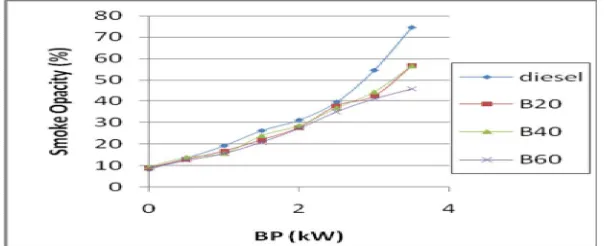
Fig. 8 represents the variation of smoke opacity with BP with different blends of thumba oil as compared to pure diesel. Smoke opacity is usually found to decrease with preheated oil in comparison to diesel. This might be due to the viscosity reduction and hence improvement in spray, fuel–air mixing and combustion characteristics because of preheating. As pfactors such as pressure, temperature, oxygen content and fuel-air ratio in the combustion chamber affect combustion in the IC engines, it is seen clearly that preheating improved these parameters.
Figures 8. Variation Smoke Opacity w.r.t. brake Power
VI. CONCLUSION
From the above graphs it is clear that the brake specific fuel consumption of preheated thumba oil is more than diesel but brake thermal efficiency of B20 is more than diesel and other concentarion blends. Also exhaust gas temperature and smoke opacity is much less for B20 blend. It can be concluded from the above results that 20% concentration of thumba oil in diesel is more suitable fuel for future energy needs. In addition to increasing the efficiency of the engine it also reduces the emissions.
REFERENCES
[1] S. B. Chavan, R. R. Kumbhar and Y. C. Sharma, “Transesterification of Citrullus colocynthis (Thumba) oil: Optimization for biodiesel production”, Adv. In Applied sci. Res, 5(3), 2014.
[2] R. S. Sain, P. Joshi and Sharma, S.N., Cytomorphological studies in genus Citrullus (Cucurbitaceae). Seed, 347(268.8), pp.887-5.
[3] A. S. Ramadhas, S. Jayaraj and C. Muraleedharan, “Use of vegetable oils as IC engine fuels—a review”, Renewable energy, 29(5), pp.727-742, 2004
[4] M. Lalwani and M. Singh, “Conventional and renewable energy scenario of India: Present and Future”, Canadian Journal on Electrical and Electronics Engineering, 1(6), pp.122-40, 2010
[5] K. Kalyani, R., S. Naga and N. EL, “Performance and emission characteristics of CI engine operated on vegetable oils as alternate fuels”, International Journal of Automotive and Mechanical Engineering (IJAME), 4, pp.414-427. 2011
[6] Radha, K. Kalyani, A. A. Kumari, N. S. Sarada, E. L. Nagesh and K. Rajagopal, “Alternative fuels for a single cylinder direct injection diesel engine”, Emerging Trends in Engineering and Technology, First International Conference, IEEE, pp. 1083-1088, 2008.
[image:5.612.156.458.331.454.2]