www.ijraset.com Volume 4 Issue I, January 2016 IC Value: 13.98 ISSN: 2321-9653
International Journal for Research in Applied Science & Engineering
Technology (IJRASET)
©IJRASET 2013: All Rights are Reserved
238
A Study on Nanocomposites for Biofuel Cell in
Surface Engineering
P. Puviarasu
ME - Advanced Manufacturing Technology, Second year, Coimbatore Institute of Technology, Coimbatore, India
Abstract-A novel strategy of surface functionalization and immobilization for EBFC applications using electropolymerized polypyrrole thin film, and demonstrate the advantages of the electropolymerized pyrrole immobilized enzyme/graphene sheet composite electrodes for EBFC application.A membrane less enzymatic glucose/oxygen biofuel cell applications is described using surface Engineering. The biofuel cell employs the gold plate electrodes modified by specific graphene-enzyme conjugations, which are immobilized by electrochemical deposition of the conducting polypyrrole polymer. The electrochemical activity of these electrodes is superior to the electrodes immobilized with sol–gel. Such enhancements can be attributed to the excellent electrical property and enzymeloading capability of the polypyrrole material. The power output and the biostability of the integrated biofuel cell can be also improved.
Keywords—Graphem nanosheets, Polypyrrole, surface engineering, Biofuel cell, enzymatic fuel cell
I. INTRODUCTION
Biofuel cells are electrochemical power generators that are able to convert chemical energy into electrical energy through redox reactions.In recent years, the development of enzymatic biofuel cells (EBFC) is likely to have a significant impact on homeland security, aerospace, and healthcare industries as the EBFCs can produce higher power output than other types of biofuel cells [1]– [4]. The output power of such EBFCs is well sufficient to supply some microscale electronic systems, such as cameras for remote surveillance, transmitters, actuators, or even wireless sensor networks, which paves the path for the U.S. Army’s goalto eliminate all army military batteries or at least reduce the frequency of replacing batteries, thus to realize integrated soldier sensor suites as envisioned in the war fighter concept. Considerable efforts of researchers are also given to explore the potential of EBFCs for long-term space mission applications [5].
Current technologies, including solar and nuclear energies are either excessively expensive or dangerous, which motivates scientists to develop an alternative portable energy source. However, due to the poor stability caused by enzyme denaturation, the EBFCs have not been successful in practical applications. Currently, how to improve the stability and to fabricate practical EBFC devices out of theoretical concepts [6]–[10] is a key challenge. Among others, covalent binding and physical entrapment are the two main strategies for stability enhancement. In this paper, a simple, practical EBFC system based on electropolymerized pyrrole immobilized enzyme/ graphene sheets composite electrodes is used. Among different enzyme immobilization methods studied so far, encapsulating enzymes in polypyrrole film offers a facile strategy for the fabrication of EBFCs, since the process only includes the application of a fixed potential between the working electrode and the reference electrode in a solution containing the pyrrole monomer and enzymes. This technique is especially attractive for the enzymatic functionalization of EBFC electrodes, because we can estimate the amount of the immobilized enzyme and the thickness of the growing polymer film easily by measuring the charge passed through the electrode. Moreover, earlier studies on the microstructure and the conductivity of polypyrrole [11] showed that polypyrrole is a porous polymer with high conductivity and surface-to-volume ratio.
Technology (IJRASET)
The presence of C=C conjugation in graphene is also expected to boost the electron transfer rate, which significantly enhances the power output of the EBFCs [19]. More recently, graphene and sol–gel, another common immobilization method for biofuel cell assembly are employed. However, the power output and the stability were unsatisfied for future security and space applications [20]. In this paper, a novel strategy of surface functionalization and immobilization for EBFC applications using electropolymerized polypyrrole thin film, and demonstrated the advantages of the electropolymerized pyrrole immobilized enzyme/graphene sheet composite electrodes for EBFC application is studied.
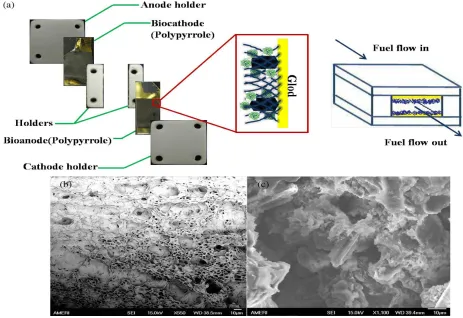
Fig. 1. (a) Polypyrrole-based electrodes microstructure and EBFC assembly diagrams. (b) SEM image of the porous structure of the polypyrrole thin film.(c) SEM image of the porous structure of silica sol–gel matrices.
II. EXPERIMENTAL ANALYSIS
[image:3.612.73.536.167.485.2]www.ijraset.com Volume 4 Issue I, January 2016 IC Value: 13.98 ISSN: 2321-9653
International Journal for Research in Applied Science & Engineering
Technology (IJRASET)
©IJRASET 2013: All Rights are Reserved
240
and an electron loss z of 2.25 was considered [21]. Finally, the polypyrrole immobilized graphene-enzyme composite electrode was stored in 1× PBS (pH 7.4) solution at 4 ◦C before test. Similarly, the biocathode was fabricated using the same strategy except the enzyme used was 2.5 mg bilirubin oxidase (E. C.1.3.3.5, from Myrothecium verrucaria; BOD) and the redox mediator was 2_ -azinobis (3-ethylbenzothiazoline-6-sulfonic acid)diammonium salt (ABTS) [see Fig. 1(a)].
III. CONCLUSION
In this paper, a study on novel strategy of surface functionalization and immobilization for EBFC applications using electro polymerized polypyrrole thin film is done. Initially, the surface characteristics of polypyrrole were evaluated by SEM imaging, which indicated a highly porous structure of this material. Moreover, cyclic voltammetry results indicated polypyrrole-based electrodes possess better electron transfer and diffusion properties in comparison with sol–gel immobilization-based electrodes. Finally the power output and life time of the assembled EBFCs are measured. In all experiments, polypyrrole exhibited a better surface immobilization performance than the sol–gel. The observed marked performance of the polypyrrole electrode is mainly due to the porous surface structure and excellent conductivity of the polypyrrole material. As future enhancement the EBFC packaging using low-temperature cofired ceramic (LTCC) for in vivo application will be conducted.
REFERENCES
[1] F. Gao, Y. Yan, L. Su, L. Wang, and L. Mao, “An enzymatic glucose/O2 biofuel cell: Preparation, characterization and performance in serum,” Electrochem. Commun., vol. 9, pp. 989–996, 2007.
[2] R. A. Bullen, T. C. Arnot, J. B. Lakeman, and F. C. Walsh, “Biofuel cells and their development,” Biosens. Bioelectron., vol. 21, pp. 2015–2045,2006. [3] J. Kim, H. F. Jia, and P. Wang, “Challenges in biocatalysis for enzymebased biofuel cells,” Biotechnol. Adv., vol. 24, pp. 296–308, 2006.
[4] T. Ikeda and K. Kano, “Bioelectrocatalysis-based application of quinoproteins and quinoprotein-containing bacterial cells in biosensors and biofuel cells,” Biochim. Biophys. Acta., vol. 1647, pp. 121–126, 2003.
[5] S. Jayaram, “Development of payload housing for temperature and pressure control of bio fuel cells for space applications,” J. Eng. Des. Technol., vol. 7, pp. 323–334, 2009.
[6] N. Mano, F. Mao, and A. Heller, “A miniature biofuel cell operating in a physiological buffer,” J. Amer. Chem. Soc., vol. 124, pp. 12962–12963,2002. [7] I. Willner, “Biomaterials for sensors, fuel cells, and circuitry,” Science.,vol. 298, pp. 2407–2408, 2002.
[8] R. F. Service, “Biofuel cells,” Science, vol. 296, pp. 1223–1223, 2002.
[9] E. Katz, O. Lioubashevski, and I. Willner, “Magnetic field effects on bioelectrocatalytic reactions of surface-confined enzyme systems: Enhanced performance of biofuel cells,” J. Amer. Chem. Soc., vol. 127, pp. 3979–3988, 2005.
[10] E. Katz and I. Willner, “A biofuel cell with electrochemically switchable and tunable power output,” J. Amer. Chem. Soc., vol. 125, pp. 6803–6813,2003. [11] N. C. Foulds and C. R. Lowe, “Immobilization of glucose oxidase in ferrocene-modified pyrrole polymers,” Anal. Chem., vol. 60, pp. 2473–2478, 1988. [12] M. D. Stoller, S. Park, Y. Zhu, J. An, and R. S. Ruoff, “Graphene-based ultracapacitors,” Nano Lett., vol. 8, pp. 3498–3502, 2008.
[13] K. S. Novoselov, A. K. Geim, S. V. Morozov, D. Jiang, Y. Zhang, S. V. Dubonos, I. V. Grigorieva, and A. A. Firsov, “Electric field effect in atomically thin carbon films,” Science, vol. 306, pp. 666–669, 2004.
[14] C.-Z. Li, W-B. Choi, and C.-H. Chuang, “Enhancement of photocurrents by finite-sized SWNT based thin films,” Electrochim. Acta, vol. 54,pp. 821–828, 2008.
[15] M. Pumera, “Electrochemistry of graphene: New horizons for sensing and energy storage,” Chem. Rec., vol. 9, pp. 211–223, 2009.
[16] A. Ambrosi, T. Sasaki, and M Pumera, “Platelet graphite nanofibers for electrochemical sensing and biosensing: The influence of graphene sheet orientation,” Chem. Asian J., vol. 5, pp. 266–271, 2010.
[17] S. Alwarappan, A. Erdem, C. Liu, and C.-Z. Li, “Probing the electrochemical properties of graphene nanosheets for biosensing applications,”J. Phy. Chem. C., vol. 113, pp. 8853–8857, 2009.
[18] M. Pumera, R. Scipioni, H. Iwai, T. Ohno, Y. Miyahara, and M. Boero,“A mechanism of adsorption of β-Nicotinamide Adenine Dinucleotideon graphene sheets: Experiment and theory,” Chem. Eur. J., vol. 15,pp. 10851–10856, 2009.
[19] W. S. Choi, S. H. Choi, B. Hong, D. G. Lim, K. J. Yang, and J. H. Lee,“Effect of hydrogen plasma pretreatment on growth of carbon nanotubes by MPECVD,” Mater. Sci. Eng. C., vol. 26, pp. 1211–1214, 2006.
[20] C. Liu, S. Alwarappana, Z. Chen, X. Kong, and C.-Z. Li, “Membraneless enzymatic biofuel cells based on graphene nanosheets,” Biosens. Bioelectron., vol. 25, no. 7, pp. 1829–1833, 2010.
[21] S. Carquigny, J. Sanchez, F. Berger, B. Lakard, and F. Lallemand, “Ammonia gas sensor based on electrosynthesized polypyrrole films,” Talanta, vol. 78, pp. 199–206, 2009.
[22] M. Umana and J. Waller, “Protein-modified electrodes. The glucose oxidase/ polypyrrolesystem,” Anal. Chem., vol. 58, pp. 2979–2983, 1986.