5
VIII
August 2017
Evaluation of Effect of Steel Fibres on M45 grade
of Concrete by Partial Replacement of Cement with
Fly ash and GGBS
Pooja1, Shreenivas Reddy Shahapur2, Maneeth PD3, Brijbhushan S4
1PG Student, 2 Chairman & Professor, 3Assistant Professor
Department of Civil Construction Technology, Visvesvaraya Technological University, Centre for Postgraduate Studies, Regional Office, Kusnoor Road, Kalaburagi, Karnataka, India
Abstract: The experimental investigation effort will be dealing with an obtained result on higher the strength of steel fiber resistant concrete. Those fibers added will be affected on the workability, density and on various strengths of M60 grade concrete. In this, fiber content will be varied from 0.5% to 2% by burden of concrete at the period of 0.5% .Here the replacement of cement by 20% of fly ash and 10% of GGBS. GGBS cement will be having higher ultimate strength than the material which is made by Portland cement. Water-cement ratio is very important to maintain within the minimum choice, for that we will be using the water falling admixture that will be super plasticizer, which will be very imperative role. As these fibre content increases the workability of soggy mix up is found to be cheap. As the fibre content increases in maximum, it is found to be strength dependent.FRC over plain high sc will be increases the strength and mechanical load carrying capacity. Higher struggle for cracking and breaking circulation is its important property of steel fibers. To find out the compressive force, split tensile force and also fighting for cracking by determining the flexural force of M45 grade 0%, 0.5%, 1%, 1.5%, 2% by volume fractions as its aspect ratio is 50.
Keywords: Concrete, Fly ash. GGBS, fiber reinforce, steel fiber, Compressive, Split tensile & Flexural strength
I. INTRODUCTION
Fiber Reinforced Concrete (FRC) is concrete as it increases its structural reliability because it contains tough material. Fibres here will be used because to be in charge of terrible due to synthetic reduction & exposure to air decrease. The sum of fibres additional to the concrete mix up will be express as a proportion of the full quantity of the concrete & fibres term as number of divisions. Adding up fibres concept is to improve the easily broken material behaviour. Now days, from different material fibres are produced, they are steel fibres, carbon fibres, glass fibres and synthetic fibres. Each has its own specific benefits. Steel fibres are most common. It can maintain strain-hardening to most of several percent of injure results in a substance will be ductile at least two preparation of elevated amount as compare to standard material or model fibre-unbreakable concrete. Steel Fibre Reinforced Material In order to reinforce concrete steel fibres is the definition as a take apart miniature wavelength, have an aspect ratio in the range 20-100, with every side analysis steel & are small and satisfactory amount of to be spread at unsystematic in a concrete mix without improvement using first of its kind methods. The most important substance possessions of concrete (SFRC) steel fibre reinforced are the hardest flexural, strength resistance & flexural disintegrate performance. For this reason SFRC has found application in flat slabs of extent where it is subject to high wheel & force loads. SFRC also has been used discursively in application of shotcrete support of soil, move up & down incline stabilization, tunnelling & repairs the ease of placement of SFRC in clumsy ways formwork has also seen its application in the manufacture of precast concrete products.
II. LITERATURE REVIEW
A. Benson. et al, (2014)
proposition of material of all structural member is mainly govern through exam of distraction along with locally spoil. In view of the fact that the presences of fibres honestly progress conflict to split and twist, to apply of fibre material in traditionally.
B. Swamy & Al-ta’an (2014)
The deformation formed by the characteristics which is described from the authority of fibre strengthening & the definitive strength in the flexure of the material of prisms has maximum with 20mm range of the aggregate with resistant bars with reinforcement with all specified with minimum number of yield strength of 460 & 617 N/mm2respectively Either of the overall the whole depth of
a beam was provided with concrete fibre or which has effective tension zone which is only surrounding of the steel bars.
C. Amit Rana (2013)
Has been discovered that the ideal steel fibre amount is required to accomplish most extreme number of flexural quality in M25
review has been found. From these thorough and broad exploratory works there has been discover that there was an expansion in cement in steel fibre was additionally an amazing increment in flexural quality. For 1% calm of steel fibre the flexural quality was 6.46% N/mm2was test again on flexural quality was 5.36% for 0%, at last add to 1.1% flexural quality.
D. Fanella & Naaman (1985)
The improved compressive resistance which are ranging from 0-15%,, which has increased in the presence of the fibres. The volume of the fibres which has gentle slope in the downward branch fraction increases in the fraction of the nervous concern curve pull. Fanella & Naaman has been proposed that in the analytical model for its complete curve which mortar all reinforced with all type of fibres with tension behind with volume of fraction.
III. MATERIALS AND ITS PROPERTIES
A. Cement
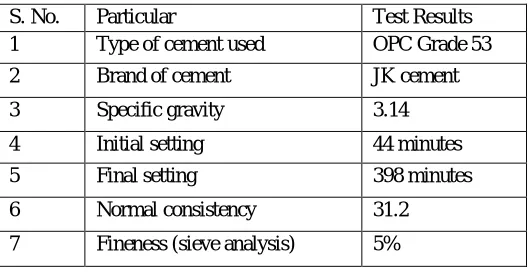
[image:3.612.175.440.433.569.2]The bond utilized is conventional Portland concrete 53 reviews i.e. JK bond which was taken from the CASHUTEC and the properties which was tried in the research centre is given underneath in table 1.
Table no 1: Shows the Preliminary Tests Properties of Cement S. No. Particular Test Results 1 Type of cement used OPC Grade 53 2 Brand of cement JK cement
3 Specific gravity 3.14
4 Initial setting 44 minutes 5 Final setting 398 minutes
6 Normal consistency 31.2
7 Fineness (sieve analysis) 5%
B. Fine Aggregate
Natural river sand which lies under Zone II. We have taken the natural river sand from Krishna River which is near to Kadlur, Raichur. The natural river sand tests will be conducted CASHUTEC laboratory. As it passes through IS sieve 4.75mm. Usage of zone 2 sand is beneficially proved that its regards to workability.
C. Coarse Aggregate
A natural aggregate whose size is 20mm & 10mm is used significantly. Aggregates shape is an angular. Aggregates are locally available. The aggregates will be tested in CASHUTEC laboratory.
D. Fly Ash
practicing ASTMC-618 of type-F. Class F fly ash: it is really commodity ion from the coal of ebony reach this as a choice anthrdoete of the blazing. This type of fly ash whichever regularly exhibits a pozolanic plot but unsuccessfully it will be hardly self crystallization of its plot.
E. Swamy & Al-ta’an (2014)
The deformation formed by the characteristics which is described from the authority of fibre strengthening & the definitive strength in the flexure of the material of prisms has maximum with 20mm range of the aggregate with resistant bars with reinforcement with all specified with minimum number of yield strength of 460 & 617 N/mm2respectively Either of the overall the whole depth of a
beam was provided with concrete fibre or which has effective tension zone which is only surrounding of the steel bars.
F. anella & Naaman (1985)
The improved compressive resistance which is ranging from 0-15%, which was increased in the presence of the fibres. The volume of the fibres which has gentle slope in the downward branch fraction increases in the fraction of the nervous concern curve pull. Fanella & Naaman has been proposed that in the analytical model for its complete curve which mortar all reinforced with all type of fibres with tension behind with volume of fraction.
IV. MATERIALS AND ITS PROPERTIES
A. Cement
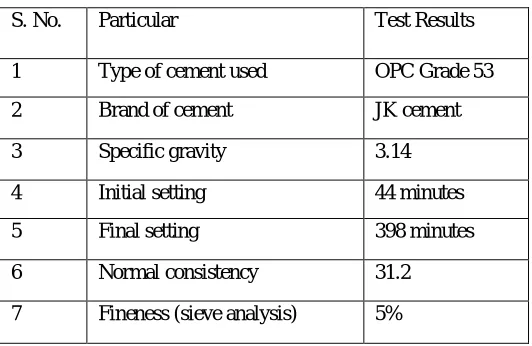
[image:4.612.174.440.365.538.2]The bond utilized is conventional Portland concrete 53 reviews i.e. JK bond which was taken from the CASHUTEC and the properties which was tried in the research centre is given underneath in table 1.
Table no 1: Shows the Preliminary Tests Properties of Cement
S. No. Particular Test Results
1 Type of cement used OPC Grade 53
2 Brand of cement JK cement
3 Specific gravity 3.14
4 Initial setting 44 minutes
5 Final setting 398 minutes
6 Normal consistency 31.2
7 Fineness (sieve analysis) 5%
B. Fine Aggregate
Natural river sand which lies under Zone II. We have taken the natural river sand from Krishna River which is near to Kadlur, Raichur. The natural river sand tests will be conducted CASHUTEC laboratory. As it passes through IS sieve 4.75mm. Usage of zone 2 sand is beneficially proved that its regards to workability.
C. Coarse Aggregate
A natural aggregate whose size is 20mm & 10mm is used significantly. Aggregates shape is an angular. Aggregates are locally available. The aggregates will be tested in CASHUTEC laboratory.
D. Fly Ash
Table no 2: Shows Chemical Composition of Fly Ash
S. No. Particular Test Results 1 Silica(SiO2) 48.3-66.9
2 Alumina(Al2O3) 15.8-27
3 Iron oxide(Fe2O3) 4.9-10.1
4 Lime(Ca O) 0.8-3.5 5 Magnesia(Mg O) 0.4-2.7 6 Sulphur trioxide(SO3) 0.4-2.5
E. Super plasticizer
As the super plasticizer it is a type of water reducer, there is a severe difference between super plasticizer & water reducers as will be reducing the water which will be required for concrete mixing. The effects of super plasticizer that is it will higher in workability or will be increase in concrete with high strength. The effect of super plasticizer will be increasing as the water-cement ratio will be decreasing. The effectiveness dosage of super plasticizer’s will be mostly depending upon the water/cement ratio. CONPLAST SP-430 of BASF chemicals will be using in the study of elevated strength concrete. The admixture dosage will be fixed to all the various trials. (Sulphonate Naphthalene Formaldehyde Condensate) SNFC super plasticizer. Specific gravity is 2.9.
F. Steel Fibres
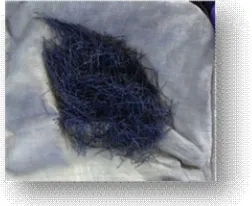
Steel fibres are plain i.e. straight in length here which we used. It is of 1mm diameter and we will be adding dosages ranges from 0.5%, 1%, 1.5% and 2% as its increment of 0.5% by the volume of concrete. As it’s perfectly mixable fibre and firstly mixed with all the ingredients as its performance is high and it resists the cracks. It’s economically good with low dosages of fibres. As the steel fibres added by discretely, uniformly distributed, the percentages variation will be increasing in strength and hence we will be going to it as the high strength concrete. As the steel fibres increases the strength of the concrete also increases. Its application is to use at concrete plants and or job site. Dosages used: 0.5 % to 2.0% with the increment of 0.5% by volume of concrete.
Fig no 1: Shows Plain Steel Fibres Are Discrete To Distribute Uniformly In the Concrete Mix
Table no 3: Shows the Preliminary Tests Properties of Steel Fibres
S. No. Particular Test Results 1 Type Plain(straight) 2 Specific gravity 7.8
[image:5.612.183.429.601.705.2]G. GGBS (Ground Granulated Blast Slag Furnace)
[image:6.612.146.466.195.335.2]As the slag is by-product of a manufacturing industry. As its composition will from 30% to 40% of silicon-di-oxide (Si O) and will be Ca O is 40%, which is similar a chemical composition of ordinary Portland cement. Will be replacing only 10% of GGBS as cementitious materials to the concrete mix. The GGBS is replaced as a cementitious material because it leads in the reducing of carbon dioxide gas emission. As the GGBS is friendly to environment which is used in the construction material. Replacing the GGBS as a cementitious material is saying that the compressive strength may be high, heat of hydration may be low, resist chemical attack, will be better workability, durability will be going good & cost will be effective.
Table no 4: Shows Chemical Composition of GGBS S. No. Particular Test Results 1 Calcium Oxide(Ca O) 40%-52% 2 Manganese Oxide (Mn O) 5-8
3 Iron Oxide(Fe O) 10%-40% (70%-80%, FeO2, 20-30% Fe2O3)
4 Phosphorous Pent oxide (P2O5) 0.6-1.1
5 Sulphur (S) <1
6 Metal( Fe) 0.7-1.3
7 Magnesium Oxide (Mg O) 5-10 8 Silicon Dioxide (SiO2) 10%-19%
V. RESULTS AND DISCUSSION
A. Compressive Strength
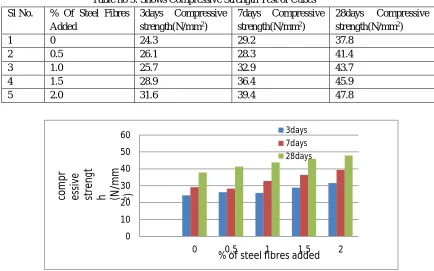
The compressive strength of the concrete was done on 150 x 150 x 150 mm cubes. Testing of the specimens was done at 3 days 7 days and 28 days at the rate of three cubes for each mix on that particular day. The average value of the 3 specimens is reported as the strength at that particular age. The compressive strength test was conducted for all the mixes and the results are shown in the table below.
Table no 5: Shows Compressive Strength Test of Cubes Sl No. % Of Steel Fibres
Added
3days Compressive strength(N/mm2)
7days Compressive strength(N/mm2)
28days Compressive strength(N/mm2)
1 0 24.3 29.2 37.8
2 0.5 26.1 28.3 41.4
3 1.0 25.7 32.9 43.7
4 1.5 28.9 36.4 45.9
5 2.0 31.6 39.4 47.8
0 10 20 30 40 50 60
0 0.5 1 1.5 2
3days 7days 28days co m p r essi ve st re n gt
h (N/m
m
2)
% of steel fibres added
[image:6.612.88.522.433.704.2]Fig 2: Shows Compressive Strength Test of Cube B. Split Tensile Strength
[image:7.612.101.513.310.571.2]This strength is to enlarge the period of the specimens. The fly ash comfortable increases with decrease in the tensile force of the specimen at the stage of the curing 3days, 7days & 28days as the cement substitute only by 30% of the fly ash & GGBS in the material mix. The material of the tensile strength will be determining the actual crack in this concrete. But unfortunately the concrete is a very scrawny in the anxiety & the strength of the tensile will poorly understand which changes with the time. Split Tensile force is essential & basic property of the concrete whose sizes will be 150mm diameter & 30mm thick & 300mm height cylindrical mould will be used.
Table no 5: Shows Split Tensile Strength Test of Cylinder S.
No.
% Of Steel Fibres Added
3days Split Tensile Strength (N/mm2)
7days Split Tensile Strength (N/mm2)
28days Split Tensile Strength (N/mm2)
1 0 2.42 3.54 4.33
2 0.5 2.80 3.19 3.92
3 1.0 2.53 3.90 4.71
4 1.5 3.49 4.29 4.98
5 2.0 3.63 4.93 5.39
0 1 2 3 4 5 6
0 0.5 1 1.5 2
3days 7days
28days
sp
lit
t
en
si
le
st
re
n
gt
h
(N
/m
m
2)
% of steel fibres added
Graph no 1: Shows 3,7,28 days Split Tensile Strength Test of Cubes with Respect to Steel Fibres Variation From 0.5%, 1.0%, 1.5% & 2.0
[image:7.612.228.391.608.708.2]C. Flexural Strength
[image:8.612.105.509.150.456.2]As below the two steel rollers which have bearing on that specimen should be placed from the 50mm at the ends of a beam. It has been divided into parts of three of a remaining 600mm of 200mm as shown figure. Here is the one of the normal size of the beam of concrete with the size 700mm*150mm*150mm has been casting in the pattern and will be set aside for curing for 24 hours.
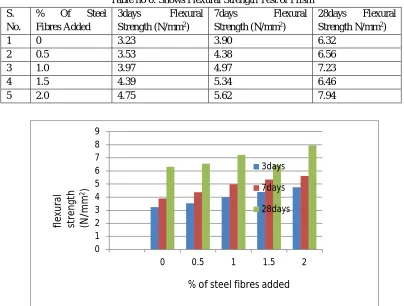
Table no 6: Shows Flexural Strength Test of Prism S.
No.
% Of Steel Fibres Added
3days Flexural Strength (N/mm2)
7days Flexural Strength (N/mm2)
28days Flexural Strength N/mm2)
1 0 3.23 3.90 6.32
2 0.5 3.53 4.38 6.56
3 1.0 3.97 4.97 7.23
4 1.5 4.39 5.34 6.46
5 2.0 4.75 5.62 7.94
0 1 2 3 4 5 6 7 8 9
0 0.5 1 1.5 2
3days
7days
28days
fl
ex
u
ral
st
re
n
gt
h
(N
/m
m
2)
% of steel fibres added
Graph no 3: Shows 3,7,28 days Flexural Strength Test of Cubes with Respect to Steel Fibres Variation From 0.5%, 1.0%, 1.5% & 2.0
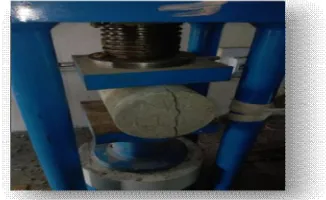
Fig 4: Shows Flexural Strength of prism
VI. CONCLUSION
[image:8.612.195.428.500.658.2]will be replacing cement by 30% fly ash & GGBS can be used in all construction of all type of structures i.e. 20% replacement of fly ash & 10% substitution of GGBS will be extreme strength with steel fibres. The best result will be found by the substitution of fly ash & GGBS with 20% & 10% by weight of concrete by adding the variation of steel fibres. Concrete mix will be evaluated for the tests of compressive force of higher the strength of concrete in which substitution of cement & addition of steel fibres while testing at 3 days, 7 days & 28 days after curing. Higher the slump will be found as 68mm in M45 grade of concrete by replacing fly
ash & GGBS. The increment will be minor when fly ash & GGBS is substitute. With 20% of fly ash & 10% of GGBS by the weight of concrete steel fibres also added.
A. Compressive strength
The optimum value in compressive strength was found in M45 grade is 47.8N/mm2 by the addition of 2% steel fibres.
B. Splitting tensile strength
The optimum value of split tensile strength was found in M45 grade is 5.39 N/mm2 by the addition of 2% steel fibres.
C. Flexural strength
The optimum value of split tensile strength was found in M45 grade is 7.94 N/mm2 by the addition of 2% steel fibres.
REFERENCES
[1] Benson. et al, (2014): “Simplified Flexural Response of Steel Fibre Reinforced Concrete Beams”, Journal of materials in Civil Engineering. Vol 20, No. 4 ASCE / April 2008.
[2] Amit Rana (2013): “Mechanical Properties of Steel Fibre-Reinforced Concrete”, Journal of materials in civil engineering Vol 19, No. 5 ASCE May 2007. [3] Fanella & Naaman (1985): “Deformation and Ultimate Strength in Flexure of Reinforced concrete Beams Made with Steel Fibre Concrete” ACI journal /
September-October 1981.
[4] Ezeldin & Balaguru (1992): “Comprehensive Study of High Strength Fibre Reinforced Concrete Under Pull out Strength” International Journal of Civil Engineering & Technology (IJCIET), Volume 6, Issue 1, 2015, pp. 14 - 20, ISSN.
[5] Dhakal (2006): “Optimisation of fly ash in Concrete: High Lime Fly Ash as a Replacement for Cement and Filler Material”, Proceedings of World of Coal Ash Conference, 4-7 May.
[6] Ghugal (2014): “Effects of Steel Fibres on Various Strengths of Concrete,” Indian Concrete Institute Journal, Vol. 4, No. 3, 2003, pp. 23-29.
[7] Lambrechts. et al, (2015): “The splitting test applied to steel fibre reinforced concrete”, The International Journal of Cement Composites & Lightweight Concrete, Vol. 5, No. 1, February 1983
[8] Parviz & Ziad (2015): “Fibre-Type Effects on the Performance of Steel Fibre Reinforced Concrete”, ACI materials journal Vol 88, No. 2, March-April 1991. [9] Swamy & Al-ta’an (2014): "Effect of Compressive Strength on Bond Behaviour of Steel Reinforcing Bar in Fibre Reinforced Concrete", International Journal
of Current Engineering & Technology. Vol.4, No.1, February, 2014, pp. 325-331.