Numerical Modeling and Comparative Analysis
with Experimental Study of Four Stoke CI Engine
using Preheated Neem Bio Diesel
Kundan Kumar1 , Vardan Singh Nayak2
1
M.Tech Scholar Mechanical Engg Dept. VIST BHOPAL
2
Asst. Prof. Mechanical Engg Dept. VIST BHOPAL
Abstract: Compression ignition engines are used in many areas to support the logistical activities associated with industry. Diesel powered locomotives and heavy-duty trucks move unprocessed commodities, chemicals, intermediate materials between manufacturing processes, and finished goods to the places in which they are all needed. Diesel also plays a considerable role mitigating the problems of waste management. Heavy mobile equipment moves wastes such as plastics, metals, and wastes to large bailing and compacting machines and other processing equipment. Different type of fuels are used for many applications in industry especially the alternate fuels are more popular now a days because they are cheaper and easily available as compare to conventional fuels. Maximum EGT is reached at brake power of 25.42 kW for all fuels. In experimental results the Maximum EGT found with highest preheating temp. (105 °C) is 425 °C, 414 °C, 420 °C and 434 °C for diesel, B20, B40 and B100 fuels respectively.B20, B40 and B100 fuel with different preheating temperature show reduction in exhaust gas temperature by 2.5%, 1.1% and 1.8% respectively compared to diesel fuel. CFD simulation results show excellent comparison with experimental Results which are the motive main goal of the present work.
Kew words: CFD, Alternate fuels, Bio diesel, Neem oil, CI Engine, Ansys (Fluent)
I. INTRODUCTION
An enormous increase in the number of automobiles in recent years has resulted in greater demand for petroleum products. With crude oil reserves estimated to ast only for a few decades, therefore efforts are made on way to research on alternative to diesel. Depletion of crude oil would cause a major impact on the transport sector. Fossil fuels play the significant role in development of country. Continuous supply of fuel with increasing rate should be ensured to sustain and further development of country. Recently, significant problems associated with fossil fuel like short supply, drastically increasing price, non-renewability, contamination of environment, adverse effect on bio systems compiles researcher to search for an alternative fuel, which promises a harmonious correlation with sustainable development, energy conservation, management, efficiency, and environmental preservation has become highly pronounced in the present context. Energy conservation is important for most of the developing countries, including rest of world. The rapid depletion in petroleum reserves and uncertainty in petroleum supply due to political and economic reasons, as well as, the sharp escalations in the petroleum prices have stimulated in search for alternatives to petroleum fuels. The situation is very grave in developing countries like India which import 70% of the required fuel, spending 30% of her total foreign exchange on oil imports.[1] In view of this, researcher found and analyze many energy sources like CNG, LNG, LPG, ethanol, methanol, hydrogen, bio-diesel and many more. Among these alternative fuels, India is having significant scope for development of bio fuel. Diesel engines are major source of transportation, power generation, marine application, agriculture vehicles etc. Bio-diesel is widely accepted as comparable fuel to diesel in compression ignition engine. It offers advantages like higher certain number, reduced emissions of particulates. Moreover, transportation and agriculture sector depends on diesel fuel therefore, it is essential that alternatives to diesel fuels must be developed. In the view of these, vegetable oils like palm oil, cotton seed oil, Neem oil, panama oil are considered as alternative fuels to diesel which are promising alternatives.
A. Alternative Fuels
of natural gas in India at 47.51 billion cubic meters’ during 2009-10 is 44.63% higher than the production of 32.85 billion cubic meters’ during 2008-09. India has total reserves (proved & indicated) of 1437 billion cubic meters’ of natural gas as on 1.4.2010 This enormous reserve of natural gas makes it a long-term substitute fuel for use in petrol & diesel engines. Low exhaust emissions, low noise, less maintenance, not prone to adulteration, driver’s comfort etc. are some of the attractive features of CNG as an automotive fuel. CNG is used in automobile as bio fuel in case of a gasoline engine and dual or single fuel mode with diesel engine with addition of gas kit to the current engine technology. CNG is widely accepted by vehicle owner as alternative fuel because of low prices, low exhaust emission, low noise, less maintenance and less modification cost of vehicle throughout the world. In spite of these advantages, in India its utilization is limited to very few cities (mainly metro or mega) due to problems of infrastructure, onboard storage & issues on safety.
Liquefied Natural Gas: LNG is a hydrocarbon mixture contains mainly methane, ethane, propane, butane and pentane. LNG is produced by cooling natural gas to its boiling temperature of -161.5˚C to eliminate low calorific value, storage and safety problem of natural gas. Very high volumes of natural gas can be transported from one country to another (long distance) with low cost in form of LNG. Scarcity of LNG and complication associated to produce and stores LNG restricted its use in automobile. During 2009-10 India has imported 8.83 Million tones of LNG.
Liquefied Petroleum Gas: LPG is composed primarily of propane and butane with smaller amounts of propylene and butylenes. LPG is produced by crude oil refining. LPG is also produced during natural gas refining as by product. In India, production of LPG during 2009-10 was 6.51 and 2.21 million tones by refining of oil and from natural gas. Due to high calorific value of the LPG it is filled in cylinder with moderate pressure of 10-15 bar. Reduction in emissions, very less carbon build-up increases life of engine parts like spark plugs, little or no damage to soil or water if it is spilled, rapid evaporation, higher octane number are some of the advantages of LPG fuel. It is generally used in gasoline fuel vehicle with addition of gas kit to engine. Short supply of LPG, due to main use as cooking gas, inhibits use of LPG as alternative fuel.
Methanol: Methanol is produced mainly from natural gas and fermentation and distillation of bio mass. Methanol contains oxygen in structure which reduces calorific value to 18500kJ/kg. This oxygenated fuel reduces problems of emission and misfires. The biological problems occurred by spilling and mixing of water is less prominent as methanol decomposes within 2-3 weeks. Another advantage of higher octane allows use of higher compression ratio engines results in to higher efficiency. Main problems associated with methanol as fuel are corrosion, moisture absorption, low calorific value, availability, high price, new or modified infrastructure for transportation and storage. The drivability is inferior during warm up. Methanol burns well in lean mixtures and produces low NOx emissions, but typically it yields high emission of unburned fuel and troublesome aldehydes. Trying to mix methanol with petrol brings problems like they are not entirely compatible and the slightest amount of water absorbed by the fuel causes the alcohol to separate out in the bottom of the tank. Additives are commercially available, but this adds to the fuel cost. Presently, methanol can be better used in industrial process rather than as fuel in automobile.
blends useable in the present day automobiles without requiring any major engine modifications; and giving reduced levels of exhaust CO and HC emissions.
Hydrogen: Otto, the German scientist, in 1870, used hydrogen gas as a fuel for his IC engine. Since then, researchers have tried to use hydrogen as automotive fuel. Till date all attempts to commercialize IC engines running on pure hydrogen have failed due to problems of storage, transportation, safety and production. Hydrogen is produced from water, which is abundantly available. Moreover, hydrogen is clean fuel with less emission compared to LPG and CNG. Vehicle running on hydrogen can meet stringent emission norms. Hydrogen can also be used as fuel for fuel cell vehicles. IIT Delhi is on forefront of R & D work on hydrogen engines. Attempts are also made to use hydrogen in form of blends with conventional fuel.
Bio-diesel is fatty acid methyl or ethyl ester made from virgin or used vegetable oils (both edible & non-edible) and animal fats. The main commodity sources for bio- diesel in India can be non-edible oils obtained from plant species such as Jatropha Curcas, Karanj, Neem, Mahua etc. Bio-diesel contains no petroleum, but it can be blended at any level with petroleum diesel to create a bio-diesel blend or can be used in its pure form. Just like petroleum diesel, bio-diesel operates in compression ignition engine; which essentially require very little or no engine modifications because bio- diesel has properties similar to petroleum diesel fuels. It can be stored just like the petroleum diesel fuel and hence does not require separate infrastructure. The use of bio-diesel in conventional diesel engines results in substantial reduction of un-burnt hydrocarbons, carbon monoxide and particulate matters. Bio-diesel is considered clean fuel since it has almost no sulphur, no aromatics and has about 10% built-in oxygen, which helps it to burn fully. Its higher cetane number improves the ignition quality even when blended in the petroleum diesel.
B. Advantages of Bio-Diesel
Successful alternative fuels fulfill environmental and energy security needs without sacrificing operating performance. Operationally, bio-diesel performs very similar to low sulphur diesel in terms of power, torque and fuel without major modification of engines or infrastructure. Bio-diesel offers similar power to diesel fuel. One of the major advantages of bio-diesel is the fact that it can be used in existing engines and fuel injection equipment with little impact to operating performance. Bio-diesel has a higher cetane number than diesel fuel. In over 15 million miles of in-field demonstrations bio-diesel showed similar fuel consumption, horsepower, torque and haulage rates as conventional diesel fuel [6]. It provides significant lubricity improvement over petroleum diesel fuel. Lubricity results of bio-diesel and petroleum diesel using industry test methods indicate that there is a marked improvement in lubricity when bio-diesel is added to conventional diesel fuel. Even bio-diesel level as low as 1% can provide up to 65% increase in lubricity in distillate fuels.[6] Using high % blends fuel system components (primarily fuel hoses and fuel pump seals) that contain elastomers compounds incompatible with bio-diesel. Manufacturers recommend that natural rubber not be allowed to come in contact with pure bio-diesel. Bio-diesel will lead to degradation of these materials over time, although effect will lessen with bio-diesel blends.
C. Disadvantages of Bio-Diesel
Cold weather can cloud and even gel any diesel fuel, including bio-diesel. Users of 20% bio-diesel blend will experience an increase of the cold flow properties (cold filter plugging point, cloud point, pour point) of approximately 3 to 5 Fahrenheit.[6] Precautions employed for petroleum diesel are needed for fuelling with 20% blends.[6] Same solutions work well with bio-diesel blends, as do the use of cold flow improvement additives
II. LITERATURE REVIEW
performance, combustion and emission characteristics of blends of biodiesel from cottonseed oil and ethanol has been performed in a diesel engine for three proportions at five different loads at 1500 rpm .S V Channapattanaa*,Kantharaj Cb,(2015) The present work investigates the emission and thermal performance of DI CI variable compression ratio engine using blends of biodiesel and standard diesel as a fuel at compression ratios of 15,16,17 and 18. The biodiesel derived from non edible Calophyllum Inophyllum linn oil is used on the engine. The blends of biodiesel and diesel used were B20, B40, B60, B80 and100% biodiesel. At 18 CR the brake thermal efficiency of the engine operated with 100% biodiesel is 8.9% less than Diesel and the brake specific fuel consumption for biodiesel found to be more than that of diesel. There is major reduction in Carbon monoxide and Hydrocarbon emissions with 100% biodiesel as a fuel compared to diesel at compression ratio of 18.The change in CR does not have much effect on the H Gas of the engine. However, at most of the CRs it is less for Hanne biodiesel than Diesel. The performance study reveals that the blend B20 operates very close to Diesel with respect to thermal performance. However the performance of Hanne biodiesel approaches that of Diesel fuel at higher CRs. Therefore it can be concluded that higher CR should be the mode of operation when engine is fuelled with Hanne biodiesel. At higher compression ratios (16 to 18), combustion of fuel is efficient due to high temperature of compressed air. Due to which, the exhaust emissions are found to reduce at higher CRs. Also at higher CRs, smoke is less due to complete combustion of fuel. However, the NOx emissions are found to increase at higher CRs with Hanne biodiesel as compared to Diesel. There is need to trade off between NOx and smoke emission. So the selection of CR can be based on the combined effect on thermal performance and emission characteristics. It is preferable to operate the engine at CR of 18 for optimum thermal performance. If NOx is considered then it is better to operate at CR 16.But it causes decrease in BTE of about 13% and increase of BSFC of about 13% which are not recommendable just to reduce NOx emissions. It is found that CO2 emissions are more for Honne biodiesel than that of diesel. Higher CO2 emissions reduce harmful CO emissions. The percentage reduction in HC emissions for Honne biodiesel is about 60% as compared to that of Diesel. Due to higher NOx emissions with pure Honne biodiesel, suitable blends can become a striking balance between NOx emissions on one end and all other emissions along with performance onthe other hand. The emission characteristics show that the Hanne biodiesel gives minimum harmful emissions as compared to all other blends. Further, at a higher CR of 18 the fairly reduced exhaust emissions are observed irrespective of the fuel. Therefore, in operating the diesel engine with Hanne biodiesel at a CR of 18 results in minimum emissions but more NOx emissions.
III. OBJECTIVE OF THE STUDY
In current study our main objective is to compare the experimental results with the Numerical analysis by using CFD. Experimental studies on the effect of Neem bio-diesel blending with fuel preheating on performance and emission of multi cylinder, four stroke, water cooled, direct injection has been performed in previous work, now we want to compare these results with simulation. Determining the relationship between diesel engine performance and the percentage of Neem bio-diesel in fuel blends with using different preheating blend. Determining the relationship between diesel engine performance and the percentage of Neem biodiesel in fuel blends with using different preheating blend.
A. CFD (Computational Fluid Dynamics)
Computational fluid dynamics, sometimes abbreviated as CFD, could be a branch of mechanics that uses numerical analysis and algorithms to unravel and analyze issues that involve fluid flows. Computers ar accustomed perform the calculations needed to simulate the interaction of liquids and gases with surfaces outlined by boundary conditions. With high-speed supercomputers, higher solutions may be achieved. Current analysis yields software system that improves the accuracy and speed of complicated simulation situations like sonic or turbulent flows. Initial experimental validation of such software system is performed employing a structure with the ultimate validation coming back in complete testing, e.g. flight tests To run a simulation, 3 main parts are needed:
1) Pre-processor: A pre-processor is employed to outline the pure mathematics for the process domain of interest and generate the mesh of management volumes (for calculations). Generally, the finer the mesh within the areas of enormous changes, the a lot of correct the answer. Fineness of the grid additionally determines the pc hardware and calculation time required. The ASCII text file pre-processor used for this project is termed Salomé.
methodology. Initial the fluid flow equations ar integrated over the management volumes (resulting within the actual conservation of relevant properties for every finite volume), then these integral equations are discretised (producing algebraically equations through changing of the integral fluid flow equations), and at last an repetitious methodology is employed to resolve the algebraically equations. (The finite volume methodology and discretisation techniques are delineated a lot of within the next sections. Open FOAM CFD code is employed for finding the simulations during this project.
3) Post-Processor: The post-processor provides for visualization of the results, and includes the aptitude to show the geometry/mesh, produce vector, contour, and second and 3D surface plots. Particles is caterpillar-tracked throughout a simulation, and therefore the model is manipulated (i.e. modified by scaling, rotating, etc.), and every one fully colour animated graphics. Para read is that the ASCII text file post-processor used for this project.
IV. METHODOLOGY
A. Basic Steps To Perform CFD Analysis
1) Pre-Processing: CAD Modeling: Creation of CAD Model by using CAD modeling tools for creating the geometry of the part/assembly of which you want to perform FEA.CAD model may be 2D or 3d.
2) Meshing: Meshing is a critical operation in CFD. In this operation, the CAD geometry is discretized into large numbers of small Element and nodes. The arrangement of nodes and element in space in a proper manner is called mesh. The analysis accuracy and duration depends on the mesh size and orientations. With the increase in mesh size (increasing no. of element), the CFD analysis speed decrease but the accuracy increases.
3) Type of Solver: Choose the solver for the problem from Pressure Based and density based solver.
4) Physical Model: Choose the required physical model for the problem i.e. laminar, turbulent, energy, multi-phase, etc. 5) Material Property: Choose the Material property of flowing fluid.
6) Boundary Condition: Define the desired boundary condition for the problem i.e. temperature, velocity, mass flow rate, heat flux etc.
B. Solution
1) Solution Method : Choose the Solution method to solve the problem i.e. First order, second order 2) Solution Initialization: Initialized the solution to get the initial solution for the problem.
3) Run Solution: Run the solution by giving no of iteration for solution to converge.
4) Post Processing: For viewing and interpretation of Result. The result can be viewed in various formats: graph, value, animation etc.
C. CFD Method Applied
The model was simulated and the required geometry configurations were pre-processed in ANSYS 14.5. This following section illustrates the method used in the CFD simulations in this particular study.
1) STEP 2
a) Mesh File: To Be Meshed
.Generated Mesh Model In The Ansys Shows In Figure 4.2 And 4.3
2). Step 3 Checks The Mesh: Various checks on the mesh and reports the progress in the console. Also check the minimum volume reported and make sure this is a positive number select mesh to mm.
a) Methods: i) Pressure based
ii) 2d ax symmetry Model is used. iii) Gravity is enabling
b) Model:
iii) P-1 radiation model is used, since it is quicker to run. However DO radiation model can be used for more accurate results in typical models.
iv) Finite rate / eddy dissipation in turbulence chemistry. Interactions are used for species model. 3) Step 4 Simulation Set Up:
a) Boundary Conditions: i) Mass Flow inlet
ii) Outlet – pressure based, pressure is 1 bar. b) Material:
i) Fluid:-Diesel oil and B20, B40 , B60, B100 Fuels
ii) Thermal conductivity: - Define two polynomial coefficients iii) (a) 0.0076736 (b) 5.8837*10-5
iv) Polynomial coefficient for viscosity (a) 7.6181e-06 (b) 3.2623e-
v) For absorption coefficient take wags domain. vi) Scattering coefficient is 1e-9.
4) Step 5 Solutions: a) Method:
i) Coupled
ii) Presto model is used:-
Presto model is often used for buoyant flows where velocity vector near walls may not align with the wall due to assumption of uniform pressure in the boundary layer so presto can only be used with quadrilateral.
b) Meshes:
Pseudo transient is enabled
i) 0.1 time scale factor of turbulent kinetic energy and turbulent dissipation rate
ii) Time scale factor of species and energy is 1
iii) Note: Higher time scale size is used for the energy and species equation to converge the solution in less number of iteration
iv) Solution Initialisation: The solution is initialize
v) Run Calculation: Start the calculation for 1000 iterations.
V. RESULTS AND CONCLUSION
Figure2: Mass fraction of oxo carbons for B20
Figure4: Mass fraction of oxo carbons for B60
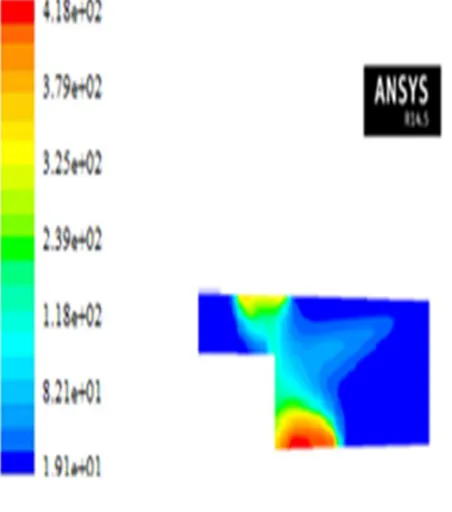
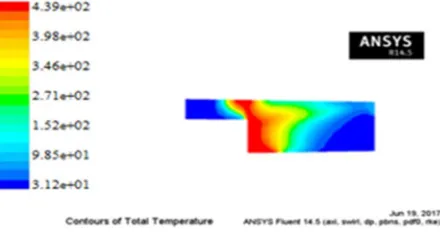
Figure 6 Temperature (0C) contour for Diesel Oil
[image:10.612.189.415.365.621.2]Figure 8 Temperature (0C) contour for B40
Figure 9 Temperature (0C) contour for B60
[image:11.612.200.420.564.681.2]RESULTS TABLE 1
fuel EGT(°C)
(EXPERIMENTAL)
EGT(°C)
SIMULATION
Diesel oil 425 427
B20 414 418
B40 420 423
B60 428 433
B100 434 439
VI. CONCLUSION
Maximum EGT is reached at brake power of 25.42 kW for all fuels. In Results table1 the comparison of different fuel with exp. and simulation results is shown. This shows variations in EGT(Exhaust Gas Temperature) with brake power for diesel, B20, B40 B60 and B100 fuels. In experimental results the Maximum EGT found with highest preheating temp. (105 °C) is 425 °C, 414 °C, 420 °C and 434 °C for diesel, B20, B40 and B100 fuels respectively. B20, B40 and B100 fuel with different preheating temperature show reduction in exhaust gas temperature by 2.5%, 1.1% and 1.8% respectively compared to diesel fuel. CFD results show excellent validation with experimental outcomes. Mass fraction of emission with different fuels which we used in present study is calculated by CFD simulation gives a excellent effect on current research.
REFERENCES
[1] Dr. Archana S., “Basic Statistics on Indian Petroleum & Natural Gas 2009-10” October 2010. http://petroleum.nic.in/petstat.pdf.
[2] H. Raheman and S. V. Ghadge, “Performance of Compression Ignition Engine with Mahua(Madhuca Indica) Bio-diesel”, Fuel 86, March 2007, pp: 2568- 2573 [3] Sivalakshmi S. and Balusamyb T.,“Experimental investigation on a diesel engine using neem oil and its methyl ester”, Thermal Science, 2011, pp: 54-58
[4] Dr. Tiwari, “Report of Committee on Development of Biofuel Planning commission of India”, April 2003,
http://planningcommission.nic.in/reports/genrep/cmtt_bio.pdf
[5] H. Raheman and S. V. Ghadge, “Performance of Compression Ignition Engine with Mahua(Madhuca Indica) Bio-diesel”, Fuel 86, March 2007, pp: 2568-2573 [6] Herath Gunatilake, “Economy-Wide Impacts of Bio-diesel Production and Use in India:AComputableGeneralEquilibrium”,May2011
[7] Anindita Karmakar, Subrata Karmakar , Souti Mukherjee “Biodiesel production from neem towards feedstock diversification : Indian perspective”, Renewable and Sustainable Energy Reviews 16 (2012) 1050 1060
[8] Ryan TW, Bagby MO:Identification of chemical changes occurring during the transient injection of selected vegetable oils. SAE 1993;1440–94 (paper no. 930933).
[9] Raina AK, Gaikwad BR Chemobotany of Jatropha species in India and further characterisation of curcas oil. J Oil Technol India 1987;1987(19):81–5. [10] Pravin A. Manade, Dr. Prof. Ashok T. Pise, Sandesh Cougule “Properties of Biofuels and their Diesel Blends as a Fuel for C.I. Engines” IEEE-International
Conference on Advance In Engineering, Science And Management (ICAESM-2012) March 30,31,2012, pp: 255 -26
[11] Atul Dhar, Roblet Kevin, Avinash Kumar Agarwal “ Production of biodiesel from high–FFA neem oil and its performance, emission and combustion characterization in a single cylinder DICI engine
[12] R.Senthilkumar,K.Ramadoss,M.Prabhu“EmissionandPerformance Characteristics of Single Cylinder Diesel Engine Fuelled With Neem Biodiesel” IEEE-International Conference On Advance In Engineering,Science And Management (ICAESM-2012) March 30,31,2012, pp: 353-359
[13] Nishant Tyagi, Ambuj Sharma “Experimental Investigation of Neem Methyl Esters as Biodisel on C.I. Engine” International Journal of Engineering Research and Aplication” ISSN: 2248-9622, Vol. 2, Issue 4, July-August 2012, pp. 1673-1679.
[14] Priyabrata Pradhan, Hifjur Raheman :Debasish Padhee, Combustion and performance of a diesel engine with preheated Jatropha curcas oil using waste heat from exhaust gas”, Fuel 115 (2014) 527–533
[15] M. Pugazhvadivua,*, K. Jeyachandranb :Investigations on the performance and exhaust emissions of a diesel engine using preheated waste frying oil as fuel. Renewable Energy 30 (2005) 2189–220
[16] Saravanana Muthusamy: Performance evaluation of non-edible vegetable oils as substitute fuels in low heat rejection diesel engines. IMechE Part D 2000;214:181–7
[17] Dinesha P1, Mohanan P2 :experimental investigation on the performance and emission characteristic of diesel engine using preheated pongamia methaylester as fuel. International Journal of Advances in Engineering & Technology, Nov. 2012
[18] H.H.Masjuki, M. A. Kalam, et al “Experimental Evaluation of Unmodified Diesel Engine using Biodiesel with Fuel Additive” IEEE-(IFOST-2006) Oct. 18- Oct. 20, 2006, pp: 96-99
[21] M Shahabbudin, H.H.Masjuki, et. al “ Effect of Additive on Performance of C.I. Engine Fuelled with Bio Diesel” Energy Procedia 14 (2012), pp:1624-1629 [22] Dr. S. S. Thipse, Internal Combustion Engine, 2nd Edition, Jaico Publishing House, 2008, pp 461-48
[23] Qi DH, Chen H, Geng LM, Bian YZH:Experimental studies on the combustion characteristics and performance of a direct injection engine fueled with biodiesel/diesel blends. Energ Convers Manage 2010;51:2985–92
[24] Raina AK, Gaikwad BR: Chemobotany of Jatropha species in India and further characterisation of curcas oil. J Oil Technol India 1987;1987(19):81–5 [25] Prabhanjan DG, Ragbavan GSV, Kennic TJ:Comparison of heat transfer rates between a straight tube heat exchanger and a helically coiled heat exchanger. Int
J Heat Mass Trans 2002;29(2):185–9
[26] Patil RK, Shendhe BW, Ghose PK.: Designing a helical coil heat exchanger. J Chem Eng 1982:85–8. December 13
[27] Gubitz GM, Mittelbach M, Trabi M: Exploitation of tropical seed plant Jatropha curcas L. Bioresour Technol 1999;67(1):73–82 [28] Griffin Shay E:Diesel fuel from vegetable oils. Biomass Bioenergy 1993;4:227–42