S O F T W A R E
Open Access
HiC-Pro: an optimized and flexible pipeline
for Hi-C data processing
Nicolas Servant
1,2,3*, Nelle Varoquaux
1,2,3, Bryan R. Lajoie
4, Eric Viara
5, Chong-Jian Chen
1,2,3,6,7,8,
Jean-Philippe Vert
1,2,3, Edith Heard
1,6,7, Job Dekker
9and Emmanuel Barillot
1,2,3Abstract
HiC-Pro is an optimized and flexible pipeline for processing Hi-C data from raw reads to normalized contact maps. HiC-Pro maps reads, detects valid ligation products, performs quality controls and generates intra- and inter-chromosomal contact maps. It includes a fast implementation of the iterative correction method and is based on a memory-efficient data format for Hi-C contact maps. In addition, HiC-Pro can use phased genotype data to build allele-specific contact maps. We applied HiC-Pro to different Hi-C datasets, demonstrating its ability to easily process large data in a reasonable time. Source code and documentation are available at http://github.com/nservant/HiC-Pro.
Keywords:Chromosome conformation, Hi-C, Bioinformatics pipeline, Normalization
Introduction
High-throughput chromosome conformation capture methods are now widely used to map chromatin interac-tions within regions of interest and across the genome. The use of Hi-C has notably changed our vision of gen-ome organization and its impact on chromatin and gene regulation [1, 2]. The Hi-C technique involves sequen-cing pairs of interacting DNA fragments, where each mate is associated with one interacting locus. Briefly, cells are crossed-linked, DNA is fragmented using a re-striction enzyme [3] or a nuclease [4], and interacting fragments are ligated together. After paired-end sequen-cing, each pair of reads can be associated to one DNA interaction.
In recent years, the Hi-C technique has demonstrated that the genome is partitioned into domains of different scale and compaction level. The first Hi-C application has described that the genome is partitioned into distinct compartments of open and closed chromatin [3]. Higher throughput and resolution have then suggested the pres-ence of megabase-long and evolutionarily conserved smaller domains. These topologically associating domains are characterized by a high frequency of intra-domain chro-matin interactions but infrequent inter-domain chrochro-matin
interactions [5, 6]. More recently, very large data sets with deeper sequencing have been used to increase the Hi-C resolution in order to detect loops across the entire genome [7, 8].
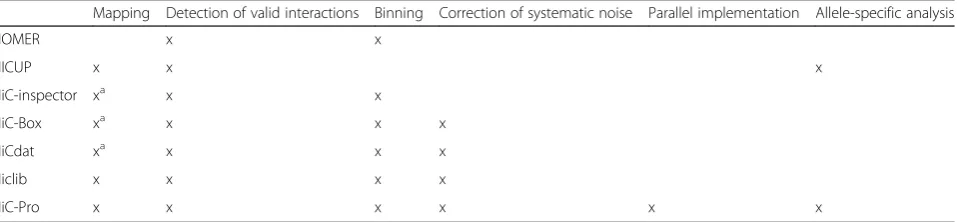
As with any genome-wide sequencing data, Hi-C usu-ally requires several millions to billions of paired-end se-quencing reads, depending on genome size and on the desired resolution. Managing these data thus requires optimized bioinformatics workflows able to extract the contact frequencies in reasonable computational time and with reasonable resource and storage requirements. The overall strategy to process Hi-C data is converging among recent studies [9], but there remains a lack of stable, flexible and efficient bioinformatics workflows to process such data. Solutions such as the HOMER [10], HICUP [11], inspector [12], HiCdat [13] and HiC-box [14] pipelines are already available for Hi-C data processing. HOMER offers several functions to analyze Hi-C data but does not perform the mapping of reads nor the correction of systematic biases. HiCdat, HiC-inspector and HiCbox do not allow chimeric reads to be rescued during the mapping of reads. HICUP provides a complete pipeline until the detection of valid interaction products. Using HICUP together with the SNPsplit pro-gram [15] allows the extraction of allele-specific inter-action products whereas all other solutions do not allow allele-specific analysis. The HiCdat and HiCbox packages offer a means of correcting contact maps for systematic * Correspondence:[email protected]
1
Institut Curie, Paris, France
2INSERM, U900, Paris, France
Full list of author information is available at the end of the article
biases. Finally, none of these software were designed to process very large amounts of data in a parallel mode. The hiclib package is currently the most commonly used solu-tion for Hi-C data processing. However, hiclib is a Python library that requires programming skills, such as know-ledge of Python and advanced Linux command line, and cannot be used in a single command-line manner. In addition, parallelization is not straightforward and it has limitations with regard to the analysis and normalization of very high-resolution data (Table 1).
Here, we present HiC-Pro, an easy-to-use and complete pipeline to process Hi-C data from raw sequencing reads to normalized contact maps. HiC-Pro allows the process-ing of data from Hi-C protocols based on restriction en-zyme or nuclease digestion such as DNase Hi-C [4] or Micro-C [16]. When phased genotypes are available, HiC-Pro is able to distinguish allele-specific interactions and to build both maternal and paternal contact maps. It is opti-mized and offers a parallel mode for very high-resolution data as well as a fast implementation of the iterative cor-rection method [17].
Results
HiC-Pro results and performance
We processed Hi-C data from two public datasets: IMR90 human cell lines from Dixon et al. [6] (IMR90) and from Rao et al. [7] (IMR90_CCL186). The latter is currently one of the biggest datasets available, used to generate up to 5-kb contact maps. For each dataset, we ran HiC-Pro and generated normalized contact maps at 20 kb, 40 kb, 150 kb, 500 kb and 1 Mb resolution. Nor-malized contact maps at 5 kb were only generated for the IMR90_CCL186 dataset. The datasets were either used in their original form or split into chunks contain-ing 10 or 20 million read pairs.
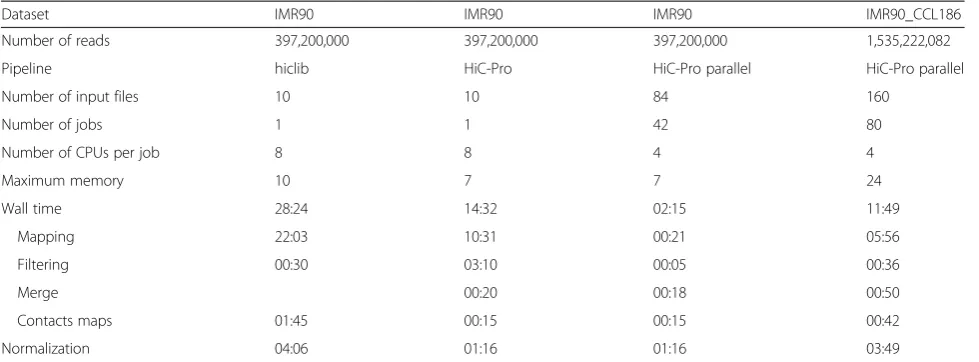
Using HiC-Pro, the processing of the Dixon’s dataset (397.2 million read pairs split into 84 read chunks) was completed in 2 hours using 168 CPUs (Table 2). Each
chunk was mapped on the human genome using four CPUs (two for each mate) and 7 GB of RAM Processing the 84 chunks in parallel allows extraction of the list of valid interactions in less than 30 minutes. All chunks were then merged to generate and normalize the genome-wide contact map.
In order to compare our results with the hiclib library, we ran HiC-Pro on the same dataset, and without initial read splitting, using eight CPUs. HiC-Pro performed the complete analysis in less than 15 hours compared with 28 hours for the hiclib pipeline. The main difference in speed is explained by our two-step mapping strategy compared with the iterative mapping strategy of hiclib, which aligned the 35 base pair (bp) reads in four steps. Optimization of the binning process and implementation of the normalization algorithm led to a three-fold de-crease in time to generate and normalize the genome-wide contact map.
The IMR90 sample from the Rao dataset (1.5 billion read pairs split into 160 read chunks) was processed in parallel using 320 CPUs to generate up to 5-kb contact maps in 12 hours, demonstrating the ability of HiC-Pro to analyze very large amounts of data in a reasonable time. At a 5-kb resolution, we observe the presence of chromatin loops as described by Rao et al. [7] (Figure S1 in Additional file 1). The merged list of valid interactions was generated in less than 7.5 hours. Normalization of the genome-wide contact map at 1 Mb, 500 kb, 150 kb, 40 kb, 20 kb and 5 kb was performed in less than 4 hours. Details about the results and the implementa-tion of the different soluimplementa-tions are available in Addiimplementa-tional file 1.
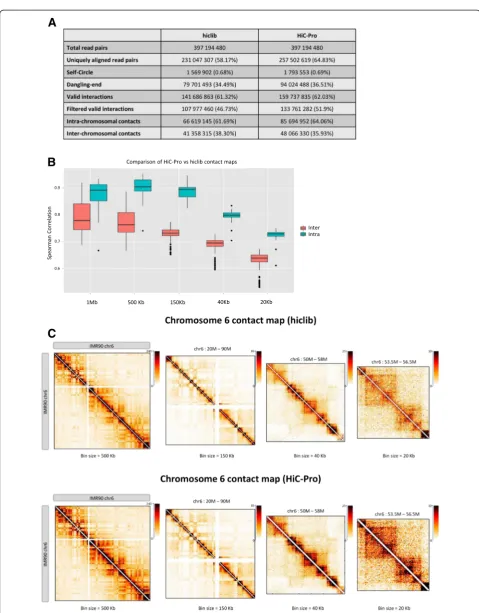
[image:2.595.61.540.571.682.2]Finally, we compared the Hi-C processing results of hiclib and HiC-Pro on the IMR90 dataset. Although the processing and filtering steps of the two pipelines are not exactly the same, we observed a good concordance in the results (Fig. 1). Using default parameters, HiC-Pro is less stringent than hiclib and used more valid interactions to
Table 1Comparing solutions for Hi-C data processing
Mapping Detection of valid interactions Binning Correction of systematic noise Parallel implementation Allele-specific analysis
HOMER x x
HICUP x x x
HiC-inspector xa x x
HiC-Box xa x x x
HiCdat xa x x x
Hiclib x x x x
HiC-Pro x x x x x x
HOMER [10] offers several programs to analysis Hi-C data from aligned reads.a
build the contact maps. The two sets of normalized con-tact maps generated at different resolutions are highly similar (Fig. 1c). We further explored the similarity between the maps generated by the two pipelines by computing the Spearman correlation of the normalized intra-chromosomal maps. The average correlation coeffi-cient across all chromosomes at different resolutions was 0.83 (0.65–0.95). Finally, since the inter-chromosomal data are usually very sparse, we summarized the inter-chromosomal signal using two one-dimensional coverage vectors of rows and columns [18, 19]. The average Spear-man correlation coefficient of all coverage vectors between hiclib and HiC-Pro inter-chromosomal contact maps was 0.75 (0.46–0.98).
Implementation of the iterative correction algorithm We provide an implementation of the iterative correc-tion procedure which emphasizes ease of use, perform-ance, memory-efficiency and maintainability. We obtain higher or similar performance on a single core compared with the original ICE implementation from the hiclib li-brary (Table 2) and from the HiCorrector package [20] (Table 3).
The HiCorrector package provides a parallel version of the iterative correction for dense matrices. We therefore compared the performance of HiCorrector with the HiC-Pro normalization at different Hi-C resolutions (Table 3). All algorithms were terminated after 20 itera-tions for the purpose of performance comparison, as each iteration requires nearly the same running time. Choosing dense or sparse matrix-based implementation is dependent on the Hi-C data resolution and on the depth of coverage. Although our implementation can be run in either sparse or dense mode, the available data
published at resolutions of 5–40 kb are currently charac-terized by a high degree of sparsity. At each level of Hi-C contact map resolution, we compared our dense or sparse implementation with the parallel and/or sequen-tial version of HiCorrector. Our results demonstrate that using a compressed sparse row matrix structure is more efficient on high resolution contact maps (<40 kb) than using parallel computing on dense matrices. As expected for low resolution contact maps (1 Mb, 500 kb), using a dense matrix implementation is more efficient in time, although the gain, in practice, remains negligible.
The code for the normalization is available as a standa-lone package (https://github.com/hiclib/iced) as well as being included in HiC-Pro. Our implementation based on sparse row matrices is able to normalize a 20-kb human genome map in less than 30 minutes with 5 GB of RAM (Table 3). Genome-wide normalization at 5 kb can be achieved in less than 2.5 hours with 24 GB of RAM. Thus, compared to existing solutions, our implementation sub-stantially speeds up and facilitates the normalization of Hi-C data prior to downstream analysis.
Allele-specific contact maps
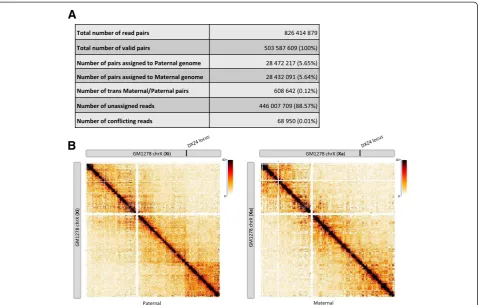
[image:3.595.56.546.100.281.2]We used HiC-Pro to generate allele-specific contact maps for the human GM12878 cell line. Differences in paternal and maternal X chromosome organization were recently described, with the presence of mega-domains on the inactive X chromosome, which are not seen in the active X chromosome [7, 21, 22]. We used HiC-Pro to generate the maternal and paternal chromosome X contact maps of the GM12878 cell line using the Hi-C dataset published by Selvaraj et al. [23]. Phasing data were gathered from the Illumina Platinum Genomes Project [24]. Only good quality heterozygous phased
Table 2HiC-Pro performance and comparison with hiclib
Dataset IMR90 IMR90 IMR90 IMR90_CCL186
Number of reads 397,200,000 397,200,000 397,200,000 1,535,222,082
Pipeline hiclib HiC-Pro HiC-Pro parallel HiC-Pro parallel
Number of input files 10 10 84 160
Number of jobs 1 1 42 80
Number of CPUs per job 8 8 4 4
Maximum memory 10 7 7 24
Wall time 28:24 14:32 02:15 11:49
Mapping 22:03 10:31 00:21 05:56
Filtering 00:30 03:10 00:05 00:36
Merge 00:20 00:18 00:50
Contacts maps 01:45 00:15 00:15 00:42
Normalization 04:06 01:16 01:16 03:49
A
B
C
[image:4.595.57.537.80.694.2]single-nucleotide polymorphisms (SNPs) were selected. The final list contained 2,239,492 SNPs. We then masked the human genome hg19 by replacing the SNP position by an ‘N’using the BEDTools utilities [25] and generated the new bowtie2 indexes. In practice, the allele-specific analysis can be easily performed by simply specifying to HiC-Pro the list of SNPs and the N-masked indexes for read alignment through the config-uration file.
Among the initial 826 million read pairs, 61 % were classified as valid interactions by HiC-Pro. Around 6 % of valid interactions were then assigned to either the pa-ternal or mapa-ternal genome and used to construct the haploid maps. As expected, the inactive X chromosome map is partitioned into two mega-domains (Fig. 2). The boundary between the two mega-domains lies near the DXZ4 micro-satellite.
Materials and methods HiC-Pro workflow
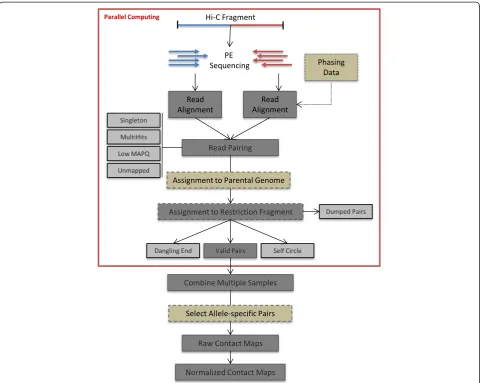
HiC-Pro is organized into four distinct modules following the main steps of Hi-C data analysis: (i) read alignment, (ii) detection and filtering of valid interaction products, (iii) binning and (iv) contact map normalization (Fig. 3).
Mapping
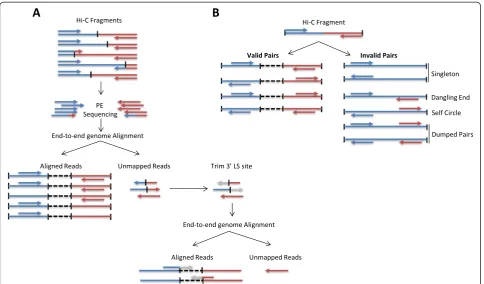
Read pairs are first independently aligned on the refer-ence genome to avoid any constraint on the proximity between the two reads. Most read pairs are expected to be uniquely aligned on the reference genome. A few per-cent, however, are likely to be chimeric reads, meaning that at least one read spans the ligation junction and therefore both interacting loci. As an alternative to the iterative mapping strategy proposed by Imakaev et al. [17], we propose a two-step approach to rescue and align those reads (Fig. 4a). Reads are first aligned on the
reference genome using the bowtie2 end-to-end algo-rithm [26]. At this point, unmapped reads are mainly composed of chimeric fragments spanning the ligation junction. According to the Hi-C protocol and the fill-in strategy, HiC-Pro is then able to detect the ligation site using an exact matching procedure and to align back on the genome the 5′ fraction of the read. Both mapping steps are then merged in a single alignment file. Low mapping quality reads, multiple hits and singletons can be discarded.
Detection of valid interactions
Each aligned read can be assigned to one restriction fragment according to the reference genome and the se-lected restriction enzyme. Both reads are expected to map near a restriction site, and with a distance within the range of molecule size distribution after shearing. Fragments with a size outside the expected range can be discarded if specified but are usually the result of ran-dom breaks or star activity of the enzyme, and can therefore be included in downstream analysis [17]. Read pairs from invalid ligation products, such as dangling end and self-circle ligation, are discarded (Fig. 4b). Only valid pairs involving two different restriction fragments are used to build the contact maps. Duplicated valid pairs due to PCR artifacts can also be filtered out. Each read is finally tagged in a BAM file according to its map-ping and fragment properties (Figure S2 in Additional file 1). In the context of Hi-C methods which are not based on restriction enzyme digestion, no filtering of re-striction fragments is applied. The uniquely mapped read pairs are directly used to build the contact maps. However, one way to filter out artifacts such as self-ligation is to discard intra-chromosomal pairs below a given distance threshold [4]. HiC-Pro therefore allows these short range contacts to be filtered out.
(See figure on previous page.)
[image:5.595.56.539.625.707.2]Fig. 1Comparison of HiC-Pro and hiclib processing.aBoth pipelines generate concordant results across processing steps. The fraction of uniquely aligned read pairs is calculated on the total number of initial reads. Self-circle and dangling-end fractions are calculated on the total number of aligned read pairs. Intra- and inter-chromosomal contacts are calculated as a fraction of filtered valid interactions.bBoxplots of the Spearman correlation coefficients of intra- and inter-chromosomal maps generated at different resolutions by both pipelines.cChromosome 6 contact maps generated by hiclib (top) and HiC-Pro (bottom) at different resolutions. The chromatin interaction data generated by the two pipelines are highly similar
Table 3Performance of iterative correction on IMR90 data
HiC-Pro–Iced (dense–1 CPU) HiC-Pro–Iced (sparse–1 CPU) HiCorrector–MES (dense–1 CPU) HiCorrector–MEP (dense–8 CPUs)
IMR90 1Mbp 00:00:12 00:00:25 00:00:25 00:00:06
IMR90 500 kbp 00:00:40 00:01:30 00:02:15 00:00:22
IMR90 150 kbp - 00:04:28 00:13:21 00:03:10
IMR90 40 kbp - 00:07:19 02:35:34 00:35:43
IMR90 2 0kbp - 00:08:36 12:57:17 02:34:05
Binning
In order to generate the contact maps, the genome is di-vided into bins of equal size, and the number of contacts observed between each pair of bins is reported. A single genome-wide interaction map containing both raw intra-and inter-chromosomal maps is generated for a set of resolutions defined by the user in the configuration file.
Normalization
In theory, the raw contact counts are expected to be proportional to the true contact frequency between two loci. As for any sequencing experiment, however, it is known that Hi-C data contain different biases mainly due to GC content, mappability and effective fragment length [18, 19]. An appropriate normalization method is therefore mandatory to correct for these biases. Over the last few years, several methods have been proposed using either an explicit-factor model for bias correction [19] or implicit matrix balancing algorithm [17, 27]. Among the matrix balancing algorithm, the iterative cor-rection of biases based on the Sinkhorn-Knopp algo-rithm has been widely used by recent studies due to its
conceptual simplicity, parameter-free nature and ability to correct for unknown biases, although its assumption of equal visibility across all loci may require further ex-ploration. In theory, a genome-wide interaction matrix is of size O(N2), where N is the number of genomic bins. Therefore, applying a balancing algorithm on such a matrix can be difficult in practice, as it requires a signifi-cant amount of memory and computational time. The degree of sparsity of the Hi-C data is dependent on the bin size and on the sequencing depth of coverage. Even for extremely large sequencing coverage, the interaction frequency between intra-chromosomal loci is expected to decrease as the genomic distance between them in-creases. High-resolution data are therefore usually asso-ciated with a high level of sparsity. Exploiting matrix sparsity in the implementation can improve the per-formance of the balancing algorithm for high-resolution data. HiC-Pro proposes a fast sparse-based implementa-tion of the iterative correcimplementa-tion method [17], allowing normalization of genome-wide high-resolution contact matrices in a short time and with reasonable memory requirements.
A
B
[image:6.595.60.539.88.393.2]Quality controls
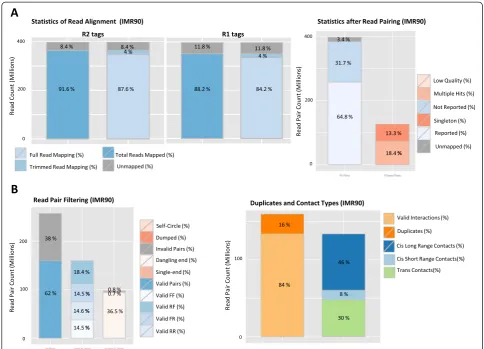
To assess the quality of a Hi-C experiment, HiC-Pro performs a variety of quality controls at different steps of the pipeline (Fig. 5). The alignment statistics are the first available quality metric. According to the refer-ence genome, a high-quality Hi-C experiment is usu-ally associated with a high mapping rate. The number of reads aligned in the second mapping step is also an interesting control as it reflects the proportion of reads spanning the ligation junction. An abnormal level of chimeric reads can reflect a ligation issue dur-ing library preparation. Once the reads are aligned on the genome, the fraction of singleton or multiple hits is usually expected to be low. The ligation efficiency
can also be assessed using the filtering of valid and in-valid pairs. As ligation is a random process, it is ex-pected that 25 % of each valid ligation class will be defined by distinct read pair orientation. In the same way, a high level of dangling-end or self-circle read pairs is associated with a bad quality experiment, and reveals a problem during the digestion, fill-in or ligation steps.
[image:7.595.58.540.88.471.2]well as long-range versus short-range intra-chromosomal interactions. As two genomic loci close on the linear genome are more likely to randomly interact, a strong diagonal is expected on the raw contact maps. A low qual-ity experiment will result in a low fraction of intra-chromosomal interactions depending on the organism and the biological context. A high quality Hi-C experi-ment on the human genome is typically characterized by at least 40 % of intra-chromosomal interactions [9]. In the same way, a high quality experiment is usually character-ized by a significant fraction (>40 %) of long-range intra-chromosomal valid pairs [7].
Speed and scalability
Generating genome-wide contact maps at 40 to 1 kb reso-lution requires a sequencing depth of hundreds of millions to multi-billions of paired-end reads depending on the or-ganism [7, 8]. However, the main processing steps from read mapping to fragment reconstruction can be optimized using parallel computation of read chunks, significantly re-ducing the time taken by the Hi-C data processing. Next, all valid interactions are merged to remove the duplicates and to generate the final contact maps.
The user can easily run the complete analysis work-flow with a single command line either on a single lap-top or on a computer cluster. Analysis parameters are all defined in a single configuration file. In addition, HiC-Pro is modular and sequential, allowing the user to focus on a sub-part of the processing without running the complete workflow. In this way, HiC-Pro can also be used to complement other methods, for instance, by running the workflow from already aligned files, or by simply normalizing published raw contact maps.
The main steps of the pipeline are implemented in Py-thon and C++ programming languages and are based on efficient data structures, such as compressed sparse row matrices for contact count data. Using an adequate data structure allows the data processing to be sped up as well circumvents memory limitations. In this way, HiC-Pro al-lows a genome-wide iterative correction to be run at very high resolution and in a short time. Our normalization implementation exploits numpy’s dense array format and fast operations, scipy’s sparse matrices representation and
Cythonto combine C and Python to reach the perform-ance of C executables with the ease of use and maintain-ability of the Python language.
[image:8.595.57.542.88.372.2]Contact map storage
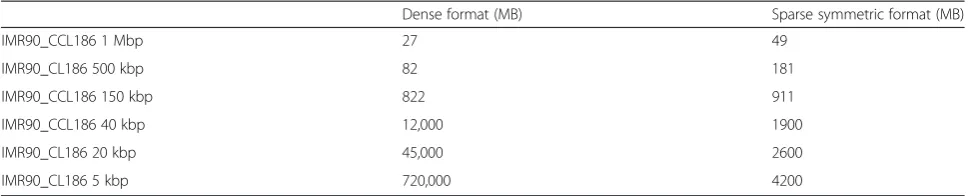
Genome-wide contact maps are generated for resolu-tions defined by the user. A contact map is defined as a matrix of contact counts and a description of the associ-ated genomic bins and is usually stored as a matrix, di-vided into bins of equal size. The bin size represents the resolution at which the data will be analyzed. For in-stance, a human 20 kb genome-wide map is represented by a square matrix of 150,000 rows and columns, which can be difficult to manage in practice. To address this issue, we propose a standard contact map format based on two main observations. Contact maps at high reso-lution are (i) usually sparse and (ii) expected to be sym-metric. Storing the non-null contacts from half of the matrix is therefore enough to summarize all the contact frequencies. Using this format leads to a 10–150-fold re-duction in disk space use compared with the dense for-mat (Table 4).
Allele-specific analysis
[image:9.595.55.540.88.437.2]are assigned to the same parental allele or for which one read is assigned to one parental allele and the other is unassigned. These allele-specific read pairs are then used to generate a genome-wide contact map for each paren-tal genome. Finally, the two allele-specific genome-wide contact maps are independently normalized using the it-erative correction algorithm.
Software requirements
The following additional software and libraries are re-quired: the bowtie2 mapper [26], R and the BioConductor packages RColorBrewer, ggplot2, grid, Samtools (>0.1.19), Python (>2.7) with thepysam,bx.python,numpyandscipy
libraries, and the g++ compiler. Note that a bowtie2 ver-sion > 2.2.2 is strongly recommended for allele-specific analysis, because, since this version, read alignment on an N-masked genome has been highly improved. Most of the installation steps are fully automatic using a simple com-mand line. The bowtie2 and Samtools software are auto-matically downloaded and installed if not detected on the system. The HiC-Pro pipeline can be installed on a Linux/ UNIX-like operating system.
Conclusions
As the Hi-C technique is maturing, it is now important to develop bioinformatics solutions which can be shared and used for any project. HiC-Pro is a flexible and effi-cient pipeline for Hi-C data processing. It is freely avail-able under the BSD licence as a collaborative project at https://github.com/nservant/HiC-Pro. It is optimized to address the challenge of processing high-resolution data and provides an efficient format for contact map sharing. In addition, for ease of use, HiC-Pro performs quality controls and can process Hi-C data from the raw se-quencing reads to the normalized and ready-to-use genome-wide contact maps. HiC-Pro can process data generated from protocols based on restriction enzyme or nuclease digestion. The intra- and inter-chromosomal con-tact maps generated by HiC-Pro are highly similar to the ones generated by the hiclib package. In addition, when phased genotyping data are available, HiC-Pro allows the easy generation of allele-specific maps for homologous
chromosomes. Finally, HiC-Pro includes an optimized ver-sion of the iterative correction algorithm, which substan-tially speeds up and facilitates the normalization of Hi-C data. The code is also available as a standalone package (https://github.com/hiclib/iced).
A complete online manual is available at http://nservant. github.io/HiC-Pro. The raw and normalized contact maps are compatible with the HiTC Bioconductor package [28], and can therefore be loaded in the R environment for visualization and further analysis.
Additional file
Additional file 1:The supplementary data file contains a description of the dataset used for this study as well as details about how the HiC-Pro, hiclib and HiCorrector software were used in practice.It also includes supplementary figures about the HiC-Pro results and output. (DOCX 1452 kb)
Abbreviations
PCR:polymerase chain reaction; SNP: single-nucleotide polymorphism.
Competing interests
The authors declare that they have no competing interests.
Authors’contributions
N.S., B.R., C.C., J.D., E.H. and E.B. designed the main steps of the Hi-C analysis workflow. N.V. and J.V. developed the new iterative correction implementation. N.S., E.V., B.R. and N.V. developed, optimized and tested the HiC-Pro pipeline. All authors read and approved the final manuscript.
Acknowledgements
We would like to thank Felix Krueger for useful discussion about allele-specific analysis, and Jesse Dixon and Neva Cherniavsky for their advice in defining the best GM12878 phasing data. This work was supported by the France Genomique National infrastructure (ANR-10-INBS-09), the Labex Deep, the European Research Coucil (SMAC-ERC-280032), the ERC Advanced Investigator award (ERC-250367), the European Commission (HEALTH-F5-2012-305626), the ABS4NGS project (ANR-11-BINF-0001), the National Human Genome Research Institute (R01 HG003143), and the Paris Alliance of Cancer Research Institutes (PACRI-ANR). J.D. is an Investigator of the Howard Hughes Medical Institute.
Author details
1Institut Curie, Paris, France.2INSERM, U900, Paris, France.3Mines ParisTech,
PSL-Research University, CBIO-Centre for Computational Biology, Fontainebleau, France.4Program in Systems Biology, Department of
Biochemistry and Molecular Pharmacology, University of Massachusetts Medical School, Worcester, MA, USA.5Sysra, Yerres, France.6CNRS UMR3215,
[image:10.595.56.542.100.198.2]Paris, France.7INSERM U934, Paris, France.8Annoroad Gene Technology Co., Ltd, Beijing, China.9Howard Hughes Medical Institute, Program in Systems Table 4Comparison of contact map formats
Dense format (MB) Sparse symmetric format (MB)
IMR90_CCL186 1 Mbp 27 49
IMR90_CL186 500 kbp 82 181
IMR90_CCL186 150 kbp 822 911
IMR90_CCL186 40 kbp 12,000 1900
IMR90_CL186 20 kbp 45,000 2600
IMR90_CL186 5 kbp 720,000 4200
Biology, Department of Biochemistry and Molecular Pharmacology, University of Massachusetts Medical School, Worcester, MA, USA.
Received: 10 August 2015 Accepted: 11 November 2015
References
1. de Wit E, de Laat W. A decade of 3C technologies: insights into nuclear organization. Genes Dev. 2012;26:11–24.
2. Barutcu AR, Fritz AJ, Sayyed KZ, van Wijnen AJ, Lian JB, Stein JL, et al. C-ing the genome: A compendium of chromosome conformation capture methods to study higher-order chromatin organization. J Cell Physiol. 2015; 1097–4652. doi:10.1002/jcp.25062.
3. Lieberman-Aiden E, van Berkum NL, Williams L, Imakaev M, Ragoczy T, Telling A, et al. Comprehensive mapping of long-range interactions reveals folding principles of the human genome. Science. 2009;326(5950):289–93. doi:10.1038/ng.947.
4. Ma W, Ay F, Lee C, Gulsoy G, Deng X, Cook S, et al. Fine-scale chromatin interaction maps reveal the cis-regulatory landscape of lincRNA genes in human cells. Nat Methods. 2015;12:71–8. doi:10.1038/nmeth.3205. 5. Nora EP, Lajoie BR, Schulz EG, Giorgetti L, Okamoto I, Servant N, et al. Spatial
partitioning of the regulatory landscape of the x-inactivation centre. Nature. 2012;485(7398):381–5. doi:10.1038/nature11049.
6. Dixon JR, Selvaraj S, Yue F, Kim A, Li Y, Shen Y, et al. Topological domains in mammalian genomes identified by analysis of chromatin interactions. Nature. 2012;485(7398):376–80. doi:10.1038/nature11082.
7. Rao SSP, Huntley MH, Durand NC, Bochkov SID, Robinson JT, Sanborn AL, et al. A 3d map of the human genome at kilobase resolution reveals principles of chromatin looping. Cell. 2014;159(7):1665–80. doi:10.1016/j.cell.2014.11.021. 8. Jin F, Li Y, Dixon JR, Selvaraj S, Ye Z, Lee Y, et al. A high-resolution map of
the three-dimensional chromatin interactome in human cells. Nature. 2013; 503(7475):290–4. doi:10.1038/nature12644.
9. Lajoie BR, Dekker J, Kaplan N. The hitchhiker’s guide to hi-c analysis: Practical guidelines. Methods. 2015;72:65–75. doi:10.1016/j.ymeth.2014.10.031. 10. Heinz S, Benner C, Spann N, Bertolino E, Lin YC, Lasio P, et al. Simple
combinations of lineage-determining transcription factors prime cis-regulatory elements required for macrophage and B cell identities. Mol Cell. 2010;38(4):576–89. doi:10.1016/j.molcel.2010.05.004. 11. HiCUP. http://www.bioinformatics.babraham.ac.uk/projects/hicup/. 12. Castellano G, Le Dily F, Hermoso Pulido A, Beato M, Roma G. Hi-Cpipe: a
pipeline for high-throughput chromosome capture.bioRxiv 2015. Cold Spring Harbor Labs Journals. doi:10.1101/020636.
13. Schmid Marc W, Schmid MW, Grob S, Grossniklaus U. HiCdat: a fast and easy-to-use Hi-C data analysis tool. BMC Bioinformatics. 2015;16:277. doi:10.1186/s12859-015-0678-x.
14. HiCbox. https://github.com/koszullab/HiC-Box.
15. SNPsplit. http://www.bioinformatics.babraham.ac.uk/projects/SNPsplit/. 16. Hsieh TS, Weiner A, Lajoie B, Dekker J, Friedman N, Rando O. Mapping nucleosome resolution chromosome folding in yeast by micro-C. Cell. 2015;162(1):108–19. doi:10.1016/j.cell.2015.05.048.
17. Imakaev M, Fudenberg G, Patton McCord R, Naumova N, Goloborodko A, Lajoie BR, et al. Iterative correction of hi-c data reveals hallmarks of chromosome organization. Nat Methods. 2012;9(10):999–1003. doi:10.1038/nmeth.2148.
18. Yaffe E, Tanay A. Probabilistic modelling of Hi-C contact maps eliminates systematic biases to characterize global chromosomal architecture. Nat Genet. 2011;43(11):1059–65. doi:10.1038/ng.947.
19. Hu M, Deng K, Selvaraj S, Qin Z, Ren B, Liu J. HiCNorm: removing biases in Hi-C data via poisson regression. Bioinformatics. 2012;28(23):3131–3. doi:10.1093/bioinformatics/bts570.
20. Li W, Gong K, Li Q, Alber Fand Zhou XJ. Hi-Corrector: a fast, scalable and memory-efficient package for normalizing large-scale hi-c data. Bioinformatics. 2015;31(6):960–2. doi:10.1093/bioinformatics/btu747. 21. Minajigi A, Froberg JE, Wei C, Sunwoo H, Kesner B, Colognori D, et al. A
comprehensive Xist interactome reveals cohesin repulsion and an RNA-directed chromosome conformation. Science. 2015;349(6245):aab2276. doi:10.1126/science.aab2276.
22. Deng X, Ma W, Ramani V, Hill A, Yang F, Ay F, et al. Bipartite structure of the inactive mouse X chromosome. Genome Biol. 2015;16:152. doi:10.1186/s13059-015-0728-8.
23. Selvaraj S, Dixon JR, Bansal V, Ren B. Whole-genome haplotype reconstruction using proximity-ligation ans shotgun sequencing. Nat Biotechnol. 2013;31(12):1111–8. doi:10.1038/nbt.2728. 24. Platinum Illumina Genomes Project. http://www.illumina.com/
platinumgenomes/.
25. Quinlan AR, Hall IM. BEDTools: a flexible suite of utilities for comparing genomic features. Bioinformatics. 2010;26(6):841–2.
26. Langmead B, Salzberg SL. Fast gapped-read alignment with Bowtie2. Nat Methods. 2012;9:357–9. doi:10.1038/nmeth.1923.
27. Cournac A, Marie-Nelly H, Marbouty M, Koszul R, Mozziconacci J. Normalization of a chromosomal contact map. BMC Genomics. 2012;13:436. doi:10.1186/1471-2164-13-436.
28. Servant N, Lajoie BR, Nora EP, Giorgetti L, Chen CJ, Heard E, et al. HiTC: Exploration of high-throughput‘C’experiments. Bioinformatics. 2012;28(21):2843–4.
Submit your next manuscript to BioMed Central and take full advantage of:
• Convenient online submission
• Thorough peer review
• No space constraints or color figure charges
• Immediate publication on acceptance
• Inclusion in PubMed, CAS, Scopus and Google Scholar
• Research which is freely available for redistribution