489
©IJRASET (UGC Approved Journal): All Rights are Reserved
Power Stability Analysis of an Active Harmonic
Filter in Presence of PFC Capacitors Using PID
Controller
Bhagya Sree.Ch1, Dr.J.Bhavani2, N. Amarnadh Reddy3 1
M.Tech Scholar, 2, 3Assistant Professor, Department of EEE. VNR Vignana Jyothi institute of engineering and technology, Hyderabad, Telangana 500090.
Abstract: With a specific end goal to make the load compensators financially effective, Dynamic Active Harmonic Filters (AHF) are utilized as a part of conjunction with Power Factor Correction (PFC) capacitors, so the load sounds are regulated by AHF and the responsive power necessity of the load is provided by the PFC capacitors. Be that as it may, nearness of PFC capacitors in relationship with the hamper of the source emphatically impacts the compensation conduct of the AHF. This paper assesses the execution of AHF wherein it works in nearness of PFC capacitors. A thorough examination of the framework is displayed and it is impartially demonstrated that under what conditions the framework fails to adjust for the load noise. A research facility model of the proposed AHF having a RMS current rating of 50 A has been created. Detailed exploratory investigations are completed using the model to confirm the unsteadiness issue.
Keywords: Active harmonic filters, closed loop stability, combined system for harmonic load compensation, harmonic amplification and indirect current control.
I. INTRODUCTION
Dynamic load compensator is required to make up for the harmonics created by nonlinear loads and also it needs to make up for the essential receptive energy of the stack. This requires the need of higher rating for the load compensator as it needs to supply central responsive segment of the load present and additionally it needs to supply symphonious parts of the load current. Also, all together to accomplish higher transfer speed, the semiconductor elements of the stack compensator must be exchanged with higher recurrence, which builds the exchanging misfortunes. With a specific end goal to lessen the current rating, the compensator can be dimensioned just to make up for the harmonics segments of the load along these lines working as an Active Harmonic Filter (AHF), and the principal receptive segment of the load is provided by including exchanged Power Factor Correction (PFC) capacitors. As the AHF needs to arrange just the symphonious part of the load which is extensively lower than the basic receptive load current segment elements having low present rating can be utilized to understand the inverter of the AHF and further, the exchanging misfortune acquired stays low. Therefore, the semiconductor elements can be made to work at higher exchanging recurrence in this manner acknowledging higher transmission capacity for the remuneration process. Due to the previously mentioned focal points, the mix of AHF and PFC has turned out to be main stream in acknowledging load compensator.
The AHF supplies the symphonious current which is equivalent in greatness and having an indistinguishable stage from that of the symphonious current drawn by the nonlinear load. In this way the harmonics current provided by the AHF courses through the source impedance in inverse bearing as that of the harmonics current drawn by the load, in this manner counterbalancing the harmonics current being provided by the source. Be that as it may, the nearness of PFC capacitors in the system alongside the limited short out impedance of the source, firmly impacts the remuneration conduct of the AHF.
490
©IJRASET (UGC Approved Journal): All Rights are Reserved
disintegration of remuneration conduct of AHF in nearness of PFC capacitors, an inside and out investigation of the framework has been done in this paper. The AHF framework utilized for the investigation is depicted in area II. The issue of insecurity of the framework in nearness of PFC capacitors is examined in shortsighted way in area III, while more inside and out investigation is introduced in area IV. A lab model of the proposed AHF having an rms current rating of 50 A has been produced. Keeping in mind the end goal to affirm the investigation , detailed simulink models recreation thinks about took after by exploratory approvals are completed and the outcomes are introduced in segment V.
II. ACTIVE HARMONIC FILTER
With a specific end goal to repay the harmonics created by the stack, the AHF needs to detect the load current with a specific end goal to gauge its harmonics substance. This can be accomplished either by detecting the current downstream to the area of AHF or by detecting the current upstream to the area of AHF. The procedure of detecting the current downstream to the area of AHF is named as 'stack side' detecting and is portrayed in Fig. 1, while the way toward detecting the current upstream to the AHF is named as 'supply side' detecting and is delineated in Fig. 2, wherein the load is displayed as parallel mix of a proportionate protection, R speaking to the successful resistive segment of the load, the comparable inductance, L speaking to the compelling inductive part of the load, what's more, the harmonics current source, Ih speaking to the symphonious current segments drawn by the load. The PFC capacitors are spoken to by the proportionate capacitor, C, though the AHF is represented by a framework associated voltage source inverter. The cut off of the source is spoken to by arrangement blend of resistor, r and the inductor Lt.
Fig.3 Control strategy for supply side current sensing
491
©IJRASET (UGC Approved Journal): All Rights are Reserved
Fig.4 Control strategy for load side current sensing
With a specific end goal to satisfy this practical prerequisite, utilizing Synchronous Reference Frame (SRF) based current controller turns into an undeniable decision. Another critical favorable position which SRF controller gives is that, the present flags under thought are converter into dc amounts which not just permits better sifting however it likewise permits utilization of traditional Relative Integral (PI) controller keeping in mind the end goal to get zero consistent state mistake. Fig. 3 delineates usage of SRF based control rationale with 'supply side' detecting, which is conveyed for pay of fifth, seventh, eleventh and thirteenth harmonics recurrence streams created by the load. Additionally, Fig. 4 portrays usage of SRF based control rationale with 'stack side' detecting. The distinction in the portrayals lies in the external current controller, which contains reference current age obstructs for singular symphonious numbers. The internal current controller gets the present reference which is basic recurrence reference current superimposed with the harmonics current references. The internal current controller can either be actualized utilizing direct current control technique or it can be actualized utilizing aberrant current control techniques. In see of the continuous exchange on strength examination of AHF, the decision of internal current controller does not assume overseeing part, thusly the discourse on execution of inward present controller is kept outside the extnt of this paper.
III. PROBLEM VERIFICATION
A. Simplistic Approach
492
©IJRASET (UGC Approved Journal): All Rights are Reserved
.
Fig.5. Demonstration of stable operation for ’below’ resonance case. (a) Harmonic load current (b) Sensed current before starting AHF (c) Harmonic current supplied by AHF current when it is started (d) Harmonic current supplied by source when AHF
is started
This marvel is clarified by alluding to Fig. 5 and Fig. 6 wherein current waveforms existing at different hubs of the system is delineated. It is worth specifying here, that the present waveforms delineated in both Fig. 5 and in addition Fig. 6 are neither real recorded streams nor are they mimicked current waveforms, however these current waveforms are indicated only for representation reason. In addition, the subplots are not reliable with time.
Fig6. Demonstration of unstable operation for ’above’ resonance case. (a) Harmonic load current (b) Sensed current before starting AHF (c) Harmonic current supplied by AHF current when it is started (d) Harmonic current supplied by source when AHF is started
For the case delineated in Fig. 5 wherein, if the harmonics stack current is having the recurrence not as much as fr, at that point the real load symphonious current and the detected load harmonics current are having a similar stage relationship as portrayed in Fig. 5(a) and Fig. 5(b). At the point when the AHF comes into operation, the harmonics current provided by it has a tendency to be in stage with detected harmonics present as appeared in Fig. 5(c). Subsequently the harmonics current provided by the source, as appeared in Fig. 5(d), which is the vector subtraction of harmonic current provided by AHF and load harmonics current, decreases. On the other hand, for the case showed in Fig. 6 wherein, the symphonious stack current is having the recurrence more than fr, the
detected symphonious current has the eliminate point which is 180◦ of stage as for the load symphonious present as appeared in Fig.
6(a) and Fig. 6(b). At the point when the AHF is brought into operation, it begins providing the harmonics current which tends to be
in stage with the detected harmonics present as appeared in Fig. 6(c). However, as the detected current itself is 180◦ out of stage
concerning the load symphonious current, the AHF begins infusing the harmonics segments into the source by framing a positive criticism circle displaying the start of unsteady operation of the AHF as appeared in Fig. 6(d). Further, it can be surmised from the previously mentioned discourse that this marvel is substantial for both the present detecting systems, i.e. 'supply side' detecting and 'load side' detecting.
IV. PROBLEM VERIFICATION
A. An Analytical Approach
493
©IJRASET (UGC Approved Journal): All Rights are Reserved
large framework, 'Supply side' detecting strategy is considered in this paper. The framework soundness is broke down by developing the by and large control piece chart of the entire framework
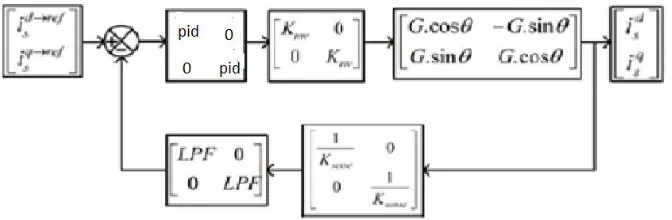
The reference outline is turning in synchronism with nth symphonious recurrence, where, n is the symphonious recurrence under thought. Inward present controller of the AHF is thought to have a sufficiently vast transmission capacity, with the goal that the inverter of the AHF can be displayed as a pick up piece, K(inv). The gain block square K(sense) is the equipment pick up of supply current detecting. A Low Pass Filter piece is required with a specific end goal to remove the dc segment, since this dc part speaks to the nth symphonious current flag in a synchronously pivoting reference outline bolted to nth harmonics recurrence. The coupling framework relates d-pivot and q-axis current parts on the supply side to the d-pivot and q-hub current segments produced by AHF. The coupling exists as a result of quality of downstream PFC capacitors.
Fig.7. Control block diagram at nth harmonic component
Fig.8. Vector representation of inverter current and supply side current
The benefits of coupling grid can be inferred geometrically as takes after, In a synchronously pivoting reference outline, consider a self-assertive inverter current vector signified as ii in Fig. 8. The vector signified by is speaks to appearance of inverter current on the supply side. The adequacy and stage point of this current vector is by all accounts unique in relation to the inverter current vector, since the inverter current gets partitioned in two ways, one through the supply side and other through the PFC capacitor. The articulation for d-hub and q-pivot parts of supply side current can be composed as far as d-pivot and q-hub current segments of inverter streams as given in (1), which can be reworked in the network frame as given in (2).
= . ( ) + . cos tan +
494
©IJRASET (UGC Approved Journal): All Rights are Reserved
= . − .
. . . ………. (2)
where, G is the proportion of amplitudes of the supply current vector to inverter current vector, and θ is the distinction in stage edges of these two vectors. It is apparent from the investigation that the d-pivot current control circle and q-hub current control circle are not free of each other, rather, there exists a coupling between the two control circles given by the coupling grid appeared in (2).
Progressively the coupling framework turns out to be near being a corner to corner network weaker is the coupling. This can be cross checked by dissecting a similar framework without PFC capacitors. In this case, since the two vectors appeared in Fig. 8 cover
[image:7.612.150.486.273.383.2]with each other, we can substitute G = 1 and θ = 0 in (2). Along these lines, the coupling network lessens to a unit framework, and the two control circles turn out to be totally decoupled. In any case, in nearness of PFC capacitors, the off-askew components in the coupling lattice demonstrate their limited nearness and the control circles end up noticeably coupled. Due to coupling between the circles the general control framework no more stays basic Single Info Single Output (SISO) framework rather it turns into Multiple Info Multiple Output (MIMO) framework. Such MIMO framework can be redrawn in more natural shape as appeared in Fig. 9.
Fig. 9. Control block diagram of MIMO system at nth harmonic frequency
V. PID CONTROLLER
The security of framework appeared in Fig. 9 can be investigated utilizing Routh's criteria for security of MIMO framework which states that for the framework having circle exchange work given by (C.P.H) to be steady, every one of the coefficients of determinant of the trademark condition, must be certain. That is, all the coefficients of condition given by det.[I +C.P.H] must be positive, where, C is the exchange work network of controller, P is the
exchange work network of plant and H is the exchange work network of criticism way. Applying the Routh's criteria to the exchange work frameworks appeared in Fig. 9 we get,
. | + | = 1 + 2. . . + . . .
= ( _ . + _ + _ . )/
= +
Term P is proportional to the current value of the SP-PV error e(t). For example, if the error is large and positive, the control output will be proportionately large and positive, taking into account the gain factor "K". Using proportional control alone will always result in an error between the setpoint and the actual process value, because it requires an error to generate the proportional response. If there is no error, there is no corrective response.
Term I accounts for past values of the SP-PV error and integrates them over time to produce the I term. For example, if there is a residual SP-PV error after the application of proportional control, the integral term seeks to eliminate the residual error by adding a control effect due to the historic cumulative value of the error. When the error is eliminated, the integral term will cease to grow. This will result in the proportional effect diminishing as the error decreases, but this is compensated for by the growing integral effect.
495
©IJRASET (UGC Approved Journal): All Rights are Reserved
VI. SIMULATION VERIFICATION
With a specific end goal to approve the shakiness issue, a model for the framework with parameters as portrayed in Table I is manufactured in MATLAB/SIMULINK condition. So also a research facility model for AHF framework is worked to tentatively confirm the flimsiness criteria.
It can be seen from stage plot that, for fifth harmonics current part, the stage edge is under 90◦, while the stage edge is more than
90◦ for eleventh harmonics current part. In this way according to numerical examination displayed in before area, remuneration of fifth harmonics current part is anticipated that would display stable operation, while pay of eleventh harmonics current segment is required to show precarious operation. With a specific end goal to check this theory, a reenactment and in addition research center investigation has been done for,
A. Compensation of fifth harmonics current and
B. Compensation of eleventh harmonics current.
C. Confirmation with pay of fifth symphonious current
For both reenactment and also trial check, the comes about are shown in following way.
1) Initially the AHF is begun and continued working just to keep up the dc transport voltage to set reference level.
2) Once the dc voltage is kept up, the charge to begin the remuneration procedure of wanted symphonious number (n) is issued.
3) The adequacy of supply side nth symphonious current is computed inside as , and is shown on the degree.
[image:8.612.189.440.318.411.2](Advanced to Analog converter is utilizedas a part of case of test confirmation.)
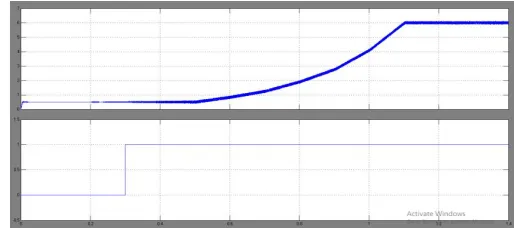
[image:8.612.194.451.519.633.2]Fig. 11. Simulation result for 5th harmonic compensation. Trace 1: Amplitude of 5th harmonic current on supply side (2A/div). Trace 2: Command signal for compensation of 5th harmonic frequency
Fig. 11 demonstrates the reproduction result for fifth consonant pay, where, it is seen that the fifth consonant current on the supply side stays zero even in the wake of beginning the pay process for fifth consonant current, which is set apart by the rising edge of the charge motion in follow 2. This illustrates the security of the present controller.
D. Confirmation with pay of eleventh symphonious current
Fig. 13. Simulation result for 11th harmonic compensation. Trace 1: Amplitude of 11th harmonic current on supply side (1A/div). Trace 2: Command signal for compensation of 11th harmonic frequency
496
©IJRASET (UGC Approved Journal): All Rights are Reserved
VII. CONCLUSION
The power rating of a load compensator ends up plainly significant in the event that it is required to adjust for the load music as well with respect to the receptive energy of the load. With a specific end goal to lessen the power evaluations of load compensators they are utilized in relationship with PFC capacitors. Be that as it may, the nearness of PFC capacitors in conjunction with limited short out impedance of the source, emphatically impacts the pay conduct of the AHF and the procedure of pay may end up noticeably temperamental for certain load conditions. Strength examinations of the framework in nearness of PFC capacitors are exhibited, what's more, it has been equitably demonstrated that, under what conditions the AHF framework shows temperamental conduct.A research center model of the AHF has been manufactured and the precariousness condition has been found out by performing exploratory approvals.
V. ACKNOWLEDGEMMENT
I am immensely thankful to my project guides Dr.J.Bhavani(Associate Professor) and Mr.N.Amarnadh(Assistant Professor), Department of EEE, VNR VJIET, for the exhaustive technical help and encouragement during this course of work.
I earnestly thank Dr. Poonam Upadhyay, Professor and HOD, Department of EEE, VNR VJIET, for the extreme cooperation and encouragement to do the project work.
I earnestly thank Dr.K.Anuradha, Dean of Academics, VNR VJIET, for the extreme cooperation and encouragement to do the project work.
I sincerely thank you Dr.C.D. Naidu, Principal of our college for the facilities provided in the college premises. my gratitude to my Parents and Classmatesfor their suggestions and moral support.
REFERENCES
[1] Chatterjee, K., Fernandes, B.G., Dubey, G.K. ”A novel high-power lowdistortion synchronous link converter-based load compensator without the requirement of VAr calculator”, IEEE Trans. Ind. Electron. Vol. 47, no. 3, pp.542-548, Jul. 2000
[2] Herrera, R.S., Salmeron, P. ,”Instantaneous Reactive Power Theory: A Reference in the Nonlinear Loads Compensation”, IEEE Trans. Ind. Electron. Vol. 56, no. 6, pp.2015-2022, 2009
[3] Sreeraj, E.S. ,Prejith, E.K., Chatterjee, K., Bandyopadhyay, S. , ”An Active Harmonic Filter Based on One-Cycle Control”, IEEE Trans. Ind. Electron. Vol. 61, no. 8, pp.3799-3809, 2014
[4] Rahmani, S., Hamadi, A., Al-Haddad, K., Dessaint, L.A. ,”A Combination of Shunt Hybrid Power Filter and Thyristor-Controlled Reactor for Power Quality”, IEEE Trans. Ind. Electron. Vol. 61, no. 8, pp.2152-2164, 2014
[5] An Luo, Zhikang S., Wenji Z., and Z. John Shen, ”Combined System for Harmonic Suppression and Reactive Power Compensation”, IEEE Trans. Power Electron. , vol. 56, no. 2, pp. 418 - 428, Feb. 2009
[6] Asiminoaei L., Aeloiza E., Prasad N. E., Blaabjerg F. ”Shunt Active- Power-Filter Topology Based on Parallel Interleaved Inverters”, IEEE Trans. Ind. Electron. , vol. 55, no. 3, pp. 1175 - 1189 , Mar. 2008
[7] Q. Trinh, H. Lee, ”An Advanced Current Control Strategy for Three- Phase Shunt Active Power Filters”, IEEE Trans. Ind. Electron., , vol. 60, no. 12, pp. 5400-5410, Dec. 2013.
[8] Xiaofeng S., N. Li, Baocheng W., XinLi ”Improvement for The Closed- Loop Control of Shunt Active Power Filter” ,IEEE 6th International Power Electronics and Motion Control Conference , , 2009. IPEMC ’09.
[9] M. P. Kazmierkowski, L. Malesani. ”Current Control Techniques for Three-Phase Voltage-Source PWM Converters: A Survey”, IEEE Trans. Ind. Electron. vol. 45, no. 5, pp.691-703, Oct. 1998