UNCORRECTED PR
OOF
1Q1
Spatial attention enhances object coding in local and distributed
2
representations of the lateral occipital complex
3Q2
Matthias Guggenmos
a,b,⁎
, Volker Thoma
c, John-Dylan Haynes
a, Alan Richardson-Klavehn
d,
4Radoslaw Martin Cichy
e,1, Philipp Sterzer
a,b,15 a
Bernstein Center for Computational Neuroscience, Berlin, Germany
6 b
Visual Perception Laboratory, Charité Universitätsmedizin, Berlin, Germany
7 c
School of Psychology, University of East London, London, UK
8 d
Department of Neurology, Otto von Guericke University, Magdeburg, Germany
9 eComputer Science and Artificial Intelligence Laboratory, Massachusetts Institute of Technology, Cambridge, USA
a b s t r a c t
1 0
a r t i c l e i n f o
11 Article history:
12 Received 30 December 2014
13 Accepted 1 April 2015
14 Available online xxxx
15 Keywords:
16 Attention
17 Objects
18 Lateral occipital complex
19 Multivariate pattern analysis
20 Mutual information
21 fMRI
22 The modulation of neural activity in visual cortex is thought to be a key mechanism of visual attention. The
inves-23 tigation of attentional modulation in high-level visual areas, however, is hampered by the lack of clear tuning or
24 contrast response functions. In the present functional magnetic resonance imaging study we therefore
systemat-25 ically assessed how small voxel-wise biases in object preference across hundreds of voxels in the lateral occipital
26 complex were affected when attention was directed to objects. We found that the strength of attentional
modu-27 lation depended on a voxel's object preference in the absence of attention, a pattern indicative of an amplificatory
28 mechanism. Our results show that such attentional modulation effectively increased the mutual information
be-29 tween voxel responses and object identity. Further, these local modulatory effects led to improved
information-30 based object readout at the level of multi-voxel activation patterns and to an increased reproducibility of these
31 patterns across repeated presentations. We conclude that attentional modulation enhances object coding in
32 local and distributed object representations of the lateral occipital complex.
33 © 2015 Published by Elsevier Inc.
34 35 36 37
38 1. Introduction
39 Attention is a cognitive process that enables us to focus on certain
as-40 pects of the environment for the benefit of improved performance
41 (Bashinski and Bacharach, 1980; Cameron et al., 2002; Carrasco et al., 42 2000; Hawkins et al., 1990). One way in which attention has been
43 found to impact neural processing is through an amplification of neural
44 responses to attended spatial locations, objects, or features (for review,
45 seeTreue, 2003). In the visual domain, attentional amplification has
46 been found throughout the visual processing hierarchy, from the
earli-47 est stage of visual neural processing in the lateral geniculate nucleus
48 (O'Connor et al., 2002), primary visual cortex (Gandhi et al., 1999; 49 Martínez et al., 1999; Somers et al., 1999), up to high-level visual
corti-50 ces (Murray and Wojciulik, 2004; O'Craven et al., 1999; Serences et al., 51 2004) and the frontal lobes (Gitelman et al., 1999). However, the nature
52 of attentional modulation remains a topic of debate. A number of studies
53 have reported that attention leads to a multiplicative scaling of neuronal
54 responses (Di Russo et al., 2001; McAdams and Maunsell, 1999; Treue
55 and Martínez Trujillo, 1999; Treue and Maunsell, 1999), which results
56
in an increase of a neuron's signal to noise ratio. In contrast, other
stud-57
ies reported results that violated the predictions of the multiplication
58
hypothesis, by showing that spatial attention leads to increased neural
59
responses in visual areas in the absence of any visual stimulation
60
(Kastner et al., 1999; Luck et al., 1997; Ress et al., 2000; Silver et al., 61 2007). According to these studies, attentional modulation involves an
62
unspecific baseline shift of activity.
63
A common approach to investigate the effects of visual attention is
64
the recording of neural responses across a range of a stimulus parameter
65
(e.g., orientation of motion direction) both in the presence and absence
66
of attention. In this way, previous studies have examined the attentional
67
modulation of single-neuron (McAdams and Maunsell, 1999; Motter, 68 1993; Treue and Martínez Trujillo, 1999) or voxel (Saproo and
69 Serences, 2010, 2014) tuning profiles. However, a complicating factor
70
for the investigation of attentional modulation in high-level
object-71
coding areas like the human lateral occipital complex (LOC) is the lack
72
of analogous neuronal tuning functions. Similarly, the analysis of
con-73
trast response functions–a technique that has been used to study the
74
nature of attentional modulation for low-level visual stimuli
75
(Reynolds et al., 2000; Williford and Maunsell, 2006)–is problematic,
76
because object-related neuronal responses become increasingly
invari-77
ant to contrast along the visual hierarchy (Avidan et al., 2002; Rolls and NeuroImage xxx (2015) xxx–xxx
⁎ Corresponding author at: Bernstein Center for Computational Neuroscience, Philippstraße 13, Haus 6, 10115 Berlin, Germany
Q3 .
E-mail address:[email protected](M. Guggenmos). 1
Contributed equally.
http://dx.doi.org/10.1016/j.neuroimage.2015.04.004 1053-8119/© 2015 Published by Elsevier Inc.
Contents lists available atScienceDirect
NeuroImage
UNCORRECTED PR
OOF
78 Baylis, 1986) and this invariance may itself depend on attention
79 (Murray and He, 2006). In the present work we therefore used a
differ-80 ent approach by exploiting the fact that the LOC represents objects in a
81 distributed fashion across ensembles of neural populations (Haxby 82 et al., 2001; Rice et al., 2014). At the spatial resolution of fMRI this
dis-83 tributed code is expressed in a differential preference of voxels for a
84 given stimulus, likely representing the cumulative stimulus preference
85 of neurons within these voxels. Thus, if attention causes an amplifi
ca-86 tion of neural activity as opposed to a mere baseline shift, these
prefer-87 ences should be augmented with attention, and as a consequence
88 single- and multi-voxel responses should become more informative
89 about the stimuli encoded in these voxels.
90 In the present study we presented human participants with objects
91 under conditions of spatial attention and inattention in a functional
92 magnetic resonance imaging (fMRI) experiment. We had two aims.
93 First, we sought to probe the nature of attentional modulation of visual
94 object responses in the LOC as described above, by examining whether
95 attentional modulation increased with a voxel's preference for a given
96 object in the absence of attention, or whether the modulation was
inde-97 pendent of object preference. In a second step we investigated whether
98 these local modulatory effects of attention resulted in a more
informa-99 tive and reliable object code. To this end we used a mutual information
100 metric (Saproo and Serences, 2010; Serences et al., 2009) to assess
101 whether single-voxel responses became more informative about object
102 identity with attention. At the multi-voxel pattern level we examined
103 how these local changes affected the quality of object representations
104 through pattern similarity and classification-based analyses.
105 2. Materials and methods
106 2.1. Disclosure
107 A previous article (Guggenmos et al., 2015) was based on the same
108 fMRI dataset, but pursued a different research question and orthogonal
109 analyses.
110 2.2. Participants
111 Eighteen healthy participants (11 female, mean age ± SEM,
112 23.4 ± 0.8 years) took part in the experiment for payment after
giv-113 ing written informed consent. The study was conducted according to
114 the declaration of Helsinki, and approved by the local ethics
115 committee.
116
2.3. Experimental design
117
Our key experimental manipulation was to direct participants'
spa-118
tial attention to either an object (attended condition) or a noise
stimu-119
lus (unattended condition). Overall the experimental design comprised
120
the factors attention (attended, unattended) as a factor of interest, as
121
well as object (camera, watering can, chair), configuration (intact,
122
split) and side of presentation (left, right) as factors of no interest.
Con-123
figuration was manipulated by minimally scrambling (half-splitting)
124
the objects, but note that the analyses in this article were based on intact
125
objects only. Within each of 8 experimental runs, an object appeared in
126
4 trials in each attention condition (in 2 trials per side of presentation).
127
The order of presentation was randomized across the 48 trials of each
128
run.
129
2.4. Experimental procedures
130
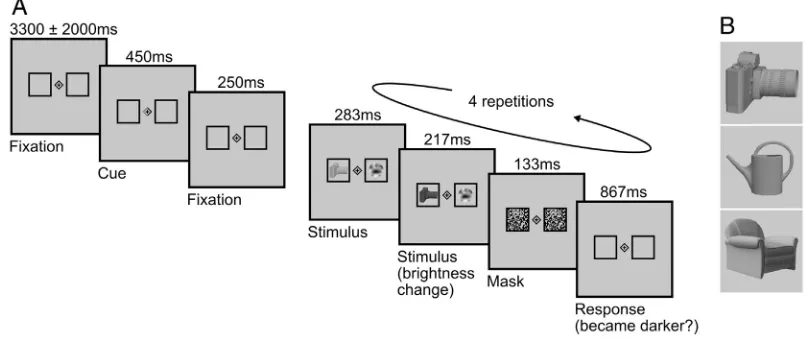
In each trial (Fig. 1A), participants viewed a stimulus display that
131
contained an object and a noise stimulus on either side of a central
132
fixation cross. Spatial attention was manipulated by means of a
133
brightness discrimination task that was performed either on the
ob-134
ject (attended condition) or the contralateral noise stimulus
(unat-135
tended condition). A trial (Fig. 1A) started with a blankfixation
136
screen for 3300 ms ± 2000 ms, after which one half of a central
137
blackfixation diamond turned red, indicating the side to which
at-138
tention should be directed. Following this cue and a shortfixed
inter-139
val (250 ms), four repetitions of the stimulus–response phase
140
appeared. Each stimulus–response phase lasted 1500 ms and
com-141
prised the presentation of the stimulus screen (500 ms), a pattern
142
mask (133 ms) and a response screen (867 ms). The object appeared
143
on one side of thefixation cross (offset 3.84° of visual angle) and a
144
noise stimulus at the same offset on the other side of the stimulus
145
screen. All visual stimuli subtended 3.81 by 3.81° of visual angle. A
146
brightness change occurred 283 ms after stimulus onset
simulta-147
neously on both the object and the noise stimulus, such that they
be-148
came independently and randomly either darker or lighter.
149
Participants were instructed to press a button on the response box
150
when the stimulus on the cued side became darker. Responses
151
were counted as valid within a time window of 1000 ms after
stimu-152
lus offset. In each repetition of the stimulus–response phase, the
153
same object was shown at the same position. The noise stimulus,
154
while also presented at the same position, was randomly generated
155
for each repetition.
156
To independently identify object-responsive regions of the lateral
157
[image:2.595.90.494.541.710.2]occipital complex (LOC) in each participant (Malach et al., 1995), we Q4
Fig. 1.Experimental procedures and stimuli. A. In each trial a cue indicated the side to which attention should be directed. Subsequently, four repetitions of the stimulus–response phase appeared, during each of which participants had to detect a decrease in brightness of either the object (attended condition) or the noise stimulus (unattended condition). B. The stimulus set consisted of three objects in an intact and half-split configuration.
UNCORRECTED PR
OOF
158 conducted a localizer run with 5 blocks of intact objects, 5 blocks of split
159 objects and 10 blocks of grid-scrambled versions of the objects in
ran-160 domized order. Blocks lasted for 15.8 s during which 20 images were
161 presented for 600 ms each, followed by 200 ms blank screen. Pairs of
162 identical objects were shown left and right offixation, equaling the
con-163 figuration of the main experiment in eccentricity and size. Participants
164 performed a one-back task on the object pairs, in which they had to
in-165 dicate via button press whenever the same stimulus display appeared
166 twice in a row.
167 2.5. Stimuli
168 Stimuli were generated with Psychophysics Toolbox 3 (http:// 169 psychtoolbox.org) and projected with a Sanyo LCD projector at 60 Hz.
170 The stimulus set consisted of three grayscale objects (camera, watering
171 can, chair) based on realistic three-dimensional models presented
ei-172 ther intact or half-split (Fig. 1B). The objects were selected for
173 representing non-overlapping man-made categories to increase the
dis-174 criminability of evoked neuronal activation patterns. The noise stimuli
175 matched the objects in terms of spatial extent and complexity to ensure
176 that there would be no performance difference. They were randomly
177 generated for each trial by sampling a 9 × 9 random binary matrix,
scal-178 ing the matrix to 216 × 216 pixels, applying a low-passfilter with a
cut-179 off frequency of 0.02/pixel and cropping pixels outside a circle of
180 216 pixels diameter. This procedure resulted in circular grayscale
stim-181 uli with randomly distributed smooth patches that approximately
182 matched the objects in terms of spatial extent. Both the objects and
183 the noise stimuli were scaled to grayscale RGB values between 50 and
184 205. To generate these brightness changes, the underlying RGB
histo-185 grams were shifted up or down by 50 (the image background remained
186 constant with an RGB value of 200). The pattern masks were generated
187 for each trial by sampling an 18 × 18 random binary matrix and scaling
188 the matrix to 216 × 216 pixels.
189 2.6. Eyetracking
190 Eyetracking data were successfully collected in 16 of 18 subjects
191 using an infrared video eyetracking system (iView XTM MRI 50Hz,
192 SensoMotoric Instruments, Teltow, Germany). For each run, the
hori-193 zontal eye movement data were low-passfiltered and drift corrections
194 were performed. As a measure offixation reliability, we computed the
195 percentage of recorded eye gaze positions during stimulus presentation
196 within a 1.93° visual angle circle around the center of thefixation cross.
197 This radius corresponded to the eccentricity of the inner edges of the
198 two stimulus-containing boxes (seeFig. 1A). In addition, we computed
199 the number of saccades to the intact objects and the noise stimuli,
sep-200 arately for the attended and the unattended condition. Saccades were
201 defined as events of at least three consecutive data points in velocity
202 space exceeding a velocity criterion of 30°/s. Saccades were counted as
203 object-directed or noise-directed saccades, when their endpoint was
lo-204 cated within the object-containing box, or the noise-containing box,
205 respectively.
206 2.7. FMRI data acquisition and preprocessing
207 FMRI data were acquired on a 3-Tesla Siemens Trio (Erlangen,
208 Germany) scanner using a gradient echo planar imaging (EPI) sequence
209 and a 12-channel head-coil. We recorded 8 experimental runs of 214
210 whole-brain volumes each, and one LOC localizer run of 242 volumes
211 (TR = 2 s, echo time (TE) 25 ms,flip angle 78°, 33 slices, 3 mm isotropic
212 resolution, interslice gap 0.75 mm). In addition, a high-resolution
T1-213 weighted image was acquired (TR = 1.9 s, echo time (TE) 2.51 ms,
214 flip angle 9°, 192 slices, resolution 1 mm isotropic). The data of the
ex-215 perimental runs were realigned using SPM8 (Wellcome Department
216 of Imaging Neuroscience, Institute of Neurology, London). Data analyses
217 for the main experiment were generally performed in native subject
218
space. An exception was an illustrative display of the whole-brain
219
group-level T-maps for the main effect of attention, for which we
gener-220
ated spatially normalized (MNI) and smoothed (8 mm Gaussian kernel)
221
volumes. Preprocessing of the localizer data included realignment,
spa-222
tial normalization to an MNI template and smoothing (8 mm Gaussian
223
kernel).
224
2.8. FMRI data analysis
225
2.8.1. First-level general linear models (GLMs)
226
For each participant we estimated a GLM including the
stimulus-227
onset regressors, accounting for the factors attention (attended,
unat-228
tended), object (camera, can, chair) and configuration (intact, split).
229
The onsets of each experimental regressor were set to the beginning
230
of the stimulus–response phase. In addition, six motion parameters
231
were included as regressors-of-no-interest. All experimental regressors
232
were modeled as stick functions and convolved with a canonical
hemo-233
dynamic response function.
234
The GLM for the functional localizer comprised regressors for objects
235
and scrambled objects and six motion parameters. The experimental
re-236
gressors were modeled as boxcar functions with durations equal to the
237
block lengths (15.8 s) and convolved with a canonical hemodynamic
re-238
sponse function as implemented in SPM8.
239
2.8.2. Region of interest procedures
240
Our region of interest (ROI) was the LOC, a functionally defined
241
region that responds more to images of objects than their
counter-242
parts and stretches from the lateral occipital cortex to posterior
fusi-243
form gyrus (Grill-Spector et al., 1999). We anatomically constrained Q5 244
the LOC by a bilateral composite mask of the inferior occipital cortex,
245
middle occipital cortex and the posterior half of the fusiform gyrus
246
(derived from the AAL Atlas,Tzourio-Mazoyer et al., 2002). Then Q6 247
the LOC ROI was defined as the intersection of the anatomical mask
248
and the functional localizer based on the t-contrast intact
249
objectsNscrambled objectsof the functional localizer at a significance
250
level of pb0.05 (family-wise error (FWE) corrected at the
whole-251
brain level). Note that this t-contrast was a group-level t-contrast,
252
because the statistical power in thefirst-level localizer contrasts
253
was not sufficient to define individual ROIs in all participants at the
254
pFWEb0.05 level. To ensure a homogenous generation of the LOC 255
ROI for all participants we thusfirst defined the LOC ROI in
group-256
level (MNI) space and subsequently reverse-normalized the
gener-257
ated ROI to each participant's native space.
258
2.8.3. Quantifying changes in mean BOLD activity
259
To estimate neural activity in the LOC ROI and its dependence on
at-260
tention, we extracted the voxel-wise beta values for attended and
unat-261
tended objects separately and averaged across objects and voxels. This
262
procedure resulted in single values representing the average BOLD
re-263
sponse to attended and unattended objects.
264
To visualize the spatial extent of the attentional modulation at a
265
whole-brain level, we performed a group-level repeated-measures
266
ANOVA with factors attention and object and computed the post-hoc
267
contrastattendedNunattended. This analysis was based on normalized
268
and smoothed data. Voxels were considered statistically significant at
269
a level of pb0.05, FWE-corrected at the whole-brain level.
270
2.8.4. Analyzing attentional modulation as a function of object preference
271
We next analyzed whether the attentional modulation depended on
272
the preference of a voxel for a given object. We reasoned that if
atten-273
tion leads to an amplification of neural responses, the difference
be-274
tween a voxel's attentional modulation for the preferred object and
275
the modulation for the non-preferred objects should increase as a
func-276
tion of object preference. By contrast, if attention led to an unspecific
277
baseline shift irrespective of a voxel's preference for the presented
ob-278
UNCORRECTED PR
OOF
279 presentations of the voxel's preferred and non-preferred object. We
280 therefore defined a preference index PI(i) for each objectiand each
281 voxel based on the data of the unattended condition:
PIð Þ ¼i βunattð Þi−hβunattð Þii;
283
283 whereβunatt(i) andβunatt(\i) are the voxel-wise beta values in the unat-tended condition for objectiand all objects excepti(denoted as“not i”:
284 \i) respectively; the symbolbNdenotes the average operation (here
285 across objects). PI was based on the unattended condition to circumvent
286 the potential issue that the object preference of a voxel in the attended
287 condition might not be independent of the magnitude of the attention
288 effect. To compute the strength of the attentional modulation for an
ob-289 jectirelative to the other objects \i, we defined a relative attentional
290 modulation index RAI(i) as follows:
RAIð Þ ¼i βattð Þi−βunattð Þi−hβattð Þi−βunattð Þii ;
292
292 whereβatt(i) andβatt(\i) are the voxel-wise beta values in the attended condition for objectiand all objects exceptirespectively.
293 Finally, we quantified the RAI as a function of PI. To preclude a
selec-294 tion bias we used a leave-one-run-out procedure, such that PI and RAI
295 were computed on independent data. The leave-one-run-out procedure
296 was performed for each objectiseparately as follows. In each fold, we
297 sorted the pooled voxels from the LOC ROI according to PI(i) based on
298 data from all but one experimental runs. We then divided the sorted
299 voxels into 10 equinumerous bins (deciles) according to PI(i) and
com-300 puted the average RAI(i) for the voxels in each bin based on the data of
301 the held-out run. Subsequently, we computed an average RAI across
ob-302 jects for each bin, resulting in a single RAI for each bin.
303 2.8.5. Computing the mutual information between BOLD response and
pre-304 sented objects
305 To investigate whether attention increased object information
306 encoded in the activity of individual voxels, we used a mutual
informa-307 tion (MI) metric. MI estimates the extent to which the uncertainty
308 about one variableY(here: BOLD response to the object being
present-309 ed) is reduced by measuring another variableX(here: the object being
310 presented) (cf.Saproo and Serences, 2010; Serences et al., 2009). The
311 mutual information (MI) measure is defined as the difference of the
312 total entropyH(X) and the noise entropyH(X|Y):
MIðX;YÞ ¼H Xð Þ−H Xð jYÞ ¼−X
x∈X
p xð Þlog2p xð Þ− − X
y∈Y p yð ÞX
x∈X
p xð Þjy log2p xð Þjy !
:
314 314
Thus we subtract from the total entropyH(X), which corresponds to
315 the overall dynamic range of responses, the noise entropy, which is a
316 measure for the noise in the data conditional on each presented object.
317 The remainder quantifies to what degree the variation in the BOLD
sig-318 nal is informative about the presented object. To compute the total and
319 noise entropies, estimated BOLD responses were transformed into a
dis-320 crete variable (X) by dividing the entire range of responses into a set of
321 10 equinumerous bins (deciles). This discretization was based on the
322 pooled range of responses from all voxels in either the attended or the
323 unattended condition after subtracting out the respective mean
activa-324 tion levels of the attended and the unattended condition. This
subtrac-325 tion was done to avoid errors in the binning process due to additive
326 shifts attributed to attention (Saproo and Serences, 2010). In the
327 above formulation,p(x) corresponds to the frequency with which a
re-328 sponse in a given voxel falls into binx. The noise entropy termH(X|Y)
329 additionally required the computation of the probabilityp(y) of each
330 objecty–1/3 in our case, given that the experiment consisted of three
331 equally often appearing objects–andp(x|y), which corresponds to the
332 frequency with which a response in a given voxel falls into binx,
333 given objectywas presented. We normalized the mutual information
334
for each participant to a range between 0 and 1 by dividing MI(X;Y)
335
by the total entropyH(X) (Kojadinovic, 2005). A normalized MI value
336
of 0 indicates that BOLD responseXand object labelYare completely
in-337
dependent, whereas a normalized MI value of 1 indicates that response
338
Xgives complete information about the object labelY. The MI metric
339
was applied to the responses of attended and unattended objects
340
separately.
341
2.8.6. Analyzing the effects of attention at the multi-voxel pattern level
342
To assess the effect of attention at the multi-voxel pattern level, we
343
examined object-related activation patterns with and without attention
344
by means of a pattern similarity measure and support vector machine
345
(SVM) classification. The two methods are complementary in the
346
sense that the similarity measure provided a transparent quantification
347
of the reproducibility (within-object pattern similarity) across runs,
348
whereas the SVM classification assessed the amount of information
349
that can be read out from these activation patterns.
350
2.8.7. Support vector machine classification
351
Support vector machine classification (SVM) was performed using
352
The Decoding Toolbox(Hebart et al., 2014) with a linear C-SVM and a
353
fixed cost parameter (c = 1). We quantified object information in the
354
LOC for attended and unattended objects. We trained the classifier to
355
discriminate between objects based on multi-voxel activation patterns
356
in the LOC ROI in native subject space (Haynes and Rees, 2005; 357 Kamitani and Tong, 2005). A leave-one-run-out cross-validation
proce-358
dure was used, such that in each of 8 folds the classifier was trained on
359
the beta maps of seven runs and tested on the left out eighth run. We
360
performed pair-wise decoding between the three pairs of objects
(cam-361
era–can, camera–chair, can–chair) separately for the attended and the
362
unattended condition. Subsequently the decoding accuracies were
aver-363
aged across folds and object pairs.
364
2.8.8. Pattern similarity analysis
365
The pattern similarity analysis was based on z-transformed
correla-366
tions between activation patterns in the LOC ROI. Thewithin-object
pat-367
tern similarity(WPS) measured the correlation between the patterns
368
evoked by the same object across the 8 runs (separately for attended
369
and unattended objects). For each object this led to 8 · (8−1) / 2 =
370
28 correlation coefficients for the pairwise combinations of runs,
371
which were z-transformed and averaged across permutations and
ob-372
jects. This procedure yielded a single within-object pattern similarity
373
value for both the attended and the unattended condition. As a control
374
analysis, we also computed thebetween-object pattern similarity(BPS).
375
BPS was assessed analogously to WPS, except that the correlation
coef-376
ficients were computed between patterns evoked by different objects,
377
resulting in three between-object comparisons (camera–can, camera–
378
chair, can–chair). To avoid an overestimation of pattern similarity due
379
to within-run autocorrelations, we excluded all within-run
compari-380
sons (Mumford et al., 2014).
381
3. Results
382
3.1. Behavioral results andfixation control
383
Participants detected and reported brightness changes of the objects
384
and the noise stimuli highly accurately (performanceN98%), indicating
385
focused attention on the correct stimulus. On average, 98.3 ± 0.8%
386
(mean ± SEM) of recorded eye gaze positions during stimulus
presenta-387
tion were within thefixation area, demonstrating that the participants
388
maintainedfixation throughout the experiment. There was no difference
389
in the overall number of saccades between the attended and the
unat-390
tended condition (attended: 3.1 ± 1.6 saccades in the experiment;
unat-391
tended: 3.6 ± 2.2; p = 0.43, t(15) =−0.80, two-tailed t-test), and
392
neither was there a difference with respect to the number of
object-393
directed (attended: 2.9 ± 1.6; unattended: 0.9 ± 0.6; p = 0.19,
UNCORRECTED PR
OOF
394 t(15) = 1.36) or noise-directed saccades (attended: 0.2 ± 0.2;
unattend-395 ed: 2.8 ± 2.0; p = 0.22, t(15) =−1.26). The interaction of saccade
direc-396 tion (object-directed, noise-directed) and attention (attended,
397 unattended) was not significant (p = 0.21, F(1,15) = 1.71,
repeated-398 measures ANOVA). These results, as well as the low absolute number of
399 object- or noise-directed saccades, indicate that differences between the
400 neural correlates of the attended and the unattended condition are
un-401 likely to ensue from effects of eye movements.
402 3.2. Attention amplifies responses to objects in the lateral occipital complex
403 To examine the influence of covert attention on neural activity, we
404 compared the overall average BOLD response for attended and
unat-405 tended objects within the LOC averaged over objects and sides of
pre-406 sentation. Attended objects led to a significant increase of neural
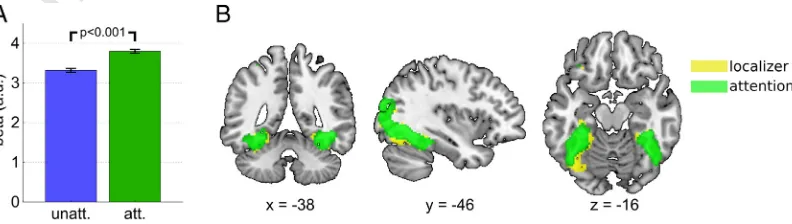
407 activation (pb0.001, t(17) = 5.00, Cohen's d = 1.17;Fig. 2A).
408 In order to test whether the effect of the attention manipulation was
409 confined to object-selective cortex, we quantified the overlap between
410 the thresholded (pFWEb0.05) whole-brain T-maps of the contrasts 411 attendedNunattended(main experiment) andintactNscrambled
(func-412 tional localizer). We found that 94.8% of the voxels showing an effect in
413 the attention contrast overlapped with voxels classified as
object-414 selective (Fig. 2B). Thus our focus on the LOC was justified by the spatial
415 extent of the attentional modulation. It should be noted, however, that
416 the attended and the unattended conditions differed only with respect
417 to the attended stimulus type (object vs. noise pattern), but neither
sys-418 tematically with respect to low-level features (likely canceling out effects
419 of attention in earlier visual areas in the contrast attendedNunattended)
420 nor with respect to task (likely canceling out effects of attention in
exec-421 utive cortices). The spatial restriction of attentional modulation to LOC
422 therefore reflects a deliberate property of our design, rather than the
ab-423 sence of attentional modulation in other brain areas.
424 3.3. Attention modulates neural activity as a function of object preference
425 We reasoned that if attention led to an amplification of neural
activ-426 ity (as opposed to a mere baseline shift), the attentional modulation
427 should be greater for a voxel's preferred object relative to its
non-428 preferred objects. An analysis of a voxel's attentional modulation for a
429 given object in dependence of its preference for the object should thus
430 be informative about the specificity of the attentional modulation. To
431 quantify the difference between the attentional modulation for
pre-432 ferred and non-preferred objects, we computed a relative attentional
433 modulation index (RAI). Further, we determined a preference index
434 (PI) for each voxel based on the mean response to a given object relative
435 to the response of the other objects in the unattended condition. We
hy-436 pothesized that RAI should increase as a function of PI.
437 To this end, we used a leave-one-run-out procedure, in which we
438 sorted the voxels according to their PI, divided the voxels into 10
439 equinumerous bins (deciles) and computed the average RAI for each
440
bin. We found that the RAI increased as a function of PI (linear slope
[image:5.595.106.502.590.702.2]441
[mean ± SEM]: 0.066 ± 0.022, p = 0.009, t(17) = 3.00, two-tailed
t-442
test against the null hypothesis of a slope of zero;Fig. 3). In direct
com-443
parison, the average RAI for preferred objects (PIN0 [mean ± SEM]:
444
0.18 ± 0.06) was greater than the average RAI for non-preferred objects
445
(PIb0:−0.17 ± 0.06) (p = 0.011, t(17) = 2.86, Cohen's d = 0.67).
446
These results show that the modulation of neural activity through
spa-447
tial attention comprises an amplificatory component and is not due to
448
a baseline shift only.
449
3.4. Attention increases the mutual information between BOLD responses
450
and object identity
451
To test whether the increase of neural activity increased a voxel's
in-452
formation about the presented objects, we computed the mutual
infor-453
mation for attended and unattended objects. We found that attention
454
increased the mutual information of a voxel's responses about the
ob-455
jects presented (pb0.001, t(17) = 5.72, Cohen's d = 1.35). The
per-456
centage of voxels showing higher mutual information in the attended
457
relative to the unattended condition was 55.1% ± 0.9% (mean ± SEM
458
across participants), which was significantly different from the chance
459
level of 50% (pb0.001, t(17) = 5.81). Thus, attention reduced the
un-460
certainty of BOLD responses about object identity, implying enhanced
461
object coding at the level of single voxels.
462
3.5. Attention enhances object representations at the pattern level
463
A growing body of evidence suggests that the LOC codes object not
464
by means of individual neurons or neuronal populations, but across
465
multiple distributed neuronal populations (Haxby et al., 2001; Rice 466 et al., 2014). Thus, if attention has an enhancing effect on sensory
repre-467
sentations, the abovefinding of object-specific local modulation by
at-468
tention should improve the quality of multi-voxel activation patterns.
469
In afirst step we assessed the effect of attention on the
reproducibil-470
ity of activation patterns by computing the within-object pattern
simi-471
larity (WPS) of activation patterns across repeated presentations of
472
the same object, separately for attended and unattended object
presen-473
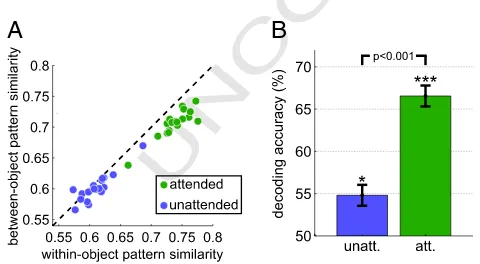
tations. We found that attention significantly increased WPS (pb0.001,
474
t(17) = 10.51, two-tailed t-test;Fig. 4A), indicating that attention
im-475
proved the reproducibility of responses at the pattern level. However,
476
in a control analysis we found that attention also led to a considerable
477
increase of the between-object pattern similarity (BPS; pb0.001,
478
t(17) = 9.73, two-tailed t-test). If the increase in reproducibility for
479
the same object (WPS) was outweighed by a simultaneous increase of
480
the ambiguity between different objects (BPS), nothing is gained. We
481
therefore directly compared WPS and BPS and found that the increase
482
in WPS was greater than the increase in BPS (pb0.001, t(17) = 4.22),
483
indicating that attention led to a functionally relevant improvement of
484
the reproducibility of multi-voxel activation patterns.
UNCORRECTED PR
OOF
485 In a second step we directly assessed how attention affected the
486 readout of object information from the LOC by performing support
vec-487 tor machine classification between objects. Decoding accuracies were
488 significantly above chance in both the attended (66.6% ± 2.0%;
489 pb0.001, t(17) = 8.36, two-tailed t-test against the chance decoding
490 accuracy of 50%) and the unattended condition (54.8% ± 1.8%; p =
491 0.017, t(17) = 2.66;Fig. 4B). Importantly, classification performance
492 was significantly and markedly greater in the attended compared to
493 the unattended condition (t(17) = 4.74, pb0.001, Cohen's d = 1.12).
494 Thus, the attentional modulation of neuronal responses increased object
495 information in the LOC at the multi-voxel pattern level.
496 3.6. Enhanced readout at the pattern level is linked to the local increase in
497 mutual information, but not mean activation
498 Finally, we assessed whether the attentional modulation at the
499 single-voxel level was related to the enhancement of object
representa-500 tions at the pattern level. In the single-voxel-level analyses we found
501 that attention led to an increase of (1) BOLD signal, and (2) the mutual
502 information. We therefore correlated–across participants–both effects
503 with the increase in decoding accuracy. We found that the increase in
504 decoding accuracy correlated with the increase in mutual information
505 (Pearson's r = 0.59, p = 0.009), but not with the increase in BOLD
acti-506 vation (r = 0.01, p = 0.96). A direct comparison confirmed that the
507
increase in mutual information explained significantly more variance
508
than the BOLD increase (p = 0.034, z-score = 2.11, Steiger's z-test;
509 Steiger, 1980). Although the absence of a significant contribution of
510
the BOLD increase is surprising (possibly caused by ceiling effects of
511
the BOLD increase), the relationship between mutual information and
512
decoding accuracy suggests that the local attentional modulation of
513
neuronal responses increases the information content of object
repre-514
sentations at the pattern level.
515
4. Discussion
516
We examined tuning-dependent attentional modulation of object
517
representations in the LOC and the resulting enhancement of object
rep-518
resentations at the single-voxel level and the multi-voxel pattern level.
519
At the single-voxel level we found that (1) responses in the LOC were
520
considerably stronger when an object was attended relative to when a
521
noise stimulus was attended; (2) the relative attentional modulation
522
(the attentional modulation for a given object relative to the average
523
modulation of other objects) increased as a function of a voxel's
prefer-524
ence for the given object; and (3) mutual information between a voxel's
525
responses and object identity increased, demonstrating that responses
526
became more informative about a presented object when the object
527
was attended compared to when it was unattended. All three results
528
provide evidence against a mere baseline-shift effect of attention.
Fur-529
ther analyses showed that these local changes resulted in increased
ob-530
ject information at the level of multi-voxel patterns and increased
531
similarity of these patterns across multiple presentations, indicating
in-532
creased reproducibility of distributed neuronal responses.
533
4.1. Effects of attention at the level of individual voxels
534
A key goal of this study was to investigate whether the observed
in-535
crease in activity involved amplificatory attentional modulation, or
536
merely an unspecific baseline shift. Previous neuroimaging studies
re-537
ported that neural activity increased with attention in high-level visual
538
cortex (Baldauf and Desimone, 2014; Connor et al., 1997; Murray and 539 Wojciulik, 2004; O'Craven et al., 1999; Serences et al., 2004), and
540
showed that the effects of attention were specific to coarse functional
541
modules, such as parahippocampal place area (PPA) or fusiform face
542
area (FFA). However, given that objects are known to be coded across
543
distributed neuronal ensembles in visual cortex (Haxby et al., 2001; 544 Rice et al., 2014), it is desirable to analyze attentional modulation at a
545
morefine-grained level, thereby accounting for the differential tuning
546
of neuronal populations within these areas. Here we provide evidence
547
for voxel-wise object-specific attentional modulation of responses in
548
the LOC by identifying a relationship between attentional modulation
549
and object preference. The consistent increase of the relative attentional
550
modulation across preference levels suggests that subtle difference in
551
preference measured in the absence of attention became amplified as
552
attention was directed to the objects. Our additional
information-553
theoretic analyses indicated that such attentional modulation
effective-554
ly increased the information of voxel-wise responses about object
iden-555
tity, in line with previous work on orientation coding in V1, which
556
likewise found an increase in mutual information with attention
557
(Saproo and Serences, 2010).
558
How do these results relate to the multiplicative gain hypothesis of
559
attention derived from neurophysiological recordings in monkeys
560
(McAdams and Maunsell, 1999; Treue and Martínez Trujillo, 1999)? It
561
should be noted that a direct comparison between the BOLD responses
562
in our study and spiking activity in these previous studies is difficult for
563
two reasons:first, BOLD responses are more closely related to the local
564
field potentials and hence synaptic activity than to spiking neuronal
ac-565
tivity (Ekstrom, 2010; Logothetis, 2003; Logothetis et al., 2001); and
566
second, efficient event-related fMRI designs such as ours do not permit
567
inferences about the absolute level of stimulus-related BOLD activity,
568
[image:6.595.60.262.56.189.2]which would be necessary to quantify the ratio between attended and
Fig. 3.Relative attentional modulation as a function of object preference. The relative at-tentional modulation index (RAI) quantifies the attentional modulation for a given object relative to the average modulation of the other objects. For each participant voxels were binned into deciles according to their object preference index (PI). The plot shows the av-eraged RAI for each preference bin. Error bars denote SEM corrected for between-subject variance (Cousineau, 2005).
A
B
Fig. 4.Pattern level. A, between-object and within-object pattern similarity within the LOC ROI. Each dot represents one participant. The dashed diagonal line indicates identical within- and between-object similarity of activation patterns. Attention leads to a shift of data points below the diagonal line, indicating higher pattern similarity for repeated pre-sentations of the same object compared to the pattern similarity of different objects. Be-tween-subject variance was removed for illustration. B, SVM decoding results based on percent correct classification (decoding accuracy). Error bars denote SEM corrected for be-tween-subject variance (Cousineau, 2005). Statistical comparison was based on a two-tailed t-test.
[image:6.595.39.279.525.657.2]UNCORRECTED PR
OOF
569 unattended responses analogous to the ratio offiring rates in these
pre-570 vious neurophysiological studies. Nevertheless, our results do provide
571 indirect evidence for the multiplicative gain as opposed to a mere
base-572 line shift hypothesis. Consider the result of increased attentional
modu-573 lation with object preference. A voxel's preference for a given object
574 may indicate that, for afixed number of neurons tuned to different
ob-575 jects, the tuning curves of neurons are biased more towards the given
576 object than to the other objects. Alternatively, it may indicate that for
577 afixed bias towards the given object an overall greater number of
neu-578 rons prefer the given object. Importantly, in both cases an unspecific
579 baseline shift would lead to an equal increase of neural activity for
pre-580 ferred and non-preferred objects, which is at odds with our results. To
581 illustrate why the increase in MI provides evidence for a multiplicative
582 gain mechanism as opposed to a pure baseline shift explanation, it is
583 helpful to consider two objects A and B and a hypothetical voxel
584 consisting of neurons with a preference for, e.g., object A. In case of a
585 pure baseline shift the voxel would show increased responses to both
586 objects and neural responses would therefore not become more
infor-587 mative about whether object A or B was presented. In contrast, in case
588 of multiplicative scaling, attention will lead to greater response amplifi
-589 cation for object A compared to object B, increasing the dynamic range
590 of responses and resulting in increased mutual information between
591 neural responses and presented objects. Thus, the increase in mutual
in-592 formation by attention provides a second line of evidence in favor of a
593 multiplicative gain mechanism and against a pure baseline shift
594 explanation.
595 4.2. Effects of attention at the multi-voxel pattern level
596 At the level of multi-voxel activation patterns we found improved
597 decodability of attended relative to unattended objects, which is in
ac-598 cordance with similar reports for early (Jehee et al., 2011; Kamitani 599 and Tong, 2005) and high-level visual areas (Pratte et al., 2013; Reddy 600 and Kanwisher, 2007). This result demonstrates that the attentional
601 modulation increased the information content of distributed object
rep-602 resentations in the LOC, potentially benefitting information readout
603 from the LOC by high-level executive cortices. An analysis of pattern
604 similarity showed that attention increased the reproducibility of
activa-605 tion patterns of the same object. Such an increase in reproducibility
606 would be expected on the assumption of a multiplicative attentional
607 scaling mechanism, where neuronal responses become amplified
with-608 out an equivalent increase of the noise (which increases as the
square-609 root of the signal). Another possibility is that the increase in
reproduc-610 ibility is the result of more discrete neural processing with attention,
611 as proposed for conscious relative to non-conscious percepts (Sackur 612 and Dehaene, 2009; Schurger et al., 2010). When discrete decisions
613 are reached at each (object) processing stage, before they are
614 dispatched to the next stage, the resulting activation patterns might
be-615 come more stereotypical and reproducible.
616 A number of previous fMRI studies have used MVPA to study the
ef-617 fects of attention on neural responses (Esterman et al., 2009; Jiang et al., 618 2013; Pratte et al., 2013; Reddy and Kanwisher, 2007; Reddy et al., 619 2009; Tamber-Rosenau et al., 2011). In particular, Reddy and 620 Kanwisher (2007)andReddy et al. (2009)investigated the decodability
621 of complex stimuli in high-level visual cortex when they were
present-622 ed alongside a second object and were either attended or unattended.
623 Reddy and Kanwisher (2007)found that information about object
cate-624 gories encoded in multi-voxel activation patterns was strongly reduced
625 to the point of being abolished when attention was diverted. In the
pres-626 ent study we showed that multi-voxel responses were reduced, but still
627 informative about object categories even when attention was diverted.
628 This difference may be explained by the fact that participants in the
629 study byReddy and Kanwisher (2007)directed their attention to
com-630 plex distractor stimuli (which, in addition, were the relevant stimuli in
631 other trials), whereas participants in our study viewed noise stimuli in
632 the unattended condition. It is conceivable that the absence of
high-633
level visual cortex information for unattended objects inReddy and 634 Kanwisher (2007)was caused by distractor-related neural responses
635
interfering with the activation pattern of the unattended target object.
636
Along similar lines,Reddy et al. (2009)interpreted the informational
637
gain for attended objects (or loss for unattended objects) in the biased
638
competition framework. According to this view, attention serves to
dis-639
ambiguate the overlapping multi-voxel patterns of different objects
640
through a shift towards the pattern of the currently attended object.
641
Aside from investigating the effect of attention in sensory cortices,
642
other studies have successfully used MVPA to study the initiation and
643
control of attentional shifts. For instance,Esterman et al. (2009)and
644 Tamber-Rosenau et al. (2011)showed that spatial patterns of brain
ac-645
tivity within the medial superior parietal lobule reliably differentiated
646
between several domains of cognitive attentional control at a given
mo-647
ment. Thus, in our and previous studies, MVPA presented a powerful
648
technique to probe distributed neural underpinnings of different
atten-649
tional phenomena, from the initiation of attentional shifts to the
modu-650
lation of sensory representations.
651
4.3. Linking the single-voxel and the multi-voxel pattern level
652
Finally, we linked the effects of attention at the single-voxel level
653
with the effects at the pattern levels by correlating the increase in
654
decoding accuracy of multi-voxel activation patterns to the increase in
655
either BOLD signal or mutual information. Unexpectedly, we found
656
that the increase in mean activation was not related to the increase in
657
decoding accuracy. This negativefinding could indicate that the
atten-658
tional manipulation in our paradigm operated in a range, in which
ef-659
fects at the pattern level were insensitive to the overall magnitude
660
(e.g., because the BOLD increase was at maximum). Alternatively, as
661
the overall effect of attention likely involves both a multiplicative
com-662
ponent and a baseline shift, the unspecific baseline shift component
663
might have masked the effect of the relevant multiplicative component.
664
In contrast, we found that the increase in mutual information explained
665
a considerable amount of variance of improvements in pattern-based
666
decoding. This result demonstrates that the increase of object
informa-667
tion at the single-voxel level substantially translated to an enhanced
ob-668
ject code at the pattern level. This link is informative, as the information
669
content encoded in the linear combination of voxels can show strong
670
gains, while information encoded in the individual voxel may show
671
only small changes (for examples of such scenarios seeHaynes and 672 Rees, 2006). It is currently not clear whether the distributed object
673
code in LOC represents the immediate neural correlate of perception,
674
or whether it reflects object processing prior to perception. In either
675
case our data indicate that the enhancement of sensory representations
676
through attention–which may directly or indirectly underlie
perceptu-677
al improvements–is not a phenomenon that solely emerges at the level
678
of distributed objectfingerprints. Instead, the improvement in pattern
679
decoding likely represents the cumulative result of informational gains
680
in multiple local units of LOC.
681
4.4. Implications for mechanisms of visual attention
682
The results of the present study corroborate the notion that
behav-683
ioral benefits of attention are based on an enhanced stimulus processing
684
in sensory brain areas (Bisley, 2011). Ourfinding that the magnitude of
685
attentional modulation increased with object preference suggests a
re-686
sponse gain mechanism that magnifies stimulus-driven responses as a
687
function of response strength without attention. Importantly, our
688
information-theoretic analyses demonstrate that the attentional
modu-689
lation effectively increases object information encoded in high-level
vi-690
sual cortex, which may facilitate the readout in executive cortices and
691
thus benefit perceptual decision making. A unifying theoretical
frame-692
work for such attentional modulation of neural activity is provided by
693
the normalization model of attention (Reynolds and Heeger, 2009).
694
UNCORRECTED PR
OOF
695 multiplication of neuronal responses by an attentionfield and a division
696 (normalization) by a suppressive drive. Thus, our observed differences
697 between neural responses to attended and unattended objects may
698 not only be caused by a boost of neural processes tuned to the attended
699 object, but also by a suppression of activity related to the unattended
700 object. Another key aspect of the model is that it makes specific
predic-701 tions regarding the effect of different attentional strategies on neural
ac-702 tivity. According to the model, a purely spatial attention strategy causes
703 a scaling of the entire tuning curves (because the attentionfield is then
704 assumed to be constant across feature dimensions), whereas a purely
705 feature-based attention strategy causes a sharpening of tuning curves.
706 The fact that our brightness discrimination task emphasized spatial
at-707 tention strategies over feature-based strategies may thus explain the
708 strong amplitude modulation of the BOLD response in our study. Future
709 neuroimaging studies could test whether our findings of
tuning-710 dependent attentional modulation and information-theoretic gains
711 through endogenous visual spatial attention generalize to other forms
712 of attention, e.g. to involuntary (exogenous) shifts of attention or to
713 other sensory modalities.
714 In conclusion, our results show that visual spatial attention
modu-715 lates neural activity as a function of voxel-based object preferences.
716 Through these modulatory processes, attention enhances object coding
717 both at the single-voxel and pattern level, which may give rise to
im-718 proved perception and perceptual decisions.
719 Acknowledgments
720 This research was supported by the German Research Foundation
721 (DFG) through the Research Training Group GRK1589/1 (to M.G. and
722 P.S.), and Grants STE1430/6-1 (to P.S.), and RI1847/1-1 and
723 SFB779TPA10N (to A.R.-K). R.C. was funded by a Feodor Lynen Grant
724 of the Alexander von Humboldt Foundation. We thank Guy Middleton
725 for assistance with rendering the object images from 3D models.
726 References
727 Avidan, G., Harel, M., Hendler, T., Ben-Bashat, D., Zohary, E., Malach, R., 2002. Contrast sensitivity 728 in human visual areas and its relationship to object recognition. J. Neurophysiol. 87, 729 3102–3116.
730 Baldauf, D., Desimone, R., 2014. Neural mechanisms of object-based attention. Science 344, 731 424–428.
732 Bashinski, H.S., Bacharach, V.R., 1980. Enhancement of perceptual sensitivity as the result of se-733 lectively attending to spatial locations. Percept. Psychophys. 28, 241–248.
734 Bisley, J.W., 2011. The neural basis of visual attention. J. Physiol. 589, 49–57.
735 Cameron, E.L., Tai, J.C., Carrasco, M., 2002. Covert attention affects the psychometric function of 736 contrast sensitivity. Vis. Res. 42, 949–967.
737 Carrasco, M., Penpeci-Talgar, C., Eckstein, M., 2000. Spatial covert attention increases contrast 738 sensitivity across the CSF: support for signal enhancement. Vis. Res. 40, 1203–1215.
739Q7 Connor, C.E., Preddie, D.C., Gallant, J.L., Essen, D.C. Van, 1997. Spatial attention effects in macaque 740 area V4. J. Neurosci. 17, 3201–3214.
741 Cousineau, D., 2005. Confidence intervals in within-subject designs: a simpler solution to Loftus 742 and Masson's method. Tutor. Quant. Methods Psychol. 1, 42–45.
743 Di Russo, F., Spinelli, D., Morrone, M.C., 2001. Automatic gain control contrast mechanisms are 744 modulated by attention in humans: evidence from visual evoked potentials. Vis. Res. 41, 745 2435–2447.
746 Ekstrom, A., 2010. How and when the fMRI BOLD signal relates to underlying neural activity: the 747 danger in dissociation. Brain Res. Rev. 62, 233–244.
748 Esterman, M., Chiu, Y., Tamber-rosenau, B.J., Yantis, S., 2009. Decoding cognitive control in 749 human parietal cortex. Proc. Natl. Acad. Sci. U. S. A. 106, 17974–17979.
750 Gandhi, S.P., Heeger, D.J., Boynton, G.M., 1999. Spatial attention affects brain activity in human 751 primary. Proc. Natl. Acad. Sci. U. S. A. 96, 3314–3319.
752 Gitelman, D.R., Nobre, A.C., Parrish, T.B., LaBar, K.S., Kim, Y.H., Meyer, J.R., Mesulam, M., 1999. A 753 large-scale distributed network for covert spatial attention: further anatomical delineation 754 based on stringent behavioural and cognitive controls. Brain 122, 1093–1106.
755 Guggenmos, M., Thoma, V., Cichy, R.M., Haynes, J.-D., Sterzer, P., Richardson-Klavehn, A., 2015. 756 Non-holistic coding of objects in lateral occipital complex with and without attention. 757 Neuroimage 107, 356–363.
758 Hawkins, H.L., Hillyard, S.A., Luck, S.J., Mouloua, M., Downing, C.J., Woodward, D.P., 1990. Visual 759 attention modulates signal detectability. J. Exp. Psychol. Hum. Percept. Perform. 16, 760 802–811.
761 Haxby, J.V., Gobbini, M.I., Furey, M.L., Ishai, A., Schouten, J.L., Pietrini, P., 2001. Distributed and 762 overlapping representations of faces and objects in ventral temporal cortex. Science 293, 763 2425–2430.
764 Haynes, J.-D., Rees, G., 2005. Predicting the orientation of invisible stimuli from activity in 765 human primary visual cortex. Nat. Neurosci. 8, 686–691.
766 Haynes, J.-D., Rees, G., 2006. Decoding mental states from brain activity in humans. Nat. Rev.
767 Neurosci. 7, 523–534.
768 Hebart, M.N., Görgen, K., Haynes, J.-D., 2014. The Decoding Toolbox (TDT): a versatile software
769 package for multivariate analyses of functional imaging data. Front. Neuroinform. 8.
770 Jehee, J.F.M., Brady, D.K., Tong, F., 2011. Attention improves encoding of task-relevant features in
771 the human visual cortex. J. Neurosci. 31, 8210–8219.
772 Jiang, J., Summerfield, C., Egner, T., 2013. Attention sharpens the distinction between expected
773 and unexpected percepts in the visual brain. J. Neurosci. 33, 18438–18447.
774 Kamitani, Y., Tong, F., 2005. Decoding the visual and subjective contents of the human brain.
775 Nat. Neurosci. 8, 679–685.
776 Kastner, S., Pinsk, M.A., De Weerd, P., Desimone, R., Ungerleider, L.G., 1999. Increased activity in
777 human visual cortex during directed attention in the absence of visual stimulation. Neuron
778 22, 751–761.
779 Kojadinovic, I., 2005. On the use of mutual information in data analysis: an overview.
Proceed-780 ings of the 11th International Symposium on Applied Stochastic Models and Data Analysis
781 (ASMDA '05), pp. 738–747.
782 Logothetis, N.K., 2003. The underpinnings of the BOLD functional magnetic resonance imaging
783 signal. J. Neurosci. 23, 3963–3971.
784 Logothetis, N.K., Pauls, J., Augath, M., Trinath, T., Oeltermann, A., 2001. Neurophysiological
inves-785 tigation of the basis of the fMRI signal. Nature 412, 150–157.
786 Luck, S.J., Chelazzi, L., Hillyard, S.A., Desimone, R., 1997. Neural mechanisms of spatial selective
787 attention in areas V1, V2, and V4 of macaque visual cortex. J. Neurophysiol. 77, 24–42.
788 Martínez, A., Anllo-Vento, L., Sereno, M.I., Frank, L.R., Buxton, R.B., Dubowitz, D.J., Wong, E.C.,
789 Hinrichs, H., Heinze, H.J., Hillyard, S.A., 1999. Involvement of striate and extrastriate visual
790 cortical areas in spatial attention. Nat. Neurosci. 2, 364–369.
791 McAdams, C.J., Maunsell, J.H.R., 1999. Effects of attention on orientation-tuning functions of
sin-792 gle neurons in macaque cortical area V4. J. Neurosci. 19, 431–441.
793 Motter, B.C., 1993. Focal attention produces spatially selective processing in visual cortical areas
794 V1, V2, and V4 in the presence of competing stimuli. J. Neurophysiol. 70, 909–919.
795 Mumford, J.A., Davis, T., Poldrack, R.A., 2014. The impact of study design on pattern estimation
796 for single-trial multivariate pattern analysis. Neuroimage 103, 130–138.
797 Murray, S.O., He, S., 2006. Contrast invariance in the human lateral occipital complex depends
798 on attention. Curr. Biol. 16, 606–611.
799 Murray, S.O., Wojciulik, E., 2004. Attention increases neural selectivity in the human lateral
oc-800 cipital complex. Nat. Neurosci. 7, 70–74.
801 O'Connor, D.H., Fukui, M.M., Pinsk, M.A., Kastner, S., 2002. Attention modulates responses in the
802 human lateral geniculate nucleus. Nat. Neurosci. 5, 1203–1209.
803 O'Craven, K.M., Downing, P.E., Kanwisher, N., 1999. FMRI evidence for objects as the units of
at-804 tentional selection. Nature 401, 584–587.
805 Pratte, M.S., Ling, S., Swisher, J.D., Tong, F., 2013. How attention extracts objects from noise.
806 J. Neurophysiol. 110, 1346–1356.
807 Reddy, L., Kanwisher, N., 2007. Category selectivity in the ventral visual pathway confers
robust-808 ness to clutter and diverted attention. Curr. Biol. 17, 2067–2072.
809 Reddy, L., Kanwisher, N.G., VanRullen, R., 2009. Attention and biased competition in multi-voxel
810 object representations. Proc. Natl. Acad. Sci. U. S. A. 106, 21447–21452.
811 Ress, D., Backus, B.T., Heeger, D.J., 2000. Activity in primary visual cortex predicts performance in
812 a visual detection task. Nat. Neurosci. 3, 940–945.
813 Reynolds, J.H., Heeger, D.J., 2009. The normalization model of attention. Neuron 61, 168–185.
814 Reynolds, J.H., Pasternak, T., Desimone, R., 2000. Attention increases sensitivity of V4 neurons.
815 Neuron 26, 703–714.
816 Rice, G.E., Watson, D.M., Hartley, T., Andrews, T.J., 2014. Low-level image properties of visual
ob-817 jects predict patterns of neural response across category-selective regions of the ventral
vi-818 sual pathway. J. Neurosci. 34, 8837–8844.
819 Rolls, E.T., Baylis, G.C., 1986. Size and contrast have only small effects on the responses to faces of
820 neurons in the cortex of the superior temporal sulcus of the monkey. Exp. Brain Res. 65,
821 38–48.
822 Sackur, J., Dehaene, S., 2009. The cognitive architecture for chaining of two mental operations.
823 Cognition 111, 187–211.
824 Saproo, S., Serences, J.T., 2010. Spatial attention improves the quality of population codes in
825 human visual cortex. J. Neurophysiol. 104, 885–895.
826 Saproo, S., Serences, J.T., 2014. Attention improves transfer of motion information between V1
827 and MT. J. Neurosci. 34, 3586–3596.
828 Schurger, A., Pereira, F., Treisman, A., Cohen, J.D., 2010. Reproducibility distinguishes conscious
829 from nonconscious neural representations. Science 327, 97–99.
830 Serences, J.T., Schwarzbach, J., Courtney, S.M., Golay, X., Yantis, S., 2004. Control of object-based
831 attention in human cortex. Cereb. Cortex 14, 1346–1357.
832 Serences, J.T., Saproo, S., Scolari, M., Ho, T., Muftuler, L.T., 2009. Estimating the influence of
atten-833 tion on population codes in human visual cortex using voxel-based tuning functions.
834 Neuroimage 44, 223–231.
835 Silver, M.A., Ress, D., Heeger, D.J., 2007. Neural correlates of sustained spatial attention in human
836 early visual cortex. J. Neurophysiol. 97, 229–237.
837 Somers, D.C., Dale, A.M., Seiffert, A.E., Tootell, R.B.H., 1999. Functional MRI reveals spatially
spe-838 cific attentional modulation in human primary visual cortex. Proc. Natl. Acad. Sci. U. S. A. 96,
839 1663–1668.
840 Steiger, J.H., 1980. Test for comparing elements of a correlation matrix. Psychol. Bull. 87,
841 245–251.
842 Tamber-Rosenau, B.J., Esterman, M., Chiu, Y.-C., Yantis, S., 2011. Cortical mechanisms of
cogni-843 tive control for shifting attention in vision and working memory. J. Cogn. Neurosci. 23,
844 2905–2919.
845 Treue, S., 2003. Visual attention: the where, what, how and why of saliency. Curr. Opin.
846 Neurobiol. 13, 428–432.
847 Treue, S., Martínez Trujillo, J.C., 1999. Feature-based attention influences motion processing gain
848 in macaque visual cortex. Nature 399, 575–579.
849 Treue, S., Maunsell, J.H.R., 1999. Effects of attention on the processing of motion in macaque
850 middle temporal and medial superior temporal visual cortical areas. J. Neurosci. 19,
851 7591–7602.
852 Williford, T., Maunsell, J.H.R., 2006. Effects of spatial attention on contrast response functions in
macaque area V4. J. Neurophysiol. 96, 40–54.