University of London
The London School of Economics and Political Science
THE UTILISATION OF AMBULATORY HEALTH CARE
SERVICES IN SAUDI ARABIA: A QUANTITATIVE
ANALYSIS
A thesis submitted for the degree
of Doctor of Philosophy
By
Doha Mahmoud Ismail Saleh
UMI Number: U210640
All rights reserved
INFORMATION TO ALL USERS
The quality of this reproduction is dependent upon the quality of the copy submitted.
In the unlikely event that the author did not send a complete manuscript and there are missing pages, these will be noted. Also, if material had to be removed,
a note will indicate the deletion.
Disscrrlâtiûn P ublishing
UMI U210640
Published by ProQuest LLC 2014. Copyright in the Dissertation held by the Author. Microform Edition © ProQuest LLC.
All rights reserved. This work is protected against unauthorized copying under Title 17, United States Code.
ProQuest LLC
' . . , ^ , y : ^ ^ j
Fri ['.^J^ij^'iiilm..__ i rr^j-f. , , i ' A '
H £ S £ S
,. 1 ii ;
2 2 7 7
#
#
#
.
•'■y
_f :
■
kj' ' , r r i '.■■'^ ; < :i'' '
h : \
. ^ '7 '" ' '-V'iV ■ ' .'■■i; ' ,'■' 'n;..'
: f e > : 7 , j•i>f, '-,1 ' ■ 'M
'■■ '"■ ' 1 'r4:7,i;
,ÿ,|ra;
i.i
, r \ "I ' k,' , <1
4r:'r". ■:'
' " ' I .'/," ' /
-Dedication
Acknowledgment
In the process of doing any serious research, moral support and academic guidance are
essential factors that help the researcher to reach his or her goal.
On the academic level I have to express my deep appreciation to my supervisor Professor
Julian Le Grand. He was always generous with his time, unlimited support and insightful
ideas. I also express my gratitude to Dr. Amani Siyam for her advice on the statistical
analysis performed in the thesis and, I appretiate the suggestions made by Maria
Evandrou and Dr. Philip Cheung which led to many important improvements on this
work.
To my parents I am indebted for providing me with their support and encouragement
throughout my life, and especially when I needed them most.
I am also grateful to Princess Sara Al-Faisal Al-Saud for her great inspiration.
To Drs. Tawfik Khoja, Nasser Al-Hamdan and Lobna AJ-Ansari I am indebted for
providing me with the data of the Saudi Arabia Family Health Survey without which this
thesis may not have been possible. Dr.Khoja, who had ably led that comprehensive
survey, was very helpful in making all the data I needed available, without any hesitation.
Last but not least I would like to express my thanks to people who helped me during the
course of my research at the Ministry of Higher Education and the Ministry of Health and
Abstract
The thesis aims to investigate whether need is the major determinant of ambulatory
health care utilisation for Saudi nationals in Saudi Arabia. This is done by applying
multivariate analysis on the utilisation of both curative and preventive services on the
data provided by the 1996 Saudi Arabia Family Health Survey. The analysis is applied
within the framework of Andersen’s sociobehavioural model, categorizing the factors
that affect health services utilisation into predisposing, enabling and need factors.
It can be concluded from the results that although need seems to be an important
determinant of ambulatory health care utilisation, some of the predisposing and enabling
factors were also found to affect health services utilisation, although the degree of their
effect differs according to the health condition and type of services tested for. Need is
dominant with regards to the utilisation of health services in response to children’s
diarrhoea, infants’ full immunisation and attending at least one prenatal care session.
But since some of the predisposing and enabling factors were found to affect health
services utilisation, this highlights the importance of addressing the factors that were
found to impede the utilisation at the health care system level as well as at the society
Table of Contents
Chapter 1. Introduction... 17
Chapter 2. The Saudi Health Care System and Population Health 2.1. INTRODUCTION...23
2.2. SAUDI ARABIA THE COUNTRY... 23
2.3. THE DEVELOPMENT OF THE SAUDI HEALTH CARE SYSTEM...24
2.3.1. Health care in the development plans... 24
2.3.2. Health care expenditure... 26
2.3.3. The development of health care resources... 28
2.3.4. The development of primary health care in Saudi Arabia... 34
2.4. THE STRUCTURE OF THE CURRENT HEALTH CARE SYSTEM... 36
2.4.1. The Ministry of Health... 37
2.4.2. Other sources of medical care... 38
2.4.3. Traditional medicince... 40
2.5. THE EPIDEMIOLOGICAL PROFILE OF THE SAUDI POPULATION...41
2.5.1. Life expectancy and mortality indicators... 41
2.5.1.1. Life expectancy... 41
2.5.1.2. Infant and childhood mortality ...41
2.5.1.3. Maternal mortality... 46
2.5.1.4. Reasons for mortality decline... 50
2.5.2. Morbidity in Saudi Arabia... 52
2.5.2.1. The incidence of notifiable infectious diseases...52
2.5.2.2. The prevalence of chronic diseases...53
2.5.2.3. The distribution of diseases among primary health care centres visitors and visitors of outpatient hospital departments...62
Chapter 3. Literature Review
3.1. INTRODUCTION...71
3.2. MODELS OF HEALTH CARE UTILISATION BEHAVIOUR...71
3.2.1. The health belief m odel...71
3.2.2. The rational choice model...72
3.2.3. The social process, help seeking model...73
3.2.4. The socio-behavioural model...74
3.2.5. A general critique of the models of health utilisation behaviour...78
3.3. FACTORS THAT AFFECT THE UTISATION OF AMBULATORY HEALTH CARE SERVICES...81
3.3.1. Predisposing factors...81
3.3.1.1. Age... 82
3.3.1.2. Gender... 85
3.3.1.3. Marital status... 87
3.3.1.4. Education... 87
3.3.1.5. Occupation... 92
3.3.1.6. Socioeconomic status... 94
3.3.1.7. Family structure... 97
3.3.1.8. Ethnicity and religion... 100
3.3.1.9. Beliefs, attitudes and knowledge... 103
3.3.1.10. Health status rating... 107
3.3.1.11. Stress...108
3.3.1.12. Previous service utilisation... 108
3.3.2. Enabling factors... 109
3.3.2.1. Income and household income indicators... 110
3.3.2.2. Health insurance... 114
3.3.2.3. Social obligations, social networks and stressful life events... 116
3.3.2.4. Accessibility of health services... 120
3.3.2.5. Area of residence... 126
3.3.3. Health care need... 128
3.4. A GENERAL CRITIQUE OF THE STUDIES PRESENTED ON HEALTH SERVICES UTILISATION...133
3.6. CHAPTER’S SUMMARY...153
Chapter 4. Methodology 4.1. INTRODUCTION... 155
4.2. RESEARCH QUESTION AND HYPOTHESES...155
4.3. SAMPLE DESIGN... 160
4.4. THE QUESTIONNAIRE...161
4.5. DATA COLLECTION...162
4.6. DATA ANALYSIS...162
4.7. THE STUDY VARIABLES...168
4.7.1. Utilisation of health services in response to acute illness or injury...168
4.7.1.1. The independent variables...168
4.7.1.2. The dependent variable...175
4.7.2. Utilisation of health services in response to children’s diarrhoea and acute respiratory infections...175
4.7.2.1. The independent variables...175
4.7.2.2. The dependent variables...177
4.7.3. Utilisation of prenatal care services...177
4.7.3.1. The independent variables... 177
4.7.3.2. The dependent variables...179
4.7.4. Infants’ full immunisation...180
4.7.4.1. The independent variables... 180
4.7.4.2. The dependent variable... 181
4.8. THE CHARACTERISTICS OF THE HOUSEHOLD POPULATION...182
4.8.1. The independent variables...182
4.8.2. The dependent variables...190
4.10. CHAPTER”S SUMMARY... 198
Chapter 5. The Utilisation of Ambulatory Care Services for Acute Sickness 5.1. INTRODUCTION...199
5.2. RESULTS... 199
5.2.1. Utilisation of health services for general acute sickness...199
5.2.2. Utilisation of doctors’ services... 200
5.2.2.1. The chi-square analysis for the utilisation of doctors’ services in response to acute sickness... 201
5.2.2.2. The multinomial logistic regression model for adults’ utilisation of doctors’ services... 202
5.2.2.3. The multinomial logistic regression model for children’s utilisation of doctors’ services 208 5.3. DISCUSSION... 214
5.3.1. Utilisation rate of health services...215
5.3.2. Utilisation of doctors’ services...218
5.3.2.1. The bivariate associations between the independent variables and the utilisation of doctors’ services... 218
5.3.2.2. Factors that affect adults’ utilisation of doctors’ services... 224
5.3.2.3. Factors that affect children’s utilisation of doctors’ services...231
5.4. CHAPTER’S SUMMARY... 236
Chapter 6. The Utilisation of Health Services for Children’s Diarrhoea and Acute Respiratory Infections 6.1. INTRODUCTION...238
6.2. RESULTS...238
6.2.1. The utilisation of health services for children’s diarrhoea and acute respiratory infections... 238
6.2.2. The chi-square analysis for the utilisation of formal health services in response to diarrhoea and acute respiratory infections... 239
6.2.3. The multivariate model for the utilisation of formal health services in response to diarrhoea... 241
6.3. DISCUSSION... 248
6.3.1. The utilisation of health services for children’s diarrhoea... 248
6.3.1.1. The percentage of health services utilisation for children’s diarrhoea... 248
6.3.1.2. The bivariate associations between the independent variables and the utilisation of health services in response to diarrhoea... 250
6.3.1.3. The multinomial logistic regression model... 252
6.3.2. The utilisation of health services for children’s acute respiratory infections... 256
6.3.2.1. The percentage of health services utilisation for children’s acute respiratory infections...256
6.3.2.2. The bivariate associations between the independent variables and the utilisation of health services in response to acute respiratory infections...257
6.3.2.3. The multinomial logistic regression model...260
6.4. CHAPTER’S SUMMARY... 265
Chapter 7. Preventive Services Utilisation: Prenatal Care and Infants’ Full Immunisation 7.1. INTRODUCTION... 267
7.2. RESULTS...267
7.2.1. The utilisation of prenatal care services and infants’ full immunisation... 268
7.2.2. The bivariate associations between the independent variables and the dependent variables... 268
7.2.3. The utilisation of prenatal care versus non-utilisation...271
7.2.4. The early initiation of prenatal care visits...274
7.2.5. The frequency of prenatal care visits...276
7.2.6. The effect of the enabling factors on the choice of the last source of Prenatal care...279
7.2.7. The full immunisation of one year old infants... 282
7.3. DISCUSSION... 283
7.3.1. The utilisation of prenatal care versus non-utilisation...284
7.3.1.1. The percentage of prenatal care utilisation...284
7.3.2. Time of initiation of prenatal care... 293
7.3.2.1 Time of initiation of prenatal care rate... 293
7.3.2.2. The bivariate associations between the independent variables and the early initiation of prenatal care... 294
7.3.2.3. The logistic regression model for the early initiation of prenatal care... 295
7.3.3. Frequency of prenatal care utilisation... 297
7.3.3.1. Number of prenatal care visits...297
7.3.3.2. The Poisson regression model for the frequency of prenatal care visits... 298
7.3.4. The utilisation of private care versus public care as the place of the last checkup... 302
7.3.4.1. Percentage of use of public and private services as a usual source of care... 302
7.3.4.2. The bivariate associations between the independent variables and the choice of the source of the last prenatal care checkup... 303
7.3.4.3. The logistic regression model for the use of public versus private care as the place of the last checkup... 304
7.3.5. Infants’ full immunisation... 306
7.3.5.1. The percentage of fully immunised one year old infants...306
7.3.5.2. The bivariate associations between the independent variables and infants’ full Immunisation... 307
7.3.5.3. The logistic regression model for the full immunisation of one year old infants... 308
7.3.6. A synopsis of the utilisation of preventive health care services...312
7.4. CHAPTER’S SUMMARY... 320
Chapter 8. Research Summary and Recommendations 8.1. INTRODUCTION...322
8.2. SUMMARY OF THE RESEARCH FINDINGS... 322
8.2.1. The predisposing factors...323
8.2.2. The enabling factors...328
8.2.3. The need factors...334
8.3. THE ROLE OF NEED... 336
8.4. POLICY IMPLICATIONS AND RECOMMENDATIONS...337
8.6. CONCLUSION... 345
References...346
List of Tables
Table 2.1. Ministry of Health budget across the years... 27 Table 2.2. Health care expenditure in Saudi Arabia, the Middle East and North
Africa and other countries, grouped by income level in the year 2000... 27 Table 2.3. The development of the Ministry of Health care resources across
the years in numbers and percentages of annual growth... 29 Table 2.4. The health care resources available for every 100,000 of resident in the different
provinces in Saudi Arabia... 31 Table 2.5. Infant mortality rates in Saudi Arabia across the years... 41 Table 2.6. Infant mortality rates in Saudi Arabia, the Middle East and North Africa
and other countries, grouped by income level in the year 2001... 42 Table 2.7. Under five mortality rates in Saudi Arabia, the Middle East and North Africa
and other countries grouped by income level in the year 2001... 43 Table 2.8. Infant and child mortality rates per 1000 live births per year by region
of residence, 1985... 44 Table 2.9. Infant and child mortality rates per 1000 live births per year by region
of residence, 1992-1996... 45 Table 2.10. Maternal mortality rates in selected hospitals in the 1970’s and the
early 1980’s... 47 Table 2.11. Maternal mortality rates in Saudi Arabia, the Middle East and North Africa
and other countries, grouped by income level in the period 1990-1997... 48 Table 2.12. The incidence of immunisable infectious diseases across the years
and 1999 infants’ immunisation coverage...52 Table 2.13. Comparison of the prevalence of overweight and obesity in different countries... 57 Table 2.14. The percentage of Saudi patients agd 15 years and older reported to have ever had
specific chronic conditions confirmed by a doctor, by age and sex in Saudi Arabia... 59 Table 2.15. The percentage among persons 15 years and older reported to have ever had
a doctor diagnosed a cardiovascular disorder by age and sex in Saudi Arabia, 1996... 61 Table 2.16. The distribution of primary care visits according to disease condition
in the year 2000...62 Table 2.17. Deaths reported to MOH hospitals by cause of death and nationality, 1999... 68 Table 4.1. Average monthly wages for Saudi employees in S.R... 170 Table 4.2. The independent variables for the analysis of children under five’s utilisation
Table 4.4. The independent variables for the analysis of infants’ full immunisation...180 Table 4.5. The utilisation of health care in response to acute sickness during the previous
two week period... 190 Table 4.6. The utilisation of public and private doctors’ services for acute sickness during
the previous two week period... 191 Table 4.7. The month when the first prenatal care checkup took place for the live births
during the previous three years period... 193 Table 4.8. The number of prenatal care checkups that took place for the live births
during the previous three year period... 194 Table 4.9. The distribution of the sample population and the Saudi population according
to area of residence... 196 Table 4.10. The distribution of the sample population and the Saudi population according
to age groups... 196 Table 4.11. The distribution of the sample population and the Saudi population according
to marital status... 197 Table 4.12. The distribution of the sample population and the Saudi population according
to educational level... 198 Table 5.1 Percentage of adults and children who have sought care in response to acute
sickness by the type of health care provider in the previous two week period... 200 Table 5.2. The utilisation of public and private doctors’ services for acute sickness during
the previous two week period...200 Table 5.3. The chi-square results of the associations between the independent variables
and adults’ utilisation of doctors’ services...201 Table 5.4. The chi-square results of the associations between the independent variables
and children’s utilisation of doctors’ services...202 Table 5.5. The multinomial logistic regression results related to the utilisation of doctors’
services for adults during a two week period...203 Table 5.6. The multinomial logistic regression results related to the utilisation of doctors’
services for children during a two week period... 208 Table 5.7. Consultation of various sources of health care in response to acute
sickness in the Arabian Gulf countries...216 Table 6.1. The chi-square results of the associations between the independent variables
and children’s utilisation of health services in response to diarrhoea... 240 Table 6.2. The chi-square results of the associations between the independent variables
Table 6.4, The multinomial logistic regression results related to the utilisation of health services for the treatment of children’s acute respiratory infections during a two week period... 244 Table 6.5. Utilisation of health services in response to diarrhoea in the Arabian
Gulf countries... 248 Table 6.6. Utilistion of health services in response to acute respiratory infections
in the Arabian Gulf countries... 256 Table 7.1. The chi-square results of the associations between the independent variables
and the utilisation versus non-utilisation of prenatal care services... 269 Table 7.2. The chi-square results of the associations between the independent variables
and the early initiation of prenatal care... 270 Table 7.3. The chi-square results of the associations between the independent variables
and the choice of the source of the last prenatal care checkup (public versus private)... 270 Table 7.4. The chi-square results of the associations between the independent variables
and infants’ full immunisation... 271 Table 7.5. The results of the logistic regression model related to the utilisation versus
non-utilisation of prenatal care for the live births in the last three year period... 272 Table 7.6. The results of the logistic regression model related to the early initiation of prenatal
care for the live births in the last three year period... 274 Table 7.7. The results of the Poisson regression model related to the frequency of prenatal
care visits for the live births in the last three year period... 276 Table 7.8. The results of the logistic regression model related to choice of a private versus
a public health facility for the last prenatal checkup... 279 Table 7.9. The results of the logistic regression model related to the full immunisation
List of Figures
Chapter 1
Introduction
{"Health is a crown on the heads of the healthy, seen only by the ill."
Arabic proverb.
After life, there is certainly nothing more worthy than health to protect and maintain. To
provide it every country in the World spends fortunes, and to preserve it every sensitive
nation allocates a large percentage of its budget. However, since ftmds are limited and
needs are not, it is incumbent on every government, institution and individual to use those
funds wisely in order to make the most of them for the benefit of the greatest number of
people that need health care. It is only through efficient utilisation of resources that we
can best serve any community.}
This study aims at examining whether need is the principal determinant of the utilisation
of ambulatory health care for Saudi nationals in Saudi Arabia. This includes the
utilisation of some aspects of both the curative and preventive services, with the inclusion
of primary and secondary health services as the ambulatory sources of care. It applies
multivariate analysis to data from the 1996 Saudi Arabia Family Health Survey, the only
comprehensive health survey conducted in Saudi Arabia covering all its regions. To my
knowledge, this is the first study that assesses this aspect of health services in Saudi
Arabia on a country vride level, using multivariate analysis.
Since the establishment of the Ministry of Health in Saudi Arabia in the 1950s and
especially after the issuing of the First Development Plan in the country in 1971, vast
developments in health care have occurred. Starting from very scarce services and
resources, provided only in major cities, the health care system witnessed continuous and
vigorous efforts throughout the years to establish a modem and competent health care
system. The effects of these efforts are visible in improvements in health indicators such
During this early period of development the issue of health service utilisation was
relatively neglected. It came to attention in the late 1980s, when the country started to
witness an increased demand on health services with rising public expectations (Ministry
of Planning, 1991). But only a few studies on the utilisation of health services were
conducted. The majority of the studies were localised to certain cities or specific areas in
Saudi Arabia; they also lacked multivariate analysis.
When assessing the significance of this issue, it is clear that understanding health service
utilisation is essential for proper planning and budgeting of health services, since
knowing the factors that affect service use sheds light on some of the deficiencies of the
health care system, in addition to reflecting the need of the population, their demands and
expectations. It also shows their compliance with the provided health programmes, thus
providing an indication of the success or failure of these programmes.
It has been stated in the Ministry of Health objectives that free and equal medical
attention should be provided to all Saudi nationals. Although not stated explicitly, it is
clear that the principal aim underlying this objective is that need should be the principal
determinant of health service utilisation. Factors such as age, gender, socioeconomic
status and place of residence and so on should not affect utilisation, except in so far as
they are associated with need. In this, Saudi Arabia is following one of the aims of most
of the health care systems, especially those that involve a substantial amount of public
funding. Thus, identifying the factors that lead to utilisation differences other than need is
a prerequisite for designing adequate corrective policies, ensuring that the positive gain
from health service contact is not confined to certain privileged groups of the population.
In this study testing whether need is the principal determinant of ambulatory health care
utilisation is undertaken by the application of the Andersen sociobehavioural model. In
this model factors that affect the utilisation of health services at the individual level are
categorized into predisposing, enabling and need factors. In the thesis predisposing
factors, the factors that predispose the use of health services, are primarily demographic
of health services. They reflect the available means and ability to use the health services,
and they include economic factors, factors related to the characteristics of the health care
system and area of residence. Need variables relate to the nature of an individual’s health
status. For curative services these include the presence of a medical condition, its severity
and duration. For the utilisation of preventive services, being pregnant, is the need factor
that should lead to having received timely prenatal care. In addition to having a medical
condition, which can lead to an increase in the number of prenatal care visits. Being an
infant is considered to be an indicator of the need of being immunised as scheduled. Need
is the major determinant of health care service utilisation if the predisposing and enabling
factors have minimal or no effect.
The specific types of curative services investigated in the thesis are the utilisation of
doctors’ services, public and private, for the care of acute sickness for adults and
children, and the utilisation of public and private services by children under five with
diarrhoea and acute respiratory infections. By public doctors’ and public services is
meant -for most of cases- GPs in public primary health care centres, while private
doctors’ and private services are most likely to be specialists working in the private
sector. Preventive services investigated include the utilisation versus non utilisation of
prenatal care -which is considered to be preventive since it is a form of a scheduled
monitoring without the need for the presence of complications or abnormalities and it is
useful for screening for possible future complications- the early initiation of prenatal
care, the number of prenatal care sessions attended, the choice of a public versus a private
source of prenatal care for the last prenatal care checkup, and infants’ full immunisation.
In each case as already indicated the different roles of the predisposing, enabling and
need factors -as specified for each type of the utilisation of health services- will be tested
to determine whether need is the major factor in determining utilisation.
The utilisation of heath services in response to acute sickness is investigated because it
includes the utilisation of health services in response to all possible acute health
background variables such as sociodemographic variables and some economic indicators.
Thus the results of the analysis are likely to be reflective of the level of demand on
curative services in Saudi Arabia. In turn, these results can be utilised in health care
planning. Utilisation of health services for children’s diarrhoea and acute respiratory
infections was included since diarrhoea and acute respiratory infections are two of the
five main causes of children’s death around the world, especially in developing countries
(WHO, 1995), and a large proportion of the death causes by these two categories of
illness, as well as further suffering from them, could be avoided by the application of
existing technology and established medical practice (Douglas, 1984).
Prenatal care utilisation is investigated since receiving timely and adequate prenatal care
is effective in reducing adverse pregnancy outcomes such as maternal mortality, perinatal
mortality, low birth weight and premature delivery. Thus the identification of subgroups
of women who do not utilise prenatal care services, or utilise it inadequately, is important
for policy intervention strategies. The non utilisation or inadequate utilisation of prenatal
care services may reflect social and cultural constraints as well as poor organizational
policies and practices. Information on the determinants of the utilisation of prenatal care
services can be used by health planners to work towards eliminating these barriers and
encouraging women to utilise the available services more effectively. Childhood full
immunisation is included in the analysis as it leads to a decrease in infants and children
under five mortality rates, adult morbidity and mortality and the incidence of vaccine
preventable diseases (Gyorkos et al., 1994), and it has been reported to be cost-effective
(Koplan & Preblud, 1982; Hinman & Koplan, 1984). Besides, it has been mentioned by
the WHO as part of the WHO/SIDA equity initiative that prenatal care coverage and
infants’ full immunisation can be used as part of the assessment of equity in health care
(WHO, 1996).
In the following part of this introductory chapter an outline of the thesis chapters’ content
is presented. In the second chapter a description of the development of the Saudi health
care system as specified in the development plans and as indicated by the development of
evaluate primary health care centres across the years and an outline of the current
structure of the health care system. In addition, an overview of the epidemiological
profile of the Saudi population is provided, including mortality rates, the incidence of
notifiable infectious diseases, the prevalence of selected chronic conditions and the health
problems profile of the attendants of the Ministry of Health primary health care centres
and public hospitals' outpatient departments. At the end of the chapter, based on the
information provided, Saudi Arabia is placed in the corresponding stage of the
epidemiological transition.
The third chapter includes a literature review of the studies carried out in the field of
ambulatory services utilisation. These include studies in both developed and developing
countries. The findings of these studies are arranged according to the classification
provided by the Andersen’s sociobehavioural model, on which the organization of the
thesis analysis is based. The review of the studies is preceded by a brief introduction to
the main models applied in research on ambulatory health care service utilisation.
The fourth chapter of the thesis is the methodology chapter. This chapter outlines the
research questions to be answered and their related hypotheses. It also includes a brief
description of the sample design, the questionnaires, data collection and data analysis
procedures. This is followed by a description of the independent and dependent variables
and a comparison between the main sample characteristics and the characteristics of the
Saudi population as provided in the 1992 Saudi demographic survey.
The fifth chapter displays the results of the bivariate associations between the
independent and the dependent variable and the results of the multinomial logistic
regression, testing the effects of the predisposing, enabling and need related factors on
the utilisation of doctors’ services, public and private, and the utilisation of services fi*om
both the public and the private sectors. This is done both for adults fifteen years and older
and for children younger than fifteen. In each case, a discussion of the effects of the
The sixth chapter of the thesis displays the results of the bivariate associations between
the independent and the the dependent variables and the results of the multinomial
logistic regression testing for the effects of the predisposing, enabling and need factors on
children’s utilisation of the public and the private services in response to diarrhoea and
acute respiratory infections, each modeled separately. This is followed by a discussion of
the effects of these factors and a comparison of the research results with the research
findings in developing countries in which these two health problems are major
contributors to children under five mortality and morbidity.
The seventh chapter of the thesis displays the results of the bivariate associations between
the independent and the dependent variables and the results of the logistic regression for
the use of prenatal care services versus non use, the initiation of prenatal care, public
versus private care as the place of the last prenatal care checkup and, for the infants, full
immunisation status is included, in addition, to the results of the Poisson regression
model for the number of prenatal care sessions attended. A discussion of the effects of the
predisposing, enabling factors and medical problems on prenatal care utilisation is
provided, as well as the discussion of the effects of the predisposing and enabling factors
on infants’ full immunisation status. The findings of this chapter are also placed within
the context of the findings from the international literature.
The final chapter of the thesis includes a summary of research findings, a brief discussion
of these findings, related policy implications and a description of the limitations of the
Chapter 2
The Saudi Health Care System and Population Health
2.1. INTRODUCTION
This chapter has two parts. The first part discusses the development of the Saudi health
care system, starting with health care in the development plans, followed by the
development of health care resources and the current distribution of these resources.
Studies conducted in primary health care to assess its problems across the years are also
discussed. The current sources of health care in Saudi Arabia are then briefly discussed.
The second part of the chapter includes an assessment of the Saudi population health
status. It considers mortality rates across the years and its determinants, followed by the
incidence of notifiable diseases, the prevalence of some chronic conditions and the types
of health problems reported for primary health care visitors and visitors of Ministry of
Health hospitals' outpatient departments. Before the end of the chapter a brief discussion
of the Saudi position according to the epidemiological transition theory is provided,
followed by a brief summary of the chapter.
2.2. SAUDI ARABIA THE COUNTRY
Saudi Arabia is a Middle Eastern country bordering the Arabian Gulf and the Red Sea,
north of Yemen (refer to the map in the appendix). It covers 1,960,582 sq km, which is
slightly more than one-fifth the size of the United States. It is constituted of 13 provinces.
Constitutionally the King rules in accordance to the Shari'a, the sacred law of Islam. A
consultative council called Majlis ash-shura is constituted of 90 members is the official
body at which policies, legislations and laws are formulated before they are authorized by
the King and the Council of Ministers.
The economy is an oil-based economy, since Saudi Arabia has the largest reserves of
(2003) the GNI per capita is 8460 US$, which makes Saudi Arabia a high middle income
country. The GDP composition by sector is: from industry 47%, from services 47% and
from agriculture 12%. The labour force composition by sector is: 63% in the services
sector, 25% in the industry sector and 12% in the agriculture sector.
According to the Central Department of Statistics at the Ministry of Planning, it is
estimated that in July 2000 the total population of Saudi Arabia was 22,023,506,
including non-Saudi nationals who are estimated to be 5,360,526. 43% of the population
are under 15 years of age, 55% are 15-64 years of age, while only 2% are 65 years and
older. The crude birth rate is 28/1000 of the population, the total fertility rate is 4.5 and
the annual population growth is 3.47%, which is considered to be high comparing to
other countries, as reported by the World Bank (2003). The population composition and
its rapid growth imply the need to implement development policies in order to
accommodate the growing population. Due to increased modernization, and according to
the World Bank (2000) it was reported that the population growth in 1980-1990 was
7.9% while in 1990-1998 the population growth fell to 3.9%, shoving a decrease by half
in the rate of population growth in a one decade time.
2.3. THE DEVELOPMENT OF THE SAUDI HEALTH CARE SYSTEM 2.3.1. Health care in the development plans
Health services from the start of their organization in the 1950’s until the late 1960’s
were progressing slowly in its development (Sebai, 1981), and planning was done in the
Ministry of Health alone. But during the 1970’s the country experienced a rapid rate of
development along the socioeconomic advancement of the country. Health planning was
coordinated between the Ministry of Planning and the Ministry of Health.
The first development plan which was published in 1971 was constituted of two phases.
In the first two years the focus was on the development of the standard of health services.
This included upgrading of health centres, preventive health programmes, health culture
and nutrition, as well as the opening of fully-fiimished hospitals and health centres.
improved. Simultaneously, data and preliminary studies 'were completed in preparation
for the second stage. In the remaining three years efforts focused on further development
of health care facilities and on increasing the number of doctors, nurses, technical and
other staff, with an eye toward Saudization. Besides, the field of studies and research was
also expanded.
In the second development plan (1975-1980) the objectives included expanding
geographical coverage to all parts of the country, developing preventive services,
establishing a network of maternity centres and standardizing the designs of hospitals in
the various provinces. It also included the development of mobile health services to cater
for desert inhabitants and small communities, increasing the number of health care
centres and establishing clinics for dentistry, chest diseases and general medicine. The
plan’s objectives also mentioned setting up blood banks, introducing health cards and
opening medical files for all, increasing human resources in all fields of specialization
and implementing the decision of the Council of Ministers in providing the private sector
with loans to set up hospitals and private clinics.
The third development plan (1980-1985) included the same objectives as the second plan
with regards to increasing the coverage of the health care system as well as the
development of health care centres, support services and the expansion of activities.
The fourth development plan (1985-1990) concentrated on strengthening the role of
primary care, being the basis for the provision of health care. Further development of all
aspects of health services, with the increased coordination between health care providers,
was considered to be some of this plan’s objectives, in addition to encouraging the
expansion of private services.
The fifth development plan (1990-1995) emphasised the importance of primary health
care development with the advancement in its coverage. It specified that for cities with
centre per 5000-6000 persons, and villages and remote populations will be served by one
primary health care centre per 500 to 2000 persons. In addition, this plan emphasised the
importance of the development of health information systems, increase in the efficiency
and effectiveness of the services and the development of national manpower.
The sixth development plan 1995-2000 emphasised the strengthening of primary care and
the referral processes, and improving the quality of health services. It also focused on the
eradication or the reduction of the incidence of infectious diseases to the lowest possible
levels.
The most recent development plan, published in 2001, addressed the issues of the
management of the health care system, ensuring optimal utilisation of health services and
the available resources. It also addressed the financing of health services, encouraging the
private sector to undertake a greater role in financing the construction and management
of health facilities. Health manpower development and increasing the capacity of medical
and allied medical colleges were also addressed. The objectives of this plan emphasised
the role of primary health care in the provision of preventive and curative health services.
It also emphasised the development of information systems and upgrading the quality of
health services, in addition to ensuring the coordination and integration of health services
and enhancing the role of the private sector in the finance, construction and the
management of health services.
2.3.2. Health care expenditure
Government expenditure on health services through the Ministry of Health increased
throughout the years with an increasing demand on health services and rising public
expectations. The following table provides health care expenditure across the years at the
Table 2.1. Ministry of Health budget across the years Year Ministry o Health budget
(in thousands of SR)
Percentage of government budget
1970 177,000 2.8
1975 3,197,000 2.9
1980 5,656,000 2.3
1985 8,815,000 4.4
1990 8,597,000 6
1995 7,364,772 4.9
2000 11,939,430 6.5
Source: Ministry of Finance and National Economy (M.O.F.N.E), Central Department of Statistics
It can be observed from the table that the proportion of the Ministry of Health budget is
considered to be small compared to the total government budget. It can also be observed
that its proportion has significantly increased from the start of the 1990’s, reaching 6.5%
of the total government spending in 2000. Detailed information of hoAv the budget is
allocated is not available, neither is information about other than Ministry of Health
expenditure on health services, nor private expenditure on health. Thus calculation of the
GDP spent on health for the corresponding years as mentioned in the table can not be
done.
In order to compare the Saudi Arabian health care expenditure to other countries within
different income groups, averages were calculated for each group of countries
categorized as having a specific income level -according to the World Bank- including
information regarding the percentage of GDP spent on health and the percentage of
government expenditure on health in the year 2000. Health expenditure information was
taken from the World Health Report 2002.
Table 2.2. Health care expenditure in Saudi Arabia, the Middle East and North Africa and
Country/countries Total expenditure on health as % GDP
General government expenditure on health as % of total expenditure on health
Low income 4.3 52.8
Lower middle income 5.5 62.2
Higher middle income 6.3 63.7
High income 7.8 71.8
Source: Calculations based on the World health report 2002 and on the World Bank data base
It can be observed from the table above that the Saudi Arabian percentage of GDP spent
on health is similar to what has been reported for the average of the %GDP spent on
health in the same income category and is better than other Middle East and North
African countries, which is the health region that Saudi Arabia belongs to. Looking at the
percentage of government expenditure on health, Saudi Arabia holds a very advantaged
position which is comparable to high income countries that are more likely to be welfare
states. This is due to the fact that Saudi Arabia provides the majority of health care for the
population which is free of charge for all types of health services as an obligation on the
Ministry of Health and other governmental bodies. This ensures more equitable access
and the increase of the probability of the success of public health programmes. It was
reported in the World Health Report 2000 that Saudi Arabia holds the 37th position in
the World with respect to the fairness in the financial contribution.
2.3.3. The development of health care resources
When assessing the achievements of the development plans, it is worth mentioning that
major evaluation studies were undertaken by governmental bodies, in which the results
were analysed and the information brought by them was utilised internally within
governmental organizations. The only available published information is information
about the development of health care resources. There were some published studies
carried out regarding the problems faced by primary care centres, which v^ll be
mentioned later on in the chapter. The effects of the total socioeconomic development of
Saudi Arabia, including the development of the health care system on the health status of
the population will also be discussed.
According to the World Health Report 2000, the Saudi Arabian health care system was
expenditure into health, thus pointing to the great positive influence of the health care
system. The Saudi health care system was ranked the 26th world wide, in terms of overall
performance; that is, the overall health system achievement to the health system’s
expenditure.
In accordance with the development plans, the Saudi health care resources have
expanded in the last decades. The following table will show the expansion of the Ministry
of Health health care resources over the years, excluding private care and health services
provided by other governmental sectors. A graphic representation of the percentage
[image:31.595.20.463.322.726.2]annual growth of health resources is displayed in the appendix.
Table 2.3. The development of the Ministry of Health care resources across the years in
Year Number of PHC centres (% annual growth) Number of hospital beds (% annual growth) Number of doctors (% annual growth) Number of nurses (% annual growth) Number of allied health personnel (% annual growth)
1970 519 7165 789 2253 1396
1974 609 9070 1900 4234 2670
(4.1) (6.1) (24.6) (17.1) (17.6)
1979 824 10978 3408 6166 4090
(6.2) (3.9) (12.4) (7.8) (8.9)
1984 1119 17961 7490 14919 7963
(&3) (10.3) (17.1) (19.3) (14.3)
1985 1306 20796 9257 20707 10086
(16.7) (15.8) (23.6) (38.8) (26.7)
1986 1431 23862 10359 24528 11513
(9.6) (14.7) (11.9) (18.5) (14.1)
1987 1438 25902 11326 25986 12793
(0.5) (8.5) ( 9 j) (5j% (11.1)
1988 1477 26315 11940 27169 14013
(2.7) (1.6) (5.4) (4.6) (9.5)
1989 1639 25918 12617 28266 15125
(11) (-1.5) (5.7) (4.0) (7.9)
1990 1668 25835 12959 29124 15329
(1.8) C43) (2.7) (3.0) (1.3)
1991 1692 26866 14082 30799 16832
(0.6) (0.0) (-1.3) (4.6) (2.2)
1993 1707 26974 14554 33373 18528
(03) (0.4) (4.7) (33) (7.8)
1994 1719 26878 15125 35687 19325
(0.7) (-0.4) (3.9) (6.9) (4.3)
1995 1725 26737 15476 35219 19973
(03) (-0.5) (23) (-1.3) (3.4)
1996 1731 26955 15266 34947 20250
(03) (0.8) (-1.4) (-0.8) (1.4)
1997 1737 27058 14717 34739 20131
(03) (0.4) (-3.6) (-0.6) (-0.6)
1998 1751 27428 14407 36101 20615
(03) (1.4) (-2.1) (3.9) C2 4)
1999 1756 27794 14786 36340 22188
(03) (1.3) (2.6) (0.7) C7 6)
2000 1766 27864 14970 37126 23073
(0.6) (03) (1.2) (2.2) (4.0)
Source: The achievements of the development plans: facts and figures 2001
Looking at the table above it can be observed that the mid 1980’s was the best time in
terms of development of health care resources. Coinciding with the third development
plan (1985-1990) with its emphasis on primary health care as the major vehicle for the
provision of health care, 1985 displayed the highest percentage in the growth of primary
health care centres, followed by 1989. In the 1990’s the expansion of primary health care
centres was slowed down, which maybe the result of the achievement of higher coverage
levels compared to the 1980’s, where it was indicated that by the year 1995 the Ministry
of Health coverage alone was 98% (Al-Mazrou et al., 1995).
Regarding hospital beds, the highest increase was in the 1980’s, except for 1989 where
there was a slight cut in the number of hospital beds. For human health care resources in
general, the highest recruitment was in the early 1970’s and in the 1980’s. A decline in
the percentage of doctors is shown after 1995 to a level below what was reported that
year, which has risen after 1997, but this is still expected to lead to a shortage in the
number of doctors, probably affecting the accessibility and the quality of health services
in the light of the fact that Saudi Arabia still has a high population growth. It is worth
noting that population growth was halved in the 1990’s compared to the 1980’s. For
numbers have increased eilmost steadily except for the small decrease in the mid 1990’s.
For other allied health care personnel, the mid 1980’s also displayed the highest rates of
percentage increase in numbers for all human health care resources, indicating that this
period was an important period for the development of the Saudi health care system. In
the 1990’s the number of allied health care personnel has grown steadily at a higher rate
than doctors’ number, which may probably indicate the increased reliance on allied
health care personnel, in an attempt to increase the efficiency of the health care system.
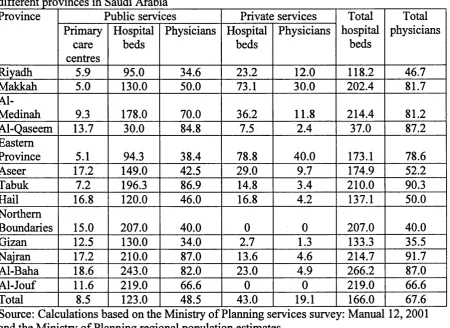
Regarding the distribution of health care resources, both public and private, the following
table displays the available health care resources for each 100,000 of the population,
[image:33.595.22.473.350.678.2]including foreign residents in the different provinces of the country.
Table 2.4. The health care resources available for every 100,000 of residents in the
Province Public services Private services Total hospital beds Total physicians Primary care centres Hospital beds Physicians Hospital beds Physicians
Riyadh 5.9 95.0 34.6 23.2 12.0 118.2 46.7
Makkah 5.0 130.0 50.0 73.1 30.0 202.4 81.7
Al-Medinah 9.3 178.0 70.0 36.2 11.8 214.4 81.2
Al-Qaseem 13.7 30.0 84.8 7.5 2.4 37.0 87.2
Eastern
Province 5.1 94.3 38.4 78.8 40.0 173.1 78.6
Aseer 17.2 149.0 42.5 29.0 9.7 174.9 52.2
Tabuk 7.2 196.3 86.9 14.8 3.4 210.0 90.3
Hail 16.8 120.0 46.0 16.8 4.2 137.1 50.0
Northern
Boundaries 15.0 207.0 40.0 0 0 207.0 40.0
Gizan 12.5 130.0 34.0 2.7 1.3 133.3 35.5
Najran 17.2 210.0 87.0 13.6 4.6 214.7 91.7
Al-Baha 18.6 243.0 82.0 23.0 4.9 266.2 87.0
Al-Jouf 11.6 219.0 66.6 0 0 219.0 66.6
Total 8.5 123.0 48.5 43.0 19.1 166.0 67.6
At the first glance at the table, it can be observed that there is an inequitable distribution
of health care resources in the various provinces in the Kingdom. Unexpectedly the
Riyadh Province, where the capital is situated, shows one of the lowest physician to
population ratios and one of the lowest primary health care centres to population ratios.
This is probably due to the rapid population growth in the capital for which the health
care services capacity can not accommodate. In contrast, provinces with a comparably
higher proportion of rural populations, such as Al-Qaseem, Najran and Al-Baha
Provinces, showed higher public physicians to population ratios and comparably high
primary health care to population ratios. This maybe due to the need for more
geographically distributed services, where smaller scattered populations exist, in order to
have a more equitable service coverage. In addition to Najran, Al-Baha, Aseer, Hail and
the Northern Boundaries, which also have a high proportion of small towns and cities and
to some extent a large proportion of rural populations, the first three Southern Region
provinces show a greater number of primary health care centres to the population ratios.
This is compared to more developed urbanized areas where major cities are located such
as Makkah, the Eastern Province and Al-Medina, where there are lower primary health
care centre to population ratios and lower public physician to population ratios in the
Eastern Province and in Makkah.
In contrast, provinces where major cities are located there are higher private physicians to
population ratios, especially in Makkah and the Eastern Province. This is probably due in
part to the higher demand for private care in these provinces. This is also reflected in the
proportion of private hospital beds, where greater proportions are found in provinces
where major cities are located, especially in Makkah and the Eastern Province where the
highest proportion of private hospital beds to the population is found. The Southern Aseer
and Al-Baha Provinces, have a high rural constituency but have relatively high private
hospital beds to population ratios, although not comparable to Makkah and the Eastern
Province. This maybe due to the increased demand for hospitalization in these provinces.
Regarding the total physicians to population ratios it is obvious that being a less
necessarily associated with lower physician to population ratios. Al-Qaseem, Tabuk,
Najran and Al-Baha Provinces, which do not have any major cities situated in them,
have a high rural constituency and have a comparably high physician to population ratios.
It can be observed that Riyadh Province where the capital is situated holds a
disadvantaged position in terms of doctors to population ratios, which is probably due to
the rapid population growth with which the service growth is not coping. The Gizan
Province also displays a problem in the physicians' distribution, since it has a high
proportion of scattered populations but a low physician to population ratio, indicating
possible problems in health service delivery and, possibly, the quality of care provided.
Regarding the total hospital beds to population ratios, the highest rate is found in the
Southern Al-Baha Province, which is mainly constituted of a high proportion of scattered
populations. The province with the third highest hospital beds to population ratio is
Najran which is located in the Southern region of the country and has a similar
population composition to Al-Baha Province. This maybe partly due to a higher demand
on hospital beds and to increase in geographical accessibility for the scattered
populations. Makkah and Al-Medinah Provinces have a high proportion of hospital beds
to the population. This is partly due to the high number of foreign visitors to the holy
mosques in these provinces which increases the demand for health services, especially
where there is a high constituency of older visitors to the holy mosques. The Riyadh
Province, like for physicians numbers, also displays a low proportion of total hospital
beds to the population, which indicates the need for a rapid expansion in health services
in this area. The province that showed the lowest total hospital beds to population ratios
is the Central Al-Qaseem Province which is closely situated to the capital. This probably
indicates a high reliance on the capital’s public hospitals, since it is within a
geographically short distance, and public care is the major source of health care in Saudi
Arabia. It is worth noting that the capital has the highest number of public hospitals (33),
next to the Makkah Province's (34) public hospitals, indicating the need for the expansion
2.3.4. The development of primary health care in Saudi Arabia
In response to the Alma-Ata Declaration on primary health care, the Saudi Ministry of
Planning declared the primary health care concept as the main objective of the health
services, which would be provided free of charge (MOP, 1981). This was followed by the
issue of the Ministry of Health Decree No. 257/1459/50 in 1980 leading to the
establishment of primary health care centres. These were administratively integrating the
existing dispensaries, health offices and maternal and child health care centres into one
unit as a first step in the initiation of primary health care centres (A1 Mazrou et al., 1990).
In 1984, a Primary Health Care project was initiated with an objective of developing a
culturally and socially acceptable primary health care system. The primary health care
delivery instruments that were tested included elements such as family files and
community surveys. It also tested some of the primary health care principles like
community participation, inter-sectoral coordination with the defined contents of primary
health care as specified in the Alma Ata declaration. In the same year evaluation took
place and it was found that the planned activities were suitable, and thus standardized
guidelines were formed and adopted in primary health care centres (A1 Mazrou et al.,
1990).
During this establishment period a number of surveys were carried out in order to study
the organization and the performance of primary health care centres in Saudi Arabia. In
general, it was found that the health centres were in rented buildings that were not
designed to meet the needs of health services. Most of the staff were non-Arabic speakers
with little understanding of the local culture. The emphasis was still on curative
medicine; maternity and child health services were at a minimum; home visits were not
permitted and the concept of the team approach to prevent disease and promote health
was not adopted, and there were no attempts to include community participation (Sebai et
al., 1980; Sebai, 1981; Banoub, 1982; Sebai, 1982), although it was reported that people
are always ready to participate if they are well informed of the objectives and possible
The primary health care approach was also supported in the following fourth
development plan (1985-1990) which stated its objectives as following:
“-to strengthen primary health care as the basis of a comprehensive health services
network provided integrating health services of high quality for the people of the
Kingdom”
“- To continue the development of preventive, public health and environmental health
programmes including health education, matemal and child health care, improved public
immunisation and occupational health programs.” (MOP, 1986).
During this period, Sebai (1988) conducted a study of the primary health care delivery
system, which indicated that primary health care centres suffered from low quality in
general, with problems such as long waiting times, problems in communication between
doctors and patients, due to language barriers and cultural barriers since most of the
workers are expatriates, shortage in health care manpower, shortage of medical
equipment and lack of a holistic approach to health. A positive reporting regarding
primary health care was its coverage, since 51% of health care centres served small
communities of 10000 people or less and they usually functioned independently.
Problems facing the implementation of primary health care were also listed in a Ministry
of Health document (MOH, 1990a) reporting unavailability of adequate resources to
primary health care centres such as laboratories, x-ray units, ambulances and so on. 82%
of the primary health care centres were in rented buildings designed originally for
housing. In addition there was a shortage and maldistribution of health professionals,
increasing demand and range of services without proportional budget increase.
The fifth development plan (1990-1995) aimed at achieving better primary health care
coverage according to specific centre to population ratios (MOP, 1991), sustaining the
commitment to primary health care and refining its policies. It mentioned:
“Providing appropriate and essential primary and preventive health care services,
delivering curative and preventive health services in an efficient manner, establishing
manpower training programs and incentives for entering the health profession.” (MOP,
1991), This was succeeded by the sixth development plan which also stressed the role of
primary health care as the main instrument through which improved levels of health will
be promoted, with the expansion of mother and child care activities and disease
prevention programmes.
Some small scale studies were carried out in primary health care centres during this
period. It was reported that in some primary health care centres human resource numbers
did not measure up to the ideal set up standards and that clinical support areas were
under-equipped (Al-Osimy, 1994). The concentration of primary health care doctors on
acute health problems was also reported (Al-Shammari, 1991). Other problems that were
mentioned still included the communication problems between non-Arabic speaking
doctors, nurses and patients (El-Shabrawy Ali & Eisa, 1993; Al-Faris et al., 1996).
Overcrowding, with its associated long waiting times, was also reported to be associated
with the dissatisfaction with primary health care services (Al-Faris et al., 1996).
In the most recent plan (2000-2005) the role of primary care was also stressed by
mentioning that it is the basic channel for the provision of preventive and curative
services, with the continuing implementation of primary health care programmes. In a
study carried out by Al-Khaldi et al. (2002) they still reported the existence of the
language barriers between primary health care staff and patients, inadequate staffing in
rural areas and the shortage in laboratory facilities.
2.4. THE STRUCTURE OF THE CURRENT HEALTH CARE SYSTEM
The Saudi health care services are provided by a wide range of institutions. In broad
terms, the provision of health care is organized through a referral system which consists
of a country-wide network of primary health care centres, and general and specialist
hospitals. These services are provided mainly by the Ministry of Health and some other
governmental bodies. The private sector also plays a role in the provision of health
2.4.1. The Ministry of Health
The Ministry of Health is the government agency responsible for health care in Saudi
Arabia. It is organized centrally and provides its main services through primary health
care centres and hospitals.
Primary health care centres are responsible for the provision of mother and child health
care with its objectives being the reduction in matemal, infant and childhood mortality
and morbidity, the promotion of reproductive health and the promotion of the physical
and the psychological development of children and adolescents within their families.
These objectives are achieved through the provision of a comprehensive matemal health
care programme, a children’s monitoring programme and a contribution to the expanded
programme of immunisation. In addition, the health care centres provide care during
illness.
Other important activities include endemic disease control, mainly through disease
surveillance, the treatment of common diseases and injuries, the provision of essential
dmgs and vaccines and the monitoring of chronic diseases, with special clinics being
established for hypertension and diabetes within primary health care centres, in addition
to responsibilities with respect to environmental health, health education and the
promotion of food supply and proper nutrition.
Besides primary health care centres, secondary and tertiary specialist hospitals are
distributed widely within the different regions in Saudi Arabia. They are linked to
primary health care centres through a referral system for which medical cases that are
untreatable in primary health care centres are referred to specialist care in the Ministry of
Health hospitals and are jointly monitored by the hospital specialists and GPs in primary
care.
In addition to primary health care and hospital services, the Ministry of Health provides
solve social problems, providing financial aid for some cases. It also provides
occupational health services, focusing mainly on protecting workers from vocational
risks, and oral health, focusing mainly on treating children’s teeth and establishing
mobile dental clinics. The Ministry of Health is also responsible for the prevention of
endemic and contagious diseases wdth its epidemic control system. It is also responsible
for environmental health, supervising and arranging continuous inspections of water
resources, dwellings, working sites and restaurants, in addition to poison control and
management. The Ministry of Health has also established rehabilitation centres providing
comprehensive care for the disabled and accident victims, optoplasty centres for the care
of the partially or totally blind and smoking cessation clinics in major cities in addition to
the organization of many anti-smoking campaigns (Ministry of information, 1990; Al-
Mufti, 1999).
2.4.2. Other sources of medical care
Other agencies which provide services alongside with the Ministry of Health are as
following:
The Red Crescent Society:
This was established in 1963. It provides emergency services for victims of accidents and
calamities as well as transportation of the wounded and participation in their treatment. It
works to prevent epidemics as well as participate in health education programmes. It also
provides health services for pilgrims to the two Holy Mosques (in Makkah and Al-
Medinah) in cooperation with other authorities. It works in coordination with the Red
Cross on the international level.
Health care provided by the Military Sector:
This is provided by the National Guard, the Ministry of Defense and Aviation and the
Ministry of Interior. It provides high quality primary, secondary and advanced levels of
health care for their staff and segments of the population. They have their health care
School Health Units:
These were first established in 1957. Their main responsibility is to provide primary care
for students in schools. They provide both preventive and immediate curative services.
Their activities include inspecting the sanitary environments in schools, conducting
health checkups for students, providing first aid and primary care when needed, and
conducting immunisation programmes under the supervision of the Ministry of Health.
The General Organisation of Social Insurance:
This provides complete health services for its clients under the social insurance. It
concentrates especially on the provision of services for the permanently injured or
handicapped. It provides its services through its two hospitals and other contracted
hospitals and specialty centres.
The General Organization of Youth Welfare:
This provides health services for athletes and the employees in the General Organization
of Youth Welfare and their families. This is done through its four health units and its
specialist hospital, which is considered the first athletic specialist hospital in the Arabian
Gulf region.
The Private sector:
This plays an increasingly significant role in Saudi Arabia, providing both outpatient and
inpatient care. It applies the health laws and regulatory requirements as specified by the
Ministry of Health, although the private sector fimctions independently in terms of fiscal
and organizational arrangements. The private sector provides high quality services
equipped with state of the art technology, and the private hospitals -especially in major
cities- provide hotel like services. Visitors to private sector hospitals or clinics are
generally seen by specialists 'without the need for a GP’s referral, as in the public sector,
thus forming a two tier health care system in Saudi Arabia with higher quality specialist
care provided privately for the ones who have the ability and willingness to pay for the
(1999) in 1997 there were 84 private hospitals serving 12 health districts, with a total
capacity of 8185 beds. There were also 611 medical centres and 775 private practices or
clinics. Private support services included 43 medical laboratories, 11 physiotherapy
centres, 749 optical centres, 273 pharmaceutical warehouses and 3178 pharmacies. The
regional distribution of private physicians and hospital beds for the year 2001 is as
mentioned above.
2.4.3. Traditional medicine
Traditional medicine practice is mainly divided into healers by herbs, healers by
cauterising, healers who use air cups and bone plasterers (Rukn, 1997), although they are
not widely referred to for the provision of health services, as reported in the 1996 Saudi
Arabia Family Health Survey.
Using herbs for the alleviation of some signs and symptoms is widely practiced such as
the use of special herbs for gastrointestinal diseases, renal system disorders, liver disease
and infertility.
Cauterising, which is the process of heating the edge of a broad headed nail with a flame
and placing it for one or two seconds on the site of treatment, is used or the treatment of
various problems especially the ones related to the musculoskeletal or the neural systems,
such as joint pain, displacement of joints especially the vertebrae and to cure some types
of paralysis. It is also used, but to a lesser extent, to treat some symptoms such as
headaches, throat aches and liver tumors (Rukn, 1997).
Air cups are used to alleviate back pain and help cure respiratory diseases, as it is thought
to suck out “bad blood” and thus help in curing from disease.
Bone plasterers are skilled mainly in correcting bone displacements, and they put special
herbs on broken bones and displaced joints for fast healing. They are generally sought for