University of East London Institutional Repository:
This paper is made available online in accordance with publisher policies. Please scroll down to view the document itself. Please refer to the repository record for this item and our policy information available from the repository home page for further information.
Author(s):
Falcarin, Paolo; Torchiano, MarcoTitle:
A Dynamic Analysis Tool for Extracting UML 2 Sequence Diagrams
Year of publication:
2006Citation:
Falcarin, P. and Torchiano, M. (2006) ‘A Dynamic Analysis Tool for Extracting UML 2 Sequence Diagrams’, in Filipe, J., Shishkov, B. Helfert, M. (eds.) ICSOFT 2006, First International Conference on Software and Data Technologies, Volume 1. Setúbal, Portugal, September 11-14. Portugal: INSTICC Press, pp.171-176.A DYNAMIC ANALYSIS TOOL FOR EXTRACTING UML 2
SEQUENCE DIAGRAMS
Paolo Falcarin, Marco Torchiano
Dipartimento di Automatica e Informatica (DAUIN), Politecnico di Torino,Corso Duca degli Abruzzi 24, Torino, Italy
[email protected], [email protected]
Keywords: UML, XMI, Dynamic Models, Aspect Oriented Programming (AOP), Reverse Engineering.
Abstract: There is a wide range of formats and meta-models to represent the information extracted by reverse engineering tools. Currently UML tools with reverse engineering capabilities are not truly interoperable due to differences in the interchange format and cannot extract complete and integrated models. The forthcoming UML 2.0 standard includes a complete meta-model and a well defined interchange format (XMI). There is an available implementation of the meta-model, therefore it is a viable option to use UML 2.0 the modelling format for reverse engineered models. In this paper we propose a technique to automatically extract sequence diagrams from Java programs, compliant to the UML 2.0 specifications. The proposed approach takes advantage of the Eclipse platform and different plug-ins to provide an integrated solution: it relies on a new dynamic analysis technique, based on Aspect Oriented Programming; it recovers the interactions between objects also in presence of reflective calls and polymorphism.
1 INTRODUCTION
A significant effort in the lifecycle of software systems is devoted to maintenance and comprehension. Some among the currently widespread software development practices, such as agile software development and open source projects devote less and less effort the production of documentation.
Though, documentation and design models are essential for the comprehension of software. Therefore, in order to achieve high maintainability it is important to provide developers with automatic tools to extract the documentation, consistent with the actual system.
Both in academic and industrial contexts the need for usable tools to help reverse-engineering tasks is strongly perceived. The Unified Modeling Language (OMG) is the most used standard for visual representation of the design of object-oriented software. Some UML tools provide reverse-engineering features, mainly class diagram extraction. Few tools reverse-engineer existing source code into a sequence diagram or
collaboration diagram (Kollmann et al. 2001). All these tools are based on static analysis of source code instead of dynamic analysis of the executable files.
Static analysis has some limitations because it is limited to source code. In case of polymorphism, dynamic creation of objects, and using of reflection, the behaviour may vary depending on data: thus, these issues can be solved running the application, i.e. using dynamic analysis techniques. Dynamic extraction of objects interactions can be applied even with a limited knowledge of the target application. Analyzing dynamic behaviour in such cases usually requires heavy code instrumentation and a reflective language support; moreover dealing with the huge amount of extracted information is an issue that has to be faced with; in this case it is often necessary to select the use case and the related parts of the system that should be analyzed: filters should be defined to set boundaries of the automated analysis.
configuration and adaptation of heterogeneous environments.
In order to extract dynamic behaviour of a software application, we present a technique based on AOP to instrument bytecode, running test cases, and then extracting sequence diagrams models, all integrated in the Eclipse platform (Eclipse).
The tool we created implements several existing techniques into a single easy-to-use plug-in. In addition it is the first reverse engineering tool built on top of the UML2 Eclipse plug-in.
The following sections will explain our Eclipse-based approach, the main concepts behind AOP, and will give more information on the UML2 Project (UML2).
2 THE
PROPOSED
APPROACH
In this section we describe the approach for extracting data from the application both statically using reflection and at run-time using AOP. The information extracted is used to populate the UML2 model of the system. The described approach has been implemented by means of some wizards working as a plug-in of the Eclipse development environment. The tool supports the following process to reverse engineer an application starting from a target Java Project in Eclipse:
1. The User identifies which java packages to inspect in the target project through a wizard in Eclipse.
2. These packages are used as parameters for a pre-defined template: the Eclipse Modeling Framework (EMF) plug-in is then used for creating an AspectTracer java file, suitable for the target application
3. The tool changes the nature of the Java Project in an AspectJ project: therefore a new build of the target project will instrument the target application with the aspect, by means of the AspectJ weaver. 4. Through another wizard, user selects a package with the JUnit test-cases for the target application (JUnit).
5. The wizard runs all the selected test cases and updates the UML2 model on the fly, adding a new interaction diagram for each test-case.
The result of the above mentioned analysis steps are stored in an object model using the UML2 plug-in API: this object model is based on the Eclipse Modeling Framework and therefore it can be serialized in a file in the standard XMI format, compliant with the recent UML 2.0 specification.
Our approach leverage different Eclipse plug-ins to provide, in few steps, UML 2 standard models; these can be visualized and manipulated by whichever UML tool able to import XMI models, without being locked to a particular UML tool provider.
2.1 Overview of AOP
Aspect-Oriented Programming (Kiczales et al., 1997) is a new programming paradigm easing the modularization of crosscutting concerns in object-oriented software development. In particular, developers can remove scattered code related to crosscutting concerns from classes and placing them into elements called aspects. This methodology relies on a join-point model, which defines the points along the execution of a program that can be possibly addressed by an aspect. Thus, AOP involves a compiling process (called weaving) for the actual insertion of aspect code into pre-existing application source code or byte code.
AspectJ (AspectJ) is the leading AOP implementation, and the more complete, stable and widely used one; it includes a language specification, a set of additions to the Java language, a compiler that creates standard Java bytecode.
In the terminology of AspectJ an aspect is composed by a set of pointcuts and advices. The term ‘advice’ represents the implementation of a crosscutting concern, i.e. additional code to be executed in join points of the application code.
AOP also involves means for identifying the join points to be extended by an aspect. The AOP term ‘pointcut’ implicitly defines at which points in the dynamic execution of the program (at which join-points) extra code should be inserted: pointcuts describe sets of join points by specifying, for example, the objects and methods to be considered, or a specific method call or execution. AspectJ offers a rich set of pointcuts: among these the ‘call’ pointcut is the more interesting for our purposes, because it intercepts method calls: the following simple example shows a simple call() pointcut, which intercepts a method call, whose signature is defined between parenthesis.
pointcut p(): call(public static void mypackage.MyClass.main(String[]));
‘mypackage’, with a single parameter of type ‘String[]‘ and a ‘void’ return value.
AspectJ utilizes a wildcard-based syntax to construct the pointcuts in order to capture join points that share common characteristics. Three wildcard notations are available in AspectJ:
1. * means any number of characters except the period.
2. .. means any number of characters including any number of periods.
3. + means any subclass or sub-interface of a given type.
Just like in Java, AspectJ provides a unary negation operator (!) and two binary operators (|| and &&) to form complex matching rules by combining simple pointcuts. The negation operator ! allows the matching of all join points except those specified by the pointcut. Combining two pointcuts with the || operator causes the selection of join points that match at least one of the pointcuts, while combining them with the && operator causes the choice of join points matching both the pointcuts.
2.2 Aspect Tracer
We defined the AspectTracer aspect to collect information for building the sequence diagrams in the UML2 model. In our approach a scenario is associated with a test-case, thus a use case can be related with a set of test-cases. Automated tests written with JUnit act like a sort of specification of scenarios.
Here we describe an example of AspectTracer created for the ‘Foo’ case study.
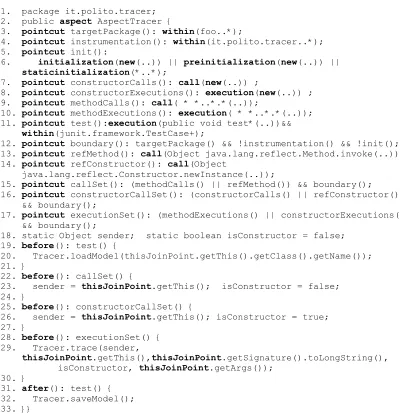
Looking at the AspectTracer’s source code (see Figure 1), the second line specifies the aspect name following the AspectJ syntax. An aspect is composed by a set of pointcuts and a set of advices.
In the aspect several pointcuts are defined and named, in order to identify different sets of join points in the application code; these pointcuts can then be composed with logical operators to define more complex pointcuts.
In order to identify these join-points, each advice is related to one named pointcut, specifying a particular set of join-points in the application code: for example, whenever the related pointcut In the aspect there are four advices of type before, used to execute some code right before the identified join-point, and one advice of type after, used to execute some code right after the join-point. Each advice contains, enclosed between braces, the additional
code that is inserted at the specified join-points during the weaving process, at compile-time.
For example, test() matches a join-point in the application, the advice of type before(), at line 19, is executed immediately before the join-point.
The methodCalls() pointcut at line 9 in figure 1 can be read like this: ‘all the method calls defined in whichever package, for whichever class, whichever method, and whichever return value; moreover the wildcard “..” used between method’s parenthesis, matches whichever list of types for formal parameters.
In the same way (see line 7) we intercept all calls to constructor methods, identified by the keyword ‘new’.
Now we need to limit the scope to the ‘foo’ package, containing our case study to be inspected: we define the targetPackage() pointcut to identify all the join-points of our target application. This pointcut relies on the AspectJ pointcut within() which identifies all the join-points defined in the source code of classes matching the type pattern defined between parenthesis. For example, “within(foo..*)” matches whichever string starting with “foo” and followed by a string including periods: this identifies all the join-points defined in package “foo” and in all its sub-packages.
Wildcards are very powerful but the extensive usage made by methodCalls() pointcut, leads to pick up undesired join-points; thus, we need to define the boundary() pointcut (see line 12) to describe all join-points we want to exclude from tracing.
In particular, in order to avoid infinite recursion, we defined the instrumentation() pointcut, which excludes all the join points occurring inside our instrumentation code, i.e. the AspectTracer’s body and the related Tracer class. Moreover, we use the init() pointcut to exclude the calls to initialization methods, transparently inserted in bytecode during compilation, and occurring whenever a new object is created and its fields are initialized. Finally the callSet() pointcut (at line 15) represents the method calls we are interested to trace.
1. package it.polito.tracer; 2. public aspect AspectTracer {
3. pointcut targetPackage(): within(foo..*);
4. pointcut instrumentation(): within(it.polito.tracer..*);
5. pointcut init():
6. initialization(new(..)) || preinitialization(new(..)) ||
staticinitialization(*..*);
7. pointcut constructorCalls(): call(new(..)) ;
8. pointcut constructorExecutions(): execution(new(..)) ; 9. pointcut methodCalls(): call( * *..*.*(..));
10. pointcut methodExecutions(): execution( * *..*.*(..));
11. pointcut test():execution(public void test*(..))&&
within(junit.framework.TestCase+);
12. pointcut boundary(): targetPackage() && !instrumentation() && !init();
13. pointcut refMethod(): call(Object java.lang.reflect.Method.invoke(..));
14. pointcut refConstructor(): call(Object
java.lang.reflect.Constructor.newInstance(..));
15. pointcut callSet(): (methodCalls() || refMethod()) && boundary();
16. pointcut constructorCallSet(): (constructorCalls() || refConstructor())
&& boundary();
17. pointcut executionSet(): (methodExecutions() || constructorExecutions())
&& boundary();
18. static Object sender; static boolean isConstructor = false;
19. before(): test() {
20. Tracer.loadModel(thisJoinPoint.getThis().getClass().getName()); 21. }
22. before(): callSet() {
23. sender = thisJoinPoint.getThis(); isConstructor = false; 24. }
25. before(): constructorCallSet() {
26. sender = thisJoinPoint.getThis(); isConstructor = true; 27. }
28. before(): executionSet() {
29. Tracer.trace(sender,
thisJoinPoint.getThis(),thisJoinPoint.getSignature().toLongString(),
isConstructor, thisJoinPoint.getArgs()); 30. }
[image:5.595.86.486.91.505.2]31. after(): test() { 32. Tracer.saveModel(); 33. }}
Figure 1: AspectTracer source code.
Another pointcut we used is methodExecutions() relying on the AspectJ’s execution() pointcut, which
behaves like the call() pointcut: the only difference is that in this case the currently executing object (obtained with thisJoinPoint.getThis() ) is the receiver object of a method call, instead of the caller object.
One may question that we just need a single before() advice for the call() pointcuts, instead of two, to extract all the information on the sender and the receiver objects. This is not possible because if we write a single advice related to a call pointcut then we are not able to extract the receiver object reference in case of constructor method calls.
On the other hand, a single advice related to an execution() pointcut would not be able to extract the
sender object reference. This clarifies the need to temporarily store the sender object reference, retrieved by the call() related advices: this value will be used immediately after by the execution() related advice to invoke the Tracer tool for updating the model. At line 29, the Tracer is invoked passing these parameters: the caller object, the receiver object, the signature of the invoked method, and an array of Objects containing the parameters’ values. It is worthwhile to notice that our approach seamlessly detects reflection-based invocations to methods and constructors (see lines 13-14). Therefore it allows identifying the actual target objects in the interaction model.
whichever JUnit test-case, in order to load the current UML2 model before starting the test, and saving it immediately.
2.3 UML2 sequence diagrams
There is an ongoing effort in the Eclipse UML2 project to develop a UML2.0 compliant class library. The object model prescribed by the OMG standard is very complex, thus to make it usable the UML2 team introduced some simplifications.
A sequence diagram depicts a scenario by showing the interactions among a set of objects in temporal order. Objects are shown as vertical bars, called “lifelines”; events or message delivery is shown as horizontal arrows from the sender to the receiver (see Figure 2).
A scenario describes a typical example of an execution trace and therefore control-flow statements and conditions are not specified.
[image:6.595.327.518.142.293.2]To better understand how these classes can be used to model a Java software system we present a very simple example. Let’s consider two classes A and B and we model the dynamic interaction where obj1, instance of class A, invokes method m2() of object obj2, instance of class B. This interaction can be represented by a sequence diagram as shown in Figure 2.
Figure 2: Sample Sequence Diagram.
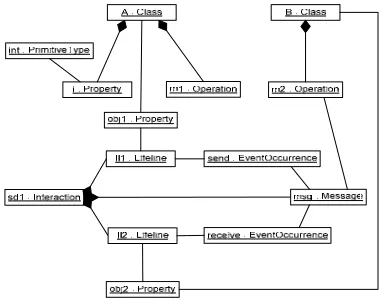
The UML2 object-model corresponding to the sequence diagram is presented in the lower part of Figure 3. Interaction object corresponds to a sequence diagram and it contains the elements of the model: lifelines and messages. The lifelines represent instances of classes, which are represented by class Property. The messages are linked to the source and destination lifelines by two EventOccurence objects: a send event and a receive event respectively. A message represents the invocation of a method, whose signature is represented by class Operation.
The Interaction sd1 contains two Lifeline objects, ll1 and ll2, which represent two objects obj1 and obj2, whose types are Class A and Class B respectively. The Interaction sd1 contains a Message msg that is sent by Lifeline ll1 through the EventOccurrence send and received by Lifeline ll2
through EventOccurrence receive. The signature of the Message msg is the Operation m2 of Class B.
Figure 3: Object-model of the sample model.
3. RELATED WORK
Recent research has shown that automated tools can be used to help engineers understand software systems. Commercial UML tools, and research tools extract a UML model from a system implementation. Typically, these tools use static analysis to parse the system source code or bytecode to extract a model of the system.
Shimba (Systa et al., 2001) is a reverse engineering environment to support the understanding of Java software systems. Shimba integrates the Rigi (Tilley et al., 1994) and SCED (Systa, 2001) tools to analyze and visualize the static and dynamic aspects of a subject system. The static software artifacts and their dependencies are extracted from Java bytecode and viewed as directed graph in Rigi format. The run-time information is generated by running the target software under a customized debugger, then the generated information is viewed as sequence diagrams using the SCED tool.
[image:6.595.138.234.428.470.2]We claim that AOP usage eases reverse engineering task because code instrumentation is modularized in a single aspect that can be easily inserted or removed at build-time; moreover there is no more need of customized debuggers or ad-hoc instrumentation of source code, which are more complex to handle and error-prone.
Thanks to the aspect-oriented platform, pointcuts can be used to set precise tracing boundaries, selecting which target packages or classes to inspect and which ones to exclude.
In (Briand et al. 2005) a method to reverse engineer UML sequence diagrams from execution traces for distributed systems is described: they define how transforming extracted data in a UML 1.3 model, relying on their ad-hoc meta-model to represent sequence diagrams.
We also rely on a meta-model to generate UML models: the innovation is that we offer an integrated Eclipse environment relying on the UML2 project in order to generate models compliant with the recent UML 2 standard and exportable through XMI standard documents.
4. CONCLUSIONS
We developed and approach to model Java programs from dynamic points of view. The approach has been implemented in a working Eclipse plug-in. In summary the main highlights of the proposed approach are:
• This is the first reverse engineering approach and toolset using UML 2 as modelling infrastructure.
• It works correctly also in presence of polymorphism, allowing both a precise recovery the correct identification of invoked methods.
• Using suitable join points it is able to recognize invocations made through the Java reflection classes.
• It leverages the use of JUnit, the widespread Java unit-testing framework, to trigger scenarios executions. The test cases are formalizations or usage scenarios. This makes the proposed approach a suitable a-posteriori documentation tool for processes mainly focused on code, e.g. agile and OSS projects.
We identified several threads for further work, in particular we plan to investigate how to determine which tests are needed to obtain an acceptable coverage; then compare design sequence diagrams with the reverse-engineered ones, this will enable checking consistency between code and models made in an early design phase; finally we need to
validate the overall approach with large sized software systems.
5.
REFERENCES
AspectJ Project homepage. Retrieved July 8th, 2006, from http://eclipse.org/aspectj
Briand, L.C., Labiche, Y., & Leduc, J, 2005. Tracing Distributed Systems Executions Using AspectJ. In ICSM’05, International Conference on Software Maintenance. IEEE Press.
Eclipse Project homepage. Retrieved July 8th, 2006, from http://eclipse.org
JUnit Project homepage. Retrieved July 8th, 2006, from http://junit.org
Kiczales, G., Lamping, J., Mendhekar, A., Maeda, C., Lopes, C., Loingtier, J.M., & Irwin, J, 1997. Aspect-oriented programming. In ECOOP’97, 11th European Conference on Object-Oriented Programming. Springer-Verlag.
Kollmann, R., Gogolla, M., 2001. Capturing Dynamic Program Behavior with UML Collaboration Diagrams. In CSMR’01, European Conference on Software Maintenance and Reengineering. IEEE Press.
OMG, Unified Modeling Language Specification. Retrieved at http://www.uml.org/
Pauw, W.D., Jensen, E., Mitchell, N., Sevitsky, G., & Vlissides, J., 2002. Visualizing the Execution of Java Programs. In Software Visualization. Springer-Verlag. Systa, T., Koskimies, K., & Müller, H., 2001. Shimba - An
Environment for Reverse Engineering Java Software Systems. In Software - Practice and Experience, vol. 31: 371-394. Wiley 2001.
Systa, T., 2001. On the relationships between static and dynamic models in reverse engineering Java software. In WCRE’99, Sixth Working Conference on Reverse Engineering, pp. 304-313. IEEE Press.
Tilley, S. R., Wong, K., Storey, M. A. D., & Müller, H. A., 1994. Programmable reverse engineering. In Journal of Software Engineering and Knowledge Engineering.