University of East London Institutional Repository: http://roar.uel.ac.uk
This paper is made available online in accordance with publisher policies. Please scroll down to view the document itself. Please refer to the repository record for this item and our policy information available from the repository home page for further information.
To see the final version of this paper please visit the publisher’s website. Access to the published version may require a subscription.
Author(s):Sims, Lionel
Article title:What is a lunar standstill? Problems of accuracy and validity in ‘the Thom paradigm’.
Year of publication:2006
Citation:Sims, L. (2006) ‘What is a lunar standstill? Problems of accuracy and validity in ‘the Thom paradigm’’. Mediterranean Archaeology & Archaeometry, Special Issue 6 (3) 157-163.
Link to published version:
What is a lunar standstill? Problems of accuracy and validity in ‘the Thom paradigm’. Abstract
Lionel Sims (University of East London)
North West European late Neolithic and Early Bronze Age (EBA) monumental alignments on the sun’s solstices and the moon’s standstills were first
systematically studied by Thom (Thom 1971). Later research, since labelled ‘the Thom paradigm’ (Ruggles 1999), has rejected Thom’s eclipse prediction and calendrical theories for these ancient alignments, yet retained his
definition of a lunar standstill as the ‘geocentric extreme declination’ of the moon (Heggie 1981a, Heggie 1981b, Hoskin 2001, Morrison 1980, North 1996, Ruggles 1999, Thom 1971). Thom suggested that prehistoric
‘extrapolation devices’ calculated this mid-transit property of the moon from observed horizon alignments, but subsequent research has found no
evidence for such devices. While a mid-transit definition of a lunar standstill is an accurate specification of the phenomena, it is based upon the premises of modern heliocentric astronomy and is unlikely to provide valid interpretations of the monument builder’s use of horizon ‘astronomy’. This paper attempts to demonstrate that the current theories used to explain the late Neolithic/EBA function of lunar standstill alignments do not fit the horizon, and therefore megalithic user, properties of lunar standstills. It is argued that a recent model (Sims 2006b) is more consistent with the archaeology and ‘astronomy’ of horizon-aligned monuments, and with any ethnographic elaboration of the Thom paradigm.
Validity problems from defining a lunar standstill by its geocentric extreme declination
Lunar standstills are defined within archaeoastronomy by the declination measure of the moon’s geocentric extremes (Heggie 1981b, North 1996, Ruggles 1999, Thom 1971). It is assumed that a series of corrections and adjustments must be made to this geocentric ‘essence’ (mainly parallax and refraction) to then translate the horizon properties of lunar standstills. While this is understood to be an ethnocentric assumption (Heggie 1981b, Ruggles 1999), there are few attempts to translate this definition into the framework of a late Neolithic/EBA horizon ‘astronomy’ which cannot have had any concept of a geocentric extreme. ‘[Geocentric extreme declination measures] …is not the framework which would suggest itself most readily to a naked-eye
avenues for future research. Archaeoastronomy’s definitional crisis coincides with an inter-disciplinary opportunity.
Two interpretations have been made for the horizon lunar alignments of ancient monuments: the ‘magical’ sinusoidal alternation of the foreshortened range of southern minor standstill moonsets (North 1996), and synchronising full moon with solstices (Ruggles 1999). Twice every nineteen years at the major and minor standstills, for a period of a year, the moon’s monthly horizon alternations between its southern and northern extremes return to the ‘same’ horizon positions. Between these periods the horizon range of the moon’s setting and rising positions move between its major and minor standstill limits which, at the latitude of Stonehenge is about 10º of azimuth outside and 9-10 years later about 10º of azimuth within the sun’s solstice horizon extremes. During the year of a standstill, when the moon is at its geocentric extreme, it exhibits a small monthly perturbation of the order of 6´ of declination which, over the course of a standstill year, describe a regular sinusoidal alternation and reverse scrolling through all lunar phases systematically meshing with solstices and equinoxes (Morrison 1980, Sims 2006b). It is North’s contention that at the southern minor standstill moonsets, this monthly perturbation can be seen in the grand trilithon upper window when viewing sarsen Stonehenge from the Heel Stone (North 1996, Sims 2006b), and it is Ruggle’s view that the synchrony of lunar geocentric perturbations with solstices allowed the monument builders to time their rituals with full moon at the solstices (Ruggles 1999). Both of these interpretations will be tested for their consistency with the horizon properties of lunar alignments.
Lunar ‘geocentric’ standstills versus ‘azimuth’ standstills
The modern method to calculate the moon’s position uses the single measure of declination – the number of degrees above or below the celestial equator. Since this measure assumes observations from the centre of the earth to the centre of the lunar disc, and since the moon is ‘close’ to earth, a ‘parallax’ correction must be made to adjust for observation from a specified position on the surface of the earth. But this method uses point estimate formulae drawn from modern astronomical spherical geometry, and this is not the only
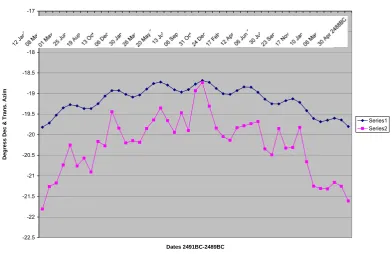
correction that must be made for interpreting prehistoric horizon ‘astronomy’. During a standstill the moon’s geocentric extremes occur when the moon is in mid-transit, not at the moment when it meets the horizon. Because the time between these moments of monthly geocentric extremes and the moments it meets the horizon are not regular, and because the moon is always changing its declination in the sky, another correction must be made which recalculates the new declination of the moon by the time it has reached a local horizon and then convert it to an azimuth value. This always modifies the pattern of
extremes, we can see that the second series of azimuths (transformed to fit the declination scale) do not display any regular quarterly wave-line
[image:4.595.96.489.258.512.2]alternation. This difference between a lunar standstill at its geocentric extreme and at its horizon azimuth is true for all standstills. North’s failure to translate lunar standstill geocentric extreme declinations to horizon setting azimuths leads him to make a claim for a lunar property that cannot be observed in the upper window of the Stonehenge grand trilithon (Sims 2006b).
Figure 1 Geocentric extreme declination and horizon azimuth (transformed) at 4º 19´ for the southern minor standstill moonsets for 2491-88BC at
Stonehenge.
Azimuth at 4 19 and Geoc. Ext. Dec.
-22.5 -22 -21.5 -21 -20.5 -20 -19.5 -19 -18.5 -18 -17.5 -17
12 Ja
n 2491
BC
Dates 2491BC-2489BC
De
gr
es
s De
c & T
ra
n
s
. A
z
im
Series1 Series2
Note
1. All calculations made from SkyMap for Stonehenge location 2490BC. 2. Point estimates made to centre of lunar disc.
3. Geocentric extreme declination occurs in the moon’s mid-transit.
4. The moon’s horizon movements are measured by azimuth at an altitude of 4º 19´, the estimated height of the grand trilithon upper window.
5. The azimuth’s for the moon’s horizon movements has been transformed to fit the declination scale.
While the change in declination of the geocentric extremes are of the order of 6´ of declination every month, the horizon azimuth oscillations of moonsets are on average double this value every month. This poses the problem as to what level of accuracy late Neolithic/EBA monument builders were able to track any oscillations in lunar or solar horizon extremes?
Problems of accuracy in horizon ‘astronomy’
temperature of melting ice, refraction errors to altitude amount to 10´ of arc, whereas at sea level (0º) refraction effects rise to 35´. Since these are errors to altitude, at the latitude of Stonehenge the azimuth errors would be
approximately twice as great. Schaefer has shown that temperature inversions are ubiquitous and significantly raise these refraction errors for alignments close to the horizon (Schaefer 1989, Schaefer 1993). Reijs concludes that, taking these effects into consideration, it is best to assume alignments in Neolithic time were accurate to within 1 degree (Reijs 2001). Very similar estimates are provided by the U.S. Naval Observatory Celestial Navigation Data and by Sampson (Observatory 2003, Sampson 2003). Sinclair and Sofaer have estimated the combined effects on azimuth
alignment errors of parallax, refraction, and missed observations and estimate them to be in the region of ½º for solstices and 1º for standstills (Sinclair & Sofaer 1993). Reijs has also shown that for the major standstill year of 2006, taking into account 0.3º errors for refraction, then the point of the major standstill cannot be distinguished from 4 or 5 dates for azimuth extremes during 2006, none of which coincide with the actual date of the geocentric extreme. He concludes that we must assume that naked eye horizon
astronomy cannot distinguish any observable differences in standstill horizon limits during course of the standstill year (Reijs 2003). In summary estimates of refraction errors for horizon alignments range from 0.3º-1º and we will assume for this paper a general alignment refraction error of 0.5º. How will this affect naked eye horizon alignments on the sun’s solstices and the moon’s standstills?
Assuming that refraction errors allow an accuracy of alignments no greater than about ½º disallows naked eye observers detecting any movement of the winter or summer sun for about 7 days before or after the solstice (SkyMap at Stonehenge latitude circa 2500BC). Similarly, over the course of a standstill year, more than half of all lunistice azimuths fall within a band of ½º, therefore also disallowing any one lunistice alignment taking precedence over the course of a standstill. The only quantitative property that horizon ‘astronomy’ can ascertain in a lunar standstill is therefore a horizon standstill position to within a degree or so upon which moonrises and moonsets hover. It remains for research to discover what qualitative property was selected from these alignments upon which cultural meaning was constructed.
Full moon versus dark moon
In over two decades of testing the Thom paradigm Ruggles has demonstrated that many monuments in prehistoric Britain and Ireland are aligned on lunar standstills and the sun’s solstices, although not to the levels of accuracy claimed by Thom. Specifically, in five regional groups of late Neolithic/EBA monuments Ruggles has shown that these alignments are to the
south-western quadrant of the horizon, therefore linking winter sunset with either the southern major or minor moonsets (Sims 2006a). Surprisingly Ruggles
There are good a priori reasons for questioning this judgement. First, during the course of a standstill year alignments on either the southern or northern lunistices will allow about nine lunistice moons to be observed setting or rising. These will scroll though the lunar phases associated with a synodic month, but now spread over the course of a year and in reverse order to monthly lunar phases (Sims 2006b). Full moon is just one of these nine possible alignments. If we claim that the monument builders were selecting full moon then some testable criteria must be identified to justify this selection. If a lunar alignment is considered separate from its pairing with a solstice alignment, then this claim is problematical since alignment differences less than half a degree are required to discriminate between full moon and any other lunistice moon during a standstill. As we have seen naked eye horizon astronomy cannot achieve these levels of accuracy. Second, the double alignments found by Ruggles combine alignments on the winter solstice sunset with the lunistice moonsets of the southern (major and minor) standstills. While this identifies a series of lunar alignments throughout a standstill year, when the winter solstice sunset joins this double alignment it conflates winter solstice sunset with dark moon – not full moon. To suggest that full moon was the builder’s moon of choice therefore throws away archaeological evidence that many stone monuments main alignments are orientated to a pairing of the sun and moon to the south west. Ruggles choice of full moon ignores the evidence from the monuments’ architecture which is a double alignment for both sun and moon to the south-west – not one to the south west for the sun and one to the north-west for the winter full moon. Third, Ruggles’ preference for full moon leads to otherwise inexplicable findings in his field data, all of which are resolvable, not anomalous, by accepting that the builders wished to bracket winter solstice with dark moon (Ruggles 1999, 142, 158)). As a point of method, this was understood in an earlier re-examination of the Thom paradigm:
‘There seems no good reason for supposing that phases other than full would have been unsuitable for observation. Nevertheless several writers put much emphasis on the full moon, and one often reads such phrases as ‘the midwinter full moon’ in some discussions of megalithic astronomy.’ (Heggie 1981b: 98).
Fourth, of course a full moon (or dark moon) will always take place within one month from any solstice. Archaeoastronomy’s job is to verify and interpret alignments on the sun, moon and other astral bodies. If Ruggles is referring to a southern standstill lunar alignment on full moon, then this occurs close to summer solstice not winter solstice, and is an alignment built into the
monument’s design. But if it is to the winter full moon (Ruggles 2006) then this takes place at the northern lunistice and ignores the main axial double
period. Interestingly this relationship is reversed for the inter-standstill years, during which full moons are closer to the day of the solstice compared to dark moons.
Table 1 Number of days between nearest solstice and lunistice full and dark moons for selected standstills and inter-standstills (SkyMap for
Stonehenge location)
--- Year Designation Lunistice Nearest Number of days from
Solstice Full moon Dark moon
--- 2508BC Minor Southern Summer 10
Winter 2
Northern Summer 4
Winter 12
2499BC Major Southern Summer 9
Winter 2
Northern Summer 5
Winter 11
2006AD Major Southern Summer 9
Winter 1
Northern Summer 4
Winter 12 2014/5AD Minor Southern Summer 9
Winter 1
Northern Summer 4
Winter 12
2495BC Inter- Southern Summer 5
stand still Winter 11
Northern Summer 9
Winter 2
2010AD Inter- Southern Summer 4
stand still Winter 5
Northern Summer 9
Winter 0
---
Indeed if monument builders wanted to fix an alignment that would guarantee a full moon to synchronise with the sun’s solstices there is much to
found hundreds of double alignments on solstices and standstills for which the main alignments are on southern standstills (major and minor) which are bracketed in a relation of identity with winter solstice sun. This always conflates dark moons, not full moons, with winter solstice. For cultures that accord respect to lunar-phased rituals, such an alignment will not be
compromised by a lunar eclipse, since eclipses cannot take place at solstices during standstills.
Conclusion
Readers should be aware that a large body of ethnographic literature is consistent with these findings. In anthropology dark moon is not ‘new’ moon. Ethnographically, the arrival of first waxing crescent moon around sunset is culturally constructed as a (re)birth out of dark moon signified ‘death’. The most powerful ceremony of the Hadzabe – Epeme – must be timed with dark moon. These Tanzanian low latitude big game hunters represent this as the time that their ancestors come closest to them, and is the most propitious time to ritually guarantee successful hunting (Power 2005, Woodburn 1982). The Saami/Samek – high latitude reindeer herders – celebrate dark moon in winter as time of magical creation (Karsten 1955). And for the First Nation people of the American Plains, the ‘Sun’ dance was a defiant ritual against the mid-day summer sun and re-appropriation of ritual power within the pitch black (dark moon) initiand’s sweat-lodge (Knight 1987, Levi-Strauss 1978, Mails 1998). Marshack showed that the notches with the greatest emphasis on Palaeolithic bone ‘calendar sticks’ were on dark moon (Marshak 1972). And the only neo-Darwinian theory of human origins which can also engage with cultural origins predicts that dark moon seclusion of matrilineal coalitions was an essential precondition for establishing the cultural domain (Knight 1995, Sims 2003). If this way of interpreting lunar standstills is robust, then it predicts that we will find not just a bracketing of solstice sunsets with standstill dark moons, but a wider syntax of ethnographic and other archaeological and ‘astronomical’ evidence associated with darkness, astral observation and waxing crescent new moonsets phase-locked with solstice alternation.
References:
Heggie, D. (1981a) Highlights and Problems of Megalithic Astronomy. Archaeoastronomy 3:S17-S37.
—. (1981b) Megalithic Science: ancient mathematics and astronomy in North-West Europe, Thames and Hudson, London.
Hoskin, M. (2001) Tombs, Temples And Their Orientations: A New Perspective on Mediterranean Prehistory, Ocarina Books, Oxford. Karsten, R. (1955) The religion of the Samek: ancient beliefs and cults
of the Scandanavian and Finnish Lapps, E.J.Brill, Leiden. Knight, C. (1987) Menstruation and the Origins of Culture, Ph.D.
Thesis, University College, University of London. Knight, C., Power, C. & Watts, I. (1995) The human symbolic
Levi-Strauss, C. (1978) The Origin of Table Manners. Introduction to a Science of Mythology: 3, Harper & Row, New York.
Mails, T. E. (1998) Sundancing: The Great Sioux Piercing Ritual, Council Oak Books, San Francisco.
Marshack, A. (1972) The Roots of Civilisation, London, Weidenfelf and Nicolson.
Morrison, L. V. (1980) On the Analysis of Megalithic Lunar Sightlines in Scotland. Archaeoastronomy 2:65-77.
North, J. (1996) Stonehenge: Neolithic Man and the Cosmos, Harper Collins, London.
Observatory, U. S. N. (2003) Celestial Navigation Data for Assumed Position and Time.
Departmenthttp://aa.usno.navy.mil/data/docs/celnavtable.html. Power, C. (2005) The importance of the moon in hunter-gatherer
ritual: the case of the Hadzabe of Tanzania. Sheffield. Theoretical Archaeology Group 2005, Conference Paper. Reijs, V. (2001) Calculating astronomical refraction and altitude.
http://www.iol.ie/~geniet/eng/refract.htm
—. (2003) Investigating the major standstill limit event in 2006. http://www.iol.ie/~geniet/eng/majorstandstills.htm
Ruggles, C. L. N. (1999) Astronomy in Prehistoric Britain and Ireland, Yale University Press, London.
Ruggles, C. L. N. (2006) Personal communication. Rhodes, SEAC2006.. Sampson, R. D., Lozowski, E.P., Peterson, A.E. & Hube, D.P. (2003)
Variability in the Astronomical Refraction of the Rising and Setting Sun. Publications of the Astronomical Society of the Pacific 115:1256-1261.
Schaefer, B. E. (1989) Astronomical computing: refraction by Earth's atmosphere. Sky and Telescope 77:311-13.
—. (1993) Basic research in astronomy and its applications to
archaeoastronomy. In C.L.N. Ruggles (ed.), Archaeoastronomy in the 1990's, Group D Publications Ltd, Loughborough.
Sims, L.D. (2003) Stonehenge Rediscovered, Film, C. Hall (ed.), National Geographic, London.
—. (2006a) Ethnographic correlates of one type of soli-lunar alignment: the doubling of winter solstice sunset with the southern (minor or major) standstill moonsets. In A. Soltysiak (ed.), Time and Astronomy in Past Cultures, pp. 117-131. Institute of Archaeology, Warsaw University, Torun-Warsaw. —. (2006b) The solarisation of the moon: manipulated knowledge at
Stonehenge. Cambridge Archaeological Journal 16:2, 191-207. Sinclair R.M. & Sofaer, A. (1993) A method of determining limits on the
accuracy of naked-eye locations of astronomical events. In C.L.N. Ruggles (ed.), Archaeoastronomy in the 1990's. Group D Publications Ltd.,Loughbrough.
Thom, A. (1971) Megalithic Lunar Observatories, Clarendon Press, Oxford.
Woodburn, J. (1982) Social dimensions of death in four African hunting and gathering societies. In M.P. Bloch (ed.), Death and the