2018 International Conference on Modeling, Simulation and Analysis (ICMSA 2018) ISBN: 978-1-60595-544-5
Dynamic Data Modeling of SCR De-NOx System
Based on NARX Neural Network
Wen-jie ZHAO
*and Kai ZHANG
Department of Automation, North China Electric Power University, Baoding, Hebei Province, China
*Corresponding author
Keywords: Coal-fired unit, SCR de-NOx system, Input variable, Dynamic data, NARX neural
network.
Abstract. Targeting at the selective catalytic reduction (SCR) de-NOx system of a coal-fired unit, a NARX-neural-network-based dynamic data modeling method was proposed. Firstly, analyzed the main factors affecting the operation characteristics of SCR de-NOx system. According to the characteristics of operational data, insignificant variables were excluded to simplify the model input variables. Secondly, the dynamic characteristics of the SCR de-NOx system near an equilibrium point were described by using a linear multivariable model of second-order inertia plus pure delay. The nonlinearity of the system was reflected in the change of linear model parameters. Based on this principle, determined the order and the pure lag time of input variables. Lastly, a NARX-neural-network model was developed on the basis of the actual operating data and the validity of the model was confirmed in comparison with the operation data of the SCR de-NOx system of the coal-fired unit.
Introduction
The emissions of nitrogen oxides (NOx) from coal-fired power plants can be reduced via selective catalytic reduction (SCR). The SCR de-NOx system has features such as nonlinearity, strong coupling, large delay, and large inertia [1]. The NOx concentration in flue gas changes violently, but it measurement has a large delay. Thereby, the control of SCR de-NOx system is very difficult. The modeling of SCR de-NOx system is the basis of effective control. Thus, it is important to build a model with high accuracy.
In literatures, the modeling methods of SCR de-NOx system include mechanism and data-driven modeling. Topsøe suggested that in a certain temperature range, on a V2O5-based catalyst, the reaction followed the Eley-Rideal (E-R) mechanism [2]. Nova et al. analyzed the E-R mechanism and proposed a dynamic reaction mechanism model [3]. However, the parameters in this model were not quantified.Hu et al. determined the parameters of this model via the least squares method [4].However, the assumptions and simplifications in the modeling of mechanism method, making the model difficult to apply to the scene.
paper, a SCR-data-based model structure optimization method was proposed for the establishment of a dynamic model for SCR denitration.
Selection of Model Input Variables
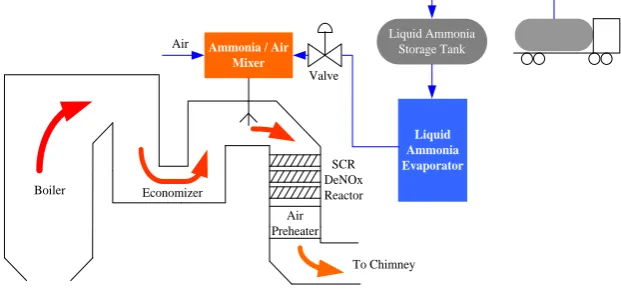
The SCR de-NOx system of the No. 6 coal-fired boiler of a power plant in Inner Mongolia was studied in this paper. The schematic process is shown in Figure 1.
Liquid Ammonia Storage Tank
Liquid Ammonia Evaporator Boiler Economizer
Air Preheater
To Chimney Ammonia / Air
Mixer Air
Valve
[image:2.595.141.452.174.322.2]SCR DeNOx Reactor
Figure 1. Schematic illustration of the SCR de-NOx system.
The flue gas generated from the boiler flows through the economizer, ammonia injection grid (mixed with air-diluted ammonia), and de-NOx system. The NOx in the flue gas reacts with the NH3 adsorbed on the catalyst to produce H2O and N2. Finally, the flue gas flows through the air preheater and downstream treatment units, and is discharged into the atmosphere through the chimney.
In the denitration process, the main reactions are listed as follows [2].
4NH3+4NO+O2 → 4N2+6H2O. (1)
2NH3+ NO +NO2 → 2N2+3H2O. (2)
8NH3+ 6NO2 → 7N2 + 12H2O. (3) According to the mechanism, the dominant factors affecting the reaction rate that can be measured should be the ammonia flow rate, reactor inlet NOx concentration, reactor outlet NOx concentration, and reactor inlet O2 concentration, reactor inlet temperature and total air volume.
As reported in literatures [9], the denitration efficiency of V2O5/WO3-TiO2 catalysts showed a volcanic trend against temperature at 220–480 ºC. The efficiency reached a maximum at 350–400 ºC. When the concentration of O2 in flue gas was higher than 1%, the influence of O2 concentration at the inlet of reactor on the reaction rate could be ignored. Figure 2 shows the variation of reactor inlet O2 concentration and temperature of the SCR reactor in a day in the present work.
Figure 2. Reactor inlet O2 concentration and temperature.
[image:2.595.146.444.614.742.2]which guarantees that the inlet temperature of the reactor is favorable to the SCR reaction. As shown in Figure 3, the inlet O2 concentration was maintained at 2%–5%, and the inlet temperature was maintained at 350–400 ºC, and thereby the influence of them on the outlet NOx concentration could be ignored.
In summary, the input variables of the modeling should include ammonia flow rate, reactor inlet NOx concentration, and total air volume.
SCR Dynamic Modeling
Data Selection
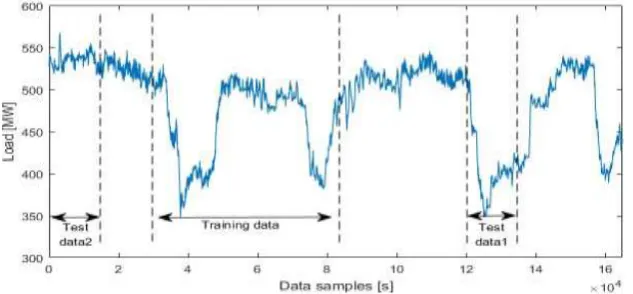
[image:3.595.136.453.317.464.2]Static and dynamic modeling requires different types of data. The former only selects several discrete stable operational data. But the latter needs continuous data that should contain information about the dynamic change of the system. In addition, the data should not be collected during malfunction. All the data were collected with an online system and recorded with a DCS database. 17280 data samples were collected at intervals of 10 s in two days. In general, the boiler load can reflect boiler operation.In general, the boiler load can reflect boiler operation. According to the load changes, select the training and test data shown in Figure 3.
Figure 3. Test and training data selected.
Because the data collected contain noise and a proportion of data are incorrect (i.e. outliers), data preprocessing is the prerequisite for data-driven modeling.With a reasonable cutoff frequency, the low-pass filter can eliminate both noise and outliers. The transfer function of the typical first-order low-pass filter can be expressed as follows:
( ) W s
s
. (4)
wherein ω is the cutoff frequency.
The different data after appropriate low-pass filtering, but also need to be normalized to remove the impact of units.The processed data can be used directly for model training and testing.
Neural Network Modeling
A nonlinear dynamic model can be described with the following NARMAX structure:
1 1 1 1
( ) ( ( ), ( 1), ( ), ( ), ( 1),
( ), ( 1), ( ))
p p
p p y
y t f u t u t u t n u t u t u t n y t y t n
… … …
… . (5) wherein u1, u2, …, and up are the input variables; y is the output variable. n1, n2, …, np, and ny represent the orders of u1, u2, …, up, and y, respectively.
Before modeling, the order of each variable need to be determined.If the orders selected are too low, the dynamic characteristics of the system cannot be well reflected; on the other hand, if the orders selected are too high, the overfitting of the model takes place.
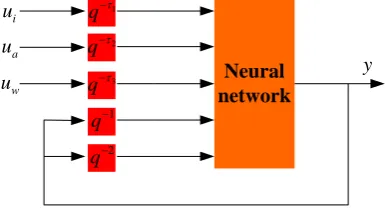
second-order-inertia-with-pure-time-delay transfer function. That is n1, n2, …, np=1, and ny=2. However, as the equilibrium changes, the parameters of the nonlinear model will change.When the parameter's delay time changes, it needs to increase its order accordingly.But in a small area, the delay can be approximated with a time constant. This will allow us to determine a suitable net delay and establish the model by changing the system parameters. So the structure of the NARX neural-network model of SCR de-NOx system can be expressed as follows:
1 2 3
( ) ( w( ), a( ), n( ), ( 1), ( 2))
y t f u t u t u t y t y t . (6) Wherein uw, ua, un, and y represent the total air volume, ammonia amount, inlet NOx
concentration, and outlet NOx concentration predicted by the model, respectively. τ1, τ2, and τ3 represent there delay time between the measurement of outlet NOx concentration. The model structure is shown in Figure 4.
Neural network 1
q
2
q
3
q
1
q
2
q
y
i
u
a
u
w
[image:4.595.198.391.243.348.2]u
Figure 4. Schematic structure of the SCR dynamic model.
Result and Discussion
Root mean square error (RMSE) can be used to evaluate the performance of a model. In addition, the RMSE of training data can function as the indicator for the generalization ability of a model. RMSE was calculated as follows:
2
1
1
= ( ( ) ( ))
n
k
RMSE o k y k n
. (7) wherein the number of samples is denoted by n; the actual and predicted output are represented by o and y, respectively. Using particle swarm optimization (PSO), the pure delay time is obtained as follows: τ1=9, τ2=9, and τ3=3. At this point, the model fits best with the training data. The RMSEs of test data set 1 and 2 are 7.5524 and 3.1691, respectively. It shows that the model has good accuracy and generalization ability. The output profiles of the model in both tests are shown in Figure 5. [image:4.595.75.528.578.731.2]Conclusions
In this paper, the input variables relative to the denitration process were verified based on the SCR de-NOx mechanism and the dominant variables were screened according to the features of the operation data of a coal-fired power plant. On the basis of the dynamic characteristics of the self-balancing process in the vicinity of an equilibrium state, we proposed a model-order optimization method with the fixation of delay time, based on the possible transformation between time delay and inertia time constant. In addition, the dynamic models, before and after the model-structure optimization, were established independently.
The comparison of the experimental results demonstrates that the reasonable model-structure optimization can improve the generalization ability of the neural-network model, resulting in the more accurate prediction of the model for the dynamic characteristics of the SCR de-NOx system.
Acknowledgment
This project was funded by the National Key R&D of China (Grant No: 2016YFB0600701) and the Hebei Province Natural Science Foundation of China (No. F2014502059). The authors would like to thank Engineer Geng B. of JingLong power plant for his assistance to collect the operation data.
References
[1] Feng, L., & Wang, L. (2009). Automatic control system of SCR flue gas denitrification and its application in Sanhe power plant. Thermal Power Generation.
[2] Topsøe, N. Y. (1994). Mechanism of the selective catalytic reduction of nitric oxide by ammonia elucidated by in situ on-line Fourier transform infrared spectroscopy. Science, 265(5176), 1217.
[3] Nova, I., Lietti, L., Tronconi, E., & Forzatti, P. (2000). Dynamics of SCR reaction over a TiO2-supported vanadia–tungsta commercial catalyst. Catalysis Today, 60(1–2), 73-82.
[4] Hu, Z., Gao, Y., Sun, W., Zhu, C., & Wang, H. (2011). Development of a Nonlinear Least Squares Method for the Model Parameterization of a SCR Model. Power and Energy Engineering Conference (pp.1-4). IEEE.
[5] Grbić, R., Slišković, D., & Kadlec, P. (2013). Adaptive soft sensor for online prediction and process monitoring based on a mixture of Gaussian process models. Computers & Chemical Engineering, 58(22), 84-97.
[6] Hecht-Nielsen, R. (1989). Theory of backpropagation neural networks. International Joint Conference on Neural Networks (Vol.1, pp.593-605 vol.1). IEEE Xplore.
[7] Yang, T., Cui, C., Lv, Y., & Li, J. (2015). Modeling on SCR process of a coal-fired boiler using LSSVM method. Control and Decision Conference (pp.4025-4028). IEEE.
[8] Zhang, Z., & Kon, M. A. (2017). Wavelet sampling and generalization in neural networks. Neurocomputing.
[9] Liu, X., Wu, X., Xu, T., Weng, D., Si, Z., & Ran, R. (2016). Effects of silica additive on the NH3-SCR activity and thermal stability of a V2O5/WO3-TiO2 catalyst. Chinese Journal of Catalysis, 37(8), 1340-1346.