2017 2nd International Conference on Software, Multimedia and Communication Engineering (SMCE 2017) ISBN: 978-1-60595-458-5
Ptychographic Algorithm Using Dual-Tree Complex Wavelet Transform
Shu-zhen CHEN
1, Li-fen PEI
1and Bao-shun SHI
1,21School of Information Science and Engineering, Yanshan University, Qin Huangdao, Hebei, China 2CETC Key Laboratory of Aerospace Information Applications, Shi Jiazhuang, Hebei, China
Keywords: Ptychography, Phase retrieval, Dual-tree complex wavelet transform, Alternating direction method of multipliers.
Abstract. Reconstructing the interesting complex image from multiple diffraction patterns is the goal of the ptychography. Previous ptychographic algorithms often suffer from low reconstruction quality under the low overlap ratios. To address this issue, we proposed a novel ptychographic phase retrieval (PR) algorithm of exploiting the sparsity of the image in dual-tree complex wavelet domain. The Fourier magnitude measurements are utilized to construct a data fidelity term, and the sparse representation model of the image over the dual-tree complex wavelet transform is utilized for the sparse induced regularization term. The data fidelity term and the proposed regularization term are combined to formulate a ptychographic PR optimization problem. Alternating direction method of multipliers (ADMM) and gradient descent algorithm are utilized for solving the corresponding optimization problem. Compared with previous algorithms, the experimental results indicate that the proposed algorithm can obtain reconstructed images with high quality even at low overlap ratios.
Introduction
Ptychography [1] which breakthroughs the resolution limit of the optics is a new kind of lens-less imaging technology. How to recover the interesting image or object accurately from the observed diffraction pattern is a challenge. Recent years, various algorithms have been proposed to address this problem. Among these algorithms, Ptychographical Iterative Engine (PIE) algorithm [2] proposed by Rodenburg and Faulkner is a popular one. Experimental results indicate that this algorithm can obtain reconstructed image with high quality via multiple diffraction patterns. Subsequently, Maiden et al. extended the PIE algorithm, and proposed the Extended Ptychographical Iterative Engine (ePIE) algorithm [3]. The ePIE algorithm can not only reconstruct the complex amplitude information of the image, but also can reconstruct the complex amplitude information of the probe by updating the probe location. Wen et al. [4] formulated the ptychographic phase retrieval problem, and exploited the alternating direction method of multipliers (ADMM) [5] technique to solve the corresponding problem.
Ptychographic Phase Retrieval
In the ptychography setup, an illuminating beam illuminates the different locations of image by moving the probe, and multiple diffraction patterns are recorded. The process can be described as
( ) [ ( + ) ( )] , 1,..., .
i P R Oi i N
b F r r (1)
Here, F is Fourier transform, P( )r is a probe, Ri is a translational vector, O( )r is the unknown object of interest.
Mathematically, the observed model can by described as:
, 1,..., .
i i i N
b FQ x (2)
Here, Qi represents theillumination matrix which corresponds to the i position of the probe. x is the underlying image or object.
Our ultimate goal is to reconstruct x, therefore we consider to tackle the following problem [7]:
2 2 1
1
ˆ arg min{ }
2
N
i i i
x
x FQ x b . (3)
The above image reconstruction model indicates that the image we want to recover matches with the measured diffraction pattern. Since image prior information is not utilized in the above model, solving it effectively cannot obtain reconstructed images with high quality, especially at the low overlap ratio. Therefore, the prior knowledge is required to enable its accurate reconstruction. Incorporate the image regularization term into the model (3):
2 2 1
1
ˆ arg min{ ( )}.
2
N
i i i
R
x
x FQ x b x (4)
where 0 is the regularization parameter, and R( )x represents the regularization term which indicates the corresponding priors that utilized in image reconstruction.
Ptychographic Imaging Algorithm Based on Dual-tree Complex Wavelet Transform
Dual-tree complex wavelet can represent the image texture sparsely, therefore, it can effectively capture the image texture information. We exploit the sparsity of the image under the dual-tree complex wavelet transform to formulate the following optimization problem:
2
1 0 2 0
2 1
1 ˆ ˆ
{ , } arg min{ }
2
N
j
i i
i
e
φ m,φ
m φ FQ m b Wm Wφ . (5)
Here, m is the underlying amplitude, φ is the underlying phase. 1, 2 are penalty parameters. W is the dual-tree complex wavelet transform.
We exploit the ADMM technique to solve the above ptychographic phase retrieval problem. We introduce a set of intermediate variables zi FQ mi ejφ, tm, yφ. The augmented Lagrangian function of (5) is defined as:
1 2
2
1 2 2 1 0 2 0
, , , , , , , 1
2 2 2
1 2 2 1 2 3 2 2
1
1 ˆ ˆ
ˆ ˆ ˆ ˆ ˆ
ˆ
{ , , , , , , , } arg min {
2
}
i i
N
i i i i
i N
j
i i i
i
e
z t m y φ ζ ζ u
φ
z t m y φ ζ ζ u z b Wt Wy
FQ m z u m t ζ φ y ζ
(6)
Here, 1, 2, 3 are the relaxation parameters, ζ ζ u1, 2, i are the scaled dual variables. We exploit
1) Fix the other variables, and update the variable zi:
1 2
2 1 1
1
2 2
1 1
1
arg min{ }
2
k
i
N N
k k j k
i i i i i i
i i
e
φ z
z z b FQ m z u . (7)
To minimize the above cost function, the phase of k
i
z needs to satisfy 1
1 1
( k )
k k j k
i i e i
φ
z FQ m u . Therefore, the optimization of zi can be translated into the
optimization problem about zi :
1 2
2 1 1
1
2 2
1 1
1
arg min{ }.
2
k
i
N N
k k j k
i i i i i i
i i
eφ
z
z z b z FQ m u
(8)The closed-form solution to the above problem is:
1 1 1 1 1 2 1 2 k
k j k
i i i
k i e φ
b FQ m u
z . (9)
Therefore, the optimal solution of zi is:
1
1 1
( k jk k )
i i
k j e k
i i e
FQ m φ u
z z . (10)
2) Fix the other variables, and update the variable t:
2
1 1
1 0 2 1 2
arg min{ }
k k k
t
t Wt m t ζ . (11)
The above problem can be solved by using the hard threshold operator [8]:
1 2
1 1 1
1
T [ ( )]
k k k
t W W m ζ . (12)
Here, T ( ) , ( )
,
τ
x abs x τ
x
otherwise
0 is the hard threshold operator, τ is the threshold value,
1
W is
dual-tree complex wavelet inverse transform. Through a large number of experiments, the series of dual-tree complex wavelet transform is 5.
3) Fix the other variables, and update the amplitude m:
1 1 2 1 2
1 2 1 2
2 1
arg min{ k }
N
k j k k k k
i i i
i
e
φ m
m FQ m z u m t ζ . (13)
Let 1 1
= Diag( k )
k j
e
φ
E , (13) can be rewritten as:
2 2
1 1 1
1 2 2 1 2
1
arg min{ }
N
k k k k k k
i i i
i
m
m FQ E m z u m t ζ . (14)
The closed-form solution to the above problem is:
1 1 1
2 1 1
1 1 1 2 1 1 ( ) ( ) ( ) ( ) N
k k k H H H k k
i i i
k i
N
k H H k i i i
t ζ E Q F z u
m
E Q Q E
. (15)
Here, FH, H i
Q , 1 ( k )H
E is the conjugate transpose of F,Qi,
1
k
2
1 1
2 0 3 2 2
arg min{ }
k k k
y
y Wy φ y ζ . (16)
Using the hard threshold operator to solve the above problem, and obtain:
2 3
1 1 1
2
T [ ( )]
k k k
y W W φ ζ . (17)
5) Fix the other variables, and update the phase φ:
2 2
1 1
1 2 3 2 2
1
arg min{ }
N
k k j k k k k
i i i
i
e
φ φ
φ FQ m z u φ y ζ . (18)
Denote the cost function of the above optimization problem as f( )φ , and the first-order derivative of φ is:
1 1
1 3 2
1
( ) 2 { ( ) [ ( )]} 2 ( )
N
j k H H k j H H k k k k
i i i i i
i
f je e
φ φ
φ m Q Q m Q F z u φ y ζ . (19)
Here, (mk H) is the conjugate transpose of mk. The gradient descent algorithm is utilized to solve the optimization problem. Through a large number of experiments, the number of gradient descent is 15, set j15, the initial value is φ φ0= k-1. The gradient descent method can be expressed as:
1 1
( ),
j j j
f
φ φ φ
(20) where is step length factor. As a result, the optimal solution of φ is:
.
k j
φ φ (21) 6) Fix the other variables, and update scale dual variables ζ ζ u1, 2, i:
1 1 1
1 2 2
1
( )
( )
( k ).
k k k k
k k k k
k k k j k
i i i e i
φ
ζ ζ m t
ζ ζ φ y
u u FQ m z
(22)
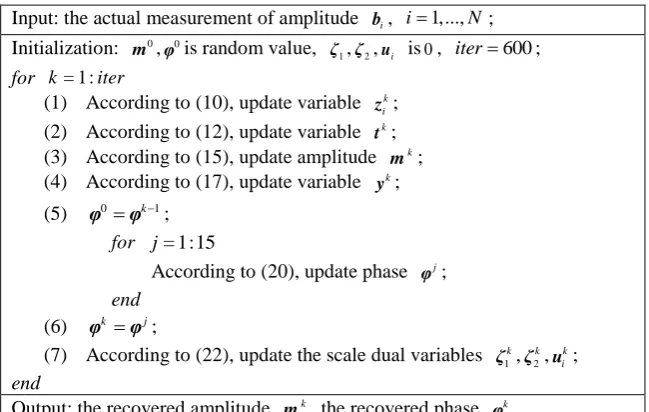
[image:4.595.136.461.565.771.2]The ptychographic algorithm based on the dual-tree complex wavelet transform (ADMM_DTCWT) is presented in Table 1.
Table 1. The proposed ptychographic algorithm. Input: the actual measurement of amplitude bi, i1,...,N;
Initialization: 0
m ,φ0is random value, 1
ζ ,ζ2,ui is0, iter600;
for k = 1:iter
(1) According to (10), update variable k i
z ; (2) According to (12), update variable k
t ; (3) According to (15), update amplitude k
m ; (4) According to (17), update variable k
y ; (5) φ0φk1;
for j= 1:15
According to (20), update phase φj; end
(6) φk φj;
(7) According to (22), update the scale dual variables ζ1k, 2 k
ζ , k i
u ;
end
Output: the recovered amplitude k
The Experimental Results
The standard gray images Lena and Peppers shown in Figure 1 are utilized to construct the amplitude and the phase of the original image respectively. The size of image is 512 512 . The pixel value of the amplitude is [0.2,1] , the pixel value of the phase is [0, ] . In this paper, using circular hole as probe function, radius of round hole is 80 pixels, scanning positions are four lines and four columns. We tune the overlap ratio by moving the center of circular hole in the horizontal direction and vertical direction. [0, 2 ]r is the distance between the adjacent circle hole center,
r is the radius of round hole. The definition of the overlap ratio [9] is:
2
= 100
2
r
% r
. (23)
The traditional ptychographic phase retrieval algorithm generally chooses the overlap ratio between 50%~80%. To demonstrate the superiority of the proposed algorithm, this paper chooses the overlap ratio less than 50%. The experiments have no noise and noise. No noise, the experiment chooses different overlap ratio; Noisy, adding different noise intensity under different overlap ratio. In this paper, using Peak Signal to Noise Ratio (PSNR) and Rooted Mean Square Error (RMSE) to evaluate the quality of reconstructed image, the higher PSNR, the lower RMSE, the higher quality of reconstructed image. In order to ensure the fairness, the number of iterations are 600 times, all algorithms use the random initial value, making 16 times experiments independently, and calculating the mean value of PSNR and RMSE after 16 times.
[image:5.595.169.428.368.471.2]
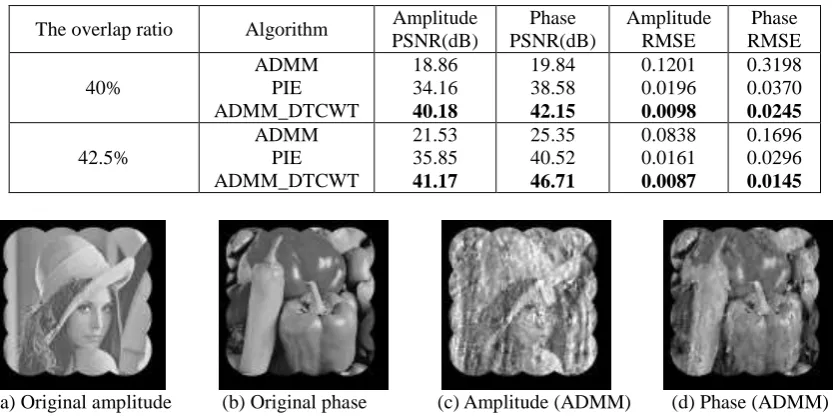
(a) Lena (b) Peppers Figure 1. The standard gray images for testing in the experiments. Table 2. The reconstructed results of amplitude and phase (No noise). The overlap ratio Algorithm Amplitude
PSNR(dB)
Phase PSNR(dB)
Amplitude RMSE
Phase RMSE 40%
ADMM PIE ADMM_DTCWT
18.86 34.16
40.18
19.84 38.58
42.15
0.1201 0.0196
0.0098
0.3198 0.0370
0.0245
42.5%
ADMM PIE ADMM_DTCWT
21.53 35.85
41.17
25.35 40.52
46.71
0.0838 0.0161
0.0087
0.1696 0.0296
0.0145
[image:5.595.90.507.508.716.2]
[image:6.595.202.512.69.164.2]
(e) Amplitude (PIE) (f) Phase (PIE) (g) Amplitude (ADMM_DTCWT) (h) Phase (ADMM_DTCWT) Figure 2. The reconstructed results of three algorithms.
Noiseless Case
Under the noiseless case, the overlap ratios are 40% and 42.5%. The ADMM algorithm and PIE algorithm are selected as the benchmark algorithms. When the overlap ratio is 40%, parameters are:
1=0.38
, 2=0.31 , 3=0.1 , =0.4 , =0.75 , if k500 , 1=0.1-0.0001998k ,
2=0.004-0.0000078k
, otherwise 1=0.0001, 2=0.0001. When the overlap ratio is 42.5%,
parameters are: 1=0.38, 2=0.31, 3=0.001, =0.4, =0.75, if k500, 1=0.2-0.0003998k,
2=0.004-0.0000078k
, otherwise 1=0.0001, 2=0.0001. The recovered results are presented in Table 2. One can see from the table that the reconstructed result of the proposed algorithm is superior to other algorithms. Figure 2 shows the result at the overlap ratio 40%. From Figure 2, compared with other algorithms, one can see that ADMM algorithm cannot recover the image effectively. One can see that PIE is obviously better than results of the ADMM algorithm, outlines of amplitude and phase are relatively clear, but there are still obvious local twill. However, the proposed algorithm can reconstruct the amplitude and phase effectively. The experimental results show that the dual-tree complex wavelet transform is effective.
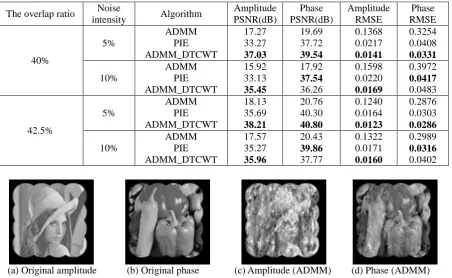
Table 3. The reconstructed results of amplitude and phase. The overlap ratio Noise
intensity Algorithm
Amplitude PSNR(dB)
Phase PSNR(dB)
Amplitude RMSE
Phase RMSE
40%
5%
ADMM PIE ADMM_DTCWT
17.27 33.27
37.03
19.69 37.72
39.54
0.1368 0.0217
0.0141
0.3254 0.0408
0.0331
10%
ADMM PIE ADMM_DTCWT
15.92 33.13
35.45
17.92
37.54
36.26
0.1598 0.0220
0.0169
0.3972
0.0417
0.0483
42.5%
5%
ADMM PIE ADMM_DTCWT
18.13 35.69
38.21
20.76 40.30
40.80
0.1240 0.0164
0.0123
0.2876 0.0303
0.0286
10%
ADMM PIE ADMM_DTCWT
17.57 35.27
35.96
20.43
39.86
37.77
0.1322 0.0171
0.0160
0.2989
0.0316
0.0402
[image:6.595.74.527.439.717.2]
[image:7.595.60.524.67.166.2]
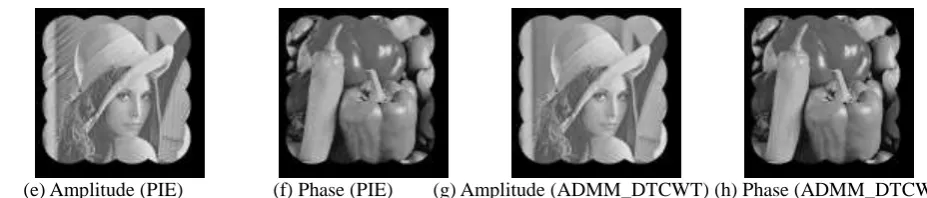
(e) Amplitude (PIE) (f) Phase (PIE) (g) Amplitude (ADMM_DTCWT) (h) Phase (ADMM_DTCWT) Figure 3. The reconstructed results of three algorithms (Noise intensity is 5%).
Noise Case
The noise intensity 5% and 10% (refer to reference [10]) of the Gaussian noise are added onto the true diffraction patterns, and we utilized the noise diffraction patterns for image reconstruction. When the overlap ratio is 40%, the parameters are: 1=0.38, 2=0.31, 3=0.1, =0.4, =0.75; When noise intensity is 5%, if k500, 1=0.1-0.00019988k, 2=0.004-0.0000078k, otherwise
1=0.0006
, 2=0.0001. When the noise intensity is 10%, if k500, 1=0.1-0.00019988k ,
2=0.004-0.0000068k
, otherwise 1=0.0006, 2=0.0006. When the overlap ratio is 42.5%, the parameters are: 1=0.38, 2=0.31, 3=0.01, =0.4, =0.75. When noise intensity is 5%, if
500
k , 1=0.1-0.0001998k , 2=0.001-0.0000018k , otherwise 1=0.0001, 2=0.0001. When noise intensity is 5%, if k500 , 1=0.1-0.00019988k , 2=0.01-0.0000188k , otherwise
1=0.0006
, 2=0.0006. One can see from Table 3, the PSNR of the reconstructed amplitude is higher than the benchmark algorithms, and the RMSE of reconstructed amplitude obtained by the proposed algorithm is lower than the benchmark algorithms. Figure 3 shows the results at noise intensity 5% case. We can see from Figure 3, ADMM algorithm cannot recover the outline of amplitude and phase. The amplitude and phase are reconstructs by PIE algorithm have obvious twill. The proposed algorithm reconstructs outline and detail clearly. The experimental shows that the proposed algorithm is robust to noise.
Conclusion
In this work, we have presented a ptychographic imaging algorithm. The dual-tree complex wavelet which can represent the image texture information effectively is utilized to construct the spare representation regularization term. The ptychographic phase retrieval optimization problem of utilizing the DDWT is formulated, and the ADMM technique is utilized to solve it effectively. The experimental results validate that the proposed algorithm can reconstruct the amplitude and phase effectively under the low overlap ratio, compared with PIE algorithm and ADMM algorithm. Moreover, the proposed algorithm is robust to noise.
Acknowledgments
This work was supported by the Natural Science Foundation of Hebei Province under Grant F2014203076, the Open Fund Project of CETC key laboratory of aerospace information applications under Grant EX166290016.
References
[1] J M Rodenburg, Ptychography and related diffractive imaging methods, J. Advances in Imaging and Electron Physics. 2008, 150(07): 87-184.
[3] A M Maiden, J M Rodenburg, An improved ptychographical phase retrieval algorithm for diffractive imaging, J. Ultramicroscopy. 2009, 109(10): 1256-1262.
[4] Z Wen, C Yang, X Liu, Alternating direction methods for classical and ptychographic phase retrieval, J. Inverse Problems. 2012, 28(11): 4666-4669.
[5] S Boyd, N Parikh, E Chu, B Peleato, Distributed optimization and statistical learning via the alternating method of multipliers, A. Foundations and Trends in Machine Learning, C. 2010, 3(1): 1-122.
[6] N Kingsbury, The dual-tree complex wavelet transform: a new efficient tool for image restoration and enhancement, J. European Signal Processing Conference. 1998: 319-322.
[7] N G Kingsbury, Complex wavelets for shift invariant analysis and filtering of signals, J. Applied and computational Harmonic Analysis. 2001, 10(3): 234-253.
[8] T Blumensath, M E Davies, Iterative thresholding for sparse approximations, J. Journal of Fourier Analysis and Applications. 2008, 14(5): 629-654.
[9] O Bunk, M Dierolf, S Kynde, Influence of the overlap parameter on the convergence of the ptychographical iterative engine, J. Ultramicroscopy. 2008, 108(5): 481-487.