2016 Joint International Conference on Artificial Intelligence and Computer Engineering (AICE 2016) and International Conference on Network and Communication Security (NCS 2016)
ISBN: 978-1-60595-362-5
The Application of GA-BP Neural Network
on Parameter Inversion of Wedge
Yu ZHANG
1,a, Jing JIA
1,b, Qing-Bang HAN
1,c,*,
Xue-Ping JIANG
1,d, Ming-Lei SHAN
1,e, Chang-Ping ZHU
1,f1Faculty of Internet of Things Engineering, Hohai University,
Changzhou, Jiangsu, China
a[email protected], b[email protected], c[email protected], d[email protected], e[email protected], f[email protected]
*Corresponding author
Keywords: Inversion, Wedge Wave, Dispersion, BP Neural Network, Genetic Algorithm.
Abstract: An inversion model based on neural network combined with genetic algorithm was established to obtain the material parameters of an unknown wedge. Firstly, a back propagation (BP) neural network was introduced and the genetic algorithm was implied to optimize the initial weights and thresholds of the BP neural network. Wedge wave dispersion curves with different angles, density and young’s modulus were obtained by simulation. Then the phase velocity of first-order mode in the anti-symmetrical flexural mode was chosen as the inputs of our inversion model, the corresponding parameters were taken as the outputs. The first-order mode data measured from samples were used to test the validity. It is found that the inversion models can inverse angle, density and young’s modulus simultaneously. Compared with the single BP neural network, it has the advantages of fast convergence speed and high precision.
Introduction
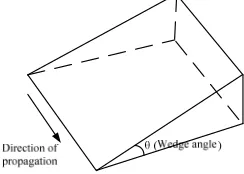
Wedge-shaped parts are common in industry, such as metal wedges, ramp pads. They are usually for the installation and leveling of equipment. Fig.1 shows the simplified wedge model. Under the impact of the temperature and humidity of complex environment, various defects occur near the tip of the wedge or in other parts. It is necessary to assess the health and determine the parameters of the wedge to replace the rusty wedge on time.
Elastic Wedge Wave (EWW for short) is the guided wave propagates along the tip of the wedge found by Lagasse and his co-workers [1]. Its anti-symmetrical flexural mode has many features, including low phase velocity (far less than Rayleigh velocity), energy concentration and the characteristic of dispersion [2]. These features make it possible to detect the wedge. Influenced by the angle and material parameters, multi-mode and dispersion will occur during the propagation. Dispersion character is an important index to assess and detect the wedge.
Now, there are several approximate theories about wedge dispersion, McKenna’s plate theory [3]and Krylov’s geometrical-acoustic theory [4]. The dispersion contains information of wedge angle and material parameters. Nevertheless, approximate theories cannot clearly express the complicated relation between dispersion and parameters.
[image:1.612.245.367.638.725.2]
Artificial neural network has a strong fault-tolerant, self-organization and generalization. It does not need the exact relationship between the input and output which make it suitable for solving complex nonlinear problem [5]. The first-order mode phase velocity of the elastic wedge wave was set as the neural network input and the corresponding parameters (wedge angles, density, and young’s modulus) were set as outputs. The relationship between phase velocity and wedge parameters can be obtained after the neural network trained. Then the trained neural networks can be used to solve the wedge parameter inversion. For a single neural network, it has the shortcomings of slow convergence, long training time and low accuracy [6]. In this paper genetic algorithm was introduced to train the neural network. After the genetic algorithm being implied, the initial threshold and weight can be optimized, then the optimized values were taken to train the neural network to establish GA-BP inversion model [7]. Finally, the experimental results were taken into the inversion model to obtain experimental wedge angle, density, young’s modulus. The results in this paper can provide a theoretical basis for the study of wedge wave dispersion.
EWW Dispersion and GA-BP Neural Network Analysis of Eww Dispersion and Inversion
Lagasse’s research on elastic wedge wave showed the wave velocity was influenced by VR、n、θ.
VR is the Rayleigh wave velocity, n is the order of the wedge wave modes, θ is the wedge angle. VR
is mainly affected by the young’s modulus and density of the material. Lagasse’s theory gives the
constraint that n*θ<90 ° which can draw there are always the first-order modes in 0 ~ 90 ° wedge.
Forward modeling can be established between the phase velocity and material parameters.
1
( , , , )
F E f A (1)
θ、ρ、E are the wedge angle, wedge density and wedge young’s modulus. A1 is the corresponding
first-order phase velocity. ∆f is the range of frequencies of first-order phase velocity; F is the
mapping relationship between θ, ρ, E, ∆f and A1.
The aim of this paper is to get parameters of samples by GA-BP inversion model trained by simulation data. After taking first-order dispersion phase velocity of samples into the trained genetic BP neural network, we will get the parameters of the samples.
GA-BP Neural Network
BP (Back Propagation) neural network is currently the most widely used neural network. Using a gradient descent algorithm to adjust the weights and thresholds, the learning process will shock. Low convergence is another shortcoming [8].
GA (genetic algorithm) is a global optimization iterative algorithm. GA has selection, crossover and mutation three processes. GA is often used in BP neural network to search optimum weight and threshold. The combination of GA and BP neural network can overcome the shortcomings of BP neural network, speed up the network training and improve the accuracy of the inversion of the network [9].
The Inversion of Wedge Parameters
Fig.2 is a wedge simulated by COMSOL with the θ= 24 °, ρ = 7800kg / m3, E = 190Gpa, t = 6μs.
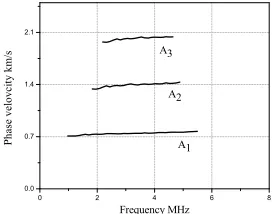
Dispersions shown in Fig.3 can be obtained by taking an array of dots matrix along the direction of the propagation together with the Two-dimensional Fourier Transform [10]. Fig 3 contains three
Figure 2. Displacement of the wedge tip along the y-axis at 6μs in Simulation.
0 2 4 6 8
0.0 0.7 1.4 2.1
Ph
as
e v
elo
vc
ity
km
/s
Frequency MHz A1 A2 A3
Figure 3. Dispersion curves obtained by simulation.
The phase velocity of A1 in ∆f=1~6MHz were set as the inputs and the corresponding parameters
[image:3.612.143.468.478.580.2]were set as the outputs. We totally applied two hundred simulation data with different parameters to train the inversion model. In the experiment, five samples were detected by the reflected optical difference technique system. Data processing method as previously described. Table.1 gives the true parameter values of the experimental wedge GA-BP inversion results are shown in table.2. In order to verify the effect of inversion model we proposed in this paper, the single BP neural network is also adopted to the inversion, the results as shown in table .3.
Table 1. True values of experimental samples.
θ ρ E
1 20 2700 70
2 25 2700 70
3 30 2700 70
4 45 2700 70
[image:3.612.147.466.616.748.2]5 60 2700 70
Table 2. Results of inversion by GA-BP neural network.
θ ρ E
1 21 2931 74
2 26 2900 66
3 27 2871 73
4 43 2560 75
5 63 2480 68
Mean relative error
Table 3. Results of inversion by BP neural network.
θ ρ E
1 17 3038 63
2 22 2990 76
3 34 3135 78
4 40 2922 79
5 66 3200 65
Mean relative error
12.3% 13.2% 10.0%
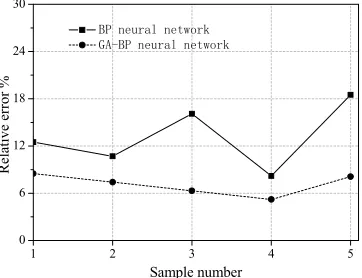
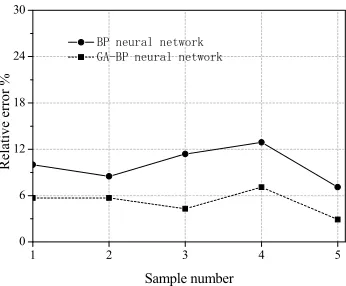
In table.2, average relative errors of angle, density and young’s modulus in GA-BP inversion model are 5.7%, 7.1% and 5.1%, average relative errors in single BP inversion model are 12.3%, 13.2% and 10.0%, GA-BP inversion model has a higher precision than single BP.
The relative errors of each parameters in two inversion models are shown in Fig 4~ Fig.6.
1 2 3 4 5
0 6 12 18 24 30
Rela
tive error
%
Sample number
BP neural network GA-BP neural network
Figure 4. Relative error of angle inversion in two models.
1 2 3 4 5
0 6 12 18 24 30
R
elative er
ror %
Sample number
BP neural network GA-BP neural network
[image:4.612.218.399.456.595.2]
1 2 3 4 5 0
6 12 18 24 30
Relati
ve err
or
%
Sample number BP neural network GA-BP neural network
[image:5.612.221.394.78.221.2]
Figure 6. Relative error of young modulus inversion in two models.
The relative error of each inversion parameter in GA-BP inversion is less than that in single BP inversion.
Table.4 shows the training time to reach the required convergence in two models Table 4. Training time of two models.
Inversion model Training time
GA-BP 11min34s
BP 30min2s
Table.4 shows that the BP inversion need much more time to train the network which means the GA-BP is more efficient.
Summary
In this paper, the GA-BP neural network model was introduce on the inversion of the wedge angle, density, young’s modulus, several conclusions can be drawn:
(1)Neural network combined with genetic algorithms can improve the inversion and reduce the calculation time.
(2)Inversion parameters with simulation data is feasible and has a certain engineering value.
Acknowledgment
This research was financially supported by the National Science Foundation of China Grant No. 11274091, 11274092, 11574072 and the Fundamental Research Founds for the Central Universities
of Hohai University No. 2011B11014, 2015B04714, 2015B04614.
References
[1] Lagasse P.E., Analysis of a dispersion free guide for elastic waves. Electronics Letters, 1972,
8(15): 372~373.
[2] Edwards R.S., Dutton B., and Clough a R. et al. Enhancement of ultrasonic surface waves at
wedge tips and angled defects. Applied Physics Letters, 2011, 99(9): 094104-1-094104-8. McKenna J.
[3] Boyd G.D., Thurston R.N. Plate theory solution for guided flexural acoustic waves along the tip
[4] Krylov, V., V. On the velocities of localized vibration modes in immersed solid wedges. The Journal of the Acoustical Society of America, 1998, 103(2): 767~770.
[5] Pan Hao, Wang Xiao-Yong, Chen Qiong et al. Application of BP neural network based on
genetic algorithm, J. Journal of Computer Applications, 2005, 25(12): 2777~2779.
[6] Li Hong-bin, Xu Chu-lin, Wen Zhou-bin. The application of BP neural network in
loudspeaker’s Rub & Buzz detection. Technical Acoustics, 2014, 33(6): 522~525.
[7] Liu Hong-lin, Hu Jian, Wang Jin-shan et al. The application of GA+BP hybrid neural network
to inter-bed deposit prediction, J. Geophysical & Geochemical exploration, 2004, 28(5): 462~466Wang.
[8] Xiao-ping, Cao Li-ming. Genetic algorithm: Theory, Application and Software implementation.
Xi'an. Xi'an Jiao tong University Press, 2002.
[9] Zhang Xue-lei, Feng Jie. A new genetic algorithm for matched-field inversion. Technical
Acoustics, 2015, 34(5): 462~466.
[10]Alleyne D., Cawley P. A two-dimensional Fourier transformation method for the measurement