2017 2nd International Conference on Computer, Network Security and Communication Engineering (CNSCE 2017) ISBN: 978-1-60595-439-4
Using Non-volatile Memories for Browser Performance Improvement
Seongmin KIM and Taeseok KIM
*Department of Computer Engineering, Kwangwoon University 20, Gwangun-ro, Nowon-gu, Seoul, Korea
*Corresponding author
Keywords: Non-volatile memories, Caching, Performance.
Abstract. How to effectively use the non-volatile memories in the computing devices is a still open problem. In this paper, we present an efficient approach that uses the non-volatile memories for performance improvement of browser, which is one of key applications. By caching the popular web resources in the non-volatile memories that have fast data access speed, we could reduce the user-perceived performance up to 33% with real workloads.
Introduction
With the fast advance of semiconductor technologies, research and development of non-volatile memories are being actively performed in academies and industries. The representative examples of non-volatile memories are STT-RAM, PCRAM, and ReRAM. Even though the physical characteristics of them are not identical, they are commonly fast, non-volatile, and byte addressable. The non-volatile memories are anticipated as the next generation storage media, and thus research domain is spreading in semiconductor devices, system architectures, and operating systems order [1-3].
How to effectively use the non-volatile memories in the computing devices is a still open problem. This paper focuses on how making use of the non-volatile memories for browsers. To the best of our knowledge, this is the first paper that presents an approach using the non-volatile memories for applications except for databases [4]. The browser is one of the most popular applications in the mobile devices. It is originally an application that retrieves and then presents the web resources like text and image from web servers, but now it has been evolved into a platform with the appearance of HTML5. Many users enjoy various services such as SNS (Social Network Services) and game through the browsers, so the performance of browser becomes more important. The performance of browser depends on resource loading time, page rendering time, and javascript execution speed [5]. Among them, slow resource loading time often becomes a performance bottleneck in mobile devices, which are based on wireless network [6]. In order to reduce the resource loading time, caching technique can be an effective solution [7, 8]. It is more important in mobile environments because it can reduce the latency that is higher in the mobile network and improves the mobile device’s battery life [9]. By caching the web resources as files in the flash memory based storages like eMMC (embedded Multi-Media Cards) and SSD (Solid State Drives), the resource loading time can be reduced when users revisit same web pages because the browser doesn’t need to download the same resources from the network again.
Non-volatile Memory Based Browser Caching Scheme
Modern browsers employ caching scheme that stores the web resources of the visited pages in the storage, and then uses them to render when users revisit that page. If the resources required for page rendering are same with the previously stored ones, the browser uses them in the storage rather than re-downloading them from network. If non-volatile memories with fast data access speed are used for browser cache and the caching algorithm is well designed, the resource loading time can be more reduced. Since the capacity of non-volatile memories may be limited due to high cost, the caching space should be carefully used. To this end, we employ two level caching architecture that consists of the first cache using the non-volatile memory and the second cache using the flash memory based storage. Although the non-volatile memory can be used as both main memory and storage, it is used as a block storage device in our work.
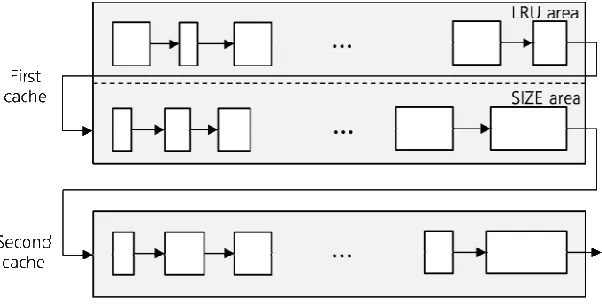
Figure 1 shows the operations of the proposed caching architecture. When a user requests a web page, the browser requests many resources belong to the page as the requested HTML document is parsed. It first looks up the resources in the first cache using non-volatile memory instead of sending the request to the network. If the requested resources exist on the first cache, they can be processed instantly. If they do not exist on the first cache, the browser looks them up in the second cache. If they are on the second cache, they are copied into the first cache and then processed. If the requested resources do not still exist on the second cache, the browser sends the requests for the resources to web server or proxy server.
Figure 1. 2-level browser caching architecture.
Figure 2. LRU+SIZE cache management scheme.
Figure 2 shows the operations of our LRU+SIZE caching scheme. If the first cache does not have sufficient free space, free space is reclaimed by moving less valuable resources to the second cache. When free space of the first cache becomes below a threshold, our scheme first moves the least recently used resources in the LRU area into the SIZE area. Note that several resources can be moved together from the LRU area to the SIZE area to obtain sufficient free space because the sizes of resources are different. When space of the SIZE area is also below the threshold, the largest resource is first moved into the second cache.
Finally, the second cache is maintained in the LRU order, so the least recently used resource is first removed. When a resource in the SIZE area of the first cache or a resource in the second cache is required again, the resource migrates into the LRU area of the first cache. If the space of the first cache is not sufficient for the migration operation, the above mentioned replacement process is performed again.
Performance Evaluation
To demonstrate the effectiveness using the fast non-volatile memories for the browser performance improvement, we implemented our scheme on QT-webkit. As the non-volatile memories are not available in our experiments yet, we used a small-sized DRAM with RAMDISK instead. Note that the I/O performance of DRAM is similar to that of STT-RAM, and a little higher than that of PCRAM or ReRAM [3]. We first gathered real workloads using browsinghistoryview tool, and they consist of 1,321 pages and 260,991 resources [11].
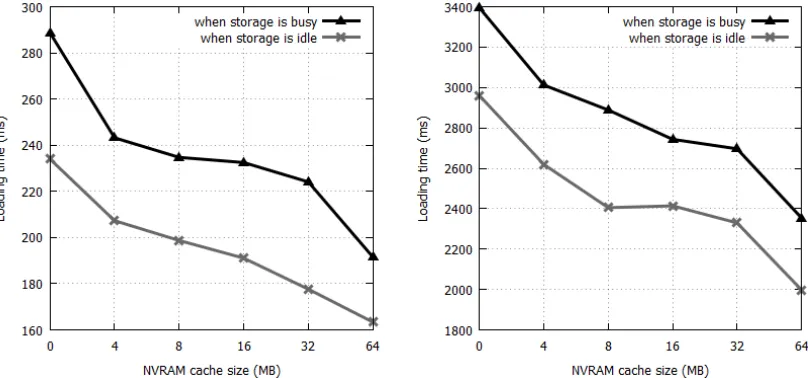
Figure 3 shows the average resource loading time. Our experiments have been performed with two scenarios: when the storage is busy and idle. We used the Bonnie++ as a background task for busy storage scenario, which is a benchmark tool that tests large file I/O and creation/deletion of small files [12]. We can see that the average resource loading time sharply decreases as the first cache size increases. If the first cache size is enough as 64MB, the average resource loading time decreases as 32% and 34% when storage is busy and idle, respectively.
Figure 3. Resource loading time. Figure 4. Page loading time.
Conclusion
A practical approach using non-volatile memories for application performance improvement was presented. We demonstrated that the web browser, which is one of the most popular applications could be improved with a small-sized non-volatile memory in terms of user-perceived performance. We believe that our scheme can be more improved by caching valuable in-memory structures such as render tree by exploiting the non-volatile feature.
Acknowledgement
This work is supported by IT R&D program MKE/KEIT (No. 10041608, Embedded System Software for New-memory based Smart Device). This research has been also conducted by the Research Grant of Kwangwoon University in 2015.
References
[1] H. Volos, A. J. Tack and M. M. Swift: ‘Mnemosyne: Lightweight persistent memory’, ACM SIGPLAN Notices 46, (3), 2011, pp. 91-104.
[2] J. Guerra, L. Mármol, D. Campello, C. Crespo, R. Rangaswami and J. Wei: ‘Software Persistent Memory’, USENIX ATC, 2012, pp. 319-331.
[3] T. Hwang, J. Jaemin and W. Youjip: ‘Heapo: Heap-based persistent object store’, ACM Trans. on Storage, 11, (1), 2015, no. 3.
[4] G. Oh, S. Kim, S. Lee and B. Moon: ‘SQLite optimization with phase change memory for mobile applications’, ACM VLDB Endowment, 8, (12), 2015, pp. 1454-1465.
[5] Z. Wang, F. X. Lin, L. Zhong and M. Chishtie: ‘How Far Can Client-Only Solutions Go for Mobile Browser Speed?’, ACM World Wide Web, 2012, pp. 31-40.
[8] K. Zhang, L. Wang, A. Pan and B. B. Zhu: ‘Smart caching for web browsers’, ACM World Wide Web, 2010, pp. 491-500.
[9] F. Qian, K. S. Quah, J. Huang, J. Erman, A. Gerber, Z. Mao, S. Sen and O. Spatscheck: ‘Web caching on smartphones: ideal vs. reality’, ACM MobiSys, 2012, pp. 127-140.
[10] Chromium: ‘Disk Cache’, Available at http://www.chromium.org/Home, 2008.
[11] NirSoft: ‘BrowsingHistoryView’, Available at http://www.nirsoft.net/utils/browsing_ history_view.html, 2012.
[12] Russell Coker: ‘Bonnie++’, Available at http://www.coker.com.au/bonnie++, 2001.