• No results found

High Precision Man machine Collaborative Assembly System

N/A
N/A
Protected

Academic year: 2020

Share "High Precision Man machine Collaborative Assembly System"

Copied!
5
0
0

Loading.... (view fulltext now)

Full text

(1)

2017 2nd International Conference on Computer, Mechatronics and Electronic Engineering (CMEE 2017) ISBN: 978-1-60595-532-2

High Precision Man-machine Collaborative Assembly System

Xin YE

1,*

, Yu-hong LIU

1

,

Hao WU

2

, Zhi-jing ZHANG

1

and Yi-jin ZHAO

1

1

School of Mechanical Engineering, Beijing Institute of Technology, Beijing, China

2Huaihai Industry Group Co. Ltd., 1 Huifeng Street, Changzhi, China

*Corresponding author

Keywords: Assembly, High precision, Adjustment, Controller.

Abstract. A high precision man-machine collaborative assembly system is designed by combining the high precision detection technology, the high precision displacement technology and the adaptive control technology. It mainly consists of the assembly execution subsystem, the precise adjustment subsystem, the visual alignment subsystem, the sensor monitoring subsystem, the clamping subsystem and the auxiliary subsystem.The assembly experiment of the shaft and hole with only 3.2µm assembly gap has proved that the assembly system can accomplish the high precision assembly under the partclearances of 2-3µm.It can liberate the labor force and improve the automation of production assembly.

Introduction

In recent years, it has become a hot research topic to realize the human-machine cooperation and automation of assembly which can liberate labor force and realize products’ consistency and reliability. A complete precision assembly system mainly involves the detection and adjustment technology, the clamping and operation technology and the motion control technology. An automatic system was developed by Song Liu et al to realize high precision assembly of two components in the size of mm level. The system consists of a manipulator, an adjusting platform, a sensing system and a computer [1]. Young-bong Bang et al presented a new micro assembly system which is composed of a micro gripper, a micro remote center compliance (RCC) unit, a voice coil motor-driving mechanism and precision motion stages [2]. To achieve a flexible and reconfigurable system, an experimental setup based on 4 degrees of freedom robot and a two-camera vision system was designed by G. Fontana et al [3].

In order to achieve high precision assembly, the assembly system should have enough freedoms to adjust. However, excessive axes will restrict the workspace and even lead to motion interferences and visuals disturbances. R. C. Montesanti presented a micro target assembly system which has 29 degrees of adjustment freedom [4]. And the MAPS assembly system also has 20 moving platforms [5]. A parallel assembly robot was proposed to assemble multiple micro-components simultaneously, in which the alignment correction algorithm was used to compensate for the visual occlusion defects [6]. The reasonable grippers can simplify the assembly system and reduce the unnecessary degrees of freedom. Chen et al designed a novel jaw gripper with human-sized anthropomorphic features to be suitable for precise in-hand posture transitions [7]. Benny H. B presented a six DOF reconfigurable gripper which can accurately clamp parts of different shapes for flexible fixtureless assembly [8].

Therefore, a perfect assembly system needs to adopt the reasonable detection technology, the high accuracy position adjustment and assembly technology, the non-destructive and reliable clamping technology and the stable motion control technology. This paper introduces a simple and high precision man-machine collaborative assembly system which can liberate the labor force and improve the consistency and reliability of the products.

The Assembly System

(2)
[image:2.612.165.441.126.332.2]

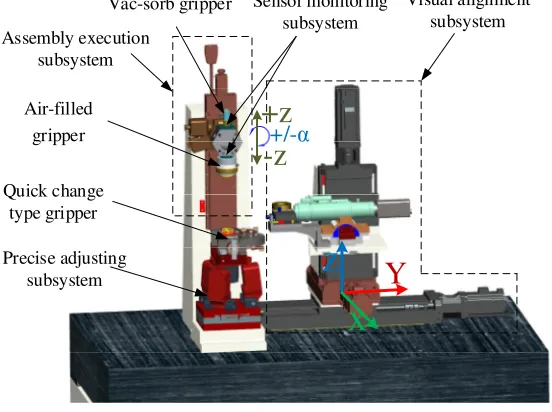
the visual alignment subsystem, the sensor monitoring subsystem, the clamping subsystem and the auxiliary subsystem. The clamping subsystem mainly includes a quick change type gripper, a vac-sorb gripper and an air-filled flexible gripper. A single axis sensor and a six axes force sensor connected with the grippers construct the sensor monitoring subsystem, as shown in Figure 1.

Figure 1. The high precision man-machine collaborative assembly system.

The assembly execution subsystem is equipped with a vertical displacement table and a 360 degrees turntable which has the vac-sorb gripper and the air-filled flexible gripper. It can finish the task of parts’ loading and unloading and the movement of precise assembly. The precise adjustment subsystem consists of a six DOF precision motion platform whose linear displacement precision reach 20nm and rotation accuracy up to 0.4 µrad. The platform is equipped with the quick change type gripper. This subsystem can achieve high precision adjustment of the clamping part. The visual alignment subsystem realizes the visual alignment and detection in the process of man-machine cooperation which based on the coaxial alignment methodology, as detailed description in the earlier article [9]. Because of the large size span of the assembly parts, a method of image stitching to fit the multi section arc to determine the center of the circle in order to ensure the assembly accuracy is used in this system. It can reduce errors of single edge recognition and improve the alignment and assembly accuracy of the system. In the assembly process, the sensor monitoring subsystem reads the assembly force information, and the six DOF precision motion platform adjusts in real time according to the micro force- micro displacement mapping method. The whole system is arranged in a modular way.For different parts to be assembled, it is necessary to change the gripper to achieve high precision assembly of different components.

The Control Structure

The control structure of the assembly system is shown in Figure 2. The UMAC core control card is mainly responsible for the movement control of electric motors and the reading of assembly force information. It calculates the micro displacements in real time according to the information. The visual alignment subsystem realizes the object’s image acquisition by a high resolution camera, an automatic zoom lens and the XYZ moving platforms. The image processing software stitches the images, and fits the center of the object position. The manual pulse generator is used to manually realize the advance and retreat of each displacement table.

According to assembly requirements, the control software of the assembly system mainly includes the equipment monitoring module, the data storage module, the motion control module and the touch screen development module.The equipment monitoring module is mainly responsible for monitoring the movement position of each moving table and the running state of each equipment.

Assembly execution subsystem

Quick change type gripper

Precise adjusting subsystem

Vac-sorb gripper

Air-filled gripper

Sensor monitoring subsystem

Visual alignment subsystem

z

Y

x

(3)

The data storage module is mainly used to store the images and movement paths. It also records the situation of each assembly.The lower PLC program and the upper program constitute the motion control module which is mainly responsible for the precise control of the whole assembly system. The touch development module is mainly used to receive instructions from the workers and transfer the information to the upper computer.

IPC

The man-machine interaction based on LABVIEW (19 inch touch

screen)

The mouse

The keyboard

USB

USB

VGA+USB UMAC The motion control card Ethernet port Motor drive The I/O card Step control card

LED light control Six axis force sensor

Camera Ethernet port Serial port Servo control card The 6-DOF precision motion platform Serial port

X axis servo motor Feedback

Motor drive Y axis servo motor Feedback

Motor drive Z axis servo motor

Motor drive Turntable motor Motor drive Assembly executive

motor Manual pulse generator Analog input card

Vacuum pneumatic system Air-filled pneumatic system The 6-DOF

precision motion platform controller

Motor drive Six axis position feedback Serial port

Lens focusing motor serial port

Single axis sensor Feedback

[image:3.612.139.476.133.401.2]

Feedback Feedback

Figure 2. The control system structure diagram.

`

Manual feeding Vision

Alignment

Fitting the center of the circle

Adjusting in real time

Resetting the visual alignment

subsystem Taking away the quick

change gripper

[image:3.612.169.442.421.721.2]
(4)

Assembly Process

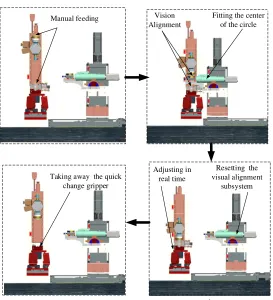
The critical position of the assembly system during assembly is shown in the Figure 3.First, the worker puts parts into the grippers. Second, after the relevant components move to the work area, the image processing software works and performs visual alignment. Then, micro assembly force is read in the assembly process and adaptive adjustment of micro position is carried out. Finally, the quick change gripper is removed to do other processing and the system returns to zero after the assembly is completed. The quick change type gripper can also be turned over 180 degrees to realize the function of assembly parts on the other side of the clamped part.

Experiment and Results

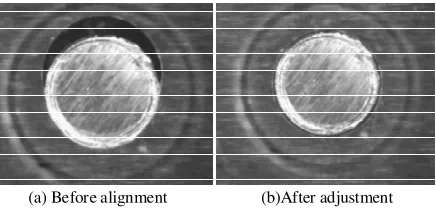
In order to verify the assembly accuracy of the assembly system, an assembly experiment was conducted using a shaft with a diameter of 2.994mm and a cylindricity of 0.0021mm, and a hole with a diameter of 2.997mm and a cylindricity of 0.0012mm. Completing a CCD coaxial alignment, six degrees of freedom micro platform in real-time adjustment, and then the final precise assembly movement. The visual images captured by the CCD camera are shown in Figure 4. Here, the difference between the diameters of the shaft and the hole is 3.1µm which is assumed that the single tolerance is not bigger than 2µm. It is proved by the experiment that the assembly system can accomplish high precision assembly under the partclearances of 2-3µm.

[image:4.612.198.416.320.424.2]

(a) Before alignment (b)After adjustment

Figure 4. The visual images.

Conclusion

In order to prevent the insufficient operation space and motion interferences, a simple high precision assembly system is designed. The system only has three visual displacement tables, a linear assembly platform, a 360 degrees turntable and a six DOF precision motion platform, which are only composed of 11 degrees of freedom. The images of assembly parts can be collected and spliced by the coaxial alignment technology, so that the precise assembly of both big and small size parts can be realized. The control structure and assembly process of the system are introduced. This system can accomplish the high precision assembly under the partclearances of 2-3µm, and it can liberate the labor force and improve the automation of production assembly.

Acknowledgements

This work was financially supported by the National Natural Science Foundation of China (51575052).

Reference

(5)

[2] Y. B. Bang, K. M. Lee, J. Kook, W. Lee, I. S. Kim, Micro parts assembly system with micro gripper and RCC unit, Ieee Transactions on Robotics. 21(2005) 465-470.

[3] G. Fontana, S. Ruggeri, I. Fassi, G. Legnani, A mini work-cell for handling and assembling microcomponents, Assembly Automation. 34(2014) 27-33.

[4] R. C. Montesanti, R. M. Seugling, J. L. Klingmann, E. G. Dzenitis, E. T. Alger, G. L. Miller, et al., Robotic System for Precision Assembly of NIF Ignition Targets, in Proceedings of the American Society for Precision Engineering 2008 Annual Meeting. (2008)19-24.

[5] A. N. Das, R. Murthy, D. O. Popa, H. E. Stephanou, A Multiscale Assembly and Packaging System for Manufacturing of Complex Micro-Nano Devices, Ieee Transactions on Automation Science and Engineering.9(2012) 160-170.

[6] H. K. Chu, J. K. Mills, W. L. Cleghorn, Parallel microassembly with a robotic manipulation system, Journal of Micromechanics and Microengineering.20(2010).

[7] F. Chen, L. Carbonari, C. Canali, M. D'Imperio, F. Cannella, Design of a novel dexterous robotic gripper for in-hand twisting and positioning within assembly automation, Assembly Automation.35(2015) 259-268.

[8] B. H. B. Yeung ,J. K. Mills, Design of a six DOF reconfigurable gripper for flexible fixtureless assembly, IEEE Transactions on Systems, Man and Cybernetics. Part C: Applications and Reviews. (2004) 226-235.

Figure

Figure 1. The high precision man-machine collaborative assembly system.
Figure 2. The control system structure diagram.
Figure 4. The visual images.

References

Related documents