2017 2nd International Conference on Communications, Information Management and Network Security (CIMNS 2017) ISBN: 978-1-60595-498-1
Research and Comparison of Smoothing Algorithms
for Geometric Solid Figures
Gang SU, Xin-rong HU, Tao PENG, Jia-li LI and Wang YIN
Wuhan Textile University, Wuhan, China 430073
Keywords: Polygonal mesh, Mesh smoothing, Surface subdivision, Triangular mesh.
Abstract. In computer graphics and computer aided design, polygon meshes are used to represent complex 3D entities. But the surface formed by polygon mesh is usually not smooth enough to form the real shape of the surface of the entity, and the mesh-smoothing method can solve the smooth problem of the 3D geometric solid surface effectively. Subdivision mesh-smoothing method is the main way to achieve smooth. This paper takes four triangular mesh subdivision algorithm like Loop Butterfly Sqrt3 PN-triangle of as examples and describes the rules of geometry and topology rules of mesh subdivision. Four algorithms are used to subdivide the same mesh model segmentation respectively and we made a comparative analysis of these four segmentation methods from many aspects of segmentation results and efficiency.
Introduction
The geometric stereoscopic pattern formed by polygonal patches can be used to represent complex three-dimensional entities, but the surface is not smooth enough to meet the requirements of practical application. Therefore, it is necessary to smooth the polygon mesh. Mesh smoothing can effectively solve the smooth problem of 3D geometric solid surface. At present, there are four types of main smoothing algorithms, namely Laplacian smoothing method, Curvature uniform method, Energy method and Surface subdivision technique [1]. In the four methods, the Surface subdivision technique is to represent a smooth surface by using a low-resolution control grid and a subdivision rule defined on the grid. Subdivision surface modeling technical rules are simple, topological adaptability, it has been widely used in surface design processing. The triangular mesh subdivision method has the advantages of good stability and no topological topology constraints. It can be used for the modeling of arbitrary topological meshes. The recursive structure is closely related to wavelet and multiresolution analysis [2]. Due to the characteristics of the triangular mesh subdivision surface, the triangular mesh is used to represent the various surfaces of the model. Not only can get a better visual effects, but also the three-dimensional grid model with different requirements can be obtained by controlling the number of triangular patches in the model[3].
This paper focuses on the principle of loop subdivision algorithm, Butterfly subdivision algorithm, Sqrt3 subdivision algorithm and PN-triangle subdivision algorithm, and implements these four kinds of surface subdivision algorithms by program. The program reads the 3D grid data and displays it with the OpenGL platform. At the same time, the experiment tries to test and compare the four kinds of subdivision algorithms by selecting the same three-dimensional grid model. When dealing with the grid model, the degree of approximation of the subdivision surface and the original mesh surface, the quality of the subdivision surface, Complexity and other performance indicators. The four subdivision algorithms are compared and analyzed from the principle of subdivision algorithm.
Typical Triangular Mesh Subdivision Algorithm
Loop Subdivision Algorithm
smoothness, but subdivision surfaces can produce greater shrinkage.Loop subdivision algorithm is a simple approximation subdivision algorithm, which has weak ability to retain the original features, especially the sharp features.Loop subdivision at the regular point can reach C2 continuous, at the singular point to achieve C1 continuous.Suppose that an initial grid is given, and after the i times of Loop subdivision, the grid vertices are denoted as Vi neighborhoods with n common edges Vji = (j =
1,2, ... , n), after the i+1 subdivision, the new grid vertex is called Vi + 1, its neighborhood has n common edges vertex Vji + 1 (j = 1,2, ... , n), the specific geometric point of the rules as follows.
(a) Internal singularity (b) Internal even (c) Boundary singularity (d) Boundary even
Figure 1. Geometrical rules for Loop subdivision patterns.
The internal singularity generation rule, as shown in Figure 1 (a), there are provided two triangles (V0, V1, V2) and (V0, V1, V3), V0V1 is shared edge, V0V1 position of the new vertex is
0 1 2 3
3 1
V ( ) ( )
8 8
E V V V V
The Internal coupling point generation rule, as shown in Figure 1(b), we set the edge V0, V1, ...,
Vn-1, n = | VE | of V, and the position of the corresponding vertex is
1
v
0
V (1 )
n
n n i
i
n V V
2 n
1 5 3 1 2
( ( cos ) )
n 8 8 4 n
The boundary singularities are shown in Figure 1 (c):
0 1
1
V ( )
2
E V V
The boundary pairs are shown in Figure 1 (d):
V 0 1
1 3
V ( )
8 V V 4V
Butterfly Subdivision Algorithm
(a) Internal singularity with regular adjacency (b) Singularity with irregular adjacency (c) Boundary singularity
Figure 2. Improved Butterfly subdivision pattern geometric rules
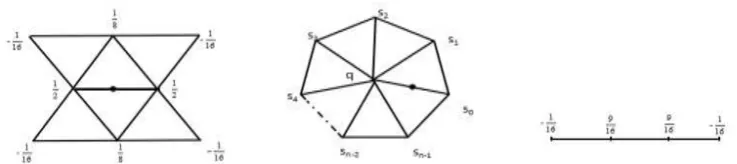
Rule 1: When the two ends of the grid edge are the regular points, the order of 6 end points, subdivision masks as shown in Figure 2 (a), the weights set to
a = 1/2-w, b = 1/8+2w, c = -1/16-w, d = w
Rule 2: When one end of the grid is a rule point of order 6 and the other end is an irregular point (order n is not 6), the subdivision mask is shown in Figure 2 (b) the irregular vertex and its adjacency are determined, where the weight coefficients for each adjacent point are as follows:
0 1,2
0 1,3 2
i
3 5 1
q , ,
4 12 12
3 3 1
, , 0,
4 8 8
3 1 2 1 4
, ( cos( ) cos( ) /
4 4 2
S S
q S S S
i i
q S N
N N 3 4 5 N N N
Rule 3: subdivide edge 2 endpoints for singular points, the first of each singular point by rule 2 get 2 new vertices, and then take the average value as the current generation of subdivision edge vertex.
Rule 4: When the subdivision edge is the boundary edge, as shown in Figure 2 (c), the insertion point is calculated as
E 1 2 1
1 9
V ( ) V
16 Vi Vi 16 i Vi
( )
Sqrt3 Subdivision Algorithm
Sqrt3 subdivision scheme[9] is a triangular mesh subdivision scheme of approximation and surface splitting proposed by Kobbelt in 2000. The subdivision surface scheme can effectively alleviate the patch growth speed.Sqrt3 uses a new vertex insertion and split mode, each subdivision, inserting a new vertex in each triangular faces, three vertices of the original triangle vertex and connected to the inside and remove the original triangle edge, which makes the number of triangular faces increased 3 times, the subdivision process is shown in figure 3. The Sqrt3 subdivision method makes the triangles increase slowly without sharp triangles, and the continuity is reserved automatically, and is suitable for local adaptive subdivision. A new vertex (V-vertex): vertex V adjacent vertex V0, V1, V2 ... , TheVn-1, then (V-vertex) vertex Vv is computed by the following
formula:
1
0
V (1 )
n n
n i
i
a
v a v v
n
1 2
a (4 2 cos )
9
n
n
The new point (F-vertex): the three vertices of the triangle are V0, V1, V2, and the new inserted F-
vertex VF is calculated by the following formula:
F 0 1 2
1
V ( )
3 v v v
(a) Initial mesh (b) Removes the original edge (c) Subdivides one time later
Figure 3. Sqrt3 surface subdivision process.
PN-triangle Subdivision Algorithm
In recent years, with the GPU computing power continues to increase, people in the GPU to achieve surface subdivision technology direction for a lot of research work. The Curved Point Normal PN-tringle subdivision algorithm[10] proposed by Vlachos, Jorg Peters, Chas Boyd and so on, it is based on the vertex position and the normal information on the interior of the triangular face of a separate double three Bezier surface interpolation, without considering the geometric topology. The uniform refinement of each patch to achieve the visual needs of the geometric model to achieve smooth drawing, it is suitable for hardware acceleration processing, and in real-time fine rendering has been widely used. The PN-triangle triangulation algorithm can generate a smooth continuous surface for the original rough triangular mesh. For the parameter triangular region, the Bezier refinement equation is defined as
3
3! b( , )
! ! ! i j k
ijk i j k
u v u v w b
i j k
Where (u, v, w) is the coordinate form of the center of gravity at the point in the triangle, and u+v+w=1.As shown in Figure 4, enter the single base triangle, obtain the normal control point nijk
and vertex control point bijk, according to the internal and boundary refinement factor to carry out
the refinement process, get the interpolation of the smooth grid vertex layout.The generation of PN triangles depends only on the vertex and normal vectors of the base triangle, and is suitable for use in GPU-based triangular refinement rendering pipelines.
(a) Base triangle (b) Vertex control point (c) Normal control point (d) Refinement effect
Figure 4. PN-triangle refinement process.
[image:4.595.118.472.561.780.2]Comparative Analysis of Segmentation Algorithm
Experiment Procedure
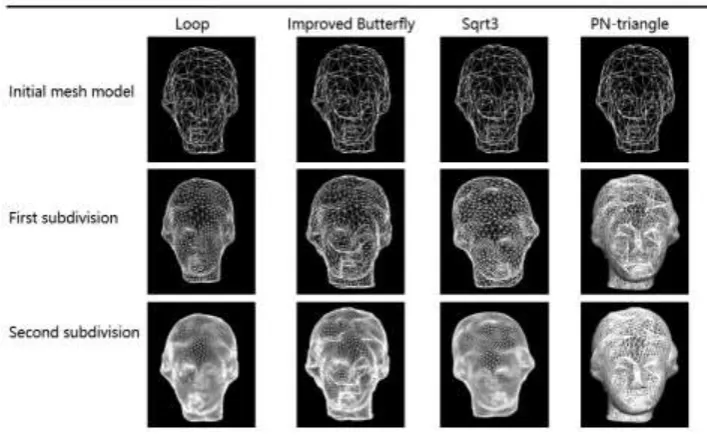
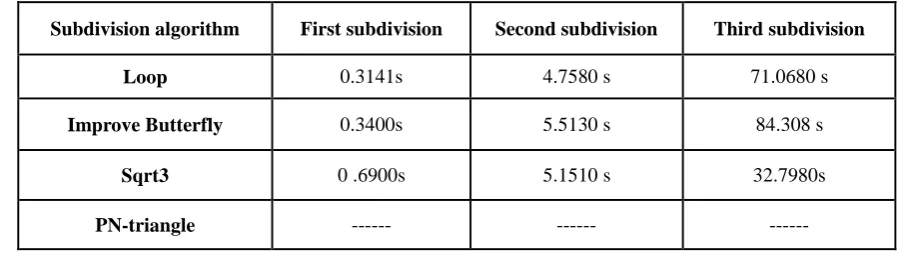
[image:5.595.69.521.283.410.2]The Venus triangle mesh model is used to test. The initial Venus triangular mesh model has 498 vertices and 992 triangular facets.The purpose of this experiment is to use Loop Butterfly Sqrt3 and PN-triangle subdivision method to subdivide the same model respectively, compare the different subdivision algorithm subdivision surface and the original grid approximation degree, subdivision surface quality and subdivision algorithm complexity and other aspects of performance indicators. The experiment shows the subdivision effect of each subdivision algorithm through the OpenGL platform. As shown in Figure 5, the initial mesh model is processed by the subdivision algorithm to get the first subdivision and the second subdivision surface. At the same time, the experiment statistics of the four different subdivision algorithm to complete each subdivision of the consumption of the time, as shown in Table 1.
Table 1. Surface subdivision algorithm operating efficiency analysis table.
Experimental Analysis and Improvement Methods
Through the above experiment, after comparison can be analyzed, the subdivision algorithm in the surface subdivision have their own strengths.First, in the approximation of subdivision surfaces and control mesh level, improved Butterfly algorithm and the PN-triangle algorithm has outstanding performance, and improved Butterfly algorithm as an interpolation subdivision algorithm, which can explain that the interpolation subdivision algorithm is more close to the control mesh generation than surface approximation subdivision algorithm, and continuity is lower, closer to the surface the control mesh, which is consistent with the characteristics of interpolation subdivision algorithm. Second, in subdivision surface quality, the Loop subdivision surface scheme produces higher surface quality, but the subdivision surface will produce greater shrinkage, and the resulting surface will appear asymmetric.Thirdly, in terms of the complexity of the algorithm, it can be concluded from Table 1 that, after the first subdivision and the second subdivision, the surface subdivision algorithm is running efficiently, and in the third subdivision, Sqrt3 algorithm is more efficient, which shows that the Sqrt3 subdivision algorithm makes triangular patches grow at a rate of three times, not only a significant reduction in the number of new triangles, but also improves the operating efficiency and resolution. PN-triangle subdivision is GPU and pipeline based graphics library (DirectX 11) technology under the premise of the subdivision triangle produced by GPU computing, the subdivision results of transmission in the rendering pipeline, almost no additional memory space, thus, this experiment method ignoring the PN-triangle subdivision algorithm of computing time.
Summary
At present, although it can be achieved to create a continuous curvature of the surface, but to create a higher order continuous surface algorithm to be further studied. In addition, it is difficult to control subdivision surfaces, and how to deal with the relationship between mesh subdivision speed
Subdivision algorithm First subdivision Second subdivision Third subdivision
Loop 0.3141s 4.7580 s 71.0680 s
Improve Butterfly 0.3400s 5.5130 s 84.308 s
Sqrt3 0 .6900s 5.1510 s 32.7980s
and surface quality needs to be further investigated.With the increasing computing power of GPU and the maturity of GPU parallel computing technology, how to use modern GPU to effectively generate and deal with subdivision surface has become one of the most popular research directions in recent years.
References
Wang Hui, Hu Xinrong, Wang Jianchun. Loop Algorithm based Mesh Smoothing for 3D Body Model[J]. Wuhan University of Science and Engineering, 2009, 22(2):35-38.
[1] Zhang Xuehui. The Research of Subdivision Surface Based on Triangle Mesh[D]. Qingdao: China University of Petroleum (East China), 2006.
[2] Cheng Huige. Research Triangle Mesh Model of the Reverse Subdivision[D]. Beijing: Peking University, 2008.
[3] Pan Jiongbo. Adaptive subdivision research for triangular mesh[J]. Liaoning Normal University, 2011, 47(18):186-187.
[4] Sun Dasong, Ju Zhitao, Sun Lijuan. Constraint adaptive Loop subdivision surface[J]. Harbin Polytechnic University, 2012, 29(09):3506-3508.
[5] Nira Dyn, David Levin, and John A. Gregory. A butterfly subdivision scheme for surface interpolation with tension control. ACM Transactions on Graphics, 9(2):160-169, April 1990.
[6] Jiang Chulin, Li Shaofa, Jia Xiping, Zhu Hongli. Classic Triangular Mesh Subdivision algorithm [J]. Computer Science and Engineering, South China University of Technology, 2009, 35(6):7-10.
[7] Wang Ruiqi, Feng Yixiong, Zhang Zixian, Cheng Jin, Tan Jianrong. Toroidal cutter tool path generation method on triangle mesh surface based on modified butterfly subdivision[J]. Zhejiang University, 2016, 22(11):2513-2521.
[8] Denis Zorin, Peter Schroeder, and Wim Sweldens. Interpolating subdivision for meshes with arbitrary topology. In SIGGRAPH 96 Conference Proceedings, pages 189-192, 1996.