University of Huddersfield Repository
Cerutti, Federico, Dunne, Paul, Giacomin, Massimiliano and Vallati, Mauro
Computing preferred extensions in abstract argumentation : a SAT based approach
Original Citation
Cerutti, Federico, Dunne, Paul, Giacomin, Massimiliano and Vallati, Mauro (2014) Computing
preferred extensions in abstract argumentation : a SAT based approach. In: 2nd International
Workshop on Theory and Applications of Formal Argumentation (TAFA 13). Lecture Notes in
Computer Science . Springer, Beijing, China, pp. 176193. ISBN 9783642543722
This version is available at http://eprints.hud.ac.uk/id/eprint/17970/
The University Repository is a digital collection of the research output of the
University, available on Open Access. Copyright and Moral Rights for the items
on this site are retained by the individual author and/or other copyright owners.
Users may access full items free of charge; copies of full text items generally
can be reproduced, displayed or performed and given to third parties in any
format or medium for personal research or study, educational or notforprofit
purposes without prior permission or charge, provided:
•
The authors, title and full bibliographic details is credited in any copy;
•
A hyperlink and/or URL is included for the original metadata page; and
•
The content is not changed in any way.
For more information, including our policy and submission procedure, please
contact the Repository Team at: [email protected].
A SAT-based Approach for Computing Extensions in
Abstract Argumentation
Federico Cerutti1, Paul E. Dunne2, Massimiliano Giacomin3, and Mauro Vallati4
1 School of Natural and Computing Science, King’s College, University of Aberdeen, AB24
3UE, Aberdeen, United Kingdom
2
Department of Computer Science, Ashton Building, University of Liverpool, Liverpool L69 7ZF, United Kingdom
3 Department of Information engineering, University of Brescia, via Branze, 38, 25123,
Brescia, Italy
4 School of Computing and Engineering, University of Huddersfield, Huddersfield, HD1 3DH,
United Kingdom
Abstract. This paper presents a novel SAT-based approach for the computation of extensions in abstract argumentation, with focus on preferred semantics, and an empirical evaluation of its performances. The approach is based on the idea of reducing the problem of computing complete extensions to a SAT problem and then using a depth-first search method to derive preferred extensions. The proposed approach has been tested using two distinct SAT solvers and compared with three state-of-the-art systems for preferred extension computation. It turns out that the proposed approach delivers significantly better performances in the large majority of the considered cases.
1
Introduction
Dung’s theory of abstract argumentation frameworks [17] provides a general model, which is widely recognized as a fundamental reference in computational argumentation in virtue of its simplicity, generality, and ability to capture a variety of more specific approaches as special cases. An abstract argumentation framework (AF) consists of a set of arguments and of anattackrelation between them. The concept ofextensionplays a key role in this simple setting, where anextensionis intuitively a set of arguments which can “survive the conflict together”. Different notions of extensions and of the requirements they should satisfy correspond to alternative argumentation semantics, whose definitions and properties are an active investigation subject since two decades (see [6, 5] for an introduction).
problems. Decision problems pose yes/no questions like “Does this argument belong to one (all) extensions?” or “Is this set an extension?”, while construction problems re-quire to explicitly produce some of the extensions prescribed by a semantics. In partic-ular,extension enumerationis the problem of constructing all the extensions prescribed by a given semantics for a givenAF. The complexity of extension-related decision problems has been deeply investigated and, for most of the semantics proposed in the literature they have been proven to be intractable. Intractability extends directly to con-struction/enumeration problems, given that their solutions provide direct answers to decision problems.
Theoretical analysis of worst-case computational issues in abstract argumentation is in a state of maturity with the available complexity results covering all Dung’s tra-ditional semantics and several subsequent prominent approaches in the literature (for a summary see [19]). On the practical side, however, the investigation on efficient algo-rithms for abstract argumentation and on their empirical assessment is less developed, with few results available in the literature. This paper contributes to fill this gap by proposing a novel approach and implementation for enumeration of Dung’spreferred extensions, corresponding to one of the most significant argumentation semantics, and comparing its performances with other state-of-the-art implemented systems. We focus on extension enumeration since it can be considered the most general problem, i.e. its solution provides complete information concerning the justification status of arguments (making it possible to determine, for instance, if two arguments cannot be accepted in the same extension) and the proposed approach can be easily adapted to solve also the decision problems mentioned above.
The paper is organized as follows. Section 2 recalls the necessary basic concepts and state-of-the-art background. Section 3 introduces the proposed approach while Section 4 describes the test setting and comments the experimental results. Section 5 provides a comparison with related works and then Section 6 concludes the paper.
2
Background
An argumentation framework [17] consists of a set of arguments5and a binary attack relation between them.
Definition 1. Anargumentation framework(AF) is a pairΓ =hA,RiwhereAis a set of arguments andR ⊆ A × A. We say thatbattacksaiffhb,ai ∈ R, also denoted
asb→a. The set of attackers of an argumentawill be denoted asa−,{b:b→a}.
The basic properties of conflict–freeness, acceptability, and admissibility of a set of arguments are fundamental for the definition of argumentation semantics.
Definition 2. Given anAF Γ =hA,Ri:
– a setS⊆ Aisconflict–freeif∄a,b∈Ss.t.a→b;
– an argumenta∈ Aisacceptablewith respect to a setS⊆ Aif∀b∈ As.t.b→a, ∃c∈Ss.t.c→b;
– a setS⊆ AisadmissibleifSis conflict–free and every element ofSis acceptable with respect toS.
An argumentation semanticsσprescribes for anyAF Γa set ofextensions, denoted as Eσ(Γ), namely a set of sets of arguments satisfying some conditions dictated by
σ. In [17] four “traditional” semantics were introduced, namelycomplete,grounded,
stable, and preferred semantics. Other literature proposals includesemi-stable [12],
ideal[18], andCF2[7] semantics. Here we need to recall the definitions of complete (denoted as CO) and preferred (denoted as PR) semantics only, along with a well known relationship between them.
Definition 3. Given anAF Γ =hA,Ri:
– a setS ⊆ Ais acomplete extension, i.e.S ∈ ECO(Γ), iffS is admissible and
∀a∈ As.t.ais acceptable w.r.t.S,a∈S;
– a setS⊆ Ais apreferred extension, i.e.S ∈ EPR(Γ), iffSis a maximal (w.r.t. set
inclusion) admissible set.
Proposition 1. For anyAF Γ =hA,Ri,Sis a preferred extension iff it is a maximal (w.r.t. set inclusion) complete extension. As a consequenceEPR(Γ)⊆ ECO(Γ).
It can be noted that each extensionS implicitly defines a three-valuedlabellingof arguments, as follows: an argumentais labellediniffa∈S, is labelledoutiff∃b∈S s.t.b → a, is labelledundecif neither of the above conditions holds. In the light of this correspondence, argumentation semantics can be equivalently be defined in terms of labellings rather than of extensions (see [11, 5]). In particular, the notion ofcomplete labelling[13, 5] provides an equivalent characterization of complete semantics, in the sense that each complete labelling corresponds to a complete extension and vice versa. Complete labellings can be (redundantly) defined as follows.
Definition 4. LethA,Ribe an argumentation framework. A total functionLab:A 7→ {in,out,undec}is acomplete labellingiff it satisfies the following conditions for any a∈ A:
– Lab(a) =in⇔ ∀b∈a−Lab(b) =out;
– Lab(a) =out⇔ ∃b∈a− :Lab(b) =in;
– Lab(a) =undec⇔ ∀b∈a−Lab(b)6=in∧ ∃c∈a−:Lab(c) =undec;
Moreover, it is proved in [11] that preferred extensions are in one-to-one correspon-dence with those complete labellings maximizing the set of arguments labelledin.
As to algorithms for computing preferred extensions, two basic approaches have been considered in the literature. On one hand, one may develop a dedicated algorithm to obtain the problem solution, on the other hand, one may translate the problem in-stance at hand into an equivalent inin-stance of a different class of problems for which solvers are already available. The results produced by the solver have then to be trans-lated back to the original problem.
The three main dedicated algorithms for computing preferred extensions in the lit-erature [16, 24, 25] share the same idea based on labellings: starting from an initial default labelling, a sequence of transitions (namely changes of labels) is applied lead-ing to the labelllead-ings correspondlead-ing to preferred extensions. The three algorithms differ in the initial labelling, the transitions adopted, and the use of additional intermediate la-bels besides the three standard ones. The algorithm proposed in [25] has been shown to outperform the previous ones and will be therefore taken as the only term of comparison for this family of approaches.
As to the translation approach, the main proposal we are aware of is the ASPAR-TIX system [22], which provides an encoding ofAFs and the relevant computational problems in terms of Answer Set Programs which can be processed by a solver like DLV [23]. Recently an alternative encoding of ASPARTIX using metaASP has been proposed [20] and showed to outperform the previous version when used in conjunc-tion with gringo/claspD solver. ASPARTIX is a very general system, whose capabilities include the computation of preferred extensions, and both versions will be used as ref-erence for this family of approaches.
3
The PrefSat approach
The approach we propose, called PrefSat, can be described as a depth-first search in the space of complete extensions to identify those that are maximal, namely preferred ex-tensions. Each step of the search process requires the solution of a SAT problem through invocation of a SAT solver. More precisely, the algorithm is based on the idea of encod-ing the constraints correspondencod-ing to complete labellencod-ings of anAF as a SAT problem and then iteratively producing and solving modified versions of the initial SAT problem according to the needs of the search process. The first step for a detailed presentation of the algorithm concerns therefore the adopted SAT encoding for complete labellings.
3.1 A SAT encoding for complete labellings
the search process, thanks to the additional constraints. On the other hand, increasing syntactic complexity might lead to worse performances, thus a careful selection of the encoding is needed.
In order to explore alternative encodings, let us consider as a starting point a boolean formula encoding the constraints of Definition 4 in conjunctive normal form (CNF), as required by the SAT solver. To this purpose, we have to introduce some notation. Letting
k=|A|we can identify each argument with an index in{1, . . . k}or, more precisely, we can define a bijection φ : {1, . . . , k} 7→ A(the inverse map will be denoted as
φ−1). φ will be called an indexing ofA and the argumentφ(i) will be sometimes referred to as argument i for brevity. For each argumenti we define three boolean variables,Ii,Oi, andUi, with the intended meaning thatIiis true when argumentiis labelledin, false otherwise, and analogouslyOi andUicorrespond to labelsoutand undec. Formally, givenΓ = hA,Riwe define the corresponding set of variables as
V(Γ),∪1≤i≤|A|{Ii, Oi, Ui}. Now we express the constraints of Definition 4 in terms of the variablesV(Γ), with the additional condition that for each argumentiexactly one of the three variables has to be assigned the value True. For technical reasons we restrict to“non-empty” extensions (in the sense that at least one of the arguments is labelledin), thus we add the further condition that at least one variableIiis assigned the value True. The detail of the resulting CNF is given in Definition 5.
Definition 5. Given anAF Γ = hA,Ri, with |A| = k andφ : {1, . . . , k} 7→ A an indexing ofA, theC1 encodingdefined on the variables inV(Γ), is given by the
conjunction of the formulae listed below:
^
i∈{1,...,k}
(Ii∨Oi∨Ui)∧(¬Ii∨ ¬Oi)∧(¬Ii∨ ¬Ui)∧(¬Oi∨ ¬Ui)
(1)
^ {i|φ(i)−=∅}
(Ii∧ ¬Oi∧ ¬Ui) (2)
^ {i|φ(i)−6=∅}
Ii∨
_ {j|φ(j)→φ(i)}
(¬Oj)
(3)
^ {i|φ(i)−6=∅}
^ {j|φ(j)→φ(i)}
¬Ii∨Oj
(4)
^ {i|φ(i)−6=∅}
^ {j|φ(j)→φ(i)}
¬Ij∨Oi
(5)
^ {i|φ(i)−6=∅}
¬Oi∨
_ {j|φ(j)→φ(i)}
Ij
^ {i|φ(i)−6=∅}
^ {k|φ(k)→φ(i)}
Ui∨ ¬Uk∨
_ {j|φ(j)→φ(i)}
Ij (7) ^ {i|φ(i)−6=∅}
^ {j|φ(j)→φ(i)}
(¬Ui∨ ¬Ij)
∧
¬Ui∨
_ {j|φ(j)→φ(i)}
Uj (8) _
i∈{1,...k}
Ii (9)
C1 corresponds to the conditions of Definition 4 with the addition of the non-emptyness requirement. Formula (1) states that for each argumentione and only one label has to be assigned. Formula (2) settles the case of unattacked arguments that must be labelledin. Formula (3) states that argumentiis labelledinif all its attackers are labelledout, while Formula (4) settles the reverse (i.e. the ‘only if’ ) condition. For-mula (5) corresponds to the constraint that argumentiis labelledoutif at least one of its attackers is labelledin, while Formula (6) corresponds to the ‘only if’ condition. Formula (7) is a bit more articulated: it states that argumentiis labelledundecif none of its attackers is labelledinand at least one of its attackers is labelledundec, and again Formula (8) corresponds to the ‘only if’ condition. Finally, formula (9) ensures non-emptyness, i.e. that at least one argument is labelledin.
The encoding of Definition 5 is redundant, i.e. it is possible to drop out some clauses so as to obtain a simpler logically equivalent encoding. The following proposition, whose proof, based on the requirement thatLabis a total function (cf. Def. 4), is omitted due to space limitations, shows the alternative non redundant encodings.
Proposition 2. Referring to the formulae listed in Definition 5, the following encodings are equivalent:
C1: (1)∧(2)∧(3)∧(4)∧(5)∧(6)∧(7)∧(8)∧(9)
Ca
1 : (1)∧(2)∧(3)∧(4)∧(5)∧(6)∧(9)
Cb
1: (1)∧(2)∧(5)∧(6)∧(7)∧(8)∧(9)
Cc
1: (1)∧(2)∧(3)∧(4)∧(7)∧(8)∧(9)
C2: (1)∧(2)∧(4)∧(6)∧(8)∧(9)
C3: (1)∧(2)∧(3)∧(5)∧(7)∧(9)
Ca
1,C1b and C1c correspond to Definition 4 where the third, first and second iff condition is removed, respectively,C2codifies the ‘only if’ (⇒) part of the conditions andC3the ‘if’ (⇐) part6.
In Section 4 we evaluate the performance of the overall approach for enumerating the preferred extensions given the above six encodings. In the next section we describe the core of our proposal.
6Ca
Algorithm 1Enumerating the preferred extensions of anAF
1: Input:Γ =hA,Ri
2: Output:Ep⊆2 A
3: Ep := ∅
4: cnf := ΠΓ
5: repeat
6: pref cand := ∅
7: cnf df := cnf
8: repeat
9: lastcompf ound := SS(cnf df)
10: iflastcompf ound! = εthen 11: pref cand := lastcompf ound
12: for a∈IN ARGS(lastcompf ound)do 13: cnf df := cnf df∧Iφ−1(a)
14: end for
15: remaining := F ALSE
16: for a∈ A \IN ARGS(lastcompf ound)do 17: remaining := remaining∨Iφ−1(a) 18: end for
19: cnf df := cnf df∧remaining
20: end if
21: until(lastcompf ound! = ε∧IN ARGS(lastcompf ound) ! = A) 22: ifpref cand! = ∅then
23: Ep := Ep∪ {IN ARGS(pref cand)}
24: oppsolution := F ALSE
25: for a∈ A \IN ARGS(pref cand)do 26: oppsolution := oppsolution∨Iφ−1(a) 27: end for
28: cnf := cnf∧oppsolution
29: end if
30: until(pref cand! = ∅) 31: ifEp=∅then
32: Ep={∅}
33: end if 34: returnEp
3.2 Enumerating preferred extensions
We are now in a position to illustrate the proposed procedure, called PrefSat and listed in Algorithm 1, to enumerate the preferred extensions of anAF Γ =hA,Ri.
Algorithm 1 resorts to two external functions:SS, andIN ARGS.SS is a SAT solver able to prove unsatisfiability too: it accepts as input a CNF formula and returns a variable assignment satisfying the formula if it exists,εotherwise.IN ARGSaccepts as input a variable assignment concerningV(Γ)and returns the corresponding set of arguments labelled asin. Moreover we take for granted the computation ofΠΓ from
Theorem 1 proves the correctness of Algorithm 1.
Theorem 1. Given anAF Γ =hA,RiAlgorithm 1 returnsEp=EPR(Γ).
The proof of the above Theorem is omitted due to space limitations, however we provide an explanation of the algorithm. The algorithm mainly consists of two nested
repeat-untilloops. Roughly, the inner loop (lines 8–21) corresponds to a depth-first search which, starting from a non-empty complete extension, produces a sequence of complete extensions strictly ordered by set inclusion. When the sequence can no more be extended, its last element corresponds to a maximal complete extension, namely to a preferred extension. The outer loop (lines 5–30) is in charge of driving the search: it ensures, through proper settings of the variables, that the inner loop is entered with different initial conditions, so that the whole space of complete extensions is explored and all preferred extensions are found.
Let us now illustrate the operation of Algorithm 1 in detail. Given the correspon-dence between variable assignments, labellings, and extensions, we will resort to some terminological liberty for the sake of conciseness and clarity (e.g. stating that the solver returns an extension rather than that it returns an assignment which corresponds to a labelling which in turn corresponds to an extension). In the first iteration of the outer loop, the assignment of line 7 results incnf df = ΠΓ in virtue of the initialization of line 4. Then the inner loop is entered and, at line 9,SSis invoked onΠΓ. Due to the non-emptyness condition inΠΓ,SSreturnsεif the only complete extension (and hence the only preferred extension) ofΓ is the empty set. In this case, lines 11–19 are not executed and the loop is directly exited. As a consequence,pref candis still empty at line 22 and also the outer loop is directly exited. The condition of line 31 then holds, the assignment of line 32 is executed and the algorithm terminates returning{∅}.
Let us now turn to the more interesting case where there is at least one non-empty complete extension. Then, the first solver invocation returns (non deterministically) one of the non-empty complete extensions of the framework which is assigned to
lastcompf oundat line 9. Then the condition of line 10 is verified andlastcompf ound
any of the preferred extensions already found and is then extended to a new preferred extension in the subsequent iterations of the loop.
4
The Empirical Analysis
The algorithm described in the previous section has been implemented in C++ and integrated with two alternative SAT solvers, namely PrecoSAT and Glucose. PrecoSAT [9] is the winner of the SAT Competition72009 on the Application track. Glucose [3, 4] is the winner of the SAT Competition in 2011 and of the SAT Challenge 2012 on the Application track.
This choice gave rise to the following two systems:
– PrefSat with PrecoSAT (PS-PRE);
– PrefSat with Glucose (PS-GLU).
To assess empirically the performance of the proposed approach with respect to other state-of-the-art systems and to compare the two SAT solvers on the SAT instances generated by our approach, we ran a set of tests on randomly generatedAFs.
The experimental analysis has been conducted on 2816AFs that were divided in different classes, according to two dimensions: the number of arguments,|A|and the criterion of random generation of the attack relation. As to|A|we considered 8 differ-ent values, ranging from 25 to 200 with a step of 25. As to the generation of the attack relation we used two alternative methods. The first method consists in fixing the prob-abilitypattthat there is an attack for each ordered pair of arguments (self-attacks are included): for each pair a pseudo-random number uniformly distributed between 0 and 1 is generated and if it is lesser or equal topattthe pair is added to the attack relation. We considered three values forpatt, namely 0.25, 0.5, and 0.75. Combining the 8 val-ues of|A|with the 3 values ofpattgives rise to 24 test classes, each of which has been populated with 50AFs.
The second method consists in generating randomly, for eachAF, the numbernatt of attacks it contains (extracted with uniform probability between 0 and|A|2). Then the
natt distinct pairs of arguments constituting the attack relation are selected randomly. Applying the second method with the 8 values of|A|gives rise to 8 further test classes, each of which has been populated with 200AFs. Since the experimental results show minimal changes between the sets ofAFs generated with the two methods, hereafter we silently drop this detail.
Further, we also considered, for each value of|A|, the extreme cases of empty attack relation (patt = natt = 0) and of fully connected attack relation (patt = 1, natt =
|A|2), thus adding 16 “singleton” test classes.
The tests have been run on the same hardware (a Quad-core Intel(R) Xeon(TM) CPU 2.80GHz with 4 GByte RAM and Linux operating system). As in the well-known international planning competition8(IPC), a limit of 15 minutes was imposed to com-pute the preferred extensions for eachAF. No limit was imposed on the RAM usage,
7http://www.satcompetition.org/
50 60 70 80 90 100
50 100 150 200
IP
C
n
o
rm
al
is
ed
to
1
0
0
Number of arguments
IPC normalised to 100 with respect to the number of arguments
C1
Ca
1
Cb
1
Cc
1
C2
[image:11.595.187.421.122.284.2]C3
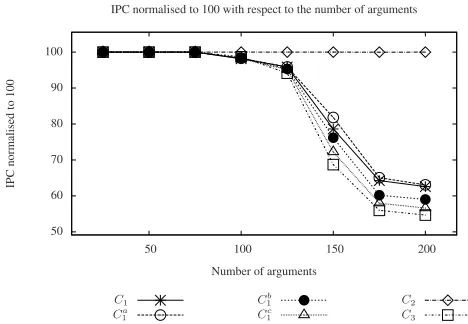
Fig. 1: IPC w.r.t.|A|(all test cases), comparingPS-GLUusing respectively encodings
C1,C1a,C1b,C1c,C2, andC3(cf. Proposition 2).
but a run fails at saturation of the available memory, including the swap area. The sys-tems under evaluation have been compared with respect to the ability to produce solu-tions within the time limit and to the execution time (obtained as the real value of the commandtime -p). As to the latter comparison, we adopted the IPC speed score, also borrowed from the planning community, which is defined as follows:
– For each test case (in our case, each testAF) letT∗ be the best execution time among the compared systems (if no system produces the solution within the time limit, the test case is not considered valid and ignored).
– For each valid case, each system gets a score of1/(1 + log10(T /T∗)), whereT is its execution time, or a score of 0 if it fails in that case. Runtimes below 1 sec get by default the maximal score of 1.
– The (non normalized)IP Cscore for a system is the sum of its scores over all the valid test cases. The normalised IPC score ranges from 0 to 100 and is defined as
(IP C/# of valid cases)∗100.
First of all, we ran an investigation on which of the alternative encodings introduced in Proposition 2 performs best. While there are cases wherePS-PREperforms better usingCa
1 and others where it performs better usingC2 (with minimal differences on average), it is always outperformed byPS-GLUusing C2, thus we refer toPS-GLU to illustrate the difference of performance induced by the alternative encodings. In Fig-ure 1, we compare the empirical results obtained by executingPS-GLU, and Table 1 summarises the average times. It is worth to mention thatPS-GLUalways computed the preferred extensions irrespective of the chosen encoding. As we can see, the overall performance is significantly dependent on the set of conditions used, where the greatest performance (considering the generatedAFs) isC2, and then in sequence, generally
Ca
|A| C1 C
a
1 C
b
1 C
c
1 C2 C3
25 5.97E-03 5.91E-03 5.43E-03 5.31E-03 6.25E-04 3.92E-03
50 3.50E-02 3.39E-02 3.38E-02 3.38E-02 9.74E-03 3.10E-02
75 1.06E-01 1.02E-01 1.05E-01 1.06E-01 2.74E-02 1.02E-01
100 2.76E-01 2.65E-01 2.78E-01 2.91E-01 6.39E-02 2.89E-01
125 5.24E-01 5.03E-01 5.54E-01 5.95E-01 1.15E-01 6.23E-01
150 1.27E+00 1.22E+00 1.39E+00 1.43E+00 2.46E-01 1.60E+00
175 2.06E+00 1.98E+00 2.46E+00 2.82E+00 4.80E-01 3.51E+00
[image:12.595.186.424.114.229.2]200 5.00E+00 4.89E+00 6.17E+00 7.90E+00 1.38E+00 1.00E+01
Table 1: Average time (in seconds) for computing the preferred extensions according to the different labellings encoding of Proposition 2 grouped by|A|. In bold the best one.
60 65 70 75 80 85 90 95 100
50 100 150 200
%
o
f
su
cc
es
s
Number of arguments Percentage of success
ASP ASP-META NOF
PS-PRE PS-GLU
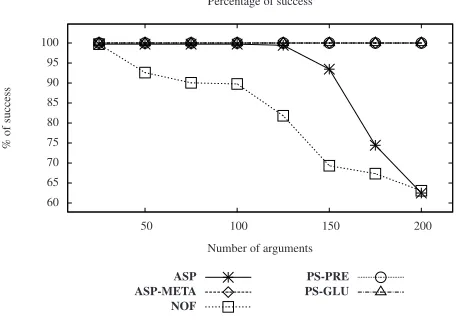
Fig. 2: Percentage of success over all test cases.
constraints) showing that on dense graphs there are situations whereC3performs better thanC1.
In order to evaluate the overall performance of Algorithm 1 (cf. Section 3), let us comparePS-PRE andPS-GLUboth using encodingC2with the other three notable systems at the state of the art:
– ASPARTIX withdlvas ASP solver (denoted asASP);
– ASPARTIX-META withgringoas grounder andclaspDas ASP solver (de-noted asASP-META) as presented in [20];
– the system presented in [25] (NOF)9.
None of five (considering also ourPS-GLU andPS-PRE) systems uses parallel execution.
[image:12.595.189.417.290.451.2]20 30 40 50 60 70 80 90 100
50 100 150 200
IP
C
n
o
rm
al
is
ed
to
1
0
0
Number of arguments
IPC normalised to 100 with respect to the number of arguments
ASP ASP-META NOF
[image:13.595.187.417.123.282.2]PS-PRE PS-GLU
Fig. 3: IPC w.r.t.|A|(all test cases).
Concerning the ability to produce solutions, Figure 2 summarizes the results con-cerning all test cases grouped w.r.t.|A|.PS-GLU,PS-PRE(both exploitingC2 encod-ing), andASP-METAwere able to produce the solution in all cases. On the other hand, the success rate of bothASPandNOFdecreases significantly with the increase of|A|. We observed that the failure reasons are quite different:ASPreached in all its failure cases the 15 minutes time limit, whileNOFran out of memory before reaching the time limit. In the light of this observation,NOF’s evaluation has certainly been negatively affected by the relatively scarce memory availability of the test platform, but, from an-other perspective, the results obtained on this platform give a clear indication about the different resource needs of the compared systems.
|A| ASP ASP-META NOF PS-PRE PS-GLU
25 7.78E-02 2.70E-01 3.24E-01 3.87E-03 6.27E-04
50 3.32E-01 1.00E+00 5.43E-01 2.32E-02 1.04E-02
75 1.03E+00 2.30E+00 1.18E+00 5.98E-02 2.96E-02
100 3.75E+00 4.33E+00 3.81E+00 1.36E-01 6.84E-02
125 1.63E+01 6.95E+00 8.50E+00 2.46E-01 1.24E-01
150 3.16E+01 1.16E+01 1.47E+01 4.59E-01 2.24E-01
175 6.65E+01 1.61E+01 2.64E+01 6.65E-01 3.21E-01
200 1.24E+02 2.27E+01 5.02E+01 1.02E+00 4.79E-01
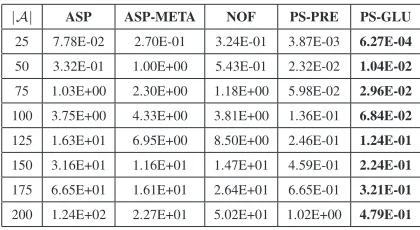
[image:13.595.200.410.498.613.2]Turning to the comparison of execution times, Figure 3 presents the values of nor-malized IPC considering all test cases grouped w.r.t.|A|, while Table 2 shows the av-erage time needed by the five systems for computing the preferred extension. Both
PS-PREandPS-GLUperformed significantly better (note that the IPC score is log-arithmic) than ASPand NOFfor all values of|A| > 25, and the performance gap increases with increasing|A|. Moreover,PS-GLUis significantly faster thanPS-PRE
for|A| > 175(again the performance gap increases with increasing|A|).ASPand
NOFobtained quite similar IPC values with more evident differences at lower values of|A|. Surprisingly,ASP-METAperformed worse that its older versionASP(and also ofNOF) on frameworks with number of arguments up to 100 (cf. Table 2). Although this may seem in contrast with results provided in [20], it has to be remarked that the IPC measure is logarithmic w.r.t. the best execution time, while [20, Fig. 1] uses a lin-ear scale, and this turned to be a disadvantage when analysing the overall performance. Indeed, the maximum difference of execution times betweenASPandASP-META ex-ecuted on frameworks up to 100 arguments is around 1.2 seconds, while the axis of ordinate of [20, Fig. 1] ranges between 0 and 300, thus making impossible to note this difference.
5
Comparison with Related Works
The relationship between argumentation semantics and the satisfiability problem has been already considered in the literature, but less effort has been devoted to the study of a SAT-based algorithm and its empirical evaluation. For instance, in [8] three ap-proaches determining semantics extensions are preliminary described, namely the equa-tional checking, themodel checking, and thesatisfiability chekingof which three dif-ferent formulations for, respectively, stable extension, admissible set, and complete ex-tension are presented from a theoretical perspective, without providing any empirical evaluation.
More recently, in [10], and similarly in [1], relationships between argumentation semantics and constraint satisfaction problems are studied, with different formulation for each semantics or decision problem. In particular, [1] proposes an extensive study of CSP formulations for decision problems related to stable, preferred, complete, grounded and admissible semantics, while [10] shows an empirical evaluation of their approach through their software ConArg, but for conflict-free, admissible, complete and stable extensions only.
Finally, as the computation of the preferred extension using [13]’s labelling ap-proach requires a maximisation process, at a first sight this seems to be quite close to a MaxSAT problem [2], which is a generalisation of the satisfiability problem. The idea is that sometimes some constraints of a problem can not be satisfied, and a solver should try to satisfy the maximum number of them. Although there are approaches aimed at finding the maximum w.r.t. set inclusion satisfiable constraints (i.e. nOPTSAT10), the MaxSAT problem is conceptually different from the problem of finding the preferred extensions. Indeed, for determining the preferred extensions we maximise the accept-ability of a subset of variables, while in the MaxSAT problem it is not possible to bound such a maximisation to a subset of variables only. However, a deeper investigation that may lead to the definition of argumentation semantics as MaxSAT problems is already envisaged as a future work.
6
Conclusions
We presented a novel SAT-based approach for preferred extension enumeration in ab-stract argumentation and assessed its performances by an empirical comparison with other state-of-the-art systems. The proposed approach turns out to be efficient and to generally outperform the best known dedicated algorithm and the ASP-based approach implemented in the ASPARTIX system. The proposed approach appears to be applica-ble for extension enumeration of other semantics (in particular staapplica-ble and semi-staapplica-ble) and this represents an immediate direction of future work. As to performance assess-ment, we are not aware of other systematic comparisons concerning computation ef-ficiency in Dung’s framework apart the results presented in [25], where different test sets were used for each pairwise comparison, with a maximum argument cardinality of 45. The comparison provided in [20] is aimed just at showing the differences be-tween the two different encoding of ASPARTIX. Java-based tools mainly conceived for interactive use, like ConArg [10] or Dungine [26], are not suitable for a systematic effi-ciency comparison on large test sets and could not be considered in this work. It can be remarked however that they adopt alternative solution strategies (translation to a CSP problem in ConArg, argument games in Dungine) whose performance evaluation is an important subject of future work.
We are currently working to integrate the proposed approach into the SCC-recursive schema introduced in [7] to encompass several semantics (including grounded, pre-ferred and stable semantics). More specifically, the approach proposed in this paper can be applied to the sub-frameworks involved in the base-case of the recursion: since such local application decreases the number of variables involved, we expect a dramatic performance increase.
References
1. Amgoud, L., Devred, C.: Argumentation frameworks as constraint satisfaction problems. Annals of Mathematics and Artificial Intelligence pp. 1–18 (2013)
10
2. Ans´otegui, C., Bonet, M.L., Levy, J.: Sat-based maxsat algorithms. Artificial Intelligence 196(0), 77 – 105 (2013)
3. Audemard, G., Simon, L.: Predicting learnt clauses quality in modern sat solvers. In: Pro-ceedings of IJCAI 2009. pp. 399–404 (2009)
4. Audemard, G., Simon, L.: Glucose 2.1. http://www.lri.fr/˜simon/?page=
glucose(2012)
5. Baroni, P., Caminada, M., Giacomin, M.: An introduction to argumentation semantics. Knowledge Engineering Review 26(4), 365–410 (2011)
6. Baroni, P., Giacomin, M.: Semantics of abstract argumentation systems. In: Argumentation in Artificial Intelligence, pp. 25–44. Springer (2009)
7. Baroni, P., Giacomin, M., Guida, G.: SCC-recursiveness: a general schema for argumentation semantics. Artificial Intelligence 168(1-2), 165–210 (2005)
8. Besnard, P., Doutre, S.: Checking the acceptability of a set of arguments. In: Proceedings of NMR 2004. pp. 59–64 (2004)
9. Biere, A.: P{re,ic}osat@sc’09. In: SAT Competition 2009 (2009)
10. Bistarelli, S., Santini, F.: Modeling and solving afs with a constraint-based tool: Conarg. In: Theory and Applications of Formal Argumentation, vol. 7132, pp. 99–116. Springer (2012) 11. Caminada, M.: On the issue of reinstatement in argumentation. In: Proceedings of JELIA
2006. pp. 111–123 (2006)
12. Caminada, M.: Semi-stable semantics. In: Proceedings of COMMA 2006. pp. 121–130 (2006)
13. Caminada, M., Gabbay, D.M.: A logical account of formal argumentation. Studia Logica (Special issue: new ideas in argumentation theory) 93(2–3), 109–145 (2009)
14. Dimopoulos, Y., Nebel, B., Toni, F.: Preferred arguments are harder to compute than stable extensions. In: Proceedings of IJCAI 1999. pp. 36–43 (1999)
15. Dimopoulos, Y., Torres, A.: Graph theoretical structures in logic programs and default theo-ries. Journal Theoretical Computer Science 170, 209–244 (1996)
16. Doutre, S., Mengin, J.: Preferred extensions of argumentation frameworks: Query answering and computation. In: Proceedings of IJCAR 2001. pp. 272–288 (2001)
17. Dung, P.M.: On the acceptability of arguments and its fundamental role in nonmonotonic reasoning, logic programming, and n-person games. Artificial Intelligence 77(2), 321–357 (1995)
18. Dung, P., Mancarella, P., Toni, F.: A dialectic procedure for sceptical, assumption-based argumentation. In: Proceedings of COMMA 2006. pp. 145–156 (2006)
19. Dunne, P.E., Wooldridge, M.: Complexity of abstract argumentation. In: Argumentation in Artificial Intelligence, pp. 85–104. Springer (2009)
20. Dvˇor´ak, W., Gaggl, S.A., Wallner, J., Woltran, S.: Making use of advances in answer-set programming for abstract argumentation systems. In: Proceedings of INAP 2011 (2011) 21. Dvˇor´ak, W., J¨arvisalo, M., Wallner, J.P., Woltran, S.: Complexity-sensitive decision
proce-dures for abstract argumentation. In: Proceedings of KR 2012. AAAI Press (2012)
22. Egly, U., Gaggl, S.A., Woltran, S.: Aspartix: Implementing argumentation frameworks using answer-set programming. In: Proceedings of ICLP 2008. pp. 734–738 (2008)
23. Leone, N., Pfeifer, G., Faber, W., Eiter, T., Gottlob, G., Perri, S., Scarcello, F.: The dlv system for knowledge representation and reasoning. ACM Transactions on Computational Logic 7(3), 499–562 (2006)
24. Modgil, S., Caminada, M.: Proof theories and algorithms for abstract argumentation frame-works. In: Argumentation in Artificial Intelligence, pp. 105–129. Springer (2009)
25. Nofal, S., Dunne, P.E., Atkinson, K.: On preferred extension enumeration in abstract argu-mentation. In: Proceedings of COMMA 2012. pp. 205–216 (2012)