2212-8271 © 2013 The Authors. Published by Elsevier B.V.
Selection and peer-review under responsibility of Professor Xiangqian (Jane) Jiang doi: 10.1016/j.procir.2013.08.024
Procedia CIRP 10 ( 2013 ) 142 – 147
12th CIRP Conference on Computer Aided Tolerancing
An efficient divide-and-conquer algorithm for morphological filters
Shan Lou*, Xiangqian Jiang, Paul J. Scott
EPSRC Innovative Manufacure Research Centre in Advanced Metrology, Centre for Precision Technologies, School of Computing and Engineering, University of Huddersfield, Queensgate, Huddersfield, HD1 3DH, UK
Abstract
Morphological filters, evolved from the traditional envelope filter, are function oriented filtration techniques. A recent research on the implementation of morphological filters was based on the theoretical link between morphological operations and the alpha shape. However the Delaunay triangulation on which the alpha shape method depends is costly for large areal data. This paper proposes a divide-and-conquer method as an optimization to the alpha shape method aiming to speed up its performance. The large areal surface is divided into small sub-surfaces so that the alpha shape method is executed on the partitioned surfaces in a fast manner. The contact points are searched on each sub-surface and merged into a super set on which the alpha shape method is applied again to archive the updated result. The recursion process is repeated until the contact points of the whole surface are obtained. The morphological envelope could be computed recursively without the 3D Delaunay triangulation to the whole surface data. Meanwhile this method retains almost all the merits of the alpha shape method. The experiment shows that the result obtained by the divide-and-conquer algorithm is consistent with the one generated by applying the alpha shape method directly. The performance evaluation reveals that the divide-and-conquer algorithm achieved superior performances over the original alpha shape method.
© 2012 The Authors. Published by Elsevier B.V. Selection and/or peer-review under responsibility of Professor Xiangqian Jiang.
Keywords: morphological filter; surface texture; divide-and-conquer; alpha shape
1.Introductiona
Morphological filters are function oriented methods, which evolved from the traditional envelope filter, called the E-system, archived by rolling a ball over the workpiece surface [1]. They are actually the superset of the envelope filter, but offering more tools and functionalities in contrast to their precedent [2]. Acting as a complement to the mean-line based filtration techniques (e.g. the Gaussian filter), known as the M-system, morphological filters play an important role in surface texture measurement and analysis.
a* Corresponding author. Tel.: +44-1484-473673; fax:+44-1484-472161.
E-mail address: [email protected].; [email protected]
Various applications of morphological filters have been found in the last decade. The morphological operations were employed to reconstruct the real mechanical surface for tactile scanning of workpiece surfaces [3, 4]. The morphological envelopes were utilized to approximate the form of functional surfaces in conformable interface [5], for instance, a soft gasket interacts with a solid block in order to provide sealing function. The alternating symmetrical filters were applied to decompose the surface topography of an internal combustion engine cylinder [6].
In terms of numerical implementation of morphological filters, a direct algorithm conforming to the definition of morphological operations was constructed in a similar manner to image processing [7]. Another conventional method for the computation of morphological filters was based on motif combination,
© 2013 The Authors. Published by Elsevier B.V.
Selection and peer-review under responsibility of Professor Xiangqian (Jane) Jiang
archived an efficient performance for profile data. Recently we developed a novel morphological method based on the link between morphological operations and the alpha shape [8, 9]. In this paper, we present an optimization approach to the alpha shape method by introducing the divide-and-conquer algorithm.
2.Morphological operations
Morphological filters are based on four fundamental morphological operations, namely dilation, erosion, closing and opening. These four basic operations lay the foundation of the mathematical morphology discipline [10].
Dilation is defined as the vector addition of the input set and the structuring element. Erosion is morphological dual to dilation, combining the input set and the structuring element using the vector subtraction. Opening and closing are dilation and erosion combined pairs in sequence. Closing is archived by applying a dilation followed by an erosion, while opening is an erosion followed a dilation.
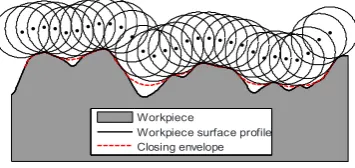
Fig 1 and Fig 2 illustrate two examples of the closing and opening envelope of an open surface profile by a circular structuring element, i.e. disk. The closing envelope is obtained by placing an infinite number of identical disks in contact with the profile from above along all the profile and taking the lower boundary of the disks [11]. On the contrary the opening filter is archived by placing an infinite number of identical disks in contact with the profile from below along all the profile and taking the upper boundary of the disks.
3.The alpha shape method for morphological filters
By convention, morphological filters are implemented in a similar manner to image processing whereby the measured data are treated like image pixels. Fig 3 presents a basic method to compute the dilation operation of profile data with the disk structuring element [12]. The disk ordinates are sampled from the disk centre to the two ends with the same sampling interval to that of the profile. These disk ordinates are placed to overlap the profile ordinates with the disk centre locating on the target profile point. The ordinate where the mapping pair of the profile ordinate and the disk ordinate gives the maximum value determines the height of the disk centre. This procedure is repeated for all the profile ordinates to obtain the whole dilation envelope. This method however has a couple of limitations, for example, poor performance for large areal dataset and not applicable for non-uniform sampled surfaces and freeform surfaces.
[image:2.595.342.479.438.537.2]Recently we developed a novel approach based on the relationship between morphological operations and the alpha shape [8, 9]. The alpha shape was introduced by Edelsbrunner in the 1980’s aiming to describe the specific “shape” of a finite point set with a real parameter controlling the desired level of details [13]. The alpha hull is the bounding envelope generated by rolling the ball with radius over the point set. See Fig 4. A theoretical link bridges the alpha hull and morphological operations: the alpha hull is equivalent to the closing of the point set X with a generalized ball of
Workpiece
[image:2.595.89.267.453.537.2]Workpiece surface profile Closing envelope
Fig. 1. The closing envelope of an open profile by a disk
Workpiece
[image:2.595.83.270.576.667.2]Workpiece surface profile Opening envelope
Fig. 2. The opening envelope of an open profile by a disk
workpiece Max height
Profile height Disk height Disk
Fig. 3. Computation of the dilation operation with the disk structuring element.
[image:2.595.354.466.584.675.2]radius 1 [14].
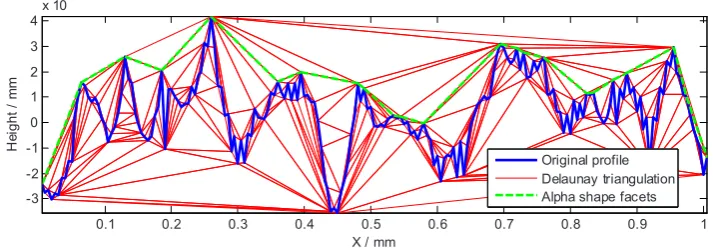
The alpha shape algorithm is based on the Delaunay triangulation from which the boundary facets of the alpha shape could be extracted. Fig 5 illustrates an example of the boundary alpha shape facets extracted from the Delaunay triangulation of the profile data. The boundary of the alpha shape is equivalent to the boundary of the alpha complex, which is the collection of the simplices in the Delaunay triangulation satisfying two properties: (1) the radius of the smallest circumsphere of the simplex is smaller than the radius and the circumsphere is empty; (2) the simplex is a face of super simplex in the alpha complex.
For open surfaces, the envelope ordinates are achieved by interpolating points on the arcs/caps determined by the boundary facets (upper facets for the morphological closing envelope and lower facets for the morphological opening envelope). Nevertheless two issues concerned with the algorithm were raised in the development. First, the spikes in the data set may cause singularities. It was solved by linearly interpolating enough points on ridges of spikes to prevent the ball (disk) from passing through. Second, the end effect of morphological filters was corrected by reflecting the boundary surface regions in the range of the ball radius starting from the surface margins.
Compared to the traditional approach, the alpha shape method provides the merits of running relative fast, allowing arbitrary large ball radii and being applicable for freeform surfaces and non-uniform sampled surfaces. An additional benefit of the alpha shape method is that the triangulation data is reusable for computation of multiple radius attempts. It saves a great deal of computation time considering in real practice a multitude of trails may be made for an appropriate ball radius. In spite of these virtues, there is a limitation with the alpha shape method. The Delaunay triangulation on which the alpha shape method depends is costly in
computation time and memory for large areal data. Thus an efficient method is required to overcome this constraint.
4.The divide-and-conquer algorithm
Aiming to break the computation bottleneck of the 3D Delaunay triangulation, the divide-and-conquer algorithm is introduced into the computation of morphological filters. The basic scheme of the divide-and-conquer approach is to break a problem into several sub-problems that are similar to the original problem but smaller in size, solve the sub-problems recursively and then combine these solutions to create a solution to the original problem [15].
In the context of the alpha shape method, the contact points are the vertices of the alpha shape facets. They are physically important because they are those points on the surface which are in contact with the rolling ball. In a mathematical morphology point of view, the contacts points are those points on the surface which remain unchanged before and after morphological closing and opening operations. The morphological envelope of a surface could be determined by these contact points and their facets. Thus in order to reduce the computation, the surface is presented by its contact points in the computation of morphological envelopes, instead of all of the sampled points.
By applying the divide-and-conquer method, the surface could be divided into a series of small sub-surfaces. Each sub-surface is rolled by the ball to generate a set of contact points. Afterward the resulting contact points from each sub-surface are merged to construct a super set of contact points. Roll the ball over this combined set of contact points and an updated set is yielded with the fake contact points removed. In such a manner, the contact points of the original surface are found.
0.1 0.2 0.3 0.4 0.5 0.6 0.7 0.8 0.9 1
-3 -2 -1 0 1 2 3 4x 10
-3
X / mm
He
ig
h
t / m
m
[image:3.595.113.470.531.655.2]Original profile Delaunay triangulation Alpha shape facets
As stated in Section 3, the alpha shape method depends upon the 3D Delaunay triangulation of the sampled points of the surface. Engineering surfaces usually contain a large amount of data, especially using fast optical measurement instruments. The 3D Delaunay triangulation for such kind of super large data set is both time and memory consuming. It was reported that the data structure of the 3D Delaunay triangulation is not suitable for datasets of millions of points [16]. Using the divide-and-conquer method, the surface with huge dataset is partitioned into small sub-surfaces recursively, until the computation of 3D Delaunay triangulation is fast enough for each sub-surface. In practice the 3D Delaunay triangulation is fast for areal matrix with 50 x 50 or 100 x 100 points. Once the contact points of sub-surfaces are obtained, they are merged and the alpha shape method is applied on the merged contact point set to produce the updated one. During this process some of the contact points on the boundary regions before
merging might be removed thereafter. This procedure repeats until the contact points of the original surface are obtained.
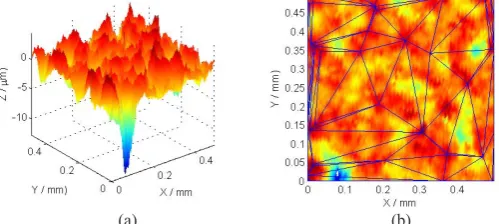
[image:4.595.169.419.73.185.2]Following the three typical steps of the divide-and-conquer paradigm, i.e. divide, divide-and-conquer, combine, at each level of the recursion, the details of each step are illustrated below. Fig 6 presents an example surface (100 x 100 points) as well as its boundary alpha shape facets computed by the alpha shape method. The example surface is then divided into four small sub-surfaces with 50 x 50 points for individual each one (see Fig 7). The search of contact points on these sub-surfaces is conquered by applying the alpha shape method. Fig 8 graphs the contact points and the boundary alpha shape facets of four sub-surfaces respectively. Finally the contact points of four sub-surfaces are merged together and the alpha shape method is applied on the combined contact points set to generate the final boundary alpha shape facets (see Fig 9). It could be noticed in the figure
[image:4.595.66.504.236.436.2]Fig. 6. An example surface and it boundary alpha shape facets. (a) Example surface; (b) Boundary facets superimposed on the surface
Fig. 7. Four divided sub-surfaces
Fig. 8. Contact points and boundary alpha shape facets of four sub-surfaces
that some of the contact points on boundary regions before merging are no longer in the updated set after the merge. The final boundary facets demonstrated in Fig 9 are identical to those generated by applying the alpha shape method directly, as presented in Fig 6(b). It indicates the results computed by two distinct methods are completely identical. For convenience of demonstration, this example only illustrates one recursion. As to large areal surfaces, more recursions might be required.
5.Verification and performance evaluation
In order to verify the proposed divide-and-conquer method, it was applied to an experimental surface. The experimental surface is 1 x 1 mm2 in size, measured by
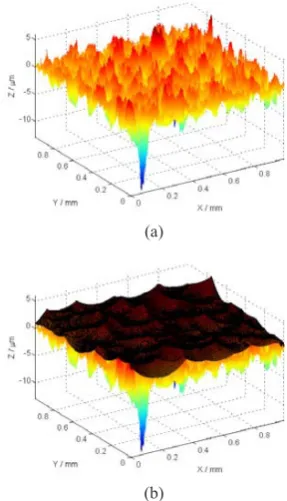
Taylor Robson PGI with sampling interval 5 m in both the X direction and the Y direction (see Fig 10(a)). The morphological closing envelope generated by the divide-and-conquer method with ball radius 0.5 mm is demonstrated in Fig 10(b). Another experimental surface with areal size 1.25 x 1.25 mm2 and sampling interval 5
m was evaluated as illustrated in Fig 11(a). Its closing envelope is demonstrated in Fig 11(b). It was verified that these resulting envelopes are same as the ones generated by applying the alpha shape method directly.
[image:5.595.337.483.73.326.2]Experiments were also carried out to evaluate the performance of the divide-and-conquer algorithm and compare the result with those of the traditional algorithm and the alpha shape method. Three distinct methods are applied on a series of areal data set ranging from 100 x 100 points to 1000 x 1000 points. The performance data are listed in Table 1. It is evident in the table that the divide-and-conquer method archives the optimal performance, especially for large areal data set. The direct alpha shape method is better than the traditional algorithm, but still time-consuming in the case of large areal data.
Fig. 9. Merged contact point set and final boundary alpha shape facets of the whole surface
(a)
[image:5.595.80.259.73.222.2](b)
Fig. 10. Experimental surface 1 and its closing envelope with ball radius 0.5 mm. (a) Experimental surface 1; (b) Closing envelope.
(a)
(b)
[image:5.595.339.483.408.659.2]6.Conclusions
The proposed divide-and-conquer algorithm is an optimization to the alpha shape method in terms of speeding up the performance and breaking the computational bottleneck of the 3D Delaunay triangulation. The large areal surface is divided into small ones so that the alpha shape method executes efficiently. The contact points are searched on each sub-surface and merged into a large set on which the alpha shape method is applied again to archive the updated result. Thus the morphological envelope could be computed recursively without performing the 3D Delaunay triangulation to the whole surface data. This method is efficient in that it uses less data in computation because only the contact points generated from the last recursion are taken into computation in the next recursion instead of all of the sampled surface points. In the meanwhile it retains almost all the merits of the alpha shape method.
The experiments show that the result obtained by the divide-and-conquer algorithm is consistent with the one by applying the alpha shape method directly. The performance evaluation reveals that the divide-and-conquer algorithm achieves superior performance over the original alpha shape method.
Acknowledgements
The authors gratefully acknowledge the European Research Council for its “Ideal Specific programme” ERC-2008-AdG 228117-Surfund and the UK research council for its “manufacturing the future” program on the EPSRC centre in advanced metrology.
References
[1] Von Weingraber H. Über die Eignung des Hüllprofils als Bezugslinie für die Messung der Rauheit. Ann. CIRP 1956;5 :116-28.
[2] Srinivasan V. Discrete morphological filters for metrology. Proceedings 6th ISMQC Symposium on Metrology for Quality Control in Production 1998:623–8.
[3] Krystek M. Morphological filters in surface texture analysis. XIth international colloquium on surfaces 2004:43-55.
[4] Roger S, Dietzsch M, Gerlach M, Je S. “Real mechanical profile” – the new approach for nano-measurements. Journal of physics: conference Series 2005;13:13-9.
[5] Malburg CM. Surface Profile Analysis for Conformable Interfaces. Transactions of ASME 2003;125:624-7.
[6] Decenciere E, Jeulin D. Morphological decomposition of the surface topography of an internal combustion engine cylinder to characterize wear. Wear 2001;249:482-8.
[7] Shunmugam MS, Radhakrishnan V. Two-and three dimensional analyses of surfaces according to the E-system. Proc Instn Mech Eng 1974;188:691-9.
[8] Lou S, Jiang X, Scott PJ. Fast algorithm to morphological filters. Journal of Physics: Conference Series 2011;311:1-5. [9] Jiang X, Lou S, Scott PJ, Morphological method for surface
metrology and dimensional metrology based on the alpha shape, Meas Sci Technol 2012;23: 015003.
[10] Serra J. Image Analysis and Mathematical Morphology, Academic Press New York; 1982.
[11] Scott PJ. Scale-space techniques. Proceedings of the X International Colloquium on Surfaces 2000:153-61.
[12] Shunmugam MS, Radhakrishnan V, Two-and three dimensional analyses of surfaces according to the E-system, Proc Instn Mech Eng 1974;188: 691-699.
[13] Edelsbrunner H, Mucke EP. Three-dimensional alpha shapes. ACM Trans Graph 1994;13:43-72.
[14] Worring M, Smelders WM. Shape of arbitrary finite point set in R2. Journal of Mathematical Image and Vision 1994;4: 151-70. [15] Cormen TH, Leiserson CE, Rivest RL. Introduction to
Algorithms. The MIT Press; 1989.
[image:6.595.95.497.95.151.2][16] Bernardini F, Mittleman J, Rushmeier H, Silva C, Taubin G. The ball-pivoting algorithm for surface reconstruction. IEEE Transactions on Visualization and Computer Graphics 1999;5: 349-359.
Table 1. Performance comparison of the three algorithms for morphological filters