2017 2nd International Conference on Computer Engineering, Information Science and Internet Technology (CII 2017) ISBN: 978-1-60595-504-9
Analysis and Classification of Logistics Function of
Bohai Sea Port Based on Fuzzy Clustering
HONGMEI JU, WEI YINand QIQI LIU
ABSTRACT
In recent years, the national "Beijing-Tianjin-Hebei integration" strategy has brought new challenges and opportunities to the ports in the Bohai Sea region, so the port operators should sort out their own logistics service function positioning and implementation of the corresponding strategy. This paper chooses fuzzy clustering analysis method to classify Bohai Bay Port Logistics service function from the aspects of comprehensive service, basic production, auxiliary operation and derivative service of port logistics. The port of Bohai Bay should be positioned according to the characteristics of port logistics function development and reasonable development direction of Port. At the same time, the regional port group development is divided into different levels of governance mode, speeding up regional port resources integration and Port Group development overall International competitiveness promotion.
KEYWORDS
Bohai Sea, Port logistics, Service function, Fuzzy clustering.
INTRODUCTION
There are many excellent ports by the two hinterland of North China and Northeast along with BohaiBay. Thanks to China's long-term high-speed development, many Bohai port throughput increased significantly, especially coal and iron ore and other resource-based goods, many of them grow into functional ports. However, in recent years, the global economy and China's supply side reform both internal and external factors, China's port production situation further sluggish, the port throughput continued to decline, the Bohai Sea port is the first to bear the brunt. The port not only to adjust the economic structure and positioning for their own development also need to rethink, and some port logistics functions of the rational classification and development model is not clear enough, so the Bohai Sea port logistics function of a reasonable classification, the implementation of the corresponding strategy is necessary.
_________________________________________
Hongmei Ju, juhongmei@bw u.edu.cn, School of Information, Beijing WUZI University, Beijing, China
THE PORT LOGISTICS SERVICE FUNCTIONS AND CHARACTERISTICS
Traditionally, the basic function of the port is located in the transport, especially in the early stages of port production, the port as a cargo transshipment point and storage, the core task is to ensure that the goods quickly, safe, high quality, cheap loading or loading ashore. With the gradual improvement of the market economy system, the port has become an important intersection of economy, trade and culture in the process of interactive development between port and city. The 1999 United Nations Conference on Trade and Development provided the concept of a fourth-generation port[1]. The fourth generation port has not existed as an isolated point in the transportation chain, but as a component part of the global supply chain, emphasizing the fine operation of Port logistics and Agile Flexible service, the port logistics function is characterized by knowledge-intensive and technology diffusion as an important feature [2]. At the same time, according to the Conference on the port and its logistics functions, it can be seen that the port logistics function has diversified and stage evolution of the two characteristics [3].
In fact, from the development process of the world port, the port is mainly accompanied by the process of industrialization and corresponding development. In the early stage of industrialization, the industrial production was mainly distributed in the coastal port area, and the port logistics production was developed in advance to support the development of port freight. In the middle of industrialization, the basic industry of port city improved obviously, the city industrial supply chain lengthened and the port logistics developed rapidly, then the logistics production operation was the stage of vigorous development. In the later period of industrialization, the development of regional economy depends not only on the logistics operation, but also on the supporting service of the port logistics, and the corresponding auxiliary features of logistics freight forwarder and ship supply are obviously. In the post-industrialization period, the port logistics service function adapts to the globalization trend, breaks through the basic function of the ship and the freight production, the relative dependence on the port hardware production system gradually decreases. So the port logistics quantity growth is limited and trended to the port logistics knowledge, the information consultation, the technology innovation and so on the neighborhood extension [4].
THE BOHAI SEA PORT LOGISTICS SERVICE FUNCTION CLASSIFICATION ANALYSIS INDICATORS AND METHODS
The index system of logistics service function of Bohai Sea port
Port cargo throughput C1
Number of berths for port operations C4 Port container throughput C2 Port logistics handling capacity C5 Port operation berth length C3 Port Logistics Set Distribution
Efficiency C6
Logistics processing value
- added level C7
Agency services and ship supply
C8
Freight broker and Ship trade
C9
Ship inspection And
build C10
Port Logistics Teaching and Information
Consulting C11
Port Logistics and Maritime Legal Arbitration Services
C12
[image:3.612.117.477.53.189.2]Port Logistics Science and Technology Innovation C13 Port Logistics Basis Production Service Function Classification Port Logistics Auxiliary Service Service Function Classification Port Logistics Derived Support Service Classification Co m pr eh en siv e S er vic e F un cti on C la ss ific ati on o f Bo ha i P or t L og ist ics Port Logistics Base Production Service Index Port Logistics Auxiliary Service Service Index Port Logistics Derivative Support Service Indicators
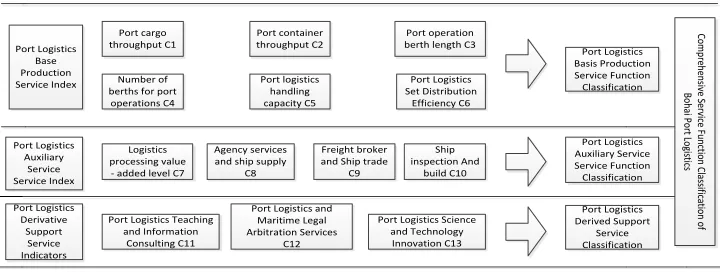
Figure 1.Port logistics services function classification key indicators.
Therefore, the selection of indicators should have the following characteristics: First, the indicators have a certain coverage, to reflect the port logistics functions of the three aspects. Second, to reflect the logistics service function indicators in the statistical data is not available, some important factors is difficult to quantify directly or lack of statistical data. The design index system should try to reflect the key factor indicators; these indicators which difficult to quantify uses expert research score to obtain the index data. Therefore, the index data sources are divided statistical data and expert research into two categories; the third selected indicators of meaning, statistical methods and expert research with the corresponding consistency. According to the experience of the port logistics function system, the experts of the port industry and the necessary analysis of the indicators, the port logistics service function classification of the main indicators shown in Figure 1.
Fuzzy clustering method and procedure for logistics service function classification of Bohai Sea port
The function system of port logistics belongs to the fuzzy systemwith incomplete information. Some of the index data in the index system can be obtained through the statistical data, while the remaining part of the index needs to be given by the fuzzy value of the expert[6]. This paper chooses the fuzzy clustering analysis method to classify the logistics service function of the Bohai Sea port. The main steps are as follows:
Establish the data matrix. Set the domain 𝑈={𝑥1,𝑥2,…,𝑥𝑛} for the classified Port
object, each object is represented by m indicators of its logistics service features, namely : 𝑥𝑖={𝑥𝑖1,𝑥𝑖2,…𝑥𝑖𝑚}(𝑖 = 1,2 ⋯ , 𝑛). Thus, the raw data matrix of the Bohai
Sea port logistics function can be classified 𝑋 = {𝑥𝑖𝑘}𝑛×𝑚 ( 𝑖 = 1,2, … ; 𝑘 =
1,2, … , 𝑚).
Standardization of data. In practical problems, different data generally have different dimensions, in order to eliminate the impact of the dimension, we need to do the appropriate transformation of the data, we need to do the appropriate transformation of the data.
𝑥′ 𝑖𝑘=
𝑥𝑖𝑘−𝑥̅𝑘
𝑆𝑘 (𝑖 = 1,2, … 𝑛; 𝑘 = 1,2, … 𝑚) (1)
Among them 𝑥̅𝑘=1
𝑛∑ 𝑥𝑖𝑘 𝑛
𝑖=1 , 𝑆𝑘=√ 1
𝑛∑ (𝑥𝑖𝑘 − 𝑥𝑘) 2 𝑛
After transformation, the mean of each variable is 0, the standard deviation is 1, and the effect of the dimension is eliminated. But this is to get the 𝑥′
𝑖𝑘 not necessarily
in the [0,1] interval. In this case, a further differential transformation is required.
𝑥𝑖𝑘′′= 𝑥𝑖𝑘 ′′−min
1≤𝑖≤𝑛{𝑥′𝑖𝑘}
max1≤𝑖≤𝑛{𝑥′𝑖𝑘}−min1≤𝑖≤𝑛{𝑥′𝑖𝑘} (𝑘 = 1,2, ⋯ , 𝑛) (2)
Calibration to establish fuzzy similarity matrix. The data elimination dimension is normalized and the data is compressed to the interval [0,1] according to the requirements of the fuzzy matrix. Set 𝑈 ={𝑥1,𝑥2,…,𝑥𝑛},𝑥𝑖={𝑥𝑖1,𝑥𝑖2,…𝑥𝑖𝑚} According to the traditional clustering method to determine the similarity coefficient, establish a fuzzy matrix 𝑥𝑖and𝑥𝑗similar degree of 𝑟𝑖𝑗 = R (𝑥𝑖. 𝑥𝑗), determine the 𝑟𝑖𝑗 = 𝑅(𝑥𝑖. 𝑥𝑗) can be used in the similarity coefficient method of quantitative product method.
𝑟𝑖𝑗={
1, 𝑖 = 𝑗
1
𝑀∑ 𝑥𝑖𝑘. 𝑥𝑗𝑘, 𝑖 ≠ 𝑗 𝑚
𝑘=1
(3)
Among them 𝑀 = max (∑𝑚𝑘=1𝑥𝑖𝑘. 𝑥𝑗𝑘). Obviously 𝑟𝑖𝑗 ∈[0,1]. If there is a negative value in the 𝑟𝑖𝑗, you can further convert 𝑟𝑖𝑗 to the [0,1] interval by using the transformation method,
𝑟′ 𝑖𝑗=
𝑟𝑖𝑗+1
2 (4)
where 𝑟′
𝑖𝑗 ∈[0,1].
Fuzzy cluster analysis is used to classify the logistics service function of Bohai Sea port, and the specific method is the transmission closure. According to the calibrated fuzzy matrix, a fuzzy similarity matrix R is not necessarily transitive; that is, R is not necessarily a fuzzy equivalent matrix. In order to classify, it is also necessary to transform R into a fuzzy equivalent matrix 𝑅∗. There is a minimum natural number k (k≤n) such that R ∈ 𝜇𝑛×𝑛 is a fuzzy similarity matrix, so that the transport closure𝑡(𝑅)=𝑅𝑘 is given for all natural numbers q. At this time, 𝑡(𝑅) is a fuzzy equivalent matrix. The formula is as follows: A = (𝑎𝑖𝑘)𝑚×𝑠, B = (𝑏𝑘𝑗)𝑠×𝑛, the fuzzy matrix A ∙ B=(𝑐𝑖𝑗)𝑚×𝑛 for the matrix A and B synthesis. In this case,
𝑐𝑖𝑗 =∨𝑘=1𝑠 (𝑎𝑖𝑘∧ 𝑏𝑘𝑗) (5)
Starting from the fuzzy similarity matrix R, followed by seeking the second power, that is R → 𝑅2 → 𝑅4 → ⋯ → 𝑅2𝑖 → ⋯. When the first occurrence of 𝑅𝑘°𝑅𝑘 = 𝑅𝑘, 𝑅𝑘 is the required transitive closure t(R). That is, after using the above
EMPIRICAL ANALYSIS ON THE CLASSIFICATION OF LOGISTICS SERVICE FUNCTION IN BOHAI SEA PORT
Port samples and raw data
According to the "China Port Statistical Yearbook 2015", we selected 13 samples of Bohai Sea port and their data as shown in Table 1.
Service function classification and result analysis
Port logistics service function classification process
First of all, the Port Integrated Logistics services function classification. From the original data in Table 1, the original matrix can be normalized by the translation-standard deviation transformation using the formula (1) to obtain the translation-standard initial data matrix.
[
−0.756 −0.488 −0.485 −0.571 −0.491 −0.971 −0.727 0.421 0.004 0.330 0.972 0.701 0.529
0.826 0.909 0.805 2.547 0.973 1.486 1.416 1.100 1.368 1.423 0.939 1.122 1.443
0.369 0.262 0.479 0.087 0.381 0.223 0.281 0.262 0.138 −0.064 0.116 −0.027 0.167
−1.450 −0.760 −0.988 −0.932 −1.572 −1.297 −1.067 −1.324 −0.910 −1.113 −0.856 −1.459 −0.312 −1.106 −0.674 −0.952 −0.963 −1.407 −1.294 −1.609 −1.688 −1.554 −1.223 −0.991 −1.189 −1.428
−0.142 −0.732 −0.330 −0.195 0.185 −0.078 −0.830 0.031 −0.097 −0.508 0.152 −0.120 −0.655
1.293 −0.545 0.686 0.197 0.697 0.393 0.380 0.322 0.345 −0.261 0.188 0.637 0.401
1.578 1.764 1.942 1.388 1.352 1.467 1.520 1.329 1.636 1.711 1.547 1.290 1.091
−0.659 −0.732 −1.044 −0.760 0.346 −0.360 −0.611 −0.457 −0.500 −0.405 0.052 −0.196 −0.491
−0.150 −0.374 1.058 0.212 0.275 0.469 0.463 0.480 −0.180 0.072 0.250 0.674 0.792
−1.404 −0.696 −1.523 −1.089 −1.641 −1.288 −0.632 −0.878 −1.405 −1.122 −1.524 −1.296 −1.483
0.361 −0.308 −0.553 −0.493 −0.437 −0.291 −0.167 −1.173 −0.458 −0.597 −1.879 −1.381 −1.373
1.240 2.374 0.906 0.573 1.338 1.480 1.582 1.575 1.612 1.758 1.036 1.244 1.320 ]
TABLE 1. BOHAI PORT SAMPLES AND THEIR DATA.
Port C1 C2 C3 C4 C5 C6 C7 C8 C9 C10 C11 C12 C13
DanDong 15040.0 00 182.90 0 14372.0 00 48.00 0 7.88 3 6.77 7 7.45 4 8.47 1 8.21 0 7.73 2 9.31 2 8.65 3 8.54 3
DaLian 41482.0 00 944.90 0 27318.0 00 247.0 00 9.54 5 9.98 3 9.77 0 9.30 1 9.67 0 9.01 3 9.28 1 9.12 3 9.32 1
YingKou 33849.0 00 592.20 0 24051.0 00 90.00 0 8.87 3 8.33 5 8.54 3 8.27 7 8.35 3 7.27 1 8.49 2 7.84 2 8.23 5
PanJin 3443.000 35.000 9321.000 25.000 6.656 6.352 7.087 6.339 7.231 6.042 7.561 6.245 7.828
JinZhou 9192.00
0 81.900
9678.00 0 23.00 0 6.84 3 6.35 6 6.50 1 5.89 4 6.54 1 5.91 3 7.43 2 6.54 6 6.87 8 Qinhuangd ao 25309.0
00 50.100
15928.0 00 72.00 0 8.65 1 7.94 3 7.34 3 7.99 5 8.10 2 6.75 1 8.52 7 7.73 8 7.53 6 TangShan g 49285.0 00 152.00 0 26121.0 00 97.00 0 9.23 2 8.55 7 8.65 1 8.35 0 8.57 5 7.04 0 8.56 1 8.58 2 8.43 4
TianJin 54051.0 00 1411.0 00 38729.0 00 173.0 00 9.97 5 9.95 9 9.88 3 9.58 0 9.95 7 9.35 0 9.86 3 9.31 0 9.02 1
HuangHua 16657.0
00 50.200
8761.00 0 36.00 0 8.83 3 7.57 5 7.57 9 7.39 8 7.67 0 6.87 1 8.43 1 7.65 3 7.67 5
YanTai 25163.0 00 245.00 0 29857.0 00 98.00 0 8.75 3 8.65 6 8.74 0 8.54 3 8.01 3 7.43 0 8.62 1 8.62 3 8.76 7
WeiHai 4213.00
0 69.600
3944.00 0 15.00 0 6.57 8 6.44 1 7.55 7 6.88 4 6.70 1 6.03 1 6.92 1 6.42 7 6.83 1
RiZhao 33707.3 60 281.00 0 13683.0 00 53.00 0 7.94 4 7.66 5 8.05 9 6.52 3 7.71 5 6.64 7 6.58 1 6.33 2 6.92 5
QingDao 48400.000 1744.000 28335.000 121.000 9.960 9.975 9.950 9.881 9.932 9.405 9.374 9.259 9.216
And then through the formula (2) translation of the difference transformation to obtain a standardized matrix.
[
0.229 0.087 0.300 0.142 0.384 0.117 0.276 0.646 0.489 0.521 0.832 0.786 0.688 0.752 0.532 0.672 1.000 0.873 1.000 0.948 0.855 0.916 0.888 0.823 0.939 1.000 0.601 0.326 0.578 0.323 0.676 0.546 0.592 0.598 0.530 0.389 0.582 0.521 0.546 0.000 0.000 0.155 0.043 0.023 0.000 0.170 0.112 0.202 0.037 0.299 0.000 0.400 0.114 0.027 0.165 0.034 0.078 0.001 0.000 0.000 0.000 0.000 0.259 0.098 0.019 0.432 0.009 0.345 0.246 0.610 0.438 0.244 0.527 0.457 0.240 0.593 0.487 0.283 0.906 0.068 0.638 0.353 0.781 0.607 0.623 0.616 0.595 0.323 0.603 0.762 0.644 1.000 0.805 1.000 0.681 1.000 0.993 0.981 0.925 1.000 0.984 1.000 1.000 0.880 0.261 0.009 0.138 0.091 0.664 0.337 0.313 0.377 0.331 0.274 0564 0.459 0.339 0.429 0.123 0.745 0.358 0.640 0.635 0.649 0.664 0.431 0.434 0.622 0.776 0.778 0.015 0.020 0.000 0.000 0.000 0.025 0.306 0.248 0.047 0.034 0.104 0.059 0.000 0.598 0.144 0.280 0.164 0.402 0.362 0.452 0.158 0.344 0.210 0.000 0.028 0.038 0.888 1.000 0.701 0.457 0.996 0.998 1.000 1.000 ]0.993 1.000 0.851 0.983 0.958]
The fuzzy similarity matrix R of the above normalized matrices is solved by using the similarity matrix number product (3) and (4).
[
1.000 0.457 0.482 0.082 0.057 0.031 0.478 0.450 0.061 0.003 0.046 0.444 0.460 0.457 1.000 0.104 0.198 0.142 0.423 0.188 0.852 0.365 0.178 0.155 0.310 0.767 0.482 0.104 1.000 0.447 0.442 0.488 0.048 0.146 0.476 0.033 0.441 0.478 0.129 0.082 0.198 0.447 1.000 0.618 0.099 0.395 0.128 0.201 0.425 0.607 0.304 0.160 0.057 0.142 0.442 0.618 1.000 0.139 0.390 0.081 0.240 0.406 0.690 0.385 0.106 0.031 0.423 0.488 0.099 0.139 1.000 0.492 0.409 0.081 0.482 0.116 0.057 0.406 0.478 0.188 0.048 0.395 0.390 0.492 1.000 0.242 0.465 0.077 0.382 0.456 0.185 0.450 0.852 0.146 0.128 0.081 0.409 0.242 1.000 0.338 0.204 0.080 0.280 0.185 0.061 0.365 0.476 0.201 0.240 0.081 0.465 0.338 1.000 0.466 0.231 0.100 0.338 0.003 0.178 0.033 0.425 0.406 0.482 0.077 0.204 0.466 1.000 0.406 0.430 0.159 0.046 0.155 0.441 0.607 0.690 0.116 0.382 0.080 0.231 0.406 1.000 0.397 0.159 0.444 0.310 0.478 0.304 0.385 0.057 0.456 0.280 0.100 0.430 0.397 1.000 0.299 0.460 0.767 0.129 0.160 0.106 0.406 0.185 0.965 0.359 0.159 0.128 0.299 1.000]
The convolution formula (5) of the fuzzy similarity matrix R is obtained,and the quadratic method is used to find the transitive closure t(R):R→𝑅2→𝑅4→𝑅∗.
[
1.000 0.460 0.482 0.447 0.447 0.482 0.482 0.460 0.476 0.482 0.447 0.478 0.460 0.460 1.000 0.460 0.447 0.447 0.460 0.460 0.852 0.460 0.460 0.447 0.460 0.852 0.482 0.460 1.000 0.447 0.447 0.488 0.488 0.460 0.476 0.482 0.447 0.478 0.460 0.447 0.447 0.447 1.000 0.618 0.447 0.447 0.447 0.447 0.447 0.618 0.447 0.447
0.447 0.447 0.447 0.618 1.000 0.447 0.447 0.447 0.447 0447 0.690 0.447 0.447
0.482 0.460 0.488 0447 0.447 1.000 0.492 0.460 0.476 0.482 0.447 0.478 0.460
0.482 0.460 0.488 0.447 0.447 0.492 1.000 0.460 0.476 0.482 0.447 0.478 0.460 0.460 0.852 0.460 0.447 0.447 0.460 0.460 1.000 0.460 0.460 0.447 0.460 0.965 0.476 0.460 0.476 0.447 0.447 0.476 0.476 0.460 1.000 0.476 0.447 0.476 0.460 0.482 0.460 0.482 0.447 0.447 0.482 0.482 0.460 0.476 1.000 0.447 0.478 0.460 0.447 0.447 0.447 0.618 0.690 0.447 0.447 0.447 0.447 0.447 1.000 0.447 0.447 0.478 0.460 0.478 0.447 0.447 0.478 0.478 0.460 0.476 0.478 0.447 1.000 0.460 0.460 0.852 0.460 0.447 0.447 0.460 0.460 0.965 0.460 0.460 0.447 0.460 1.000]
In the fuzzy equivalent matrix t (R), we obtain different intercepts of λ (0≤λ≤1). From small to large followed by0. 4475, 0.4599, 0.4762, 0.4776, 0.4819, 0.4820, 0.4888,0.4918,0.6900,0.8522,0.9649,1.000 and other 13 values. The integrated service function of the Bohai Sea port based on the Intercept array from different λ is listed.
When the λ = 1.000, classified as {Tianjin}, {Qingdao}, {Dandong}, {Dalian}, {Yingkou}, {Panjin}, {Jinzhou}, {Qinhuangdao}, {Tangshan}, {Huanghua}, {WeiHai}, {RiZhao}.
When the λ= 0.9649, classified as {Tianjin, Qingdao}, {Dandong}, {Dalian}, {Yingkou}, {Panjin}, {Jinzhou}, {Qinhuangdao}, {Tangshan}, {Huanghua}, {Yantai}, {Weihai}, {RiZhao}.
When the λ= 0.6900, classified as {Dalian, Tianjin, Qingdao}, {Jinzhou, Weihai}, {Dandong}, {Yingkou}, {Panjin}, {Qinhuangdao}, {Tangshan}, {Huanghua}, {Yantai}, {RiZhao}.
When the λ = 0.4918, classified as {Dalian, Tianjin, Qingdao}, {Panjin, Jinzhou, Weihai}, {Qinhuangdao, Tangshan}, {Dandong}, {Yingkou}, {Huanghua}, {Yantai}, {RiZhao}.
When the λ = 0.4888, classified as {Dalian, Tianjin, Qingdao}, {Yingkou, Qinhuangdao, Tangshan}, {Panjin, Jinzhou, Weihai}, {Dandong}, {Huanghua}, {Yantai}, {RiZhao}.
When the λ = 0.4820, the classification is, {Dandong, Yingkou, Qinhuangdao, Tangshan}, {Dalian, Tianjin, Qingdao}, {Panjin, Jinzhou,Weihai}, {Huanghua}, {Yantai}, {RiZhao}.
Whenthe λ = 0.4819, classified as {Dandong, Yingkou, Qinhuangdao, Tangshan, Yantai}, {Dalian, Tianjin, Qingdao}, {Panjin, Jinzhou, Weihai}, {Huanghua}. {RiZhao}.
When the λ = 0.4776, classified as {Dandong, Yingkou, Qinhuangdao, Tangshan, Yantai, RiZhao}, {Dalian, Tianjin, Qingdao}, {Panjin, Jinzhou, Weihai}, {Huanghua}.
When the λ = 0.4762, classified as {Dandong, Yingkou, Qinhuangdao, Tangshan, Huanghua, Yantai,RiZhao}, {Dalian, Tianjin, Qingdao}, {Panjin, Jinzhou, Weihai}.
When the λ = 0.4599, classified as {Dandong, Dalian, Yingkou, Qinhuangdao, Tangshan, Huanghua, Tianjin, Yantai, {RiZhao, Qingdao}, {Panjin, Jinzhou, Weihai}. When the λ = 0.4475, classified as {Dandong, Dalian, Yingkou, Qinhuangdao, Tangshan, Huanghua, Tianjin, Yantai, Rizhao, Qingdao, Panjin, Jinzhou, Weihai}.
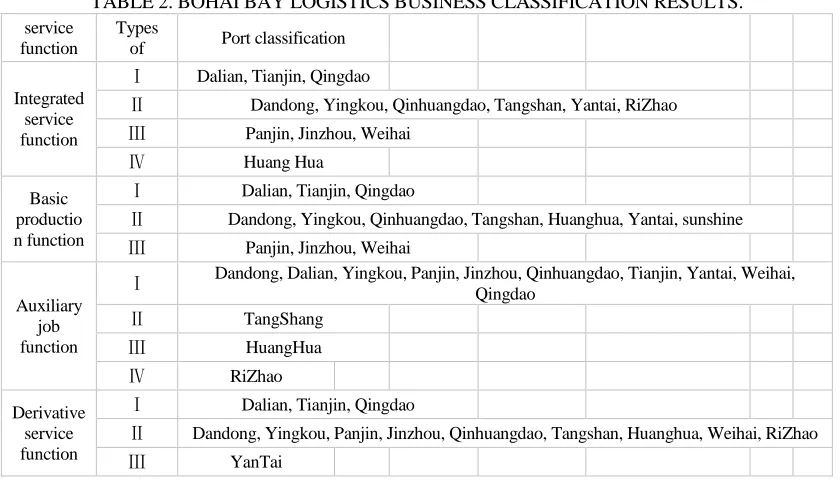
[image:7.612.89.509.473.719.2]In the same way, we can take the above steps to 13 port samples of Bohai Bay Port Logistics Basic production Service function (index C1 to C6), the Port Logistics Auxiliary Service function (index C7 to C10), the Port Logistics Derivative Support Service function (index C11 to C13)and other single functions to classify, The results of the classification of logistics services in Bohai Bay are shown in Table 2.
TABLE 2. BOHAI BAY LOGISTICS BUSINESS CLASSIFICATION RESULTS.
service function
Types
of Port classification
Integrated service function
Ⅰ Dalian, Tianjin, Qingdao
Ⅱ Dandong, Yingkou, Qinhuangdao, Tangshan, Yantai, RiZhao
Ⅲ Panjin, Jinzhou, Weihai
Ⅳ Huang Hua
Basic productio n function
Ⅰ Dalian, Tianjin, Qingdao
Ⅱ Dandong, Yingkou, Qinhuangdao, Tangshan, Huanghua, Yantai, sunshine
Ⅲ Panjin, Jinzhou, Weihai
Auxiliary job function
Ⅰ Dandong, Dalian, Yingkou, Panjin, Jinzhou, Qinhuangdao, Tianjin, Yantai, Weihai, Qingdao
Ⅱ TangShang
Ⅲ HuangHua
Ⅳ RiZhao
Derivative service function
Ⅰ Dalian, Tianjin, Qingdao
Ⅱ Dandong, Yingkou, Panjin, Jinzhou, Qinhuangdao, Tangshan, Huanghua, Weihai, RiZhao
Analysis and Countermeasure of Port Logistics Service Function Classification Result
As can be seen from Table 2, different port logistics functions form different ports types. In the integrated service function of port logistics, the Bohai Sea port comes down to four categories, including Dalian Port, Tianjin Port, Qingdao Port which are hub in Northeast Asia, Naturally have a comparative advantage of the logistics integrated services; Huanghua Port has some advantages in logistics basic production service and auxiliary operation service, but the development of derivative services is relatively insufficient. In the Port Logistics Basic Production service function aspects, Dalian Port, Tianjin Port, Qingdao port which have relatively large throughput belongs to the first category, its basic production services function in the region as the forefront, while the other ports are mainly in the second and third categories. In aspects of Port logistics auxiliary operation function, the development gap of the Bohai Bay port is not obvious, but Tangshan Port, Huanghua Port, Rizhao for their own reasons belong to a category; other ports are classified as the first category. In the derivative support service function is divided into three categories, and Dalian, Tianjin, Qingdao also classified as the first category, and Yantai because of excellent location advantage classified as the third category, the other ports are divided into a class, in fact, the inner harbor city logistics Derivative Support Service development gap is not big.
SUMMARY
Port logistics service function model is the key factor of port development orientation and transformation and upgrading, it is very important to construct port logistics service function classification system and carry on empirical research. The classification of Port logistics service function is a fuzzy system with incomplete information, which can be classified and evaluated by using fuzzy clustering method. Based on the statistic survey data of 13 main ports in Bohai Rim of China, this paper uses the method of fuzzy clustering to determine the main indexes and analysis data of Port Logistics service function classification by means of the combination of statistic data and expert investigation, and then combine the quantitative and qualitative methods to get more objective results. The research shows that the method of fuzzy clustering is effective to study the classification of port logistics service function. Through the comparison and analysis of the classification results of this study, the characteristics and rational development direction of the logistics function development of Bohai Bay Port, the government's layered governance model of the development of the Bohai Sea Port group, and the determination of the regional port resource integration and the overall international competitiveness of Port Group development are of great reference significance.
ACKNOWLEDGEMENTS
This research was financially supported by The Funding Project of Beijing high level innovation and entrepreneurship program teaching teacher.
Corresponding author: Wei Yin. Graduate school of Beijing WUZI University, Beijing, China. [email protected]
REFERENCES
1. Zhen Hong. The concept of the fourth generation port and its implementation, J. Journal of
Transportation Engineering, 2006.5 (4): 90-95.
2. Paixаo A C, Marlow P B. Fourth Generation Ports-A Question of Agility, J. International Journal of
Physical Distribution & Logistics Management, 2003, 33(4):355-376.
3. Liu Guiyun, Zhen Hong, Zhao Dan.Study on the Evolution Mechanism of Port Function, J. Journal
of Zhejiang University, 2008,469 (1); 183-186.
4. Chen Jihong, Xu Xiangming, Meng Jian, etc. Coastal city port logistics comprehensive service
capacity evaluation system and application, J. Shanghai Management Science, 2014,36 (1), 24-30
5. Nam H S, Song D W, Defining Maritime Logistics Hub and Its Implication for Container Port, J.
Maritime Policy & Management, 2011, 38(3), 269-292.
6. Chen Jihong, He Xinhua, Ning Yue, et al. Dissipative structure characteristics and functional