Full Length Research Article
PERFORMANCE OF TCP AND UDP PROTOCOLS FOR SECURE MULTIPATH ACO
COMMUNICATION IN MANET
*
1Shanti Rathore and
2Dr. M.R. Khan
Lecturer Dept. of Electronics and Telecommunication, Govt. Polytechnic, Janjgir – Champa, Janjgir, Chhatisgarh
HOD Dept. of Electronics and Communication, Principal of Govt. Engg. Collage Jagdalpur, chhatisgarh
ARTICLE INFO ABSTRACT
The ACO (Ant Colony Optimization) isnovel concept to improves the routing performance of network because multiple choices of path available to deliver data to destination. The link capacity in network is limited and it is also not possible extend easily as wired network. The multipath protocol like AOMDV is balance the load by providing alternative path but not proficient at every condition. The problem of congestion in MANET is not possible to removes completely because of limited bandwidth capacity of link between the two nodes. The transport layer protocol like TCP and UDP is control the communication end to end in dynamic network. In Network both protocols are used for communication. In this paper we measure the performance of TCP and UDP protocol, in dynamic network in presence of DDoS attack and normal ACO routing and proposed secure communication. The attacker behaviour is identified by security mechanism to detect and prevent network from attacker. The packet loss in presence of attacker is more in network but after applying prevention scheme the packet loss is minimized.
Copyright©2017, Shanti Rathore and Dr. Khan. This is an open access article distributed under the Creative Commons Attribution License, which permits
unrestricted use, distribution, and reproduction in any medium, provided the original work is properly cited.
INTRODUCTION
MANET is collection of mobile nodes that communicate with each other over a wireless medium (Donatas Sumyla, 2006), without fixed infrastructure. Since, the topology of the network changes frequently, the problem of routing packets between two nodes becomes a challenging task, which has a significant impact on the performance of the network. Moreover, routing plays a vital role in deciding the better network performance. Various metrics associated with performance analysis includes packet delivery ratio, delay, pause time, control overhead, routing overhead and so on. The performance of the network can be improved by minimizing the link failure probability, by reducing delay in transferring the packets, by providing alternate path in case of link or node failure, by reversing the resources that are utilized in the path for packet transmission and also by ensuring security of the nodes. Ensuring performance of the routing protocol optimizes the routing paths. The multipath routing appears an efficient solution for the ad hoc networks (Maysam, 2007). It can provide load balancing and route failure protection by distributing traffic among a set of diverse paths (Banner, 2007 and Cho, 2005).
*Corresponding author: Shanti Rathore,
Lecturer Dept. of Electronics and Telecommunication, Govt. Polytechnic, Janjgir – Champa, Janjgir, Chhatisgarh.
The problem consist to find the investment with minimum cost of nominal capacity and reserve that provide the routing of nominal traffic and guarantee its reliability in case of any failure of link or node. On other hand, the routing on Ad Hoc network is far away to be evident because the environment imposes news limitations compared to wired environment. The routing strategy must take the usual change of the topology, the bandwidth (which is limited) and other factors into account. The Ad hoc network, that we consider, is multi hopes. In these networks, the communication range of a node is often limited and not all nodes can directly communicate with one another. Nodes are required to relay packets on behalf of other nodes to facilitate communication across the network. Therefore, if a mobile want to communicate with another that don’t reach, the message must be transmitted to neighboring step by step to reach the destination. The main idea in AOMDV (Marina, 2001), is to compute multiple paths during route discovery procedure for contending link failure. In fact, the main goal to concept this protocol is to search multiple routes during the same route discovery procedure, but only the best path based on some metric (number of hop) is chosen and is used for data transmission between source and destination. The other paths are used only when the primary path fails. This protocol is intended for ad hoc network where the mobility of nodes is very important and consequently the route breaks frequently.
ISSN: 2230-9926
International Journal of Development Research
Vol. 07, Issue, 01, pp.11214-11218, January,2017
DEVELOPMENT RESEARCH
Article History:
Received 17th October, 2016
Received in revised form 22nd November, 2016
Accepted 20th December, 2016
Published online 30th January, 2017
Key Words:
ACO Overview
The ACO (Subha, 2009 and Gunes, 2002), method is based on generic problem representation and the definition of the ant’s behavior. ACO adopts the foraging behavior of real ants. When multiple paths are available from nest to food, ants do random walk initially. During their trip to food as well as their return trip to nest, they lay a chemical substance called pheromone, which serves as a route mark that the ants have taken. Subsequently, the newer ants will take a path which has higher pheromone concentration and also will reinforce the path they have taken. As a result of this autocatalytic effect, the solution emerges rapidly. Mobile ad hoc network routing is a difficult problem because network characteristics such as traffic load and network topology may vary stochastically and in a time varying nature. The distributed nature of network routing is well matched by the multi agent nature of ACO algorithms. The given network can be represented as a construction graph where the vertices correspond to set of routers and the links correspond to the connectivity among routers in that network. Now network route finding problem is just finding a set of minimum cost path between nodes present in the corresponding graph representation which can be done easily by the ant algorithms.
General Characteristics of ACO algorithms for routing
The following set of core properties characterizes ACO instances for routing problems:
Providing traffic-adaptive and multipath routing.
Relying on both passive and active information
monitoring and gathering.
Making use of stochastic components.
Not allowing local estimates to have global impact,
Setting up paths in a less selfish way than in pure
shortest path schemes favoring load balancing.
Showing limited sensitivity to parameter settings.
ACO application
Routing in telecommunication networks
Traveling Salesman
Graph Coloring
Scheduling
Constraint Satisfaction
ACO advantage
Inherent parallelism
Positive Feedback accounts for rapid discovery of good
solutions
Efficient for Traveling Salesman Problem and similar
problems
Can be used in dynamic applications (adapts to changes
such as new distances, etc)
Literature Survey
The previous work description in field of ACO is mentioned in in section.Aws Kanan et al. (Aws Kanan, 2013), applied the Ant Colony evolutionary optimization technique to the routing problem, where more of those desirable properties can be implied in the guided probabilistic choice of paths.
Simulations of a routing based on the biological system referred to as Ant Colony Optimization (ACO) were conducted, taking into account several factors to analyze its adaptive nature. Scenarios with high degrees of node mobility showed that the performance of the algorithm in terms of average end-to-end delay and success rate was not degraded. Ma Lin et al. (2011), presented an effective congestion elusion scheme explicitly based on ant colony algorithm for mobile ad hoc networks, which explored the optimal route between two nodes promptly and in the meantime forecast congestion state of the link. Accordingly, a new path was found rapidly to have the flow spread around to relieve the congestion state. Results showed that comparing with OLSR, the scheme greatly reduced the packet loss ratio and the average end-to-end delay, thus stating that it makes use of networking resource effectively. Vahide Rajabi Zanjan, et al. (2009), presented an algorithm called AAODV for mobile ad hoc networks inspired by Ant Colony Optimization algorithms. It was proposed by maintaining the nature of the Ad hoc On-demand Distance Vector (AODV) routing through the use of Ant Colony Optimization.
It maintained the on demand nature of AODV but worked in an adaptive manner. It did not send any Route Request packet that AODV does. Rather it identified its paths with the feedback of previously traveled packets and updated and maintained the paths accordingly. It was probabilistic and adaptive technique that can change its route with the change of network topology by learning the environment. Simulations show that the AAODV algorithm provided better performance in average delay, bandwidth overhead, throughput, and packet loss than the AODV algorithm. M. Heissenbüttel, and T. Braun (Heissenbüttel, 2003),Mobile Ants Based Routing (MABR) is introduced in as a routing algorithm for MANET’s inspired by social insects. The authors extend the approach presented in AntNet to ad hoc networks by abstracting the network into logical links and nodes based on relative node location. Location data is used by positioning devices. Messages are forwarded between nodes by an optimized greedy routing algorithm.M. Gunes, U. Sorges, and I. Bouazizi, in (Günes, 2002), the details of Ant colony based routing Al algorithm (ARA) is presented including route discovery and maintenance mechanisms. Route discovery is achieved by flooding forward ants to the destination. A reverse links to the source is established. Route maintenance is accomplished by data packets as they pass through the network. When a route failure occurs, an attempt is made to send the packet over another link. Otherwise, it is returned to the previous node for similar processing. If the packet is returned to the source, a new route discovery is started.
Proposed Security Scheme Architecture and Description
Proposed security method defend the distributed denial of service attacks whose deny the service through spreading junk message within the short period of time in distributive manner. The junk data flooded by attacker is not match by network format or heavy loaded, preventer also block the forwarding criteria of junk message to next hop so DDOS not execute in future and protect the network. The working architecture are:
Proposed Working Architecture
The proposed architecture of identified attack in network clearly visualized the attack detection and prevention in dynamic network. The performance of protocols is measures through performance metrics of UDP and TCP protocol in term of packet loss and packet receiving.
RESULT DESCRIPTION
The performance of TCP and UDP protocol in normal routing ACO scenario, DDoS scenario and proposed security scheme
scenario is mentioned in this section TCP Data Receives Analysis. Transmission Control Protocol is reliable protocol and these protocols are also secure if at destination end data are drop continuously after sending sender again and again in network. in MANET attacker is disturb the original performance of protocol by that the degradation in performance is clearly visible in in presence of DDoS attack. The prevention scheme is secure network and provides secure communication by blocking attacker malicious activities. In MANET nodes processing capability is affected to handle huge amount of unwanted malicious packets and TCP packets receiving is continuously showing poor performance. But after applying prevention scheme performance is better and equivalent to normal ANT routing.
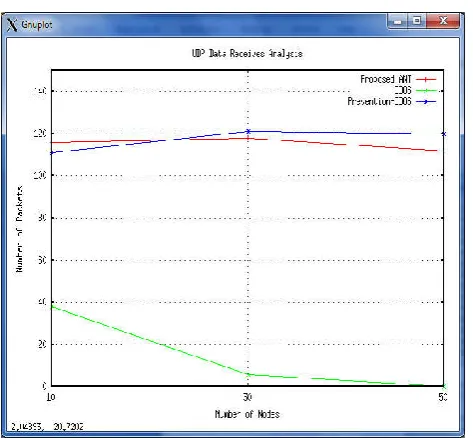
UDP Data Receives Analysis
The transport layer is handles the communication at the end to end in network. This layer is maintaining the end to end synchronization of protocols. The User Datagram Protocol
(UDP) is one of the transport layer protocol and also provides time efficient communication in network. But the reason is that this protocol is not reliable as TCP. In this graph the DDoS attacker effect is showing the negligible performance in network and this performance degradation is improves after improving the nodes density in network because more number of nodes contact in range if the quantity is increases. The proposed security scheme first detect the attacker on the basis of their flooding based behaviour and secure network after prevent network from attacker. The secure and normal ANT OPTIMIZED performance is almost equal in all nodes density scenario.
[image:4.595.44.283.202.413.2]Fig.2. TCP Packets Receiving Analysis
Fig. 3. UDP Receiving Analysis
TCP Packet Delivery Ratio Analysis
The problem of congestion is totally different from the signs of attacker blocking conditions. In congestion the data packets are affected and drop in network. The routing packets flooding are recognized by particular destination if sender is wanted to send data packets to destination. The data forwarding and receiving capability of mobiles nodes is balance the
communication. The PDF (Packet Delivery Ratio)
performance is depending on the percentage of receiving and sending. In this graph the PDF performance of proposed ANT
[image:4.595.46.283.435.654.2]routing is about 98 % and after prevention performance is upgraded and reaches to more than 99% in network. The attacker performance is degrades the performance and PDR is only counted up to 45% up to end of simulation.
Fig. 4. TCP PDR Analysis
UDP Packet Delivery Ratio Analysis
The attacker presence is network is easily affected the performance of UDP packet end due to absence of any Acknowledgement (ACK) packet. UDP packets PDF are separately measured in this analysis because the combination of both is always provide better results due to presence of reliable TCP protocol in MANET. The three scenarios of different node density in simulated and as usual observe that attacker presence in degrades protocol performance and due to that in 50 nodes scenario performance is counted zero. After applying prevention scheme performance is improves and reaches to normal performance of ANT routing in dynamic network.
Fig.5. UDP PDR Analysis
Conclusion and Future Work
[image:4.595.310.556.502.715.2]through because of absence of centralized administration and continuously movement of nodes with limited processing capacity as compare to wired network. The flooding of unnecessary packets in network by DDoS attack is control and block by proposed security scheme to improve network performance in network. The UDP packet loss and performance of TCP congestion window performance in network improve in presence of prevention scheme. The attacker is network is preserve whole bandwidth and this effect is reduces the normal communication in between sender to receiver. The ACO is the normal multipath routing and attacker is attack on this network, by that the whole paths are jammed by flooding packets and security scheme is completely provides the secure communication by removes the flooding of attacker through stop their communication and also prohibited their existence in network. The security is also the one of the major issue in MANET. The decentralized network performance is easily affected from malicious behaviour of attacker. In future we proposed a security scheme in MANET against Vampire Attack. Analyse Vampire attack in detail, analysis in loss factor and proposed security scheme to recognize the attacker node that target is limited energy resource called node power or energy.
REFERENCES
Aws Kanan, Taisir Eldos, Mohd Alkahtani, “Mobile Ad Hoc Networks Routing Using Ant Colony Optimization”, World of Computer Science and Information Technology
Journal (WCSIT), pp.105-109, 2013
Banner, R., Orda,A. 2007. “Multipath Routing Algorithms for Congestion Minimization,” IEEE/ACM Transactions on Networking, 15(2), pp. 413–424.
Cho, H.K., Kim, E.S., Kang, D.W. 2005. ”A Load-Balancing Routing Considering Power Conservation in Wireless Ad Hoc Networks”, Proceeding of 16th International
Workshop on Database and Expert Systems
Applications,128–132.
Donatas Sumyla, “Mobile Ad-Hoc Networks (MANET)”, Technical Report, 2006
Günes, M. Sorges, U. and Bouazizi, I. 2002. “ARA-The Ant-Colony Based Routing Algorithm for MANETs”,
International Conference on Parallel Processing
Workshops (ICPPW’02), IEEE Computer Society Press,
pp.79-85, 2002.
Gunes, M., Sorges, U. and Bouazizi, I. 2002. “ARA-The Ant-Colony Based Routing Algorithm for MANETs”,
International Conference on Parallel Processing
Workshops (ICPPW’02), IEEE Computer Society Press, pp.79-85.
Heissenbüttel, M. and Braun, T. 2003. “Ants-Based Routing in Large Scale Mobile Ad-Hoc Networks”, Kommunikation in Verteilten Systemen (KiVS).
Ma Lin, Xu Yubin, Meng Weixiao, “An Ant Colony Based Congestion Elusion Routing scheme for MANET”, Proceedings published in IEEE Globecom 2011.
Marina,M.K. Das, S.R. 2001. “On-demand Multipath Distance Vector Routing in Ad hoc Networks. In Network Protocols, Ninth International Conference, pp. 14-23.
Maysam, Y. Hossein, M. Nasser, Y. 2007. “Multipath Routing in Mobile Ad Hoc Networks: Design Issues“, 12 th International CSI Computer Conference (CSIC’07), Tehran, Iran.
Subha,M. Dr. R. Anitha, 2009. “An Emerging Ant Colony Optimization Routing Algorithm (Acora) For MANETs,
Journal of Computer Applications”, Vol-II, No.3, July-Sep.
2009.
Vahide Rajabi Zanjani, Abolfazl Toroghi Haghighat, “Adaptive Routing In Ad Hoc Wireless Networks Using Ant Colony Optimization”, International Conference on Computer Technology and Development, Proceedings published in IEEE, 40-q 45, 2009.