IJPSR (2012), Vol. 3, Issue 1 (Research Article)
Received on 13 September, 2011; received in revised form 04 December, 2011; accepted 26 December, 2011
FORMULATION DEVELOPMENT OF ISOXSUPRINE HYDROCHLORIDE MODIFIED RELEASE MATRIX TABLETS
Ketan Patel*1 and Mukesh C. Gohel 2
Dharmsinh Desai University 1, Nadiad- 380 054, Gujarat, India L. M. College of Pharmacy 2, Ahmedabad-380 009, Gujarat, India
ABSTRACT
The objective of the present investigation was to study the effect of critical formulation parameters affecting release of isoxsuprine hydrochloride from matrix tablets using combination of polyethylene oxide (PEO) and dicalcium phosphate (DCP). The powder blend consisting of drug and excipients was analyzed for angle of repose, Carr’s index and Hausner’s ratio. The tablets were prepared by direct compression method. To assess the compressional behavior of the drug-excipient blend, the tablets were analyzed for friability and crushing strength. The in vitro drug release study was carried out in distilled water. The powder blend exhibited satisfactorily flow as measured by angle of repose, Carr’s index and Hausner’s ratio. The formulation ingredients showed satisfactory tableting properties (friability <1%, crushing strength ≥ 4 kgf). The drug release was modified on addition of PEO and DCP. Addition of 5 to 25% DCP in the formulation of matrix tablets caused apparent difference in the drug dissolution in distilled water. However, the difference was insignificant as analyzed by analysis of variance (ANOVA) and similarity factor ( f2). The drug release from the tablets was best explained by
Weibull model. Unified Weibull model was evolved to predict drug release from the formulated batches. The findings of this investigation can be extended to industry to cut down the cost of formulation and to by-pass the existing patents employing hydrophilic matrixing agents, at least for selective drugs.
INTRODUCTION: Isoxsuprine hydrochloride is
structurally a novel vasodilator 1. The short biological half-life (5±2 hr) and the fast clearance make the drug, a suitable candidate for the development of modified release formulation.
Furthermore, the drug is required to be taken for a long period by the patients. The use of modified release formulation is associated with less nausea and dizziness at the initiation of therapy. Hence, to improve the patient compliance as well as to reduce side effects, the drug needs to be formulated in modified release dosage form.
Hydrophilic polymer matrix systems are widely used in oral modified drug delivery because of their flexibility to obtain a desirable drug release profile, cost-effectiveness, and broad regulatory acceptance 2, 3. These dosage forms are designed to deliver the drug at a modified and predetermined rate, thus maintaining a therapeutically effective concentration of the drug in the systemic circulation for a long period of time and therefore reducing the frequency of dosing and improving patient compliance 4, 5. Hydrophilic polymers such as hydroxylpropyl methylcellulose (HPMC), sodium carboxymethylcellulose, Carbopols® and
Correspondence to Author:
Ketan Patel
Troikaa Pharmaceuticals Ltd., Ahmedabad-380 009, Gujarat, India
Keywords:
Isoxsuprine hydrochloride, PEO,
DCP, Direct compression,
polyvinyl alcohol have been extensively examined in the formulation of modified release systems either alone or in combination with other release controlling agents 6-10.
Drug release from matrix tablets is dependent mainly on the properties of active pharmaceutical ingredient and excipients. The most frequently used hydrophilic excipient in matrix tablets is HPMC. The wide spread use of HPMC is attributed to the fact that is available in various viscosity grades and it enjoys wide regulatory acceptance. The research and development scientists dealing with generic drugs are in search of a formulation/process that is not covered under patents. Literature search revealed that PEO has not been fully explored by scientists, at least for the newer drugs. Polyethylene oxide (PEO) has been recently studied as a matrix forming polymer due to its availability in a range of molecular weight/viscosity grades, wide regulatory acceptance and unique swelling and erosion characteristics, which are utilized for modulating release of drugs with different solubility and doses. PEO hydrates rapidly and forms gelatinous barrier layer around wetted tablet when it comes in contact with water,. Drug release occurs by diffusion of active through gel layer and/or gradual erosion of gel exposing fresh surfaces containing drugs to dissolution medium. Diffusion is dominant mechanism controlling release of water soluble actives and erosion of matrix is dominant mechanism controlling release of water insoluble actives.
The use of water insoluble and non-swellable dicalcium phosphate (DCP) has not been explored in formation of matrix tablets. Hence, one of the objectives of this investigation was to explore the use of DCP. Dicalcium phosphate may provide less porous environment as compared to the use of water soluble excipient in a matrix tablet.
It is worthwhile to note that PEO undergoes quick gelling during aqueous granulation, especially when little excess water is added. Dicalcium phosphate is not sensitive to water and therefore it can be tried in wet granulation along with PEO in the formulations demanding the step of granulation to address the issues of flow and/ or compressibility.
The objectives of the present study were to prepare isoxsuprine hydrochloride modified release matrix tablets by direct compression and to determine the optimal levels of excipients such as PEO and DCP.
MATERIALS AND METHODS:
Materials: Isoxsuprine hydrochloride I.P., polyethylene oxide (PEO, Polyox WSR 303) and magnesium stearate were obtained as gift samples from Troikaa Pharmaceuticals Ltd. (Ahmadabad, India). Colloidal silicon dioxide (Aerosil 200) and butylated hydroxy toluene were procured from Evonik Degussa and S. D. Fine Chem. respectively. Dicalcium phosphate was purchased from Innophos.
Preparation of Isoxsuprine Hydrochloride Matrix Tablets: Matrix tablets of isoxsuprine hydrochloride were prepared by direct compression method. Polyethylene oxide and magnesium stearate were sifted through 60 # screen. All the ingredients were blended in geometric fashion. Butylated hydroxy toluene was added in all the batches as an antioxidant. The blend was compressed to tablets by using a rotary tablet machine employing 5.55 mm FFBE punch (D tooling). The batch size was 2000 tablets.
Evaluation: All the powder blends were evaluated for Angle of repose, Carr’s index and Hausner’s ratio. Tablets were evaluated for friability, crushing strength and in vitro dissolution study with release kinetics. Angle of Repose: It was determined by funnel
method. Accurately weighed powder blend was taken in funnel. Height of funnel was adjusted in such a way that tip of funnel just touches the apex of heap of powder. The powders were allowed to flow through funnel freely onto a clean surface. Diameter of powder cone was measured and angle of repose was calculated. According to USP, the flow property is graded as excellent if the value of angle of repose is in between 25 and 30o.
nominal rate of 300 drops per minute. The cylinder was tapped 500 times initially and the tapped volume was measured. Tapped density was calculated by using tapped volume, which was used to find out the Carr’s index and Hausner’s ratio. Hausner’s ratio less than 1.25 indicates good flow properties while ratio greater than 1.5 shows poor flow of powder.
Friability: One hundred tablets were loaded in friability tester (Electrolab Ltd.) after recording their weight. The drum was recorded at 25±1 rpm for 4 min and then they were weighed after screening. The percentage friability of tablet was calculated using the values of weight.
Crushing strength: Crushing strength of the compressed tablets was measured employing tablet breaking force tester USP (Electrolab Ltd.) The equipment was put on ON mode and zero value was adjusted on display panel. The unit switch was set to Kgf. The guard cover was slided and the tablet was placed on the tablet platform. The plunger was driven by turning the knob. The point at which the tablet fractured (n=3) was recorded.
In- Vitro Dissolution Test: Isoxsuprine
hydrochloride release from tablets was determined in 500 ml water at 37±1°C. The paddle rotation speed was 100 rpm. Five ml samples were withdrawn at defined time intervals, and the same volume of water was replaced. Samples were subsequently collected at predetermined time. The samples were analyzed by using a double beam UV-VIS spectrophotometer (UV-1700, Shimadzu Corp, Kyoto, Japan) at a wavelength of 274 nm. Dissolution tests were repeated three times for all formulations and the percentage drug dissolved was calculated using standard calibration curve. The results of dissolution study were analyzed for kinetics and drug release.
RESULTS AND DISCUSSIONS: One of the objectives of the present study was to use direct compression as a method of manufacturing tablets since the current trend in the industry is to select a method that require simplified validation. The two important requirements for direct compression are good flow and good
compressibility. Hence, the formulations were assessed for these two parameters. Wet granulation was not employed in the present study since the granulation step with aqueous fluid is very critical, demanding stringent control of variables, especially when PEO is used as a matrixing agent. .
The major objective of this investigation was to prepare modified release tablets isoxsuprine hydrochloride, which should release less than or equivalent to 25% drug in first hour and uniform drug release thereafter. Accordingly an ideal drug release at 1, 2, 4, 6, 8, 10 and 12 hr should be about 25, 31, 45, 59, 72, 86 and 100% respectively. A batch that showed least deviation from this profile was labeled as the most appropriate formulated batch.
Preliminary study was carried out by preparing a batch of 2000 tablets containing 30% of the drug and 70% of DCP. The powder blend showed poor flow (angle of repose 51o) and the tablets exhibited low crushing strength (2.25 kgf). The probable reason for poor flow could be presence of small size DCP particles. More than 90% drug was released in less than 1 hr, indicating the need of a release retardant such as hydrophilic matrixing material. Polyethylene oxide was used as a hydrophilic material in the range of 40 to 70%. These formulations are expected to release the drug at a flow rate due to swelling and gelling of PEO. Piriyaprasanth and Sriamornsak reported that drug release at one hr sampling time was strongly influenced by flowability (Carr’s index and angle of repose) from HPMC matrix 11. The investigators further reported that poor flowability may result in higher weight variation in tablet and lower tablet strength. Hence, in the present investigation, these evaluation parameters were included. The powder blends containing PEO showed excellent flow and good compressibility (see Tables 1 and 2).
The other possible reason for incomplete drug release from the tablets containing 70% PEO could be increased resistance to diffusion of drug solution. Hence, it was decided to reduce the amount of PEO in the succeeding trials. The tablets of batch 2 containing 60% drug failed to meet the criteria of crushing strength (3.5 kgf).
In the batches 3 to 5, five to twenty five percentages DCP was tried to achieve the target dissolution profile. The results shown in Table 2 reveal that the powder blends of batches 3-5 showed good flow and
[image:4.612.314.588.94.189.2]acceptable mechanical properties. The tablets were further tested for dissolution studies in water.
TABLE 1: FORMULATION OF ISOXSUPRINE HCL TABLETS Batch
no.
Isoxsuprine HCl (%)
PEO (%)
DCP (%)
Aerosil (%)
Magnesium stearate (%)
1 30 70 - 1 1
2 60 40 - 1 1
3 30 45 25 1 1
4 30 55 15 1 1
5 30 65 5 1 1
TABLE 2: RESULTS OF FLOW PROPERTY OF POWDER BLEND AND TABLET CHARACTERISITICS
Batch Angle of repose Bulk density Tapped density Carr’s Index Hausner’s Ratio Friability Crushing Strength
1 25.87 0.466 0.60 22.33 1.29 0.06 6
2 29.22 0.482 0.636 24.22 1.32 0.03 3.5
3 27.76 0.573 0.769 25.49 1.34 0.11 6
4 27.52 0.513 0.681 24.6 1.33 0.1 6
5 28 0.483 0.635 23.94 1.31 0.14 6
According to USP, the flow property is excellent, if the range of angle of repose is 25-30. The unit of bulk and tapped density is gm/mL. During dissolution studies, the aqueous fluid first
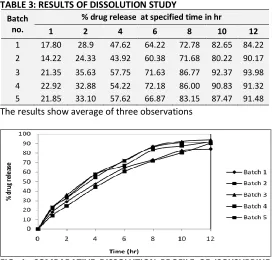
hydrates PEO particles present on the tablet surface and the hydrated PEO (swollen gel) form barrier around tablet. The barrier layer reduces the medium uptake by tablets and secondly it controls diffusion of drug solution. The process of gel formation, drug dissolution and drug diffusion continues till the matrix is exhausted. The results of dissolution studies are presented in Table 3, fig. 1.
TABLE 3: RESULTS OF DISSOLUTION STUDY Batch
no.
% drug release at specified time in hr
1 2 4 6 8 10 12
1 17.80 28.9 47.62 64.22 72.78 82.65 84.22 2 14.22 24.33 43.92 60.38 71.68 80.22 90.17 3 21.35 35.63 57.75 71.63 86.77 92.37 93.98 4 22.92 32.88 54.22 72.18 86.00 90.83 91.32 5 21.85 33.10 57.62 66.87 83.15 87.47 91.48 The results show average of three observations
FIG. 1: COMPARATIVE DISSOLUTION PROFILE OF ISOXSUPRINE HYDROCHLORIDE TABLETS
For PEO content of 40% or more, the particles of PEO are close enough to permit a faster establishment of the gel layer. During dissolution studies, it was observed that a stable gel layer was formed around tablets and it persisted during the dissolution studies. The permeability of PEO matrix can be modified by the addition of additives. Moreover, the nature of the additives also plays an important role in changing the diffusion of drug solution from the matrix. DCP is a water insoluble excipient.
Partial replacement of PEO by DCP did not significantly affect the angle of repose (Table 2) of the powder blend, which was confirmed from the results of analysis of variance (ANOVA). The calculated Fisher’s ratio was 0.089 and the critical Fisher’s ratio was 2.539. Hence, it is concluded that the powder blend exhibited statistically similar angle of repose in presence of different amount of DCP.
[image:4.612.27.303.475.735.2]The knowledge gained in the present study can be constructively utilized for fine tuning of dissolution pattern of test formulation especially when one is looking for selection of bio-batch or when one is interested in developing IVIVC.
Similarity factor was calculated employing the data of ideal drug release profile (reference) and the experimental batches numbered 3 to 5 (test). The results of ANOVA (Fcalculated=0.015 and Fcritical=3.554)
and similarity factor (f2=78 to 85) also indicated that
the difference in dissolution pattern is insignificant. The batches 3-5 demonstrated drug release profile close to previously defined ideal release profile. In order to select an optimum batch out of batches 3 to 5, further data analysis was carried out. It is worthwhile to note that for similarity of two dissolution profile a deviation of 10% is permitted by FDA in dissolution pattern at each sampling time. Upper and lower dissolution ranges were decided by adding or subtracting 10 in the data of ideal drug release pattern defined earlier. Sum of square of residuals were computed. Batch 5 showed least deviation from the ideal profile and hence it was selected as an optimum batch.
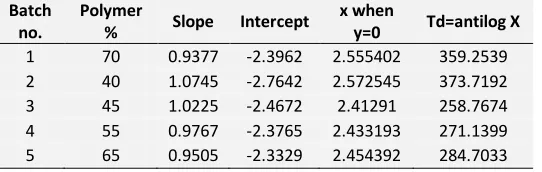
The drug release data of the batches 3 to 5 were fitted to Hixon-Crowell, Korsmeyer-Peppas, Weibull, zero order, first order and Higuchi model. The Weibull model showed a good fit. The next objective was to develop unified Weibull equation to correlate the drug release from different batches. The unified equation was evolved by combining the equations of slope and intercept (see Table 4) 12.
Percentage of drug dissolved = 1- e (-[t/Td](-0.00426)* Polymer
% + 1.2269)
[image:5.612.314.588.44.215.2]
TABLE 4: CALCULATIONS FOR THE WEIBULL MODEL Batch
no.
Polymer
% Slope Intercept
x when
y=0 Td=antilog X
1 70 0.9377 -2.3962 2.555402 359.2539 2 40 1.0745 -2.7642 2.572545 373.7192 3 45 1.0225 -2.4672 2.41291 258.7674 4 55 0.9767 -2.3765 2.433193 271.1399 5 65 0.9505 -2.3329 2.454392 284.7033
The results of observed and predicted percentage drug dissolved are shown in Fig. 2-4. The figure indicates predictive ability of the unified Weibull equation.
FIG. 2: COMPARISON OF DISSOLUTION PROFILE OF BATCH 3 WITH PREDICTED RELEASE
FIG. 3: COMPARISON OF DISSOLUTION PROFILE OF BATCH 4 WITH PREDICTED RELEASE
FIG. 4: COMPARISON OF DISSOLUTION PROFILE OF BATCH 5 WITH PREDICTED RELEASE
[image:5.612.313.584.256.422.2] [image:5.612.315.584.462.639.2] [image:5.612.29.300.614.700.2]equation of the line was Td = 1.3*polymer % +199.5. For validation of the equation, the computed value of Td was 277.5 for a batch containing 60% polymer. The unified equation of percentage of drug dissolved was used for calculating drug release profile from a batch containing 60% polymer. The observed and predicted values were found close to each other. It is, therefore, finally concluded that unified model can be used in real life at research and development department.
The equation of similarity factor can be applied if the samples of reference and test profiles are pulled at the same time. However, in real practice the analyst might have pulled samples of reference and test at different time points. In such cases, after model fitting (e.g. Weibull), inverse function can be applied to compute the percentage of drug release at various time points. The inverse Weibull function can also be used for computing parameters such as time for 50% (t50) or
90% (t90) drug release 13.
t = (-α * ln (M0 –M/M0)) 1/b
The computed values of t50 % and t75% for the selected
batches are 3.51 and 7.27 hr respectively. The equation was also validated by inserting the value of % drug release as 33.10 and the computed value of time was found to be 1.97 hr, which is very close to the actual sampling time of 2 hr (see table 3).
CONCLUSIONS: It is concluded that modified release tablets of isoxsuprine HCl could be prepared using a blend of PEO and DCP by direct compression method. Dicalcium phosphate can be added in PEO matrix without significantly altering flow, compressibility and dissolution of the drug. Weibull model best explained the kinetics of drug release. The dissolution profile of the optimized formulation was very close to the ideal drug release profile. The findings of this investigation can be extended to industry to cut down the cost of formulation and to by-pass the existing patents
employing hydrophilic matrixing agents, at least for selective drugs. The powder blend exhibited good flow and the tablets prepared using this powder blend exhibited satisfactory mechanical strength.
REFERENCES:
1. Sean C. S. Martindale, The complete drug reference, 35th edition, pharmaceutical press, 2110.
2. Alderman D.A. A review of cellulose ethers in hydrophilic matrices for oral modified-release dosage forms. Int J Pharm Tech Prod Mfr. 1984, 5: 1-9.
3. Anurag S., Ramesh P. Design of modified release delivery systems using a modified pharmacokinetic approach: a case study for drugs having a short elimination half-life and a narrow therapeutic index. Int J Pharm. 2003, 261(1-2): 27-41.
4. Najib N., Suleiman M.S. The kinetics of drug release from ethylcellulose solid dispersions. Drug Dev Ind Pharm. 1985, 11(12): 2169-2181
5. Li C.L., Martini L.G., Ford J.L., Roberts M. The use of hypromellose in oral drug delivery. J Pharm Pharmacol. 2005, 57(5): 533-546.
6. Chattaraj S.C., Das S.K., Effect of formulation variables on dissolution profile of diclofenac sodium from ethyl- and hydroxylpropylmethyl cellulose tablets. Drug Dev Ind Pharm. 1996, 22(7): 555-.559.
7. Tiwari S.B., Murthy T.K., Pai M.R., Mehta P.R., Chowdary P.B. Modified release formulation of tramadol hydrochloride using hydrophilic and hydrophobic matrix system, AAPS PharmSciTech. 2003, 4(3), article 31.
8. Petrovic A., Cvetkovic N., Ibric S., Trajkovic S., Djuric Z. Application of mixture experimental design in the formulation and optimization of matrix tablets containing carbomer and hydroxy-propylmethylcellulose, Archives of Pharmacal Research, 2009, 32: 1767
9. Conti S., Maggi L., Segale L., Ochoa M. E., Conte U., Grenier P., Vergnant G. Matrices containing Sodium CMC and HPMC, International Journal of Pharmaceutics, 1, 2007, 333: 136. 10. Kojima S., Yoshihara K., Sawada T., Kondo H., Sako K. Extended
release of a large amount of highly water soluble diltiazem HCl by utilizing counter polymer in PEO/PEG matrix, European Journal of Pharmaceutics and Biopharmaceutics, 2008, 70: 556. 11. Piriyaprasarth S. and Sriamornsak. Effect of source variation on
drug release from HPMC tablets: linear regression modeling for prediction of drug release. Int. J. Pharmaceutics, 2011, 411: 36-72.
12. Kirilmaz L.. Data mining for the controlled dosage form. Pharm Tech (Europe). 2001, 1:25.
13. Johannes von O., Hans L., Search for technological reasons to develop a capsule or a tablet formulation with respect to wettability and dissolution. Int. J. Pharmaceutics, 2004, 287: 135-145.