IJPSR (2013), Vol. 4, Issue 10 (Research Article)
Received on 13 May, 2013; received in revised form, 17 June, 2013; accepted, 15 September, 2013; published 01 October, 2013
A VALIDATED RP-HPLC METHOD FOR THE ESTIMATION OF ANAGRELIDE IN CAPSULE DOSAGE FORMS
K. Sujatha*1, C. Palavan 2, J.V.L.N. Seshagiri Rao 3
Government Polytechnic 1, Visakhapatnam, Andhra Pradesh, India
College of Pharmaceutical Sciences, Andhra University 2, Visakhapatnam,Andhra Pradesh, India
Yalamarty College of Pharmacy 3, Visakhapatnam, Andhra Pradesh, India
ABSTRACT: An accurate and precise high performance liquid chromatographic method was developed for quantitative estimation of anagrelide in capsule dosage forms. Chromatographic separation of
the drug was achieved on a Kromosil C18 column (150 x 4.6 mm; 5µ)
by isocratic elution using a mobile phase consisting of phosphate buffer (pH 2.5) and acetonitrile (75:25 v/v) at a flow rate of 1.2 mL/min. The drug in the eluate was monitored by UV detection at 250 nm. Under optimized conditions, the retention time obtained for the drug was 4.818 min. The calibration curve was linear over the range of 50-150 µg/mL of the drug. The recovery of drug by the proposed method was found to be 98.95% to 100.45%. The performance of the method was validated as per ICH guidelines. The method was also found to be applicable for determination of anagrelide in its capsule dosage forms without any interference from the excipients. The proposed method is suitable for routine quality control analysis of anagrelide.
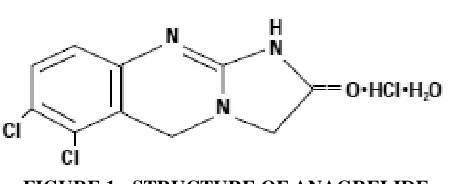
INTRODUCTION: Anagrelide hydrochloride (6,
7-dichloro-1, 5-dihydroimidazo [2, 1-b] quinazoli
n-2(3H)-one monohydrochloride monohydrate) is an antithrombotic and platelet-reducing agent used for
the treatment of essential thrombocytosis 1. The
drug is especially useful in managing chronic
myeloid leukemia 2. The mechanism by which
anagrelide reduces blood platelet count is still under investigation. Studies in patients support a hypothesis of dose-related reduction in platelet
production resulting from a decrease in
megakaryocyte hypermaturation 3.
QUICK RESPONSE CODE
DOI:
10.13040/IJPSR.0975-8232.4(10).3920-24
[image:1.612.326.557.498.590.2]Article can be accessed online on: www.ijpsr.com
FIGURE 1: STRUCTURE OF ANAGRELIDE
A literature survey revealed that very few analytical methods have been reported for the determination of anagrelide in biological samples
and in pharmaceutical dosage forms using LC-MS 4
and HPLC 5-7 techniques. We have developed a
new accurate and precise RP-HPLC method with short retention and run times for the determination of anagrelide in raw drug samples and in capsule dosage forms. The developed method has been
validated as per ICH guideline 8.
Keywords:
Anagrelide, Estimation, Capsules, HPLC
Correspondence to Author: K. Sujatha
Senior Lecturer, Department of Pharmacy, Government Polytechnic, Visakhapatnam – 530 007, Andhra Pradesh, India
MATERIALS AND METHODS:
Drugs, chemicals, and solvents: The reference sample of anagrelide was obtained from Aizant drugs, Hyderabad. The commercial capsule formulation of anagrelide (0.5 mg), manufactured by Cipla Ltd., Goa, India, was used for the study. Potassium dihydrogen phosphate, ortho phosphoric acid and HPLC grade acetonitrile, methanol and water used in the experimentation were purchased from Rankem Laboratories.
Equipment and chromatographic conditions: A Waters Alliance liquid chromatograph (Model
2695) fitted with a U.V. diode array detector (Model 2996) and running on Empower2 data handling system was employed in the study. A
Kromosil C18 column (150 x 4.6 mm; 5m) was
used for analyzing the drug. All chromatographic runs were carried out in isocratic mode by using a mobile phase consisting of phosphate buffer (pH 2.5) and acetonitrile at a flow rate of 1.2 mL/min. The injection volume of the samples was 10 µL. The detector wavelength was set at 250 nm. Under these optimized conditions, the retention time obtained for anagrelide was 4.818 min.
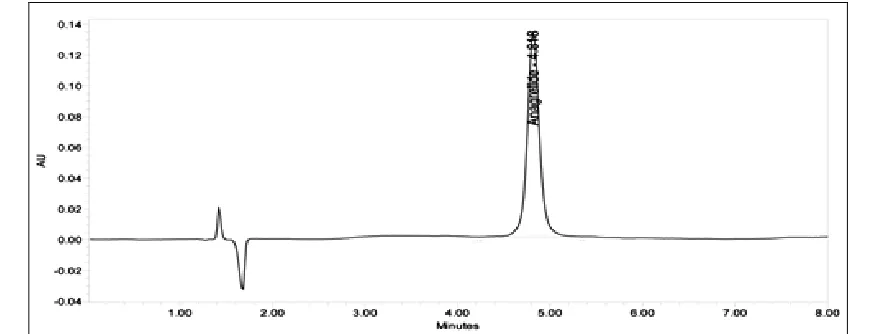
FIGURE 2: A REPRESENTATIVE CHROMATOGRAM OF THE WORKING STANDARD SOLUTION OF ANAGRELIDE
Phosphate buffer (pH 2.5): The phosphate buffer was prepared by dissolving 6.8 g of Potassium dihydrogen ortho phosphate in 1000 mL of water and adjusting the pH of the solution to 2.5 using ortho phosphoric acid. It was then sonicated and filtered through a 0.45µ membrane filter.
The mobile phase: The mobile phase consisted of a mixture of the phosphate buffer (pH 2.5) and acetonitrile in the ratio of 75:25 v/v.
The diluent: A mixture of the phosphate buffer (pH 2.5) and acetonitrile in the ratio of 50:50 v/v was used as the diluent.
Working standard solution of anagrelide: 10 mg of anagrelide reference standard was accurately weighed and transferred into a 10 mL volumetric flask. To this, 2 mL of 0.1N NaOH solution was added and the contents shaken to dissolve the drug. The volume was made up with methanol. This was used as the standard stock solution.
The working standard solution (100 µg/mL) was prepared by transferring 1.0 mL of the standard stock solution into a 10 mL volumetric flask and diluting to volume with water.
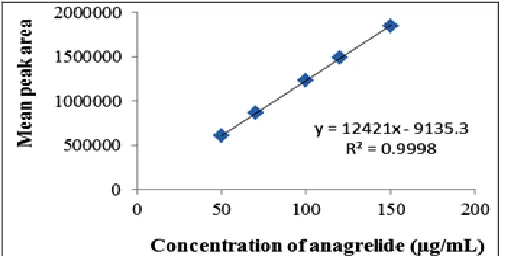
Calibration curve: Linearity study was done by preparing solutions of anagrelide at different concentration levels including the working standard concentration mentioned above. Ten micro litres of each concentration (n=3) was injected into the HPLC system. The response was read at 250 nm and the corresponding chromatograms were recorded. From these chromatograms, the mean peak areas at each concentration level were calculated and a linearity plot of the mean peak area over concentration was constructed.
[image:2.612.87.525.243.410.2]The volume was made up with the diluent and the contents were filtered through a 0.45µ nylon filter. Six replicate samples of this solution were then
chromatographed. From the chromatograms
obtained, the average area of the drug peaks was noted. The drug content in the formulation was calculated from the calibration curve obtained with the standard drug dilutions.
FIGURE 3: A REPRESENTATIVE CHROMATOGRAM OF THE CAPSULE FORMULATION OF ANAGRELIDE RESULTS AND DISCUSSION: During the
method optimization studies, various combinations and proportions of the solvents and buffers were
examined on the Kromosil C18 column for efficient
separation of anagrelide. Using a mobile phase consisting of a mixture of phosphate buffer (pH 2.5) and acetonitrile in the ratio of 75:25 v/v, a good resolution and baseline separation of the drug
peak were obtained. All the chromatographic conditions were optimized after evaluating the column efficiency parameters like theoretical plates
and tailing factor (Table 1). Under these optimized
conditions, the retention time obtained for
anagrelide was 4.818 min (Figure 2). The proposed
[image:3.612.78.510.87.274.2]method was also found to be applicable for the analysis of anagrelide in capsule formulations.
TABLE 1: OPTIMIZED CHROMATOGRAPHIC CONDITIONS
Stationary Phase Kromasil C18 (150 x 4.6 mm, 5m) Mobile Phase Phosphate buffer : Acetonitrile =75:25 v/v
Diluent Phosphate buffer : Acetonitrile =50:50 v/v
Flow Rate 1.2 mL/min
Column Temperature 26°C
Injection Volume 10 µL
Detection Wavelength 250 nm
Run Time 8 min
Retention Time 4.818 min
Specificity: A good analytical method should be able to measure the analytes accurately in the presence of probable interferences from matrix and
excipients in the formulation. Figure 2 shows good
chromatographic baseline separation of anagrelide
in working standard solution. Figure 3
demonstrates that no interference was found at the retention time of anagrelide from the excipients in its dosage form.
Linearity: The calibration curve constructed for the drug was linear over the concentration range of
50 – 150 µg/mL (Figure 4). The regression of the
plot was computed by the least squares method.
[image:3.612.314.567.613.741.2]The relevant correlation coefficient is greater than 0.99 and the %RSD for each concentration studied (n=3) was less than 2.
Accuracy and Precision: The accuracy of the method was determined by recovery experiments. The recovery studies were carried out and the percent recovery and standard deviation of the percent recovery were calculated and represented in
Table 2. The high percentage of recovery indicates that the proposed method is highly accurate.
The precision of the method was demonstrated by inter-day and intra-day variation studies. Six replicate injections of sample solutions were made and the percent RSD was calculated and presented in Table 3. From the data obtained, the proposed RP-HPLC method was found to be precise.
TABLE 2: ACCURACY DATA OF THE PROPOSED METHOD Analyte Amount of the analyte taken
(µg/mL)
Mean recovery
(µg/mL) ± SD % Mean recovery ± SD Anagrelide
50 50.23 ± 0.047 100.45 ± 0.094
100 100.02 ± 0.935 100.02 ± 0.935
150 148.43 ± 0.793 98.95 ± 0.529
TABLE 3: PRECISION DATA FOR THE PROPOSED METHOD
S. No. Intra-day precision Inter-day precision
1 1239846 1216598
2 1223570 1225784
3 1219789 1217859
4 1219985 1235478
5 1224567 1224875
6 1231256 1244965
Average 1226502 1227593
SD 7752.927 10865.18
%RSD 0.63 0.88
System suitability parameters: System suitability parameters were studied with six replicates of the standard sample solution and the parameters are
presented in Table 4.
TABLE 4: SYSTEM SUITABILITY PARAMETERS OF THE PROPOSED METHOD
Parameter Value Retention time (min) 4.818
Tailing factor 1.1
Theoretical plates 4586
HETP 0.03271
Method suitability: Studies for recovery of anagrelide from its commercial capsule formulation (Agrylin) were carried out by the proposed method. The average value obtained from six replicate samples (99.6 % recovery) was found to be in good agreement with the labeled amount. This confirms the suitability of the method for the analysis of anagrelide in capsule dosage form.
CONCLUSION: The proposed RP -HPLC method is sensitive, accurate and precise and can be used for the routine quality control analysis of anagrelide in its capsule dosage forms.
ACKNOWLEDGEMENT: The authors are thankful to M/s Aizant Drugs, Hyderabad, for providing the reference sample of anagrelide.
REFERENCES:
1. Hussar DA: New drugs of 1997. Journal of the American Pharmaceutical Association (Washington, D.C.: 1996) 1998; 38:155-195.
2. Voglová J, Maisnar V, Beránek M and Chrobák L: Combination of imatinib and anagrelide in treatment of chronic myeloid leukemia in blastic phase . Vnitr̆ní Lékar̆ství 2006; 52:819 – 822.
3. Petro E Petrides: Anagrelide: What was new in 2004 and 2005. Seminars in Thrombosis and Hemostasis 2006; 32:399-408.
4. Zhu Z, Gonthier R and Neirinck L: High-performance liquid chromatography–mass spectrometry method for determination of anagrelide in human plasma. Journal of Chromatography B 2005; 822: 238-243.
5. Kalaichelvi R and Jayachandran E. Development and validation of a reversed-phase HPLC method for the determination of anagrelide in capsule. International Journal of Pharmaceutical Chemistry. Available at:
6. Venugopal V, Ramu G, Malleswara Rao NNV and Rambabu C: A new RP-HPLC method development for the estimation of an anti-thrombocythemic agent anagrelide in pure and pharmaceutical formulations. Der Pharma Chemica 2012; 4:1716-1722.
7. Sudhakar SP, Khader AMA and Seetharamappa J: Development and validation of a stability-indicating RP-HPLC method for the quantitative analysis of
anagrelide hydrochloride. Scientia Pharmaceutica 2012; 80: 567–579.
8. ICH Harmonized Tripartite Guidelines (Q2R1). Validation of analytical. Validation of analytical procedures: Text and Methodology. International Conference on Harmonization, European commission, Japan and USA :2005.
All © 2013 are reserved by International Journal of Pharmaceutical Sciences and Research. This Journal licensed under a Creative Commons Attribution-NonCommercial-ShareAlike 3.0 Unported License.
This article can be downloaded to ANDROID OS based mobile. Scan QR Code using Code/Bar Scanner from your mobile. (Scanners are available on Google Playstore)
How to cite this article: