8291
PROMOTING SUCCESSFUL KNOWLEDGE MANAGEMENT
PROCESSES INTEGRATED INTO INFORMATION
TECHNOLOGY IN HIGHER EDUCATION UNIVERSITIES IN
IRAQ
1HAYDER SALAH HASHIM, 2ZAINAB AMIN AL-SULAMI
1,2Basra University, Basra-Iraq
E-mail: 1[email protected], 2[email protected]
ABSTRACT
Knowledge is an important asset in many fields, such as business, health sector and higher education. The incremental concern towards knowledge leads to the formulation of knowledge management (KM). Universities are knowledge-intensive organizations. Knowledge assets should be managed efficiently and effectively to promote the education level and overall performance of universities. Information technology plays vital task in sustaining knowledge management processes, such as acquisition, sharing, conversion and application of knowledge. This study explores the real situation of knowledge management processes. This study also examines related IT systems that could be deployed to support successful KM processes in Basra University, which is used as the case study for higher institutions in Iraq. Quantitative method in the form of a questionnaire survey was used to obtain data from 217 technical employees in Basra University. The findings show weaknesses in the KM processes in Basra University. Basra does not have clear KM processes for acquiring, converting, sharing and applying knowledge. Moreover, an IT system was not integrated with KM processes to create a knowledge management system. This study advocates top management in Basra University to adopt policies for the successful implementation of KM processes with an integrated IT system. This integration could help enhance daily activities in the university, such as teaching, research and administration.
Keywords: Knowledge Management, Knowledge Management System, Knowledge Management Processes
and Information Technology.
1. INTRODUCTION
Knowledge is an important aspect in many fields, such as business, health sector and higher education. The deployment of knowledge in these fields led to the establishment of knowledge management (KM) and knowledge management systems (KMS) [1]. KM is considered the art of deploying knowledge asset by utilizing KM activities, such as creating, collecting, sharing and aggregating valuable knowledge in any organization to enhance organizational competency. KMS is defined as an information system that promotes effective and efficient KM activities [2]. The concept of knowledge should be examined to understand the purpose of KM roles. Knowledge is generally interpreted as a collection of valuable expertise, thoughts, concepts and insights that enhance existing knowledge and create more valuable knowledge [3]. Knowledge is classified into two basic types, namely, explicit and tacit knowledge. Explicit knowledge is defined as
knowledge that could be seen and touched, such as papers, articles, books, copyright and form of manual documents; by contrast, tacit knowledge is intangible in nature, embedded in the human mind and difficult to extract and transfer [4]. These two types of knowledge can be transferred inversely; transfer is implemented by deploying socialization, externalization, combination and internalization processes (SECI) [5]. The SECI model involves four processes of transferring knowledge:
1.Socialization: transferring tacit knowledge to another form of tacit knowledge
2.Externalization: transferring tacit knowledge to explicit knowledge
3.Combination: transferring explicit knowledge to another form of explicit knowledge
8292 KM is an important method in any organization for alternately converting knowledge types. Organizations support and utilize KM activities to improve income and maintain competitive advantage.
Several existing studies investigated the taxonomy of KM processes. For instance, [6] identified KM activities as acquisition, identification, dissemination and application. Furthermore, [7] identified the basic processes of KM, which are acquiring current knowledge, generating new knowledge, aggregating generated knowledge and enhancing collected knowledge for reuse. However, the role of information systems should be highlighted to achieve successful KM processes. Information systems are formatted and designed in knowledge-intensive organizations to improve the momentum of KM activities. For instance, many industrial organizations such as Siemens, Dell and Hewlett Packard deploy information technology (IT) implantations like information systems to enable efficient utilization of KM activities. These organizations relay on the IT as a vital enabler of successful KM implantations. For instance, IT can be used to allocate experts through the experts map techniques or help access information or record knowledge base to retain employee expertise. However, the role of IT in enabling KM activities in higher learning institutions remains an issue. Empirical studies on how IT can enable successful KM activities in higher education institutions are neglected. [8] Studied the potential support that IT could provide to enhance the KM in higher education from a theoretical view. Hence, the main purpose of this study is to empirically examine the role of IT in enabling successful KM activities in Basra University as one of the higher education instructions in Iraq. This study investigates the real situation of KM activities and the IT systems that enable these activities in the Iraqi environment.
2. LITERATURE REVIEW
2.1 KM in Universities as Higher Education
Institutions
Universities are recognized as organizations of knowledge creation. Most of the basic activities of universities involve knowledge implantations, such as creating knowledge when a lecturer delivers a lecture, transferring knowledge during the lecture and converting knowledge between the lecturer and students from tacit to explicit form or vice versa. Universities engage in natural KM activities that
are implemented spontaneously during daily activities. However, universities do not conduct standard KM activities that are implemented officially. Thus, these activities should be recognized to transform them into standard processes that can enhance the overall performance of universities [9].
Standard KM implantations can bring many advantages to the higher education sector; these advantages include reduced time in conducting research, reduced effort and cost in administrative processes and enhanced competitive advantage through the deployment of an e-learning system and a library system [10].However, KM has limited implementation in higher educationsector.KM processes should be identified and standardized as an organizational unit in universities. Main KM processes, such as knowledge creation, conversion, utilization and sharing can save knowledge assets from potential loss. Knowledge could be lost due to the lack of KMS that can systematically retain knowledge. Thus, universities should adopt KM activities as official processes to optimize the performance and reputation of universities.
2.2 KMS in Universities as Higher Education Institutions
8293 advantages. The practical application of KMS could facilitate the continuous creation of knowledge, improved decision making, enhanced learning and advanced strategy and planning [14]. KMS can bring great benefits to universities, such as cost reduction, time saving, and utilization of overall performance.
2.3 Main KM Processes
KM is a modern approach that supports the knowledge assets of organizations, thereby enabling them to keep pace with their competitors. To achieve this goal, organizations should manage knowledge assets throughout systematic processes [7].Previous studies identified various processes and phases,such as acquisition, transfer, retrieval, dissemination and conversion of knowledge types. These processes can be deployed to maximize organizational performance and add value to the workplace [15]. According to Darroch (2003), acquisition is the first phase of KM processes. Acquisition represents the creation of new knowledge from existing ones. Knowledge generation requires a high level of endeavour and valuable expertise for creating and retaining new knowledge [16]. New knowledge should be converted into different knowledge trends and patterns to facilitate use in all organizational units and functions. This process is called conversion [17]. Converted knowledge must be accessible to all employees inside the organization to enhance their personal skills and expertise. This process is called knowledge sharing [18]. An organization will then apply this knowledge in practical operations throughout the knowledge application process [19]. The following sections explain each process separately.
a. Knowledge Acquisition
Knowledge acquisition is the most critical KM process. Knowledge acquisition can be described as the process of obtaining knowledge from different sources to provide organizations with core competencies and values [20]. Knowledge can be obtained through various methods and activities, such as learning by example, informal training inside organization, and searching and aggregating knowledge from external sources outside organizations. Knowledge is classified as external and internal. External knowledge source is important in maintaining benchmarking and collaboration capabilities for the organisation. Sources, such as suppliers, competitors, clients and
experts that are hired outside the organization represent the main external knowledge sources. Internal knowledge consists of operations and procedures that are used to aggregate knowledge that exist within the organization. A high level of collected knowledge in an organization can increase organizational competency [20].
b. Knowledge Conversion
Knowledge conversion represents the ability of an organization to make existing knowledge useful. Knowledge conversion is the process of conversion of knowledge types from tacit knowledge to explicit knowledge or vice versa [5]. Converting tacit knowledge into explicit knowledge is more difficult than the opposite because of the intangible nature of tacit knowledge. Four approaches can be used to convert knowledge types efficiently. These processes are categorised to socialisation (from tacit to tacit), wherein employees obtain knowledge from others through dialogue, face-to-face conversations and observations. Externalisation (from tacit to explicit) entails the transfer of knowledge into tangible documents and knowledge base through archiving and documenting the expertise and skills of employees. Combination (from explicit to explicit) is the process of aggregating different types of explicit knowledge, such as books or documents. Internalisation (from explicit to tacit) is the process of internalising explicit knowledge, such as manuals and documents, into tacit knowledge in the minds of employees; an example of this approach is the principle of “learning by doing” [5].
c. Knowledge Sharing
8294 productivity and increase revenue from the creation of new products and services and optimisation of organisational achievements and employee competence.
d. Knowledge Application
Knowledge application is described as the ability of an organization to create knowledge and apply it in actual situations. Knowledge application involves the process of converting knowledge into a workable asset [2]. IT infrastructures are the basic enabler of knowledge application by transforming manual routines and processes of knowledge to automatic functions. IT-based knowledge application can improve the process of capturing, updating and accessing knowledge. Three main methods are used to combine existing knowledge and create organizational capability:
1. Directives: specific set of rules, standards, procedures and instructions developed through conversion of specialists’ tacit knowledge to explicit and integrated knowledge for efficient communication to non-specialists
2. Organizational routines: development of task performance and coordination patterns, interaction protocols and process specifications that allow individuals to apply and integrate their specialised knowledge without the need to communicate what they know to others 3. Self-contained task: teams of individuals
with prerequisite knowledge and specialty are formed to facilitate for problem solving in situations, wherein task uncertainty and complexity prevent the specification of directives and organisational routines [2].
Therefore, the effective application of knowledge can help organizations reduce product cost and enhance work efficiency.
3. RESEARCH PURPOSE
This study aims to examine the current situation of KM processes alongside relevant IT system in Basra University. To achieve this objective, this study identifies the main KM processes that must be implemented successfully. This study also examines standard KMS that will promote efficient and systematic KM processes. However, many barriers can prevent successful KM implementations in Basra University. Thus, this
study investigates the actual condition of KM processes and KMS in the university environment.
4. DATA COLLECTION AND ANALYSIS
This study obtained data from the technical staff of Basra University in Iraq. The contact details of the respondents were obtained from the university. A total of 311 questionnaires were emailed to Basra technical staff. The respondents were given four weeks to answer the questionnaires. Follow up emails were sent in the second and third week to remind respondents to fill in the questionnaires. A total of 217 questionnaires were received and qualified as complete and usable. A seven-point Likert scale was used with the following items: 1 for “Strongly Disagree” (SD), 2 for “Disagree” (D), 3 for “Trend to Disagree” (TD), 4 for “Neutral” (N), 5 for “Trend to Agree” (TA), 6 for “Agree” (A) and 7 for “Strongly Agree” (SA). The distributed questionnaire is composed of 44 items categorized into five parts, namely, knowledge acquisition, knowledge conversion,
knowledge sharing, and knowledge
application/utilization and information technology. The Statistical Package for Social Sciences (SPSS) version 20.0 was used to analyze the collected data. Several analytical techniques, such as frequency, descriptive, and reliability analyses, were applied to achieve the research purpose.
5. FINDINGS
5.1 Validity and Reliability Analysis
Four KM experts were consulted to confirm the validity level of questionnaire items and scales. The experts’ comments and adjustment were used to enhance the interconnections amongst the items and the overall cohesion of the questionnaire structure. The reliability of the measurements was examined by asking the technical employees to answer the questionnaire items. The Cronbach’s alpha for the reliability study and for final data collection is 0.93, which is considered acceptable.
5.2 Descriptive Analysis
8295 respondents agree on the items of the statement. This approach was also used to understand the respondents’ opinions regarding the implantation of KM processes along with IT and to provide recommendations based on the findings of the descriptive information.
5.2.1 Knowledge acquisition
The descriptive analysis showed that the majority of respondents tend to agree with the knowledge acquisition items. However, some respondents only agree with Items 1, 5 and 9.Thus, the overall mean value of Knowledge Acquisition is 5.40.Table 1 shows the mean values of the knowledge acquisition part and its items.
Table 1: Mean Values of Knowledge Acquisition.
No Item Mean Interpretation
1 Our organization has processes
for acquiring knowledge. 5.61 Agree
2 Our organization has processes for generating new knowledge from existing knowledge.
5.37 Trend Agree to
3 Our organization has processes for acquiring knowledge about our suppliers.
5.11 Trend Agree to
4 Our organization uses feedback from projects to improve subsequent projects.
5.36 Trend Agree to
5 Our organization generates new
knowledge through
collaboration with business partners.
5.63 Agree
6 Our organization has processes for acquiring knowledge about new products and services within our industry.
5.37 Trend Agree to
7 Our organization has processes for acquiring the knowledge about competitors within our industry.
5.31 Trend Agree to
8 Our organization has processes
for benchmarking performance. 5.33 Trend Agree to 9 Our organization has teams
devoted to identifying best practice.
5.82 Agree
10 We regularly carry out
environmental scanning for the
purpose of acquiring
knowledge.
5.33 Trend Agree to
11 We encourage employees to document their experiences. 5.37
Trend to
Agree
12 We routinely benchmark
ourselves against our
competitors.
5.29 Trend Agree to
Overall mean score value of
knowledge acquisition 5.40
Trend to
Agree
The mean values of Items 1, 5 and 9 indicate that Basra University have processes to obtain
knowledge. Thus, Basra University can create new knowledge by obtaining external knowledge outside the university. The university can identify best practices via expertise teams. However, the majority of responses totally indicate that the respondents are unsure of the efficiency of knowledge-acquiring processes even if these processes exist. In addition, the majority of the respondents also are unsure of how the university use feedback from operating procedures and processes. The process of acquiring knowledge from external sources and competitors are also ambiguous for the respondents. Similarly, the respondents are unsure of the quality and efficiency of knowledge-acquiring processes even if the university encourages the retention of acquired knowledge. Finally, the mean values prove that Basra University have existing knowledge-acquiring processes. Nevertheless, the efficiency and productivity of these processes are unclear for the employees.
5.2.2 Knowledge conversion
Descriptive analysis showed that the majority of respondents trend to agree with the knowledge conversion items. However, some respondents only agree with Items 3 and 7.Thus, the overall mean value of knowledge conversion is 5.34.Table 1 shows the mean values of knowledge conversion and its items.
Table 2: Mean Values of Knowledge Conversion
No Item Mean Interpretation
1 In our organization, knowledge of individual is recorded in a structured way, so that other members of the organization may be benefit from it.
5.21 Trend Agree to
2 In our organization, knowledge is represented in standard way. 5.30
Trend to
Agree 3 In our organization, knowledge
is catalogued for easy retrieval. 5.47 Agree 4 Our organization has process
for integrating knowledge from different resources.
5.16 Trend Agree to
5 In our organization, knowledge is organized in a useful way. 5.27
Trend to
Agree 6 Our organization has process
for replacing outdated
knowledge.
5.10 Trend Agree to
7 Our organization has process
for filtering knowledge. 5.89 Agree
Overall mean score value of
knowledge conversion 5.34
Trend to
Agree
8296 retrieving and filtering required knowledge. However, the majority of responses reveal that the respondents are unsure of how knowledge is recorded and its usefulness. Moreover, the respondents are unsure if the knowledge is stored randomly or through standard methods. In addition, the respondents are unsure of how knowledge is integrated from different resources and how it is replaced and updated. Finally, the overall mean value indicate that the respondents are unsure of most knowledge-conversion activities that support the operations of Basra University.
5.2.3 Knowledge sharing
Descriptive analysis demonstrates that all respondents trend to agree with the knowledge sharing items. The overall mean value of Knowledge sharing is 5.02.Table 3 shows the mean values of knowledge sharing and its items
Table 3: Mean Values of Knowledge Sharing
No Item Mean Interpretation
1 Our organization has systems and venues for people to share their knowledge with others in the company.
5.05 Trend Agree to
2 Our employees regularly share knowledge with their superiors. 4.09
Trend to
Agree 3 Our employees regularly share
knowledge with their
subordinates.
5.04 Trend Agree to
4 Our employees regularly share ideas with other employees even if they are based in different departments.
5.32 Trend Agree to
5 Our organization has processes for distributing knowledge throughout the organization. 5.25
Trend to
Agree
6 Our organization has processes for exchanging knowledge between individuals.
5.24 Trend Agree to
7 Our organization makes
knowledge accessible to those who need it.
5.17 Trend Agree to
8 Our organization promotes sharing of knowledge between work groups/teams.
5.01 Trend Agree to
Overall mean score value of
knowledge sharing 5.02
Trend to
Agree
The mean values in Table 3 show that all respondents are totally unsure of the efficiency of knowledge-sharing process and its subroutines. Respondents believe that a clear system was not established to share their knowledge inside the organisation, no regular meeting to share their knowledge with superiors, no standard process for inter-employee knowledge exchange, no
mechanism to make knowledge easy to access and use and no practice for promoting knowledge sharing amongst employees. Finally, the mean values of responses reveal that Basra University severely lacks knowledge-sharing processes.
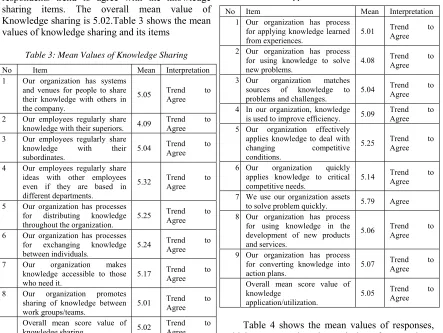
5.2.4 Knowledge application/utilisation
[image:6.612.88.531.286.619.2]Descriptive analysis indicates that all respondents trend to agree with all the knowledge application items except Item 7, in which they agree with. Thus, the overall mean value of knowledge sharing is 5.05.Table 4 shows the mean values of knowledge application and its items.
Table 4: Mean Values of Knowledge Application/Utilization
No Item Mean Interpretation
1 Our organization has process for applying knowledge learned from experiences.
5.01 Trend Agree to
2 Our organization has process for using knowledge to solve new problems.
4.08 Trend Agree to
3 Our organization matches sources of knowledge to
problems and challenges. 5.04
Trend to
Agree
4 In our organization, knowledge is used to improve efficiency. 5.09
Trend to
Agree 5 Our organization effectively
applies knowledge to deal with
changing competitive
conditions.
5.25 Trend Agree to
6 Our organization quickly applies knowledge to critical competitive needs.
5.14 Trend Agree to
7 We use our organization assets
to solve problem quickly. 5.79 Agree
8 Our organization has process for using knowledge in the development of new products and services.
5.06 Trend Agree to
9 Our organization has process for converting knowledge into action plans.
5.07 Trend Agree to
Overall mean score value of knowledge
application/utilization.
5.05 Trend Agree to
8297 mechanism to develop, convert and improve required knowledge.
5.2.5 IT
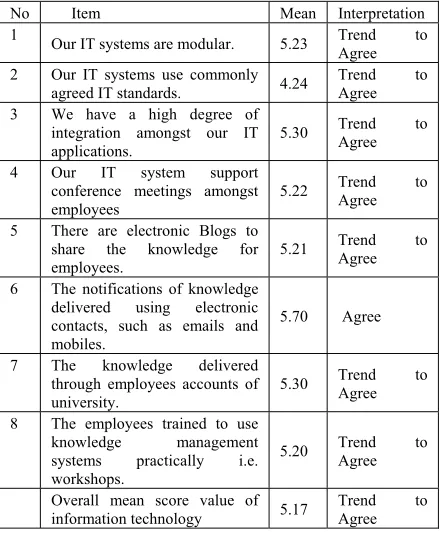
[image:7.612.85.305.246.514.2]Descriptive analysis indicates that all respondents trend to agree with all information technology items except in Item 6, in which they agree with. Thus, the overall mean value of information technology is 5.17.Table 5 shows the mean values of information technology and its items.
Table 4: Mean Values of Information Technology
No Item Mean Interpretation
1 Our IT systems are modular. 5.23 Trend to
Agree 2 Our IT systems use commonly
agreed IT standards. 4.24
Trend to
Agree 3 We have a high degree of
integration amongst our IT applications.
5.30 Trend Agree to
4 Our IT system support
conference meetings amongst employees
5.22 Trend Agree to
5 There are electronic Blogs to share the knowledge for employees.
5.21 Trend Agree to
6 The notifications of knowledge delivered using electronic contacts, such as emails and mobiles.
5.70 Agree
7 The knowledge delivered
through employees accounts of university.
5.30 Trend Agree to
8 The employees trained to use
knowledge management
systems practically i.e. workshops.
5.20 Trend Agree to
Overall mean score value of
information technology 5.17
Trend to
Agree
Table 5 shows the means value of all responses, which indicates that Basra University use information technology tools, such as emails and mobile applications, to deliver knowledge and notify employees of the delivery process. However, the respondents are unsure of all the issues concerning the implementation of information technology. These neglected issues are the following: Basra University uses modular information system; Basra University have conference meeting techniques; Basra University provides blogs for knowledge-sharing process; and Basra University have knowledge management system to support work activities. Overall, the respondents believe that no standard information technology system is used currently to support knowledge processes practically and university’s main services and processes generally.
6. DISCUSSION
Based on the data analysis results of the items in Part 5(1,2,3,4,5,7and 8) in conjunction with the items in Part 1(2,3,4,6,7,8,10,11and 12), a slight interrelation was observed between information technology infrastructure and knowledge acquisition process. Basra University does not support knowledge acquisition process. The university has no robust information system for acquiring internal knowledge, seeking and aggregate external knowledge, bringing useful feedback for knowledge acquisition process and regenerating new knowledge from the existing knowledge to support work activities. Thus, the current information technology tools cannot be considered as standard IT system with comprehensive tools and techniques.
Based on the data analysis results from the items in Part 5 (1,2,3,4,5,7and 8) in conjunction with the items in Part 2(1,2,4,5and 6), information technology tools and knowledge conversion process are poorly implemented. Thus, no activated information system is established currently to support knowledge conversion process. Basra University has not implemented standard system to represent required knowledge in organized categories. The university also did not implement any modern mechanism to integrate new knowledge and update old knowledge. Thus, ambiguity is observed around how Basra University stores, integrates, enhances and retrieves knowledge via practical information systems.
8298 Based on the data analysis results from the items in Part 5 in conjunction with items in Part 4(1, 2, 3, 4, 5, 6, 8 and 9), simple information technology infrastructures, such as emails and mobiles applications, are used currently in Basra University. However, IT does not clearly support the knowledge application process. Thus, the current information technology tools are unable to solve new problems, convert knowledge into practical actions and develop new products and services. Accordingly, Basra University suffers from the absence of standard information technology system that could support knowledge application and overall processes in the university
7. RECOMMENDATIONS
This study shows the existing situations of KM processes and supported IT systems. Data analysis shows that Basra University have limited KM processes, but a KM process was not implemented formally in the university. Furthermore, they use IT tools that are very primitive and simple. No advanced IT system has been applied clearly to support KM implementation. To solve these problems, Basra University should adopt certain policies to implement KM processes successfully. These policies include the following:
1. Identify formal KM processes that are aligned with Basra University’s needs and requirements
2. Use standard IT system to implement the KMS
3. Use IT system that is compatible with Basra University’s objectives and strategies
4. Increase the level of employee’s awareness of KM processes and implementations
5. Maximise the interactivity amongst employees and KM processes and implementations
8. CONCLUSION
Universities should implement KM processes successfully to enhance their daily activities, such as teaching, research and administration. Basra University has weak KM processes. The university has no clear KM processes to acquire, convert, share and apply the knowledge. Furthermore, the university has no IT system integrated with KM processes to create KMS. These barriers must be
addressed to deliver the promised advantages of implementing KMS. This study provides various recommendations to implement successful KM system in Basra University. Basra University should focus on encouraging employees to implement KM processes, use clear and unified IT system to support KM and create a knowledge repository to store and classify acquired knowledge based on disciplines. They should also allow employees to access knowledge repositories to gain the required knowledge based on their disciplines. These recommendations must trigger practical actions toward successful KM implementations that could prompt the learning, research and innovation capacities of Basra University.
REFRENCES:
[1]Oqaily AT, Hassan ZB, Rashid AM, Al-sulami ZA. Success factors of knowledge management in universities (A Case Study: Jordanian Private Universities). Middle-East Journal of Scientific Research. 2014; 22(7):994-1002.
[2]Alavi M, Leidner DE. Knowledge management and knowledge management systems: Conceptual foundations and research issues. MIS quarterly. 2001 Mar 1:107-36.
[3]Mustafa R, Klepper S. Industrial development through tacit knowledge seeding: evidence from the Bangladesh garment industry. Management Science. 2017 Jan 12; 64(2):613-32.
[4]Park C, Vertinsky I, Becerra M. Transfers of Tacit Vs. Explicit Knowledge and Performance in International Joint Ventures: The Role of Age. International Business Review. 2015 Feb 1; 24(1):89-101.
[5]Nonaka I, Takeuchi H. The Knowledge Creation Company: How Japanese Companies Create The Dynamics Of Innovation?
[6]Arias Aranda D, Molina-Fernandez LM. Determinants of innovation through a knowledge-based theory lens. Industrial Management & Data Systems. 2002 Jul 1; 102(5):289-96.
[7]Davenport TH, De Long DW, Beers MC. Building successful knowledge management projects. Center for business innovation working paper. 1997 Jan; 4.
8299 [9]Arthur EN. Knowledge Management Initiatives
and Implementation: a qualitative meta-analysis of public and private organizations. [10]Kidwell JJ, Vander Linde K, Johnson SL.
Applying corporate knowledge management practices in higher education. Educause quarterly. 2000; 23(4):28-33.
[11]Lindner F, Wald A. Success factors of knowledge management in temporary organizations. International Journal of project management. 2011 Oct 1; 29(7):877-88. [12]Ramakrishnan K, Yasin NM. Knowledge
management system and higher education institutions. International Proceedings of Computer Science and Information Technology. 2012; 37(1):67-71.
[13]Luan J, Serban AM. Technologies, products, and models supporting knowledge management. New Directions for Institutional Research. 2002 Mar; 2002(113):85-104. [14]Hasani K, Sheikhesmaeili S. Knowledge
management and employee empowerment: A study of higher education institutions. Kybernetes. 2016 Feb 1; 45(2):337-55.
[15]Mahdi OR, Nassar IA, Almsafir MK. Knowledge management processes and sustainable competitive advantage: An empirical examination in private universities. Journal of Business Research. 2018 Feb 21. [16]Darroch J. Developing a measure of knowledge
management behaviors and practices. Journal of knowledge management. 2003 Dec 1; 7(5):41-54.
[17]Gold AH, Malhotra A, Segars AH. Knowledge management: An organizational capabilities perspective. Journal of management information systems. 2001 May 31; 18(1):185-214.
[18]Kumar S, Singh V, Haleem A. Knowledge management–enablers and barriers: a questionnaire–based study. International Journal of Knowledge Engineering and Data Mining. 2014 Jan 1; 3(1):31-57.
[19]Jantunen A. Knowledge-processing capabilities and innovative performance: an empirical study. European Journal of Innovation Management. 2005 Sep 1; 8(3):336-49. [20]Todericiu R, Boanta A. KNOWLEDGE AND
BARRIERS TO THEIR TRANSFER TO SMEs. Revista Economica. 2017 Dec 1; 69(6). [21]Wongthongtham P, Zadjabbari B, Naqvi HM.