IJPSR (2012), Vol. 3, Issue 09 (Research Article)
Received on 16 May, 2012; received in revised form 14 June, 2012; accepted 25 August, 2012
FORMULATION AND OPTIMIZATION OF OSMOTICALLY CONTROLLED, MICROBIALLY TRIGGERED COLON TARGETED SYSTEM USING FACE CENTERED CENTRAL COMPOSITE DESIGN
Sapna Saini and Rajesh Saini*
Janta College of Pharmacy, Butana, Sonipat-131 302, Haryana, India
ABSTRACT
The purpose of present investigation was to achieve successful delivery especially to colon using microbially triggered, osmotically controlled approach. Prednisolone was chosen model drug for treatment of inflammatory bowel disease (IBD). Prednisolone-β-cyclodextrin complex were prepared and phase solubility study was carried out. Cellulose acetate solution containing chitosan was used to prepare semi-permeable. Face centered central composite design was employed to study the effect on independent variables (concentration of sodium chloride, polyethylene glycol, and chitosan), % cumulative release and disintegration time. Both independent variables, the proportion of chitosan (X1) and proportion of NaCl and PEG (X2) had an influence on the % drug release in both the media (buffers and buffer with rat ceacal content). Formulations were evaluated for their Preformulation parameters and found within the specified limit. Formulation code F8 and S8 were the optimized batches with an in vitro release of 83.77 and 99.13 % respectively. The formulations containing PEG was found to be a promising drug delivery system better release kinetics.
INTRODUCTION: Oral drug delivery is the most desirable and preferred method of administering therapeutic agents for their systemic effects. Oral drug delivery system can be classified into three categories: Immediate-release (IR) preparation, Controlled-release (CR) preparation and Targeted release preparation or site specific drug delivery system that requires spatial placement of drug delivery device at a desired site within the GI tract 1. Although oral delivery has become a widely accepted route of administration of therapeutic drugs, the gastro intestinal tract presents several formidable barriers to drug delivery. It has serious drawback in conditions where localized
Colon specific drug delivery system should be capable of protecting the drug en route to the colon i.e. drug release and absorption should not occur in the stomach as well as in the small intestine, but the drug only released and absorbed once the system reaches to the colon 3. Colonic delivery offers numerous therapeutic advantages like drugs, which are destroyed by the stomach acid and metabolized by pancreatic enzymes are minimally effected in the colon 4. Colon targeted drug delivery systems have been gaining significant attention not just for providing more effective therapy to colon related disease, but also as a potential approach for systemic delivery of therapeutic
Keywords: Colon, Gastrointestinal tract,
Circadian rhythm
Correspondence to Author:
Rajesh Saini
Assistant Professor, Janta College of Pharmacy, Butana, Sonipat-131302, Haryana, India
E-mail: [email protected]
QUICK RESPONSE CODE
IJPSR:
ICV- 4.57
Website:
Various colon specific drug delivery systems are being developed by taking advantages of the luminal pH in the ileum and microbial enzymes in the colon 7. In general, four primary approaches have been proposed for colon-specific delivery namely prodrugs, pH- dependent, time dependent, and microflora-activated systems 8. Most recently new colon specific delivery system are developed. These are pressure controlled colon delivery capsule, CODESTM, osmotically controlled drug delivery system, pulsincap system, time clock system etc 9.
A significant milestone in oral NDDS is the development of the osmotic drug delivery system, an innovative and highly versatile drug delivery system. Osmotic drug delivery system (ODDS) differ from diffusion- based system in that; the delivery of active agent (s) is driven by an osmotic gradient rather than the concentration of drug in the device 10. Osmotic systems utilizes the principle of osmotic pressure for the delivery of drugs.. They are also known as gastrointestinal therapeutic system. Alza corporation of the USA was first to develop an oral osmotic pump and still they leading in this field with the technology named OROS 11.
In the present research, colon targeted drug delivery system was formulated by using a combination of microbially triggered and osmotically controlled approaches. The β-cyclodextrin complexation was used to improve the solubility of the drug. Face centered central composite design of Design expert software 8.0.1.5, was used to formulate and optimized the formulations of the batches. Chitosan is natural polysaccharide serves dual functions, osmogen as well as microbially degrading agent. Face centerted composite design (FCCD) was used to studies the effect of independent variable i.e. Concentration of osmogens, Chitosan, Sodium chloride and Polyethylene glycol 4000 and 6000 on the dependent variable i.e. % cumulative drug release (%CDR) and disintegration time (DT).
MATERIAL AND METHODS:
Materials: Prednisolone IP (OM Biotech. Pvt. Ltd.),Cyclodextrin (Ranbaxy Laboratory Pvt. Ltd, Gurgaon) Microcrystalline cellulose, Sodium chloride, Polyethylene glycol, Isopropyl alcohol, Methanol (S.D.
Fine Pvt. Ltd. Mumbai), Chitosan (Central institute of fisheries technology, Kochi), Starch (Priya Drugs Chemical Pvt. Ltd. Ambala), Triethyl citrate (S.D.Fine Pvt. Ltd. Mumbai), Eudragit L 100, Eudragit S100 (Degussa Pvt. Ltd. Mumbai), Talc,Magnesium stearate (Himedia Laboratories Pvt. Ltd., Mumbai).
Methods:
Complexation of Prednisolone with β-cyclodextrin: β-cyclodextrin has been extensively used to modify drug’s physio-chemical properties. In the present study, drug-cyclodextrin complexes were prepared in two different ratios 1:2 and 1:4.
Physical mixing: For physical mixtures, Prednisolone and β-cyclodextrin were weighed accurately, mixed thoroughly by trituration in a mortar and sieved through a 0.25 mm sieve (# 60). The prepared physical mixture was stored in a dessicator until further evaluation.
Kneading method: The kneaded complex of Prednisolone and β-cyclodextrin was prepared by wetting the physical mixture in a mortar with a minimum volume of ethanol/water mixture (15/85, V/V) and kneading thoroughly with a pestle to obtain a paste, which was then dried under vacuum at room temperature, sieved through a 0.25 mm sieve (# 60) and stored in a dessicator until further evaluation.
Phase Solubility Study: The phase solubility technique illustrates the evaluation of the affinity between β-CD and prednisolone in water. The solubility measurement of prednisolone with β-CD was performed according to Higuchi and Connors. An excess amount of drug (50 mg) was added to conical flasks containing an aqueous CD solution of concentration 0-0.014 M. The flasks were placed in orbital shaker for 3 days at 25˚C. Aliquots of 2 ml were withdrawn and filtered suitably and analysed foe prednisolone by measuring absorbance at 242 nm. The intrinsic solubility in water was determined from sample without CD. Study was carried out in triplicates.
Experimental design for formulations of batch F and S
All other formulation and processing variables were kept invariant throughout the study. Cumulative % drug release (% CDR) and disintegration time (DT) were taken as the response variables. Similarly for batch S, amount of chitosan (X1) and amount of PEG 4000 and PEG 6000 (X2) were studied at 3 levels as shown in
Table 1 and 2.
Preparation of Core Tablets: Granules were prepared using wet granulation method. Firstly prednisolone, microcrystalline cellulose, sodium chloride, polyethylene glycol, starch, cellulose acetate, talc and magnesium stearate were pass through sieve # 60. Two batches, F and S (13 formulation each) were decided by the optimization software, Design Expert 8.4.0.5 version.
Granules were prepared by using starch paste as binder by sieve # 16 according to the formulae (Table 1 and 2) and dried at 54˚C for about 3 hrs. These granules were passing through sieve # 18/20 and lubricated with a mixture of talc and magnesium stearate. Granules were compressed into tablets (each of 220 mg) were formulated on minirotary tablet press (Fluidpack machinery) using 8 mm standard concave punches.
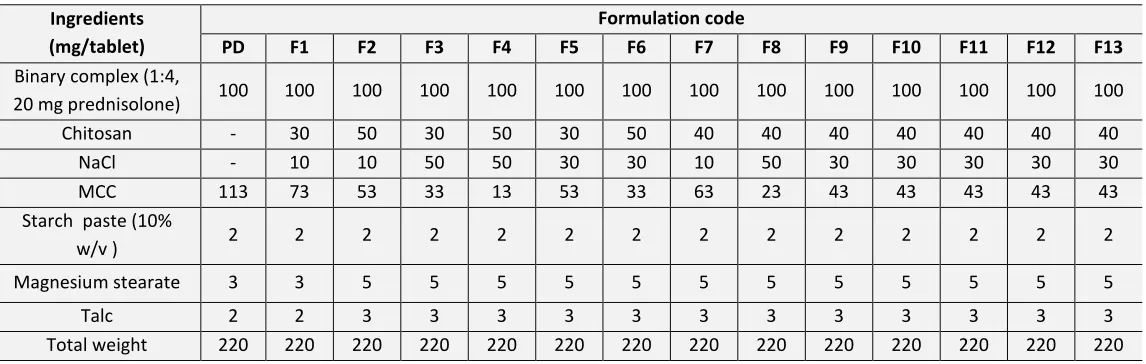
PD batch of pure prednisolone was prepared without any osmogen to evaluate the effect of osmogen onto the other batches. Formulations of different batches are shown in Table 3 and 4.
TABLE 1: CENTRAL COMPOSITE DESIGN USING ACTIVE FORMULATION AND PROCESS VARIABLES INFLUENCING %CDR, DT (FOR F BATCH)
Formulation code Coded factor levels
X1 X2
FI or S1 -1 -1
F2 or S2 +1 -1
F3 or S3 -1 +1
F4 or S4 +1 -1
F5 or S5 -1 0
F6 or S6 +1 0
F7 or S7 0 -1
F8 or S8 0 +1
F9 or S9 0 +1
F10 or S10 0 0
F11 or S11 0 0
F12 or S12 0 0
F13 or S13 0 0
TABLE 2: THE AMOUNT OF FACTORS SELECTED FOR OPTIMIZATION AT DIFFERENT LEVELS (BATCH F AND S)
Coded level -1 0 +1
X1: Chitosan (mg) 30 40 50
X2: NaCl (mg) or
PEG 4000 and 6000 (1:1 ratio)
[image:3.612.317.582.149.389.2]10 30 50
TABLE 3: FORMULAE USED FOR THE PREPARATION OF COLON TARGETING TABLETS OF PREDNISOLONE CONTAINING CHITOSAN AND NaCl AS OSMOGENS
Ingredients (mg/tablet)
Formulation code
PD F1 F2 F3 F4 F5 F6 F7 F8 F9 F10 F11 F12 F13
Binary complex (1:4,
20 mg prednisolone) 100 100 100 100 100 100 100 100 100 100 100 100 100 100
Chitosan - 30 50 30 50 30 50 40 40 40 40 40 40 40
NaCl - 10 10 50 50 30 30 10 50 30 30 30 30 30
MCC 113 73 53 33 13 53 33 63 23 43 43 43 43 43
Starch paste (10%
w/v ) 2 2 2 2 2 2 2 2 2 2 2 2 2 2
Magnesium stearate 3 3 5 5 5 5 5 5 5 5 5 5 5 5
Talc 2 2 3 3 3 3 3 3 3 3 3 3 3 3
[image:3.612.22.595.500.682.2]TABLE 4: FORMULAE USED FOR THE PREPARATION OF COLON TARGETING TABLETS OF PREDNISOLONE CONTAINING CHITOSAN, PEG 4000 AND PEG 6000 AS OSMOGENS
Ingredients (mg/tabet)
Formulation code
S1 S2 S3 S4 S5 S6 S7 S8 S9 S10 S11 S12 S13
Binary complex (1:4,
20 mg prednisolone) 100 100 100 100 100 100 100 100 100 100 100 100 100
Chitosan 30 50 30 50 30 50 40 40 40 40 40 40 40
PEG 4000 and 6000
(1:1) 10 10 50 50 30 30 10 50 30 30 30 30 30
MCC 73 53 33 13 53 33 63 23 43 43 43 43 43
Starch paste (10%
w/v ) 2 2 2 2 2 2 2 2 2 2 2 2 2
Magnesium stearate 3 5 5 5 5 5 5 5 5 5 5 5 5
Talc 2 3 3 3 3 3 3 3 3 3 3 3 3
Total weight 220 220 220 220 220 220 220 220 220 220 220 220 220
Coating of Tablets: Initially the tablets were coated with a moisture sealant to prevent the interaction of drug with coating polymers. Then the tablets were coated with Cellulose acetate solution after it with enteric coating polymers. The solution contained cellulose acetate, chitosan and triethyl citrate.
Coating Process: About 1000 tablets of prednisolone were taken and allow to coating in a pan coater (12” conventional with 3 baffles) at 60-70 rpm and 50 ˚C temperature. Coating was carried out by the spray method and dried with the same.
Evaluation of Tablets: The prepared tablets were evaluated for the following parameters Hardness (Pfizer hardness tester), Weight Variations (Electronic balance), Friability (Roche friabilator) and Drug content (Assay, UV-analysis).
Disintegration Test: Disintegration test was performed on each formulation for checking intactness of enteric coat. Disintegration apparatus (Electro lab Ltd., ED-2L) was used and I.P. method was followed. Six tablets of each formulation were tested for disintegration. Tablets were firstly tested in water for 5 minutes then in 0.1N HCL for 2 h (simulating gastric transit time) to see the damage to the coat. Afterwards, tablets were tested in the phosphate buffer pH 7.4 (simulating intestinal pH) till the coating dissolved. Temperature in each case was kept constant at 37±0.5oC.
In-vitro release studies: The in-vitro dissolution studies
were carried out using USP dissolution apparatus type-II in different medium. Buffer stage: Two hours in 900 ml of 1.2 pH buffer, three hours in in 900 ml of 7.4 pH buffer and seven hours in 900 ml of 6.8 pH buffer
solution at 100 rpm. Dissolution test was carried out for a total period of 12 hours. Analysis for prednisolone was done by UV spectrophotometer at 242 nm.
[image:4.612.316.583.318.494.2]In vitro drug release study- F batch:
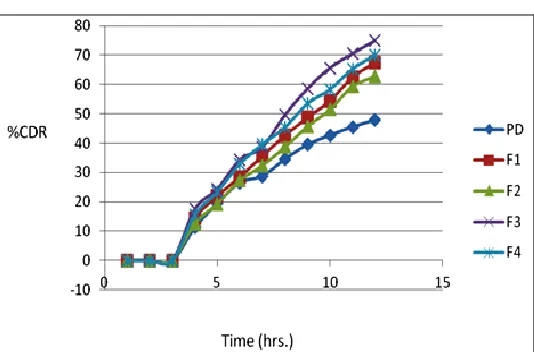
[image:4.612.313.586.526.713.2]FIG. 1: IN VITRO % CUMULATIVE DRUG RELEASE FROM BATCH F1 TO F4 CONTAINING NaCl AS SYNTHETIC OSMOGEN
FIG. 3: IN VITRO % CDR FROM BATCH F10 TO F13 CONTAINING NaCl AS SYNTHETIC OSMOGEN
[image:5.612.316.582.43.222.2]In vitro drug release study- S batch:
[image:5.612.27.299.43.217.2]FIG. 4: IN VITRO % CDR OF A BATCH S1 TO S5 CONTAINING PEG AS SYNTHETIC OSMOGEN
FIG. 5: IN VITRO % CDR OF A BATCH S6 TO S9 CONTAINING PEG AS SYNTHETIC OSMOGEN
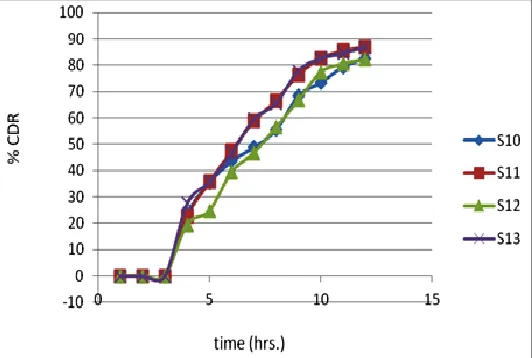
FIG. 6: IN VITRO % CDR OF BATCH S10 TO S13 CONTAINING PEG AS SYNTHETIC OSMOGEN
RSM for formulations of F batch
Mathematical Modeling: Mathematical relationships generated using multiple linear regression analysis for the studied response variables are expressed as equations given below:
% CDR (100 rpm) = +78.87 - 2.49 X1 + 3.88 X2 - 0.03 X1 X2 - 9.5 X12 – 0.034 X22 …. (1)
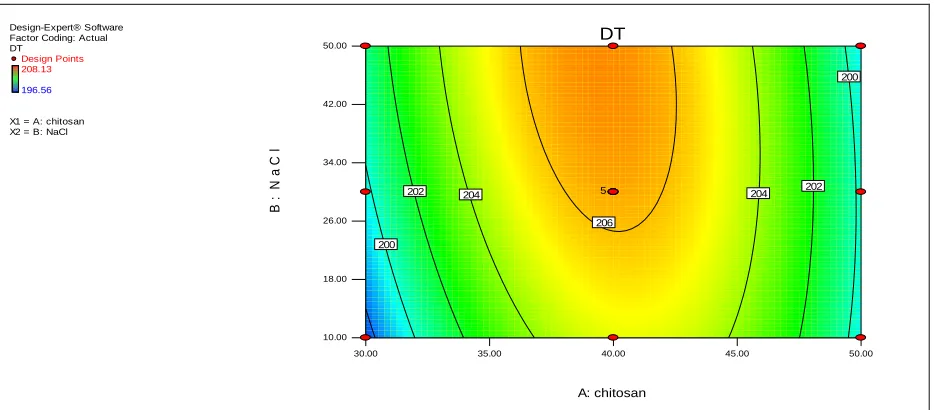
DT (min.) = + 206.25 + 0.018 X1 + 0.80 X2 – 0.94 X1 X2 – 6.53 X12 - 0.48 X22 ...(2)
[image:5.612.26.299.273.453.2]Design-Expert® Software Factor Coding: Actual CDR
Design Points 83.77
62.82
X1 = A: CHITOSAN X2 = B: Nacl
30.00 35.00 40.00 45.00 50.00
[image:6.612.72.541.63.445.2]10.00 18.00 26.00 34.00 42.00 50.00 CDR A: CHITOSAN B : N a c l 65 70 70 75 75 80 5
FIG. 7: CONTOUR PLOT SHOWING THE INFLUENCE OF TWO FACTORS ON % CDR AT 100 RPM- F BATCH
Design-Expert® Software Factor Coding: Actual CDR
Design points above predicted value
Design points below predicted value
83.77
62.82
X1 = A: CHITOSAN X2 = B: Nacl
10.00 18.00 26.00 34.00 42.00 50.00 30.00 35.00 40.00 45.00 50.00 60 65 70 75 80 85 C D R A: CHITOSAN B: Nacl
FIG. 8: 3D RESPONSE SURFACE PLOT SHOWING THE INFLUENCE OF TWO FACTORS ON % CDR AT 100 RPM- F BATCH
Design-Expert® Software Factor Coding: Actual DT
Design Points 208.13
196.56
X1 = A: chitosan X2 = B: NaCl
30.00 35.00 40.00 45.00 50.00
10.00 18.00 26.00 34.00 42.00 50.00 DT A: chitosan B : N a C l 200 200
202 204 204 202
[image:6.612.77.543.285.492.2]206 5
[image:6.612.76.543.530.735.2]Design-Expert® Software Factor Coding: Actual DT
Design points above predicted value Design points below predicted value 208.13
196.56
X1 = A: chitosan X2 = B: NaCl
10.00 18.00
26.00 34.00
42.00 50.00
30.00 35.00 40.00 45.00 50.00 196
198 200 202 204 206 208 210
D
T
[image:7.612.70.545.48.268.2]
A: chitosan B: NaCl
FIG. 10: RESPONSE SURFACE PLOT SHOWING THE INFLUENCE OF TWO FACTORS ON DT (MIN.) - F BATCH
RSM for formulations of S batch Mathematical Modeling: Mathematical relationships
generated using multiple linear regression analysis for the studied response variables are expressed as equations given below
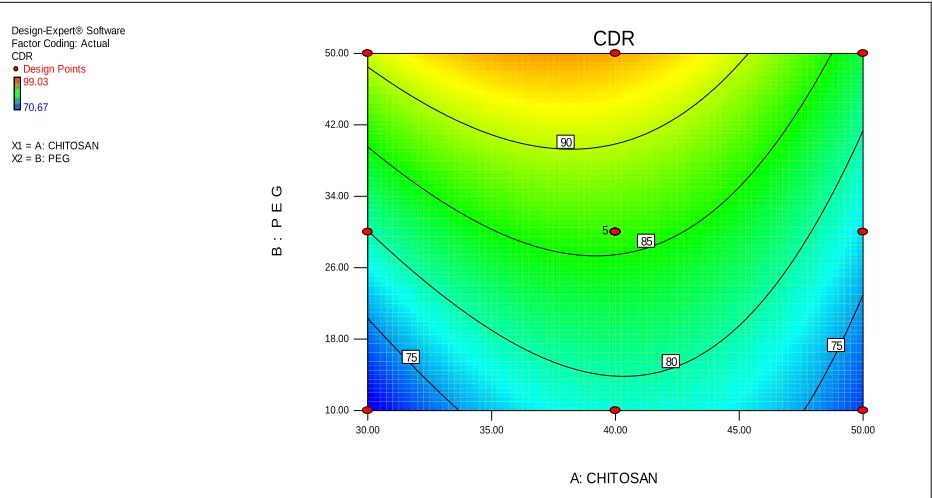
% CDR (100 rpm) = + 85.99 – 1.56 X1 + 7.86 X2 – 2.54X1 X2 – 7.63 X12 + 0.55 X2 2 …. (3)
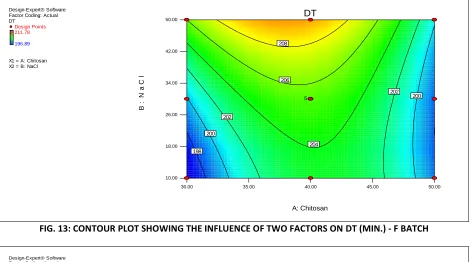
DT (min.) = + 205.38 – 0.86X1 + 2.94 X2 – 2.04 X1 X2 -6.33 X12 + 1.12 X2 …. (4)
The polynomial equations comprise the coefficients for intercepts, first-order main effects, interaction terms and higher order effects. The sign and magnitude of the main effects signify the relative influence of each factor on the response.
Design-Expert® Software Factor Coding: Actual CDR
Design Points 99.03
70.67
X1 = A: CHITOSAN X2 = B: PEG
30.00 35.00 40.00 45.00 50.00
10.00 18.00 26.00 34.00 42.00
50.00 CDR
A: CHITOSAN
B
:
P
E
G
75 80 75
85 90
5
[image:7.612.75.541.426.675.2]Design-Expert® Software Factor Coding: Actual CDR
Design points above predicted value Design points below predicted value 99.03
70.67
X1 = A: CHITOSAN X2 = B: PEG
[image:8.612.80.541.46.252.2]10.00 18.00 26.00 34.00 42.00 50.00 30.00 35.00 40.00 45.00 50.00 70 75 80 85 90 95 100 C D R A: CHITOSAN B: PEG
FIG. 12: 3D RESPONSE SURFACE PLOT SHOWING THE INFLUENCE OF TWO FACTORS ON % CDR AT 100 RPM- S BATCH
Design-Expert® Software Factor Coding: Actual DT
Design Points 211.78
196.89
X1 = A: Chitosan X2 = B: NaCl
30.00 35.00 40.00 45.00 50.00
[image:8.612.72.543.284.546.2]10.00 18.00 26.00 34.00 42.00 50.00 DT A: Chitosan B : N a C l 198 200 200 202 202 204 206 208 5
FIG. 13: CONTOUR PLOT SHOWING THE INFLUENCE OF TWO FACTORS ON DT (MIN.) - F BATCH
Design-Expert® Software Factor Coding: Actual DT
Design points above predicted value
Design points below predicted value
211.78
196.89
X1 = A: Chitosan X2 = B: NaCl
10.00 18.00 26.00 34.00 42.00 50.00 30.00 35.00 40.00 45.00 50.00 195 200 205 210 215 D T A: Chitosan B: NaCl
[image:8.612.70.542.365.724.2]Mathematical modeling to study the in-vitro release kinetics of optimized batches: To establish the order and mechanism of drug release, dissolution data of the optimized batches were fitted to four different kinetic models, namely. Zero order model, first order model, Higuchi model and Korsmeyer peppas model. The model for best fit was predicted from the value of R2. For an ideal fit, value of R2 was 1. Hence, the model which gives the R2 value nearest to 1 describes the order of drug release.
In-vitro studies in RCC: At last to evaluate the effect of
colonic microflora on the rate of degradation of semi-permeable membrane containing chitosan, in-vitro
dissolution was carried out in 6.8 buffer cotainining 4% rat ceacal content (RCC). The study was carried out for optimized batch to establish an in-vitro/in-vivo
correlation. Anaerobic condition was maintained during the whole study by continuous supply of CO2 because of anaerobic nature of the colonic microflora.
RESULTS:
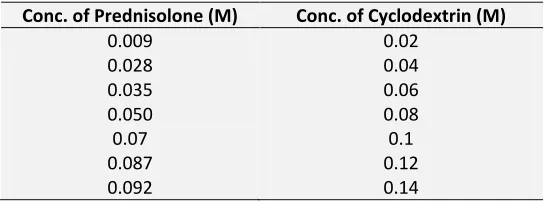
Phase-Solubility Study: The phase solubility diagram of the prednisolone with β-CD is shown in figure 15. The intrinsic solubility in water was determined from sample without β-CD. Study was carried out in duplicates. The intrinsic solubility was found to be 254 mg/L, slightly higher than the reported value 200 mg/L. The phase solubility diagram for prednisolone β-CD showed AL type curve according to Higuchi and Connors. The aqueous solubility of drug was increased linearly as a function of the concentration of β-CD. Straight line was fitted to the AL type diagrams with regression coefficient 0.986.
TABLE 5: PHASE SOLUBILITY DIAGRAM OF PREDNISOLONE CD SYSTEM
Conc. of Prednisolone (M) Conc. of Cyclodextrin (M)
0.009 0.02
0.028 0.04
0.035 0.06
0.050 0.08
0.07 0.1
0.087 0.12
0.092 0.14
[image:9.612.316.587.43.229.2]
FIG. 15: PHASE SOLUBILITY STUDY DIAGRAM
Phase-solubility diagram of prednisolone and cyclodextrin indicated a linear increase in solubility of prednisolone as the concentration of CD increases. Straight line was fitted according to AL - type diagram with R2 0.984
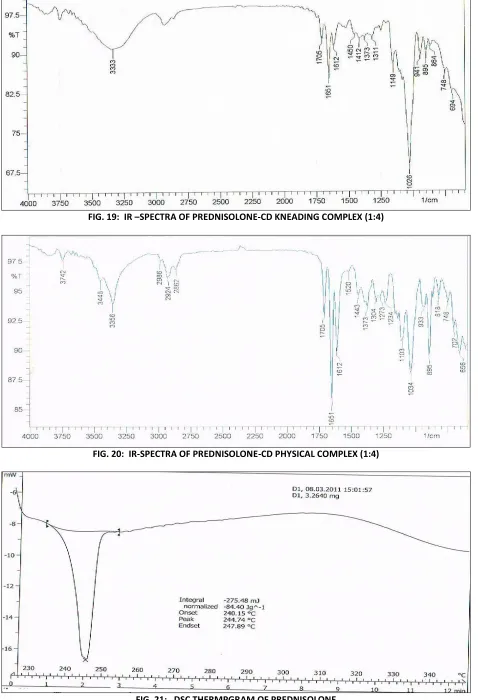
Fourier transform infrared spectroscopy (FTIR): From the IR spectras of the pure drug and complexes prepared by physical mixture and kneading method 1:2 and 1:4 ratio, it was observed that the intensity and shape of prednisolone characteristics peaks changed dramatically for the inclusion complex prepared by kneading method as compare to physical method. Out of two kneading complexes, 1:4 ratio showed better interaction than the 1:2 ratio.
[image:9.612.26.299.575.676.2]FIG. 16:IR-SPECTRA OF PURE DRUG
FIG. 17:IR-SPECTRA OF PREDNISOLONE-CD KNEADING COMPLEX (1:2)
FIG. 19: IR –SPECTRA OF PREDNISOLONE-CD KNEADING COMPLEX (1:4)
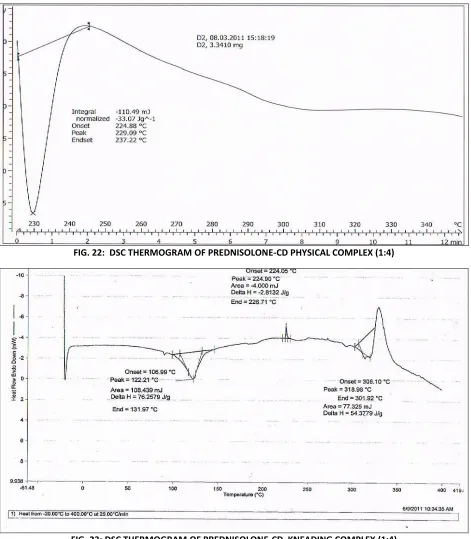
[image:11.612.74.540.46.265.2]FIG. 22: DSC THERMOGRAM OF PREDNISOLONE-CD PHYSICAL COMPLEX (1:4)
FIG. 23:DSC THERMOGRAM OF PREDNISOLONE-CD KNEADING COMPLEX(1:4)
All the other parameters of the tablet were within the specified limits. The solution provided by the optimization software implied that from batch F containing Chitosan and NaCl, formulation F8 was the optimized batch (83.77% in vitro release) while from S batch containing Chitosan and PEG, formulation S8 was the optimized batch (99.13% in vitro release). The DT of both the batches was found to be optimum. All the batches found to be disintegrated over 3 hrs i.e. gastric transit time.
The optimized batch F8 and S8 showed better result in the presence of rat ceacal contant. The %CDR was found to be 89.86% and 104.67 % for F8 and S8 batch respectively.
Firstly, solubility of prednisolone was enhanced by complexation with β-CD. The tablets were formulated according to the FCCD Software and coated with cellulose acetate solution to form a semi- permeable membrane. At last tablets were enteric coated with Eudragit L and S polymer to prevent its release in upper GI tract. The formulated core tablets contains different amount of synthetic osmogens i.e. NaCl and PEG 4000 and 6000. From the dissolution it was found that the formulation containing PEG as synthetic osmogen i.e. S batch shows the better release profile as compare to F-batch formulations containing NaCl as synthetic osmogen.
The PEG form solid-dispersion with the drug and hence shows better result. The effects of different formulation variables were studied to select the optimum formulation.The drug release is directly proportional to the amount of synthetic osmogens. The amount of chitosan in the core formulation had a profound effect on the amount of drug release. An optimum core formulation that benefited from suspending and osmotic effect of chitosan has been developed. Furthermore the physicochemical and digestible property of chitosan-cellulose acetate free films and in vivo/in vitro correlation of microbially triggered, osmotically controlled colon targeted drug delivery system are in progress to fully evaluate the system.
REFERENCES:
1. Lee VHL and Mukherjee: Drug delivery-Oral colon specific. In: Swarbrick J and Boylan JC. (eds.) Encyclopedia of Pharmaceutical Technology, Marcel Dekker, New York, Third edition 2002, 871-884.
2. Chourasia M K, Jain S K: Pharmaceutical approaches to colon targeted drug delivery system. Journal of Pharmacy and Pharmaceutical sciences, 2003; 6:1, 33-66.
3. Wasnik Shailendra, Parmar Poonam: The design of colon-specific drug delivery system and different approaches to treat colon disease. International Journal of Pharmaceutical Sciences Review and Research, 2011; 6:2, 167-177.
4. Tiwari Gaurav, Tiwari Ruchi, Wal Pranay, Wal Ankita, Rai Awani K: Primary and novel approaches for colon targeted drug delivery – A review. International Journal of Drug Delivery, 2010; 2:1, 01-11.
5. Kshirsagar SJ, Bhalekar MR, Umap RR: In vitro in vivo comparison of two pH sensitive eudragit polymers for colon specific drug delivery. Journal of Pharmaceutical Sciences and Research, 2009; 1:4, 61-70.
6. Aurora Jack, Talwar Naresh, Pathak Vinayak: Colonic drug delivery challenges and opportunities- An overview. European Gastroenterology Review, 2006, 1-6.
7. S.K.Uma Devi, R. Thiruganesh R, S.Suresh: Preparation and characterization of chitosan tablets of aceclofenac for colon targeted drug delivery. JPRHC, 2010; 2:1, 46-65.
8. Yang Libo, Chu James S. Fix Joseph A: Colon-specific drug delivery: new approaches and in vitro in vivo evaluation. International Journal of Pharmaceutics, 2002, 235: 01-15. 9. Rangasamy Manivannan: Colon targeted drug delivery systems:
A review. International Journal of Drug Formulation & Research, 2010; 1:2, 30-54.
10. Gupta RN, Gupta R, Basniwal PK: Osmotically Controlled Oral Drug Delivery System: a review. International journal of Pharmaceutical Science, 2009; 1:2, 269-275.
11. Sharma S, Osmotic controlled drug delivery system, Pharmainfo.net, 2008; 6:3. Available from: http://www.pharmainfo.net
How to cite this article: