6225
THE IMPACT OF SOCIAL NETWORKS ON INDIVIDUAL’S
BEHAVIORAL CHANGE IN KINGDOM OF BAHRAIN
JAFLAH ALAMMARY
University of Bahrain, Department of Information Systems, Kingdom of Bahrain E-mail: [email protected]
ABSTRACT
The growth in Social Networks in Arab countries played a crucial role in civil mobilization, empowerment, shaping opinion and influencing change. The popularity of Social Networks tools has continued to grow, however, extent to what the communication via Social Networks can lead to social or individual change is still debatable in these countries. The present study proposed and tested a holistic model that extended the Theory of Planned Behavior - TPB and redefined behavioral intention toward using technology to behavioral change as an effect of using new technology by exploring the impact of Social Networks on the individual behavioral change. Toward achieving the objectives of the current research, a quantitative research method was adopted. Three hundred surveys were distributed to residents from the different governorates in Kingdom of Bahrain. The research indicates that there is a need for an action to be taken by the decision makers and governance people in the Arab countries towards SN which essentially have become a weapon of mass persuasion. This weapon can be used by unconcerned individuals to change the society: socially, politically or even economically. The impact of Social Networks on changing behavior should be considered strategically. More attention needs to be paid on controlling the information and material which are exchanged on Social Networks to redirect their impact positively.
Keywords:Social Networking, Behavioral Change, Perceived Privacy, Trust, Kingdom Of Bahrain
1. INTRODUCTION
Social Networks (SN) are online services, sites or platform which facilitates communication among people who share interests and information, ideas, events, activities, backgrounds and develop new relationships [1]. With SN, users generate a self-descriptive profile and make links to other members despite the location boundaries [2]. In addition, users can join virtual groups, receive/send private messages, read and post comments, engage in conversation, and interact via e-mail and instant messages [3]. The most well-known SN with high number of active users are Facebook, Google+, YouTube, LinkedIn, Instagram and Twitter (Mashable.com). SN are considered as useful medium of electronic Word Of Mouth (eWOM), a connection which is not possible in any other type of media [4]. SN services have altered the way people interact and allowed them to buildup new relationships at the same time keep track of their existing ones. Building relationship and sharing information may impact or change both the social and individual’s behavior. The significant correlation between the using of SN and individual behavioral change has been examined by several
studies [5][6][7]. The individual and social change resulted from the communication via SN has received significant attention during the crisis in Mumbai attack (2008), Iran election protests (2009) and Haiti earthquake (2010) which increase the world awareness toward this critical tools Sheedy, C. (2011). [3]. More attention was paid to SN site like Facebook which reshaped the way people communicate and played a critical role in the Arab spring, London riots and Assam riots [8]. However, the SN impact on social and individual change is not an immediate result of online communication but it is a gradual process following sharing information and developing relationship among users leading to behavioral intention and behavioral change [5].
6226 active Twitter users are 61,900 with penetration rate of 5% [11]. Due to the demand on SN in the Arab world, many new SN were established mainly for Arabs like AreebaAreeba. This SN site is a UAE-based social networking which has reached 1.7 million users (Firm’s founder) [12]. The growth in SN in Arab countries played a crucial role in civil mobilization, empowerment, shaping opinion and influencing change. The using of SN has been shifted from its social nature to more politic usage [11]. For Example, Bahraini activists used SN specially Facebook to promote their ideas and organize an Egyptian-style occupation of a Bahraini square after the success of Tunisian and Egyptian revolution [13]. In addition, there is a growing blogger and Instagram communities in KB with political nature [14].
The popularity of SN tools has continued to grow [11], however, the extent to which the online communication via SN sites can lead to social and individual change are still debatable in these countries [3] [11][15]. There is a lack in the studies which conducted to investigate the SN issues and their impact on society and individuals in the context of Arab countries which makes this research such as important one that fill this gap. The current research is aim to investigate the current situation regarding the adoption of SN by individuals at Kingdom of Bahrain (KB). Many aspects of SN will be investigated include: the usage of SN, privacy and security concerns, and individual attitude and behavior toward using SN. Furthermore, the research will explore the impact of the SN on the individual behavioral change with the focus on the indirect impact of perceived security and perceived privacy on sharing information and developing relationships via perceived trust, and perceived risk. The finding of this research will enhance the awareness toward the importance of the SN as a political weapon that may direct the nation social and political orientation by changing their behavior. This will help the decision maker to pay more attention to the impact of such tools on the youth and embedded that in their long term strategic and politic planning. On the other hand, the current research will enrich the theoretical literature and knowledge on the field of SN in the context of the Arab countries by developing a theoretical model on the impact of SN on social behavior and behavioral change which rarely undertaken by previous studies.
The current paper is articulated into five sections including the introduction. The research and hypotheses were discussed in the Section 2. Section
3 talks over the research methodology and design. Section 4 presents the results of the research. The paper then concludes with Section 5.
2. RESEARCH MODEL AND HYPOTHESES
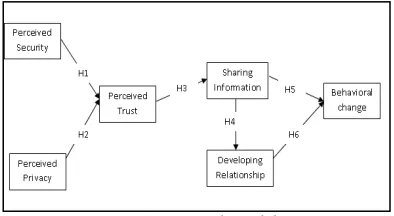
[image:2.612.327.524.343.451.2]Many scholars have proposed various approaches for analyzing the individual behavior and attitude [16] such as the Theory of Planned Behavior (TPB), Technology Acceptance Model (TAM), etc. Most of the previous studies indicated that there is no direct impact for the SN content on changing the user behavior [17][18]. By extending the TPB model, the current research is presenting a holistic model for studying the impact of SN on individual’s behavioral change (Figure 1). Using literature on SN and TPB, the research model has redefined attitude toward using technology to a behavioral change as an effect of using the technology.
Figure 1: Research model
The model first examines the indirect impact of perceived security and perceived privacy via perceived trust on sharing information and developing relationships. Secondly, the impact of sharing information and developing relationships on behavioral change will be examined. The research model is depicted in Figure (1). The model is based on an assumption that SN has an influence on changing the behavior of individual. In other words, by perceiving trust of SN, users will be encouraged to share information and develop different relationships which can in turn change their behavior and attitude [17][18].
2.1 The impact of perceived security and perceived privacy on trust
6227 personal data. Risk in this context can be defined as the extent to what the outcome of SN is uncertain and insignificant to users [20] which include intimidations such as destructing, selling or modifying the data or information on the network [21]. In addition, it can include threats like various types of fraud and misuse [20][22]. Perceived security relates to the security feeling and confident expectations of the user while using the internet. It is the extent to which online users believe that they are protected against security risks during their online activities [22]. As such, users believe that the risk on using SN is minimized in which their personal information are protected and will not be viewed or changed by unauthorized persons [23]. Chih et al. [24] found that perceived security has a relationship with trust. While effect of perceived security can either positively or negatively affect consumer trust [25], Thaw and Mahmood [26] show that perceived security has the potential of affecting trust positively.
On the other hand, the term privacy is defined as an exchange of Internet users’ personal information for some benefits [27]. Privacy in the context of SN is usually connected with information privacy including the personal information and information that were generated based on online activities as well as future usage of information [28]. Therefore, perceived privacy represents the control on the sharing and disclosing information [29]. Perceived privacy influences the individual’s readiness to involve in trusting relationships with other users on SN. It aims mainly to minimize vulnerability of personal data [22]. There are many studies revealed that there is a strong relationship between perceived privacy and trust [30][31]. For instant, Lauer and Deng [31] revealed that stronger privacy in website results in a higher perception of trust for consumer.
From the aforementioned discussion, perceived security and privacy can be considered as critical factors in the online participation and sharing information [23]. Understanding the user’s perception of security and privacy is vital for using SN. The impact of perceived privacy and security on decreasing the uncertainly and prompt trust for consumers is revealed by many studies [32][33]. Therefore, the following hypotheses are formed as follows:
H1: The user’s perceived security has a positive effect on perceived trust on using SN at KB.
H2: The user’s perceived privacy has a positive effect on perceived trust on using SN at KB.
2.2 The impact of trust on sharing information and developing relationship
In context of SN where there is a much user interaction and content creation, trust became a vital factor to be considered [34]. In this context, trust can be defined as the expectation of online users that other participants are trustful and hence, users are willing to be susceptible to their online actions and activities [34][16]. By relying on trust in order to reduce social ambiguity [35], online users are willing to express their thoughts, beliefs and choices and share personal information with others they trust within their online community [36][37]. Trust plays an important role in forming and maintaining long-term relationships [38]. It reduces uncertainties related to online interactions and relationships and hence it identified as essential element for an effective online trading [16].
H3: The user’s perceived trust has a positive effect on sharing information through SN at KB.
2.3 The impact of sharing information and developing relationship
Information sharing is one of the crucial activities in SN. Many users participate in SN for many reasons include sharing information [39], developing relationships, creating group and enhancing community building [40]. Sharing information is considered as an important motivation for people to join online communities and developing relationships [41]. It usually helps in generating common standards and pressures on people to act [40]. Users believe that they are members of a group and form contribution intention and thus they are using SN to maintain existing relationships and establish new connection with others [40]. Moreover, many studies revealed that as personal conversation increased, both public participation and political activity will be promoted and relationships can become stronger with time [36] [42].
6228
2.4 The impact of sharing information and developing relationship on individual’s behavioral change
While, behavioral change was realized as a crucial factor for accepting and developing new technology [41], technology in fact could impact and change the individual behavior [7]. Previous studies revealed that the emergent technology such as SN and Web2.0 can change not only the society and individual behavior but it can also impact the evolution of the humankinds [7]. SN’ content can be used to predict individual and groups attitudes and behavior [42]. The utilization of SN applications has encouraged the social support for changing the individual behavioral [43]. Although, SN have been mainly developed to enhance the online communication, interaction, connection and information sharing; many studies revealed that they are playing a vital role in changing individual’s behavior [41]. SN have driven the individual behavior through the community engagement in the field of marketing, health, political and charity [17]. However, despite the usefulness of the timeliness and communication of SN; the impact of such tools in changing individual’ behavioral is still doubted [17]. On the other hand, there is no straightforward relationship exists between SN’ content and attitudes/behavioral change in the real-world [18]. There are many factors mediating the influence of SN on the behavioral change. For instance, sharing information among the members of an online communities or groups could effectively spread the information and experience and hence could change individual’s behavior [18]. The individual behavior is often defined by the user’s interpersonal relationships and his perception of social norms; which both are inherent parts of SN [16]. Opinions or ideas are spread through SN as a result of person to person simulation without people even intentionally being aware of their actions [17]. Another why in which SN can be used in order to redirect behavior for positive or negative outcomes is building relationship. SN and their supports are considered as the main encouragement for embracing online communication and building relationships [6][7]. They provide the users the feel of a sense of community and connectedness. Consequently, users take advantage of SN to connect with people who have practiced similar situations or emotions they are going through [6][7], which in turn will impact their behavior and attitudes. So, the following hypotheses were proposed:
H5: Sharing information in SN has a positive effect on individual’ behavioral change at KB.
H6: Developing relationships in SN has a positive effect on individual’ behavioral change at KB.
3. DATA COLLECTION AND RESEARCH VARIABLES MEASUREMENTS
A self-administered questionnaire was adopted in order to elucidate the impact of using SN on individual’s behavioral change at KB. The sample size were calculated using one of the best sample size calculators with a total population of 1.3 million, confidential level of 95% and interval of 5 which provide a sample size of 384. Therefore, four hundred surveys were distributed to different residents from the different governorates in KB. Only two hundreds and seventy eight completed questionnaires were returned with a response rate of 69.5%. The response rate can be considered as high rate bearing in mind the difficulty in reaching people in different cities and convince them to fill a survey. Many people especially the oldest refused to answer the questionnaire either because they were very busy or they were not interested. The study sample is comprised of residents from the KB with different level of education, occupation, ages and nationality. The survey instruments for this study was developed using validated items from the prior researches. As such, scales for measuring perceived security (PS) and perceived privacy (PP) were developed by adopting items from the measurement of Buchanau [44] and Hassan et al. [45]. Scales of perceived trust (PT) was developed by adopting items from the measurement of Dwyer et al. [46]. Measurements of sharing information (SI), developing relationship (DR) and behavioral change (BH) were developed by the authors for the purpose of the research. All items were measured on a seven-point Likert-scale anchored at both extremes to 1 (strongly disagree) and 7 (strongly agree). The midpoint (3) represents the state of unsure or “neutral.
4. DATA ANALYSIS AND RESULTS
4.1 Demography
6229
Table 1: Sample Of The Characteristics Of The Participants
Gender % Education % Occupation %
Male 27 Secondary
school/less 15.3 Students 52
female
73
BSc./diplo
ma 64.9
Construction and property management
1
Higher
education 18.9
Education, teaching and lecturing
12
Age % Nationality % Health care 11
less than 20 years 7.2
Bahraini
83.8
Information services, IT and economics
6
20-40
years 76.6
Advertising, marketing and PR
6
more than 40 years
16.2 No-Bahraini
16.2
Publishing, media and performing arts
5
Finance and management consultancy
8
Sales, retail
and buying 10
The results moreover, demonstrate that most of the participants were students (52%) and BSc. or Diploma holders (64.9%). However, employees are shown to be from education, teaching and lecturing (12%), health care (11%) and sales, retail and buying (10%).
4.2 Current situation regarding the using of SN, and the SN’ privacy and security concerns, attitudes and behaviors
Results on the current situation regarding the usage of SN at KB are shown in Table (2) until Table (5). The overall results indicated that there is a good adoption for SN in KB. Most of the participants have an account/profile on SN especially Instagram (92.8%), Facebook (74.8%) and Twitter (71.2%).
Table 2: Usage Of SN At KB
Table 3: Time And Frequency For Using Of SN At KB
In addition, most of the participants have at least 200 connectors or friends on the SN (43.2%) as shown in Table (2). While most of the participants (53.2%) are log on SN just once in a few days, they are spending from one to five hours on the SN (55.9%) as shown in Table (3). Participants are spending their time on SN on making new friends and building relationships (71.2%), getting others opinions and consultations (63.1%), and seeking/searching for information (55%) as shown in Table (4).
The results moreover, reveal that participants are joining particular SN or On-line groups if they get an invitation from close friends (55.95), or online groups related to their interests (45%), if the invitation is for a professional or well established groups (42.3%). Among the reasons for not using SN are the lack of time (28.8%) or security (participants believe that SN are unsecured) (16.2%) as shown in Table(5).
Has profile on % No. of connections (friends) %
Facebook 74.8 less than 10 4.5
Instagram 92.8 Between 11 and 49 13.5
LinkedIn 26.1 Between 50-99 18.9
Twitter 71.2 Between 100 and 200 19.8
YouTube 51.4
More than 200 43.2
Orkut 4.5
Blogger 1
Flicker 5.4
Average hours on the
SNs sites %
Frequent log
on SNs %
Less than 1 hour 6.3 Constantly logged on 35.1
Between 1 - 5 hours 55.9 Several times a day 5.1
Between 6 - 10 hours 20.9 Once a days 53.2
More than 10 hours 17.1 Once a week 2.7
Occasionally (less than once
6230
[image:6.612.85.300.246.379.2]Table 4: Purpose For Using SN At KB
Table 5: Reasons For Participating Or Not Participating In SN At KB
Table 6: Privacy Concern Of SN At KB
Table 7: Security Concerns Of SN At KB
The participants were asked about their privacy and security concerns; the results are shown in Table (6) and Table (7). Results in Table (6) demonstrate that most of the participants are aware about their privacy on SN as most of them have shown their
concern about the privacy policy and certificate of the SN (72%, 70.6% and 69.5% respectively). Moreover, results presented in Table (7) show that most of the participants are trusting information they obtain via SN and that only 26% of them are not trusting such information. Among those who are trusting information via SN (74%), 26.1 % are trusting information if it comes from company profile, 20.7% if it is comes from professional community and 19.1% if it’s comes from their friends (19.1%).
4.3 Model measurement assessment
The strength of the measurement model is determined by its reliability and validity. Cronbach’ alpha was used to assess the reliability value of each dimension as demonstrated in Table (8). All of the reliability values are higher than 0.7.
[image:6.612.323.527.505.665.2]
Table 8: Assessment Of The Model Measurements (Reliability)
Table 9: Assessment Of The Model Measurements (Validity)
Purpose for using SN %
For social communication 47.7
For making new friends and building relationship 71.2
For academic and scientific purpose 1
For learning purpose 23.4
For entertainment 10.8
For professional purpose 29.7
For improving my personal knowledge 55.0
For consultation and opinion exchange 63.1
When you will accept the invitation to participate in
SNs %
When the invitation comes from close friends 55.9 When the invitation is for something for my interest 45.0 When the invitation is for a professional or well
established groups 42.3
I will never accept any invitation to participate in SNS 8.1
Reasons for not participating in SNs %
I don’t have time 28.8
I'm not interesting in participating in SNs 8.1
SNs in general is not secured 16.2
Cultural and regional reasons 9.9
Privacy concern %
I usually provide my real information 67.4
I only register for SN sites that have a privacy policy 70.6
I read a SN sites privacy policy before I register my information
72.7
I look for a privacy certification on a SN sites 69.5
To what extent users trust information they
obtain via SNs %
Yes, in general I trust the information obtained
from SNs 5.4
Yes, if the information comes from my
friends/connections 19.8
Yes if the information comes from professional
communities , groups or sits 20.7
Yes if the information comes from company
official profiles/pages 26.1
No, I can't trust the information obtained from
the SNs 26.1
Variable Reliability
Perceived privacy (PP) 0.715
Perceived security (PS) 0.782
Perceived trust (PT) 0.811
Information sharing (IS) 0.872
Developing relationships (DR) 0.820
Change behavior (CB) 0.743
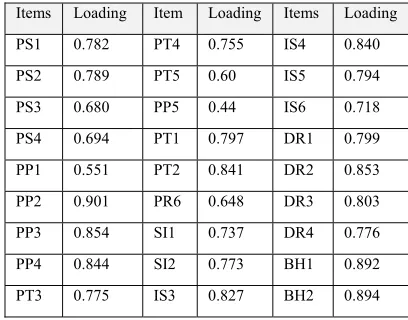
Items Loading Item Loading Items Loading
PS1 0.782 PT4 0.755 IS4 0.840
PS2 0.789 PT5 0.60 IS5 0.794
PS3 0.680 PP5 0.44 IS6 0.718
PS4 0.694 PT1 0.797 DR1 0.799
PP1 0.551 PT2 0.841 DR2 0.853
PP2 0.901 PR6 0.648 DR3 0.803
PP3 0.854 SI1 0.737 DR4 0.776
PP4 0.844 SI2 0.773 BH1 0.892
6231 Moreover, to assess the convergent validity confirmatory factor analysis with Varimax rotation was conducted to assess the underlying structure for the items of each research construct. The loading of each factor should be greater than or equal to 0.5 which has been achieved except with the item PP5 (0.44) which has been removed. Results are shown in Table (9).
4.4 Hypotheses Testing
To test the research model regression analyses were conducted and the results are demonstrated in Table (10) and Table (11). The first regression analysis was performed to test the impact of the perceived security and perceived privacy on perceived trust as shown in Table (10). The results show that both perceived security and perceived privacy (β=0.320, t=3.471; β=0.260, t=2.814 respectively) have a positive effect on perceived trust. The value of the R reveals that only 24% of the variance on perceived trust is caused by perceived security and perceived privacy.
[image:7.612.310.527.94.169.2]The second regression analysis was conducted to test the impact of the perceived trust on information sharing. The results demonstrated that perceived trust has a positive effect on information sharing through SN (β=0.565, t=7.450) in which 38.7% of the variances in information sharing is explained by perceived trust. In addition, the impact of sharing information on development relationships was measured using a fourth regression analysis. The results demonstrated that sharing information has a strong positive effect on developing relationships (β=.625, t=8.363) as shown in Table (10).
Table 10: Model Testing Results
Hypotheses T Status
H1: The user’s perceived security has a positive effect on perceived trust for using SN at KB.
0.32 3.471 Supported
H2: The user’s perceived privacy has a positive effect on perceived trust for using SN at KB
0.26 2.814 Supported
H5: The user’s perceived trust has a positive effect for sharing information through SN at KB
0.565 7.45 Supported
H6: The user’s perceived risk has a negative effect for sharing information through SN at KB.
0.203 2.679 Supported
H7: Sharing information in social networks has a positive effect in developing
relationships through SN at KB.
0.625 8.363 Supported
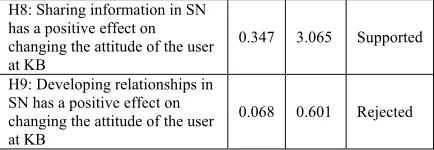
H8: Sharing information in SN has a positive effect on changing the attitude of the user at KB
0.347 3.065 Supported
H9: Developing relationships in SN has a positive effect on changing the attitude of the user at KB
0.068 0.601 Rejected
The results moreover, reveal that sharing information caused almost 40% of the variance on the developing relationships (Table 11). Final regression was conducted to test the impact of sharing information and developing relationship on behavioral change. The results demonstrated that only sharing information has shown a positive effect on behavioral change (β=0.374, t=3.065) as developing relationships has shown no impact (β=0.068, t=0.601). The results furthermore, reveal that only 15.5% of the variance in behavioral change is explained by sharing information.
Table 11: Explanation Of Variances
5. DISCUSSION AND CONCLUSION
The main aim of the current research was to investigate the current situation regarding the adoption of SN by individuals in KB and examine the impact of the SN on individual’s behavioral change. Overall, the research findings confirm that there is a well-established adoption for SN by individuals in KB. The results demonstrated that Instagram, Facebook and Twitter are the most SN used in KB and that users are spending long time on SN (between 1 to 5 hours) communicating with more than 200 connectors. However, users are using SN mostly for sociality and relationships development. Just few of them are using SN for conducting research, developing their professionalism or improving their business. This means that users in KB are using SN in their private environment rather than in work environment. These findings were supported by many studies which tackled to investigate the current usage of SN at the Arab countries [47][10]. These studies indicate essentially that SN are providing an effective social environment for enhancing the sociality and relationships building in such
Factors R2
Perceived Trust 0.239
Sharing Information 0.387
Developing Relationships 0.391
[image:7.612.85.303.548.733.2]6232 countries which are characterized by a special culture.
The findings on the other hand, demonstrated that there is a lack of awareness on the privacy and security of SN among the participants. The results demonstrate that participants are selective in accepting any invitation for online networks or site as they are accepting just those invitations which come from their close friends, or if they come from well-established professional groups as well as if they are associated with their interests and concerns. However, accepting interested messages, videos or any online documents regardless of its source is not secure [22]. Users need to pay more attention in this regard and need to be sure about the source of online documents or material even if they are very interested in receiving them. Moreover, the results show that most of the SN users in KB show no concern about their privacy and security on SN. Although they register their information only for SN sites which have a privacy policy after reading the policy very well, they are usually provide real information (date of birth, name ...etc).
The research findings regarding the research hypotheses revealed that perceived privacy and perceived security have a significant and positive effect on perceived trust. This findings support previous studies which revealed that perceived privacy and perceived security have a strong relationship with the perceived trust. Both of perceived privacy and perceived security are impacting the users’ readiness to involve in sharing and exchanging information with others [31]. The findings illustrated that perceived trust encourage sharing information. Thus, when users feel that they are not at risk, they then will sharing information with others via SN if they trust this information. This results is in agreement with the findings of Stutzman et al. [47] who found that trust are encouraging users to communicate online and share information. Moreover, sharing information has shown a positive impact on both developing relationships and behavioral change. This positive impact was also supported by previous studies which revealed that by sharing information via SN, user can build more relationships which on the other hand can impact the people behavior and direct their opinion and actions [6][7][48]. Besides, the results show that there is insignificant effect for developing relationships on behavioral change. These results are disagreed with the previous studies [18][7[6]. Most of the previous studies
revealed that the community feeling - which is supported by SN - allows users to share their sense and emotion with people who have practiced similar situations and hence they may be impacted by their attitudes and behaviors [6][7]. Therefore, more investigation need to be done by using larger size of data and using more qualitative methods for getting better and more accurate and reflective results to support the rejected hypotheses. Moreover, the impact of the culture which characterizes the Arab countries needs to be examined because it may impact the research hypotheses.
6233 mass persuasion. This weapon can be used by unconcerned individuals to change the society: socially, politically or even economically. The improvement in the security and privacy protection techniques enhances the users trust and encourages them to be involved more on SN. This involvement increases sharing information and relationship development which can lead to exchange opinions; consequently changing attitude and behavior [7]. Therefore, it is critically important that decision makers at Arab countries to not only understand how new media technologies and tools are changing behavior, but also how those processes can be harnessed in order to create a social good. SN can be structured to promote the spread of positive behavior and encourage more health, commercial, learning or professional behavioral change. The impact of SN on changing behavior should be considered strategically. More attention needs to be paid on controlling the information and materials which are exchanged on SN to redirect their impact positively. This interference will help in diluting the bad impact of SN on the future of the people and societies in the Arab countries.
Although the present research was carefully prepared, there were still some unavoidable limitations and shortcoming. First, the research conducted on a small size of population. Therefore, to generalize the results for large groups, the study should have involved more participants at different levels. Second, because quantitative methodology was used, it was not possible fully to explore the impact of sharing information and developing relationship in changing the individual behavior and many other related issues. Therefore, more qualitative methods such as interviews and focus group need to be adopted. Finally, there is a need to consider some characteristics and demographics of the individuals such as the age, sex, and educational level that may have critical impact on sharing information or developing relationship through SN. Moreover, examine the cultural impact on sharing different types of information on SN can provide a distinguish results reflecting the nature of the Arab countries.
REFRENCES:
[1] Boyd, D. and Ellison, N. (2007). “Social Network Sites: Definition, History, and Scholarship”, Journal of computer-Mediated Communication, Vol. 13, No. 1, pp. 210-230 [2] Donath, J. and Boyd, D. (2004). “Public
displays of connection”, BT Technology Journal, Vol. 22, No. 4, pp. 71-82
[3] Sheedy, C. (2011). Social Media for Social Change: A Case Study of Social Media Use in the 2011 Egyptian Revolution, A Capstone Project Presented to the Faculty of the School of Communication, pp.1-58
[4] Jain, M., Ms. G., P. and Anand, N. (2012). “Impact of Social Networking Sites In The Changing Mindset Of Youth On Social Issues - A Study Of Delhi-Ncr Youth”, Journal Of Arts, Science and Commerce, Vol. 3, No. 2, April, pp. 36-43
[5] Peslak, A., Ceccucci, W. and Sendall, P. (2011). “Empirical Study of Social Networking Behavior Using Theory of Reasoned Action”, in proceeding of Conference for Information Systems Applied Research 2011 CONISAR, Wilmington North Carolina, USA 4(1807)
[6] Pezzolla, D. (2013). “Exploring the role of social media on social behavior”, in proceeding of the 2013 Northeast Region Decision Science Institute (NEDSI) Annual meeting, April 5-7, New York, pp.1055-1066 [7] Joinson, A. and Piwek, G. (2013). Technology
and Behavior change, for good and evil, Behavior Research Lab, Bristol social marketing center, University of the west of England
[8] Doerr, B., Fouz, M., and Friedrich, T. (2012). “Why rumors spread so quickly in social networks”, ACM, Vol. 55, No. 6, pp. 70-75, [9] ASMR (2012). “Social Media in the Arab
World: Influencing Societal and Cultural Change?”, Arab Social Media Report, 4th edition, Dubai school of Government. [10] ASMR (2014). “Citizen Engagement and
Public Services in the Arab World: The Potential of Social Media”, Arab social media report, 6th EDITION, Dubai School of government.
[11] ASMR (2011),”Civil Movements: The Impact of Facebook and Twitter”, Arab social media report, 1(2), Dubai School of government.
[12] Irshaid, A. (2013).
http://arabianindustry.com/comms/united- arab-emirates/news/2013/sep/6/uae-based- social-networking-site-areebaareeba-passes-17m-users-4435470/.visited on 1-7-2014 [13] Karolak, M. (2011). “Civil Society and Web
2.0 Technology: Social Media in Bahrain”, Social Media and Society (TBS Journal), No. 14, Summer
6234 the Third Gulf Research Meeting (GRM) proceeding, Cambridge, 11-14 July.
[15] Papic, M., and Noonan, S. (2011). Social Media as a Tool for Protest 03 February 2011. Retrieved 10 March 2014, from http://www.stratfor.com/weekly/20110202-social-media-tool-protest
[16] Attia, A., Aziz, N. and Friedman, B. (2012). “The impact of social networks on behavioral change: a conceptual framework”, World Review of Business Research, Vol. 2, No. 2, pp. 91-108
[17] Cole, D. (2010). “Can social media drive positive behavior change”, Advertising Aphasia”, posted on November 15, 2010 [18] Centola, D. (2013). “Social Media and the
Science of Health Behavior”, Circulation, Vol. 127, No. 21, pp. 2135–2144, doi:10.1161/CIRCULATIONAHA.112.1018 16
[19] Mital, M., Israel, D. and Agarwal, S., (2010), “Information exchange and information discloser in social networking web sites: Mediating role of trust”, Learning Organization, Vol.17,No. 6, pp. 479-490. [20] Dinerman, B. (2011). “Social networking and
security risk”, GFI white paper, available online on http://www.gfi.com
[21] Beye, M., Jeckmans, A., Erkin, Z., Hartel, P. , Lagendijk, R. and Tang, Q. (2010). Literature Overview - Privacy in Online Social Networks, Technical Report TR-CTIT-10-36, Centre for Telematics and Information Technology University of Twente, Enschede. ISSN 1381-3625
[22] Mekovec, R. and Hutinski, Z. (2012). “The role of perceived privacy and perceived security in online market”, in proceeding of the MIPRO, the 35 the International Conversion, May 21-25, pp. 1549-1554 [23] Halaweh, M. and Fidler, C. (2008). “Security
perception in e-commerce: conflict between customer and organization perspectives”, in proceeding of the International Multi-conference on Computer Science and Information Technology IMCSIT, Poland, October 20-22, pp. 443-449
[24] Chih, W., Lin, Y. and Yang, Y. (2011). “The study of antecedents of consumers’ purchase intention for online shopping”, in proceeding of the International conference on Commerce, Administration, Society, e-Education and e-Technology, January 18-20, Tokyo
[25] Ally, M., and Toleman, M. (2005). “A framework for assessing payment security mechanisms and security information on e-commerce web sites”, Paper presented at the 9th Pacific Asia Conference on Information Systems (PACIS), Bangkok, Thailand. [26] Thaw, Y. and Mahmood, A. (2009). “A Study
on the Factors That Influence the Consumers’ Trust on E-commerce Adoption”, International Journal of Computer Science and Information Security- (IJCSIS), Vol. 4, No. 1 and 2
[27] Faja, S. (2005). “Privacy in E-commerce: understanding trade-offs”, Issues in Information Systems, Vol. VI, No. 2, pp.83-89
[28] Young, A. and Quan-Haase, A. (2009). “Information Revelation and Internet Privacy Concerns on Social Network Sites: A Case Study of Facebook”, in proceeding of the Fourth Communities and Technologies Conference, pp. 253-275. Dordrecht: Springer Verlag.
[29] Cavusoglu, Hu., Phan, T. and Cavusoglu, Ha. (2013). “Privacy Controls and Content Sharing Patterns of Online Social Network Users: A Natural Experiment”, in proceeding of the International Conference on Information Systems (ICIS), Milan, Italy, Dec 15-18
[30] Yang, C. and Lin, M. (2010). Online purchase intention: from a transaction cost, quality and customer perceived, in proceeding of the International Conference on e-Commerce, e-Administration, e-Society, e-Education, and e-Technology, Jan 25-27, Macau, China, 1, ISSN 2074-5710, 2010 [31] Lauer, T. and Deng, X. (2007). “Building
Online Trust through Privacy Practices”, International Journal of Information Security, Vol. 6, pp. 323-331.
[32] Pavlou, P., Liang, H. and Xue, Y. (2007). “Understanding and Mitigating Uncertainty in Online Exchange Relationships: A Principal-agent Perspective”, MIS Quarterly, Vol. 31, No. 1, pp. 105-136. [33] Yousafzai, S., Pallister, J. and Foxall, G.
(2009). “Multi-dimensional Role of Trust in Internet Banking Adoption”, The Service Industries Journal, Vol. 29, No. 5, pp. 591-605
6235 IEEE International Conference on Social Computing, Boston, Massachusetts
[35] Gefen, D. and Straub, D. (2004). “Consumer trust in B2C e-commerce and importance of Social presence: experiment in e-products and e-services”, Omega, 32(6), 407-424 [36] Pitta, D. and Fowler, D. (2005). “Online
consumer communities”, Journal of Product and Brand Management, 14(5), 283-291. [37] Shin, D (2010). “The effects of trust, security
and privacy in social networking: a security-based approach to understand the pattern of adoption”, Interacting With Computers, 22(5), 428-38.
[38] Sanchez-Fernandez, R., Iniesta-Bonillo, M., Schlesinger-Diaz, W. and Rivera-Rorres, P. (2010). “Analysis of the value creation in higher institutions: a relational perspective”, Theoretical and Applied Economics, Vol. 17, No. 10, pp. 25-36.
[39] Steinfield, C., Ellision, N., Lampe, C., and Vitak, J. (2012), “Online social networks sites and the concept of social capital”, in Lee, F., Leung, L., Qiu, J. and Chu, D. (edu), Frontiers in New Media Research, New York, Routledge, pp. 115-131.
[40] Chen, X., Pan, Y., and Cai, S. (2013). “User self-disclosure on SNSs: A privacy risk and social capital perspective”, in proceeding of the International Conference on Electronic Business, Singapore, December 1-4
[41] Ridings, C. and Gefen, D. (2004). “Virtual Community Attraction: Why People Hang out Online”, Journal of Computer‐Mediated Communication, Vol. 10, No. 1
[42] Zhang, C., Sun, J., Zhu, X. and Fang, Y. (2010). “Privacy and Security for online Social Networks: Challenges and Appendix: Springer-Author Discount
[43] Young, S. (2013). “The science behind using online communities to change behavior”, TC, News, posted Sep 28, 2013
[44] Buchanan, T. (2006), “Development of measures of online privacy concern and protection for use on the Internet”, Journal of the American Society for Information Science and Technology, Vol. 58, No. 2, pp. 157-165
[45] Hassan, A., Kunz, M., Pearson, A. and Mohamed, F. (2006). “Conceptualization and measurement of perceived risk in online shopping”, Marketing Management Journal, Vol. 16, No. 1, pp. 138-147
[46] Dwyer, C., Hiltz, S. and Passerini, K. (2007), “Trust and privacy concern within social
networking sites: A comparison of Facebook and MySpace”, in proceeding of the Thirteenth Americas Conference on Information Systems, Keystone, Colorado, August 09 - 12.
[47] Stutzman, F., Capra, R., Thompson, J. (2011). “Factors mediating disclosure in social network sites”, Computers in Human Behavior, Vol. 27, pp. 590–598.