1377
DEVELOPING PROBLEM-SOLVING AND CRITICAL
THINKING ABILITY WITH THE USE OF CROWDSOURCING
IN UNIVERSITY WRITING INSTRUCTION
1HWA-SEON KIM, 2*KYEONG-OUK JEONG
1Department of Basic Education, Pai Chai University, Korea
2Hannam University, Department of English Education, Graduate School of Education, Korea
E-mail: 1[email protected], 2*[email protected]
ABSTRACT
In the recent trends, writing education has been transformed from teacher-centered to learner-centered education, and has shifted from theory-oriented writing education to writing education as the problem-solving strategy. Under the paradigm shift in writing education, it has become essential to integrate new technology that can help students actively engage in the writing process or help them realize writing as collaborative learning experience. Among diverse innovative instructional procedures, crowdsourcing can be integrated into writing education, which strives to develop students’ ability for problem-solving and critical thinking through the use of collaborative learning and collective intelligence. This paper tries to incorporate new technological strategies into writing education at two levels. The first level is to design classroom writing activities for online collaborative learning through the use of the online authoring tool. The second level is to develop classroom activities for the students to engage in producing their own writing textbook materials with the utilization of crowdsourcing as collective intelligence into the writing course. In this study, a prototypical instructional model is proposed for the classroom implementation of crowdsourcing into writing education. This study also scrutinizes the responses and attitudes of the participants about their learning experiences of engaging in the writing tasks via crowdsourcing as collective intelligence and Google document as an interactive course platform.
Keywords: Crowdsourcing, Collective intelligence, Writing education, Problem-solving, Google Docs
1. INTRODUCTION
Writing can be thought of as a strategy or rule to properly arrange and present existing ideas. Writing can be also defined as an extremely intellectual performance. In fact, writing has both of these characteristics. [1]. Therefore, these two directional goals can be chosen depending on what is the priority in the writing education. In fact, these two directions are not completely different. Whatever the direction, the university writing education has been transformed from teacher-centered education to learner-centered education, and has shifted from product-oriented writing education to process-oriented writing education. In the recent trends, writing education has been also transformed from theory-oriented writing education to writing education as the problem-solving strategy. In recent years, writing education has been recognized as liberal arts education for university students, and writing education is being conducted in connection with various programs such as counseling from
writing clinics and adjunct programs which are assisted by writing tutors. This is the characteristic of recent writing education. Through writing education, students can develop their communication skills as well as their thinking skills and problem-solving abilities. As the paradigm of writing education has changed in this way, it has become essential to integrate new technology that can help students actively engage in the writing process or help them realize writing as collaborative learning experience.
1378 nurture the students as an intellectual with the critical mind under the preposition that writing can enhance higher level of critical thinking ability. Linda Flower, in particular, represents this position. She suggests that writing is both a personal act of thinking and feeling and also a social act of forming relationships with others because writing is both a social process and a cognitive process [2].
Recently, the influence of new technology and online networking has grown and innovative technological concepts have had a huge impact in the every sector of our society such as business, science, art, and education.Among the groundbreaking ideas, crowdsourcing can be utilized in boosting cooperative classroom interaction and inspiring pedagogical milieu. The term 'crowdsourcing' was coined by J. Howe and it is a combined word of 'crowd' with the meaning of the public or the crowd, and 'outsourcing' with a tactic to elevate efficiency [3]. Through crowdsourcing, some interest groups or a certain number of people involve in the creation, social service, and problem solving procedure. As crowdsourcing liberates the potential of the public through the development of networking and online communication technology, the unique concept of crowdsourcing has gained considerable attention in the diverse fields. Based on the idea of prosumers, where the limits between producers and consumers withdraw, people create interest groups to share their common interests and ideas [4]. Since networking systems and new technology have develop, businesses often acquire new ideas from customers and the public.
As crowdsourcing is recognized as the new model that can create social change and economic progress, the exceptional notion of crowdsourcing can be integrated into pedagogical realm including the field of writing education. If crowdsourcing is applied into writing education, an innovative writing instructional prototype can be made for cooperative classroom learning through the use of collective intelligence. Because crowdsourcing has recently gained much attention as the new approach, integrating this concept into writing education will have much impact in fulfilling the current paradigm of writing education, which strives to promote students’ ability for problem-solving and critical self-expression through cooperative learning.
This paper attempts to integrate technology into writing education at two levels. The first level is to design classroom writing activities for online cooperative learning using crowdsourcing and Google Docs. The second level is to develop instructional tasks for the students to take part in
creating their own writing textbook materials with the use of crowdsourcing into the writing course. In this research, a prototypical model is proposed for the classroom implementation of crowdsourcing into writing education, in which crowdsourcing and collective intelligence are utilized as innovative instructional strategies to improve classroom interaction and student cooperation.This study also examines the attitudes of the participants about their learning experiences of engaging in the writing tasks via crowdsourcing as collective intelligence and Google document as an interactional course platform.
2. RELATED RESEARCH
1379
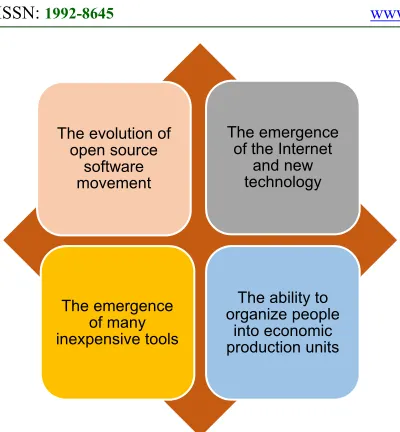
Figure 1: Four Interweaving Factors of Crowdsourcing
Crowdsourcing has been actively used in various fields such as funding, design competition, and cultural contents planning. It is expected that crowdsourcing will be further developed in the future. The most successful example of crowdsourcing in the film industry is the movie “Life in A Day”, co-produced by R. Scott and K.
Macdonald, which is a crowdsourced documentary film with series of video clips collected from 80,000 video clips submitted to the YouTube. They asked people around the world to film their lives and answer simple questions. A total of 4,500 hours of video clips arrived from 192 countries. All were photographed on July 24, 2010 only during that day. The movie “Life in A Day” was created as a finished
[image:3.612.95.302.551.699.2]work of 1 hour 34 minutes 53 seconds by editing the videos taken one day from all over the world [9]. Figure 2 shows the image of the crowdsourced documentary film
Figure 2: A Crowdsourced Documentary Film, “Life in a Day”
Throughout 24 hours of the day, the film tries to depict what the meaning of life is by connecting the fragments of the lives of many people around the world like a mosaic. This film is a representative example of crowdsourcing and shows that crowdsourcing can create something larger than the sum of its parts [10]. In addition, ArtPrize, held in Grand Rapids, USA, combines crowdsourcing and sociality to create new forms of art. It creates an art competition open to anyone willing to submit work and awards the world’s largest art prize, of $250,000 that year, to a participating artist based solely on votes from the public present at the event [11]. The art competition is open to the pubic who wants to submit art work. This art competition offers the largest art prize to a participating artist only based on the votes from the crowd attending at the event. In addition, the introduction of crowdsourcing in the translation field has made people abandon the existing machine-based translation project. The crowdsourcing translation has emerged as a new paradigm because the crowdsourcing translation yields more satisfying and improved output using the power of collective intelligence while the public takes part in the translating project through the Internet. In this way, crowdsourcing is actively used in the field of arts as well as business.
However, it is rare to find that crowdsourcing is applied in the field of writing education because the actual implementation of crowdsourcing work can be mostly found in the translation field or corpus data search in developing Korean dictionary for emotional expression. While research related to crowdsourcing has mostly focused on the studies about the paradigm shift in art field, design field, translation field, or industry field, there has been little study about crowdsourced writing education. The use of crowdsourcing in writing education can develop students’ ability for critical thinking and problem-solving. Using crowdsourcing can promote classroom interaction and student cooperation that are the goals of the current writing education. Cooperative learning through outsourcing strategy also has a lot of advantages for process-oriented writing education compared to traditional writing strategy [12]. Cooperative learning can contribute to developing students’ problem-solving ability in writing education and also to improving students’ ability for negotiation, self-control, and classroom discussion [13]. Writing education through crowdsourcing and cooperative learning has the impact of fulfilling the features of current direction of writing education since crowdsourcing and cooperative learning definitely involve in experiencing the advantages of shared learning
The evolution of open source
software movement
The emergence of the Internet
and new technology
The emergence of many inexpensive tools
The ability to organize people
1380 community. As online technology is expanding into various fields and collaboration is being done on a large scale, there is a need to actively utilize collaborative work using crowdsourcing with collective intelligence into the field of writing education.
3. THE CLASSROOM IMPLEMENTATION
ON ONLINE COLLABORATIVE
WRITING
3.1 Online Cooperative Writing Activities Using
Crowdsourcing
The participants of this study were 30 Korean university students. The research context of this research was centered on a creative writing course. The objectives of this writing course were to facilitate university students to promote critical thinking skills and effective communication skills as a self-reliant intellectual of the academic community and eventually help them develop the ability of becoming an active and successful communicator.
For the classroom writing activities, crowdsourcing as the concept of collective intelligence was utilized to assist the instructional objectives of the course. Participants of this study could engage in cooperative learning by the use of online authoring tools such as Google document. Based on the online interaction and cooperation, participants of this study took part in creative writing activities. Since the paradigm of writing education has moved from product-based or knowledge-oriented to process-based or problem solving-based within the meaningful social context, technological consideration was incorporated into the classroom application through providing online cooperative writing activities.
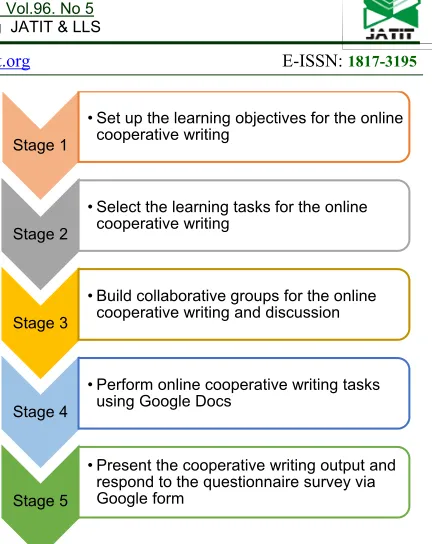
The classroom procedure of implementing online collaborative writing activities were divided into five interconnecting stages: setting up the learning goals, selecting learning tasks, building cooperative groups, performing the writing tasks, and presenting the cooperative writing output. Each stage was designed to help participants of this course experience cooperative learning by engaging in writing activities through the crowdsourcing technique as the collective intelligence and the online authoring tool as the course management platform.
[image:4.612.312.528.48.320.2]Figure 3 shows the classroom procedures of the online cooperative writing activities using crowdsourcing in this creative writing course [14].
Figure 3: The Procedure of the Online Cooperative Writing Activities
For the first stage, the instructor clearly informed students that the objectives of this writing activity were to improve comprehensive skills for communication and problem-solving. The instructor highlighted the importance for the students to recognize the paradigm change of writing education, in which the boundaries between producers and accepters of ideas are eliminated and collective intelligence can play the main role to create and develop ideas of the writing.
At this time, the method of crowdsourcing was introduced as an innovative method to create a new work by deleting the boundaries between the artist and the audience. The instructor presented the documentary film “Life in a Day” as the model work
using crowdsourcing and had the students watch the works uploaded on You Tube. While watching the work, students analyzed the features of the way of expressing the subject and theme of the film, and had time to evaluate and think about the impact of crowdsourcing on the theme of the movie. The instructor guided students to contemplate how creation and acceptance have changed through the use of crowdsourcing.
At the second stage, the instructor proposed the theme of the writing task. The theme of writing can be chosen freely, but in this writing cooperation work, the instructor proposed "Life of college students" as the topic of writing. The writing task was arranged for the students to cooperate among members of the group using Google documents and to produce writing result through the use of
Stage 1
• Set up the learning objectives for the online cooperative writing
Stage 2
• Select the learning tasks for the online cooperative writing
Stage 3
• Build collaborative groups for the online cooperative writing and discussion
Stage 4
• Perform online cooperative writing tasks using Google Docs
Stage 5
1381 collective intelligence. The students were advised to refer to the movie "Life in a Day" mentioned in Step
1 here. Students were well aware of what they should do for the writing task and could recognize the need to write articles on the topic about college students' life using Google documents. Stage 1 and stage 2 can be linked for the quick procedure.
In the third stage, some students volunteered to take initiatives as the task planners and became the leading axis of the online cooperative learning process. When organizing the group, students should be able to form a group with various majors and diverse age distribution as much as possible. When the student who played the role of task planner recruited the group members, he/she could have an opportunity to briefly express his/her thoughts about the life of the university student and then had the other students choose the group for their preference. Once the students chose their preferred groups, they brainstormed the writing themes and had offline-discussion time. In this process, they could get the ideas about what they needed to write and then made an outline for the writing.
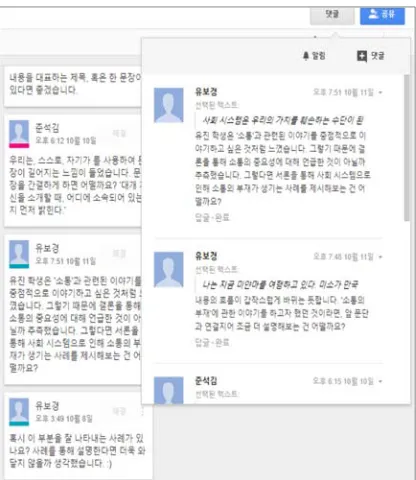
[image:5.612.315.523.393.633.2]At the fourth stage, the most significant stage, students cooperated together to elicit creative ideas and wrote articles about the given theme. Then students shared their ideas using Google Docs, took part in online discussion, and revised their writing product through cooperative online interaction. Figure 4 shows the result of a group writing that applied the writing topic called "YOLO (You Only Live Once)" into the group writing, which has been an issue in Korean society recently about college students' lives.
Figure 4: Online Cooperative Writing Activities Using Google Docs
The title of this article was "You Only Live Once" and the writing activity was performed using online collaborative interaction. The students in this article were concerned about the lives of college students and discussed how the students spent their day by referring to the movie "Life in a Day" and
selected the word "YOLO", which has recently been attracting much attention as an intriguing keyword in Korean society. After the off-line discussion, the students wrote an outline of one article, and one group member wrote one paragraph and the other group members wrote the next one paragraph respectively to produce a complete article. Students used online documents such as Google Docs to complete their own article. Before completing the article, the group members talked to each other about the parts needed to fix using Google documents, and they exchanged comments to find out whether other group members were making good use of the discussed ideas they made as the collaboration team. In this stage, the group members gave advice mostly on the contents of the article, and offered responses through the online comments. Figure 5 shows the online interaction for cooperative wiring activities through the course discussion board.
Figure 5: Online Cooperative Writing Activity Using the Course Discussion Board
[image:5.612.91.300.496.686.2]1382 medium to monitor the process of group writing and to freely share opinions beyond the constraints of space.
3.2 Creating University Writing Textbook
Materials With The Use Of Crowdsourcing
Until now, the development of textbooks for university writing courses has been mostly conducted by professors. However, it may be meaningful if the students who are the consumer of the writing education or the students who are the target of the writing education can participate in the development of writing textbook materials and have chances to give their voices in their own learning process. The development of writing textbook materials can be carried out in the similar format to the idea contest conducted by companies through the selective crowdsourcing. This can be an example of crowdsourcing that utilizes collective intelligence, in which professors and students collaborate with each other and students participate in the development of writing textbook materials as creators.
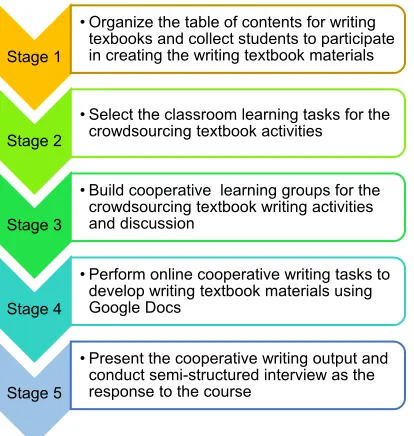
[image:6.612.316.522.368.663.2]For these purposes, in this research, participants who were interested in creative writing were informed that they could participate in the writing project to develop textbook materials for the writing course next year. Then, the instructor and the volunteered participants collaboratively created the textbook materials. Figure 6 shows the collaborative procedures of creating textbook materials through crowdsourcing for the next semester’s writing course.
Figure 6: The Procedures of the Crowdsourcing Textbook Activities
[image:6.612.91.298.486.704.2]When students participated in the idea planning and compilation meeting for textbook development, integrating crowdsourcing into the textbook writing project would be more desirable. However, due to the realistic constraints, this study was limited to develop the prototype of classroom implementation of the cooperative writing through crowdsourcing. Thus, classroom implementation of creating textbook materials were limited for participants to take part in producing some designated chapters of the writing textbook materials for the next semester through cooperation with the use of crowdsourcing. In the first stage, the table of contents for the writing textbook materials were organized and the instructor recruited volunteers who would take part in developing the writing textbook materials through diverse online channels. Table 1 shows the table of contents of the writing textbook development for freshmen of the next semester.
Table 1: Table of Contents of the Writing Textbook for Freshmen of the Next Semester
Part Ⅰ. Read, Discuss and Write for University Students
Chapter 1 Me, College Student, Self-reflection
Chapter 2 Family and Love
Chapter 3 Youth and Dreams
Chapter 4 Arts and Culture
Chapter 5 Classic and Wisdom of Life
Chapter 6 Science and Technology and Future
Chapter 6 Community and Ethics
Part Ⅱ. Theory and Practice of Writing
Chapter 1 Creative Thinking and Writing Practice
Chapter 2 The Practice of Paragraph Writing
Chapter 3 Write a reading essay
For the expected format of the writing textbook, Part 1 was composed of three essays that freshmen could read and discuss, followed by presenting the problems to discuss and then proposing a writing topic based on the contents. Part 2 consisted of the
Stage 1
• Organize the table of contents for writing texbooks and collect students to participate in creating the writing textbook materials
Stage 2
• Select the classroom learning tasks for the crowdsourcing textbook activities
Stage 3
• Build cooperative learning groups for the crowdsourcing textbook writing activities and discussion
Stage 4
• Perform online cooperative writing tasks to develop writing textbook materials using Google Docs
Stage 5
1383 introduction of writing theories and actual writing exercises using the theoretical knowledge about writing. Students’ writing samples for the textbook creation were included into the Part 2.
In the second stage, the instructor let the participants volunteering in the textbook writing project choose their preferred topic from topics in Chapter 1 to Chapter 7. After the participants chose their topics, they engaged in the discussion and textbook writing activities.
In the third stage, cooperative learning groups were organized for the participants to carry out crowdsourcing the writing textbook materials and then an offline discussion was held to produce textbook writing materials that would be included in the textbook.
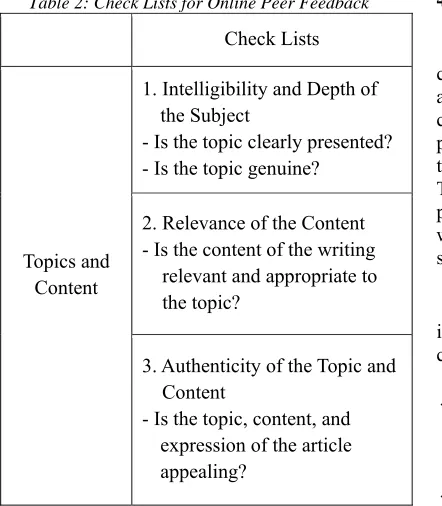
[image:7.612.316.527.75.261.2]In the fourth stage, group members took part in online cooperative writing through Google Docs and exchanged online feedback about the articles written by members of the group. At this time, students referred to the feedback checklist and gave peer feedback to the articles written by all group members. Compared to the online cooperative writing activities presented earlier, the online peer feedbacks for the creation of the writing textbook materials were much more advanced because this writing activity was aimed at the students who voluntarily applied to creating the writing textbook materials. Table 2 shows the checklists for the online peer feedback.
Table 2: Check Lists for Online Peer Feedback
Check Lists
Topics and Content
1. Intelligibility and Depth of the Subject
- Is the topic clearly presented? - Is the topic genuine?
2. Relevance of the Content - Is the content of the writing
relevant and appropriate to the topic?
3. Authenticity of the Topic and Content
- Is the topic, content, and expression of the article appealing?
Organization and Expression of
Writing
1. Organization of Paragraphs - Is the connection between
paragraphs and paragraphs natural?
2. Relationship between the Title and Content
- Is the title and content closely related?
3. Intelligibility of the Sentences
- Does the sentence clearly convey the author's thoughts?
Students took part in online collaborative writing activities by referring to the items for online feedback. After conducting the textbook chapter writing activities, an in-depth interview was conducted with the participants in order to examine their responses of participating in the development of the writing textbook materials. The interview questions were two items: the first question was, “In what ways did the online collaborative writing activities help your wring experience?” and the second one was, “How do you feel about the fact that your writing samples will be parts of the next semester’s writing textbook materials through the result of crowdsourcing?”
4. RESULT AND DISCUSSION
After the cooperative writing activity using crowdsourcing, each group made a presentation about their group writing work. A course survey was conducted to explore the students’ attitudes and perspectives about experiencing cooperative writing tasks using crowdsourcing via Google document. The survey result showed that the participants had positive viewpoints of experiencing cooperative writing activities to develop skills for problem solving and critical thinking.
In the responses to the open-ended questionnaire items of the survey, the participants in the cooperative writing activities responded as follows.
It was great that I was able to see the progress of the other classmates’ writing in real time!
[image:7.612.95.316.454.707.2]1384 tool, but exchanging online feedback to
writing output was quick and easy.
Developing the cooperative group teamwork through exchanging ideas and engaging in online discussion via Google Docs was a great way to enjoy companionship.
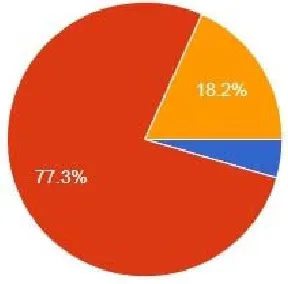
[image:8.612.318.533.52.235.2]According to the research result from the questionnaire survey, over seventy seven percent of the participants responded that the most advantageous feature of using the cooperative online authoring tool for crowdsourcing was the convenience of the group work, followed by the effectiveness for editing work and the appealing aspect of the new tool. Figure 7 shows the percentile result of students’ responses about advantages of using Google document as the online authoring tool for their cooperative writing activities.
Figure 7: Students’ Responses to Advantageous Features of Using the Online Authoring Tool
There were also some negative comments on using the online authoring tool. According to the least advantageous feature of using the cooperative online authoring tool for crowdsourcing was the unfamiliarity to the new tool,followed by the small screen size of the smartphone, the failure of downloading the application, and big memory size of the tool. Figure 8 shows the percentile result of students’ responses about disadvantages of using Google document as the online authoring tool.
[image:8.612.123.267.357.499.2]Figure 8: Students’ Responses to Disadvantageous
Features of Using the Online Authoring Tool
Participants of this study also took part in the in-depth interview about their experience of engaging in the cooperative writing activities through crowdsourcing. The responses of the in-depth interview of the participants were as follows.
1)“In what ways did the online collaborative writing activities help your wring experience?”
I think that online interaction has several benefits. When working offline, I have to look at the face of the interlocutor. That's why it's often difficult to be honest. But in the case of the online discussion, we do not face the communication partner. That's why I was able to add honest comments. In other words, through online collaboration, we were able to clearly see the positive parts of the other’s writing as well as problems of the writing, so the improvement in writing could be achieved (Student’s response from the interview data).
I think the best way to improve the writing skills is to show my writing work to as many people as possible around me and to receive peer-feedback. I shared my posts online, so my group members could easily access my writing work and left comments as the constructive feedback. Then I could stay on the track and check out the comments at any time (Student’s response from the interview data).
1385
Just as a saying that actual experience is better than secondary experience, I think it is the best way to show an authentic example when describing anything. Even if my writing sample is not a good article, it will be helpful to the freshmen next semester, who can refer to my writing sample with the process of exchanging peer-feedback as the classroom interaction and cooperation. In that respect, I would be pleased if the annotation process is included in the textbook for the next semester (Student’s response from the interview data).
I always thought that only the best articles of writing samples would be included in the textbook. But if our writing samples are created through the cooperative peer-feedback and response comments using crowdsourcing, I think this learning experience will be engaging and motivating in that readers come to the idea that writing is not a difficult task. The freshmen of the next semester would think, 'I can also take part in this cooperative writing project! (Student’s response from the interview data).
5. CONCLUSION
This study examined the use of crowdsourcing as the innovative instructional procedures for university writing education in order to cultivate university students’ ability for problem-solving and critical thinking through the application of collaborative learning and collective intelligence. This study tried to integrate new technological strategies into writing education at two levels. The first level was to utilize classroom writing activities for collaborative learning through the use of the online authoring tool such as Google documents. The second level was to develop cooperative classroom activities for the students to engage in creating their own writing textbook materials with the use of crowdsourcing as collective intelligence. In this study, a prototypical syllabus model was suggested for the classroom application of crowdsourcing into university writing education. This study also examined university students’ responses and attitudes about their learning experiences of engaging in the writing tasks via crowdsourcing as collective intelligence and Google Docs as an interactive course platform.
This study revealed that the use of an online authoring tool such as Google Docs could enrich the output of collaborative learning performance [15]. When online collaboration using crowdsourcing was integrated into intensive writing education for the university level, it could help provide students with the opportunities to improve their problem solving ability and critical thinking ability. While students in this writing course were engaging in the crowdsourcing activity with the support of new technology, they could collaborate with each other, share interesting ideas, and experience the value of collective intelligence in fulfilling the reciprocal learning goals [16]. This study also showed that cooperative learning through the use of technology could help students to improve skills for negotiation, learning motivation, and classroom discussion [17] [18].
The implication of this study is to develop insight about how to integrate crowdsourcing into writing education. There has been little study about crowdsourced writing education while research related to crowdsourcing has mostly focused on the studies about the paradigm shift in art field, design field, translation field, or industry field. The use of crowdsourcing in writing education can develop students’ ability for critical thinking and problem-solving. Using crowdsourcing can promote classroom interaction and student cooperation that are the goals of the current writing education.
ACKNOWLEDGEMENTN
This work was supported by the research grant of Pai Chai University in 2017.
REFRENCES:
[1] Flower, L.S., and Hayes, J. R., “Problem-Solving Strategies and the Writing Process”, College English, Vol.39, No. 4, 1977, p. 449.
[2] Flower, L., Problem-Solving Strategies for Writing in College and the Community,
Harcourt Brace & Company, Florida, 1997. [3] Howe, J., “The Rise of Crowdsourcing”, Wired
Magazine, Vol. 14, No. 6, 2006, pp. 1-5.
[4] Yu, J. H., “To Succeed in Crowdsourcing with the Wisdom of the Public”, LG Business Insight
2010, pp. 46-52, 2010, available at http://www.lgeri.co.kr/uploadFiles/ko/pdf/man/ LGBI1089-46_20100420125940.pdf
[5] Kim, H. S., “A Study on Problem-solving Writing Instruction Model with the Use of Big Data”,
International Journal Knowledge and Learning,
1386 [6] Levy, P., “Collective Intelligence”, in Trend, D.
(ed.), Reading Digital Culture, Malden, MA:
Blackwell, 2001.
[7] Newman, D. R., Johnson, C., Webb, B., and Cochrane, C., “Evaluating the Quality of Learning in Computer Supported Co-operative Learning”, Journal of the Association for Information Science and Technology, Vol. 48,
No. 6, 1997, pp. 484-495.
[8] Howe, J., Crowdsourcing: Why the Power of the Crowd Is Driving the Future of Business,
Danvers, MA: Crown Business, 2012.
[9] Life in a Day (2011 film), Wikipedia, available at
https://en.wikipedia.org/wiki/Life_in_a_Day_( 2011_film)
[10] Morse, T., “All Together Now: Artists and Crowdsourcing”, Art News, September, 2014,
available at http://www.artnews.com/2014/09/02/artists-and-crowdsourcing/
[11] ArtPrize, available at https://www.artprize.org/
[12] Barkley, E. F., Cross, K. P., and Major, C. H.,
Collaborative Learning Techniques, Hoboken,
NJ: Jossey-Bass, 2005.
[13] Jeong, K. O., “A Study on the Integration of Google Docs as a Web-based Collaborative Learning Platform in EFL Writing Instruction”,
Indian Journal of Science and Technology, Vol.
9, No. 39, 2016, pp. 1-7.
[14] Park, H. I., & Kim, H. S., “A Study on the Example of the University Writing Education through Collaborative Learning”, Research on Writing, Vol. 12, 2011, pp. 333-358.
[15] Zhou, W., Simpson, E., and Domizi, D. P., “Google Docs in and Out-of-Class Collaborative Writing Activity”, International Journal of Teaching and Learning in Higher Education,
Vol. 24, No. 3, 2012, pp. 359-375.
[16] Timmerman. C. E., and Kristine A. K., “Computer-Assisted Instruction, Media Richness, and College Student Performance”,
Communication Education, Vol. 55, No. 1, 2006,
pp. 73-104.
[17] Gralla, P., “Google Docs better; Ready to take on Office”, Computerworld, available at
http://www.cio.com.au/article/344145/google_ docsbetter_ready_take_office_/
[18] Kim, H. S., & Jeong, K. O., “The Flipped Classroom: Redesigning a Course to Foster Active and Interactive Learning for College Literacy Education”, Advanced Science Letters,