Dumontheil, Iroise and Roggeman, C. and Ziermans, T. and Peyrard-Janvid,
M. and Matsson, H. and Kere, J. and Klingberg, T. (2011) Influence of the
COMT Genotype on Working Memory and Brain Activity Changes During
Development. Biological Psychiatry 70 (3), pp. 222-229. ISSN 0006-3223.
Downloaded from:
Usage Guidelines:
Please refer to usage guidelines at or alternatively
Iroise Dumontheila, Chantal Roggemana, Tim Ziermansa, Myriam Peyrard-Janvidb, Hans Matssonb, Juha
Kereb,c,d, Torkel Klingberga
a. Neuroscience Department, Karolinska Institutet, Stockholm, Sweden
b. Department of Biosciences and Nutrition, Karolinska Institutet, Huddinge, Sweden
c. Science for Life Laboratory, Department of Biosciences and Nutrition at Novum, Karolinska Institutet,
Solna, Sweden
d. Department of Medical Genetics, Haartman Institute, University of Helsinki, and Folkhälsan Institute of
Genetics, Helsinki, Finland
Correspondence should be addressed to:
Dr. Iroise Dumontheil, Neuroscience Department, Retzius väg 8, Karolinksa Institute, SE-171 77 Stockholm
Tel: +46 8 524 86 394, Email: [email protected]
Key Words: working memory; child development; genetics; VBM; fMRI; grey matter
Word count abstract: 250
Word count text: 4000
Number of figures: 4
Supplementary information: 1 (1943 words)
Number of supplementary figures: 3
2
Abstract
Background: The Val158Met polymorphism of the catechol-O-methyltransferase (COMT) gene leads to lower
enzymatic activity and higher dopamine availability in Met carriers. The Met allele is associated with better
performance and reduced prefrontal cortex (PFC) activation during working memory (WM) tasks in adults.
Dopaminergic system changes during adolescence may lead to a reduction of basal dopamine levels,
potentially affecting Met allele benefits during development.
Methods: We investigated the association of COMT genotype with behavioral (N=322) and magnetic
resonance imaging (MRI) data (N=81-84) collected during performance of a visuospatial WM task and
potential changes in these effects during development (reflected in age x genotype interactions). Data were
collected from a cross-sectional and longitudinal typically developing sample of 6 to 20 year-olds.
Results: Visuospatial WM capacity exhibited an age x genotype interaction, with a benefit of the Met allele
emerging after 10 years of age. There was a parallel age x genotype interaction on WM-related activation in
the right inferior frontal gyrus and intraparietal sulcus (IPS), with increases in activation with age in the
Val/Val group only. Main effects of COMT genotype were also observed in the IPS, with greater gray matter
volumes bilaterally and greater right IPS activation in the Val/Val group compared to the Met carriers.
Conclusion: These results suggest that COMT genotype effects on WM brain activity and behavior are not
static during development. The full developmental picture should be considered when trying to understand
3
Introduction
The gene coding for the catechol-O-methyltransferase (COMT) enzyme, which mediates the degradation of
catecholamines, in particular dopamine, has attracted considerable attention as a promising candidate
gene for studying variance in cognitive function and mental illness (1,2). Developmental studies of this gene
could inform us on the typical development of the dopamine system and provide a reference for the study
of developmental disorders which have been linked to dopamine system dysfunction, such as schizophrenia
(3), for which COMT function may be relevant (2, 4,5), although the evidence is inconsistent (e.g. 1).
The common rs4680 Val158Met single nucleotide polymorphism (SNP) leads to a reduction of COMT
enzymatic activity in Met carriers (6-8). The effect of rs4680 on cognition has been extensively studied in
adults, both in typical and neuropsychiatric populations. Better working memory (WM) performance (e.g.
in N-back tasks), fewer perseverative errors, and higher IQ tend to be associated with the Met allele in
healthy individuals (9-11), although some studies have failed to replicate these effects (see 10). In
functional magnetic resonance imaging (fMRI) studies Val/Val adults tend to exhibit greater prefrontal
cortex (PFC) activation during WM tasks than Met/Met individuals (12,13). Structural imaging studies
report less consistent results (14-16).
In children and adolescents effects of COMT genotype in specific age groups have been reported on brain
structure (17-19), resting brain perfusion (20) and brain activation in response to emotional stimuli (17).
Behavioral findings are mixed (21-23). This lack of consistency may arise from age differences in the effect
of COMT genotype on cognition.
Dopamine effects on behavior follow an inverted U-shaped dose-response curve, with both deficient and
excessive amounts of dopamine activity predicting poor cognitive tasks performance (24,25). Met/Met
adults are thought to be near the apex of this curve, while Val carriers lay towards the lower end because
4
There is some evidence that the dopamine system undergoes changes during childhood and adolescence.
In the rhesus monkey, dopamine concentration in the PFC and dopamine synthesis in the PFC and parietal
cortex peak around puberty (2-3 years), while dopamine concentration in the parietal cortex remains stable
from 5 months of age (28,29). Dopaminergic input in the PFC also peaks around puberty, both in terms of
length of the axons and density of varicosities (30-32). In humans, postmortem studies of the PFC have
shown that dopamine concentration is highest during early postnatal development (33), while D1 receptor
density peaks in adolescents (age 14-18) and young adults compared to neonates, infants, adults and aged
adults (33). In the living brain, a decrease in D1 receptor binding was observed in the PFC and parietal
cortex over an age span of 10 to 30 years (34). These results overall suggests a decrease in dopamine levels
from puberty to adulthood (23).Little information is available regarding potential sex differences.
A decrease in basal dopamine level between childhood and adulthood could affect the position of the
Val158Met genotypes on the inverted U-shaped curve and lead to a differential effect of rs4680 during
development. We tested the hypothesis of a change in the effect of COMT genotype with age on behavioral
and neuroimaging data associated with visuospatial WM, a cognitive ability which develops during
5
Methods and Materials
Participants and genetic data
Participants in nine different age groups (6, 8, 10, 12, 14, 16, 18, 20 and 25 years) were recruited using
random sampling from the population registry in Nynäshamn in Sweden (‘Brainchild’ study, (36)). Informed
consent was obtained from the participants and from the parents of children under 18. The study was
approved by the local ethics committee of the Karolinska University Hospital, Stockholm. See Table 1 and
Figure 1 for a description of included participants. Deoxyribonucleic acid (DNA) was extracted either from
blood or saliva. COMT is located on chromosome 22q11.2 and SNP rs4680 is in exon 4 of the gene (see
Supplemental Information for details of the genetic analyses and excluded participants).
Assessment of working memory
Participants completed a large neuropsychological battery administered individually and in a quiet room.
Visuospatial working memory (WM) was assessed using a grid task (Dot Matrix) from the AWMA battery
(37). This computerised task involves remembering the location and order of dots displayed sequentially in
a four-by-four grid, for 1000 ms each, with a 500 ms interval between dots. After training with one, two and
three dots, the test started with one dot. Each level consisted of six trials. Four correct answers were
required for moving to the next level, where one more dot needed to be remembered. The test terminated
when three errors were committed on one level. The score used was the total number of correct trials.
Dot Matrix statistical analyses
Linear mixed model analyses, which allow the inclusion of data from participants who have not attended all
testing waves and adjust for inter-correlation between testing waves (38-40), were performed using the
PASW 18.0 statistical package (41). A compound symmetry covariance structure was used and Dot Matrix
score was treated as a repeated measure (rounds 1 and 2). We first identified how to best model changes
in WM capacity with age, including the leveling of performance during mid-adolescence. We compared
entering the age variable as age without transformation (linear effect), the inverse of age (age-1) and the
6
of interest at the mean age of our sample and reduce collinearity between main effects and interactions
(44). Sex and sex x age were entered as covariates. The best model was identified using Akaike’s (AIC) and
Schwartz’s information criteria (SBC or BIC) (45,46).
We then tested whether including COMT genotype and age x COMT genotype as additional fixed effects
improved the model. Genotype x sex and genotype x age x sex interactions were also included to test for
potential sex differences in the effect of COMT genotype (47). Although the effect of rs4680 on dopamine
degradation is additive, the effect on cognition is suggested to follow a non-linear, inverted U-curve. In
order to allow the detection of such effects, we evaluated both additive (0=Met/Met, 1=Val/Met,
2=Val/Val) and dominance models (Val dominance: 0=Met/Met, 1=Val carriers; Met dominance: 0=Met
carriers, 1=Val/Val) (similarly to (9,48)).
Brain imaging (fMRI)
MRI data was collected on a 1.5 T Siemens scanner (see Supplementary Information). Participants
performed two 5 min sessions each including 16 WM and 16 Control trials in a pseudo-randomized order.
Dots were presented sequentially in a four-by-four grid. To reduce potential age or genotype differences in
behavior, the task included load 2 (two dots) and 4 (four dots) trials only. After the last dot was shown a
number was presented in the grid. Participants were asked to indicate whether the number and its position
in the grid matched. For example “2?” would prompt the participant to indicate whether the second circle
had appeared in the grid position filled by the number. In the Control condition, the dots were presented in
the corners of the grid and the cue (“8?”) always required a “no” response.
Preprocessing and statistical analysis (see (36)) were carried out with SPM5
(http://www.fil.ion.ucl.ac.uk/spm/software/spm5). Contrast images comparing WM and Control
conditions, irrespective of load, for each participant, were used in flexible factorial design second-level
7
subject and testing round as factors. This permitted the inclusion in a single analysis of participants with
and without longitudinal data. Age in months was transformed into Z score (ageZ).
First ageZ and sex were entered as covariates and the main WM-Control contrast was performed correcting
for multiple comparison across all voxels within the brain, with a false discovery rate (FDR) threshold of p <
0.05, to identify regions recruited during the task. Then, genotype and genotype x ageZ were entered as
additional covariates. Genotype was entered with an additive, Met dominant or Val dominant effect. In
each model a single F-test was performed to test whether any main effect of genotype or age x genotype
interaction could be observed (FDR, p < .05). Contrasts were inclusively masked by the WM-Control main
effect previously defined. Results were plotted on a surface-based human atlas (PALS)(49,50) using the
Caret software (51; http://www.nitrc.org/projects/caret/). Mean parameter estimates from the first level
contrasts were obtained in the significant clusters using MarsBar (52) and further analysed using linear
mixed models with PASW 18.0.
Brain imaging (Voxel-based morphometry)
Structural T1-weighted spin echo images were acquired with a 3D MPRAGE sequence (FOV = 256 x 256 mm,
256 x 256 grid, 1 mm3 voxel size). Voxel-based morphometry (VBM) was performed using SPM5. Following
segmentation of the T1-weighted images, high-dimensional normalization was performed using the
Diffeomorphic Anatomical Registration using Exponentiated Lie algebra (DARTEL) toolbox in SPM (53). The
modulated warped gray matter (GM) images were then smoothed with an 8 mm Gaussian kernel. The same
flexible factorial analyses and statistical thresholds as those used for the fMRI data were used for the VBM
8
Results
Analyses combined data from all participants and both testing rounds using linear mixed models. The
complicated non-independent design did not allow the calculation of standardised effect statistics (54).
Effect sizes from analyses performed on the round 1 data only are reported in the Supplementary
Information.
Behavioral analysis
WM capacity development
Behavioural data were available for 322 participants, including 260 with longitudinal data. We first
compared the information criteria of three different models (with the age variable as ageZ, age-1Z or
ln(age)Z) to identify the best model of WM capacity development. Linear mixed model analyses included
Dot Matrix score as the dependent variable, sex, age, and their interaction were entered as fixed effects.
The best model was where WM capacity was explained by age-1Z, with a steeper change in WM capacity
over younger ages and then flattening to an asymptote.
Influence of COMT genotype on WM capacity development
We then tested whether including the main effect of COMT genotype and the genotype x age interaction
improved this model. Genotype x sex and genotype x age x sex interactions were also included. Genotype
was modelled with an additive effect, Val dominance, or Met dominance.
Only the Val dominance model led to a significantly improved fit of the data compared with the age and sex
only model (likelihood-ratio test, D = 9.77, 4 degrees of freedom, p = .045). The only significant effects
observed in this full model were a main effect of age-1Z (F(1,502.7)= 171.01, p < .001) and an interaction
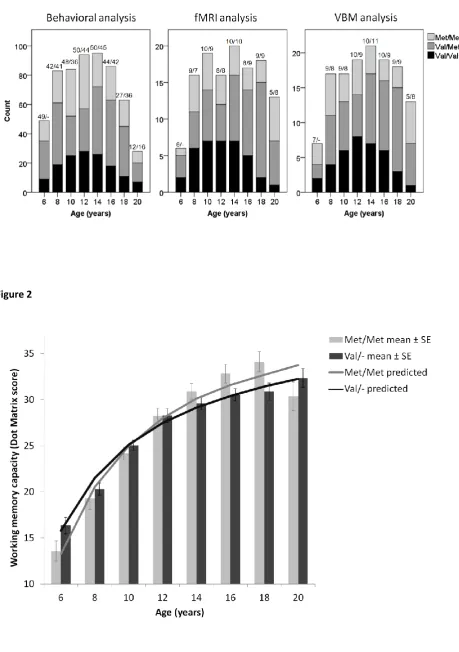
between genotype (Met/Met vs. Val carriers) and age-1Z (F(1,500.1)= 4.40, p = .036). Met/Met individuals
switched from being poorer performer during childhood to being the better performers from
mid-adolescence onwards (Figure 2). According to the model estimates, the cross-over occurred at 10.2 years of
9
FMRI analysis
In-scanner performance
FMRI data were available for 81 participants, including 44 with longitudinal data. Accuracy was high overall.
Participants were less accurate in the WM condition (WM: mean 90.6 % ± SD 10.6; Control: 98.4 % ± 3.5)
(t(124) = 9.52, p < .001), as well as slower to respond (correct trials only, WM: 1277 ms ± 360; Control: 738
ms ± 215) (t(124) = 25.11, p < .001). The difference between WM and Control conditions decreased with
age in terms of both accuracy and reaction time (main effect of age-1Z respectivelyF(1,87.8) = 10.06, p =
.002, and F(1,97.1) = 32.05, p < .001), however there was no main effect of genotype or age by genotype
interaction (all ps > 0.29). Genotype thus did not affect WM vs. Control condition performance.
Furthermore only correct trials were used in the brain activity analyses.
WM-Control main effect
FMRI data were analysed using a flexible factorial second level analysis of the WM-Control contrast which
coded subject and testing round as factors and ageZ and sex as covariates. Because of the smaller sample
size of the fMRI data, only the linear effect of age was tested in SPM analyses. The resulting WM-Control
contrast image (FDR, p < .05) was saved and used as a mask for the subsequent analyses. A large
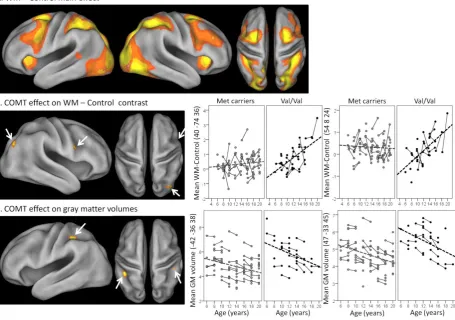
frontoparietal network of regions was more active in the WM than the Control condition (Figure 3a).
Effect of COMT genotype on the WM-Control contrast
COMT genotype and genotype x ageZ were added as additional covariates in the flexible factorial analysis.
Genotype was entered as an additive effect, with Val or with Met dominance. Interactions between
genotype and sex, and genotype, sex and age were included in the follow up analyses only. In each analysis
a single F-test assessed whether genotype or genotype x ageZ had significant effects (FDR, p < .05, within
WM-Control mask). Only the Met dominance model resulted in significant clusters, located in the right
inferior frontal gyrus (IFG) and in the posterior section of the right intraparietal sulcus (IPS)/angular gyrus
10
Mean parameter estimates from the individual first level WM-Control contrasts were obtained for these
two clusters. Linear mixed level model analyses demonstrated (see Table 2 for statistics) that the parietal
cluster exhibited both a main effect of genotype, with greater activation in Val/Val participants than Met
carriers, and an age by genotype interaction, with an increase in activation with age in the Val/Val
participants only (Val/Val, F(1,22.5) = 21.5, p < .001; Met carriers, p > .2). The frontal cluster exhibited an
age by genotype interaction, with a similar pattern (Val/Val, F(1,20.3) = 25.9, p < .001; Met carriers, p > .4)
(Figure 3). Note that for both clusters the genotype effects were significant when using age-1Z but the
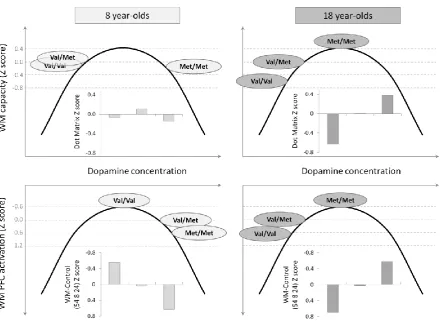
information criteria indicated that the models including ageZ were a better fit of the data. Figure 4 relates
our findings to the suggestion that PFC functioning and WM performance follow an inverted-U curve
function of dopamine levels.
The main effect of genotype and age x genotype interaction remained significant (ps ≤ .001) when including
genotype x sex, age x sex, and genotype x age x sex interactions in the model. In the IPS, the main effect of
genotype tended to be greater in males, while in the IFG the interaction between age and genotype tended
to be greater in males (Table 2).
Further analyses (see Supplemental Information, Figures S2, S3) indicated that activations in the IFG and IPS
clusters were more strongly correlated in the Val/Val group and that these participants also showed a
positive correlation between IFG activation and Dot Matrix performance.
Voxel-based morphometry
Structural MRI data were available for 84 participants, including 47 with longitudinal data. rs4680 effects on
GM volumes were analysed in the same way as for the fMRI data. Total GM volumeZ was included as an
additional covariate to permit the study of regional rather than global effects. However, similar results
11
Again only the Met dominance model resulted in significant clusters, located in the lateral bank of the IPS
bilaterally (see Table 2, Figure 3c and Figure S1). Individual mean GM volumes were calculated for each
cluster. Linear mixed level model analyses indicated that all three clusters showed a main effect of
genotype, with greater GM volumes in Val/Val participants than Met carriers. There was a weak trend in
the largest cluster for a genotype by age interaction, with a steeper decrease in GM with age in the Val/Val
individuals than Met carriers. The main effects of genotype in the three clusters remained significant (all ps
≤ .0001) when including genotype x sex, age x sex, and genotype x age x sex interactions in the model.
Significant interactions between sex and genotype were observed bilaterally (Table 2). In both cases, the
12
Discussion
This longitudinal and cross-sectional study of 6 to 20 year-olds combined a large sample and full age range
of participants to investigate developmental changes in the effect of a functional polymorphism of the
COMT gene on cognition, brain structure and brain function. Previous studies of children and adolescents
observed inconsistent COMT genotype effects and were restricted by either a small age range (21) or a
small sample size (22,23). Our results show that the adult pattern of the effects of the COMT Val158Met
polymorphism on brain and behavior during the performance of a visuospatial WM task emerges during
adolescence. Met/Met individuals showed a steeper increase in performance with age than Val carriers,
while Val/Val individuals exhibited an increase in activation in the right IFG and right IPS/angular gyrus with
age. Additional main effects of genotype were observed in the parietal cortex for both fMRI and gray
matter data, with larger activation and GM volumes in Val/Val participants than Met carriers.
Differences in genotype effects on the behavioral and neuroimaging data, such as the Val vs. Met
dominance effects, may have been driven by a range of factors. For example the fMRI visuospatial WM task
included only relatively low WM loads and a control task while the behavioral score reflected the
performance achieved up to the participants’ maximum WM load level. In addition, behavior may reflect
more complex and global dopamine effects on brain activity and structure in a wide network of brain
regions.
Behavioral results of the Dot Matrix task indicated that Met/Met homozygotes switched from being the
underperformers to follow the adult pattern of better WM performance at around the age of 10-12 years
old, typically considered as the start of puberty. Barnett et al. (21) reported a greater effect of COMT
genotype on verbal IQ in 8 year-old boys who were pubertal at age 9 compared to prepubertal boys or girls.
This pattern was not observed on other measures, including a counting span measure of WM. The present
study did not evaluate pubertal state. However, WM capacity showed no significant effect of sex or
interaction between sex and age or gene. We therefore interpret the observed interaction of COMT
13
additional interactions with hormonal effects. Note however that substance use was not recorded in this
study and is a potential confound of the age effect observed here (55). In Sweden, daily or almost
daily smoking increases during adolescence from < 1 % at age 11-12 to a 12 % at age 18-20 (56,57), and
the COMT Val allele has been shown to be a small risk factor (odds ratio 1.12) for smoking (58). Smoking is
associated with lower WM in adults, while the evidence is mixed in younger samples (59). The increasingly
poorer WM performance in Val carriers compared to Met/Met individuals may thus partly reflect increased
smoking during adolescence particularly in Val carriers. However, smoking rate is low, the associations
between the Val allele and smoking, and between smoking and WM, are weak and therefore unlikely to
explain the entire effect observed here.
The effects of genotype and genotype x age interactions also remained significant in the neuroimaging data
when interactions with sex were included in the models. In the IPS both brain activity (trend in the right
IPS) and GM volumes (bilateral IPS) exhibited an interaction between sex and genotype, with greater
genotype effects in males than females. In addition a greater interaction effect on IFG activation tended to
be observed in males. There is widespread but weak evidence of an interaction between sex and rs4680 on
behavior, brain structure and the incidence of psychiatric disorders (47). Estrogens have been implicated to
explain these sex differences, as they are thought to down-regulate COMT activity (47). The current study
included only small age groups when split for sex. This limitation and the lack of pubertal stage information
prevented us from investigating sex differences during development in more detail.
Our findings of rs4680 effects on GM volumes are consistent with previous evidence for an effect of this
polymorphism on both adolescent and adult GM volumes (14,16) and cortical thickness (15,18). However,
the locations of the observed effects differ between studies, which may be due to differences in
methodology and age of the participants. rs4680 is a functional variant and could be thought to affect brain
function but not brain structure. However, the pruning of synapses and axons during development is
affected by synaptic functioning (60,61). Thus, during maturation, genotype effects on brain function could
14
observed in the VBM compared to the fMRI and behavioral data may be due to the fact that these
processes occur over protracted period and are not as flexible and rapid as functional changes in brain
activity.
It is unclear yet what the greater parietal GM volumes observed in Val/Val individuals across ages precisely
reflect, and why the Val carriers are those with greater volumes. Further investigation using a combination
of cortical thickness, cortical surface area and volume data may provide more insight on the underlying
developmental changes in structure (62). A possible interpretation of the results of this study relates them
to the altered trajectories of brain structure maturation reported in developmental psychiatric disorders
(63). For example, delayed peaks in cortical thickness in Attention-Deficit/Hyperactivity Disorder (ADHD)
(64), a disorder associated with visuospatial WM impairments (65), lead to increased cortical thickness in
ADHD during late childhood and early adolescence. In the current study, Val/Val participants had greater
gray matter volumes in the parietal cortex and show poorer WM capacity from mid-adolescence onwards.
The effects of COMT genotype we observed were not limited to the PFC. In line with these results,
dopamine D1 receptors availability (34) and correlation between D1 receptors availability and COMT
genotype (66) are similar throughout the cortex, and dopamine D1 receptors density and change in WM
capacity after training are correlated in both prefrontal and parietal cortex (67). Recent multimodal studies
combining positron emission tomography (PET) and fMRI data to study the dopamine system in adults have
repeatedly identified parietal and lateral PFC regions similar to the clusters observed in the present study
and provide independent evidence that these regions are sensitive to basal dopamine levels and dopamine
levels in interconnected subcortical regions (68-70).
In both the behavioral and fMRI data sets, we observed a gradual emergence from age 12 of the adult
pattern of COMT genotype effects. PFC functioning and WM performance have been suggested to follow
an inverted-U curve function of dopamine levels (24), with adult rs4680 Met/Met individuals near the apex
15
activation and improvement in WM performance observed in Val/Val adults administered amphetamine,
which increases basal dopamine levels (27). Thus our findings are compatible with a decrease in basal
dopamine levels during adolescence (23), providing indirect evidence for the development of the dopamine
system in humans.
Increased prefrontal activity could reflect top-down boosting of WM capacity in the parietal cortex (71).
Val/Val individuals showed an increase in prefrontal and parietal activation during adolescence, a greater
correlation between the activation in these two clusters than Met carriers, and a correlation between
greater WM activity in the right IFG and better WM capacity outside the scanner. Together these results
suggest that a top-down excitation from frontal to parietal cortex may be gradually implemented during
adolescence in Val/Val individuals to compensate for deficient amounts of dopamine levels and parietal
functioning.
Given that the onset of many psychiatric conditions occurs during adolescence (72), and that genotype
variations have been associated with the incidence of developmental psychiatric disorders, elucidating the
role of genetics in determining brain function during childhood and adolescence is critical to our
understanding of the development of these disorders. The findings presented here show that the full
developmental picture should be considered when trying to understand the impact of genetic
16
Acknowledgements
We would like to thank Jens Gisselgård, Ylva Samuelsson, Douglas Sjöwall and Sissela Bergman Nutley for
help with study administration, Keith Humphreys for statistics help, Kerstin Eriksson and Tomas Jonsson for
scanning, and the Mutation Analysis core Facility (MAF) at the Karolinska Institute. This work was
supported by Knut and Alice Wallenberg Foundation, The Swedish Research Council and a Swedish Royal
Bank Tercentennial Foundation grant in the program “Learning and Memory in Children and Young Adults”
to TK and JK. Data from round 1 of testing was previously published in (36).
Financial disclosures
17
References
1. Craddock N, Owen MJ, O’Donovan MC (2006): The catechol-O-methyl transferase (COMT) gene as a candidate for psychiatric phenotypes: Evidence and lessons. Mol Psychiatry 11:446-458.
2. Meyer-Lindenberg A, Weinberger DR (2006): Intermediate phenotypes and genetic mechanisms of
psychiatric disorders. Nat Rev Neurosci 7:818-827.
3. Howes OD, Kapur S (2009): The dopamine hypothesis of schizophrenia: Version III--the final common pathway. Schizophr Bull 35:549-562.
4. Gothelf D, Hoeft F, Ueno T, Sugiura L, Lee AD, Thompson P, Reiss AL: Developmental changes in multivariate neuroanatomical patterns that predict risk for psychosis in 22q11.2 deletion syndrome. J Psychiatr Res doi: 10.1016/j.jpsychires.2010.07.008
5. Vorstman JAS, Morcus MEJ, Duijff SN, Klaassen PWJ, Heineman-de Boer JA, Beemer FA, et al. (2006): The 22q11.2 deletion in children: High rate of autistic disorders and early onset of psychotic symptoms. J Am Acad Child Adolesc Psychiatry 45:1104-1113.
6. Chen J, Lipska BK, Halim N, Ma QD, Matsumoto M, Melhem S, et al. (2004): Functional analysis of genetic variation in catechol-O-methyltransferase (COMT): Effects on mRNA, protein, and enzyme activity in postmortem human brain. Am J Hum Genet 75:807-821.
7. Männistö PT, Kaakkola (1999): Catechol-O-methyltransferase (COMT): Biochemistry, molecular biology, pharmacology, and clinical efficacy of the new selective COMT inhibitors. Pharmacol Rev 51:593-628.
8. Weinshilboum RM (2006): Pharmacogenomics: Catechol O-methyltransferase to thiopurine S-methyltransferase. Cell Mol Neurobiol 26:539-561.
9. Barnett JH, Jones PB, Robbins TW, Müller U (2007): Effects of the catechol-O-methyltransferase Val158Met polymorphism on executive function: A meta-analysis of the Wisconsin Card Sort Test in schizophrenia and healthy controls. Mol Psychiatry 12:502-509.
10. Barnett JH, Scoriels L, Munafò MR (2008): Meta-analysis of the cognitive effects of the catechol-O-methyltransferase gene Val158/108Met polymorphism. Biol Psychiatry 64:137-144.
11. Flint J, Munafo MR (2007): The endophenotype concept in psychiatric genetics. Psychol Med 37:163-180.
12. Dickinson D, Elvevåg B (2009): Genes, cognition and brain through a COMT lens. Neuroscience 164:72-87.
13. Mier D, Kirsch P, Meyer-Lindenberg A (2010): Neural substrates of pleiotropic action of genetic variation in COMT: A meta-analysis. Mol Psychiatry 15:918-927.
14. Cerasa A, Gioia MC, Labate A, Liguori M, Lanza P, Quattrone A (2008): Impact of
catechol-O-methyltransferase Val(108/158) Met genotype on hippocampal and prefrontal gray matter volume. Neuroreport 19:405-408.
15. Cerasa A, Cherubini A, Quattrone A, Gioia MC, Tarantino P, Annesi G, et al. (2010): Met158 variant of the catechol-O-methyltransferase genotype is associated with thicker cortex in adult brain. Neuroscience 167:809-814.
16. Honea R, Verchinski BA, Pezawas L, Kolachana BS, Callicott JH, Mattay VS, et al. (2009): Impact of
interacting functional variants in COMT on regional gray matter volume in human brain. Neuroimage 45:44-51.
17. Mechelli A, Tognin S, McGuire PK, Prata D, Sartori G, Fusar-Poli P, et al. (2009): Genetic vulnerability to affective psychopathology in childhood: A combined voxel-based morphometry and functional magnetic resonance imaging study. Biol Psychiatry 66:231-237.
18
19. Thomason ME, Dougherty RF, Colich NL, Perry LM, Rykhlevskaia EI, Louro HM, et al. (2010): COMT genotype affects prefrontal white matter pathways in children and adolescents. Neuroimage 53:926-934.
20. Thomason ME, Waugh CE, Glover GH, Gotlib IH (2009): COMT genotype and resting brain perfusion in children. Neuroimage 48:217-222.
21. Barnett JH, Heron J, Ring SM, Golding J, Goldman D, Xu K, et al. (2007): Gender-specific effects of the catechol-O-methyltransferase Val108/158Met polymorphism on cognitive function in children. Am J Psychiatry 164:142-149.
22. Diamond A, Briand L, Fossella J, Gehlbach L (2004): Genetic and neurochemical modulation of prefrontal cognitive functions in children. Am J Psychiatry 161:125-132.
23. Wahlstrom D, White T, Hooper CJ, Vrshek-Schallhorn S, Oetting WS, Brott MJ, et al. (2007): Variations in the catechol O-methyltransferase polymorphism and prefrontally guided behaviors in adolescents. Biol
Psychiatry 61:626-632.
24. Vijayraghavan S, Wang M, Birnbaum SG, Williams GV, Arnsten AFT (2007): Inverted-U dopamine D1 receptor actions on prefrontal neurons engaged in working memory. Nat Neurosci 10:376-384.
25. Arnsten AF (1997): Catecholamine regulation of the prefrontal cortex. J Psychopharmacol 11:151-162.
26. Giakoumaki SG, Roussos P, Bitsios P (2008): Improvement of prepulse inhibition and executive function by the COMT inhibitor tolcapone depends on COMT Val158Met polymorphism. Neuropsychopharmacology 33:3058-3068.
27. Mattay VS, Goldberg TE, Fera F, Hariri AR, Tessitore A, Egan MF, et al. (2003): Catechol O-methyltransferase val158-met genotype and individual variation in the brain response to amphetamine. Proc Natl Acad Sci U S A 100:6186-6191.
28. Goldman-Rakic PS, Brown RM (1982): Postnatal development of monoamine content and synthesis in the cerebral cortex of rhesus monkeys. Brain Research 256:339-349.
29. Goldman-Rakic PS, Brown RM (1981): Regional changes of monoamines in cerebral cortex and subcortical structures of aging rhesus monkeys. Neuroscience 6:177-187.
30. Lambe EK, Krimer LS, Goldman-Rakic PS (2000): Differential postnatal development of catecholamine and serotonin inputs to identified neurons in prefrontal cortex of rhesus monkey. J Neurosci 20:8780-8787.
31. Rosenberg DR, Lewis DA (1994): Changes in the dopaminergic innervation of monkey prefrontal cortex during late postnatal development: A tyrosine hydroxylase immunohistochemical study. Biological Psychiat 36:272-277.
32. Rosenberg DR, Lewis DA (1995): Postnatal maturation of the dopaminergic innervation of monkey prefrontal and motor cortices: A tyrosine hydroxylase immunohistochemical analysis. J Comp Neurol 358:383-400.
33. Weickert CS, Webster MJ, Gondipalli P, Rothmond D, Fatula RJ, Herman MM, et al. (2007): Postnatal alterations in dopaminergic markers in the human prefrontal cortex. Neuroscience 144:1109-1119.
34. Jucaite A, Forssberg H, Karlsson P, Halldin C, Farde L (2010): Age-related reduction in dopamine D1 receptors in the human brain: From late childhood to adulthood, a positron emission tomography study. Neuroscience 167:104-110.
35. Luna B, Padmanabhan A, O’Hearn K (2010): What has fMRI told us about the development of cognitive control through adolescence? Brain Cogn 72:101-113.
36. Söderqvist S, McNab F, Peyrard-Janvid M, Matsson H, Humphreys K, Kere J, Klingberg T (2010): The SNAP25 gene is linked to working memory capacity and maturation of the posterior cingulate cortex during
childhood. Biol Psychiatry 68:1120-1125.
37. Alloway TP (2007): Automated Working Memory Assessment Manual. Oxford: Harcourt.
19
39. Molenberghs G, Verbeke G (2001): A review on linear mixed models for longitudinal data, possibly subject to dropout. Stat Model 1:235-269.
40. Starr JM, Fox H, Harris SE, Deary IJ, Whalley LJ (2007): COMT genotype and cognitive ability: a longitudinal aging study. Neurosci Lett 421:57-61.
41. SPSS, Inc. (2005) Linear mixed-effects modeling in SPSS: An introduction to the MIXED procedure. SPSS Technical Report. Chicago, IL: SPSS, Inc.
42. Kail RV, Ferrer E (2007): Processing speed in childhood and adolescence: Longitudinal models for examining developmental change. Child Dev 78:1760-1770.
43. Luna B, Garver KE, Urban TA, Lazar NA, Sweeney JA (2004): Maturation of cognitive processes from late childhood to adulthood. Child Dev 75:1357-1372.
44. Aiken LS, West SG (1991): Multiple Regression: Testing and Interpreting Interactions. Newbury Park: CA:Sage.
45. Akaike H (1974): A new look at the statistical model identification. IEEE Trans Automat Contr 19:716-723.
46. Schwartz G (1978): Estimating the dimension of a model. Ann Stat 6:461-464.
47. Harrison PJ, Tunbridge EM (2008): Catechol-O-methyltransferase (COMT): A gene contributing to sex differences in brain function, and to sexual dimorphism in the predisposition to psychiatric disorders. Neuropsychopharmacology 33:3037-3045.
48. Hersrud SL, Stoltenberg SF (2009): Epistatic interaction between COMT and DAT1 genes on eating behavior: A pilot study. Eating Behav 10:131-133.
49. Van Essen DC (2005): A Population-Average, Landmark- and Surface-based (PALS) atlas of human cerebral cortex. Neuroimage 28:635-662.
50. Van Essen DC, Dierker DL (2007): Surface-based and probabilistic atlases of primate cerebral cortex. Neuron 56:209-225.
51. Van Essen DC, Drury HA, Dickson J, Harwell J, Hanlon D, Anderson CH (2001): An integrated software suite for surface-based analyses of cerebral cortex. J Am Med Inform Assoc 8:443-459.
52. Brett M, Valabregue R, Poline J-B. Region of interest analysis using an SPM toolbox [abstract]. 8th International Conference on Functional Mapping of the Human Brain, June 2-6, 2002, Sendai, Japan.
53. Ashburner J (2007): A fast diffeomorphic image registration algorithm. Neuroimage 38:95-113.
54. Nakagawa S, Cuthill IC (2007): Effect size, confidence interval and statistical significance: A practical guide for biologists. Biol Rev 82:591-605.
55. Saraceno L, Munafó M, Heron J, Craddock N, van den Bree MBM (2009): Genetic and non-genetic influences on the development of co-occurring alcohol problem use and internalizing symptomatology in adolescence: A review. Addiction 104:1100-1121.
56. Hvitfeldt T, Gripe I (2009): Rapport 118 Skolelevers drogvanor 2009. Stockholm: Centralförbundet för alkohol- och narkotikaupplysning (CAN).
57. Galanti MR, Rosendahl I, Wickholm S (2008): The development of tobacco use in adolescence among "snus starters" and "cigarette starters": An analysis of the Swedish "BROMS" cohort. Nicotine Tob Res 10:315-323.
58. Tammimäki AE, Männistö PT (2010): Are genetic variants of COMT associated with addiction? Pharmacogenet Genomics 20:717-741.
59. Durazzo TC, Meyerhoff DJ, Nixon SJ (2010): Chronic cigarette smoking: Implications for neurocognition and brain neurobiology. Int J Environ Res Public Health 7:3760-3791.
60. Webb SJ, Monk CS, Nelson CA (2001): Mechanisms of postnatal neurobiological development: Implications for human development. Dev Neuropsychol 19:147-171.
20
62. Winkler AM, Kochunov P, Blangero J, Almasy L, Zilles K, Fox PT, et al. (2009): Cortical thickness or grey matter volume? The importance of selecting the phenotype for imaging genetics studies. Neuroimage 53:1135-1146.
63. Giedd JN, Rapoport JL (2010): Structural MRI of pediatric brain development: What have we learned and where are we going? Neuron 67:728-734.
64. Shaw P, Eckstrand K, Sharp W, Blumenthal J, Lerch JP, Greenstein D, et al. (2007):
Attention-deficit/hyperactivity disorder is characterized by a delay in cortical maturation. Proc Natl Acad Sci U S A 104:19649-19654.
65. Westerberg H, Hirvikoski T, Forssberg H, Klingberg T (2004): Visuo-spatial working memory span: a sensitive measure of cognitive deficits in children with ADHD. Child Neuropsychol 10:155-161.
66. Slifstein M, Kolachana B, Simpson EH, Tabares P, Cheng B, Duvall M, et al. (2008): COMT genotype predicts cortical-limbic D1 receptor availability measured with [11C]NNC112 and PET. Mol Psychiatry 13:821-827.
67. McNab F, Varrone A, Farde L, Jucaite A, Bystritsky P, Forssberg H, Klingberg T (2009): Changes in cortical dopamine D1 receptor binding associated with cognitive training. Science 323:800-802.
68. Fischer H, Nyberg L, Karlsson S, Karlsson P, Brehmer Y, Rieckmann A, et al. (2010): Simulating
neurocognitive aging: Effects of a dopaminergic antagonist on brain activity during working memory. Biol Psychiatry 67:575-580.
69. Landau SM, Lal R, O’Neil JP, Baker S, Jagust WJ (2009): Striatal dopamine and working memory. Cereb Cortex 19:445-454.
70. Nyberg L, Andersson M, Forsgren L, Jakobsson-Mo S, Larsson A, Marklund P, et al. (2009): Striatal dopamine D2 binding is related to frontal BOLD response during updating of long-term memory representations. Neuroimage 46:1194-1199.
71. Edin F, Klingberg T, Johansson P, McNab F, Tegnér J, Compte A (2009): Mechanism for top-down control of working memory capacity. Proc Natl Acad Sci U S A 106:6802-6807.
21
Figure legends
Figure 1: Distribution of the data points across round 1 and round 2 according to age and COMT genotype
in each of the three analyses. For each age group, the number of participants from round 1 and round 2 is
indicated above each bar (round 1 N / round 2 N).
Figure 2: Working memory capacity as a function of each age year group at testing and COMT Val158Met
polymorphism. The bars are included for illustrative purposes only and represent the mean and standard
error (SE) of WM capacity, as measured by the Dot Matrix score, in each age group, collapsing across
longitudinal and cross-sectional data. Participants tested at both rounds are included as two data points.
Analyses were performed with age as a covariate rather than considering the age groups separately. The
lines represent the mean predicted Dot Matrix score for each genotype group, as obtained from the mixed
model analysis using the inverse of age as a factor and genotype effects with Val dominance.
Figure 3: FMRI and VBM results. a) Render of the fMRI main effect WM – Control (FDR, p < 0.05) on a
surface-based human atlas (see Methods and Materials). From left to right: lateral view of the left and right
hemisphere, dorsal view of the left and right hemispheres. This contrast was used as a inclusive mask for
the tests of the effect of COMT genotype presented in b and c. b) F-test of COMT genotype or genotype x
age effects on the fMRI WM – Control contrast (FDR, p < 0.05). Mean parameter estimates of the WM –
Control contrast at the first level were calculated and plotted for the parietal and frontal clusters observed
in the right hemisphere. Full lines connect those participants who participated to both testing rounds.
Dashed lines are the predicted fit from linear mixed models including sex, ageZ, COMT genotype (with Met
dominance) and genotype x ageZ interaction as covariates. The age by genotype interaction was significant
in both clusters. There was an additional main effect of genotype in the parietal cluster. c) F-test of COMT
genotype or genotype x age effects on the VBM gray matter data (FDR, p < 0.05). Mean gray matter volume
were calculated and plotted for the two largest parietal clusters (see Table 2). Full lines connect those
22
models including sex, ageZ, total gray matter volume (Z), COMT genotype (with Met dominance) and
genotype x ageZ interaction as covariates. The main effect of genotype but not the age x genotype
interaction was significant in both clusters. (see also Figure S1)
Figure 4: COMT genotype, WM capacity and WM activity and their relation to a hypothetical basal
dopamine concentration. Brain activity is from the right lateral PFC. 8 and 18 year-old age groups were
chosen to illustrate the changes in the influence of COMT genotype on WM function during development.
On the top row, WM capacity Z scores were calculated using the Dot Matrix scores of the 8 and 18
year-olds separately and are plotted in the inset bar charts for each COMT genotype. The three COMT genotypes
were accordingly located on the hypothetical inverted U-curve of prefrontal functioning as a function of
dopamine concentration proposed from adult and animal data (e.g. 25, 27). Here an arbitrary Gaussian
curve was used. On the bottom row, similar steps were applied to the WM – Control activation in the right
lateral PFC. Note that greater brain activation is associated with worse performance (27) and thus the y-axis
is inverted to highlight the similarities between the behavioral and imaging results. 8 year-olds showed a
detrimental effect of the Met allele, while 18 year-olds showed the typical adult pattern of a beneficial
effect of the Met allele, with higher WM capacity and lower brain activity in the frontal cortex. This pattern
of change in genotype effect with age can be regarded as a shift during development of the position of the
COMT Val158Met genotypes on the inverted-U curve of PFC function relative to dopamine levels in the
23
[image:24.595.66.525.100.328.2]Figure 1
24
25