BIROn - Birkbeck Institutional Research Online
Zhang, G. and Xu, Q. and Liu, Xiaming (2011) Knowledge diffusion within
the Datang sock-manufacturing cluster in China. Regional Studies 45 (7),
pp. 977-996. ISSN 0034-3404.
Downloaded from:
Usage Guidelines:
Please refer to usage guidelines at or alternatively
Knowledge Diffusion within the Datang Sock Manufacturing
Cluster in China
Gang Zhang
a, Qian Xu
band Xiaming Liu
ca
School of Management
b
College of Economics Zhejiang University Gudun Road, Hangzhou
Zhejiang 310058 China Tel: 86 (0)571 88206856
E-mail: [email protected] and [email protected]
c
School of Management Birkbeck College University of London Malet Street, Bloomsbury
London WC1E 7HX Tel: 0044 (0)20 7079 0895 Fax: 0044 (0)20 76316769 E-mail: [email protected]
Final version resubmitted to the Special Issue of Regional Studies on Regional Innovation Systems
Knowledge Diffusion within the Datang Sock Manufacturing
Cluster in China
ABSTRACT: In this paper a cognitive community-based analytic framework is
established to investigate intra-cluster knowledge diffusion. The results from both a
case study on a sock manufacturing cluster in China and an agent-based simulation
indicate that the initial pattern of knowledge distribution has a significant impact on
the process of knowledge diffusion in a cluster. A cluster with a higher knowledge
level but lower knowledge heterogeneity enjoys higher efficiency of knowledge
diffusion.
KEY WORDS: Knowledge diffusion; Cluster; Case study; Simulation; China
(2) INTRODUCTION
Intra-cluster knowledge diffusion has long been recognized as an important
source of the competitiveness of industrial agglomeration (MARSHALL, 1920;
MASKELL and MALMBERG, 1999; MASKELL, 2001a, 2001b; BRESCHI and
LISSONI, 2001). The research on this topic has used two alternative perspectives –
geographic proximity and non geographic proximity (GERTLER, 2003; BOSCHMA,
2005). The geographic proximity perspective argues that tacit knowledge can only be
transferred by face-to-face interactive learning. The closer two firms are located, the
more effective the tacit knowledge transfers, so that a cluster is efficient in knowledge
absorption and creation (DESROCHERS, 2001; PORTER, 1990; JAFFE et al., 1993;
FLORIDA, 1995; AUDRETSCH and FELDMAN, 1996; MASKELL and
MALMBERG, 1999; TALLMAN et al., 2004). On the other hand, the non geographic
proximity perspective stresses the effect of relational or social proximity on
knowledge diffusion between firms. It argues that as firms in a cluster have a certain
type of relational proximity, they can communicate knowledge efficiently between
them (CAPELLO and FAGGIAN, 2005; CREVOISIER, 2004; KEEBLE and
WILKINSON, 1999).
Though these two perspectives lay a concrete foundation for an understanding of
regional diffusion of knowledge, one problem is that they consider meso-level
variables only and are unable to explain the uneven diffusion of knowledge in a
cluster effectively. This may be the reason why scholars have recently started
(BOSCHMA and WAL, 2006; OWEN-SMITH and POWELL, 2004; GIULIANI
and BELL, 2005; GIULIANI, 2005).
Focusing on the knowledge structure, one of the firm-specific variables, this
paper aims to examine the phenomenon of knowledge diffusion within Datang, a sock
manufacturing cluster from the Yangtze River Delta, China. Methodologically, we
combine a cross-section case study and a longitudinal simulation to investigate both
the static and dynamic nature of technological and business knowledge learning and
diffusion within a cluster.
YIN (2003) suggests that case studies should start with theoretical propositions.
In the next section, we establish a cognitive community-based analytic framework for
intra-cluster knowledge diffusion by using the concept of scheme from social
cognition. It argues that a cognitive community formed through the cognitive
proximity between firms is the fundamental method of knowledge diffusion in the
cluster, so that only those firms with similar knowledge structures would be efficient
in learning and transferring knowledge.
In section 3, the evidence from our case study of 8 firms indicates that the
technological knowledge distribution in Datang is relatively homogeneous (i.e. firms
belong to a proximate cognitive community), and hence there is fluent and efficient
local learning and diffusion of such knowledge. On the other hand, business
knowledge distribution is heterogeneous, and such knowledge diffusion is rare.
Our analytical framework is tested and confirmed not only by the case study, but
pattern of knowledge distribution has a significant impact on the process of
knowledge diffusion in a cluster. A cluster with a higher knowledge level but lower
knowledge heterogeneity enjoys higher efficiency of knowledge diffusion. In section
5, we summarise our findings and discuss the implications as well as limitations of
this study.
2. THEORETIC FRAMEWORK
It is generally accepted that the efficiency of intra-cluster knowledge diffusion is
very important for the competitiveness of a cluster. Knowledge diffused in a cluster is
often classified into two categories: tacit or codified (MASKELL, 2001a; PINCH et al,
2003). According to this classification, two alternative perspectives, geographic
proximity and non geographic proximity, have emerged. Although these perspectives
emphasise the different factors influencing intra-cluster knowledge diffusion, they
both have an implicit assumption that firms in a cluster are homogenous, and what
determines the efficiency of knowledge diffusion among firms is the similarity of
some meso-level variables such as geography, culture and relationship (BOSCHMA,
2005).
It has recently been realised that some micro- or firm-specific variables also play
a critical role in intra-cluster knowledge diffusion. For instance, OWEN-SMITH and
POWELL (2004) emphasise the influence of a firm’s social role in knowledge
diffusion in a cluster. GIULIANI (2005), GIULIANI and BELL (2005) and
BOSCHMA and WAL (2006) all argue that the absorptive capacity of firms in a
firms’ absorptive capacity leads to a heterogeneous distribution of knowledge in the
cluster. Although such micro-variable focused studies help deepen our understanding
of the phenomenon of intra-cluster knowledge diffusion, so far not enough attention
has been paid to a firm’s knowledge structure, another important micro-variable. In
our view, the efficiency of knowledge diffusion between firms may be dependent
more on whether the knowledge fits into their knowledge structures than what type of
knowledge is diffused (tacit or codified). To some extent, a cluster’s cognitive
community formed by the similarity of knowledge structures determines the
efficiency of knowledge diffusion within it.
From the view of firms in a cluster, cognitive proximity may be the necessary
condition for knowledge diffusion between firms in it, and a cluster’s efficiency of
knowledge diffusion may depend on its distribution of knowledge. Borrowing the
concept of schema from social cognition, we start by explaining the meaning of the
term “knowledge structure of a firm in a cluster”, and then develop our cognitive
community-based analytic framework.
The perspective of cognition stresses the impact of an agent’s existing knowledge
structure on his/her perceiving, interpreting, analyzing and remembering the
information received (WALSH, 1995). One of the most important concepts of
cognition used in the area of psychology, sociology and management is schema
(BARTUNEK, 1984; GIOIA and POOLE, 1984; LORD and KERNAN, 1987;
HARRIS, 1994; RENTSCH and KLIMOSKI, 2001; WOEHR and RENTSCH, 2003).
concept or type of stimulus, including its attributes and relations among those
attributes” (FISKE and TAYLOR, 1991, p.98). Social psychologists have identified
numerous groups of schema, the main ones including: person schemas, self-schemas,
role schemas and event schemas. Existing studies show that schemas enable us to
efficiently code and categorise information, and influence what we pay attention to
and what we ignore, and what we remember about a social situation.
The concept of schema from social cognition may be useful in interpreting the
influence of firms’ knowledge structures on the process of knowledge diffusion
between them. In the view of cognition, the knowledge structure of a firm determines
not only its absorptive capacity but also its information processing procedure,
including perceiving, encoding, memorizing and inferring. As knowledge about any
stimulus can be schematized, individuals have numerous schemas at their disposal
(RUMELHART, 1984). According to this, HARRIS (1994) uses concepts such as
organisation schema and object schema to investigate the impact of organizational
culture upon individual sense-making. What kinds of schema are most relevant to
understanding intra-cluster knowledge diffusion? Given that technological and
business knowledge are the most exchanged in a cluster and are the most important
factors for the development of firms, we propose that a firm’s knowledge structure is
comprised of two types of schema1: technological schema and business schema.
These schemas capture the range of knowledge a firm uses to make sense of
knowledge diffused in a cluster.
concerning the concepts and processes of a certain type of technology. It includes not
only the knowledge about what the technology is but also the evaluation and opinion
about the technology. For instance, television producers may have different
technological schemas on the high-definition technology. Some may know much
about the LCD technology and rate it more promising and others may know more
about PDP technology and think it superior to LCD. Apart from the concept and
opinion of a technology, technological schemas include technological scripts, which
describe a firm’s knowledge about expected event sequences and appropriate
operation in using the technology.
(2) Business schema. Business schema refers to the knowledge of concept and
process about management and marketing in a firm’s daily operation. For a firm,
business schemas may include knowledge about how to do international marketing,
how to manage workshops, and how to keep good relations with employees.
Once schemas have been established, they influence a firm’s information
processing in two ways:
(1) Schema-driven effect. Schemas guide the search for, acquisition and
processing of information, and subsequent behaviour in response to that information.
As people are limited in their ability and capacity to process information, schemas
offer simplified ways to code and categorise new information, without the need to
start from a blank sheet every time (FISKE and TAYLOR, 1991; PENNINGTON,
2000).
from a great deal of experience may be quite resistant to change with pressure to
maintain the status quo (FISKE and TAYLOR, 1991). That is, previously formed
beliefs tend to persist even in the face of contradictory evidence.
Firms with similar schemas belong to a cognitive community (or schematic
community). The similarity of schema articulates that commonality among the firms’
schemas will be characterized by incomplete overlap (WOEHR and RENTSCH, 2003)
as they will not be identical. Therefore, schema similarity refers to the degree to
which firms in a cluster have similar or compatible knowledge structures for
organizing and understanding cluster-related phenomena. The schema similarity
consists of two components: schema congruence and schema accuracy. Schema
congruence exists when firms’ schemas are compatible in content and/or structure.
For example, if firms A and B’s schemas of client services contain ‘delivery in time’,
then their schemas of client services have some degree of congruence. Schema
accuracy refers to the degree to which a firm’s schema is similar to a ‘true score’ or
target (RENTSCH and KLIMOSKI, 2001). For example, firm A’s schema of firm B’s
adherence to customers’ value is accurate when B actually believes that the adherence
to customers’ value is very important.
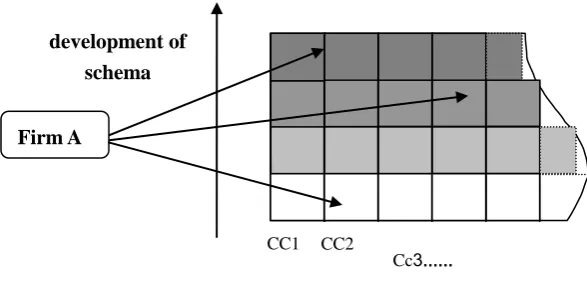
As schemas become more complex, they may develop into some sub-schemas.
Firms in the same type of cognitive community will fall into different sub-cognitive
communities by their development stages of schemas (see Fig. 1).
Fig. 1. The Classification of Cognitive Community2
The concept of cognitive community is more focused on the similarity of
knowledge structure, and this is different from the concepts of community or
community of practice often used by some researchers. A cognitive community is not
an observable or real entity, and lacks a definite object or structure as a community
and community of practice, so that even the members of a cognitive community may
not be aware of their own membership.
As a firm’s schemas influence its whole information processing procedure
(including perceiving, encoding, memorizing and inferring), a cognitive community
formed by schematic similarity has two important effects on intra-cluster knowledge
diffusion:
(1) Cognitive community’s blocking effect on knowledge diffusion. As soon as
they have been established, schemas take place in a firm’s information processing
procedure. Firms with a similar (or the same) type of schema enjoy higher efficiency
of knowledge diffusion than firms with different types of schema. Given the
schema-driven effect, a firm is more sensitive to the information most relevant to its
schema, and may ignore other information. The priming effect also shows that a
schema activated recently is most likely to be reactivated (FISKE and TAYLOR 1991).
As firms are limited in their ability to process information, and as the information
received is often fragmentary and passing, without the help of schemas firms can
hardly make sense of any information circulated in a cluster. Only firms with similar
schemas can exchange knowledge through such fragmentary and passing information.
complex, only a knowledge sender and receiver with the same codebook can
communicate well with each other. The schema in our framework is equivalent to the
codebook. With a similar schema, knowledge flows within channels of this specific
cognitive community. In this sense, there is a blocking effect on knowledge diffusion
between firms with different schemas.
(2) Cognitive community’s filtering effect on knowledge diffusion. A filtering
effect takes place between sub-cognitive communities within a general cognitive
community at different development stages. As schemas become more complex, they
may develop into some sub-schemas. Even for sub-schemas of the same type, their
degrees of precision are different by their stages of development, which affects firms’
information processing efficiency and speeds (FISKE and TAYLOR, 1991; COWAN
et. al, 2000). Firms with less developed (or coarser) schemas sometimes may not
understand the information diffused from firms with well-developed (or finer)
schemas. It is equivalent to what happens in computer software development: an old
edition of word processing software cannot be used to read or edit a file produced by a
new edition, but the new version can be used to edit either version of the file. REED
and DEFILLIPPI’s (1990) study on imitation between firms in an industry also shows
that the difference in the stage of knowledge development raises the barrier to
imitation.
Obtaining the membership of a cognitive community by schema similarity, firms
enjoy efficient knowledge diffusion. Given the blocking and filtering effects,
fact, because of thedifference in firm knowledge structure, knowledge is not diffused
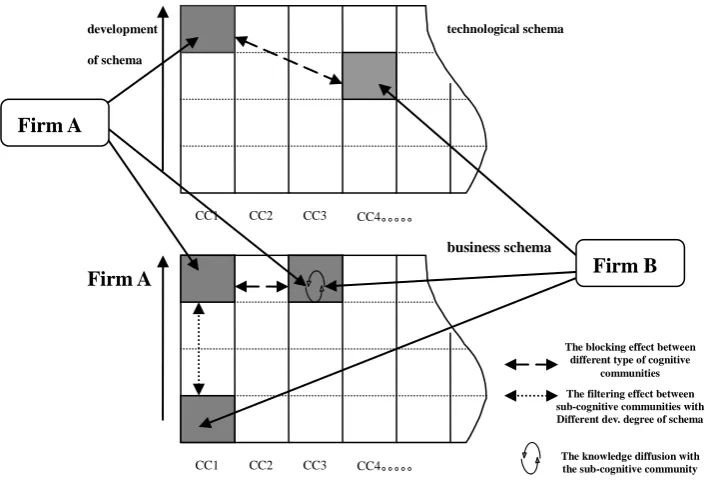
evenly in a cluster. Fig. 2 presents an illustration of cognitive community-based
intra-cluster knowledge diffusion.
Fig. 2. The Cognitive Community-based Intra-cluster Knowledge Diffusion
<Fig 2 about here>
In Fig. 2, firms A and B are assumed to be classified into different cognitive
communities due to their schema similarity patterns. Firm A is a member of the
technological cognitive community (T1-4)3 and business cognitive community (B1-4),
(B3-4), and firm B is a member of the technological cognitive community (T4-3) and
business cognitive community (B1-1), (B3-4). As firms A and B belong to different
types of technological community (T1-4) (T4-3), knowledge diffusion between them
is not efficient due to a cognitive community’s blocking effect. In other words, firm A
can hardly learn the knowledge in the cognitive community (T4-3) from firm B, and
vice versa.
What happens in the business cognitive communities represents both the blocking
effect and filtering effect. As firms A and B belong to the business cognitive
communities (B1-4)、 (B3-4) and (B1-1)、(B3-4) respectively, both are members of a
cognitive community of the same type, and the only difference between them is their
development stages of schema. Firm A in the business cognitive community B1 has a
development stage in business cognitive community B3. The different business
knowledge structures of firms A and B make knowledge diffusion between them
asymmetric. Firm A may be more efficient than B in learning by a cognitive
community’s filtering effect in business cognitive community B1. However, in
business cognitive community B3, both firms can diffuse knowledge with efficiency
as they have schemas at a similar development stage. It needs to be noticed that the
existence of a cognitive community’s blocking effect may prevent the firms from
enjoying high efficiency of technological knowledge diffusion in other business
cognitive communities (such as B1) even though they are both the members of a
highly developed cognitive community (B3).
To sum up, our cognitive community-based analytic framework for intra-cluster
knowledge diffusion argues that the cognitive community formed through the
cognitive proximity between firms is the fundamental way of knowledge diffusion in
the cluster, so that only those firms who have a similar knowledge structure will be
efficient in learning and transferring knowledge. In addition, on the cluster level,
knowledge distribution of a cluster has a critical effect on knowledge diffusion within
it. In a cluster with highly homogeneous firms’ knowledge structures, knowledge
diffusion would be active, as most firms belong to proximate cognitive communities.
On the contrary, in a cluster with highly heterogeneous firms’ knowledge structures,
knowledge diffusion would be inactive and knowledge would flow in an uneven way,
as most firms are located in the many scattered cognitive communities and knowledge
3. CASE STUDY
Since the 1990s, a number of industrial clusters have emerged in China where
thousands of firms in related industries have agglomerated. Among industrial clusters
in China, the most remarkable ones are located in the Pearl and Yangtze River Deltas.
The former Delta focuses on electronics, communication equipment and chemicals
and the latter on textiles and home appliances. Industrial clusters in these two areas
are highly competitive in both the home and overseas markets (ZHANG et al., 2004;
ENGARDIO and DEXTER, 2004). Zhejiang Province is located in the southern part
of the Yangtze River Delta, which covers a total land area of 101,800 square
kilometers. There are 11 cities under the direct jurisdiction of the Zhejiang provincial
government, including Hangzhou, Ningbo, Wenzhou, Jiaxing, Huzhou, Shaoxing,
Jinhua, Quzhou, Zhoushan, Taizhou and Lishui, under which there are 36 counties, 22
town-level cities and 30 county-level districts. As one of the most economically
vibrant and developed provinces, Zhejiang ranks fourth in China in terms of overall
economic output, and the economy is characteristic of hundreds of industrial clusters
in various industries, such as textiles, garment, socks, ties, auto parts, plastics and
mould. According to the Zhejiang Statistical Yearbook 2007, the economic output of
these industrial clusters has made up approximately 50 per cent of the province’s GDP
in 2006. As the Datang Sock Cluster (DSC) in Shaoxing City of Zhejiang Province is
provide some insights into the underlying causes of the competitiveness of China’s
traditional industrial clusters, and even for similar traditional clusters in other
countries.
In this section, to further explore and verify the cognitive community-based
analytic framework presented above, we report a case study of eight representative
firms in the DSC. Table 1 summarises the major characteristics of the firms. The
identities of these firms are disguised to ensure confidentiality.
Three factors were considered for the case selection. Firstly, cases were in industrial
clusters with strong competitive capabilities. Secondly, firms were representative in
size, from small to medium and large. Thirdly, for the data stability, only firms which
had been in operation for at least three years would be chosen.
Although the sock production industry is less knowledge intensive than the
electronics, telecommunication and biotechnology industries, a study of knowledge
diffusion in this industry is still valuable. It is undeniable that low labour cost is an
important element of competitiveness for traditional low-technology and
low-knowledge intensive clusters. However, considering the fact that every region in
China enjoys such advantage, it is hard to explain why most of the competitive
clusters have only emerged in limited places such as the Pearl and Yangtze River
Deltas and not evenly throughout the nation. Factors other than labour cost may have
had an important effect on the success of such traditional clusters. In our view,
competitive advantage of Chinese traditional clusters does not depend merely on low
no such thing as a low-tech industry. There are only low-tech companies”. Although
the sock industry is traditionally labour-intensive, there are extensive knowledge
learning and diffusing activities, and business knowledge may be more important for
a study of traditional industries. Actually, studies on traditional industries by
BOSCHMA and WAL(2006), BELL and ALBU (2005) and GIULIANI (2005) have
proved this.
The Datang Sock Cluster is in Datang, a small town in eastern Zhejiang Province.
Sock production is the pillar industry of Datang. There are more than 10,000 sock
makers in the town at present, with more than 200,000 employees. There are about
100,000 sock-knitting machines in Datang, including more than 40,000 top grade
computer knitting machines and 20,000 associated facilities. DSC holds a very
important position both in the Chinese and global sock-making industry (ZHANG et
al., 2004; LEE, 2005; DATANG TOWN GOVERNMENT, 2005). According to the
statistics from Macrochina Database published by the Chinese National Bureau of
Statistics, China produced about 18 billion pairs of socks, among which Datang
produced 12 billion pairs, accounting for 67 per cent of total domestic and 35 per cent
of global output in 2004.
Sock-making in Datang can trace its history back to the 1930s, when a few
craftsmen produced socks with manual sock machines in their homes to meet local
needs. The development of the modern sock industry in Datang has gone through
three stages. Between the 1970s and the mid-1980s, with the transition of the planned
Chaota, Zhongjia, Anhua and Chenshan Sock Factory. From the mid-1980s to the
mid-1990s, with the deepening of economic reforms in China, most township and
village-owned sock factories gradually went bankrupt and privatized, and many
former workers began to run their own household sock-making factories on a small
scale. From the mid-1990s to present, there have emerged many firms with large scale
production among these household factories. Currently, sock firms in Datang can be
classified into two types in terms of size: large (and medium) enterprises and small
manufacturers. Large enterprises usually have the capability of large scale production,
but they don’t invest in the whole production process of sock-making. They are
mainly concerned with obtaining big orders from foreign buyers such as Wal-Mart or
Carrefour. After getting these orders, they subcontract to small manufacturers who
produce semi-finished socks for them, and then accomplish the final stage of
production such as packing. On average, a large enterprise will have about 20 to 30
small manufacturers to fulfill orders, and a small manufacturer would have to act as a
supplier for one or more large/medium enterprises. Small manufacturers account for
approximately 90 per cent of the total number of sock firms in Datang.
3.1 Data Collection and Codification
3.1.1 Data Collection
We conducted in-depth interviews with the general or deputy general managers
and chief engineers of the eight firms listed in table 1. Each interview lasted for about
one and a half hours on average. Interviews were tape-recorded unless the informants
(YIN, 1981; YAN and GARY, 1994). All the interviews were conducted during
October and November 2006. In addition to interviews, approximately 30 pages of
archival data were collected for each firm, including the information about the firm’s
history, strategies, and main clients.
Table 1. Summary of the Major Characteristics of the Firms4
<Table 1 about here>
3.1.2 Data Coding
Data from the interviews and archives were coded using content analysis
methods. Firstly, we coded all data into a number of categories according to the
proposed theoretical framework. These categories are (1) type of technology, (2) level
of technology, (3) technological development strategy, (4) market orientation, (5)
market development ability, (6) business strategy, (7) channels for acquiring
technological knowledge, and (8) channels for acquiring business knowledge.
Secondly, we created subcategories according to the characteristics of the above
categories. For example, three subcategories: international market, home market, and
local market, were grouped into “market orientation”. Table 2 shows an example of
data coding for one of the eight firms.
Table 2. Examples of Data Coding5
Data coding was completed by three team members participating in the
interviews. We jointly developed the coding category in the first stage and used it to
code one case. Then, the three team members each specialised in coding, auditing and
checking for the remaining seven cases. The auditing and checking consisted of two
steps: the confirmation and double checking of data coding.
3.2 Results
Our study on the DSC shows that knowledge distribution of a cluster has a
significant influence on knowledge diffusion within it. Firms in DSC have a high
degree of homogeneity in technological knowledge, and are located within a
proximate cognitive community. In conformity with our cognitive community-based
analytic framework, the knowledge diffusion between firms is very active and
knowledge flows mainly in the local area. Contrary to the case of technological
knowledge, firms in DSC have a high degree of heterogeneity in business knowledge
so that it is hard for knowledge diffusion between firms to take place intentionally or
non-intentionally, so that knowledge flows suffer from stickiness.
DSC also shows that the combination of similarity in technological knowledge
and divergence in business knowledge facilitates local flexible production and
contributes to the competitiveness of the cluster. For technological knowledge,
homogeneity guarantees that a sufficient number of local firms will participate in the
related sectors and fulfill re-allocated orders. For business knowledge, heterogeneity
achieve economies of scale and efficiency.
3.2.1 Knowledge Distribution of Firms in DSC
From the case studies it can be seen that the knowledge structures of firms in
DSC were neither purely heterogeneous nor completely homogeneous, because the
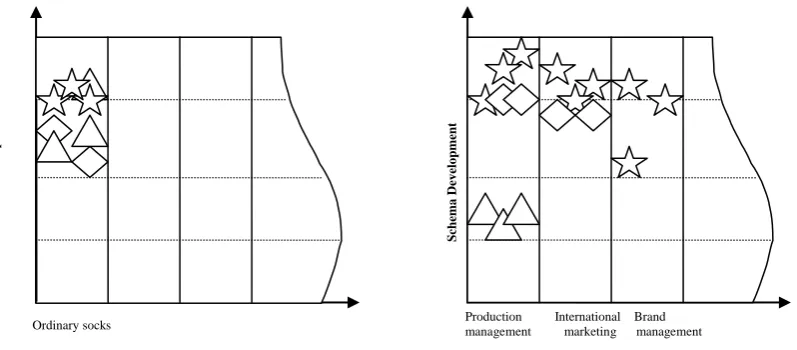
distribution of technological and business knowledge exhibited different patterns. Fig.
3 indicates that the sample firms are highly similar in the technology but significantly
different in the business dimension.
Fig. 3 The Distribution of Knowledge Structure in DSC6 <Fig 3 about here>
The firms have no fundamental differences in both the technological selection
(traditional sock-producing technology) and current technological levels. From a
cognitive community perspective, firms in DSC are in the proximate cognitive
community of technological knowledge. Three factors may explain this result. Firstly,
the technologies and methods the firms adopted are comparatively traditional.
Although the machines are imported from Italy or Japan, the operational principles
are basically the same. Secondly, computerised sock knitting machines have gained
prevalence in this area since year 2001, and most machines firms purchased were
similar. Technological problems and solutions are also basically the same. A third and
probably the most important factor is that the collective enterprises (or
the technological knowledge similarity between firms in DSC. Most entrepreneurs
and technicians in DSC originated from several TVEs in the 1980s, and have acted as
technological knowledge disseminators, leading to a reasonably homogeneous
distribution of technological knowledge in DSC.
We failed to detect a positive relationship between the technological level and
firm size. For example, case JC is very small in size, but its technological level is
comparable to those of large enterprises. One deputy general manager of the large
firm WY gave the following comments on small firms specializing in outsourcing
during his interview:
These producers are relatively strong in technology. Sometimes we even consult
them when we have problems in our internal production. After all, they have been
producing socks for ten to twenty years, and are very experienced. They are good at
technology, but there exists a very large gap between them and us in other aspects,
particularly in management and operational thoughts, and it’s hard for them to
develop. At present, nearly 30% of the firms in Datang are our suppliers, and some
have been doing this for eight or ten years. -WY D. GM
Different from their high congruence on technological knowledge structures,
firms in DSC have great diversity in business knowledge, especially between
large/medium-sized enterprises and small manufacturers7. In other words, from the
perspective of business knowledge structure, there are several sub-cognitive
are at higher stages than small manufacturers in production management knowledge.
In terms of operational knowledge in international marketing, the difference is even
greater. Small manufacturers have so little knowledge about international marketing
that they know little about and never bother to know about the international market. In
terms of brand management knowledge, medium-sized enterprises are significantly
different from large ones.
The export ratio of large/medium-sized enterprises in DSC is about 70%, and
these firms normally take international marketing seriously and pay close attention to
the accumulation of international marketing knowledge. They are conscious about the
development trends of the industry. The deputy general manager of BP pointed out the
following during the interview:
We must be concerned about international trade policy, e.g. antidumping and
quota, because they have great impact on our operation and production. The year
before last, the US government imposed quota limits on Chinese socks, which brought
great pressure on us. We did all the following to tide over the crisis: quickening the
pace to develop other external markets such as Japan, Korea and Europe, increasing
added value of products to raise profit margins, establishing overseas entities to avoid
tariff barriers, improving the competitiveness of the firm, and obtaining accreditation
of product quality (ISO9000 and ISO14000) and environmental protection (green
textiles). . –BP D. GM
Two small-sized firms, JA and JB, are typically representative of small
specialised in supplying large or medium-sized firms. They had neither proper
management systems nor marketing staff and the entrepreneurs did all the managerial
work. Their communication circles were largely restricted in DSC. Though good at
sock-producing technology, these firms were not so at management and marketing.
The boss of a small-sized firm talked about the influence of industrial development on
his business:
We usually don’t care about where these products are exported. We just take
orders from and make socks for large-sized firms. Sometimes they turn to us for
technological advice, and they are inferior to us in technology. However, we don’t do
such things as customs declaration, inspection, document attachment or management.
We just employ several people to produce socks.
–JB Boss
As mentioned earlier, there are huge gaps in business knowledge structures
between the large and medium-sized enterprises, especially in brand management.
The large and medium-sized sample firms are engaged in both domestic and export
sales, but only three firms have their own brands, and two of the brands are influential
on the domestic market. In most circumstances, AL uses its own brand for export
sales. Other medium-sized firms mainly do outsourcing for other brands and know
little about brand management and operating modes.
To sum up, the two dimensions of knowledge distribution of DSC diverge. In
terms of technological knowledge, a high degree of homogeneity can be found and
firms of different size. In contrast, when it comes to business knowledge, a high
degree of heterogeneity can be identified and a firm’s level and type of business
knowledge are significantly related to its size. On the basis of the information
collected from interviews, we reckon that the similarity of technological knowledge
and heterogeneity of knowledge between firms in DSC may result from some unique
characteristics of TVEs.
TVEs were distinct products of China’s transitional economy. It is very different
from the western system under which the individual is the ultimate owner of property
(BOWLES and DONG, 1999). It is a unique form of enterprise organisation based on
collective ownership and its property rights are in practice exercised by Town and
Village Governments (TVGs) (NAUGHTON, 1994). TVGs who own and control
TVEs have an objective defined more broadly than narrow economic interests and
profits. It may include social as well as ideological interests. In particular, it usually
includes employment maximisation. TVGs place a strong priority on employment
generation. Accordingly, most employees in TVEs come from local towns or villages
(BOWLES and DONG, 1999). In the context of DSC, small manufacturers appeared
in the mid-1980s and entrepreneurs of large enterprises emerged in the 1990s. Almost
all of them have had work experiences in TVEs and many entrepreneurs started their
business through privatization of the bankrupt TVEs. In the 1970s and early 1980s,
China was still a relatively isolated planned economy and TVEs focused their efforts
mainly on manufacturing and local trading rather than modern business activity such
willing to transfer knowledge and provide skill training than private owned or state
owned enterprises, making it easy for local employees to acquire technological
knowledge from them. However, as TVEs themselves were not good at modern
business management, they were unable to diffuse business knowledge effectively in
the region.
This historical factor has led to high heterogeneity of business knowledge and
high similarity of technological knowledge in DSC. At present, most sock firms in
DSC are small manufacturers who focus mainly on manufacturing semi-finished
socks. Only a few firms have learnt new business knowledge outside the cluster since
the privatisation of TVEs, and have the ability to incorporate small firms into their
subcontracting networks in DSC. Consequently, those with good business knowledge
have developed faster than others and grown into large enterprises.
3.2.2 Knowledge Diffusion Patterns in DSC
As described before, firms in DSC participated in different cognitive
communities according to their knowledge structures. The case study indicates that a
cognitive community’s blocking and filtering effects have an important impact on
knowledge diffusion between firms in DSC.
In DSC, all firms selected almost the same technology, reached similar
technological levels, and were highly congruent in the technological knowledge
structure. In fact, they were in the same technological cognitive community. During
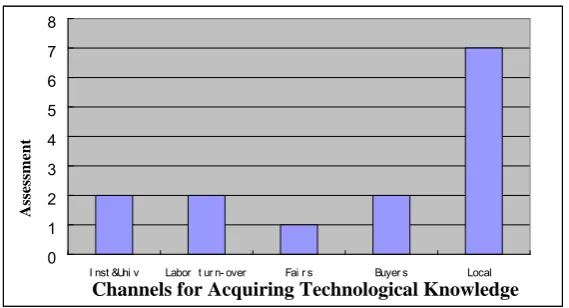
the interviews, we found that the firms frequently communicated with each other on
shows that localised technological knowledge is transmitted with extraordinarily high
efficiency and speed because the firms have a similar technological knowledge
structure.
Fig. 4 Main Channels for Acquiring Technological Knowledge8
<Fig 4 about here>
It is noted that technological knowledge diffusion was not intentional by the
firms. In fact, the firms took various measures to keep their knowledge a secret, but
spontaneous knowledge spillover was unpreventable because the firms had similar
technological knowledge structures. The deputy general manager of WY and the chief
engineer of AL said:
We usually sign agreements on secret information with subcontractors … but the
effects are limited, and there’ll be a lot of similar socks in Datang in several months…
We have no choice but to accelerate the pace of releasing new products!
-WY V.CEO
Generally speaking, because we have been making socks for so many years, we
could tell how to produce new products or new styles on the market simply by
glancing or touching them. -AL CTO
We also notice that the frequent interaction between the small manufacturers and
large enterprises involved only technological knowledge, rather than knowledge in
international trade and brand management. On the contrary, while there are no close
important information from the large enterprises in the cluster.
Sometimes we help small makers in production management to control product
quality, but they are slow learners, and we have to fill some important orders on our
own. Our experience in management and international trade is our competitive edge,
and they lag behind a lot (on these aspects) even after seven or eight years of
cooperation. - WY V.CEO
They taught us useful knowledge about production and workshop management,
and we love to learn. But we do not know how to learn international trade. We just fill
the order, that’s OK. –JC BOSS
In fact, these phenomena reflected the blocking effect of a cognitive community
on knowledge flows. Even though geographical and relational proximity exist
between small and large manufacturers, and even though they have long term
cooperation, it is very hard for the small manufacturers to learn (international trade
knowledge) because they are not in the same cognitive community of business
knowledge. The medium-size enterprises have no close business links with the large
ones, but they are in the same cognitive community, and could be enlightened upon
some phenomena seeming irrelevant. As indicated in Fig 5, the most important
channel for firms in DSC to gain business knowledge is self-study.
Fig.5 Main Channels for Acquiring Business Knowledge9
<Fig 5 about here>
technology and heterogeneous in business knowledge. Technological knowledge
diffused under the control of a cognitive community’s filtering effect, i.e.
technological learning mainly centered in DSC. On the other hand, a cognitive
community’s blocking effect is evident in business knowledge diffusion, i.e. firms in
different business schema communities are significantly different in their learning
efficiency. The results suggest that firms’ knowledge structures have a significant
impact on knowledge diffusion in DSC, and the existence of the blocking and filtering
effects in cognitive communities directly shape the mechanisms and efficiency of
knowledge diffusion.
In addition, our findings suggest that the complementarity between business
knowledge heterogeneity and technological knowledge congruence is an important
factor that has led to competitive advantage of DSC. A powerful flexible production
system has been developed in DSC because of high homogeneity in technological
knowledge, and large enterprises have been brought up with business knowledge
heterogeneity.
In fact, large enterprises play the role of leadership in DSC. They hold relatively
abundant managerial knowledge, have a better understanding of foreign buyers’ needs,
and are more experienced in production management and quality control. After
getting big orders from overseas, they divide and subcontract them to dozens of small
manufacturers. In this way, they realise a flexible production with low cost. From the
perspective of the cognitive community, this kind of production can be realised
knowledge in DSC. Therefore, the case study not only further verifies the explanatory
power of the cognitive community-based analytic framework for intra-cluster
knowledge diffusion, but also leads us to an important discovery that the combination
of various dimensions of knowledge distribution may be a new approach to explain
the formation and development of a cluster. That is to say, it seems that a cluster’s
competitiveness is derived from a flexible production system within it, but a more
fundamental factor is the combination of various dimensions of knowledge (e.g.
technological and business knowledge) among the firms within it.
4. SIMULATION STUDY
The case study provides a snapshot of intra-cluster knowledge diffusion in DSC.
Since firms in Datang reached a high level of similarity in technological knowledge,
they have achieved diffusion efficiency in technology by the filtering effect of a
cognitive community. In contrast, due to their high dissimilarity in business
knowledge, the diffusion efficiency is low by the filtering and blocking effects of a
cognitive community. Even between those firms who have similar technological
knowledge and have developed a long term partnership, the diffusion of business
knowledge is still very hard due to the existence of the cognitive community’s
blocking effect. Consequently, our case study shows that a cluster’s distribution of
knowledge through the filtering and blocking effects of a cognitive community does
only provides a static cross-sectional description of knowledge diffusion in the cluster.
There is a dynamic relationship between knowledge distribution and knowledge
diffusion as they affect each other. The case study does not tell us this dynamic
process. For example, it is uncertain what will happen to knowledge diffusion when
both the heterogeneity and level of knowledge distribution are taken into
consideration, and whether a higher level of knowledge distribution leads to more
effective knowledge diffusion. Moreover, although it verifies the cognitive
community-based analytic framework for intra-cluster knowledge diffusion, the case
study is concerned with a traditional industrial cluster in China only. It is very
difficult to control proximity factors, e.g. industry and regulation, and to conclude
whether the knowledge diffusion pattern in DSC is a special case only.
To compensate for the deficiencies of the case study, we use an agent-based
simulation to simulate the dynamics of knowledge diffusion in a cluster, aiming to
find out whether the blocking and filtering effects of a cognitive community take
place in the short or long term, and obtain a better understanding of the phenomenon
of knowledge diffusion in a cluster.
Agent-based simulation is now recognised as one of the most promising new
tools for regional study, allowing us “to understand better the relations between
micro-processes (the decisions and behaviors of economic actors) and the emergence
of stylised facts common across much of industry (relating to R&D and the geography
of firms) in the model output” (TAYLOR and MORONE, 2005). Recently GILBERT
and JONARD (2004) have all used the agent-based methodology to study innovation
dynamics in clusters.
4.1 A Cognitive Community-based Knowledge Diffusion Model
We assume a global environment G consisting of a grid of W Wcells and a
population of N agents (N < W W), representing a cluster and firms in it
respectively. The grid is wrapped (i.e. a torus) so that there are no edge effects. Each
agent is initially assigned a random position in the grid. Not all the cells of the grid
are occupied by agents, and those occupied are occupied by only one agent. To
simulate knowledge diffusion in the cluster, every agent i {1, 2,.... }N is endowed
with two types of knowledge randomly: the initial level of technological knowledge
~ [ , ]
T
i d u
k U T T and the initial level of business knowledgekiB ~U B B[ d, u].
Given these types of knowledge in the cluster, every agent i has two sets of
acquaintances: T( , )i t and B( , )i t , representing the agent’s technological and
business acquaintances at cycle t. Agenti’s initial technological acquaintances
( , 0)
T i and business acquaintances B( , 0)i are all other agents on its MOORE
neighborhood: those cells adjacent in the eight directions (north, south, east, west,
northeast, northwest, southeast and southwest) and within the agent’s visible range10
.
In our model, we call the unit of time a ‘cycle’. In each cycle, every agent is permitted
to interact with two acquaintances randomly chosen: technological acquaintance
( , )
T
p i t and business acquaintanceq B( , )i t . Why does the agent choose two
acquaintances respectively? The answer is that, according to the blocking effect of
cognitive community, knowledge transfer may be more effective between firms
After agenti’s interacting learning with the acquaintance p and q, it will
randomly choose another two agents k T( , ),p t l B( , )q t from the acquaintance
set of the two acquaintances interacted with and add the two new acquaintances to
agenti’s sets of acquaintances T( ,i t 1), B( ,i t 1) respectively. Consequently,
with the simulation process, agenti’s two sets of acquaintances will become larger
and larger.
We suppose that while the interaction between agents i and jtakes place, only
the agent who launched the interaction will have gains from interactive learning.
Agenti’s gains from the interaction are calculated in the following steps (MORONE
and TAYLOR, 2004):
Firstly, we calculate the distance in two types of knowledge between
agentsiand j:
T T T
i kj ki ,
B B B
i kj ki
Then we calculate the knowledge/distance ratio in technological and business
dimensions:
T T i i T
i
k , B iB
i B
i
k
Finally, we calculate agenti’s knowledge gains in two dimensions:
max{min{ , }, 0}, max{min{ , }, 0}
T T T B B B
i i i i i i
g g
The above knowledge gain function embodies the filtering effect of a cognitive
community: even for firms within the same type of cognitive community, knowledge
diffusion between them still does not occur easily if the difference between their
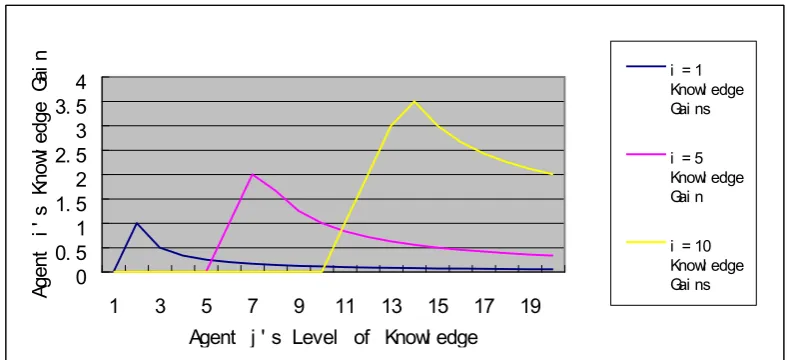
has different levels of knowledge: 1, 5, 10) knowledge gains that arise through
interaction with agent j. We can see two things: the higher the level of the agent, the
more it gains from interaction; and the smaller the difference between the two agents,
the more the agent can gain.
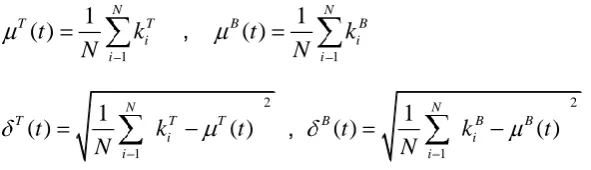
To measure knowledge diffusion using a simulation, we provide two groups of
indices: the average knowledge level T( )t , B( )t and the standard variance of the
knowledge level T( )t , B( )t . Using these indices and relevant figures, we can grasp
some important information about knowledge distribution and diffusion in the
simulation. 1 1 ( ) N T T i i t k
N , 1
1 ( ) N B B i i t k N 2 1 1 ( ) ( ) N
T T T
i i
t k t
N , 2 1 1 ( ) ( ) N
B B B
i i
t k t
[image:34.595.112.408.360.445.2]N
Fig. 6. The Knowledge Gain of Agent i with an Initial Level of Knowledge Equal to 1, 5 and 10
<Fig 6 about here>
4.2 Setting and Results of Simulation Experiment
4.2.1 Setting of Simulation Experiment
We performed the simulation with a population of 300 agents allocated randomly
over a wrapped grid of dimensions21 21 units (i.e. a total of 401 cells) (see Fig. 7).
To explore the relationship between knowledge distribution and diffusion, the agent’s
initial interval of knowledge distribution is classified into three
knowledge distribution (HH), low level and low heterogeneity of knowledge
distribution (LL), and high level and low heterogeneity of knowledge distribution
(HL)11 respectively. Since there are two dimensions of knowledge, technological and
business, combining the three types of knowledge distribution in each dimension, we
will have nine ( 3 3 ) classes of cluster. As set in the simulation model, there is no
difference in the agent’s learning strategy in technological and business knowledge
dimensions, and the diffusion of these two types of knowledge is operated
independently by a cognitive community’s blocking effect. To save space, in the next
two sub-sections we mainly focus on the dynamics of technological knowledge
distribution and diffusion, and the dynamics of business can be inferred from it12.
Fig. 7. 300 Agents on the Wrapped Grids
<Fig 7 about here>
In the following part, we report the result of three clusters: high level and high
heterogeneity of technological knowledge (HH), low level and low heterogeneity of
technological knowledge (LL), and high level and low heterogeneity of technological
knowledge (HL). Meanwhile, we let agents interact 30 cycles and 300 cycles to
observe dynamics in both the short and long term.
4.2.2 Results of Long Term Analysis
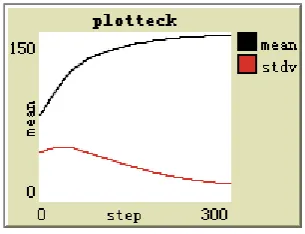
After letting agents interact for a period of 300 cycles, we observed that
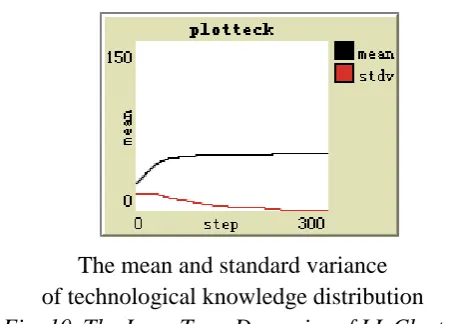
cluster almost converged13. The only difference between them is the velocity of
convergence. The HL cluster converged first, followed by the LL cluster, and finally
the HH cluster.
Fig. 8. The Long Term Dynamics of HH Cluster
Fig. 9. The Long Term Dynamics ofHL Cluster
Fig. 10. The Long Term Dynamics of LL Cluster
<Figs 8-10 about here>
Industrial technology progresses fast in a knowledge economy. The only way for
firms to maintain competitiveness is to keep learning new knowledge of technology
and business. Knowledge in a cluster converges in the long term so that it is very
important for firms to acquire new knowledge rapidly and efficiently in the short term.
We now analyse the short term dynamics of knowledge distribution and diffusion.
4.2.3 Results of Short Term Analysis
Knowledge diffusion dynamics in a cluster is comparable to macroeconomic
evolution, and the short-term dynamics of knowledge diffusion may be more
important for firms. Our results of the short term simulation show that in the HH, HL
and LL clusters, the initial distribution of technological knowledge plays an important
role in the dynamics of knowledge diffusion.
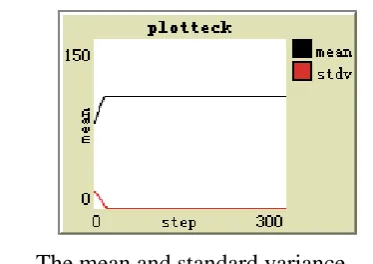
Fig. 11. The Short Term Dynamics of HH Cluster
Fig. 12. The Short Term Dynamics of HL Cluster
<Figs 11-12 about here>
In the HL cluster, the agents’ technological knowledge quickly achieved
convergence with a high mean and low standard variance. This may indicate that
knowledge is diffused effectively between the agents by the filtering effect of a
cognitive community when they all belong to a highly developed sub-cognitive
community of the same type. Such high efficiency of knowledge diffusion is also
evident in the graph of the agents’ knowledge distribution at different stages. As the
agents in the HL cluster have a comparatively high level of technological knowledge,
after 20 cycles of simulation, almost all agents have achieved the level of knowledge
100, and all agents in the cluster have reached the level of knowledge 50 by cycle 30.
Fig. 13. The Dynamics of Agents’ Distribution of Knowledge in the HL Cluster
<Fig 13 about here>
The filtering effect of a cognitive community is also evident in the LL cluster.
Although the agents in the LL cluster have improved their technological knowledge
through 30 cycles of interaction, the standard variance of the agents’ technological
knowledge has not declined, indicating that some agents have absorbed the
have a relatively low level of technological knowledge, knowledge exchange among
them is more difficult due to the filtering effect of the cognitive community. Some
agents with a relatively high level of technological knowledge benefit a lot from the
interaction, but other agents with a relatively low level of knowledge only benefit a
little. From the graphs of the agents’ knowledge distribution at different stages it can
be seen that, after 20 cycles of simulation only half of the agents arrived at the level of
knowledge 50, and even by cycle 30, some agents still had not reached the level of
knowledge 50.
Fig. 14. The short term dynamics of LL cluster
Fig. 15. The Dynamics of Agents’ Distribution of Knowledge in the LL Cluster
<Figs 14 and 15 about here>
The most interesting discovery of the short term simulation is the result of the HH
cluster. From fig. 11, we can see that although HH has a relatively high level of
average knowledge, its heterogeneous knowledge distribution leads to an
extraordinarily low diffusion efficiency. This phenomenon is very interesting, because
we usually expect that a high level of average knowledge distribution ensures active
knowledge diffusion in a region. In reality, some regions replicate the development
modes of other successful regions, and during the process, they focus particularly on
the development of local research institutes to improve the average level of local
knowledge distribution. However, this strategy does not often lead to an ideal result.
knowledge distribution is of vital importance, distribution heterogeneity also plays a
key role. To realise highly efficient knowledge diffusion in a cluster, we must ensure a
high level and low heterogeneity of knowledge distribution among agents in the
cluster.
The HL cluster represents a cognitive community with highly developed
technological knowledge, and the LL cluster a less developed one, but the HH cluster
represents one with significant differences inside. The simulation experiment on the
three clusters shows that the filtering effect of a cognitive community is evident.
Technological knowledge is diffused more effectively in HL than the other clusters.
Firms in the HL cluster can learn more and at a higher speed.
In sum, the simulation of knowledge distribution and diffusion leads to two
findings:
(1) In the long term, a cluster’s initial distribution of knowledge has no
significant effect on knowledge diffusion within the cluster. Irrespective of the initial
distribution of knowledge, all agents in the three clusters can converge to the similar
level of knowledge.
(2) In the short term, a cluster’s initial distribution of knowledge has a critical
effect on the process of knowledge diffusion. The HL cluster can stimulate knowledge
diffusion among agents within it, enabling the agents to converge to a high level of
technological knowledge more quickly than the LL cluster and HH cluster. Since the
agents have a low initial level of technological knowledge, interactive learning
cluster has a high level of average knowledge, the differences between the agents are
too dramatic, and the knowledge diffusion efficiency of the HH cluster is even lower
than that of LL cluster under the influence of the filtering effect of the cognitive
community.
Compared to the static results of the case study in section 3, our agent-based
simulation reveals some interesting findings. As all agents in a cluster can keep
learning for a long time to achieve a similar level of knowledge, the heterogeneity of
technological knowledge in the cluster may be a short term phenomenon. However,
the speed of the convergence process depends on the cluster’s initial distribution of
knowledge. A cluster with a high level but low heterogeneity of initial knowledge has
an advantage in the speed of knowledge learning and diffusion. As shown in the short
term simulation of clusters HL, LL and HH, both heterogeneity and the level of
knowledge distribution play an important role in knowledge diffusion.
5. CONCLUSIONS
This paper has adopted a perspective of firm knowledge structure in a cluster to
discuss the issue of intra-cluster knowledge diffusion. A cognitive community-based
analytic framework is established, a case study on a cluster from China is conducted
and an agent-based simulation is performed to further verify it. Several conclusions
can be drawn from the case study and simulation:
1. Our cognitive community-based framework provides some new thoughts and
cognitive community’s blocking and filtering effects, it is important to establish a
high level and low heterogeneity of knowledge distribution in a cluster with which it
will be relatively easy for knowledge to diffuse at a high speed. Our simulation study
proves that knowledge diffusion in a cluster with a high knowledge level but low
knowledge heterogeneity is most efficient, followed by the one with a low knowledge
level and low knowledge heterogeneity, and finally by one with high knowledge level
and high knowledge heterogeneity.
2. A cluster’s knowledge distribution may not be as homogenous as the traditional
wisdom would suggest. However, it may not be purely heterogeneous either. Our case
study shows that knowledge distribution in DSC is relatively homogenous for
technological knowledge but heterogeneous for business knowledge, which renders
the cluster different diffusion efficiency in different dimensions of knowledge and
gives DSC potential for success. Given the homogeneous distribution of technological
knowledge, firms in DSC belong to the same cognitive community at a high
development stage, leading to fluent and efficient local learning and diffusion of
technological knowledge. This pattern of technological knowledge diffusion is very
much like the “industrial atmosphere” described by Marshall. In contrast, as DSC has
a heterogeneous distribution of business knowledge, the diffusion of such knowledge
is rare. Even for firms maintaining technological cooperation for many years, there is
little business knowledge diffusion. Apart from several large firms acquiring business
knowledge from outside DSC, most small and medium-sized firms learn business
homogeneity or merely consider technological knowledge and neglect the business
dimension, our investigation considers multi-facet knowledge distribution and hence
provides new insight into the phenomenon of intra-cluster knowledge diffusion.
3. In a cluster, some firms may hold the position of “gatekeepers” by their knowledge
endowments, and they may determine the characteristics and development direction
of the cluster. In DSC, the leader firms behave differently in the technological and
business cognitive communities. In the technological cognitive community, they have
to act as “generous gatekeepers” to communicate with others either consciously or
unconsciously, because firms in DSC have highly homogeneous technological
knowledge, and because it is very difficult to keep technological knowledge secret
due to the filtering effect of a cognitive community. However, the leader firms in DSC
behave more like “stingy gatekeepers” in diffusing business knowledge. These leader
firms may exploit business knowledge exclusively by the cognitive community’s
blocking and filtering effect, as firms are highly heterogeneous in business
knowledge,
4. Both the case study and simulation indicate that a high knowledge level but low
knowledge heterogeneity in a cluster can have a very important impact on its
competitiveness. However, due to the lack of a public knowledge infrastructure basis,
such as resources in science and technology education and social service
organisations, it is hard for most developing countries to obtain the important initial
distribution of high-level knowledge with low-knowledge heterogeneity in order to
we have found that collective enterprises or town-and-village enterprises, a product of
China’s transitional economy, laid an important foundation for the formation of
high-level knowledge and low-knowledge heterogeneity in DSC in the 1980s.
Although most collective enterprises or town-and-village enterprises went bankrupt or
were privatised in the 1990s, the initial knowledge distribution they formed was an
important premise for the development of DSC. It shows that for clusters in
developing countries, even developed ones, an appropriate knowledge distribution is
the prerequisite condition for their formation and development. From the experiences
of China’s clusters such as DSC, TVEs as a product of transitional economy
contributed much to building such knowledge distribution. Even though other
countries may not have such historical opportunities, there are many equivalents such
as universities or trade unions which can have similar effects.
5. Last but not the least, our research provides a new explanation for sources of a
cluster’s competitiveness. Our case study shows that the combination of various
dimensions of knowledge distribution may be fundamental for the formation and
development of a cluster. That is to say, it seems that although a cluster’s
competitiveness is derived from the flexible production system in it, a more
fundamental factor is the combination of various dimensions of knowledge (e.g.
technological and business knowledge) among the firms in it. In DSC, there is a
high-level homogeneity distribution of sock producing knowledge and high
heterogeneity distribution of business knowledge, which gives large enterprises an
relatively abundant managerial knowledge, better understanding of foreign buyers’
needs, and greater experience in production management and quality control, large
enterprises often get big orders from overseas. As there are numerous small
manufacturers with high sock producing technology, large enterprises divide and
subcontract foreign orders to these partners conveniently. In this way, they realise
flexible production with low cost and gain tremendous advantage over their
competitors located outside DSC.
The study is an exploratory one using a perspective of the cognitive community to
interpret the phenomenon of intra-cluster knowledge diffusion. Several limitations
need to be noticed and overcome in future.
(1) Our analytic framework is focused on intra-, rather than extra-cluster knowledge
diffusion, and the knowledge transferred from outside is not discussed in detail.
Kowledge diffusion from outsidemay be very important for a cluster’s development
and innovation.As BELL and ALBU(1999) point out, for developing countries, the
need for technological chasing and developing means that extra-cluster knowledge
diffusion may have a great impact on cluster development. In future, a study
incorporating outside knowledge diffusion into the analysis would enable us to know
more about the topic.
(2) Our cognition-based analytic framework argues that only those firms with similar
knowledge structures would be efficient in learning and transferring knowledge. This
framework is in nature a knowledge diffusion model, implying that a small
the diffusion of similar knowledge enhances firms’ technological capabilities and
places them in a better position for innovation, our paper has not provided an explicit
discussion of the relationship between knowledge diffusion and innovation while
advancement in a cluster demands further knowledge that allows modernisation,
innovation and adjustment. Consequently, in future research more attention should be
paid to the relationship between innovation and diffusion.
(3) In addition to firm knowledge structures, other micro-level variables such as
strategy orientation, organisational structure and entrepreneurship need to be
considered in future studies of cluster knowledge diffusion.
(4) Although DSC is representative of China’s traditional clusters, our case study
covers 8 firms only, which may limit the interpretation of the findings from this study.
A larger sample size would be preferable in future research.
(5) In order to simplify the simulation model, we do not distinguish between large and
small enterprises and we assume that all firms have complete information about each
other’s knowledge, which may restrict the model’s explanatory power.
Acknowledgements - This research is supported by the Soft Science Program of
Zhejiang Province (Grant No. 2005C35007). We would like to thank Li Xiong for
assistance in preparing the first draft of this paper, and the journal editors and two