Applications
Shiu Lun Tsang
A thesis submitted to the University of Dublin, Trinity College
in fulllment of the requirements for the degree of
Doctor of Philosophy (Computer Science)
I, the undersigned, declare that this work has not previously been submitted to this or any other
University, and that unless otherwise stated, it is entirely my own work. I agree that Trinity College
Library may lend or copy this thesis upon request.
Shiu Lun Tsang
I owe a very grateful thank you to many people who have helped me in countless ways during my doctorate experience.
I would like to thank my supervisor Siobhán Clarke for her guidance and assistance over the years. I very much appreciate her understanding, motivation, and patience. Thank you to the members of the Hermes project - Cormac Driver, Éamonn Linehan, and Mike Spence - for all the insightful discussions and expert opinions about my research. Thank you also to Anthony Harrington, Andronikos Nedos, Tim Walsh, and Raymond Cunningham for their review and valuable suggestions regarding the thesis. Special thanks to Neil O'Connor, Andrew Jackson, Alan Gray, Ioanna Stamouli, and Jenny Munnelly for their constant support, encouragement, and friendship. You were always there when needed whether it's to discuss an idea, gain feedback about a problem, or simply just to listen.
To my other colleagues in the Distributed Systems Group, thank you for making it such a relaxed and enjoyable research environment to work in and it has been my pleasure to be a part of. I would also like to thank the Irish Research Council for Science, Engineering, and Technology who provided the funding for this research.
Finally, I would like to thank Laura and my family who have always been supportive of whatever I choose to do. I am forever grateful for their continuous love, understanding, and encouragement -thank you.
Shiu Lun Tsang
Personalisation is the process of tailoring application behaviour to the requirements of its users. A primary concern of personalisation is providing users with behaviour recommendations that will aid them with their tasks. Making accurate recommendations benets users by facilitating them with their activities, such as proposing actions preferred by the user, adapting resources to the user's situation, or informing users about news or events of interest. Accurate personalised recommendations also enable applications to make more eective use of user attention (e.g., by not interrupting users with irrelevant information) and facilitate greater user acceptance in proposed actions.
behaviours. In addition, user mobility means that providing input when necessary is not always possi-ble. Given the limitations of existing techniques, a new approach to personalisation for context-aware applications is therefore necessary - one which does not rely on static, development-time denition of information or require domain experts or users to explicitly specify and maintain preferences over time. This motivates the research question addressed by this thesis, which is: what techniques/algo-rithms are necessary to support the dynamic and implicit determination of user preferences from user behaviour, including relevant information and correct information utility, to facilitate context-aware applications in making accurate personalised recommendations to users?
To address this question, this thesis describes an investigation into a novel approach to personal-isation that supports context-aware applications in making recommendations without explicitly pre-dening the set of context relationships, user preferences and recommended behaviour. Instead, the solution dynamically relates this information at run-time. It addresses the limitations of existing work by providing software components that facilitate user autonomy, unconsidered context relationships, and changing user preferences. At the core of the approach is the identication and examination of associations between contexts and user choices. These associations, generated from past user inter-actions, represent patterns in behaviour from which the preferred actions of users, for a particular context, are inferred. The main contribution of this thesis is the provision of a multi-staged recom-mendation process consisting of a set of operations and algorithms that: automatically elicits user preferences from user behaviour; dynamically lters relevant information and adjusts the relative utility of information to reect the current context and up-to-date preferences of the user; and dy-namically generates and ranks competing recommendations. The process uses existing techniques and algorithms (employed in various other elds), which are adapted and combined in a novel manner to provide an integrated approach for supporting personalisation in the context-aware domain.
Shiu Lun Tsang and Siobhán Clarke. Mining User Models for Eective Adaptation of Context-aware Applications. In the International Journal of Security and Its Applications (IJSIA), Vol.2, No.1, Jan-uary 2008. SERSC.
Éamonn Linehan, Shiu Lun Tsang, and Siobhán Clarke. Supporting Context-awareness: A Tax-onomic Review. Technical Report, Department of Computer Science, Trinity College Dublin, TCD-CS-2008-37,http://www.cs.tcd.ie/publications/tech-reports/reports.08/TCD-CS-2008-37.pdf.
Shiu Lun Tsang and Siobhán Clarke. Mining User Models for Eective Adaptation of Context-aware Applications. In Proceedings of the International Conference on Intelligent Pervasive Comput-ing (IPC), Jeju Island, South Korea, 2007. IEEE.
Cormac Driver, Éamonn Linehan, Mike Spence, Shiu Lun Tsang, Laura Chan and Siobhán Clarke. Facilitating Dynamic Schedules for Healthcare Professionals. In Proceedings of the 1st International Conference on Pervasive Computing Technologies for Healthcare, Innsbruck, Austria, 2006. IEEE.
Acknowledgements iii
Abstract iii
List of Tables xii
List of Figures xiii
List of Listings xvi
Chapter 1 Introduction 1
1.1 Background . . . 1
1.2 Motivation . . . 3
1.3 Approach . . . 9
1.3.1 Implicit Preference Determination . . . 10
1.3.2 Information Selection . . . 11
1.3.3 Utility Assignment . . . 12
1.3.4 Recommendation Generation and Ranking . . . 13
1.4 Contributions . . . 14
1.5 Thesis Outline . . . 15
Chapter 2 State of the Art 16 2.1 Recommender Systems . . . 16
2.1.1 Overview . . . 16
2.1.2 Analysis . . . 18
2.2 Context-aware Applications and Frameworks . . . 20
2.3.1 MobiLife . . . 26
2.3.1.1 Analysis . . . 27
2.3.2 Daidalos . . . 28
2.3.2.1 Analysis . . . 28
2.3.3 Multidimensional Recommendation Model . . . 29
2.3.3.1 Analysis . . . 29
2.3.4 The Personal Digital Secretary . . . 30
2.3.4.1 Analysis . . . 32
2.3.5 Pervasive Autonomic Context-aware Environments . . . 33
2.3.5.1 Analysis . . . 34
2.3.6 SenSay . . . 35
2.3.6.1 Analysis . . . 35
2.3.7 A Context-aware Preference Database System . . . 36
2.3.7.1 Analysis . . . 37
2.3.8 Context-aware Content Filtering and Presentation . . . 38
2.3.8.1 Analysis . . . 38
2.3.9 Amigo . . . 38
2.3.9.1 Analysis . . . 39
2.3.10 Passepartout . . . 39
2.3.10.1 Analysis . . . 40
2.3.11 Context-aware Case-based Reasoning Applications . . . 40
2.3.11.1 AmbieSense . . . 41
2.3.11.2 LISTEN . . . 41
2.3.11.3 Personal Travel Assistant . . . 42
2.3.11.4 Ticketyboo . . . 42
2.3.11.5 Analysis . . . 42
2.3.12 The 1:1 Pro System . . . 43
2.3.12.1 Analysis . . . 44
2.3.13 Summary and Analysis . . . 45
3.1.1 Design Methodology . . . 49
3.1.2 Hermes . . . 50
3.1.2.1 Applications . . . 50
3.1.2.2 Application Framework . . . 52
3.2 Multi-Stage Recommendation Process . . . 53
3.2.1 Overview . . . 54
3.2.1.1 Recommendation Strategies . . . 56
3.2.2 Context Management . . . 56
3.2.2.1 Context Acquisition . . . 57
3.2.2.2 Context Modelling . . . 58
3.2.3 User Modelling . . . 59
3.2.4 Association Determination . . . 63
3.2.4.1 Association Discovery . . . 64
3.2.4.2 Rule Elimination . . . 67
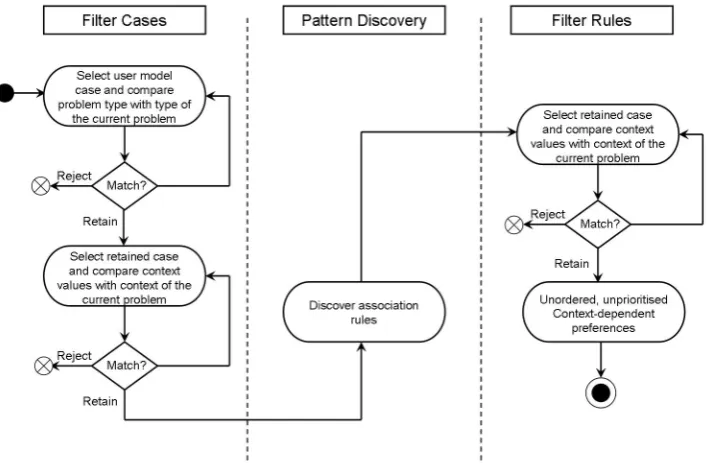
3.2.5 Implicit Preference Determination . . . 71
3.2.6 Information Selection . . . 76
3.2.7 Utility Assignment . . . 81
3.2.8 Recommendation Generation and Ranking . . . 88
3.2.8.1 Learning from Implicit User Feedback . . . 93
3.3 Chapter Summary . . . 94
Chapter 4 Implementation 96 4.1 Architecture Overview . . . 96
4.2 Context Management and Hermes Integration . . . 100
4.3 Personalisation Conguration . . . 104
4.4 User Modelling . . . 106
4.4.1 Extensibility . . . 108
4.5 Association Determination . . . 109
4.6 Implicit Preference Determination . . . 113
4.7 Information Selection . . . 115
4.8 Utility Assignment . . . 119
Chapter 5 Evaluation 127
5.1 Set-up . . . 128
5.1.1 Personalisation Conguration . . . 129
5.1.2 Issues with Live Deployment . . . 131
5.1.3 Measuring Accuracy . . . 132
5.1.4 Evaluation Statistics . . . 133
5.2 Context-aware Restaurant Recommender System . . . 136
5.2.1 Application Scenario and Set-up . . . 136
5.2.2 Analysis . . . 137
5.2.3 Comparisons . . . 139
5.3 Context-aware Travel Recommender System . . . 143
5.3.1 Application Scenario and Set-up . . . 144
5.3.2 Analysis of Original Recommendation Strategy . . . 144
5.3.3 Analysis of Extended Recommendation Strategy . . . 147
5.3.4 Analysis of Information Selection . . . 149
5.3.5 Analysis of Utility Assignment . . . 151
5.3.6 Comparisons . . . 153
5.4 Analysis of Dierent User Model Sizes . . . 158
5.5 Analysis of a Dierent Number of Supported Context Relationships . . . 161
5.6 Evaluation Summary . . . 164
Chapter 6 Conclusions and Future Work 166 6.1 Achievements . . . 166
6.2 Future Work . . . 170
6.2.1 Evaluation Extensions . . . 170
6.2.2 Dynamic Adaptation of Conguration Data . . . 171
6.2.3 Utility, Temporal, and Sequential Data . . . 171
6.2.4 Context Uncertainty . . . 172
6.2.5 User-Application Scrutiny . . . 172
A.2 Normal Plots for Evaluation Results . . . 174
A.3 User Model Size Analysis Results . . . 177
A.4 Number of Supported Context Relationships Analysis Results . . . 177
Appendix B Additional User Case Study Data 178 B.1 Restaurant Recommender Example User Problem . . . 178
B.2 Rules-based System Outline Implementation . . . 179
B.3 Developer Post-Implementation Questionnaire . . . 183
B.4 Travel Recommender Example User Problem . . . 183
2.1 Recommender Systems Overview . . . 18
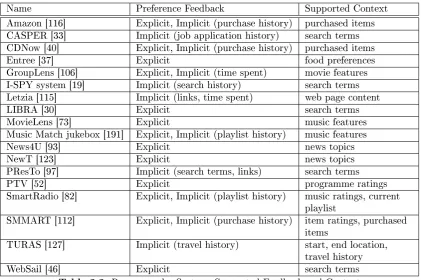
2.2 Recommender Systems Supported Feedback and Context . . . 19
2.3 Summary of Context-aware Personalisation Support . . . 45
5.1 Restaurant Recommender Context and Solution Features . . . 136
5.2 Summary Statistics for Original Strategy Accuracy . . . 138
5.3 User Model Cases versus New Cases Summary Statistics . . . 139
5.4 Summary Statistics for Rule-based and Neural Network Comparison . . . 141
5.5 Rule-based Implementation Opinions . . . 142
5.6 User Model Cases versus New Cases Summary Statistics . . . 143
5.7 Summary Statistics for Original Strategy Accuracy . . . 147
5.8 Summary Statistics for Comparing Extended and Original Strategy Accuracy . . . 149
5.9 Summary Statistics for Comparing the Accuracy of Information Selection with All Context Types Relevant . . . 150
5.10 Summary Statistics for Utility Assignment Accuracy . . . 153
5.11 Summary Statistics for Comparing the Accuracy of Preference Models with the Ex-tended Strategy . . . 156
5.12 Summary Statistics for Comparing the Accuracy of CBR with the Extended Strategy 156 5.13 Summary Statistics for the Accuracy of Dierent User Model Sizes . . . 161
1.1 Context-aware Personalised Recommendation Process . . . 9
1.2 Personalisation of Context-aware Applications . . . 10
2.1 Layered Conceptual Structure for Context-aware Systems [18] . . . 21
2.2 MobiLife Contextual Personalisation Architecture [176] . . . 26
2.3 Multidimensional Recommendation Model [4] . . . 30
2.4 Conceptual Structure of the PDS [39] . . . 32
2.5 Context- and Preference-based Decision Process in PACE [85] . . . 34
2.6 Example Communication Preferences in PACE [86] . . . 34
2.7 Context Parameter Data Cubes [172] . . . 37
2.8 An Example Experience in Passepartout [28] . . . 40
2.9 Rule Discovery Prole Building in 1:1 Pro System [5] . . . 44
3.1 The Hermes Application Framework . . . 52
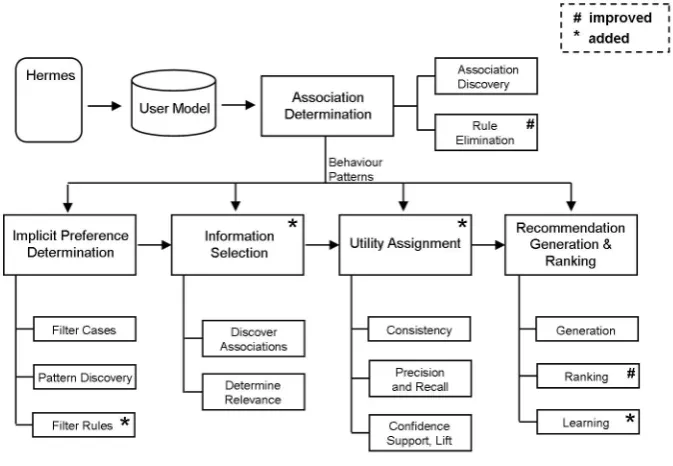
3.2 Personalisation Support for Context-aware Applications . . . 55
3.3 Context Acquisition in Hermes . . . 58
3.4 Hermes Context Model . . . 59
3.5 User Modelling Inputs and Outputs . . . 61
3.6 Association Determination Inputs and Outputs . . . 64
3.7 Apriori Algorithm . . . 65
3.8 Apriori Candidate and Large Itemsets Generation [45] . . . 66
3.9 Sample Association Rules . . . 66
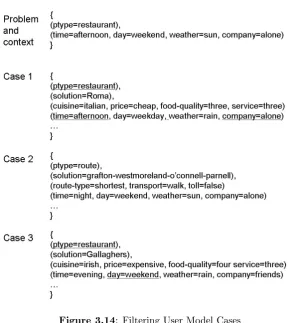
3.10 Redundant Rule Elimination . . . 69
3.11 Implicit Preference Determination Inputs and Outputs . . . 72
3.15 Filtering Association Rules . . . 76
3.16 Information Selection Inputs and Outputs . . . 78
3.17 Information Selection . . . 78
3.18 Information Selection Example . . . 80
3.19 Utility Assignment Inputs and Outputs . . . 82
3.20 Utility Assignment . . . 84
3.21 Determining Precision and Recall for Association Rules and Context Types . . . 85
3.22 Determining Condence and Support for Context Types . . . 86
3.23 Determining Precision, Recall, Condence, Support, and Lift . . . 86
3.24 Recommendation Generation and Ranking Inputs and Outputs . . . 88
3.25 Recommendation Generation and Ranking . . . 89
3.26 Rule Applicability Example . . . 89
3.27 Recommendation Ranking Algorithm . . . 92
3.28 Recommendation Ranking Example . . . 92
3.29 Implicit User Feedback Learning Algorithm . . . 93
4.1 High-level Architecture of Personalisation Functionality . . . 98
4.2 High-level Sequence of Operations . . . 99
4.3 PersonalisationManager Class . . . 101
4.4 Tuple Class . . . 103
4.5 User Modelling Classes . . . 107
4.6 Storing a New User Model Case - Sequence of Operations . . . 109
4.7 Association Determination Classes . . . 110
4.8 Association Determination - Sequence of Operations . . . 110
4.9 Implicit Preference Determination Classes . . . 113
4.10 Implicit Preference Determination - Sequence of Operations . . . 114
4.11 Information Selection Classes . . . 116
4.12 Information Selection - Sequence of Operations . . . 117
4.13 Utility Assignment Classes . . . 120
4.14 Utility Assignment - Sequence of Operations . . . 121
4.15 Recommendation Generation and Ranking Classes . . . 123
5.1 Original Strategy Accuracy . . . 138
5.2 User Model Cases versus New Cases . . . 139
5.3 Rules and Neural Network Accuracy . . . 140
5.4 Rules and Neural Networks: User Model Cases versus New Cases . . . 143
5.5 Dublin City Coverage . . . 145
5.6 Accuracy of Original Strategy for Route and Transport Recommendations . . . 146
5.7 Extended Strategy vs Original Strategy Accuracy . . . 148
5.8 Information Selection Accuracy . . . 150
5.9 Utility Assignment Accuracy . . . 152
5.10 Extended Strategy vs Preference Model Accuracy . . . 155
5.11 Extended Strategy vs CBR Accuracy . . . 155
5.12 Original Strategy vs Preference Model Accuracy . . . 157
5.13 Original Strategy vs CBR Accuracy . . . 157
5.14 User Model Sizes Accuracy . . . 161
5.15 Context Types Supported Accuracy . . . 163
A.1 Restaurant Recommender Original Strategy Accuracy . . . 175
A.2 Travel Recommender Original Strategy Accuracy . . . 175
A.3 Extended Strategy Accuracy . . . 175
A.4 Information Selection Accuracy . . . 176
A.5 Utility Assignment Accuracy . . . 176
A.6 Accuracy for Each User in Each User Model Size Category . . . 177
4.1 The startRecommendationProcess() method . . . 100
4.2 Hermes Basic Communications Conguration . . . 101
4.3 Adding a Local Context Source in Hermes . . . 102
4.4 Retrieving Location Context from Hermes . . . 103
4.5 Personalisation Conguration File . . . 104
4.6 A sample User Model csv le . . . 106
4.7 Persisting User Model Cases to Memory . . . 107
4.8 Filtering User Model Cases . . . 108
4.9 Discovering and Creating Association Rules . . . 111
4.10 Removing Redundant Rules . . . 112
4.11 Implicit Preference Determination Operations . . . 113
4.12 Filtering Association Rule by Context . . . 115
4.13 Determining Relevant and Irrelevant Context . . . 118
4.14 Calculating Context Utility . . . 120
4.15 The updateUtility() method in ContextSet . . . 121
4.16 Calculating Precision and Recall . . . 122
4.17 Ranking Candidate Recommendations with rankRecommendations() . . . 124
4.18 Learning from Implicit User Feedback . . . 125
5.1 Personalisation Conguration File . . . 129
Introduction
Personalisation is the process of tailoring application behaviour to the requirements of its users. Per-sonalisation benets users by facilitating them with their work tasks, making more eective use of their attention, and increasing their satisfaction. Current approaches to personalisation are inadequate for context-aware applications for two main reasons. They rely on human input to identify and relate dierent contexts, user preferences, and appropriate behaviour - a task which is time-consuming, com-plex, and error-prone. They also rely on specically dened algorithms that are inherently static and therefore unable to automatically adapt relevant decision making information to accommodate chang-ing user preferences. This thesis examines the challenge of personalischang-ing context-aware applications and proposes an approach that supports the dynamic and implicit determination of user preferences, including relevant decision-making information and information utility (i.e., its relative importance), for a particular context. Behaviour recommendations that satisfy these preferences are subsequently generated, ranked and presented to the user. This introductory chapter provides the background and motivation to this work, introduces the proposed approach to personalisation of context-aware applications, presents the contributions of the thesis, and outlines the remainder of the document.
1.1 Background
providing users with recommendations, tailored to their preferences, that will aid them with their tasks [86, 95, 31]. The more accurate personalised recommendations are, the more they will benet users. Accurate recommendations will increase user motivation in carrying out their work tasks [144, 31], make better use of user attention [53], facilitate greater user acceptance in recommended actions [144, 53], and increase user satisfaction [114]. At the core of personalisation is a description of user preferences, usually referred to as a user model [100, 11]. User models contain information such as user preference criteria, the relative importance of criteria, and past user choices. Applications adapt and make recommendation decisions based on preference data contained in a user model. For example, the Travelling Salesman Problem (TSP) is a well known recommendation problem where applications evaluate and recommend travel routes based on a user's preference for the least costly [13].
Like personalisation, the aim of mobile, context-aware computing is to tailor application behaviour. Mobile, context-aware computing is a computing paradigm in which mobile devices have access to situational information (e.g., user location, time of day, nearby people, available resources etc.) [167, 201], dened initially by Dey as context [60]. The increased availability and access to context in a mobile setting facilitates applications in better adapting to its surrounding environment. In general, context-aware applications exploit context, to make behaviour decisions that will aid users with their activities. Many examples of context-aware applications exist including tourist guides [48], reminder services [61], and teaching/learning systems [76].
accurately predict the customers preferred behaviour [145, 74]. The context-dependent nature of user preferences is consistent with denitions of user-centered context [144, 22, 24, 63] (classied by Dourish as an interactional problem [63]) and supports the view of context as a set of conditions or factors that aect user preferences and subsequent behaviour. A user-centered denition of context is distinct from the widely adopted technology-centered approach, and denes context as a relational and dynamic property that may or may not be contextually relevant for a particular activity, the scope of which cannot be dened in advance, but should be dynamically determined [63].
Following from these denitions, this thesis adopts a user-centered denition of context. This work distinguishes between user preferences and other forms of environmental context (such as location, time of day, and weather). The thesis examines the context-dependent nature of user preferences (i.e., the eect of environmental context on user preferences) as well as the eect of preferences on the contextual relevance of environmental context in personalised recommendation decisions (i.e., the current user preference predicates the set of environmental context that is relevant for recommen-dation decisions). In particular, the thesis investigates possible approaches for implicitly capturing user preferences in context-aware applications, dealing with large sets of context and user preferences, identifying and supporting the eects of context on user preferences, adjusting the contextual rele-vance of environmental context to the current user preference, and tailoring context-aware application behaviour to users.
1.2 Motivation
exam-ples. However, experts are required to dene a learning function (e.g., reward function or similarity function) that trains the application about how to respond to dierent user preferences or context. In case-based reasoning (CBR) for example, experts specify the information types and corresponding similarity measures that make up a similarity function (e.g., a travel application may consider origin, destination, price, and total time for comparing ights [55]).
Existing personalisation techniques provide a suitable approach for many current context-aware systems as they are generally conned to well dened domains, limited in the number of context types they support, and restricted to making recommendations of one particular type (e.g., a route rec-ommendation in TSP). However, both explicit and implicit techniques used for specifying behaviour in current context-aware systems are limited in personalising larger context-aware applications that support context-dependent preferences. In particular, they are limited in supporting important person-alisation tasks such as identifying and representing context-dependent user preferences (i.e., the eect of context on user preferences) and adjusting the contextual relevance and utility of environmental context in recommendation decisions to match the user's current context and up-to-date preferences. There are two main reasons for this:
Current personalisation techniques rely on humans (domain experts or users) to identify, relate, and prioritise context and preferences to ensure correct behaviour. However, this task is complex, error-prone, and time-consuming particularly with large sets of information; and
Current personalisation techniques rely on specically dened algorithms or functions that are inherently static, with information relationships, relevant information, and the relative impor-tance (or utility) of information used in making recommendations, dened at development time. The denition of these algorithms/functions is a non trivial task and they will result in inaccu-rate recommendations if relevant decision making information or utility changes, which occurs as a result of a user's preferences changing or when new relationships between existing context, preferences, or behaviour are required.
techniques, experts are required to explicitly identify the set of possible user preferences and dene the appropriate relationships between preferences, context and behaviour. However, this human task is dicult due to the dynamism of context-aware environments and the growing availability of sensor information. Context-aware applications operate in highly dynamic environments. The mobility and spontaneous interaction between dierent people and devices means that the current situation of the user is constantly changing [11, 147, 171, 23]. In addition, advances in sensor, mobile, and network devices are providing context-aware applications with greater availability and access to information. This dynamism and increased availability will see applications needing to support and respond to a larger number of more complex contexts, user preferences, and behaviours in order to adapt eec-tively. For example, an application that supports 10 independent contexts types, each with 5 dierent values, will need to consider 510 (i.e., almost 10 million) possible dierent context combinations. To
support context-dependent preferences with existing approaches would require humans (users or ex-perts) to identify the set of context combinations that are relevant, the eect of each combination on user preference, and the corresponding appropriate behaviour. That is, a user preference will need to be correctly identied and related to each of the relevant 510 possible context combinations
and the appropriate behaviour recommendation will need to be determined and associated with each context and user preference pair. The large number of possible cases and the diculty in accurately dening relationships between context, preferences, and behaviour makes the human task of correctly capturing this information extremely time-consuming, complex, and error-prone.
incorrectly dened. Inaccurate recommendations will therefore result until the relevant relationship denitions are corrected.
Recommendation algorithms that learn from user behaviour eliminate the limitations associated with the need to identify, relate, and pre-dene all relevant relationships between context and user preferences. However, these algorithms are also pre-dened with details about information relation-ships, relevance, and utility that are to be considered in application decisions (e.g., a Bayesian network structure is statically dened to represent information relationships that are relevant in an applica-tion while a CBR similarity funcapplica-tion pre-denes a set of relevant informaapplica-tion used for measuring the similarity of cases). Changes to user preferences would therefore render pre-dened information as in-accurate and as these approaches rely on statically dened functions, they are unable to automatically adapt to necessary changes and require explicit human modication in order to be corrected (e.g., a dened CBR similarity function would need to be explicitly modied to accommodate any changes to the relevance or utility of information items used to compare case similarity).
The ability of a person to identify, relate, and dene relevant context and preference informa-tion represents an example of the Informainforma-tion Overload problem [123, 77]. As available informainforma-tion increases, the human task of identifying, relating, and prioritising relevant context and user pref-erences to ensure correct application behaviour becomes correspondingly time-consuming, complex, and error-prone. Diculties associated with this task such as knowledge discovery (e.g., determining what user preference and behaviour applies in a certain context), relating and prioritising information, and maintenance and eciency are well recognised [149, 72]. The resultant eect is inecient and ineective decision-making [68, 187].
interpret, leading to an inaccurate description of their preferences. In addition, studies have shown that users do not have conscious access to their own preferences, and are therefore unable to give accurate feedback about them [159, 25, 170]. The mobility of context-aware users creates further diculties for explicit user input. As users are mobile, providing input when necessary is not always possible and the primitive input capabilities and form factor of many existing mobile devices makes giving feedback dicult. In addition, a user's interaction with their device becomes a secondary task as they are engaged in other surrounding activities. Applications can no longer rely on prompt user input and any request for feedback may become frustrating and intrusive. In addition, a recent study by Barkhuus and Dey has shown that explicit user feedback is often inappropriate and that although users feel a loss of control, they prefer autonomy if accurate results are provided [21]. Other studies go a step further and indicate that the main reason for the success of personalised applications is because they do not require users to provide feedback or input [141, 116].
Given the limitations of existing personalisation techniques, a new approach to personalisation for context-aware applications is therefore necessary - one which does not rely on static, development-time denition of information or require domain experts or users to explicitly specify and maintain preferences over time. Existing context-aware systems and traditional personalised (recommender) systems have been analysed with a particular focus on investigating: how current applications acquire user preferences; how the eect of context on user preferences is identied and represented; how preferences aect the contextual relevance and utility of environmental context in recommendations; and how possible behaviour recommendations are generated and ranked. From this analysis, the following requirements for supporting the accurate personalisation of context-aware applications are derived:
1. Context-dependant user preferences - applications must support the implicit identication and representation of user preferences, the eect of context on these preferences, the eect of pref-erences on the contextual relevance of environmental context, and the mapping of context and preferences to appropriate behaviour. Personalised context-aware applications are required to support adaptation along two dimensions: user preferences and context. That is, either a pref-erence change or a context change will inuence an application's behaviour recommendation.
consider when making decisions, sometimes referred to as a multi-attribute utility estimation problem [183]. In personalised context-aware applications, this set of information will need to be dynamically adjusted depending on the user's recommendation problem (e.g., determining a travel route between two locations) and context.
3. Complex context-aware environments - advances in sensor and mobile devices and the myriad of interactions between devices and people mean that accurately capturing all possible relation-ships between context, preferences, and behaviour is dicult. Applications must accommodate a large set of dierent context types, values, and combinations and also adapt to previously un-considered or inaccurate context relationships while maintaining the utility of recommendations. The complexity of the environment also means that users will necessitate recommendations con-sisting of dierent output types (e.g., recommend both the preferred route and preferred mode of transport). Personalisation support in context-aware applications should therefore support the evaluation of multiple dierent output types, recommending those that are most appropriate for the current context and preference of the user.
4. Dynamic execution (to support developers) - the ability of a developer/domain expert to accu-rately pre-dene the set of information relationships necessary for personalising context-aware applications is dicult due to the large number of possible contexts, the probability of discover-ing previously unsupported context relationships, and the diverse and changeable nature of user requirements. A dynamic approach eliminates the need for experts to specify relevant informa-tion relainforma-tionships. Instead, relevant relainforma-tionships between context, preferences, and behaviour are dynamically determined at run-time, when required (e.g., when a user's task changes) and tailored for the current context and user preference. Dynamic execution also enables applications to evolve to support changing user preferences or previously unconsidered context relationships, without explicit input, as relationships are generated from up-to-date information.
5. Autonomous execution (to support users) - explicit user input is used by personalised appli-cations to start a recommendation process or to correct any inaccuracies in developer-dened preferences or recommendations. However, the problems associated with explicit user input necessitate applications to act with autonomy. Applications will have greater responsibility to automatically infer the desires of its users and act transparently on their behalf. Autonomous execution facilitates a move to achieving the aim of pervasive invisible computing [143].
pref-Figure 1.1: Context-aware Personalised Recommendation Process
erences from user behaviour, including relevant information and correct information utility, to facilitate context-aware applications in making accurate personalised recommendations to users?
1.3 Approach
To address the research question, this thesis describes an investigation into a novel approach to per-sonalisation. This approach does not require information about relationships between context, user preferences, behaviour, or about the relevance and utility of information to be explicitly pre-dened. Instead, the approach dynamically determines context-dependant user preferences and relevant deci-sion making information by implicitly identifying and reasoning appropriate information relationships at run time. It addresses the limitations of existing work by providing techniques and algorithms that facilitate user autonomy, unconsidered context relationships, and changing user requirements. Figure 1.1 illustrates the aim of the personalisation approach proposed in this thesis, which is to dynamically determine the preferences of a user for a particular problem and context. Information relevance and utility, tailored for the given problem and context, is subsequently inferred from the user's preferences and inferred knowledge is used to rank candidate recommendations. The run-time, implicit execution of these functions is designed to support applications in making recommendations that are specically tailored to the problem, context, and preferences of users.
Figure 1.2: Personalisation of Context-aware Applications
examination of associations between contexts and user behaviour choices. These associations, gen-erated from a user model of past user interactions, gathered from implicit user feedback, represent patterns in behaviour from which the preferred actions of users, for a particular context, are inferred. Details about relevant information, information utility, and criteria for ranking recommendations are also inferred from these patterns. The main contribution of this thesis is the provision of a multi-stage recommendation process consisting of a set of operations and algorithms that: automatically determines user preferences from past behaviour; dynamically lters relevant recommendation infor-mation and adjusts the relative utility of inforinfor-mation to reect the current context and up-to-date preferences of the user; and dynamically generates and ranks competing recommendations. Figure 1.2 illustrates this multi-stage process including the series of operations that support the personalisation of context-aware applications.
1.3.1 Implicit Preference Determination
identifying behaviour patterns from past user behaviour stored in a user model (i.e., recurring asso-ciations between context and user choices). Several techniques adopted from other research elds are adapted and combined to complete the various tasks necessary for implicit preference determination. Methods from context-awareness are adopted for the acquisition, reasoning, and management of con-text [18, 132, 12, 42]. Functions from the Hermes framework [65] have been used for concon-text-related tasks. User modelling techniques [100] and user proles applied in content-based systems [6] were examined for representing user model data. User information such as past behaviour is gathered from implicit user feedback, therefore eliminating the need for users to explicitly specify details about their preferences. The user model is extended to also store the context at the time of each behaviour. User model data is represented in the form of cases in a similar manner as that used in case-based reasoning (CBR) [1]. Association data mining [8, 45] is used for mining user model data. Mining eliminates the need for explicit human input to identify and relate context and preferences. Instead, mining enables the autonomous and dynamic determination of association between context and user choices, which represent the context-dependent preferences of a user. These associations represent patterns in behaviour from which the preferred actions of users, for a particular context, are inferred. New user interactions and behaviour in addition to the context at the time of the behaviour are added to the user model with application use. As associations are generated at run-time using an up-to-date set of user interactions, the application can accommodate previously unconsidered context relationships or any changes to user preferences. Associations are also in a form that provides an intuitive and descriptive way of representing user behaviour and are compatible with explanation methods that enable users to query and scrutinise applications about their behaviour [27, 96]. Associations between dierent context types and values and user choices are generated, facilitating user preferences to be determined for multiple dierent combinations of context and multiple dierent types of recommenda-tion problems. The CBR concept of using past similar cases to solve the current problem is adopted to determine user preferences from historic behaviour cases. The assumption is that behaviour patterns represent the preferred actions of users in a particular context [1, 53].
1.3.2 Information Selection
Depending on their goal and their context, users will vary in the types of information they use for making decisions. An important task is therefore to dynamically and autonomously determine the subset of all context, preferences, and behaviour that are relevant for making recommendation decisions. Information selection (often referred to as feature selection [118]) is concerned with ltering information to determine the subset that is relevant to the current recommendation problem, context, and preference of the user.
Association mining techniques are used to discover patterns in user behaviour, which are itera-tively compared to determine relevant information. Specically, the user's action choice under various context settings is compared. From the analysis of similarities and dierences that exist in patterns, relevant information that signicantly inuences use behaviour choices, and therefore should be con-sidered in recommendation decisions, is inferred. Metrics from association mining, such as support and condence [45] are used to lter generated association rules, ensuring only those that meet a particular accuracy and interestingness threshold are retained before comparisons. Techniques for textual matching and fuzzy comparisons used in information retrieval [17] and CBR [1] are facilitated for comparing information stored in behaviour patterns.
Determining the set of contextually relevant information for a particular context can also address the question of when to begin the recommendation process [65]. Starting the recommendation process at the incorrect time can lead to inaccurate recommendations, be intrusive to users, and result in sub-optimal performance (e.g., using a device's processing and battery power when unnecessary). By identifying the set of relevant information, information selection can be used to signal when a new recommendation should be evaluated and presented to the user. That is the preferred action of a user is likely to change when the value of a relevant context type changes (e.g., if a user's preferred transport option is based on the weather context, then a change in the value of the weather context (e.g., from dry to wet) will require making a new transport recommendation to the user).
1.3.3 Utility Assignment
stage therefore provides functions and algorithms for dynamically determining and assigning the cor-rect weight (or utility) to information without the need for explicit user input, so that its relative importance reects the preferences of a user in a particular context. The algorithm and heuristics used to dynamically determine the appropriate weight to assign to information for a particular con-text is constructed using information quality metrics from information retrieval [17] and data mining [45]. Precision, recall, condence, support, and lift measures are combined and aggregated to create a customisable algorithm that determines the strength of user behaviour patterns, with information stronger rules given more weight in recommendation decisions. Multi-attribute utility theory [183] and decision theory [70] techniques that assign numeric weight values (or scores) to prioritise the importance of items are adopted to represent the utility of context information.
1.3.4 Recommendation Generation and Ranking
A primary goal of personalisation in context-aware applications is to provide users with behaviour recommendations that will aid them with their activities. The nal stage of the recommendation process is concerned with generating and ranking candidate behaviours that best accommodate the current context and preference of the user. The implicit preference determination stage generated association rules representing the context-dependent preferences of users. These rules are then ltered, aggregated, and prioritised at the information selection and utility assignment stages to ensure that the most relevant and suitable rules that match the current user preferences and context are considered at this recommendation stage. Retained rules are used to rank any competing alternatives. Possible recommendations are generated from the current context from the domain (e.g., what actions are possible given the current context), determined using context-aware functionality [65], and a list of past actions chosen by the users, which are stored in the user model. The multi-attribute utility technique [183] is used to rank each of the possible behaviours using the outputs of information selection and utility assignment. The integration of this technique with the personalisation approach proposed in this thesis facilitates candidate behaviours to be scored using multiple dimensions with dierent levels of relative importance. The highest ranked behaviour (or a number of highest ranked behaviours) is then presented as recommendations to the user. Rules generated at the preference determination stage support the association of multiple dierent context and problem types, therefore facilitating the ranking and recommendation of multiple dierent recommendations (e.g., recommend both the preferred route and preferred mode of transport).
complete personalization, where users are in full control and specify how an application should behave, and an active approach, where applications act with full autonomy including making actual changes to application behaviour. Users have been shown to prefer a passive approach over personalization, while no signicant preference was concluded between passive and active approaches [21].
1.4 Contributions
The personalisation approach described in this thesis contributes to the state of the art in the area of mobile, context-aware personalisation by addressing the following issues:
Current approaches for determining context-dependant user preferences require users or domain experts to explicitly identify and represent relationships between context and preferences (typi-cally as rules or learning functions) to ensure correct behaviour. However, the accurate denition of this information is dicult due to the large set of (complex) context and preferences relation-ships and the changeable nature of user preferences. This thesis describes a dynamic approach to determining context-dependant preferences, where preferences for a particular recommendation problem and context are automatically inferred from past user behaviour.
Current approaches to personalisation require domain experts or users to statically specify the set of information to be considered relevant in recommendation decisions, typically at development time. However, when context, preference or behaviour denitions are incorrect, when previously unconsidered context relationships arise, or when user preferences change, a static approach is unable to automatically adapt and will therefore result in inaccurate recommendations. This thesis describes an approach that addresses this limitation by providing a technique that dynam-ically and autonomously determines, from past user behaviour, the set of relevant information, which is tailored for dierent recommendation problems, context, and user preferences.
Current approaches for generating and ranking competing recommendations require explicit in-put from users or domain experts and are limited by the number of recommendations types they can evaluate. However, accurately determining and ranking behaviour is dicult due to the de-pendency between context and preferences as well as the changeable nature of user preferences. This thesis describes a technique which dynamically generates and ranks multiple recommen-dation types. The approach considers user preferences, context, and possible behaviours and prioritises recommendations by examining the strength of user behaviour patterns.
In summary, this thesis describes the development of a multi-stage recommendation process, which uses, adapts, and combines existing techniques and algorithms in a novel manner, for implicit pref-erence determination, information selection, utility assignment, and recommendation generation and ranking to provide an integrated approach for supporting personalisation in context-aware applica-tions.
The contributions of the thesis are evaluated by comparing behaviour recommendations against the preferred choice of users under dierent context. The ability of the approach to make recommendations which match actual user choices validates the contributions regarding the multi-stage recommendation process and the determination of context-dependant user preferences. The eectiveness of information selection, utility assignment, and recommendation ranking algorithms are also evaluated by comparing them with user choices. Two user studies and a set of computer simulated empirical experiments were conducted to assess the accuracy of two developed recommendation strategies. In addition, several of the most relevant recommendation approaches (rules, preference models, case-based reasoning, and neural networks) were implemented and evaluated, and the results of a study comparing the accuracy of these approaches against the algorithms described in this thesis are presented.
1.5 Thesis Outline
State of the Art
This chapter examines state of the art projects that provide an approach to support personalisation in context-aware applications. Recommender systems, context-aware applications and frameworks, and projects that focus specically on personalisation in context-aware systems are reviewed. A critical evaluation of how these projects support the requirements described in Section 1.2 is also presented. While a number of state of the art projects oer support for the development of personalised context-aware applications, this thesis concludes that no single approach oers support for the full set of requirements needed for eective personalisation in context-aware applications.
2.1 Recommender Systems
This section presents an overview of recommender information systems and discusses the approaches they provide to tailor behaviour recommendations to the preferences of users. An analysis of how these systems address the requirements outlined in Section 1.2 is also presented.
2.1.1 Overview
Recommender systems are designed to aid users by recommending items that match their preferences in situations where they have too many options to choose from [6, 134].
of a user's past interactions such as their purchasing history or navigation history to represent user interests; user ratings contain a record of user-item ratings that are explicitly inputted by users; and vector space models represent user preferences as a vector of features with an associated utility value (e.g., a song will have features such as artist and genre and an associated preference rating).
As user preferences and interests change over time [23, 11, 171, 147, 134], a user model should also change in order to maintain the utility of recommendations. Relevance feedback from the user is required for systems to monitor how user preferences change. Feedback is either explicit, which requires users to explicitly maintain user model information, or implicit, which automatically infers changing user's preferences by monitoring their behaviour.
There are three main methods for ltering and recommending candidate items so that only those that match the user's preferences are recommended. They are: content-based (or case-based), collabo-rative, and hybrid approaches [6, 134]. With content-based recommendations, users are recommended items similar to those they preferred in the past. A user prole is built from descriptions of items a user previously expressed interest in (e.g., by purchasing or rating a particular item). Recommenda-tions are made by comparing features of candidate items with features contained in the user prole. Those that match or are suciently similar are recommended to the user. With collaborative recom-mendations, users are recommended items that other people with similar preferences have selected in the past. That is, the utility of items for a particular user is based on items previously rated by other similar users. A user prole is built from the behaviour of a group of similar users, which is then used to make recommendations for an individual user. A hybrid approach combines content-based and collaborative methods.
Ama-Name Domain Preference
Representation RecommendationApproach
Amazon [116] E-Commerce History Hybrid
CASPER [33] Recruitment History Content-based
CDNow [40] E-Commerce History, User-item
rating Hybrid
Entree [37] Restaurant
Recommender Feature Vector Content-based
GroupLens [106] News User-item rating Collaborative
I-SPY system [19] Web Search History Collaborative
Letzia [115] Web Recommender History Content-based
LIBRA [30] Book Recommender User-item rating Hybrid
MovieLens [73] Entertainment Feature Vector Hybrid
Musicmatch jukebox [191] Entertainment Feature Vector Content-based
News4U [93] News Feature Vector Content-based
NewT [123] News Feature Vector Content-based
PResTo [97] Web Search History Content-based
PTV [52] Entertainment User-item rating Hybrid
SmartRadio [82] Entertainment User-item rating Content-based
SMMART [112] E-Commerce Feature Vector Content-based
TURAS [127] Travel Route
Recommender History Content-based
WebSail [46] Web Search Feature Vector Content-based
Table 2.1: Recommender Systems Overview
zon [116] supports personalisation by maintaining a user's set of purchased products and other similar products purchased by similar users are recommended. Table 2.1 illustrates the domain, preference representation method, and recommendation approach of a number of state of the art recommender systems.
2.1.2 Analysis
appli-Name Preference Feedback Supported Context Amazon [116] Explicit, Implicit (purchase history) purchased items
CASPER [33] Implicit (job application history) search terms
CDNow [40] Explicit, Implicit (purchase history) purchased items
Entree [37] Explicit food preferences
GroupLens [106] Explicit, Implicit (time spent) movie features
I-SPY system [19] Implicit (search history) search terms
Letzia [115] Implicit (links, time spent) web page content
LIBRA [30] Explicit search terms
MovieLens [73] Explicit music features
Music Match jukebox [191] Explicit, Implicit (playlist history) music features
News4U [93] Explicit news topics
NewT [123] Explicit news topics
PResTo [97] Implicit (search terms, links) search terms
PTV [52] Explicit programme ratings
SmartRadio [82] Explicit, Implicit (playlist history) music ratings, current playlist
SMMART [112] Explicit, Implicit (purchase history) item ratings, purchased items
TURAS [127] Implicit (travel history) start, end location,
travel history
[image:35.595.110.532.123.403.2]WebSail [46] Explicit search terms
Table 2.2: Recommender Systems Supported Feedback and Context
cations such as CASPER and Entree provide limited support for context by enabling user to explicitly specify their current context through search terms. Other applications such as Letzia and SmartRadio provide support for implicitly inferring user context by recording the user's current behaviour. How-ever, these applications are limited by the number of context types they support. Existing approaches for representing user models such as user history, user-item ratings, and vector spaces also are limited in their support for context in their representation. As an extension to the limited support for con-text, methods that will aid users and developers to identify and represent dependencies between user preferences and context are also unsupported by current recommender systems, therefore restricting the ability of recommender applications to adapt user preferences to dierent context.
relevant information and information utility to ensure that the system evolves with user preference changes. Some systems (e.g., Letzia and SmartRadio) do provide implicit techniques for acquiring and evolving user preferences, but these are restricted to very specic application types such as history of purchases or navigation history, and more importantly are limited by the number of context types they consider when determining preferences. While human input is acceptable for many traditional desktop based personalised systems, the problems outlined in Section 1.2 show that autonomous techniques for identifying and maintaining context-dependent user preferences are required. This view is supported by Keenoy and Levene [97]. As part of their survey of web search personalisation techniques, they outlined a set of requirements for an ideal personalised search system. Central to these requirements are the need for the implicit collection of user preference information and the automatic adaptation to current up-to-date user preferences. Table 2.2 summarises the preference feedback approach and context types supported by the surveyed state of the art personalised recommender systems.
Other limitations with content-based and collaborative approaches also exist. A content-based approach is limited by its tendency to over specialize to particular items described in the user's prole and the need to represent features as textual descriptions. Collaborative approaches are limited by their lack of scalability in terms of eciency and the sparse nature of data. They are also restricted by privacy concerns associated with sharing data and the diculty in identifying similar users.
The limited support for context and dependencies between context and user preferences, and the reliance on explicit human input limits the support for personalisation techniques used in existing recommender systems to provide accurate personalised recommendations in context-aware applica-tions. However, a survey of these personalised systems, along with the techniques and approaches they utilise, provide a useful insight into how preferences can be identied, captured, and represented in context-aware applications.
2.2 Context-aware Applications and Frameworks
Figure 2.1: Layered Conceptual Structure for Context-aware Systems [18]
2.2.1 Overview
A large body of research in the context-awareness domain has focused on creating architectures, infras-tructures, middlewares and frameworks that provide functionality to support developers in building context-aware applications. The primary goal of these frameworks is to make context information available to application developers so that they do not need to concern themselves with the complexi-ties of context-related tasks. These frameworks provide uniform abstractions of common functionality and reliable services for common operations [88]. Core context-related functionality provided by these frameworks includes operations for the collection, management, and use of context information, which serve as the building blocks for developing context-aware applications.
The functionality provided by existing context-aware frameworks and applications have been re-viewed and categorised in many recent studies [18, 132, 12, 42, 2, 117]. The conceptual structure dened by Baldauf et al. (shown in Figure 2.1) illustrates the set context-aware functionality common to existing context-aware applications and frameworks. The structure consists of the following layers (from bottom to top):
Sensors - this layer consists of a collection of data sources that may provide context informa-tion. Sensors are classied as physical, virtual, or logical. Physical sensors are hardware devices such as colour sensors, microphones, and GPS systems, which provide light, audio, and loca-tion context respectively; virtual sensors are software applicaloca-tions or services such as electronic calendars, emails, and keyboard input; and logical sensors combine physical and logical sensors e.g., determining user location by analysing logins at desktop PCs and subsequently querying a mapping database about the location of devices.
context data. It uses appropriate drivers and APIs to provide reusable methods that hide the low level details of sensor access, which supports the exchange of underlying sensors (e.g., a RFID system can be replaced by a GPS system) without aecting current and upper layers.
Preprocessing - this layer is responsible for reasoning and interpreting context information and for transforming context into a high-level representation that is internally understood by the application.
Storage/Management - this layer organises context data acquired from lower levels and provides clients (i.e., applications) with synchronous or asynchronous access to context.
Application - this layer denes the actual reaction to dierent context events such as the suitable behaviour to recommend to application users.
Personalisation is not a primary concern of existing contextaware applications and frameworks -context-related functionality such as acquiring, reasoning, and managing context information is. How-ever, personalisation is supported by existing context-aware applications and frameworks and this is achieved by supporting user preferences in the same manner as other types of context. User prefer-ences, like other context types, are acquired through the sensor and raw data retrieval layers (e.g., through user keyboard input), are interpreted and modelled at the preprocessing and storage/man-agement layers, and used by applications to recommend appropriate personalised behaviour.
applications and smart home applications which adapt their behaviour to both user preferences and context in a similar manner to GUIDE and P-Tour include Dynamic Tourist Guide [109], the museum guide by Zancanaro et al. [196], CRUMPET [148], Personal Home Server [139], Smart Home [122], Aware Home [179], and Microsoft Easy Living [129].
evidence, are acquired from sensors or user input. Resolvers enable the user to control the classes of evidence made available while the view mechanism enable subsets of the user model to be queried. A critical element of the Personis framework is to provide interfaces, enabling users to query any part of the user model and make changes where necessary. Other context-aware projects, like Merino and Personis, have also focused on providing appropriate interfaces that support users in specifying preferences such as those by Weis [185], Riekki [156], and Korpipaa [107].
Other context-aware frameworks such as the Context Toolkit [62], the Java Context-Awareness Framework (JCAF) [20], the Sentient Object Model (SOM) [29], and the Technology Enabling Aware-ness (TEA) layered architecture by Chen [41] do not explicitly mention user preferences in their design. However, personalisation can be achieved by these frameworks in a similar manner to the previously described applications and frameworks (i.e., by acquiring and adapting to preferences in the same manner as other context types). For example, in the Context Toolkit, widgets and interpreters can be applied to the acquisition and interpretation of user preferences as they would other context such as user location. Similarly JCAF provides Java-based operations, SOM provides context modelling and rule-based inference functionality, and TEA provides a set of commands organised in a layered fashion that can be applied to support the gathering and management of, and adaptation to, user preferences. Other examples of frameworks which do not explicitly include user preferences in their design but support preferences as they do other context types include ContextFabric [89], Context Shadow [94], Hydrogen [87], HyCon [32], SOCAM [78], and CoBrA [43].
2.2.2 Analysis
A review of existing context-aware applications and frameworks has shown that personalisation is provided by supporting user preferences in the same manner as other types of context. This enables operations designed for context acquisition, reasoning, and adaptation to be reused and applied to the management of user preferences.
in dynamically identifying and representing the eect of dierent and changing context on the pre-ferred actions of users. For example, with rule-based adaptation in SOM, developers are responsible for specifying and prioritising a set of context-action rules to ensure correct personalised behaviour. Similarly, with Bayesian Network adaptation in Gaia, expert knowledge and input is required to dene the structure of the network, including modelling the relevant set of context relationships and calcu-lating the associated set of probability distributions. The diculty of this human task of identifying and specifying context-dependent preferences highlights the need for techniques and algorithms that will automatically identify and represent the preferred actions of a user in dierent contexts.
In addition, any changes to user preferences are not autonomously supported by existing context-aware applications and frameworks. To accommodate changing user preferences and to maintain the utility of recommendations over time, existing approaches currently require explicit human (developer or user) knowledge and input. Updates to dened context, preference, or behaviour information as well as to the relevance and utility of information in recommendation decisions will be necessary. State of the art frameworks require users or developers to manually modify preference details such as rule denitions or model structures to cater for preference changes. For example, the Hermes framework enables users to modify their preferences by adjusting the relevance and utility of context in recommendation decisions. In SOM, rules will need to be re-dened or re-ordered. In Gaia, the Bayesian Network structure will require re-modelling or the probability distribution tables will require updating. Online learning facilitates applications to automatically adapt to changing user preferences. However, online machine learning also requires extensive expert knowledge and current context-aware applications and frameworks do not explicitly support online learning in their designs. Explicit human input provides a possible approach to maintaining user preferences over time (and is the approach adopted by existing context-aware applications and frameworks). However, this thesis contends that explicit user feedback is not always accurate or possible (as described in Section 1.2), and dynamic methods that autonomously react and adapt to changing context and user preferences at the appropriate time are required for eective personalisation in context-aware applications.
Figure 2.2: MobiLife Contextual Personalisation Architecture [176]
2.3 Approaches to Context-dependant Personalisation
While current context-aware applications support adaptation to context and user preferences, they are not specically focused on supporting dependencies between user preferences and other types of context. This section reviews the most related state of the art projects in context-awareness that focus directly on addressing the challenge of supporting personalisation (and in particular identifying, rep-resenting, and adapting to context-dependent user preferences) in context-aware applications. These projects are evaluated against the requirements described in Section 1.2.
2.3.1 MobiLife
The EU-IST MobiLife project [176, 165] conducts research aimed at developing an architecture to support the contextual and personalised adaptation of multimodal mobile applications for users. The architecture of MobiLife is based on a generic context management framework, which provides ap-proaches for managing, reasoning about, and exchanging context data.
and Recommender. The CGI component is responsible for collecting sensor data and determining the user's current context from this data; the BURP stores historical user behaviour; the IPM man-ages user preferences and is responsible for linking user preferences with a particular context; and the Recommender uses data from BURP and IPM to model user behaviour patterns for a particular context (i.e., context-dependent user preferences) and makes recommendations accordingly. User data is described in user models, which contain domain submodels and conditional submodels. Domain submodels describe user preferences for a particular domain or function (e.g., a user's preferred news-paper content) and conditional submodels describe user information for a particular context (e.g., user preference for newspaper content at a particular time of day). User data is represented using RDF(S) and OWL representation languages. Two approaches are currently supported by the Recommender -rule bases and Bayesian Networks - to provide personalised service adaptation to users.
2.3.1.1 Analysis
provided to support changes to the contextual relevance of information in recommendation decisions that occur when a user's context or preferences changes.
2.3.2 Daidalos
Daidalos is an ongoing European research project that provides a platform architecture consisting of features for context-awareness and personalisation for telecommunication systems and services [186]. The architecture consists of six main software components. Context Management, Pervasive Service Management, Event Management, Rule Management, Security and Privacy Management, and Per-sonalisation Module. The rst ve components are responsible for managing context information, discovering and composing services depending on the current context, ring events to signal relevant context changes, maintaining the set of rules that control the systems, and tracking user identities to ensure security and privacy protection respectively. In terms of personalisation support, the Person-alisation Module component provides functionality for handling personPerson-alisation tasks such as learning user preferences, monitoring user preferences, and selecting and composing services. A number of subcomponents are responsible for these tasks: Personalized Selection, Adaptation of Composition Process, Parameter Conguration, Preference Manager, User Monitor, and Inference Engine [192]. The current implementation of Daidalos requires user preferences to be manually specied by users through the device interface and preferences are stored in a rule-based format. Future implementations plan to support other means of establishing user preferences such as the use of stereotypes and the learning of preferences from user behaviour [126]. Personalisation in Daidalos is adopted for a number of functions including personalised call redirection, personalised service selection, and personalised network or device selection.
2.3.2.1 Analysis
implementations, the details of which are yet to be published) and context-dependent preferences are currently acquired from users who explicitly rank candidate services in dierent context. There is also no support for dynamically adjusting the relevance and utility of information in recommendation decisions for dierent context. Users are again required to explicitly specify this information. Prefer-ences are represented as rules and the manual modication of these rules is required to accommodate changing user preferences. A rule-based approach to store preferences also suers from maintenance and scalability problems [149].
2.3.3 Multidimensional Recommendation Model
Adomavicius et al. [4] present a Multidimensional Recommendation Model (MD model) that provides personalised recommendations while incorporating context information. The MD model extends the traditional two dimensional (2D) Users x Items paradigm to make recommendations based on multiple dimensions. Systems using the 2D paradigm support only two types of entities, users and items. The MD model diers as it is extended to support multiple other entities such as context information in the recommendations process. The model is based on an adjusted version of the multidimensional Online Analytical Process (OLAP) model. User preferences are expressed by providing ratings for each dimension in the MD model. For example, a three dimensional recommendation space User x Item x Time with a rating R(101, 7, 1) = 6 represents a rating of 6 for a given User 101 to Item 7 for weekday (represented by the value 1). Figure 2.3 illustrates the specication of this user preference in the MD model [4]. Dimension hierarchies (e.g., the Time dimension may be broken down into minutes, hours, days, months) and the aggregation of multiple dimensions (through aggregation functions such as summation) are also supported by the MD model. A rating estimation method based on the reduction-based approach is provided to estimate unknown ratings in a multidimensional recommendation space. Reduction enables ratings to be ltered based on a particular dimension (e.g., ltering movie recommendations by time) or expanded to include some superset of the context (e.g., predicting movie ratings for a Monday could use ratings given for weekday). A Recommendation Query Language (RQL) is supported as part of the MD model approach and enables users to create complex recommendations queries that consider multiple dimensions of context and user preference information.
2.3.3.1 Analysis

![Figure 2.2: MobiLife Contextual Personalisation Architecture [176]](https://thumb-us.123doks.com/thumbv2/123dok_us/8800796.913940/42.595.237.406.129.274/figure-mobilife-contextual-personalisation-architecture.webp)
![Figure 2.3: Multidimensional Recommendation Model [4]](https://thumb-us.123doks.com/thumbv2/123dok_us/8800796.913940/46.595.174.460.139.351/figure-multidimensional-recommendation-model.webp)
![Figure 2.4: Conceptual Structure of the PDS [39]](https://thumb-us.123doks.com/thumbv2/123dok_us/8800796.913940/48.595.232.414.131.289/figure-conceptual-structure-of-the-pds.webp)

![Figure 3.8: Apriori Candidate and Large Itemsets Generation [45]](https://thumb-us.123doks.com/thumbv2/123dok_us/8800796.913940/82.595.144.499.126.339/figure-apriori-candidate-large-itemsets-generation.webp)