
Optimisation of sintering factors of titanium foams using taguchi method
6
0
0
Full text
(2) International Journal of Integrated Engineering (Issue on Mechanical, Materials and Manufacturing Engineering). 2. METHODOLOGY 2.1 Sample Preparation Titanium powder was purchased from Sumitomo Titanium Corporation of Japan. The particles are spherical in shape with the diameters less than 45µm. The density of the titanium powder was 4540 kg/m3 and the melting point was 1670oC. Polyethylene glycol (PEG) and methylcellulose (CMC) were used as binders. PEG and methylcellulose are water soluble materials. Firstly, PEG and CMC were stirred in distilled water for one hour. Pure titanium powder was subsequently added to the solution and stirred for two hours. The titanium slurry was used to impregnate polyurethane (PU) foam. The PU foams were dipped into the slurry and the dipping and drying processes were repeated until the struts of the foam were completely coated with titanium slurry. The excess slurry was then removed by pressing the foam under a roller. Lastly sintering process will be carried out for these samples followed the orthogonal array of Taguchi method.. 1. INTRODUCTION The polymer electrolyte membrane fuel cell (PEMFC) is a cell of choice for future automotive propulsion applications, in part because of its modestly low operation temperature (< 100°C) [1]. Hydrogen and oxygen were used in PEMFC system to generate electricity with water as the only byproduct. The advantage of this system is very environmental friendly. The components in this system are MEAs (membrane electrode assemblies), anode and cathode. We can also call anode and cathode as bipolar plate. This bipolar plate are designed to accomplish many functions, such as to distribute reactants uniformly over the active areas, remove heat from the active areas, carry current from cell to cell and prevent leakage of reactants and coolant [2]. Conventionally, carbon based materials have been selected to make the bipolar plate. These carbons are chemically steady in a fuel cell environment and produce the highest electrochemical power output. However, the lack of mechanical strength with is natural with carbon, limits the size of the bipolar plate can be produced, as well same as the volumetric power density [3]. Because of these disadvantages, many researchers have studied the alternative material to replace carbon as a bipolar plate. The alternative materials are carbon-carbon composite, carbon-polymer composite and metals [4]. This study, focused mainly on the possibility of adopting titanium (Ti) foam as bipolar plate. The traditional approach to experimental work is to vary one factor at a time, holding all other factors fixed. This method does not produce satisfactory result in a wide range of experiment settings [5]. In this study, the Design Of Experiment (DOE) method which is called Taguchi method is adopted to determine and optimize the sintering parameters. In recent years, the Taguchi method has become a powerful tool for improving productivity during research and development [6]. The effect of four factors: composition, sintering temperature, heating rate and soaking time on the electrical conductivity were investigated. The optimum sintering condition was proposed and confirmation experiments were conducted.. 2.2 Design of Experiment (DOE) There are many sintering parameters that can affect the mechanical and physical properties of titanium foam. A design of experiment (DOE) methods is necessary for the experimental work which involving many inputs to minimise the number of experiments need to be performed. The most frequently used methods are partial or full factorial and the Taguchi approach. The Taguchi approach is mostly used for scientific research. The method is based on balanced orthogonal arrays [7]. In this work, L9 (34) orthogonal array consisting of 9 experiment trials and 4 column is used followed by ANOVA (ANalysis Of VAriance) to determine the significant level and contribution of each variables to the electrical conductivity. The main variables involved in this study are shown in Table 1. Three levels for each variable refer to the maximum and minimum limit that influences electrical conductivity.. 2.
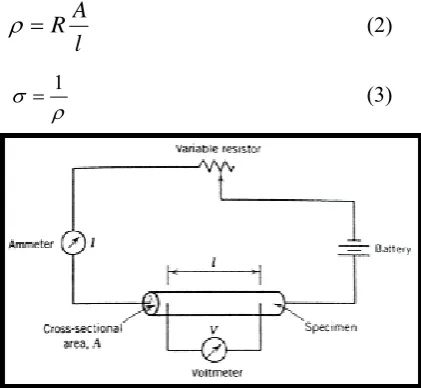
(3) International Journal of Integrated Engineering (Issue on Mechanical, Materials and Manufacturing Engineering). Table 1: Factor level in the experiment and Orthogonal array. Factor Experiment no. A. B. C. D. 1 2 3 4 5 6 7 8 9. 1 2 3 1 2 3 1 2 3. 1 2 3 2 3 1 3 1 2. 1 2 3 3 1 2 2 3 1. 1 1 1 2 2 2 3 3 3. sintering Composition Temperature (oC) 60 60 60 65 65 65 70 70 70. 1200 1250 1300 1200 1250 1300 1200 1250 1300. 2.3 Characterisation of Electrical Conductivity From the ohm’s law, the current (I) to the applied voltage (V) as follows; (1) V IR where R is the resistance of the material through which the current is passing. The value of R is influenced by sample configuration, and for many materials is independent of current. The resistivity (ρ) is independent of sample geometri but related to R through the expression where l is the distance between the two points at which the voltage is measured, and A is the crosssectional area perpendicular to the direction of the current.. R . 1. . A l. Experimental value Heating rate (oC min-1) 1.5 1 0.5 1 0.5 1.5 0.5 1.5 1. Soaking time (min) 60 90 120 120 60 90 90 120 60. Using equation 3 we can get the electrical conductivity using the resistivity result. Figure 2 show the experiment arrangement for measuring electrical resistivity. 3. RESULT AND ANALYSIS The electrical conductivity was calculated using resistivity from the sample after the sintering process. Three replications were recorded for each experiment as shown in Table 2. The ANOVA technique was used to establish the relative significance of the factors. As shown in Table 2, a combination of A3 B1 C3 D2 gives a maximum electrical conductivity (1225.41 S/cm). While, a combination of A2 B3 C1 D2 produced a minimum electrical conductivity for titanium foam (526.87 S/cm). These values are much higher compare to carbon fibre epoxy composite (300 S/cm) and carbon based polypropylene composite (36.4 S/cm) [10], [11]. Overall, the value for electrical conductivity of the samples was much higher than the requirement electrical conductivity for bipolar plate PEMFC. From the previous research, the requirement for electrical conductivity should be over 10 S/cm [9].. (2) (3). Fig. 1Schematic diagram of an experimental arrangement for measuring electrical resistivity [8]. 3.
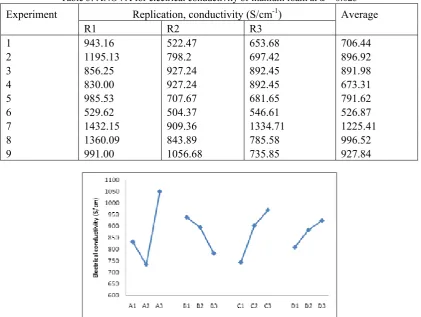
(4) International Journal of Integrated Engineering (Issue on Mechanical, Materials and Manufacturing Engineering). Table 2: Result Electrical Conductivity of Titanium Foams. Degrees of Sum Variable Freedom, squared, fn. Pure Sum Variance, squared,. Varience ratio, Critical F value. Contribution,. Sn. Vn. Sn. Fn. Pn. 235551.9. 392419.3. 5.987. 58463. 38241.5. 1.486. 164760.6. 3.094. A. 2. 471103.8. B. 2. 116926. C. 2. 243445.1. 121722.6. D. 2. 61492.2. polled. error. 18. 708160.4. 39342.2. Total. 26. 1601128. F0.025,2,18=4.5597. 2.39 F0.1,2,18=2.6239. 100.00 composition of the titanium powder has significant effect on the electrical conductivity at the 97.5% significance level or α = 0.025 followed by the heating rate with a significant factor at α = 0.1. On the other hand, the soaking time factors did not have any contribution for this experiment. For the sintering temperature factor, F ratio did not exceed 90% of significant level (2.6239) but it still gave 2.39% contribution for this experiment.. Table 3: ANOVA for electrical conductivity of titanium foam at α = 0.025. 1 2 3 4 5 6 7 8 9. R1 943.16 1195.13 856.25 830.00 985.53 529.62 1432.15 1360.09 991.00. 10.29 62.81. Besides that, the analysis of variance (ANOVA) was used to establish the relative significance of the factors. ANOVA is a table of information that displays relative influences of factor and interactions assigned to the column of an OA. Table 3 shows the results of the ANOVA after “pooling” with “at least 97.5% confidence”. From the ANOVA table, the effects of sintering factors on the electrical conductivity were determined. The. Experiment. 24.51. Replication, conductivity (S/cm-1) R2 R3 522.47 653.68 798.2 697.42 927.24 892.45 927.24 892.45 707.67 681.65 504.37 546.61 909.36 1334.71 843.89 785.58 1056.68 735.85. Average 706.44 896.92 891.98 673.31 791.62 526.87 1225.41 996.52 927.84. Fig. 2 Response graphs of electrical conductivity against various factors. 4.
(5) International Journal of Integrated Engineering (Issue on Mechanical, Materials and Manufacturing Engineering). optimum performance is as high as 1336.23 S/cm while the range of the optimum performance based on 90% confidence level is 1095.62 S/cm < µ < 1576.83 S/cm of the electrical conductivity. The optimum parameter has been proven in the confirmation experiment that is conducted at the combined setting of A3 B1 C3 D3 and the result fell within the predicted 90% confidence interval as shown in Table 4.. Based on the ANOVA, the main effect of the experiments is calculated based on the highest average value as shown in Figure 2. As shown by the response plot in Figure 2, a combination of A3 B1 C3 D3 is the highest yield, i.e., composition 70% of titanium powder, sintering temperature1200°C, heating rate 0.5°C/min and soaking time 120 minutes. The expected result at optimum performance is as shown in Table 4. The. Table 4: Optimum sintering parameter, optimum performance and confirmation experiment. Optimum parameter: A3 B1 C3 D3 (Composition, 70% of titanium powder; sintering temperature, 1200°C; Heating rate, 0.5°C/min; soaking time, 120 minute) Optimum performance: 1336.23 S/cm Confident interval: ± 240.6044 at 90% confident level (α = 0.1) Range of optimum performance: 1095.6226 S/cm < µ < 1576.8314 S/cm Confirmation experiment Repeat. 1. 2. 3. Average. S/cm. 1285.25. 1386.68. 1409.47. 1359.8. 5. CONCLUSION Electrical conductivity of the titanium foams was optimised using the Taguchi method. An L9 orthogonal array was used to vary the experiment variables. ANOVA showed that the composition of titanium powder and the heating rate as the most significant that influence the electrical conductivity of the titanium foams produced. The optimum sintering parameter were found to be A3 B1 C3 D3 corresponding to 70% of composition titanium powder, 1200°C of sintering temperature, 0.5°C/min of heating rate and 120 minutes of soaking time. Confirmation experiments indicated that when sintering titanium foam was performed at the optimum condition, an electrical conductivity of 1359.8 S/cm can be achieved.. 4. DISCUSSION From the analysis of the experimental results using the Taguchi method, the composition of titanium has the most significant effect on the electrical conductivity. Among the three compositions, 70% of titanium has the highest electrical conductivity. When more particle of titanium in the sample, more connection among of particle is obtained and more current (I) pass through in the sample. From the Ohm’s law theory, if current (I) was increases so the resistance (R) is also increases, therefore the electrical conductivity will be increased. The second factor which has a significant influence to the electrical conductivity is the heating rate. When the heating rate is increase, the porosity will be decreased and the grains become finer [5]. As porosity decrease, the sample will shrink further, and there will reduce the area of the sample. As the area of the sample decreases, the resistivity (ρ) will also decreases and the electrical conductivity will be increased, as state in equations 2 and 3. 5.
(6) International Journal of Integrated Engineering (Issue on Mechanical, Materials and Manufacturing Engineering). [9] Ruge, M. and Buchi, F.N, “Bipolar Elements for PE Fuel Cell Stacks based on the mould to size process of carbon polymer mixtures”, Proceedings of the first European PEFC Forum (EPCF), pp 299308, 2001. [10] Hwang, I.U., Yu, H.N., Kim, S.S., Lee, D.G., Suh, J.D., Lee, S.H., Ahn, B.K., Kim, S.H. and Lim, T.W, “Bipolar plate made of carbon fiber epoxy composite for polymer electrolyte membrane fuel cells”, Journal of Power Sources, 184, pp. 90-94, 2008. [11] Dweiri, R. and Sahari, J, “Electrical properties of carbon-based polypropylene composites for bipolar plates in polymer electrolyte membrane fuel cell (PEMFC)”, Journal of Power Sources, 171, pp. 424432, 2007.. ACKNOWLEDGMENT The authors would like to thank the Ministry of Science Technology and Innovation (MOSTI) and Universiti Kebangsaan Malaysia for their support in providing research grant for the project entitled “Development and Processing of Titanium Foam for Polymer Electrolyte Membrane (PEM) Fuel Cell Bipolar Plate” (UKM-KK-02-FRGS00052006). The first author likes to thank the University Tun Hussein Onn Malaysia (UTHM) for PhD scholarship. REFERENCES [1] Gottesfeld, S. and Zawodzinski, T, “Polymer electrolyte fuel Cells”, Adv Electrochem Science Engineering, 5, pp 195-301, 1997. [2] Hermann, A., Chaudhuri, T. and Spagnol, P, “Bipolar plates for PEM fuel cells: A review”, International Journal of Hydrogen Energy, 30, pp 1297-1302, 2005. [3] Wang, S.H., Peng, J. and Lui, W.B, “Surface modification and development of titanium bipolar plates for PEM fuel cells”, Journal of Power Sources, 160, pp. 485489, 2006. [4] Larminie, J and Dicks, A, “Fuel Cell System Explained”, United Kindom: John Wiley & Sons, pp 96, 2002. [5] Ji, C.H., Loh, N.H., Khor, K.A. and Tor, S.B, “Sintering study of 316L stainless steel Metal Injection Molding parts using Taguchi method: final density”, Materials Science and Engineering, Vol. A311, pp. 74-82, 2001. [6] Khairur Rijal Jamaludin, Norhamidi Muhamad, Mohd Nizam Ab. Rahman, Sri Yulis M.Amin and Murtadhahadi, “Analysis of Variance on the Metal Injection molding parameters using a bimodal particle size distribution feedstock”, Proceeding of International Conference of Mechanical and Manufacturing Engineering (ICME), pp 15, Johor Bahru, Malaysia, 2008. [7] Park, S.H, “Robust design and analysis for quality engineering”, UK: Chapman & Hall, 1996. [8] Callister, W.D, “Materials Science and Engineering an Introduction”, United Kindom: John Wiley & Sons, 2003. 6.
(7)
Figure
Related documents
However, including soy- beans twice within a 4-yr rotation decreased cotton seed yield by 16% compared to continuous cotton across the entire study period ( p < 0.05); whereas,
Biofilm production by selected strains of bacteria (a) and yeasts (b) in the presence of Textus bioactiv, Textus multi dressings, and culture broth without dressing.. The figures
Screening of cytotoxic activities using WiDr and Vero cell lines of ethyl acetate extracts of fungi-derived from the marine sponge
In summary, we have presented an infant with jaundice complicating plorie stenosis. The jaundice reflected a marked increase in indirect- reacting bilirubin in the serum. However,
A basic task in sentiment analysis is classifying the polarity of a given text at the document, sentence, or feature/aspect level—whether the expressed opinion in
Cite this article as: Cheng et al.: Weak up-regulation of serum response factor in gastric ulcers in patients with co-morbidities is associated with increased risk of
In conclusion, the finding of this cross-sectional study of pre and post menopausal women show no evidence of a significant difference in BMD between Ocs users and never user
Antihypertensive therapy in hypertensive patients imme- diately post stroke may be effective and cost-effective compared with placebo from the acute hospital perspec- tive at
