LEARN BY DOING: A GLANCE IN AN APPROACH FOR
BETTER SKILL ENHANCEMENT IN ENGINEERING
PROGRAM
A YOB JOHARI WAHID RAZALLY
AFANDI AHMAD
DANIAL MD NOR
MOHD HELMY ABD WAHAB
MOHD ERDI AYOB
NIK SHAHIDAH AFIFI MD TAUJUDDIN
INTERNATIONAL CONFERENCE ON ENGINEERING
TECHNOLOGY
1 1 - 1 3 DISEMBER 2007
LEARN BY DOING: A GLANCE IN AN APPROACH FOR BETTER SKILL ENHANCEMENT IN ENGINEERING PROGRAM
Ayob Johari WahidRazally, Afandi Ahmad, Danial. Md. Nor, Mohd. Helmy. Abd.Wahab, Mohd .Erdi. Ayob, Nik Shahidah Afifl Md. Taujuddin
Universiti Tun Hussein Onn Malaysia
ABSTRACT
This paper focuses on the implementation of engineering programmes in the Universiti Tun Hussein Onn Malaysia (UTHM). UTHM is one of the first technical universities formed in the country that offers engineering program with more emphasize on the practical aspect. The amounts of theoretical engineering contents are at least similar with the so called conventional engineering program in conventional universities. The extra parts are the elements of practical which based on the activities in the workshop or field work. All of these are to enhance the students' skill in certain area of expertise. The practical activities are conducted by adopting the concept of 'learn by doing', 'problem-based learning', 'and practical-'problem-based learning' etc. Other aspect that is given attention is the way the lectures are delivered to the students. UTHM is adopting the concept of lecture cum-lab in which students can easily relate the theory they learnt and apply it in practical in the same lab. Certain concept, operation, function and the usage of certain equipments can be easily understood by showing and demonstrating them while having lecture. Students can simply grasp, hold, and use it from the very first day of their lectures. This will definitely help the students to understand and appreciate better.
Keywords: technical university, problem-based, learn by doing, lecture-cum-lab, grasp. Introduction
Education plays a key role in the development of nations throughout the world. The success or failures of nations depended on the extent to which the populations of these nations have access to education. Education is one of the principal means to foster human development as well as contribute to national development. Education has to lead in the invention and reinvention of societies. It derives its strengths from interaction with other sectors, namely economic, political, social and cultural, both within and across national boundaries.
, 1 '
engineers (14,000); and 29,000 chemical engineers (3,000). On top of that, the country also needed 312, 000 systems analysts and computer engineers. Malaysia's economic development had undergone a major transformation over the last 30 years, with the introduction of the New Economic Policy (NEP) in 1971 which came to an end in 1990. Under the National Development Policy (2001-2020), the nation has come to the second phase which basically focuses on automation in the employment sector.
The engineering education in Malaysia is regarded as 'difficult' program to the majority of average students. As such, the engineering education programs are mostly dominated by students with more exposure in related field or by students from urban schools. The university colleges in Malaysia have to move forward to promote engineering education more aggressively especially for those who are graduating from remote schools. They have very important role to play in bringing up the number of graduates in engineering profession for the need of various industrial sectors in the country.
While we are working on providing training for engineering graduates, we should always bear in mind that the context of education is rapidly changing due to dominant global forces such as globalization, liberalization, and Knowledge-based Economy (K-economy). The seriousness and impact of the present and future changes in these sectors and contexts will require education systems to review and make the necessary changes or improvements. In this context, the conventional engineering program that normally offered in traditional universities, need to be realigned its scope of implementation to cater the need of rapid development in engineering and industrial sector.
In order to ensure educational excellence in a complex and rapidly changing environment, there is a dire need to examine the development affecting education, and explore how education would change, what the consequences and implications are, and what needs to be done. All these would have a great impact on the present and future generations as well as nations. The real challenge to educationists and the government is to devise strategies that are creative, innovative, proactive, visionary and future-oriented.
Background
In 2000, the programs are open to all qualified candidates not just for the Ministry of Education Malaysia candidates only. The programs have been running well ever since and had acquired positive response from the stake holder (clients).
To enhance the competitiveness of the programs and to strengthen its operation, certain elements of practical, skills and hands-on were added in the programs. These will be the added value of the programs compared with other universities. The elements of practical and hands-on are embedded in the programs and also carried out in different semester by itself. The programs are designed to encompass among others are the following crucial thrusts:
• enhancing competitiveness to meet the challenges of globalization and liberalization; • strengthening human resource development to produce a competent, productive and
knowledgeable work force, and
• enhancing productivity growth through improvement in workers knowledge, skills and expertise as well as upgrading of R&D and science and technology (S&T);
• expanding the usage of ICT within and across sectors to accelerate the growth process; • strengthening the human resource base to ensure the availability of manpower with
higher levels of knowledge, technical and thinking skills,
• intensifying efforts to nurture and inculcate positive values and attributes among Malaysians through the education system, social and religious organizations and the media.
Training of engineers in Malaysia
The training of engineers in Malaysia started from as early as student enters his/her tertiary education. Malaysia has more than 15 public universities including the most recent five university colleges. Most of the earlier universities such as University of Malaya, National University of Malaysia, University of Science Malaysia, University Putra Malaysia, University of Technology, Malaysia etc. offer engineering courses in electrical, mechanical, civil, chemical etc. The engineering programs offered in those universities are very traditional and conventional. Meaning that the programs are very much suitable for highly academic students to be scientist engineers. These conventional engineering programs are called Model I. But there are others in the so called practically inclined learning students. These students need to be given equal opportunity to further their tertiary education in the practical environment and the type of programs offered in UTHM are catering for these students. These programs are referred as Model II.
1
education (SPM) examination, good students are normally continuing their study in matriculation center under the Ministry of Education, Malaysia. Some will go to polytechnic to continue engineering program at certificate or diploma level. Only small percentages prefer to continue into sixth form to sit for the Higher Certificate of Education (STPM).
The engineering program offered by the universities takes at least four years to complete after matriculation or STPM. Another route of entry will be from the polytechnics of Ministry of Education, Malaysia. The polytechnics offer courses in various field such as commerce, engineering, accountancy etc. at certificate and diploma level. Only those with diploma in engineering will get entered into the second year of studies in degree of engineering at the university.
Apart from the public universities, there are 666 private institutions either at the university status, branch campuses or colleges established throughout the country up to 3 1s t May 2001. Out of that number 22 are recognized by National Accreditation Council
(LAN) to offer degree program solely or through collaboration with overseas universities. The establishment of these private universities had helped the government to cater the need of the people to pursue their tertiary education locally. At the same time it was also helped to spear head the nation to be the center of education in this region. Most of the engineering program run at these private universities are in a form of 2+2 or 3+1 program. Students have to spend for at least one year at the main campus abroad during the course of their studies.
The Model II Curriculum
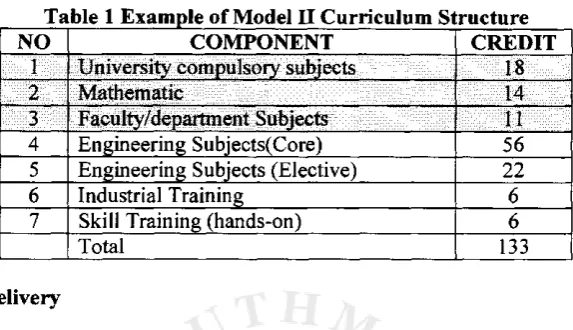
The curriculum structure of the engineering programs offered is basically divided into two main sections namely social sciences subjects and engineering subjects. The universities that offer the program have to abide by the rules and regulations set by accreditation and professional bodies such as Board of Engineers, Malaysia and Institution of Engineer Malaysia. Under the regulation, the total number of credit for any engineering program offered by university must not less than 120 credit. One credit is equivalent to one hour of lecturing or 2-3 hours of practical activities. Out of this total credit, 40 credit must comprise humanities, social sciences subjects and the remaining 80 hours comes from engineering subjects. Example of Model II engineering curriculum structure is shown in Table 1. The non engineering subjects totaled 43 credits and the engineering subjects totaled 90 credits. These conform the requirements set by the accreditation body in Malaysia.
The so called hands-on training in the short semester will be carried out in the second year of study and given six credit. Students are also required to do industrial training in the related field. The training is carried out in the short semester in the third year of their study. The training is given six credits.
Table 1 Example of Model II Curriculum Structure
N O COMPONENT CREDIT
1 University compulsory subjects 18
2 Mathematic 14
3 Faculty/department Subjects 11
4 Engineering Subjects(Core) 56
5 Engineering Subjects (Elective) 22
6 Industrial Training 6
7 Skill Training (hands-on) 6
Total 133
Modes of Delivery
Most of the engineering subjects carry three credits each. Each credit is equivalent to one hour of lecture. For three credits subject will have three hours of lectures and 1 hour of tutorial. Each engineering subject consists of list of topics and project activities in its curriculum. In the project activities, students are required to do small projects related to the topic taught in the lecture. The project may last for couples of days or weeks. The students need to allocate their own time to complete the project. They can do it on Saturdays, during the laboratory session or term break. The objectives of introducing mini projects in the subjects are to;
• give first hand experience for students to use basic hand tools • Gain experience on how to handle equipments, meters, tools etc. • understand and to know how to handle the specialize equipments • enhance the hands-on skills
• Enhance the creativity, critical thinking etc.
Some examples of mini project are as the following.
• design and fabricate regulated dc power supply • design and fabricate FET power amplifier • design and fabricate of cantilever bridge
• design and fabricate of portable hydraulic system
The projects will be graded and the marks will be added together with the course work marks of the subject.
explaining, showing and demonstrating the real equipments related to the topic. Students will have the opportunity to see, hold and know how to use the equipments right from the first day of their lecture. These will help the students to understand better the topic taught by their lecturer.
Programmes at UTHM - An experience and overview
UTHM have an on-going programs in Bachelor of Engineering with more emphasize on practical. These programs are currently offered by the Faculty of Engineering Technology. There are three major engineering disciplines namely electrical, mechanical and civil engineering. These programs are designed in such a way that the practical aspects are given more emphasizing across the curriculum. The graduates will be knowledgeable in their respective discipline with strong technical knowledge and have acquired some skills.
UTHM hopes to produce graduates with the following
abilities:-• Able to think and make of intelligent decision based on substantiated idea and facts.
• Aware of the development of new technology in the related fields.
• Skillful in various kind of works, and able to manage workshops and laboratories.
• Responsible and dedicated to the society and nation.
An engineer must therefore be trained to manage the rapid development in engineering and technology and must be able to combine comprehensive know-how and know-why and in depth practical know-how in design, operation, maintenance, fault analysis and repair of complex high technology plant and equipment. This call for a different set of highly skilled and versatile work force and has far-reaching implications to the present approach of engineering training in this country. Practical and competent engineer has to be well trained especially in the following aspects
[4]:-a) technical competence b) learning competence c) social competence
The country is moving towards globalize high-technology industrial society and k-economy and thus places different demands on long term engineering and technological training. Review and changes are now necessary to ensure that the engineers are prepared for the future in the three aspects mentioned above. The learning by doing, problem based learning, or the kind will actually enhance the students' abilities and skills in the competencies they should acquire. The competencies are;
a) Technical Competence
materials and substances until the product is created or the services are rendered. This requirement enforces the need for two types of engineers, the theoretical capability of an engineer and the competence and skill of the engineer to implement and turn ideas into reality.
The training program for engineers and practical and competent engineers must therefore be distinct and appropriate according to the needs of the profession. Therefore new university colleges need to prepare graduates required by the current industry. The new engineers must learn the skill to retool and relearn quickly to respond effectively to the rapid and multiple changes in the profession. These engineers called practical and competent engineer should be able to perform their task independently and perform wide variety of tasks in the ever changing work environments. They must also be able to mediate effectively between planning, execution and control of processes.
b) Learning Competence
One of the first things an engineer does when acting in an unfamiliar area is to learn about the situation. Learning competence is very important because of the decreasing half-life time of knowledge and engineers need to be able to learn new knowledge and skills as quickly as possible. Therefore the process of learning that is the competency of learning itself has to be addressed. The attitude of being responsible for the learning process and the competency to master the learning process including for instances, computer literacy and various other means and ways of learning, have to be trained. Learning through the internet is another important learning skill that should be provided.
c) Social Competence
Problem solving capabilities in an enterprise or a team is an essential skill for a practical and competent engineer. This capability normally requires the ability of the engineer to work together with other employees and to bring about such integration can be defined as social competence [4]. Social competence will lead to other process which will make the engineer's job more effective.
A good social competence can help to integrate the following individual processes and activities:
ii) Able to react adequately to various management and administrative function within the enterprise (e.g. job scheduling, job evaluation, accounting, works council insurance and health)
iii) Able to apply various communication system (linguistic, mathematical, graphic as well as electronic communication)
Normally, short term courses can be used to address technical competence. Industry and other sectors of the economy will never cope with changes in the working environment without skills upgrading through short term courses. The acquisition of behaviour is a long-term process and has to be trained in a real life situation. A training institution should generate learning situation that promote such behaviour. Training, short or long term will only be effective if there is a solid foundation and an industrial discipline, complimented with serious commitment.
The engineer training program should expose student to solid basic knowledge and allows some diversification especially in industrial projects. The practical and competent engineer should be trained extensively in practical skills using wide range of application teach ware and computer based learning approach should be encouraged.
Engineering technologist should be trained using real machineries as much as possible, not just demonstration set. They should be provided with well planned, guided and supervised industrial exposure. Current technology should be emulated in the training program and if possible the training should be as close as possible to the real technological enterprise. Most if not final year projects should come from industry. The program should promote job competency and the graduates should be able to start work as soon as they graduated.
Lecturers should be encouraged to undergo continual upgrading and specialization due to fast changes in technology. There should be special training in current technologies short term as well as long term. Appropriate scholarships should be made available to all lecturers and they should be allowed to joint industries and come back to teach after that without loosing seniority and promotion. Lecturers, instructors and supporting technicians should posses the capability to change, learn and relearn new technologies. Continuous effort on skill upgrading should be carried out.
There should also be a centre in the University for high technology training which can be called transfer centre. The centre should be a base for in-service training of instructors, a resource for information on latest technology and also training services for industrial clients. The centre should also be a centre where new knowledge is shared and research carried out jointly with the private sector.
industry into the institutions. Close co-operation between industry and institutions is a critical factor.
PRACTICAL AND COMPETENT ENGINEERING PROGRAM: IMPLEMENT STRATEGIES
Engineering is an art rather than a science. A major engineering activity is problem solving, and for some engineers this is an art. The engineering method of problem solution includes a clear statement of the problem and necessary assumptions, the mental creation of a concept or device or system that appears to meet the need, a logical analysis of the situation based on established principles, a careful checking of the results, and a set of conclusions or recommendations based on the facts. On the basis of inadequate information, the engineer must design for the unknown future. The ability to conceive an original solution and predict its performance and cost is a distinguishing attribute of the professional engineer. In contrast, the function of the engineer is "to do". The engineer brings science to bear on practical problems; the engineer is a person of action. The engineer uses science, but is not limited to scientific knowledge.
Engineering is a profession with four common characteristics,
1. Associated with a profession is a great body of special knowledge. 2. Preparation for a profession includes training in applying that knowledge. 3. The standards of a profession are maintained at a high level through the force of
organization or concerted opinion.
4. Each member of a profession recognizes his or her responsibilities to the public over and above responsibilities to clients or to other members of the profession.
In order to produce engineers with the knowledge and appropriate and related practical skills, the university colleges may adopt the following method in the implementation of its programs.
Problem based learning - A professional engineering practitioner learning program. The traditional teaching and learning engineering subjects are well known and well practiced in most universities. This method has been practiced by many engineering practitioner including Malaysian universities and well recognized by accreditation and professional bodies which govern the validity of the program offered by the universities. The so called traditional learning method, students have to spend more of their time in learning the theoretical principles with little emphasize on the practical aspect of the subject. Over the years, the same method has been practiced and at the end of the day, the graduates seem to have discrepancies in areas such as hand-skills in their respective disciplines.
each semester of study designated as a single subject incorporating Project Based Learning. In some countries such as Australia where PBL is practiced the findings of the Institution of Engineers, Australia (IEAust) review of professional engineering education "Changing the Culture: Engineering Education into the Future" published in December 1996, supported the integrated, generic and technical knowledge and skills development approach of the new program. The objective was to establish a new learning paradigm for students to develop into exemplary practitioners of the engineering profession.
An excellent way to learn and understand a theory is trying to see whether we can apply the theory. Engineering is problem solving — by applying results from engineering research. Therefore it is obvious to try to combine the fundamental learning process and engineering problem solving. The Problem Based Learning concept allows the students to develop excellent analytical skills and they add up with good experiences in coping with and attacking complex engineering problems. In addition to a thorough theoretical insight the students become experienced in applying the theoretical elements from the lecturing in practical engineering problem solving.
A great variety of projects at all professional levels must always be accessible, and co-operation between university (students, researchers) and industry is a necessity to find enough relevant real life problems. On the other hand, this co-operation will increase the contact and mutual understanding between industrial development centers, students and university professors with benefit to all partners. In the light of the experiences from this concept some further development will make it possible to integrate productive engineering and engineering education.
Why use Problem Based Learning (PBL)?
The normal delivery of engineering program seems to be lack of practical elements in the majority of engineering subjects. PBL will be dealing with learning in which the context for the learning would bring enthusiasm to students. The following outcomes are what was expected would be achieved by engaging students in problem based learning.
• Motivation • Enthusiasm • Context
• Problem Solving Skills
• Act as a practitioner of the profession • Critical thinking
• Proactive thinking • Systems thinking • Team Skills • Leadership skills
• Ability to work as part of a team (vs. group) • Social skills
• Ethics
• Self directed learning skills
• Ability to find and use appropriate resources • Self sufficient
• Self motivated
• Communication Skills
Other aspect of approaches that can be linked with PBL is work based learning, project based learning, experienced based learning, competency based learning etc. All of these approaches enriched the students' outcomes as mentioned above.
The current curricula i) The Lecture
The engineering programs offered by the faculty (Faculty of Engineering Technology, UTHM) are practical biased. Its curricula are the comprehensive combination and properly blended with the theoretical and practical aspects. The curricula are designed based on the guide lines of the Board of Engineers Malaysia.
Apart form the technical subjects, students need to enroll soft skill subjects such humanities, Islamic Civilization, foreign language, entrepreneurship, critical thinking, creativity and innovation, environment awareness, and management. The spirit of having students to enroll these subjects is to prepare them to be better engineer not only practically (physically) but spiritually. The graduates are supposed to be more rounded in all aspect of working environment, easily adaptable to any changes in the course of their work in future.
In the implementation of the program, lectures are not solely delivered in conventional classroom or theatre. It is delivered in many modes depending on the nature of the subject. Lecture cum-lab is one of the examples, in which lectures are delivered in a laboratory environment where the equipments or tools related to the subject matters are easily accessible during the course of the lecture. With this, the lectures are more easily understood, more appreciated, and students are more motivated. This approach may create an environment where a lot of activities and mobility happen among the students. Students are given enough support, motivation, time and facilities to explore in depth on any particular topic or subject.
In the aspect where very specialized topic or technology needs to be delivered to the students, experts from related industries are welcomed to give lecture, present demonstration, seminars or talk to the students. This expert or invited lecturer will be paid on hourly basis by the university.
ii) Laboratory/Workshop
offered. It is practically implemented in the laboratory session, field work, small project work which takes up in between 40 - 50% of total students learning time in a week.
The type of experiment, work laboratory or workshop is related to industry, that means students are not merely do experiment just for the purpose of validating theory as what normally do in conventional engineering program, but they will perform experiment which relate to reality and industry. Students are also taught on the safety in the workshop, health, cleanliness, work ethic and so on. Students will have more exposure to experience on the use of real equipments during the laboratory session. This will eventually enhance and enrich students skill and confident in using the equipments.
iii) Project Work
Final year project is a must to every bachelor degree student. It takes two semesters to complete in their final year of study with the total of six credits. The project can be carried out by group or individual. It can be in a form of a new design, modification or improvement of the existing system or equipment, and industrially based. At the end of the project work, the students are expected to fabricate the product.
iv) Industrial Training
Industrial training is one of the major parts in the curriculum structure of the program. Training for duration of one complete semester is a must for every engineering student. The training will be in between third and fourth year or at the end of semester. They have to undergo training for at least 12 weeks in any engineering related field. The program is designed for students to enrich their knowledge, technical skill, soft skill, work ethic and so on. Every one of them will be given log book in which they have to take note all the important and significant activities during the industrial training period. These placements, which are an academic component of the program, allow students to apply their already learned skills and knowledge. They will be monitored and evaluated by the industry personnel assigned by the university and lecturer from the faculty.
The faculty considered that the feedback from the employers would be a valuable interim assessment of the effectiveness of the new PBL program.
The lecturers and students are ever ready for the change. The industrial training will benefit students in many ways; such as:
• Function independently • Work in a team
• Communicate articulately • Problem solve
• Know their limitations, and are prepared to ask for help
Assessment
Each of the projects was given a percentage of the full term's mark. Each student's final grade was then determined by moderating that mark based on peer assessment and the supervisor's observations of how that student had performed in their teamwork. Assessment is also carried out based on portfolio presented by student. The portfolio could include anything that the student wanted to use to build their case, and could include work done elsewhere.
The only compulsory component of the portfolio was a reflective journal, and a reflective paper. The reflective paper was the only individual piece of work set for the subject. The intention of the reflective paper was to encourage students to read a philosophical book, and relate the reading to their learning objectives. A suggested reading list was supplied. The reflective journal was to be the student's main continuing assessment item, which had to be part of their final portfolio submission. In this journal students were expected to comment on what they had learned and reflect on why and how they had developed over the course of the term in the context of their learning through their team activities and projects carried out. It was emphasized that all activities, including extra-curricular, that they believed had helped (or hindered) their development towards becoming a professional engineer, should be included. It was believed in addition to other benefits this would be the best way students could demonstrate the transfer of learning capability that would typify a mature and responsible learner.
Outcomes
The main issues that will determine the ultimate acceptance and success of the program are an ongoing acceptance of, and engagement by, staff and students, in the cultural change in the learning environment. To achieve this, it must be remembered by all that:
• the students need time to develop specific skills
• the staff need time to develop specific skills (in facilitating the projects) • project subjects must integrate technical and generic knowledge and skills.
• the program is attempting to transform entry level passive learners into active learners
Many of these issues can be overcome by ongoing staff development and a commitment by staff to the program and its aims and ideals.
CONCLUSION
other traditional universities. Feedback from students and employers of co-operative industry placement students indicate that many of the goals of the program are being realized. The ongoing success of the program will however require a team commitment from the staff of the faculty.
REFERENCES
Institution of Engineers, Australia Task Force (1996), Changing the Culture: Engineering Education into the Future — Review Report, Institution of Engineers, Australia: Canberra
Economic Planning Unit of Malaysia (EPU), 1991, "RRJP2 dan RM6 Perlaksanaan Dasar dan Program " Malaysian Government Printers, Kuala Lumpur.
The Prime Minister Department, Government of Malaysia, 1991, "The Second Outline Perspective Plan 1991-2000" Malaysian Government Printers, Kuala Lumpur, Malaysia.
Malaysian Government (EPU), 1996, "Rancangan Malaysia KeTujuh, RM7, 1996-2000 ". National Printers of Malaysia Limited, Kuala Lumpur, Malaysia.
Corfield K. "Getting The Engineers We Need" Proceeding of Institution of Mechanical Engineers Vol. 1988 No. 14, 1984.
ELMS D.G. 'Formation Of The New Engineer" AEESEAP, Journal of Engineering Education, Vol. 22, No. 2, 1992.
Yeoh Hak Koon "Rethinking Engineering: Creation of Wealth?" Buletin Bulanan IJM, No. 5, Bil. 1998.
D a m W a t e r Level Control using E m b e d d e d W e b Server
M. H. Yusof, S. I. A. Y a m i n , D. M. Nor*, M.M. S o m , M. H. A. W a h a b , A. Johari, N.S.A.M. Taujuddin
Faculty of Electrical and Electronic Engineering Universiti Tun Hussein O n n Malaysia P . O . Box 101, Pt. Raja, 86400 Batu Pahat, Johor
E-mail: {danial, mohamads, helmy, ayob,shahidah}@uthm.edu.my
A B S T R A C T
This paper presents the designation and implementation of a dam and river controller unit connected via Local Area Network. A prototype known as Dam Water Level Control Using E m b e d d e d W e b Server is a web-based dynamic system to control and monitor overall d a m ' s system through web pages. Through remote monitoring, several sites will be able to monitor from control room, hence it will minimize labour and time usage. Apart from that, this system also may reduce mistakes from h u m a n m a d e and monitor r i v e r ' s water level at upstream and downstream river consequently, it may avoids flood if dam releases a lot of water. Beside that, connectivity is cheap and using L A N is by far one of the cheapest methods of electronically connecting large physical area. T h e design project successfully implements an embedded network enabled dam system controller. R C M 3 0 0 0 microcontroller is used in main module to control the whole system operation. RJ-45 Ethernet cable used to enable the communication within microcontroller and server through TCP/IP port. Dynamic C programming language is software used to programme R C M 3 0 0 0 as H T T P servers that will response to the web browser request through Graphical User Interface (GUI), and alert user will be available via e-mail to mobile phone. W e b authoring tool is used to create web page and User Login and P H P code to setup security system. Beside that, remote monitoring system will perform when high level sensor is detected, a warning e-mail will be sending out from the system to e-mail server. Hence, this research is hopefully can be considered as alternative way for the support group to provide quality services.
I N T R O D U C T I O N
In the world that heading towards globalization in technology, we are m o r e focusing to wireless system communication as well as web communication (S.O. Jr, 2007). It provides us seamless connectivity, flexibility, and mobility. The availability of monitoring and control systems has greatly enhanced the product and contributes to reduction of costs.
N o w a d a y s , water level controls of dam are controlled manually. But n o w , d a m ' s water level should be more practical to control greater amount of water. Moreover, current manual system needs a lot of workers to control and m a n a g e the dam. Problem will arise during rainy season, when the water level of dam will increase dramatically and the administrator should take immediate action to open the valve before unexpected incident happen.
This project is developed to centralized the control of dam system. It used GUI (Graphical User Interface) to control system. Users can access the system through U T H M ' s L A N network. Generally, this system automatically activated when the sensor detects the water. Analogue signal from sensor will be send to Rabbit Microcontroller Module through the interface circuit that will change the analogue signal to digital signal. Graphical User Interface (GUI) has been designed to control the whole system automatically as well as manual. Administrator can either open or close the d a m ' s gate by click the mouse at GUI.
R E L A T E D W O R K
other features c o m m o n to web browsers. When applied to embed systems, web technologies offer graphical user interfaces, which are user-friendly, inexpensive, cross-platform, and network-ready.
T h e architecture o f an embedded web server that can provide a simple but powerful API also can be constructed. T h e P O S - E W S , which is an embedded web server, is developed for web-based network element management. P O S - E W S ' s also can make performance evaluation and E W S optimization in a commercial Internet router.
All kinds o f peripheral device can be connected using web connection and plug and play technology. Any information can be access using W e b Browser through Ethernet and TCPIP. It also make user interface more interactive and interesting. Accessing and processing data also can be done using Web Server. T h e client only needs to request, receive and read the displayed information. Administrator also can m a n a g e their o w n properties and always has the right to access the W e b Server. It will bring a great convenience for administrator in terms of maintenance and management. With lots more archive in openness and standardization in automation system, application of W e b , Ethernet and TCP/IP, contribute to the popularity of real-time Ethernet distributed control system based on embedded Web ( H . W u e t a l , 2004).
High performance monitoring and control of real-time environments over network is one of the important element in modern process control. The designed system will focus on meeting the special requirements in control-level at communication systems to transmit real-time data via a switched Ethernet Network. Helei W u introducedt he architecture of the e m b e d d e d - w e b based distributed control system as well as hardware configuration and software structure of the embedded web server (H.Wu et.al, 2004).
An open web structure and open communication protocol will definitely b e c o m e great impetus of industry automation. In industry control system, the distributed control system which is based on Switched Ethernet can be used in combination with embedded W e b technology to produce a n e w system design that will contributes greatly to the openness of the whole system.
Safaric introduced a new w w w based virtual laboratory for robotics engineering, allowing both interactive simulations and remote experimentation with a real world robot mechanism (Safaric, 1999). Users can configure the robot tip path and parameters, invoke the experiment, and analyze the response of the robot system via internet. Presented approach requires the user to develop tasks off-line, using their local computing resources and a V R M L based simulation model and teach pendant which incorporates enhanced collision detection, before submitting the experiment to the M u M a T E laboratory server for execution on the actual device.
M E T H O D O L O G Y
POWER SUPPLY
ROM 3000 RABBIT CONTROLMODULE
O U T P U T I N T E R F A C E
C I R C U I T
O U T P U T I N T E R F A C E
C I R C U I T
INTERFACE CIRCUIT
D«OL Sensor 1 (HIGH)
D s n Sens or 2 (NORMAL))
D * n Serif or 3 . ( L O W )
INTERFACE CIRCUIT
Rarer Sensor 1 (HIGH)
R r v w Sensor 1 (NORMAL)
River Sen*or 1 (LOW)
Valve 2 VaVe 1
U T H M SERVER
T h e dam control systems today usually using the manual systems to control the water level. N e w method is needed to ease this controlling system. This project is concerned with the design of dam control system using the embedded web server where the proposed systems allow dam water level is control from remote.
R C M 3 0 0 0 embedded web server microcontroller is used to control overall system operation. This microcontroller is capable with TCP/IP port. The microcontroller is programmed using Dynamic C programming language. RJ-45 is used to connect to Ethernet port. T h e connection is used to consent the communication between the microcontroller and h o s t ' s server.
Administrator of the system can monitor and control the dam using G U I . This online monitoring system enable the administrator to open or close the valve and gate immediately when the sensor at the interface circuit detect unusual even. By using the system GUI or mobile phone, administrator can instruct the microcontroller to activate the output interface circuit.
S Y S T E M S D E V E L O P M E N T A N D I M P L E M E N T A T I O N
D a m Water Level Control is a realistic and practical system that has been design to control and monitor the dam system via web pages and mobile phone. This system divided into t w o parts. First part is hardware part which is developing the prototype of dam. While the second part is software part which including programming the microcontroller and designing web page.
There are six water sensors used to detect water level in the dam and river. T h e level of the river is indicated in 3 stages that are; high level, normal level and low level. O n c e these sensors detect water at certain level, it will send the signal to microcontroller. Then the microcontroller will be triggered the server to send S M S alert message to dam administrator and the information also send to the web site.
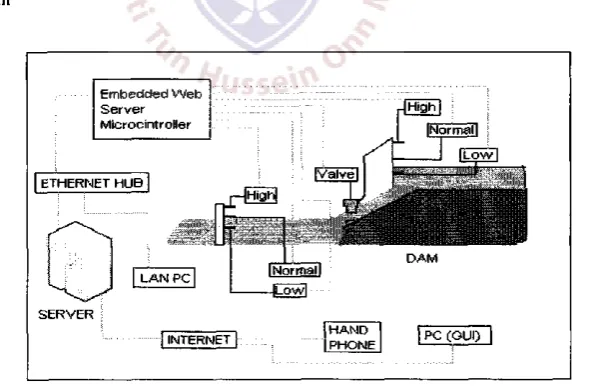
So, if the administrator is out of the station, he still can control the situation of the dam by opening or closing the valve via web site. T h e administrator can open the valve when the water level of the dam is too high or close the valve when the condition is back to normal. Figure 2 shows the graphic design of the system
Embedded W e b Server Microcontroller
4 High I
INormall j
ETHERNET HUB IVaivel
i N n r r m l l
— O w l
SERVER
[image:18.594.169.474.433.626.2]INTERNET H A N D PHONE 1 PC (GUI)
Figure 2: Graphical design of the system.
| M I C R O (.' O N T R O L L E R f
Figure 3 : T h e Prototype of Dam Water Level Control Using E m b e d d e d W e b Server.
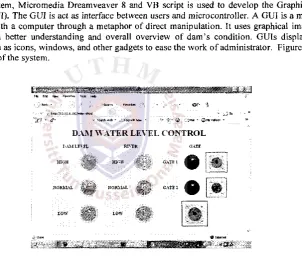
For Web system, Micromedia Dreamveaver 8 and VB script is used to develop the Graphical User Interface (GUI). T h e G U I is act as interface between users and microcontroller. A GUI is a method of interacting with a computer through a metaphor of direct manipulation. It uses graphical images and widgets for a better understanding and overall overview of d a m ' s condition. GUIs display visual elements such as icons, windows, and other gadgets to ease the work of administrator. Figure 4 shows the interface of the system.
FIE EDIT VTNV F-SVOTFTOI TOOTS HELP
-<'-- .-<'--JBOTK • • .. -•SEARCH • FEVORTM • • ": • A
•••r ..;IHFLP:,7l0,l0.6,LD0F)NDB<.IJTJFIL :. J SO •. < " "jif * <?" V 5!ARRHVVEB - ,-}UPPREDE NOW I - '— -s^-> <G> . :>;MAL * ^HYVAHOEI - »
DAM WATER LEVEL CONTROL
D A M LEVEL RIVER GATI
man HIGH OATS 1
•
" i s .
NORMAL ^ K O R i l A L GATE 2
•
s
LOW LOWM
Figure 4: T h e interface of the system.
The hardware of the project is divided to three main circuits that are Power Supply circuit, Output circuit and Input circuit.
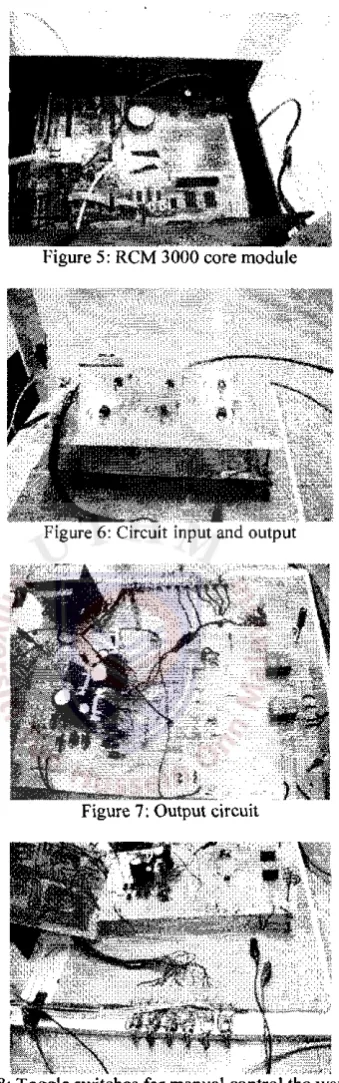
Power supply provide three state voltage with two channel 12 volt for output (trigger circuit), supply for input p o w e r and R C M 3 0 0 0 microcontroller board. Other one channel is 5 volt for L E D turn ON at output circuit. T h e L E D indicators at the output circuit will O N if the 5V voltage were trigger from the relay. The relay will trigger if there is a voltage appear from the microcontroller output. The functions of this circuit are to open or close the gate (valve) if the user pushes the toggle button at the GUI page. This circuit is an active and passive component.
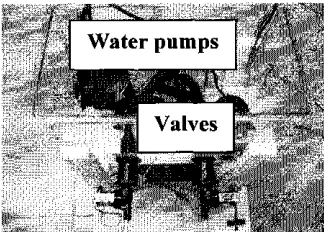
Figure 9: T h e water pumps and the valves
R E S U L T A N D A N A L Y S I S
Basically this project is successfully done. The system will alert user via S M S system when high level sensor detected either in dam or river. User can monitor the dam situation either in workplace or other places. User will be identify to control the system either automatically or manually, regarding on the situation in the dam. User can access the web site using P D A , L A N networking or any places that have internet.
A l a r m s S i g n a l
M o b i l e P h o n e
M o b i l e P h o n e W A P G a t e w a y
Y a h o o P O P3 S e r v e r
: I n t e r n e t
W e b S e r v e r
[image:21.595.248.410.86.202.2]U - r
Figure 10: Remote Monitoring Process Plant Block Diagram.
Remote Alarms Monitoring and Water Level Control System had been designed to remotely monitor six different types of signals. Alarm will alert user when dam water level detects the high water level.
[image:21.595.212.451.321.443.2]E N V I R O N M E N T A L S E N S O R S S P E C I F I C A T I O N S
Table 1: Sensors Configuration
Sensors Parameter C o m m e n t
D a m Water Sensor 1 High Level Water Use to detect high water level at the dam. Ovoid water overflow by dam
Dam Water Sensor 2 Normal Level Water
Use to maintain abstemious of water level in the dam.
Dam Water Sensor 3 L o w Level Water Use to k n o w critical water level in the dam.
River Water Sensor 4 High Level Water Use to detect high water level in the river. Ovoid occurs the flood.
River Water Sensor 5 Normal Level Water
Use to maintain abstemious of water level in the river
River Water Sensor 6 L o w Level Water Use to avoid s e a ' s water enter to the river, because low level water.
[image:21.595.129.522.508.722.2]C O N C L U S I O N A N D R E C O M M E N D A T I O N
This project has described the basic design approach for Dam Water Level Control Using Embedded W e b Server. Control and monitor systems is not something new as there are many different kinds of technologies, solutions and system currently available in the market. T h e idea of this project is to propose a d a m ' s monitoring system which provide a cheaper cost, practical, efficient and user friendly features.
R E F E R E N C E S
Sixro Ortiz Jr., (2007). "Searching the Visual W e b " , Computer Magazine, I E E E Computer Society.
Hong-Taek Ju, Mi-Joung Choi and James W. Hong, (2000). "An efficient and lightweight embedded W e b server for Web-based network element management", International Journal O f Network M a n a g e m e n t 2 0 0 0 ; 10:261 - 2 7 5
Safaric, R. Jezernik, K. Calkin, D.W. Parkin, R.M. (1999). "Telerobot control via Internet" Proceedings of the IEEE International Symposium on Industrial Electronics (ISIE '99); Vol 1: 298-303
Helei W u , Jing M i n g , Yirong Yang, Shanan Zhu (2004). "Integrating E m b e d d e d - W e b Technology and Real-time Ethernet for Modern Distributed Control" Proceedings of the 5t h World Congress on