C
HARUC
HANDRADepartment of Industrial and Manufacturing Systems Engineering
University of Michigan - Dearborn
S
AMEERK
UMARDepartment of Manufacturing Systems and Engineering University of St. Thomas
A
BSTRACTThis paper describes an instructional module designed to create a repository for introducing students and industry practitioners to enterprise systems. A web-based design was used to make the module scalable, utilizing Internet capabilities and adapting a sys-temic approach to disseminate information on research projects. Important characteristics of a web site for organizing information are described. A generic web design problem is outlined and a case study on supply chain management is illustrated. Uses of the mod-ule on curricula that satisfy cognitive goals of enterprise system ed-ucation are discussed. The module offers extensibility to incorpo-rate live applications through the web site.
I. E
NTERPRISES
YSTEMS: E
VOLUTION ANDP
EDAGOGICALI
SSUESIn the current environment of globalization, strategic alliances among organizations are steadily growing. A collaborative environ-ment promoting cooperation among enterprise partners is required in order to meet their individual and collective goals. An enterprise system is designed to meet these needs. It integrates partssuch as, functions, departments, and divisions of an enterprise into a whole with shared objectives, technology, operations, processes, con-straints, resources, and knowledge.1This network of autonomous members, when designed to coordinate demand with supply, is a supply-chain.
This paper describes an instructional module for research and learning in design and analysis on enterprise integration and supply chain management topics.* The purpose of the module is twofold:
1) to share knowledge gained by authors through this research with peers in research and academe, and 2) to create a learning repository for introducing students and practitioners to enterprise systems, in particular, the design and analysis issues in a supply chain. A web-based design was used to make the module scalable and utilize In-ternet capabilities.
The paper is organized as follows. The enterprise system de-sign and analysis process is defined. Cognitive goals of research and learning module to support this process are outlined. A web-based design is presented. Features of module with the proposed framework applied to a supply chain management problem are presented. Implications of module on engineering education are discussed.
II. E
NTERPRISES
YSTEMD
ESIGN ANDA
NALYSISP
ROCESSSeveral factors contribute to increasing interest in integrated en-terprise systems. First, it is realized that management of interrelated systems leads to improvement in enterprise productivity. Second, advances in information technologies complemented by sophisti-cated decision support systems enable delivery of these systems. The motive for pursuing research on supply chain, a class of enter-prise system, is proposing a frameworkthat deals with these issues effectively. This approach to enterprise integration proposes do-main-independent problem solving and modeling to develop com-mon information and process flow architectures of an enterprise, and domain-dependent analysis and implementation. The purpose is to ascertain characteristics of the problem independent of its en-vironment. Analysis methods help to understand characteristics of the solution methodology as well as provide specific guarantees of effectiveness. Invariably, insights gained from analyses can be used to develop effective problem solving tools and techniques. The focus of this paper is to emphasize, how research and learning issues in design and analysis of enterprise systems may be used to support pedagogy in engineering education. For this purpose, a web-based module for supply chain management has been developed.
III. C
OGNITIVEG
OALSThe primary objective of this module is helping students en-gaged in research and practice of enterprise systems to develop an understanding of structure, control, and interactions among its components for design and analysis of problem solutions. Based on this objective, cognitive goals were established to create increased awareness in three categories:
A Web-Based Instructional Module for
Research and Learning in Design and
Analysis of Enterprise Systems
1. Systems thinkingabout enterprise concepts.
2. Perceptionabout problem solving, from the traditional “island of problem-solving” to an integrated enterprise view. 3. Learningby practicing enterprise integration problem-solving
skills on applications.
The first goal is met by emphasizing systems concepts—frame-work, theory, model, hypothesis, problem-solving technique, enti-ty, relationships, structure, control, and their integration in devel-oping solution methodologies.
The second goal is addressed by emphasizing model develop-ment based upon primary characteristics—structure, representa-tion, diagnosis, and prescription. Models for first two characteris-tics are designed, independent of system’s application domains. For the remaining two characteristics, models are designed dependent on problem domain. Thus, this approach effectively differentiates between structural and diagnostic issues in offering flexible enter-prise system problem-solving methodological designs.
The third goal is to enable students to integrate theoretical knowledge into practice. This is achieved by mapping abstract sys-tem concepts into simulated models of an enterprise with software tools and studying their behavioral traits under different scenarios.
IV. U
SERI
NTERFACED
ESIGNIn order to develop an instructional module that satisfies above cognitive goals, it is essential to create an effective user interface de-sign. Three main considerations that guided the user interface for web design capabilities are discussed below.
A. User Friendliness
Primary characteristics of user friendliness in a web site are audi-ence, content,and usability. It is essential to determine audienceof the web site so that relevant information can be offered.2–4Research au-diences for this web site have interest in design, modeling, and analysis of supply chain. Practitioner audiences are interested in ap-plications of enterprise integration and supply chain concepts in various domains.
Contentof the web site is strongly linked with audiences’ infor-mation needs and its presentation.2The way to increase value of the web site to users is to enhance the quality of its content.5For in-stance, integration is explained as a mechanism with roots in control theory, organizational strategies, and planning and allocation of re-sources in operations research. For practitioners, topics relate to en-terprise integration and supply chain management applied to prob-lem domains such as, in forecasting, and inventory management.
The usabilityof the web site is to enable audience obtain specific information from it. The construction of the web site offers utility to its primary user, a researcher in enterprise integration and supply chain. It is designed to navigate important focus areas and drilling down for details on these topics.
For a web-design to provide an effective user interface, its archi-tecture must incorporate these web characteristics. This can be achieved best with a modular web design.
B. Modularity
Assimilationand disseminationare main components of a modu-lar web design.
Assimilationrelates to identifying, locating,and selecting informa-tion pertinent to the web site.
1. Identifying published literature in supply chain and related areas appearing in, (a) books and articles, (b) web pages maintained by peers in academe, and industry.
2. Locating supply chain topics via search in research indexes. 3. Selecting information relevant to the focus of research. That
is, pruning information for common interface to managing a supply chain system, systems theory, systems engineering, and production planning and control areas.
Problems associated with assimilation of information relate to validity, currency,and reliabilityof sources. This is verified by ensur-ing that information captured:
1. relates to modeling, and analysis issues of supply chain valid only to the problem focus
2. is current in terms of its publication date or significance of the problem
3. can be relied upon based on its citation record and applicabili-ty to problems.
The disseminationprocess involves creating a database and a web site for its use. Its main activities are:
● organizing information in supply chain management in a
database using clusters of related topics
● accessing information for topics through structured menus
and formatted pages
● providing connections for links between information across
networks.
Due to massive information that is placed on the web, investi-gating layouts, connecting methods and software tools enable de-veloping improved techniques for this activity.
Web Site Design.A strategy for design of the web site helps in fo-cusing information presented towards its target audience. A design also facilitates adopting appropriate model(s) for retrieving infor-mation needs, identified in the web-design problem. Scenarios varying in user profile suggest differing opportunities for interactiv-ity and information manipulation in Web site design.6Table 1 compares three such approaches.
A mixed web design approach has been applied to the case study described here. A large spectrum of web audience can be accommo-dated with this type of design through development of varied learn-ing environments to suit their interests and needs.
A web application development strategy is needed to deal with dissemination of information. A software tool kit is required for implementation of the web-site.
C. Technical Feasibility
site. Core design consideration of any hypermedia system is how it models relationships as links.7
A Web Development Tool Kit.To create a user-friendly web-site, appropriate development tool(s) must be selected.8Key features in web development application tools used for creating the web site are presentation, linkage, visualization, referential, modeling, and process mapping.
V. F
EATURES OF THEW
EB-
BASEDE
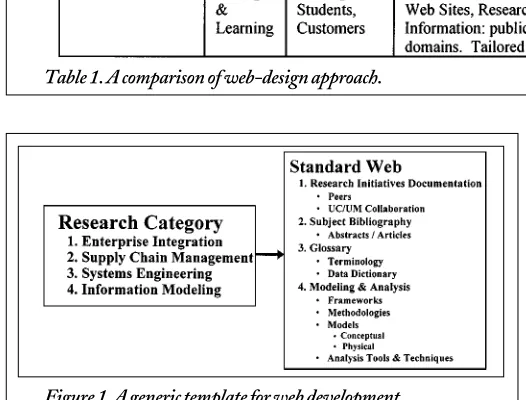
NVIRONMENTIn order to illustrate use of the web site, a representative research and learning model has been developed. Its purpose is to demon-strate how research and learning awareness can be enhanced in en-terprise integration areas. A standard template depicted in Figure 1 has been used for illustrations. Its components are described below.
The Research Categorycomponent of the template describes the focus of research and its categorization. Research in these cate-gories pertains to issues of generic enterprise integration. For each category, information is organized and disseminated in four func-tional units. For illustrative purposes, these are described for the Supply Chain Management Research category. The Research Ini-tiatives Documentationcomponent benchmarks, research described in this case study with published research. This component has two sections:
1. Peers. Research pertaining to this case study is compared and contrasted with published literature as well as current re-search at other peer institutions.
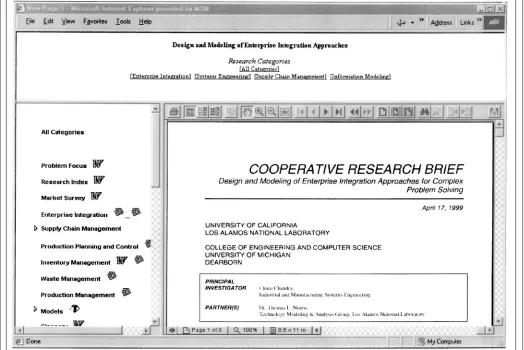
2. UC/UM Collaboration.* Collaborative research initiatives be-tween University of California and University of Michigan on topics of mutual interest in the Enterprise Integration and
Supply Chain Management area are described. Figure 2 de-picts its web site.
The Subject Bibliographysection offers bibliographies on current research topics in the Supply Chain Management area. Brief ab-stracts, and full text articles are offered.
The Glossaryoffers a listing of terms and their definitions rela-tive to each research category. A data dictionary of all attributes pertaining to various logical models utilizing object-oriented methodology is provided.
The Modeling and Analysisactivity facilitates design and imple-mentation of Supply Chain Management systems. Its components are as follows:
● Frameworksprovide a unified roadmap for design and
imple-mentation of Supply Chain Management systems with the-ory, hypothesis, and methodology.9
● Methodologiesare methods utilized for supply chain problem
solving. Through a systematic evaluation process an “As-Is” system is decomposed and analyzed to obtain a “To-Be” model. Figure 3 depicts the proposed seven-step enterprise modeling and analysis methodology.10
● Models.A conceptual model of the “As-Is” system is
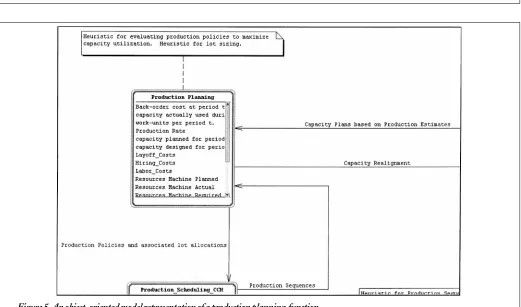
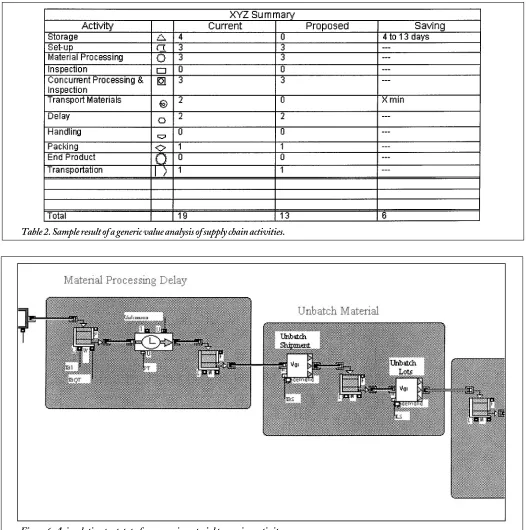
devel-oped using IDEF model representation.* * It is elaborated further into a logical model using object-oriented modeling constructs defined by a Unified Modeling Language, and fi-nally a simulation prototype is developed using a simulation language. Figure 4 is an IDEF model representation of an “As-Is” system for production planning function for a textile manufacturer at level 0, or business level. This generic model can be drilled down to a more specific model for a given prob-lem. Figure 5, is an object-oriented generic model representa-tion of an “As-Is” system for producrepresenta-tion planning funcrepresenta-tion for a textile manufacturer. Figure 6, depicts a simulation pro-totype of a generic material processing activity. Each icon in this figure depicts an input, output, and process required for transforming material from one state to the next.
● Analysis Tools and Techniques.The simulation prototype is
an-alyzed on a variety of tools. For value analysis, methods that differentiate value-added from non-value-added components
*This paper documents results of research by first author supported by grants from the Department of Energy, Los Alamos National Laboratory, including sub-contract # H1757-0019-2G, 11/9/98 on University of Michigan.
[image:3.612.43.560.40.198.2]**IDEF (Information Definition) technique representation of a system at various enterprise levels namely, a business, function, process, and activity.
[image:3.612.33.296.157.357.2]of the “As-Is” model are employed. Table 2 differentiates value-added components of a system from its non-value-added components, offering the decision-maker a basis for improvement. This refined model is subjected to sensitivity analysis utilizing cases that test the validity of the model under
various system constraints. The outcome of this analysis process is the “To-Be” model, offering feasible solution(s) for the problem under investigation.
[image:5.612.49.558.39.354.2]The application of a research and learning module described above highlights, effectiveness of a research web site in promoting
Figure 5. An object-oriented model representation of a production planning function.
[image:5.612.39.560.355.662.2]learning of system concepts and their appropriate application in problem solving to specific fields of inquiry.
VI. U
SINGI
NSTRUCTIONALM
ODULE FORE
NGINEERINGE
DUCATIONThe generic template approach adapted in organizing and dis-seminating information on the web-site, enables standardization of deliverables for any research and learning categories identified in Figure 1. Curricula for two engineering courses, (a) Supply Chain Management and (b) Enterprise Optimization, similar to those identified in reference 1, have been structured by the authors
around the framework described in the instructional module. Cog-nitive goals identified in Section III of the paper, were satisfied as follows for these curricula. The theoretical component of these courses emphasizes system thinking, based on relevant theories, hypotheses, methodologies, problem-solving models, and analysis techniques related to supply chain as a class of enterprise systems. Students are instructed in modeling the supply chain using infor-mation and process flow techniques to decompose the enterprise at conceptual and logical levels, so that they can develop an integrat-ed view of the problem. This can take the form of modeling the, (a) demand network representing the distribution chain from dis-tributor, dealer and end-consumer, (b) supply network represent-ing tier I, tier II, and raw materials vendors, and (c) integration of
[image:6.612.35.561.38.568.2]Table 2. Sample result of a generic value analysis of supply chain activities.
demand and supply networks to a common logistics network. The applied component offers students opportunities to apply the the-oretical knowledge to specific applications, such as a “production planning control” problem for a retail garment supply chain in the textile industry. Other examples being developed are from the au-tomotive and computer industries. This method of instruction fa-cilitates comprehension by students of abstract system concepts in relation to real problems faced by industries. It also provides them exposure to development and/or use of the latest and relevant deci-sion support software.
VII. C
ONCLUSIONS, E
XTENSIONS,
ANDF
UTUREW
ORKAn overview of a web site for an instructional module on enter-prise integration and supply chain management topics is offered. The design of the web site facilitates implementation of both learn-ing and research components of the proposed web development framework. The dissemination of information from simple to com-plex topics pertaining to a research category satisfies audiences with discerning knowledge needs. The information presented in its cur-rent form on the web site is incomplete. Additional information for various research areas is still being collected, organized, and associ-ated with various learning models. For this purpose, a better job of dissemination of information is required. In future, it is hoped to link live applications through the web site.
R
EFERENCES1. Chandra, C., and S. Kumar, “Enterprise Systems: Challenges and Opportunities for Information Systems Education,” Journal of Engineering Education, vol. 89, no. 1, January 2000, pp. 25–29.
2. Rettig, J., and C. LaGuardia, “Beyond ‘Beyond Cool.’ Reviewing Web Resources,” Onlinevol. 23, Issue 4, July/August 1999, pp. 51–55.
3. Swack, T., “Case Studies in Strategy and User-Centered Design,”
Web Review, 1998, URL: http://webreview.com/wr/pub/web98east/18/ swackcase.ht.
4. Vassos, T., Strategic Internet Marketing, Macmillan Publishing Company Inc., 1996, p. 326.
5. Nielsen, J., “User Interface Directions for the Web,” Communications of the ACM, vol. 42, no. 1, 1999, pp. 65–72.
6. Palmer, J.W., and D.A. Griffith, “An Emerging Model of Web Site Design for Marketing,” Communications of the ACM, vol. 41, no. 3, March 1998, pp. 45–51.
7. Fielding, R.T., et al., “Web-Based Development of Complex Infor-mation Products,” Communications of the ACM, vol. 41, no. 8, August 1998, pp. 84–92.
8. Miller, M.J., “Create a Great Site,” PC Magazine, June 8, 1999, pp. 98–175.
9. Chandra, C., “Enterprise Architectural Framework for Supply Chain Integration,” Proceedings of the Sixth Annual Industrial Engineering Research Conference, May 17–18, 1997, Miami Beach, FL, pp. 873–878.