Open Access
Study protocol
Efficacy and cost-effectiveness of a physiotherapy program for
chronic rotator cuff pathology: A protocol for a randomised,
double-blind, placebo-controlled trial
Kim Bennell*
1, Sally Coburn
1, Elin Wee
1, Sally Green
2, Anthony Harris
3,
Andrew Forbes
4and Rachelle Buchbinder
4,5Address: 1Centre for Health, Exercise & Sports Medicine, School of Physiotherapy, University of Melbourne, Australia, 2Monash Institute of Health
Services Research, Monash University, Melbourne, Australia, 3Centre for Health Economics, Monash University, Melbourne, Australia, 4Department of Epidemiology and Preventive Medicine, Monash University, Melbourne, Australia and 5Monash Department of Clinical
Epidemiology at Cabrini Hospital, Melbourne, Australia
Email: Kim Bennell* - [email protected]; Sally Coburn - [email protected]; Elin Wee - [email protected]; Sally Green - [email protected]; Anthony Harris - [email protected];
Andrew Forbes - [email protected]; Rachelle Buchbinder - [email protected] * Corresponding author
Abstract
Background: Chronic rotator cuff pathology (CRCP) is a common shoulder condition causing pain and disability. Physiotherapy is often the first line of management for CRCP yet there is little conclusive evidence to support or refute its effectiveness and no formal evaluation of its cost-effectiveness.
Methods/Design: This randomised, double-blind, placebo-controlled trial will involve 200 participants with CRCP recruited from medical practices, outpatient departments and the community via print and radio media. Participants will be randomly allocated to a physiotherapy or placebo group using concealed allocation stratified by treating physiotherapist. Both groups will receive 10 sessions of individual standardised treatment over 10 weeks from one of 10 project physiotherapists. For the following 12 weeks, the physiotherapy group will continue a home exercise program and the placebo group will receive no treatment. The physiotherapy program will comprise shoulder joint and spinal mobilisation, soft tissue massage, postural taping, and home exercises for scapular control, posture and rotator cuff strengthening. The placebo group will receive inactive ultrasound and gentle application of an inert gel over the shoulder region. Blinded assessment will be conducted at baseline and at 10 weeks and 22 weeks after randomisation. The primary outcome measures are self reported questionnaires including the shoulder pain and disability index (SPADI), average pain on an 11-point numeric rating scale and participant perceived global rating of change. Secondary measures include Medical Outcomes Study 36-item short form (SF-36), Assessment of Quality of Life index, numeric rating scales for shoulder pain and stiffness, participant perceived rating of change for pain, strength and stiffness, and manual muscle testing for shoulder strength using a handheld dynamometer. To evaluate cost-effectiveness, participants will record the use of all health-related treatments in a log-book returned to the assessor monthly. To test the effect of the intervention using an intention-to-treat analysis, linear regression modelling will be applied adjusting for baseline outcome values and other demographic characteristics. Published: 31 August 2007
BMC Musculoskeletal Disorders 2007, 8:86 doi:10.1186/1471-2474-8-86
Received: 26 June 2007 Accepted: 31 August 2007
This article is available from: http://www.biomedcentral.com/1471-2474/8/86
© 2007 Bennell et al; licensee BioMed Central Ltd.
Participant measures of perceived change will be compared between groups by calculating the relative risks and their 95% confidence intervals at each time point using log binomial regression.
Discussion: Results from this trial will contribute to the evidence regarding the effectiveness of a physiotherapy program for the management of CRCP.
Trial registration: NIH Clinical Trials Registry # NCT00415441
Background
Shoulder disorders are a common cause of musculoskele-tal morbidity in the community [1,2], affecting 15–30% of adults at any one time [3] and having their peak preva-lence in the mid-to-older age groups [4]. Since moving the shoulder allows placement of the hand, compromised shoulder function impacts substantially on tasks essential to daily living such as dressing, eating, personal hygiene and work [5]. Shoulder pain often impairs the ability to sleep, thus affecting mood and concentration. Hence shoulder disorders can lead to considerable disability, reductions in health-related quality of life, absenteeism from work and substantial utilization of health care resources [5-7].
Shoulder disorders are a common reason for seeking med-ical care – in Australia, they account for 1.2% of all general practice encounters, being third only to back (3.8%) and neck complaints as musculoskeletal reasons for primary care consultations [8]. They also account for up to 10% of all referrals to physiotherapists [9]. Shoulder disorders are often recalcitrant with persisting pain and disability from 12 [10] to 18 months [11] in up to 50% of cases. Chronic shoulder conditions may require surgical intervention in 15–28% of individuals [12]. Thus, they are a relevant health problem for clinicians, funding providers and health-care policy makers.
Although there is controversy as to exact definitions for different shoulder diagnostic categories, a large propor-tion of shoulder problems can be classified under the term 'chronic rotator cuff pathology' (CRCP). The term (or its variants such as impingement syndrome) includes a spec-trum of pathologies (tears, inflammation, tendonitis, degeneration) involving contractile and other local struc-tures around the shoulder joint [13,14] giving rise to sim-ilar signs and symptoms. Pain is the main feature, particularly on overhead movement, at night, and when lying on the affected side. Examination may reveal a pain-ful arc during shoulder elevation, pain on resisted shoul-der abduction, external rotation or internal rotation, and a positive impingement test (ref). Restricted shoulder range may be present but is mostly related to pain rather than stiffness per se [15]. Unlike other shoulder condi-tions, such as adhesive capsulitis, global shoulder passive restriction is not a feature. Diagnosis is traditionally based
on history and clinical findings. Investigative procedures such as x-ray, ultrasound or magnetic resonance imaging may be used to demonstrate CRCP or to exclude other less common shoulder pathologies.
It is thought that shoulder impingement is involved in the initiation and/or perpetuation of CRCP. This occurs when the greater tuberosity impinges against the coracoacro-mial arch in shoulder elevation causing mechanical irrita-tion of local structures [15]. While there is speculairrita-tion as to whether the pathology seen with CRCP is primary or secondary to impingement, a number of factors can play a role in CRCP [15,16]. In particular, if the rotator cuff muscles do not function in a co-ordinated manner with each other as well as with the principal muscles that move the humerus and scapula, then inadequate stabilisation of the humeral head may occur during shoulder elevation [17,18]. Poor shoulder, cervical and thoracic posture as well as tight structures can also contribute to dysfunc-tional movement patterns [19,20] and ultimately chronic pathology and pain.
Physiotherapy is often the first line of management for CRCP [21]. In a survey of approximately 800 primary care medical practitioners, 79% stated that their usual treat-ment of a patient with CRCP would be referral to a phys-iotherapist [21]. Physiotherapy aims to reduce pain and disability by improving the biomechanics and movement patterns of the shoulder complex rather than by treating the pathology per se. In clinical practice, patients with CRCP receive a combination of physiotherapy interven-tions in order to effectively address the modifiable factors contributing to pain and dysfunction.
not recommended by expert clinicians as the most appro-priate physiotherapy modality to treat CRCP. From the tri-als in CRCP or in mixed shoulder disorders that were included in the review, there was some evidence to pro-pose that exercise may be effective, with additional benefit from mobilisation [23-26]. Recent trials identified since this Cochrane review still fail to clarify the effectiveness of physiotherapy for CRCP given differences in the treatment program, comparison group and outcomes [27-30]. The need for further clinical trials in this area is supported by the conclusions and recommendations of other recent systematic reviews [31-33].
Therefore, the aim of this trial is to determine whether a 10-week multimodal physiotherapy program reflective of current physiotherapy practice improves pain, disability and health-related quality of life and is more cost-effective than placebo in individuals with CRCP.
Methods/Design
DesignThis will be a randomised placebo controlled trial with blinded participants and outcome assessors (Figure 1). The trial comprises a 10-week intervention and a 12-week follow-up (Figure 1). Participants will be assessed imme-diately before treatment (baseline), immeimme-diately after treatment (final) and at 22 weeks (follow-up) post ran-domisation. The assessments will be performed by the same assessor who will be blind to group allocation.
Participants
A community sample will be recruited in Melbourne, Aus-tralia through orthopaedic and rheumatology outpatient clinics, community-based practices and general practi-tioners as well as by advertising in print and radio media. Inclusion criteria will be: (i) aged over 18 years; (ii) shoul-der pain for greater than 3 months; (iii) pain severity on movement rated at least 4/10 on an 11 point numeric rat-ing scale; (iv) pain on active abduction or external rota-tion and; (v) positive shoulder impingement quick test [34]. Exclusion criteria will be: (i) resting shoulder pain of greater than 7/10 in severity; (ii) reason to suspect a com-plete rotator cuff tear eg. substantial shoulder weakness, a positive drop-arm sign or a high riding humerus observed on plain xray; (iii) prior shoulder surgery; (iv) radiological evidence of shoulder osteoarthritis, shoulder joint calcifi-cation or prior fracture; (v) systemic pathology including inflammatory joint disease or neoplastic disorders; (vi) more than 50% restriction of passive range of motion in two or more planes; (vii) shoulder pain referred from ver-tebral structures diagnosed via spinal clearing tests [35]; (viii) symptoms of complex regional pain syndrome; (iix) active intervention in last 3 months including corticoster-oid/hydrodilatation injection or physiotherapy; (ix)
anti-inflammatory medication in past two weeks; (x) inability to understand written and spoken English.
A diagnosis of CRCP by a medical doctor supported by a plain x-ray of the shoulder will be necessary for potential inclusion. All volunteers will then be required to undergo a physical examination with a physiotherapist to screen for signs and symptoms, and to exclude shoulder pain that is not due to rotator cuff origin (eg, neural or cervical referral, adhesive capsulitis). Participants with bilateral CRCP symptoms will be asked to indicate which shoulder is the most symptomatic. This shoulder will be treated. Those with equally symptomatic shoulders will receive treatment for the shoulder of the dominant limb.
The Royal Melbourne Hospital Human Research Ethics Committee approved the study (Project #2001.115) and all participants will provide written informed consent.
Randomisation and allocation
Following a physical screening examination, volunteers who meet the inclusion criteria will be accepted as partic-ipants and undergo baseline assessment at the University of Melbourne. Following baseline assessment, partici-pants will be stratified by treatment site and randomly assigned in permuted block of six and eight to either phys-iotherapy or placebo treatment groups. The randomisa-tion sequence will be generated using a computer-generated table of random numbers by the study biostat-istician (AF). Allocations will be sealed in opaque and consecutively numbered envelopes kept in a locked loca-tion. These will be opened in sequence by an independent administrator not involved in eligibility assessment, out-come assessment or treatment. Allocation will be revealed to the treating physiotherapist by fax before the partici-pant presents for treatment.
Interventions
Ten musculoskeletal physiotherapists located around metropolitan Melbourne will implement both interven-tions. All treatments will be individual sessions lasting 30–45 minutes, twice weekly for the first 2 weeks, once a week for the next 4 weeks, then once a fortnight in the last 4 weeks (a total of 10 treatments). Participants will be requested to refrain from seeking other forms of treatment during the trial. However, due to ethical considerations, analgesia will be permitted. Use of medications and other therapies will be recorded in a logbook.
inten-Trial profile
Figure 1
Trial profile.
Phone Screening
Ineligible Fail inclusion criteria Meet exclusion criteria
Physical Screening
Ineligible Fail inclusion criteria Meet exclusion criteria
0 weeks Consent, baseline assessment and randomisation
Placebo intervention Physiotherapy
intervention
10 weeks Final assessment
Home exercise No treatment
sity of the standardised treatment techniques to match the participants' capabilities. Thus the number of repetitions of the exercises can be reduced. Deletion of techniques will be permitted if participants find them too painful. At the end of each treatment session for each participant, the physiotherapist will complete a checklist to ensure com-pliance with the standard approach.
All participants will be requested not to seek other forms of treatment during the study but use of analgesia will be permitted and recorded in a log-book.
Physiotherapy intervention group
A standardized treatment protocol has been devised (SC) based on the literature and on the results of a formal writ-ten survey we conducted involving 10 musculoskeletal physiotherapists around Australia, considered by the pro-fession to be experts in treating shoulder conditions. These physiotherapists were asked to indicate which of a series of interventions they would generally use at three stages of a 10-week program when managing a typical patient with CRCP. The results showed that the most com-monly employed modalities were scapular retraining (100%), rotator cuff exercises (100%), spinal (83%) and shoulder joint mobilisation (50%), soft tissue massage (66%) and taping (50%). Less emphasis is placed on elec-trotherapy modalities (33%) with few using these, partic-ularly past the first three weeks of treatment (Coburn et al unpublished data).
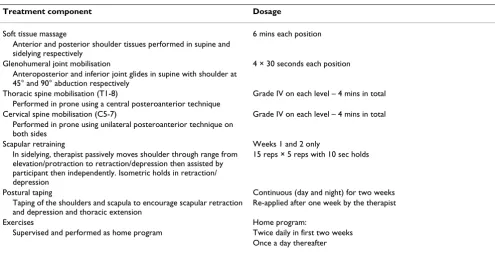
The aims of the resultant physiotherapy intervention are to i) decrease pain; ii) improve functional range of shoul-der motion; iii) improve scapular control; iv) strengthen scapular stabilisers and rotator cuff muscles; v) improve posture and thoracic extension range of motion; vi) regain normal shoulder biomechanics. The treatment has five components comprising soft tissue massage, passive mobilisation of the glenohumeral joint, scapula retrain-ing, spinal mobilisation, and home exercises (Table 1). Cognitive behavioural strategies will also be incorporated including education, goal-setting, motivation and posi-tive reinforcement.
Soft tissue massage
Deep massage of the soft tissue structures around the shoulder joint will be performed for six minutes in two positions. The posterior joint capsule and scapular shoul-der musculature will be massaged in sidelying while the anterior shoulder structures including the supraspinatus, long head of biceps and pectoralis minor tendons will be massaged in supine.
Glenohumeral joint mobilisation
Anteroposterior and inferior glenohumeral joint mobili-sations will be performed with the participant in supine
and with the shoulder in 45 degrees abduction and 90 degrees abduction respectively [35]. Grade IV oscillations (into 50% resistance) will be maintained for 30 seconds and repeated four times.
Scapular retraining
The aim of scapular retraining is to improve control of scapular movement, particularly to avoid excessive eleva-tion and protraceleva-tion, so as to optimise the funceleva-tional position of the shoulder. The therapist will passively guide the participant from a neutral shoulder girdle posture to an adducted, depressed position, then to an upwardly rotated, elevated position. The participant will then per-form the movement actively for several repetitions fol-lowed by a 10 second hold in the adducted, depressed posture. This will be repeated 5 times. Postural taping will also be worn full time for the first two weeks. The therapist will firstly apply a protective skin barrier followed by non-rigid, hypoallergenic tape to provide skin protection, and then rigid strapping tape for postural adjustments. The shoulder taping technique aims to encourage a retracted, depressed scapular posture and thoracic extension.
Spinal joint mobilisations
Mobilisation techniques will be performed to improve range of cervical and thoracic motion, particularly tho-racic extension. They will include unilateral lower cervical spine (C5-7) and central upper-mid thoracic spine (T1-8) posteroanterior mobilisation techniques with the partici-pant in prone lying [35]. The therapist will use a Grade IV force at each level, on both sides for the cervical spine and centrally for the thoracic spine. The duration of this treat-ment will be four minutes for each technique.
Home exercises
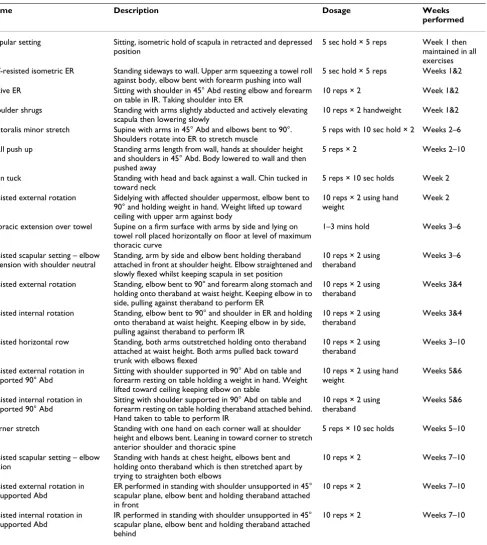
These are predominantly designed to increase rotator cuff and scapular muscle strength (Table 2). Most exercises require the participant to incorporate their scapular retraining with strengthening of the rotator cuff muscles. Some exercises reinforce and facilitate correct posture. These exercises will be taught and performed during each treatment session and exercise progressions will be intro-duced regularly throughout the course of the treatment program. Resistance for specific exercises will be provided by hand weights or elastic theraband. Participants will be asked to perform the exercises daily, except during the first week of treatment where exercises will be completed twice per day. Compliance will be monitored via a weekly log book completed by the participant. During the follow-up, the physiotherapy group will be requested to continue daily home exercises.
Placebo group
physiother-apy program. However, our aim is to control for the effect of regular contact with a therapist, the belief that treat-ment will assist CRCP and the therapeutic environtreat-ment. Participants in the placebo group will receive the same number and length of visits as those in the physiotherapy group but will receive only sham ultrasound and light application of a non-therapeutic gel. Participants in the placebo group will receive no instruction in exercise tech-niques and no manual therapy. We have used an identical placebo protocol in completed clinical trials of physio-therapy for patellofemoral pain syndrome [36], knee oste-oarthritis [37] and shoulder adhesive capsulitis [38]. In these trials, between 68% to 83% of participants in the placebo group thought they had received 'real' physiother-apy or were unsure. Blinding index was 0.49 (bootstrap 95% CI 0.40 to 0.56), interpreted as moderate success of blinding in one study [38]. The placebo participants will not receive any intervention or complete any home exer-cises during the 12 week follow-up period.
Blinding
To maintain blinding, the plain language statement and consent procedures will inform participants that they have an equal chance of receiving real or placebo physio-therapy but will not disclose details of the actual treat-ments. A blinded examiner will perform all outcome assessments. Participant blinding will be optimised by using a realistic placebo intervention and by ensuring par-ticipants do not attend for treatments or assessments con-currently. Participants will also be requested to refrain from discussing their treatment with the outcome
asses-sor. At trial completion, participants will nominate which group they believed they have been allocated to. The data manager and statistician will be unaware of treatment allocation until completion of analyses.
Outcome assessment
Demographic information will be collected including age, sex, duration of symptoms, previous investigations and treatment, history of medical conditions, and medication use. Expectation of a beneficial treatment effect will be scored on an ordinal scale from 1 to 5 with higher scores indicating higher expectations.
[image:6.612.56.551.97.351.2]A number of outcome measures will be collected for this study (Table 3). A combined shoulder pain and disability index (SPADI) will be used to measure changes in shoul-der pain and function at final and follow-up time points. This is a self-administered, shoulder-specific index con-sisting of 13 items divided into two subscales: pain (five items) and disability (eight items) [39]. Responses to each item are recorded on a 11 point Likert scale where 0 = "no pain" or "no difficulty" and 10 = "worst imaginable pain" or "so difficult it required help" for the pain and disability items respectively. The SPADI score is calculated by sum-ming then averaging the two subscales to give a score out of 100 (higher score more pain/disability). It has accepta-ble test-retest reliability, construct validity and responsive-ness [39-41]. We have confirmed the clinimetric properties of this index and found it to be more respon-sive than other shoulder-specific questionnaires (effect sizes 1.01–1.69) (Buchbinder et al unpublished data). Table 1: Components of the physiotherapy intervention
Treatment component Dosage
Soft tissue massage 6 mins each position Anterior and posterior shoulder tissues performed in supine and
sidelying respectively
Glenohumeral joint mobilisation 4 × 30 seconds each position Anteroposterior and inferior joint glides in supine with shoulder at
45° and 90° abduction respectively
Thoracic spine mobilisation (T1-8) Grade IV on each level – 4 mins in total Performed in prone using a central posteroanterior technique
Cervical spine mobilisation (C5-7) Grade IV on each level – 4 mins in total Performed in prone using unilateral posteroanterior technique on
both sides
Scapular retraining Weeks 1 and 2 only In sidelying, therapist passively moves shoulder through range from
elevation/protraction to retraction/depression then assisted by participant then independently. Isometric holds in retraction/ depression
15 reps × 5 reps with 10 sec holds
Postural taping Continuous (day and night) for two weeks Taping of the shoulders and scapula to encourage scapular retraction
and depression and thoracic extension
Re-applied after one week by the therapist
Exercises Home program:
Average pain, worst pain and pain on three self-selected activities (over the past week) will be measured by sepa-rate 11-point numeric rating scales [12] numbered in 1 cm intervals. The amount of weakness, stiffness and inter-ference with activities of daily living (over the past week) will be measured similarly.
[image:7.612.70.557.98.643.2]Participant perceived global rating of change overall and in pain, strength, and stiffness (since commencement) will be recorded on separate 5 point Likert scales (1-much worse, 2-slightly worse, 3-no change, 4-slightly better, 5-much better). Measuring participant perceived improve-ment using a rating of change scale has been shown to be Table 2: Description of specific exercises
Name Description Dosage Weeks
performed
Scapular setting Sitting, isometric hold of scapula in retracted and depressed position
5 sec hold × 5 reps Week 1 then maintained in all exercises Self-resisted isometric ER Standing sideways to wall. Upper arm squeezing a towel roll
against body, elbow bent with forearm pushing into wall
5 sec hold × 5 reps Weeks 1&2
Active ER Sitting with shoulder in 45° Abd resting elbow and forearm on table in IR. Taking shoulder into ER
10 reps × 2 Week 1&2
Shoulder shrugs Standing with arms slightly abducted and actively elevating scapula then lowering slowly
10 reps × 2 handweight Week 1&2
Pectoralis minor stretch Supine with arms in 45° Abd and elbows bent to 90°. Shoulders rotate into ER to stretch muscle
5 reps with 10 sec hold × 2 Weeks 2–6
Wall push up Standing arms length from wall, hands at shoulder height and shoulders in 45° Abd. Body lowered to wall and then pushed away
5 reps × 2 Weeks 2–10
Chin tuck Standing with head and back against a wall. Chin tucked in toward neck
5 reps × 10 sec holds Week 2
Resisted external rotation Sidelying with affected shoulder uppermost, elbow bent to 90° and holding weight in hand. Weight lifted up toward ceiling with upper arm against body
10 reps × 2 using hand weight
Week 2
Thoracic extension over towel Supine on a firm surface with arms by side and lying on towel roll placed horizontally on floor at level of maximum thoracic curve
1–3 mins hold Weeks 3–6
Resisted scapular setting – elbow extension with shoulder neutral
Standing, arm by side and elbow bent holding theraband attached in front at shoulder height. Elbow straightened and slowly flexed whilst keeping scapula in set position
10 reps × 2 using theraband
Weeks 3–6
Resisted external rotation Standing, elbow bent to 90° and forearm along stomach and holding onto theraband at waist height. Keeping elbow in to side, pulling against theraband to perform ER
10 reps × 2 using theraband
Weeks 3&4
Resisted internal rotation Standing, elbow bent to 90° and shoulder in ER and holding onto theraband at waist height. Keeping elbow in by side, pulling against theraband to perform IR
10 reps × 2 using theraband
Weeks 3&4
Resisted horizontal row Standing, both arms outstretched holding onto theraband attached at waist height. Both arms pulled back toward trunk with elbows flexed
10 reps × 2 using theraband
Weeks 3–10
Resisted external rotation in supported 90° Abd
Sitting with shoulder supported in 90° Abd on table and forearm resting on table holding a weight in hand. Weight lifted toward ceiling keeping elbow on table
10 reps × 2 using hand weight
Weeks 5&6
Resisted internal rotation in supported 90° Abd
Sitting with shoulder supported in 90° Abd on table and forearm resting on table holding theraband attached behind. Hand taken to table to perform IR
10 reps × 2 using theraband
Weeks 5&6
Corner stretch Standing with one hand on each corner wall at shoulder height and elbows bent. Leaning in toward corner to stretch anterior shoulder and thoracic spine
5 reps × 10 sec holds Weeks 5–10
Resisted scapular setting – elbow flexion
Standing with hands at chest height, elbows bent and holding onto theraband which is then stretched apart by trying to straighten both elbows
10 reps × 2 Weeks 7–10
Resisted external rotation in unsupported Abd
ER performed in standing with shoulder unsupported in 45° scapular plane, elbow bent and holding theraband attached in front
10 reps × 2 Weeks 7–10
Resisted internal rotation in unsupported Abd
IR performed in standing with shoulder unsupported in 45° scapular plane, elbow bent and holding theraband attached behind
10 reps × 2 Weeks 7–10
a clinically relevant and stable concept for interpreting truly meaningful improvements from the individual per-spective [42]. A successful outcome will be defined a pri-ori as 'much better' on the rating scale.
Health-related quality of life will be measured using the Medical Outcomes Study 36-item short form (SF-36) (8 subscales scaled from 0–100 where a higher score repre-sents better health) [43]. This the most widely used generic measure of health related quality of life and per-mits comparison of the impact of disease and treatment across studies and populations. The clinimetric properties of the SF-36 have been well established on samples from diverse populations [43,44]. We will also use the Assess-ment of Quality of Life (AQoL) instruAssess-ment. The AQoL comprises 15 items on ordinal scales with four levels per item covering five dimensions (illness, independent liv-ing, social relationships, physical senses and psychologi-cal wellbeing). It produces a single utility index that ranges from -0.04 (worst possible health-related quality of life) to 1.00 (full health-related quality of life). The AQoL has strong psychometric properties [45,46]. The AQoL can also be converted into a utility index to calculate quality adjusted life years (QALY).
Isometric shoulder strength for shoulder abduction, inter-nal and exterinter-nal rotation will be measured using the Nicholas Manual Muscle tester (Lafayette, USA). For shoulder abduction, participants will be positioned in
supine with the shoulder in 90 degrees of abduction and the elbow flexed to 90 degrees. The dynamometer will be positioned on the lateral surface of the distal humerus, proximal to the lateral epicondyle. Measurements of exter-nal and interexter-nal rotation will be performed in sitting with the arm by the side against a folded towel, the elbow flexed to 90 degrees and the forearm in midprone. The dynamometer will be positioned on the distal forearm. One warm up trial followed by three maximal contrac-tions will be performed and the median reading taken. We previously measured 12 people with CRCP on two occa-sions three days apart. Intraclass correlation coefficient (ICC 2,3) values were 0.95 for abduction, 0.96 for internal rotation and 0.93 for external rotation indicating that test retest reliability was excellent.
A number of other measures will be obtained (Table 3). Participant compliance will be obtained by recording the number of physiotherapy sessions attended (out of a max-imum number of 10). Those in the physiotherapy group will complete a daily log-book to record the number of home exercise sessions completed. Adverse events and the use of co-intervention will be recorded in a log-book and by open-probe questioning by the assessor at trial comple-tion. Log-books will be posted back to the assessor on a monthly basis and checked for completion. At the final and followup measurement time points, study partici-pants will be asked to indicate which treatment they Table 3: Outcome measures
Primary Outcomes Measurement
Shoulder pain and disability index (SPADI) 13 items scored on an 11 point Likert scale
Average pain over past week 11 point horizontal numeric rating scale (end descriptors of 0 = no pain and 10 = worst pain possible)
Participant perceived global rating of change overall Ordinal scale (1-much worse, 2-slightly worse, 3-no change, 4-slightly better, 5-much better)
Secondary Outcomes
Worst pain, and pain on 3 self selected activities in past week 11 point horizontal numeric rating scale (end descriptors of 0 = no pain and 10 = worst pain possible)
Amount of stiffness, weakness, and interference to activities of daily living in past week
11 point horizontal numeric rating scale
Participant perceived global rating of change in pain, strength, and stiffness
Ordinal scale (1-much worse, 2-slightly worse, 3-no change, 4-slightly better, 5-much better)
Health-related quality of life • SF-36
• Assessment of Quality of Life index (AQol) Isometric muscle strength of shoulder abduction, internal rotation and
external rotation
Hand held dynamometer
Other measures
Compliance • Number of therapy visits
believe they have received and reasons for that choice to assess the success of blinding.
Information on direct health care costs, direct non-health care costs and production losses over the 22 weeks will be collected by a logbook posted back to the assessor on a monthly basis and checked for completion. Direct health care costs will include costs of physiotherapy attendance (assumed zero in the placebo group), additional health provider visits, tests, prescription and over the counter medication, professional home care and hospitalisation. These will be valued using published prices for medical costs. Direct non-health care resources will include use of paid and unpaid help, lost time and travel, and number of lost days at work.
Sample size
Sample size was calculated based upon the ability to detect a 10-point difference in improvement in SPADI score, previously reported to indicate a clinically impor-tant improvement (or worsening) of shoulder function [41]. Applying power calculations appropriate for analysis of covariance (adjusting for baseline SPADI score), to detect a difference in 10 week SPADI of 10 units assuming a common between-participant standard deviation of 27 and a baseline to 10 week correlation in SPADI scores of 0.45 (from our pilot study), 91 participants per group will be required to achieve 80% power at a two-sided 5% sig-nificance level. Including the 10 week and further 22 week follow-ups in a repeated measures analysis increases the power to 85% assuming a conservative correlation of 0.8 between all post-baseline measurements and a uniform physiotherapy effect. We will allow for a 10% loss to fol-low-up and aim to recruit 100 participants per group.
Data analysis
All analyses will be conducted on an intention-to-treat principle using all randomized participants. Missing data will be replaced by the last score carried forward. Demo-graphic characteristics and baseline data will be summa-rised by descriptive statistics. An index will be computed to assess the success of blinding [47]. This index takes the value one for complete blinding and zero for complete lack of blinding.
For outcomes measured using an essentially continuous scale, differences in mean change from baseline to each time point will be compared between groups using linear regression modelling adjusting for baseline levels of the outcome measure. Model assumptions will be checked by standard diagnostic plots [48]. For analysis across all time points simultaneously, accounting for repeated measure-ments, we will estimate the differences between groups using generalised estimating equation models for the post-baseline measurements with adjustment for baseline
measurements, a robust variance and unstructured work-ing correlation [49]. Constancy of the difference between groups over time will be assessed by fitting models which include a term for the interaction between treatment and time. Sensitivity analyses include repetition of analyses with calculation of bootstrap standard errors, and identi-fication of influential individuals by sequentially omit-ting each participant and refitomit-ting the model.
Participant measures of perceived improvement following physiotherapy or placebo treatments will be compared by calculating the relative risks and their 95% confidence intervals at each time point using log binomial regression [50]. Repeated measures relative risk calculations will be performed using generalised estimating equations with a logarithmic link function, robust variance and unstruc-tured correlation [49]. As above, models including a term for the interaction between treatment and time will be fit to assess the constancy of the difference between groups over time.
Discussion
This study uses a double-blind randomised controlled trial design to investigate whether a multimodal physio-therapy program has greater effects on pain, disability and health-related quality of life and is more cost-effective than placebo in people with CRCP. The benefits of physi-otherapy for this patient group have not been well estab-lished in the literature and there is no information on its cost effectiveness.
At present there is no gold standard diagnostic test for CRCP. Our criteria for inclusion into the study are based on clinical assessment performed by a medical doctor and a physiotherapist together with a shoulder xray to assist in differential diagnosis. While imaging techniques such as magnetic resonance imaging or ultrasound may further improve diagnostic accuracy particularly if performed by a single experienced operator [55], these still lack sensitiv-ity for certain pathologic features [56,57] and are costly. We wished to reflect the population that present to pri-mary care for assessment and treatment and who in many cases will not have these investigative procedures per-formed.
Physiotherapy generally encompasses a multimodal approach to treatment. Therapists utilise a variety of tech-niques such as mobilisation, soft tissue massage, taping, exercise prescription and education. As there is no 'gold standard' physiotherapy for CRCP, we chose to use a standardised program rather than employ a pragmatic design whereby therapists chose the program based on their own clinical reasoning and experience. This was done to ensure a consistent approach and to allow repli-cation of the program tested. A number of treating thera-pists were included to increase the external validity of the results.
We chose a placebo treatment as the comparator rather than no treatment as we wished to evaluate the specific effects of physiotherapy over and above those gained from regular contact with a caring therapist. There is some debate in the literature about whether it is appropriate to use a placebo treatment for interventions such as physio-therapy or acupuncture where it is difficult to isolate the direct and indirect effects of the therapy [58]. It has been argued that these effects are unlikely to be distinct, divisi-ble and additive and that using a placebo controlled trial design will not detect the whole treatment effect and may generate false negative results. However, we believe that the primary goal of physiotherapy is to improve the mod-ifiable impairments associated with CRCP using various techniques and as such it should provide greater benefits than those simply due to the therapeutic environment. The project physiotherapists will treat an equal propor-tion of experimental and placebo group participants to
ensure that any effects of the personality of each therapist and the treatment environment are equally distributed.
It is anticipated that all participants will be recruited by the middle of 2007 with data acquisition completed six months later. The results from this trial will contribute to evidence based recommendations for the effectiveness of a physiotherapy program in the management of CRCP.
Competing interests
The author(s) declare that they have no competing inter-ests.
Authors' contributions
KB, SC and RB conceived and designed the trial protocol. KB, RB, SG, SC, AH and AF procured the project funding. SC and SG designed the physiotherapy intervention. AH designed the economic analysis. AF designed the statisti-cal analysis. EW is the research assistant and blinded assessor. KB drafted the manuscript and RB, EW, SC, SG, AH and AF contributed to the manuscript. All authors read and approved the final manuscript.
Acknowledgements
This work is funded by the National Health and Medical Research Council (Project Grant #299840). Pilot funds were provided by ANZ Trustees, Department of Physiotherapy and Victor Hurley Grant Royal Melbourne Hospital, and the School of Physiotherapy, University of Melbourne. None of the funders have any role in the study other than to provide funding. R Buchbinder is funded by an Australian National Health and Medical Research Council Practitioner Fellowship. We wish to acknowledge the project physiotherapists Richard Bohen, Tanya Farmer, Marie-Louise Francken, Nigel Friend, Jean Leaf, Arthur Lee, Stephen Maloney, Christine Roberts, Paul Visentini and Simon Wilson.
References
1. Rekola KE, Keinanen-Kiukaanniemi S, Takala J: Use of primary health services in sparsely populated country districts by patients with musculoskeletal symptoms: consultations with a physician. Journal of Epidemiology & Community Health 1993,
47(2):153-157.
2. Roquelaure Y, Ha C, Leclerc A, Touranchet A, Sauteron M, Melchior M, Imbernon E, Goldberg M: Epidemiologic surveillance of upper-extremity musculoskeletal disorders in the working population. Arthritis Rheum 2006, 55(5):765-778.
3. Pope DP, Croft PR, Pritchard CM, Silman AJ: Prevalence of shoul-der pain in the community: the influence of case definition.
Annals of the Rheumatic Diseases 1997, 56(5):308-312.
4. Badley EM, Tennant A: Changing profile of joint disorders with age: findings from a postal survey of the population of Cal-derdale, West Yorkshire, United Kingdom. Ann Rheum Dis
1992, 51(3):366-371.
5. Smith KL, Harryman DT 2nd, Antoniou J, Campbell B, Sidles JA, Mat-sen FA 3rd: A prospective, multipractice study of shoulder function and health status in patients with documented rota-tor cuff tears. J Shoulder Elbow Surg 2000, 9(5):395-402.
6. Gartsman GM, Brinker MR, Khan M, Karahan M: Self-assessment of general health status in patients with five common shoul-der conditions. Journal of Shoulder & Elbow Surgery 1998,
7(3):228-237.
7. Roquelaure Y, Mariel J, Fanello S, Boissiere JC, Chiron H, Dano C, Bureau D, Penneau-Fontbonne D: Active epidemiological sur-veillance of musculoskeletal disorders in a shoe factory.
8. Bridges-Webb C, Britt H, Miles D, Neary S, Charles J, V. T: Morbid-ity and treatment in general practice in Australia 1990-91.
Med J Aust 1992, 157:S1-S56.
9. Peters D, Davies P, Pietroni P: Musculoskeletal clinic in general practice: study of one year's referrals. Br J Gen Pract 1994,
44(378):25-29.
10. van der Windt DA, van der Heijden GJ, Scholten RJ, Koes BW, Bouter LM: The efficacy of non-steroidal anti-inflammatory drugs (NSAIDS) for shoulder complaints. A systematic review. J Clin Epidemiol 1995, 48(5):691-704.
11. Chard MD, Hazleman R, Hazleman BL, King RH, Reiss BB: Shoulder disorders in the elderly: a community survey. Arthritis Rheum
1991, 34(6):766-769.
12. Bartolozzi A, Andreychik D, Ahmad S: Determinants of outcome in the treatment of rotator cuff disease. Clin Orthop Relat Res
1994:90-97.
13. Singson RD, Hoang T, Dan S, Friedman M: MR evaluation of rota-tor cuff pathology using T2-weighted fast spin-echo tech-nique with and without fat suppression. American Journal of Roentgenology 1996, 166(5):1061-1065.
14. Tillander B, Franzen L, Norlin R: Fibronectin, MMP-1 and histo-logic changes in rotator cuff disease. Journal of Orthopaedic Research 2002, 20(6):1358-1364.
15. Brukner P, Khan K: Clinical Sports Medicine. Sydney , McGraw-Hill; 2006.
16. Soslowsky LJ, Thomopoulos S, Esmail A, Flanagan CL, Iannotti JP, Wil-liamson JD 3rd, Carpenter JE: Rotator cuff tendinosis in an ani-mal model: role of extrinsic and overuse factors. Ann Biomed Eng 2002, 30(8):1057-1063.
17. Ludewig PM, Cook TM: Translations of the humerus in persons with shoulder impingement symptoms. J Orthop Sports Phys Ther 2002, 32(6):248-259.
18. Reddy AS, Mohr KJ, Pink MM, Jobe FW: Electromyographic anal-ysis of the deltoid and rotator cuff muscles in persons with subacromial impingement. Journal of Shoulder and Elbow Surgery
2000, 9(6):519-523.
19. Bullock MP, Foster NE, Wright CC: Shoulder impingement: the effect of sitting posture on shoulder pain and range of motion. Manual Therapy 2005, 10(1):28-37.
20. Lewis JS, Wright C, Green A: Subacromial impingement syn-drome: the effect of changing posture on shoulder range of movement. Journal of Orthopaedic & Sports Physical Therapy 2005,
35(2):72-87.
21. Glazier RH, Dalby DM, Badley EM, Hawker GA, Bell MJ, Buchbinder R, Lineker SC: Management of common musculoskeletal problems: a survey of Ontario primary care physicians. Cmaj
1998, 158(8):1037-1040.
22. Green S, Buchbinder R, Hetrick S: Physiotherapy interventions for shoulder pain. Cochrane Database of Systematic Reviews
2003:42-58.
23. Bang MD, Deyle GD: Comparison of supervised exercise with and without manual physical therapy for patients with shoul-der impingement syndrome. Journal of Orthopaedic & Sports Phys-ical Therapy 2000, 30(3):126-137.
24. Brox JI, Staff PH, Ljunggren AE, Brevik JI: Arthroscopic surgery compared with supervised exercises in patients with rotator cuff disease (stage II impingement syndrome). British Medical Journal 1993, 307(6909):899-903.
25. Conroy DE, Hayes KW: The effect of joint mobilization as a component of comprehensive treatment for primary shoul-der impingement syndrome. Journal of Orthopaedic & Sports Phys-ical Therapy 1998, 28(1):3-14.
26. Ginn KA, Herbert RD, Khouw W, Lee R: A randomized, control-led clinical trial of a treatment for shoulder pain. Physical Ther-apy 1997, 77(8):802-811.
27. Ludewig PM, Borstad JD: Effects of a home exercise programme on shoulder pain and functional status in construction work-ers. Occup Environ Med 2003, 60(11):841-849.
28. Walther M, Werner A, Stahlschmidt T, Woelfel R, Gohlke F: The subacromial impingement syndrome of the shoulder treated by conventional physiotherapy, self-training, and a shoulder brace: results of a prospective, randomized study. J Shoulder Elbow Surg 2004, 13(4):417-423.
29. Dickens VA: Role of physiotherapy in the treatment of subac-romial impingement syndrome: a prospective study. Physio-therapy 2005, 91:159-164.
30. Haahr JP, Ostergaard S, Dalsgaard J, Norup K, Frost P, Lausen S, Holm EA, Andersen JH: Exercises versus arthroscopic decompres-sion in patients with subacromial impingement: a ran-domised, controlled study in 90 cases with a one year follow up. Annals of the Rheumatic Diseases 2005, 64(5):760-764. 31. Grant HJ, Arthur A, Pichora DR: Evaluation of interventions for
rotator cuff pathology: a systematic review. J Hand Ther 2004,
17(2):274-299.
32. Faber E, Kuiper JI, Burdorf A, Miedema HS, Verhaar JA: Treatment of impingement syndrome: a systematic review of the effects on functional limitations and return to work. J Occup Rehabil
2006, 16(1):7-25.
33. Trampas A, Kitisios A: Exercise and manual therapy for the treatment of impingement syndrome of the shoulder: a sys-tematic review. Physical Therapy Reviews 2006, 11:125-142. 34. Hawkins RJ, Kennedy JC: Impingement syndrome in athletes.
American Journal of Sports Medicine 1980, 8(3):151-158.
35. Maitland GD: Vertebral Manipulation. Oxford , Butterworth-Heinemann; 2001.
36. Crossley K, Bennell K, Green S, Cowan S, McConnell J: Physical therapy for patellofemoral pain: a randomized, double-blinded, placebo-controlled trial. Am J Sports Med 2002,
30(6):857-865.
37. Bennell KL, Hinman RS, Metcalf BR, Buchbinder R, McConnell J, McColl G, Green S, Crossley KM: Efficacy of physiotherapy man-agement of knee joint osteoarthritis: a randomised double-blind placebo-controlled trial. Annals of the Rheumatic Diseases
2005, 64:906-912.
38. Buchbinder R, Youd J, Green S, Stein A, Forbes A, Harris A, Bennell K, Bell S, Wright W: Efficacy and cost-effectiveness of physio-therapy following glenohumeral joint distension for adhesive capsulitis: A randomized trial. Arthritis Care and Research in press.
39. Roach KE, Budiman-Mak E, Songsiridej N, Lertratanakul Y: Develop-ment of a shoulder pain and disability index. Arthritis Care Res
1991, 4(4):143-149.
40. Heald SL, Riddle DL, Lamb RL: The shoulder pain and disability index: the construct validity and responsiveness of a region-specific disability measure. Phys Ther 1997, 77(10):1079-1089. 41. Williams JW Jr, Holleman DR Jr, Simel DL: Measuring shoulder
function with the Shoulder Pain and Disability Index. J Rheu-matol 1995, 22(4):727-732.
42. ten Klooster PM, Drossaers-Bakker KW, Taal E, van de Laar MA:
Patient-perceived satisfactory improvement (PPSI): inter-preting meaningful change in pain from the patient's per-spective. Pain 2006, 121(1-2):151-157.
43. Ware JE Jr, Sherbourne CD: The MOS 36-item short-form health survey (SF-36). I. Conceptual framework and item selection. Med Care 1992, 30(6):473-483.
44. Walters SJ, Munro JF, Brazier JE: Using the SF-36 with older adults: a cross-sectional community-based survey. Age Ageing
2001, 30(4):337-343.
45. Osborne RH, Hawthorne G, Lew EA, Gray LC: Quality of life assessment in the community-dwelling elderly: validation of the Assessment of Quality of Life (AQoL) Instrument and comparison with the SF-36. J Clin Epidemiol 2003, 56(2):138-147. 46. Whitfield K, Buchbinder R, Segal L, Osborne RH: Parsimonious and efficient assessment of health-related quality of life in osteoarthritis research: validation of the Assessment of Quality of Life (AQoL) instrument. Health Qual Life Outcomes
2006, 4:19.
47. James KE, Bloch DA, Lee KK, Kraemer HC, Fuller RK: An index for assessing blindness in a multi-centre clinical trial: disulfiram for alcohol cessation--a VA cooperative study. Stat Med 1996,
15(13):1421-1434.
48. Neter J, Kutner M, Nachtscheim C, Wasserman W: Applied Linear Statistical Models. 4th edition. Chicago , Irwin; 1996.
49. Diggle P, Heagerty P, Liang KY, Zeger S: Analysis of Longitudinal Data. 2nd edition. Oxford ; 2002.
50. McNutt LA, Wu C, Xue X, Hafner JP: Estimating the relative risk in cohort studies and clinical trials of common outcomes. Am J Epidemiol 2003, 157(10):940-943.
51. Glick HA, Doshi JA, Sonnad S, Polsky D: Economic evaluation in clinical trials. Oxford , Oxford University Press; 2007.
para-Publish with BioMed Central and every scientist can read your work free of charge "BioMed Central will be the most significant development for disseminating the results of biomedical researc h in our lifetime."
Sir Paul Nurse, Cancer Research UK
Your research papers will be:
available free of charge to the entire biomedical community
peer reviewed and published immediately upon acceptance
cited in PubMed and archived on PubMed Central
yours — you keep the copyright
Submit your manuscript here:
http://www.biomedcentral.com/info/publishing_adv.asp
BioMedcentral
metric and non-parametric techniques using Monte Carlo simulation. Stat Med 1999, 18:3245-3262.
53. Fenwick E, Marshall DA, Levy AR, Nichol G: Using and interpret-ing cost-effectiveness acceptability curves: An example usinterpret-ing data from a trial of management strategies for atrial fibrilla-tion. BMC Health Services Research 2006, 6:52.
54. Hoch JS, Briggs AH, Willan AR: Something old, something new, something borrowed, something blue: a framework for the marriage of health econometrics and cost-effectiveness anal-ysis. Health Economics 2002, 11:415-430.
55. Cullen D, Breidahl W, Janes G: Diagnostic accuracy of shoulder ultrasound performed by a single operator. Australas Radiol
2007, 51(3):226-229.
56. Cothran RL Jr.: Imaging in evaluating the rotator cuff. J Surg Orthop Adv 2006, 15(3):132-139.
57. Moosmayer S, Heir S, Smith HJ: Sonography of the rotator cuff in painful shoulders performed without knowledge of clinical information: results from 58 sonographic examinations with surgical correlation. J Clin Ultrasound 2007, 35(1):20-26. 58. Paterson C, Dieppe P: Characteristic and incidental (placebo)
effects in complex interventions such as acupuncture. Bmj
2005, 330(7501):1202-1205.
Pre-publication history
The pre-publication history for this paper can be accessed here: