Volume 2012, Article ID 932420,18pages doi:10.1155/2012/932420
Research Article
Optimized Steffensen-Type
Methods with Eighth-Order Convergence
and High Efficiency Index
F. Soleymani
Department of Applied Mathematics, School of Mathematical Sciences, Ferdowsi University of Mashhad, Mashhad, Iran
Correspondence should be addressed to F. Soleymani,[email protected]
Received 21 March 2012; Revised 23 May 2012; Accepted 6 June 2012
Academic Editor: V. R. Khalilov
Copyrightq2012 F. Soleymani. This is an open access article distributed under the Creative Commons Attribution License, which permits unrestricted use, distribution, and reproduction in any medium, provided the original work is properly cited.
Steffensen-type methods are practical in solving nonlinear equations. Since, such schemes do not need derivative evaluation per iteration. Hence, this work contributes two new multistep classes of Steffensen-type methods for finding the solution of the nonlinear equation fx 0. New techniques can be taken into account as the generalizations of the one-step method of Steffensen. Theoretical proofs of the main theorems are furnished to reveal the eighth-order convergence. Per computing step, the derived methods require only four function evaluations. Experimental results are also given to add more supports on the underlying theory of this paper as well as lead us to draw a conclusion on the efficiency of the developed classes.
1. Introduction
Finding rapidly and accurately the zeros of nonlinear functions is a common problem in various areas of numerical analysis. This problem has fascinated mathematicians for centuries, and the literature is full of ingenious methods, and discussions of their merits and
shortcomings1–13.
Over the last decades, there exist a large number of different methods for finding the
solution of nonlinear equations either iteratively or simultaneously. Thus far, some better modified methods for finding roots of nonlinear equations cover mainly the pioneering
work of Kung and Traub 14 or the efficient ways to build high-order methods through
the procedures discussed in15–18.
In this paper, we consider the problem of finding a numerical procedure to solve a
simple rootαof the nonlinear equation:
by derivative-free high-order iterations without memory. We here note that higher order of convergence is only possible through employing multistep methods. In what follows, we first give two definitions concerning iterative processes.
Definition 1.1. Let the sequence{xn}tends toαsuch that
lim
n→ ∞
xn 1−α
xn−αp C /0, n≥1. 1.2
Therefore, the order of convergence of the sequence {xn} is p, and C is known as the
asymptotic error constant. Ifp 1,p 2, orp 3, the sequence is said to converge linearly,
quadratically, or cubically, respectively.
Definition 1.2. The efficiency of a method2is measured by the concept of efficiency index and is defined by
EIp1/β, 1.3
wherep is the order of the method andβis the whole number offunctionalevaluations
per iteration. Note that in1.3we consider that all function and derivative evaluations have
the same computational cost. Moreover, we should remind that by Kung-Traub conjecture
14: an iterative scheme without memory for solving nonlinear equations has the optimal
efficiency index 2β−1/βand optimal ratespeedof convergence 2β−1.
The so-called method of Newton is basically taken into account to solve1.1. This
scheme is an optimal one-step one-point iteration without memory. The method is in fact the essence of all the improvements of root solvers. We should remind that iterations are
themselves divided into two main categories of derivative-involved methods in which at
least one derivative evaluation is needed to proceed; see, e.g.,19,20and derivative-free
methodsdo not have a direct derivative evaluation per iteration21–23which are more
economic in terms of derivative evaluation. Clearly, the arising real problems in science and engineering are not normally of the type to let the users to calculate their first or second derivatives. Since, they include hard structures, which make the procedure of finding the
derivatives so difficult or time consuming. Due to this, derivative-free methods now comes
to attention to solve the related problems as easily as possible. For further reading, one may
refer to24–28.
This paper tries to overcome on the matter of derivative evaluation for nonlinear solvers by giving two general classes of three-step eighth-order convergence methods, which
have the optimal efficiency index, optimal order, accurate performance in solving numerical
examples as well as are totally free from derivative calculation per full cycle to proceed. Hence, after this short introduction in this section, we organize the rest of the paper as
comes next.Section 2shortly provides one of the most applicable usages of root solvers in
Mechanical Engineering in order to manifest their applicability. This section is followed by
Section 3, where some of the available derivative-free schemes in root-finding are discussed
and presented. Section 4 gives the heart of this paper by contributing two novel classes
of three-step derivative-free without memory iterations. The theoretical proofs of the main theorems are given therein to show that each member of our classes without memory attain
of evaluations. InSection 5, we give large number of numerical experiments to reveal the
accuracy of the obtained methods from the proposed classes. And finally,Section 6contains
a short conclusion of this study.
2. Describing an Application of Nonlinear Equations Solvers
In Mechanical Engineering, a trunniona cylindrical protrusion used as a mounting and/or
pivoting point; in a cannon, the trunnions are two projections cast just forward of the center
of mass of the cannon are fixed to a two-wheeled movable gun carriagehas to be cooled
before it is shrink fitted into a steel hub.
The equation that gives the temperatureTf to which the trunnion has to be cooled to
attain the desired contraction is given by
fTf−0.50598×10⁻¹⁰Tf3 0.38292×10⁻⁷Tf2 0.74363×10⁻⁴Tf 0.88318×10⁻²⁰.
2.1
Clearly 2.1 could be solved using nonlinear equation solvers. This was one
application of the matter of nonlinear equation solving by iterative processes in the scalar case. At this time, consider that the obtained nonlinear scalar equations in other problems are complicated; therefore their first and second derivatives are not at hand and moreover, better accuracy by low elapsed time is needed. Consequently, a close look at the derivative-free high-order methods should be paid by considering multi step iterations. Also note that such iterative schemes can be extended to solve systems of nonlinear equations which have
a lot of applications in engineering problems, see for more29.
3. Available Derivative-Free Methods in the Literature
For the first time, Steffensen in30coined the following derivative-free form of Newton’s
method:
xn 1xn− ffxxn
n, wn, wnxn fxn, 3.1
which possesses the same rate of convergence and efficiency index as Newton’s.
We here remind the well-written family of derivative-free three-step methods, which
was given by Kung and Traub14as comes next
zn yn−β fxnf
yn
fyn−fxn, ynxn βfxn,
wnzn− fxnf
yn
fzn−fxn
1
fyn, xn −
1
fzn, yn
xn 1wn−fxnf
ynfzn
fwn−fxn
×
1
fwn−fyn
1
fwn, zn−
1
fzn, yn
− 1
fzn−fxn
1
fzn, yn −
1
fyn, xn ,
3.2
where β ∈ R \ {0}. This family of one-parameter methods possesses the eighth-order
convergence utilizing four pieces of information, namely, fxn, fyn, fzn and fwn.
Therefore, its classical efficiency index is 1.682. Note that the first two steps of 3.2, are
an optimal fourth-order derivative-free uniparametric family, which could also be given as comes next
ynxn−ffxxn
n, wn, wnxn βfxn, β∈R\ {0},
xn 1yn−
fynfwn
fwn−fynfxn, yn.
3.3
Another uniparametric three-step derivative-free iteration was presented recently by
Zheng et al. in21as follows:
ynxn−ffxxn
n, wn, wnxn βfxn,
znyn− f
yn
fxn, yn fyn, wn−fxn, wn,
xn 1zn−fz fzn
n, yn fzn, yn, xnzn−yn fzn, yn, xn, wnzn−ynzn−xn,
3.4
wherefxn, xn−1, . . . , xn−iis the divided differences offx. And we recall that they can be
defined recursively via
fxi fxi; fxi, xj fxi−f
xj
xi−xj , xi/xj 3.5
and, form > i 1, via
fxi, xi 1, . . . , xm fxi, xi 1, . . . , xm−x1−fxi 1, xi 2, . . . , xm
4. Main Contributions
As usual to build high-order iterations, we must consider a multipoint cycle. Now in order to contribute, we pay heed to the follow up three-step scheme in which the first step is
Steffensen, while the second and the third steps are Newton’s iterations. This procedure is
completely inefficient. Since it possesses 81/4≈1.414 as its efficiency index, which is the same
to Steffensen’s and Newton’s:
ynxn−ffxxn
n, wn, znyn−
fyn
fyn, xn 1zn−
fzn
fzn. 4.1
To annihilate the derivative evaluations of the structure4.1and also keep the order at
eight we must reconstruct our structure in which the first two steps provide the optimal order four using three evaluations and subsequently to the eighth-order convergence by consuming four function evaluations. Toward this end, we make use of weight function approach as
comes nextand also by replacingfyn≈fxn, wnandfzn≈fxn, wn:
ynxn−ffxxn
n, wn, wnxn βfxn,
znyn− f
yn
fxn, wn{GA×HB},
xn 1zn−ffxzn
n, wn{KΓ×LΔ×PE×QB×JA},
4.2
wherein β ∈ R \ {0}, GA, HB, KΓ, LΔ, PE, QB, and JA are seven
real-valued weight functions when A fy/fx, B fy/fw, Γ fz/fx,
Δ fz/fw, and E fz/fy, without the indexn, should be chosen such that
the order of convergence arrives at the optimal level eight.Theorem 4.1indicates the way
of selecting the weight functions in order to reach the optimal efficiency index by using the
smallest possible number of function evaluations.
Theorem 4.1. Let us considerαas a simple root of the nonlinear equationfx 0 in the domainD.
And assume thatfxis sufficiently smooth in the neighborhood of the root. Then the derivative-free iterative class without memory defined by4.2is of optimal order eight, when the weight functions satisfy
G0 G0 1, G0 G30 0, G40<∞,
H0 H0 1, H0 0,
H30 18 6βfx
K0 K0 1,
L0 L0 1,
P0 P0 1, P0<∞,
Q0 Q0 1, Q0 2 2βfxn, wn, Q30 0,Q40<∞,
J0 J0 1, J0 J30 0, J40<∞.
4.3
Proof. Using Taylor’s series and symbolic computations, we can determine the asymptotic
error constant of the three-step uniparametric class 4.2-4.3. Furthermore, assume
en xn − α be the error in the nth iterate and take into account fα 0, ck
fkα/k!, for allk1,2,3, . . .. Now, we expandfx
naround the simple zeroα. Hence, we
have
fxn c1en c2en2 c3e3n c4e4n c5e5n c5e5n c6en6 c7en7 c8en8 O
e9
n
. 4.4
By considering4.4and the first step of4.2, we attain
yn−αc2
1
c1 β
e2
n · · · O
e9
n
. 4.5
In the same vein, by considering4.3and4.5, we obtain for the second step that
zn−α
c2
1 c1β
−c1c3
1 c1β
c2
22 c1β2
c3
1
e4
n · · · O
e9
n
, 4.6
and fzn c21 c1β−c1c31 c1β c222 c1β2/c12e4n · · · Oe9n. We also
havefzn/fxn, wn 1/c31c21 c1β−c1c31 c1β c222 c1β2e4n · · · Oe9n.
Using symbolic computation in the last step of 4.2 and considering 4.3 and 4.6, we
have
zn−ffxzn
n, wn−α
c2
2
1 c1β
2 c1β
−c1c3
1 c1β
c2
2
2 c1β
2
c4
1
e5
n · · · O
e9
n
.
Furthermore using4.3, we have
fzn
fxn, wn{KΓ×LΔ×PE×QB×JA}
c2
1 c1β
−c1c3
1 c1β
c2
2
2 c1β
2e4
n c3 1 − 1 c4 1 c2
1c23
1 c1β
2
2 c1β
c2
1c2c4
1 c1β
2
2 c1β
−c1c22c3
1 c1β
26 c1β
37 c1β
19 3c1β
c4
2
29 c1β
65 c1β
57 4c1β
6 c1β
e5
n · · · O
e9 n . 4.8
And finally, Taylor series expansion around the simple root in the last iterate by using4.3
and the above relationvalues of higher order derivatives ofKΓand LΔ; not explicitly
given in4.9, can be arbitrary at the point 0, will result in
en 1 −
1 24c7 1 c2
1 c1β
−c1c3
1 c1β
c2
2
2 c1β
2
×−24c2 1c2c4
1 c1β
2 12c2
1c23
1 c1β
2−
2 P0
24c1c22c3
1 c1β
26 c1β
6 c1β
−2 c1β
2P0
c4
2
−504 192P0−G40−H40 J40
c1β
4−270 96P0−G40 J40
c1β
6−144 48P0−G40 J40
c1β
c1β
−48 12P0−G40 J40
4−78 24P0−G40 J40
Q40e8
n O e9 n , 4.9
which shows that the three-step without memory class 4.2-4.3 reaches the order of
A simple computational example from the class4.2-4.3can be
ynxn−ffxxn
n, wn, wnxn fxn,
znyn− f
yn
fxn, wn
×
⎧ ⎨ ⎩
⎛
⎝1 fyn
fxn
fyn
fxn
5⎞
⎠
×
⎛
⎝1 fyn
fwn
3 fxn, wn5 fxn, wn4 fxn, wn
fyn
fwn
3⎞
⎠ ⎫ ⎬
⎭,
xn 1zn−
fzn
fxn, wn{W1},
4.10
where
W1
1 fzn
fxn
fz
n
fxn
3
1 fzn
fwn
fz
n
fwn
3⎛
⎝1 fzn
fyn
fzn
fyn
2⎞ ⎠ × 1 f yn
fwn
1 fxn, wnffwyn
n
2
1 f
yn
fxn
fy
n
fxn
5
,
4.11
and its error equation is as comes next
en 1
1 c13c22
2 c12c22−c11 c1c35 c13 c1c32−4c1c2c3 c21c4
c7 1 e8 n O e9 n . 4.12
Remark 4.2. Although the structure4.10is hard, it could be coded easily becausefxn, wn
and the factors fyn/fxn, fyn/fwn, fzn/fxn, fzn/fwn, and fzn/fyn
should be computed only once per computing step and their values will be used throughout
and we thus have some operational calculations in implementing4.10.
The contributed class4.2-4.3uses the forward finite difference approximation in
eighth-order derivative-free iteration without memory can be constructed. For this reason, our second general derivative-free class could be given as
ynxn−ffxxn
n, wn, wnxn−βfxn,
znyn− f
yn
fxn, wn{At×Bi},
xn 1 zn−
fzn
fxn, wn{Pr Qi Jt Lk},
4.13
whereβ∈R\ {0},At,Bi,Pr,Qi,Jt, andLkare six real-valued weight functions
whentfy/fx,ify/fw,rfz/fy,kfz/fw, without the indexn, and
they must read
A0 A0 1, A0 2, A30 0, A40<∞,
B0 B0 1, B0 6−4βfxn, wn, B30 0, B40<∞,
P0 P0 1, P0<∞,
Q0 0, Q0 1, Q0 10−8βfxn, wn,
Q30 60 12βfx
n, wn−8 3βfxn, wn, Q40<∞,
J0 0, J0 1, J0 2, J30 0, J40<∞,
L0 0, L0 4−2βfxn, wn.
4.14
The scheme4.13-4.14defines a new family of multipoint methods. To obtain the
solution of1.1by the new derivative-free class, we must set a particular guessx0, ideally
close to the simple root. In numerical analysis, it is very useful and essential to know the behavior of an approximate method. Therefore, we will prove the order of convergence of the new eighth-order class.
Theorem 4.3. Let us considerαas a simple root of the nonlinear equationfx 0 in the domainD.
And assume thatfxis sufficiently smooth in the neighborhood of the root. Then the derivative-free iterative class defined by4.13-4.14is of optimal order eight.
Proof. Applying Taylor series and symbolic computations, we can determine the asymptotic
error in the nth iterate and take into accountfα 0,ck fkα/k!, for allk 1,2,3, . . ..
Then, the procedure of this proof is similar to the proof ofTheorem 4.1. Thus, we below give
the final error equation of4.13-4.14:
en 1 − 1
24c6
1
c2c3
−1 c1β
2
×24c2 1c2c4
−1 c1β
2 48c
1c22c3
−1 c1β
7 c1β
−7 c1β
−12c2 1c23
−1 c1β
2−
2 P0
c4
2
264 A40 B40−J40
c1β
−4156 A40−J40
c1β
660 A40−J40
c1β
−4A40 c 1β
−24 A40−J40
4J40−Q40e8
n O
e9
n
.
4.15
This shows that the contributed class4.13-4.14achieves the optimal order eight by using
only four pieces of information. The proof is complete.
A very efficient example from our novel class 4.13-4.14 can be the following
iteration without memory
ynxn−ffxxn
n, wn, wnxn−fxn,
znyn− f
yn
fxn, wn
×
⎧ ⎨ ⎩
⎛
⎝1 fyn
fxn
fyn
fxn
2⎞
⎠ ⎛
⎝1 fyn
fwn
3−2fxn, wn
fyn
fwn
2⎞
⎠ ⎫ ⎬
⎭,
xn 1zn−ffxzn
n, wn{W2},
where
W2 1 fzn
fyn
fzn
fyn
2
fyn
fwn
5−4fxn, wn
fyn
fwn
2
10 2fxn, wn−8 3fxn, wn
fyn
fwn
3
11−fxn, wn
26−15fxn, wn fxn, wn3
fyn
fwn
4
fyn
fxn
fyn
fxn
2
4−2fxn, wnfzn
fwn,
4.17
and its very simple error equation comes next as
en 1−
−1 c13c22c327 −7 c1c1c2c3 −1 c1c1c4
c5 1 e8 n O e9 n
. 4.18
Mostly, and according to the assumptions made in the proof ofTheorem 4.1,c71should be in
the denominator of the asymptotic error constant of the optimal eighth-order methods, and if
one obtains some forms likec6
1orc15, then the derived methods will be mostly finer than the
other existing forms of optimal eighth-order methods.
Remark 4.4. Each method from the proposed derivative-free classes in this paper reaches the
efficiency index√4
8 ≈ 1.682, which is greater than√3
4 ≈ 1.587 of the optimal fourth-order
techniques’ and√2
2≈1.414 of optimal one-point methods’ without memory.
Some other examples from the class4.13-4.14can be easily constructed by changing
the involved weight function in4.14. For example, we can have
ynxn−ffxxn
n, wn, wn xn−fxn,
znyn− f
yn
fxn, wn
×
⎧ ⎨ ⎩
⎛
⎝1 fyn
fxn
fyn
fxn
2⎞
⎠ ⎛
⎝1 fyn
fwn
3−2fxn, wn
fyn
fwn
2⎞
⎠ ⎫ ⎬
⎭,
xn 1zn−ffxzn
n, wn{W3},
with
W31 fzn
fyn
fyn
fwn
5−4fxn, wn
fyn
fwn
2
10 2fxn, wn−8 3fxn, wn
fyn
fwn
3
11−fxn, wn26−15fxn, wn fxn, wn3
×
fyn
fwn
4
fyn
fxn
fyn
fxn
2
4−2fxn, wnffwzn
n,
4.20
where its error equation comes next as
en 1−
−1 c13c2c3
27 −7 c1c1c22c3 −1 c1c1c32 −1 c1c1c2c4
c5 1 e8 n O e9 n . 4.21
And also we could construct
ynxn−ffxxn
n, wn, wn xn−fxn,
znyn− f
yn
fxn, wn
×
⎧ ⎨ ⎩
⎛
⎝1 fyn
fxn
fyn
fxn
2⎞
⎠ ⎛
⎝1 fyn
fwn
3−2fxn, wn
fyn
fwn
2⎞
⎠ ⎫ ⎬
⎭,
xn 1zn−ffxzn
n, wn{W4},
4.22
where
W4 1 fzn
fyn
fzn
fyn
2
fyn
fwn
5−4fxn, wn
fyn
fwn
2
10 2fxn, wn−8 3fxn, wn
fyn
fwn
11−fxn, wn
26−15fxn, wn fxn, wn3
fyn
fwn
4
fyn
fxn
fyn
fxn
2
fyn
fxn
4
4−2fxn, wnfzn
fwn,
4.23
and its error equation comes next as
en 1
−1 c13c22c3
−1 c13c32−2c17 −7 c1c1c2c3−−1 c1c21c4
c6
1
e8
n O
e9
n
.
4.24
5. Numerical Examples
We check the effectiveness of the novel derivative-free classes of iterative methods4.2-4.3
and4.13-4.14in this section. In order to do this, we choose4.10as the representative
from the optimal class4.2-4.3and4.16as the representative of the novel three-step class
4.13-4.14. We have compared4.10and4.16with Steffensen’s method3.1, the
fourth-order family of Kung and Traub3.3withβ0.01, the eighth-order technique of Kung and
Traub3.2withβ 1, and the optimal eighth-order family of Zheng et al.3.4withβ1,
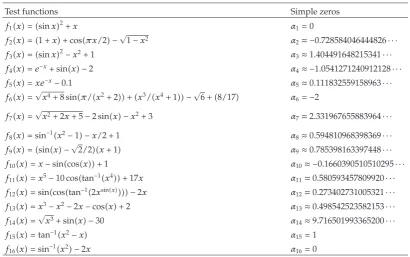
using the examples listed inTable 1.
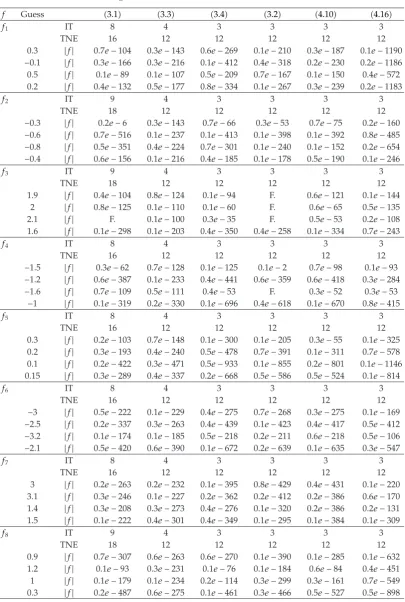
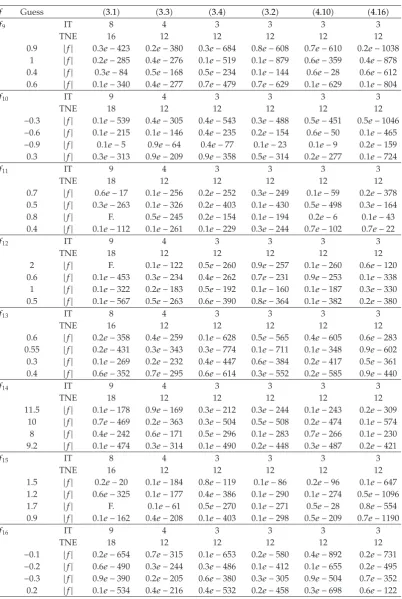
The results of comparisons are given in Table 2 in terms of the number significant
digits for each test function after the specified number of iterations, that is, for example,
0.1e− 1190 shows that the absolute value of the given nonlinear function f1, after three
iterations, is zero up to 1190 decimal places. For numerical comparisons, the stopping
criterion is|fxn|<1.E−1200. InTable 2, IT and TNE stand for the number of iterations and
the total number offunctionevaluations. We used four different initial guesses to analyze
the behaviors of the methods totally. InTable 2, F stands for failure, for instance, when the
iteration for the particular initial guess becomes divergence, or finds another root, needs more numerical computing steps to find an acceptable solution of the nonlinear equations.
It can be observed from Table 2that almost in most cases our contributed methods
from the classes of derivative free without memory iterations are superior in solving nonlinear equations. Numerical computations have been carried out using variable precision arithmetic in MATLAB 7.6.
We here remark that the eighth-order iterative methods such as 4.10 and 4.16
improve the number of correct digits in the convergence phase for the simple roots of1.1
by a factor of eight and in order to show this and also the asymptotic error constant, we have applied 1200 digits floating point.
Note that experimental results show that whatever the value of β /0 is small, then
the output results of solving nonlinear equations will be more reliable. As a matter of fact, experimental results for the contributed methods from the three-step derivative-free classes
4.2-4.3and4.13-4.14can give better feedbacks in most cases, for instance they provide
better accuracy than those illustrated in Table 2, by choosing very small values for β. By
Table 1: The examples considered in this study.
Test functions Simple zeros
f1x sinx2 x α10
f2x 1 x cosπx/2− √
1−x2 α
2≈ −0.728584046444826· · ·
f3x sinx2−x2 1 α3≈1.404491648215341· · ·
f4x e−x sinx−2 α4≈ −1.0541271240912128· · ·
f5x xe−x−0.1 α5≈0.111832559158963· · ·
f6x √
x4 8 sinπ/x2 2 x3/x4 1−√6 8/17 α
6−2
f7x √
x2 2x 5−2 sinx−x2 3 α
7≈2.331967655883964· · ·
f8x sin−1x2−1−x/2 1 α8≈0.594810968398369· · ·
f9x sinx− √
2/2x 1 α9≈0.785398163397448· · ·
f10x x−sincosx 1 α10≈ −0.1660390510510295· · ·
f11x x5−10 costan−1x4 17x α11≈0.580593457809920· · ·
f12x sincostan−12xsinx−2x α12≈0.273402731005321· · ·
f13x x3−x2−2x−cosx 2 α13≈0.498542523582153· · ·
f14x √
x3 sinx−30 α14≈9.716501993365200· · ·
f15x tan−1x2−x α151
f16x sin−1x2−2x α160
by an iteration through the data of the first step per cycle, then with memory iterations from the suggested classes will be attained, which is the topic of the forthcoming papers in this field.
A simple glance at Table 2 reveals that 4.16 is mostly better than its competitors.
The reason indeed is that whatever the error equation is finer, the better numerical results
will be attained. The error equations correspond to4.16, for instance4.18is very small,
in fact in its denominator we have c51 which clearly shows these refinements. In general,
and according to the assumptions made in the proof of Theorem 4.1, c71 should be in the
denominator of the optimal eighth-order methods, and if one obtains forms like c6
1 or c51,
then the derived methods will be mostly finer than the other existing forms of the optimal eighth-order methods.
6. Conclusions
Multipoint methods without memory are methods that use new information at a number of points. Much literature on the multipoint Newton-like methods for function of one variable
and their convergence analysis can be found in Traub2.
In this paper, two novel classes of iterations without memory were discussed fully. We have shown that each member of our contributions reach the optimal order of convergence eight by consuming only four function evaluations per full cycle. Thus, our classes support the optimality conjecture of Kung and Traub for building optimal without memory iterations. Our classes can be taken into account as the generalizations of the well-cited derivative-free
Table 2: Results of convergence under fair circumstances for different derivative-free methods.
f Guess 3.1 3.3 3.4 3.2 4.10 4.16
f1 IT 8 4 3 3 3 3
TNE 16 12 12 12 12 12
0.3 |f| 0.7e−104 0.3e−143 0.6e−269 0.1e−210 0.3e−187 0.1e−1190
−0.1 |f| 0.3e−166 0.3e−216 0.1e−412 0.4e−318 0.2e−230 0.2e−1186
0.5 |f| 0.1e−89 0.1e−107 0.5e−209 0.7e−167 0.1e−150 0.4e−572 0.2 |f| 0.4e−132 0.5e−177 0.8e−334 0.1e−267 0.3e−239 0.2e−1183 f2 IT 9 4 3 3 3 3
TNE 18 12 12 12 12 12
−0.3 |f| 0.2e−6 0.3e−143 0.7e−66 0.3e−53 0.7e−75 0.2e−160
−0.6 |f| 0.7e−516 0.1e−237 0.1e−413 0.1e−398 0.1e−392 0.8e−485
−0.8 |f| 0.5e−351 0.4e−224 0.7e−301 0.1e−240 0.1e−152 0.2e−654
−0.4 |f| 0.6e−156 0.1e−216 0.4e−185 0.1e−178 0.5e−190 0.1e−246
f3 IT 9 4 3 3 3 3
TNE 18 12 12 12 12 12
1.9 |f| 0.4e−104 0.8e−124 0.1e−94 F. 0.6e−121 0.1e−144 2 |f| 0.8e−125 0.1e−110 0.1e−60 F. 0.6e−65 0.5e−135 2.1 |f| F. 0.1e−100 0.3e−35 F. 0.5e−53 0.2e−108 1.6 |f| 0.1e−298 0.1e−203 0.4e−350 0.4e−258 0.1e−334 0.7e−243 f4 IT 8 4 3 3 3 3
TNE 16 12 12 12 12 12
−1.5 |f| 0.3e−62 0.7e−128 0.1e−125 0.1e−2 0.7e−98 0.1e−93
−1.2 |f| 0.6e−387 0.1e−233 0.4e−441 0.6e−359 0.6e−418 0.3e−284
−1.6 |f| 0.7e−109 0.5e−111 0.4e−53 F. 0.3e−52 0.3e−53
−1 |f| 0.1e−319 0.2e−330 0.1e−696 0.4e−618 0.1e−670 0.8e−415
f5 IT 8 4 3 3 3 3
TNE 16 12 12 12 12 12
0.3 |f| 0.2e−103 0.7e−148 0.1e−300 0.1e−205 0.3e−55 0.1e−325 0.2 |f| 0.3e−193 0.4e−240 0.5e−478 0.7e−391 0.1e−311 0.7e−578 0.1 |f| 0.2e−422 0.3e−471 0.5e−933 0.1e−855 0.2e−801 0.1e−1146 0.15 |f| 0.3e−289 0.4e−337 0.2e−668 0.5e−586 0.5e−524 0.1e−814 f6 IT 8 4 3 3 3 3
TNE 16 12 12 12 12 12
−3 |f| 0.5e−222 0.1e−229 0.4e−275 0.7e−268 0.3e−275 0.1e−169
−2.5 |f| 0.2e−337 0.3e−263 0.4e−439 0.1e−423 0.4e−417 0.5e−412
−3.2 |f| 0.1e−174 0.1e−185 0.5e−218 0.2e−211 0.6e−218 0.5e−106
−2.1 |f| 0.5e−420 0.6e−390 0.1e−672 0.2e−639 0.1e−635 0.3e−547
f7 IT 8 4 3 3 3 3
TNE 16 12 12 12 12 12
3 |f| 0.2e−263 0.2e−232 0.1e−395 0.8e−429 0.4e−431 0.1e−220 3.1 |f| 0.3e−246 0.1e−227 0.2e−362 0.2e−412 0.2e−386 0.6e−170 1.4 |f| 0.3e−208 0.3e−273 0.4e−276 0.1e−320 0.2e−386 0.2e−131 1.5 |f| 0.1e−222 0.4e−301 0.4e−349 0.1e−295 0.1e−384 0.1e−309 f8 IT 9 4 3 3 3 3
TNE 18 12 12 12 12 12
Table 2: Continued.
f Guess 3.1 3.3 3.4 3.2 4.10 4.16
f9 IT 8 4 3 3 3 3
TNE 16 12 12 12 12 12
0.9 |f| 0.3e−423 0.2e−380 0.3e−684 0.8e−608 0.7e−610 0.2e−1038 1 |f| 0.2e−285 0.4e−276 0.1e−519 0.1e−879 0.6e−359 0.4e−878 0.4 |f| 0.3e−84 0.5e−168 0.5e−234 0.1e−144 0.6e−28 0.6e−612 0.6 |f| 0.1e−340 0.4e−277 0.7e−479 0.7e−629 0.1e−629 0.1e−804 f10 IT 9 4 3 3 3 3
TNE 18 12 12 12 12 12
−0.3 |f| 0.1e−539 0.4e−305 0.4e−543 0.3e−488 0.5e−451 0.5e−1046
−0.6 |f| 0.1e−215 0.1e−146 0.4e−235 0.2e−154 0.6e−50 0.1e−465
−0.9 |f| 0.1e−5 0.9e−64 0.4e−77 0.1e−23 0.1e−9 0.2e−159
0.3 |f| 0.3e−313 0.9e−209 0.9e−358 0.5e−314 0.2e−277 0.1e−724 f11 IT 9 4 3 3 3 3
TNE 18 12 12 12 12 12
0.7 |f| 0.6e−17 0.1e−256 0.2e−252 0.3e−249 0.1e−59 0.2e−378 0.5 |f| 0.3e−263 0.1e−326 0.2e−403 0.1e−430 0.5e−498 0.3e−164 0.8 |f| F. 0.5e−245 0.2e−154 0.1e−194 0.2e−6 0.1e−43 0.4 |f| 0.1e−112 0.1e−261 0.1e−229 0.3e−244 0.7e−102 0.7e−22 f12 IT 9 4 3 3 3 3
TNE 18 12 12 12 12 12
2 |f| F. 0.1e−122 0.5e−260 0.9e−257 0.1e−260 0.6e−120 0.6 |f| 0.1e−453 0.3e−234 0.4e−262 0.7e−231 0.9e−253 0.1e−338 1 |f| 0.1e−322 0.2e−183 0.5e−192 0.1e−160 0.1e−187 0.3e−330 0.5 |f| 0.1e−567 0.5e−263 0.6e−390 0.8e−364 0.1e−382 0.2e−380 f13 IT 8 4 3 3 3 3
TNE 16 12 12 12 12 12
0.6 |f| 0.2e−358 0.4e−259 0.1e−628 0.5e−565 0.4e−605 0.6e−283 0.55 |f| 0.2e−431 0.3e−343 0.3e−774 0.1e−711 0.1e−348 0.9e−602 0.3 |f| 0.1e−269 0.2e−232 0.4e−447 0.6e−384 0.2e−417 0.5e−361 0.4 |f| 0.6e−352 0.7e−295 0.6e−614 0.3e−552 0.2e−585 0.9e−440 f14 IT 9 4 3 3 3 3
TNE 18 12 12 12 12 12
11.5 |f| 0.1e−178 0.9e−169 0.3e−212 0.3e−244 0.1e−243 0.2e−309 10 |f| 0.7e−469 0.2e−363 0.3e−504 0.5e−508 0.2e−474 0.1e−574 8 |f| 0.4e−242 0.6e−171 0.5e−296 0.1e−283 0.7e−266 0.1e−230 9.2 |f| 0.1e−474 0.3e−314 0.1e−490 0.2e−448 0.3e−487 0.2e−421 f15 IT 8 4 3 3 3 3
TNE 16 12 12 12 12 12
1.5 |f| 0.2e−20 0.1e−184 0.8e−119 0.1e−86 0.2e−96 0.1e−647 1.2 |f| 0.6e−325 0.1e−177 0.4e−386 0.1e−290 0.1e−274 0.5e−1096 1.7 |f| F. 0.1e−61 0.5e−270 0.1e−271 0.5e−28 0.8e−554 0.9 |f| 0.1e−162 0.4e−208 0.1e−403 0.1e−298 0.5e−209 0.7e−1190 f16 IT 9 4 3 3 3 3
TNE 18 12 12 12 12 12
−0.1 |f| 0.2e−654 0.7e−315 0.1e−653 0.2e−580 0.4e−892 0.2e−731
−0.2 |f| 0.6e−490 0.3e−244 0.3e−486 0.1e−412 0.1e−655 0.2e−495
−0.3 |f| 0.9e−390 0.2e−205 0.6e−380 0.3e−305 0.9e−504 0.7e−352
underlying theory developed in this paper. Numerical results were completely in harmony with the theory developed in this paper, and accordingly, the contributions hit the target.
Acknowledgment
The author cheerfully acknowledges the interesting comments of the reviewer, which have led to the improvement of this paper.
References
1 A. Iliev and N. Kyurkchiev, Nontrivial Methods in Numerical Analysis (Selected Topics in Numerical Analysis), Lambert Academic Publishing, 2010.
2 J. F. Traub, Iterative Methods for the Solution of Equations, Prentice-Hall, Englewood Cliffs, NJ, USA, 1964.
3 F. Soleymani, R. Sharma, X. Li, and E. Tohidi, “An optimized derivative-free form of the Potra-Ptak method,” Mathematical and Computer Modelling, vol. 56, pp. 97–104, 2012.
4 F. Soleymani, “Optimal fourth-order iterative methods free from derivative,” Miskolc Mathematical Notes, vol. 12, pp. 255–264, 2011.
5 F. Soleymani and B. S. Mousavi, “On novel classes of iterative methods for solving nonlinear equations,” Computational Mathematics and Mathematical Physics, vol. 52, pp. 203–210, 2012.
6 F. Soleymani and S. K. Khattri, “Finding simple roots by seventh- and eighth-order derivative-free methods,” International Journal of Mathematical Models and Methods in Applied Sciences, vol. 6, pp. 45– 52, 2012.
7 F. Soleymani, “On a novel optimal quartically class of methods,” Far East Journal of Mathematical Sciences, vol. 58, pp. 199–206, 2011.
8 F. Soleymani, “Optimal eighth-order simple root-finders free from derivative,” WSEAS Transactions on Information Science and Applications, vol. 8, pp. 293–299, 2011.
9 F. Soleymani and F. Soleimani, “Novel computational derivative-free methods for simple roots,” Fixed Point Theory, Computation and Applications, vol. 13, pp. 247–258, 2012.
10 F. Soleymani, S. K. Vanani, and A. Afghani, “A general three-step class of optimal iterations for nonlinear equations,” Mathematical Problems in Engineering, vol. 2011, Article ID 469512, 10 pages, 2011.
11 W.-X. Wang, Y.-L. Shang, W.-G. Sun, and Y. Zhang, “Finding the roots of system of nonlinear equations by a novel filled function method,” Abstract and Applied Analysis, vol. 2011, Article ID 209083, 9 pages, 2011.
12 B. Ignatova, N. Kyurkchiev, and A. Iliev, “Multipoint algorithms arising from optimal in the sense of Kung-Traub iterative procedures for numerical solution of nonlinear equations,” General Mathematics Notes, vol. 6, no. 2, 2011.
13 S. Kumar, V. Kanwar, S. K. Tomar, and S. Singh, “Geometrically constructed families of Newton’s method for unconstrained optimization and nonlinear equations,” International Journal of Mathematics and Mathematical Sciences, vol. 2011, Article ID 972537, 9 pages, 2011.
14 H. T. Kung and J. F. Traub, “Optimal order of one-point and multipoint iteration,” Journal of the Association for Computing Machinery, vol. 21, pp. 643–651, 1974.
15 P. Sargolzaei and F. Soleymani, “Accurate fourteenth-order methods for solving nonlinear equations,” Numerical Algorithms, vol. 58, no. 4, pp. 513–527, 2011.
16 M. S. Petkovi´c, J. Dˇzuni´c, and B. Neta, “Interpolatory multipoint methods with memory for solving nonlinear equations,” Applied Mathematics and Computation, vol. 218, no. 6, pp. 2533–2541, 2011.
17 F. Soleymani, S. Karimi Vanani, and M. Jamali Paghaleh, “A class of three-step derivative-free root-solvers with optimal convergence order,” Journal of Applied Mathematics, vol. 2012, Article ID 568740, 15 pages, 2012.
18 M. Sharifi, D. K. R. Babajee, and F. Soleymani, “Finding the solution of nonlinear equations by a class of optimal methods,” Computers & Mathematics with Applications, vol. 63, pp. 764–774, 2012.
20 F. Soleymani, M. Sharifi, and B. Somayeh Mousavi, “An improvement of Ostrowski’s and King’s techniques with optimal convergence order eight,” Journal of Optimization Theory and Applications, vol. 153, no. 1, pp. 225–236, 2012.
21 Q. Zheng, J. Li, and F. Huang, “An optimal Steffensen-type family for solving nonlinear equations,” Applied Mathematics and Computation, vol. 217, no. 23, pp. 9592–9597, 2011.
22 F. Soleymani, “On a new class of optimal eighth-order derivative-free methods,” Mathematica, vol. 3, pp. 169–180, 2011.
23 F. Soleymani and S. Karimi Vanani, “Optimal Steffensen-type methods with eighth order of convergence,” Computers & Mathematics with Applications, vol. 62, no. 12, pp. 4619–4626, 2011.
24 F. Soleymani, “New optimal iterative methods in solving nonlinear equations,” International Journal of Pure and Applied Mathematics, vol. 72, pp. 195–202, 2011.
25 F. Soleymani, “On a bi-parametric class of optimal eighth-order derivative-free methods,” Interna-tional Journal of Pure and Applied Mathematics, vol. 72, no. 1, pp. 27–37, 2011.
26 F. Soleymani, S. K. Khattri, and S. Karimi Vanani, “Two new classes of optimal Jarratt-type fourth-order methods,” Applied Mathematics Letters, vol. 25, pp. 847–853, 2012.
27 F. Soleymani, “Novel computational iterative methods with optimal order for nonlinear equations,” Advances in Numerical Analysis, vol. 2011, Article ID 270903, 10 pages, 2011.
28 B. I. Yun, “A non-iterative method for solving non-linear equations,” Applied Mathematics and Computation, vol. 198, no. 2, pp. 691–699, 2008.
29 D. K. R. Babajee, , Analysis of higher order variants of Newton’s method and their applications to differential and integral equations and in ocean acidification [Ph.D. thesis], University of Mauritius, 2010.
Submit your manuscripts at
http://www.hindawi.com
Hindawi Publishing Corporation
http://www.hindawi.com Volume 2014
Mathematics
Journal ofHindawi Publishing Corporation
http://www.hindawi.com Volume 2014
Hindawi Publishing Corporation http://www.hindawi.com
Differential Equations International Journal of
Volume 2014
Applied MathematicsJournal of
Hindawi Publishing Corporation
http://www.hindawi.com Volume 2014
Hindawi Publishing Corporation
http://www.hindawi.com Volume 2014
Hindawi Publishing Corporation
http://www.hindawi.com Volume 2014
Mathematical PhysicsAdvances in
Complex Analysis
Journal ofHindawi Publishing Corporation
http://www.hindawi.com Volume 2014
Optimization
Journal ofHindawi Publishing Corporation
http://www.hindawi.com Volume 2014
Combinatorics
Hindawi Publishing Corporation
http://www.hindawi.com Volume 2014
International Journal of Hindawi Publishing Corporation
http://www.hindawi.com Volume 2014
Journal of
Hindawi Publishing Corporation
http://www.hindawi.com Volume 2014
Function Spaces
Abstract and Applied Analysis
Hindawi Publishing Corporation
http://www.hindawi.com Volume 2014
International Journal of Mathematics and Mathematical Sciences
Hindawi Publishing Corporation http://www.hindawi.com Volume 2014
The Scientific
World Journal
Hindawi Publishing Corporationhttp://www.hindawi.com Volume 2014
Hindawi Publishing Corporation
http://www.hindawi.com Volume 2014
Discrete Dynamics in Nature and Society
Hindawi Publishing Corporation
http://www.hindawi.com Volume 2014 Hindawi Publishing Corporation
http://www.hindawi.com Volume 2014
Discrete Mathematics
Journal ofHindawi Publishing Corporation
http://www.hindawi.com Volume 2014
Hindawi Publishing Corporation
http://www.hindawi.com Volume 2014