2018 International Conference on Computer Science and Software Engineering (CSSE 2018) ISBN: 978-1-60595-555-1
Based on Support Vector Machine of Cold
Rolling Force Prediction Research
Huijuan Guo, Hao Peifeng and Zeng Weicheng
1
ABSTRACT
The prediction of the rolling force model is the core of the cold rolling process. When using the traditional mathematical model to calculate the cold rolling force, there is a large calculation error. After analyzing various learning algorithms of artificial intelligence, various models suitable for cold rolling force prediction were studied. A combination of mathematical model and Bayesian LSSVM was proposed. The Bland-Ford-Hill model was used as the main value of pre-calculation of rolling force, and Bayesian LSSVM was used to correct the deviation of the aforementioned calculation of the rolling force model. A large number of actual production data were used for simulation experiments. Through analysis of experimental results, this model can solve the prediction problem under small samples, and has good generalization ability and prediction accuracy.
INTRODUCTION
In the cold rolling process, the rolling force model is the core of the process control model, and its prediction accuracy directly affects the predicted values of other models such as rolling moment, so the study of the rolling force prediction model in the tandem cold rolling control system It is of great significance. The prediction accuracy of the traditional rolling force model has always been not ideal and has limitations. Because the rolling force is not only affected by physical factors such as friction and tension, but also related to chemical factors
Guo Huijuan1, Hao Peifeng1, Zeng Weicheng1
1
such as strip temperature [1]. In recent years, artificial intelligence has been increasingly applied in rolling engineering, such as neural network methods and statistical methods, have achieved good effect in the practical, especially the support vector machine method based on statistical theory. Support vector machine is a kind of a small sample with solid theoretical foundation of novel learning method. It avoided from induction to deduction of the traditional process, implement the efficient from the training sample to forecast sample "transduction reasoning", greatly simplifies classification and regression problems, usually better solves the small sample, local minimum point, such as nonlinear problem [2].
Based on the analysis of prediction accuracy of cold rolling force, this paper proposes a combination of mathematical model and Bayesian LSSVM. It uses mathematical model to predict the main value of rolling force, and uses Bayesian LSSVM to predict the deviation of rolling force. . On the basis of establishing the least squares support vector regression nonlinear prediction model, using the parameters of the inference model under the Bayesian framework, the first layer determines the optimal parameters of the nonlinear model, the second layer determines the regularization coefficient, the third layer Determine the parameters of the kernel function. Least square method changes the support vector machine from solving non-linear problems to solving linear equations, which greatly improves the efficiency of the algorithm. The Bayesian principle solves the selection of kernel functions and the optimization of related parameters. The actual production data of a tandem cold rolling mill is used to simulate the pre-calculated model. The experimental results show that the model studied can solve the prediction problem under the small sample, and has good generalization ability and prediction accuracy.
Bland-Ford-Hill rolling force mathematical mode
According to Bland-Ford-Hill (abbreviated to Hill) simplified formula obtained from Bland-Ford theory, the structure is simple and reasonable. Most of them are applied to on-site mathematical models. The Hill rolling force model has become the basic structural form of the rolling force model during cold rolling, and has been widely used [3].
Hill rolling force model is [4]:
K K Q Bl
Where Blc′is contact area, Kis deformation resistance, QPis stress state
factor, KTis tension effect coefficient.
As the rolling force is increasingly demanded by the strip thickness and shape index, the calculation of rolling force has become a non-linear model. Hill's rolling force model can no longer meet the conditions of high precision of rolling force calculation. There will be a certain amount of deviation. In the study, the calculated values of the above models were used as the main values for the prediction of rolling force and optimized using the LS-SVM algorithm.
LS-SVM Algorithm Based on Bayesian Framework
A. LS-SVM ALGORITHM
Least-squares support vector machine is an improved algorithm of support vector machine. The biggest difference between it and SVM is that LS-SVM modifies the inequality constraints of the original method into equality constraints[5], which simplifies the solution problem. The complexity increases forecasting efficiency.
For a nonlinear system, suppose there are n eigenvalues, m training samples. The optimization goal is:
2 , ,
1
1 1
min (w, e)
2 2
N T
w b e k
k
J w w γ e
=
= +
∑
s.t yk =wT
ϕ
(x ) b e ,k + + k k =1,...,N (2)Where wis weight vector, γ is regularization parameters, bis constant, ek
is error parameter,
ϕ
(x )k is nuclear space mapping function.In addition, the quadratic programming problem can be converted into a dual problem through Lagrangian duality. The advantages of this approach are that: one of the dual problems is often easier to solve; both can be naturally introduced into the kernel function, and then generalized to nonlinear classification problems. In this paper, the Gaussian kernel function support vector machine algorithm is used due to its small sample size and large eigenvalues:
2
2
(x, x ) exp
Finally get the LSSVM regression function [6]:
1
(x) (x, x ) b
N
k k
k
y α K
=
=
∑
+ (4)B. LS-SVM IN BAYESIAN FRAMEWORK
In the least squares support vector machine (LS-SVM) regression function, the regularization parameter γ and the kernel parameter σ are generally determined by cross validation. Using cross-validation to determine the exact parameters takes a lot of time, especially in the case of large sample sizes. Therefore, Bayesian principle is used in this paper to determine the best parameters and improve the efficiency of modeling. The basic idea of Bayesian inference is to maximize the posterior of the parameter distribution, and the best parameter value is obtained when the parameter distribution has the largest posterior [7]. Bayesian inference is divided into 3 levels: Level 1 inference can determine wandb, Level 2 inferring regularization parameterγ , and Level 3 inferring estimated coefficient σ [8].
Rolling force prediction algorithm based on Bayesian framework for LS-SVM
This model is mainly used to correct the deviation of rolling force. The factors affecting the rolling force can be generally divided into two categories. One is the factor that affects the nature of the strip material, such as the chemical composition of the metal, the deformation temperature, the deformation rate, etc. These final reactions are changes in the deformation resistance, the second category It is a factor that affects the stress state, such as the speed of the roller, the size of the tension, and the lubrication of the contact surface [9].
Considering comprehensively, the input items of the LS-SVM model are mainly defined as the strip width, the thickness to be rolled in each stand, the tension, the roll radius, the strip speed, the roll speed, and the friction force. In order to further improve the prediction accuracy of the rolling force, the rolling force value calculated by the Hill mathematical model can also be regarded as part of the model input. The output is the deviation of the rack rolling force. Here are the steps for creating a Bayesian LS-SVM model.
• Preprocess the original data and normalize the data.
values as the input of the samples; there are always m samples using the top k samples as the training set and the last m-k samples as the cross validation set.
• Set the initial value of parameter ( , )γ σ .
• Training the sample with LS-SVM, inferring the parameters wandbfrom the first layer of Bayesian.
• Inferring regularization parameter γ based on Bayesian second layer.
• Inferring the nuclear parameter
σ
using the third layer of Bayes• Use LS-SVM model to train the training set. If the prediction accuracy meets the requirement and the result is improved, then α and bunder the optimal condition are obtained; otherwise, the inference is started again from step 4.
• After obtaining the optimized regression model, use cross-validation sets to predict and obtain the results. Use the inverse normalization to process the result data.
Simulation Experiment
In this study, a Bland-Ford-Hill mathematical model and a Bayesian LS-SVM method are used to design an off-line optimization rolling force algorithm. The mathematical model calculates the main value of the rolling force, and the Bayesian LS-SVM model predicts the deviation of the rolling force. Combined with the two, the rolling force prediction is more accurate. The model for predicting rolling force is [10].
i m ANN
P =P +P (5)
Where Pmis the main value of the rolling force, which is the calculated value of
the mathematical model, PANNis the deviation value of the rolling force through Bayesian LS-SVM, i is the rolling mill number in the rolling mill.
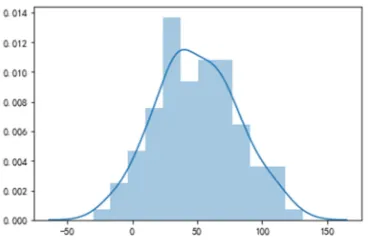
data result value and the vertical axis represents the probability value. Figure 2 compares the results of the Bayesian LSSVM model, the traditional LSSVM, and the measured values. The horizontal axis represents the index number of the test set sample, the vertical axis represents the rolling force deviation (unit: KN), and the red line is the Bayesian LSSVM. The result value of the test set data, the blue line is the result value of the LSSVM test set data, and the black line is the result value of the measured data.
[image:6.612.166.454.371.479.2]Figure 1. Probability distribution of measured rolling force deviation.
Figure 2. Bayes-LSSVM, measured values, LSSVM experimental results comparison chart.
TABLE I. TWO MODEL PREDICTION RELATIVE ERROR DISTRIBUTION TABLE.
Relative error absolute value
Error distribution rate(%)
Bayes of LSSVM Tradition of LSSVM
0-10 80.5 50.43
10-20 18.54 23.64
20-30 0 18.79
30-50 0.48 6.66
[image:6.612.117.479.540.671.2]Figure 1 shows that the distribution of the rolling force deviation data set obeys the normal distribution. The distribution model determines that the prediction of the rolling force deviation can use the Bayesian LSSVM prediction algorithm in the cold rolling process. Figure 2 shows the results of the Bayesian LSSVM test sample. Table I shows the error distributions of the two models. It can be seen from the combination of the two that most of the data are consistent with the measured values (with minimal errors). For some data bias fluctuations, there will be large errors. For example, around the 70th sample point, the measured value has a bias value close to -25, and the Bayesian LSSVM predicts the bias to be around 75, and the two errors are close to 100.This may be due to the fact that the sample point is affected by various aspects such as temperature, resulting in a large difference between the actual value and the predicted value of the mathematical model, and thus a prediction error occurs. So Bayesian LSSVM also has a certain error rate, there is room for improvement. The traditional LSSVM model compared with the Bayesian LSSVM model, most of the data fluctuations in this model is relatively large, there are many samples with errors in the actual value, the prediction results do not reach the desired accuracy.
CONCLUSION
Bayesian LSSVM predicts the precision of rolling force and determines the precision of rolling force. The deviation model achieves the automatic adjustment of regularization parameters and nuclear parameters, which makes up for the shortcomings of traditional LSSVM manual adjustment parameters and is more disadvantageous than the traditional LSSVM phase. Compared with the good generalization ability and prediction accuracy, an offline optimization of the rolling force method is realized. The Bayesian LSSVM was applied to the prediction of rolling force in cold continuous rolling. Good experimental results were obtained and the calculation accuracy was improved. The actual production data of different rolling mills are used for experiments, and the calculation accuracy is also relatively high, which means that the method also applies to different specifications.
REFERENCES
1. Wei-gang LI, Chao LIU, Ning Feng, Xi Chen, Xiang-hua Liu. Friction Estimation and Roll
Force Prediction during Hot Strip Rolling [J]. Journal of Iron and Steel Research (International), 2016.
2. Aishe Shui, Hanming Fang, Fuxing Zong, Yuheng Wu, Fei Wang.The error prediction of
MFOA-LSSVM [J]. Journal of Petroleum Exploration and Production Technology, 2017, Vol.7 (3), pp. 895-904
3. Jianbin Chen, Jianyong Xu, Yao Shen. Five-stand Rolling Schedule Optimization Design and
Simulation[D].Shanghai:Shanghai Jiaotong University. 2009.1
4. M. Poursina, M. Rahmatipour, H. Mirmohamadi. A new method for prediction of forward
slip in the tandem cold rolling mill [J]. The International Journal of Advanced Manufacturing Technology, 2015, Vol. 78 (9-12), pp. 1827-1835.
5. Alireza Baghban, Mohammad Navid Kardani, Sajjad Habibzadeh. Prediction viscosity of
ionic liquids using a hybrid LSSVM and group contribution method [J]. Journal of Molecular
Liquids, 2017.
6. Dongxiao Niu, Haitao Lv, Yunyun Zhang. Long-Term Load Combination Prediction of
Bayesian Framework with Least Squares Support Vector Machines[J]. Journal of North
China Electric Power University. 2008.11
7. Gao Dong, Liu Yongxin, Meng Junmin, Jia Yongjun, Fan Chenqing. Estimating significant
wave height from SAR imagery based on an SVM regression model [J].
8. Hui Zhang, Peng Yu, Ji-Xia Ren, Xi-Bo Li, He-Li Wang, Lan Ding, Wei-Bao Kong.
Development of novel prediction model for drug-induced mitochondrial toxicity by using
naïve Bayes classifier method [J]. Food and Chemical Toxicology, 2017.
9. Wenjiao Zhao, Hongwei Yan, Zhen Yang. An offline optimization method to improve the
setting precision of rolling force [J].2017.8
10. Xiaohu Li. Analysis and Optimization of Rolling Force Prediction Model for Cold Rolling